Marble Densifier Chemicals in Bangalore and India
A chemical-focused guide to marble densifiers, hardeners and stone-strengthening treatments: what they are designed to do, where they fit in the grinding and polishing process, how formulations differ by marble condition, and how to compare DUSH Densi-Max Ultra, Densi-Max Pro, Fabio+, Bianco+, Glaze Chem and Link without confusing densifiers with sealers or polishing powders.
What is a marble densifier chemical?
A marble densifier is a penetrating chemical treatment used during professional stone processing to strengthen or consolidate suitable porous marble, reduce the practical effect of micro-porosity and improve the surface’s response to later polishing stages. It is not a grinding abrasive, not a polishing powder and not automatically the same thing as a stain-protection sealer.
DUSH currently lists a dedicated densifier range including Link, Fabio+, Bianco+, Glaze Chem, Densi-Max Pro, Densi-Max Ultra and Densi-Max Black. The products are differentiated by marble condition, porosity, colour and project level rather than presented as one universal formula. Exact chemical composition is not consistently disclosed on DUSH’s public product pages, so this article does not invent active ingredients that are not documented in the current TDS.
In this chemical guide
- What densifier chemicals do
- What can be said about the chemistry
- Densifier vs sealer vs polish
- DUSH densifier selection table
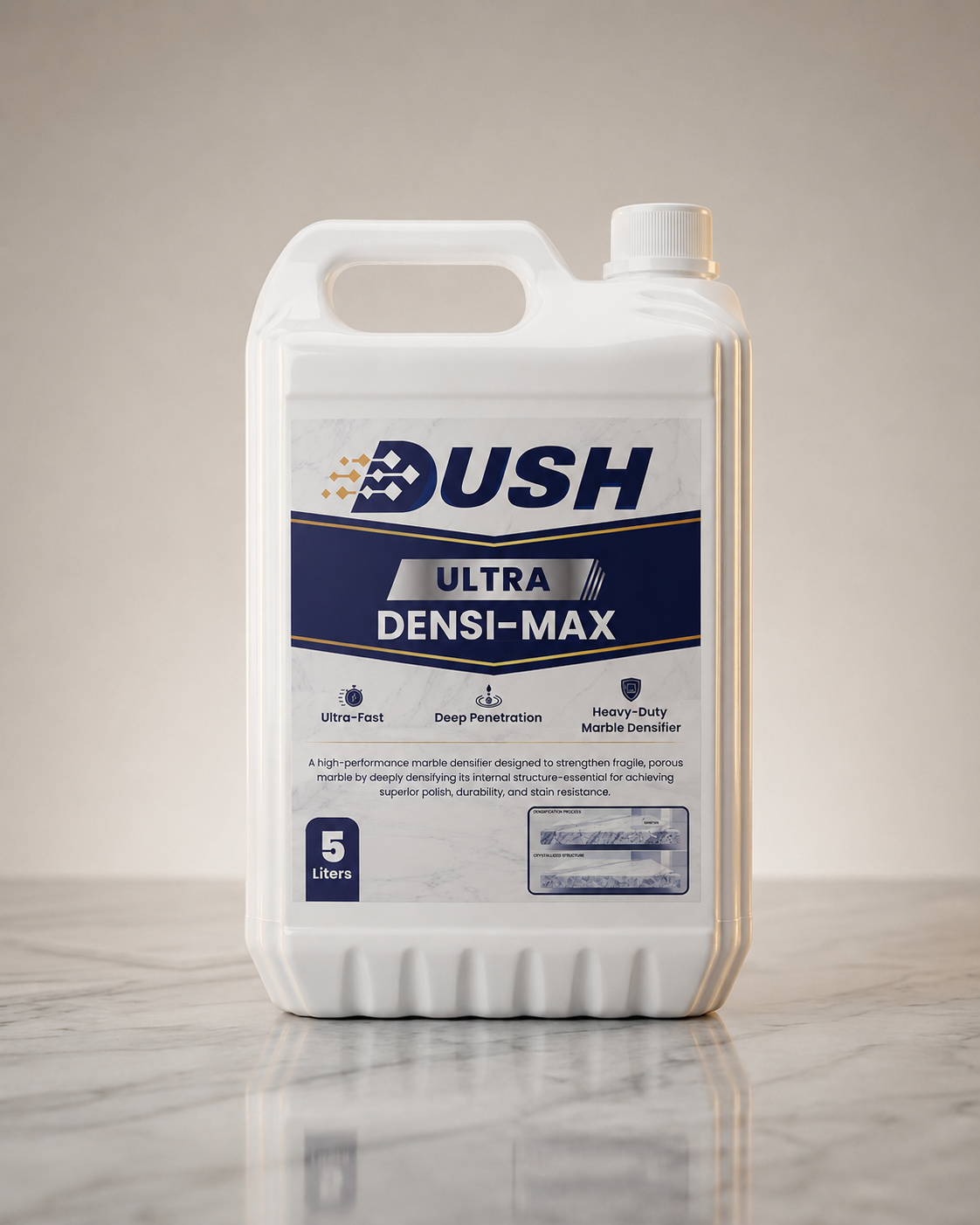
- Densi-Max Ultra
- Densi-Max Pro
- Fabio+
- Bianco+
- Glaze Chem
- DUSH Link
- Chemical application stage
- Porosity and chemical selection
- White vs beige vs dark marble
- How to specify a densifier
- Common chemical-selection mistakes
- FAQs
What does a marble densifier chemical actually do?
Marble is not a perfectly closed material. Depending on the variety, mineral structure, micro-fissures, resin treatment, processing history and finish, the stone can contain pathways that influence strength, liquid movement and polishing behaviour. Professional densifier products are formulated to penetrate suitable stone and modify that internal condition.
In practical marble processing, the chemical objective is usually described with terms such as densification, consolidation, strengthening, hardening, micro-fissure treatment and porosity reduction. These words overlap but should not be used carelessly. A product may improve several properties, yet its exact mechanism depends on its formulation.
Strengthening
Fragile or highly porous stone may benefit from a chemical treatment intended to improve internal cohesion and make the surface respond more consistently during later abrasive stages.
Porosity treatment
Densifier manufacturers commonly describe their products as treating open pore structures or micro-fissures. The objective is to reduce pathways that contribute to weak polishing response or rapid absorption.
Polish response
A more stable, compact surface can often be refined more consistently through subsequent honing and polishing, which is why densifiers are commonly integrated into the polishing sequence rather than applied after everything is finished.
What is the chemistry of a marble densifier?
There is no responsible one-line answer such as “all marble densifiers are sodium silicate” or “all densifiers are nano polymers.” The commercial term densifier covers different proprietary formulations, and products developed for concrete cannot automatically be treated as chemically identical to products designed for natural marble.
DUSH’s public catalogue uses terms including nano-technology marble hardener, stone strengthener, stone densifier, heavy-duty marble densifier and ultra-premium marble densifier. Those descriptions communicate intended function, but they do not consistently disclose the full active-ingredient chemistry. Therefore, this article limits itself to verifiable functional claims and recommends the current TDS/SDS when chemical composition, pH, solids content, VOC, reaction mechanism or compatibility must be specified professionally.
What a technical data sheet should ideally tell a specifier
- Product chemistry or chemical family where disclosure is appropriate.
- Physical form, appearance and density.
- pH and solvent/water base where relevant.
- Recommended substrates and excluded substrates.
- Required stone condition before application.
- Application stage within grinding/honing.
- Dwell time, number of coats and reapplication interval.
- Consumption or coverage.
- Drying/curing time before the next abrasive stage.
- PPE, ventilation and handling instructions.
- Storage conditions and shelf life.
Densifier chemical vs sealer vs polishing powder vs epoxy
Marble contractors often use the word “chemical” broadly, which can blur products that do completely different jobs. A densifier belongs to one specific chemical category within the marble-processing system.
| Chemical category | Primary job | Typical stage | Does it mechanically remove scratches? | DUSH examples |
|---|---|---|---|---|
| Densifier / hardener | Strengthen or consolidate suitable porous marble; improve polishing response | During grinding/honing sequence | No | Densi-Max Ultra, Densi-Max Pro, Fabio+, Bianco+, Glaze Chem, Link |
| Impregnating sealer | Reduce water/oil/stain absorption | Normally after final finishing, depending on product | No | PROTEK+, NANO+ |
| Polishing powder | Final surface refinement and gloss | Final polishing stage | Not deep scratches | Glosso+, Yellow Powder, Dazzle Powder |
| Epoxy / mastic | Fill, repair, bond or reinforce cracks/joints | Repair/fabrication stage | No | BCR 601 4+1, SPN 1650, mastics and epoxy systems |
| Cleaner / stain remover | Dissolve or extract contamination | Before restoration or during maintenance | No | Stain-Ex, Alka Cleaner, other DUSH cleaners |
The distinction is essential for SEO and for real technical use. A search for “marble hardener chemical” should lead to densification guidance, not a generic sealer page. A search for “marble polish chemical” should not be answered only with a densifier. Clear categories make the DUSH product entity easier for both contractors and AI search systems to understand.
DUSH marble densifier chemicals: product-selection table
| DUSH chemical | Current catalogue positioning | Pack size | Stone / condition to evaluate | Selection note |
|---|---|---|---|---|
| Densi-Max Ultra | Ultra-premium marble densifier | 5 L / 10 L / 20 L | High-end Italian marble and premium natural stone | Evaluate where deep densification and polish retention are priorities |
| Densi-Max Pro | Heavy-duty marble densifier | 5 L | Fragile, porous marble | Professional restoration/strengthening category |
| Fabio+ | Nano-technology marble hardener | 20 L | Very high-porosity marble | Evaluate where porous marble needs strengthening |
| Bianco+ | Stone strengthener | 20 L | Very high-porosity marble, especially where natural colour must be preserved | Useful DUSH category for white/light-looking stone applications |
| Glaze Chem | Stone densifier | 20 L | Beige and other dark-coloured marble | DUSH positions this by marble colour/appearance |
| DUSH Link | Marble densifier | 20 L | General marble densification category | Catalogue describes porosity and micro-fissure treatment |
| Densi-Max Black | Heavy-duty dark-marble densifier | 5 L | Black, grey and dark-coloured marble | Current catalogue positions it specifically for dark stone |
DUSH Densi-Max Ultra
Ultra-premium densifier for Italian marble and premium stone
DUSH’s current all-products catalogue describes Densi-Max Ultra as an ultra-premium densifier developed for high-end Italian marble and premium natural stone. The catalogue attributes deep penetration, improved polish retention and a richer, longer-lasting sheen to the treatment.
DUSH’s broader marble-care content commonly positions the product around the 80-grit grinding stage. That placement makes technical sense as a densifier workflow: the stone is open enough to accept treatment and still has subsequent abrasive stages available to refine the finish.
However, stronger DUSH editorial pages also make broad “permanent stain-proof” claims. Those statements should not be repeated in a technical authority page unless the current TDS or independent test data supports the exact durability and stain-resistance claim under defined conditions.
When Densi-Max Ultra is the category to investigate
- Premium Italian marble with visible or measured porosity.
- A professional polishing sequence where densification is deliberately included.
- High-value flooring where polish retention and surface consistency matter.
- Projects where a sample slab can be treated before the whole floor.
DUSH Densi-Max Pro
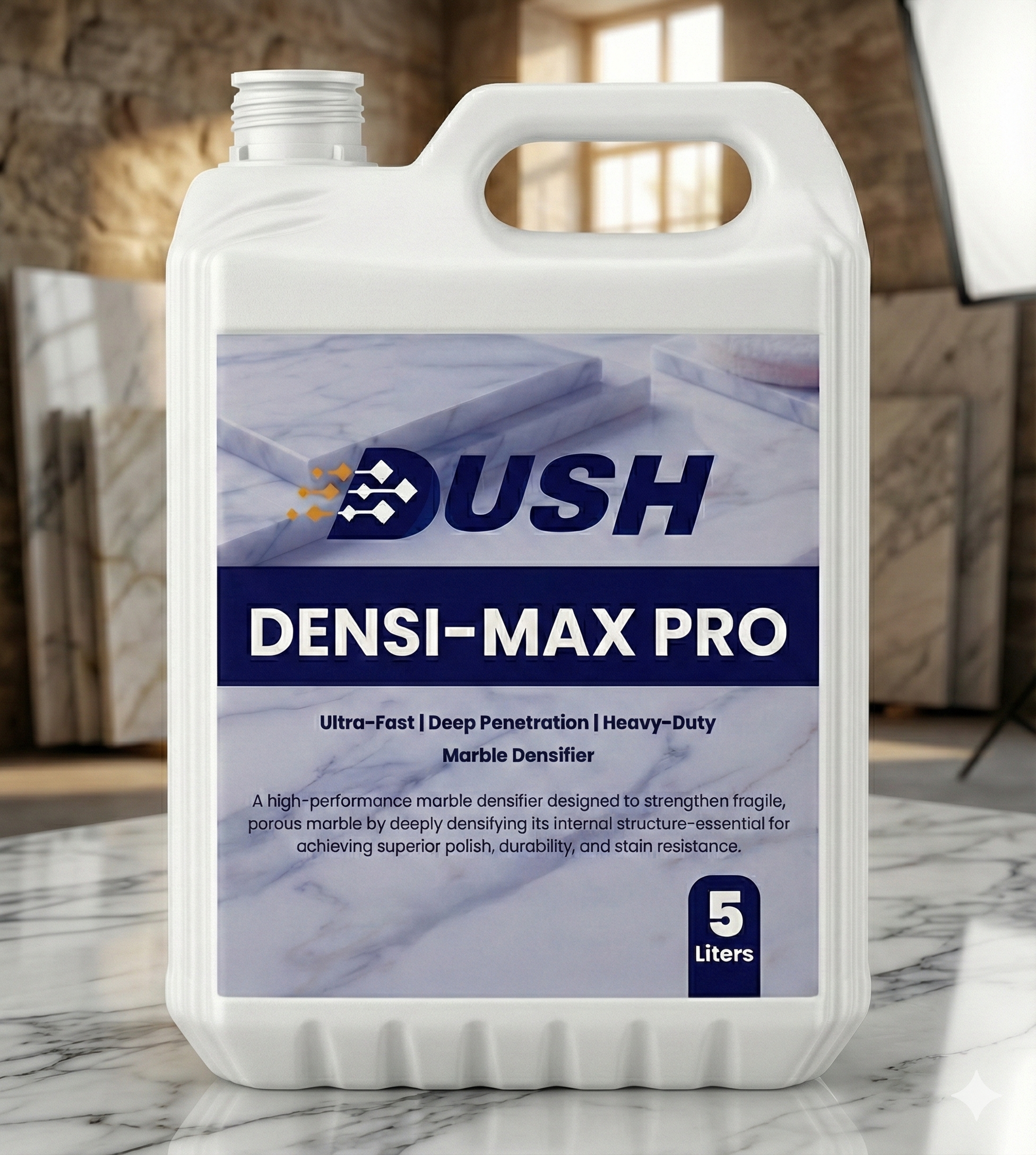
For fragile and porous marble
The current DUSH catalogue describes Densi-Max Pro as a high-performance densifier designed to strengthen fragile, porous marble from within and improve hardness, polishing response, durability and stain resistance. It is listed in a 5-litre pack and clear appearance.
DUSH also uses Densi-Max Pro in its dark-marble editorial content. The current all-products catalogue, however, describes the product more generally as a porous-marble densifier. If a specification is colour-critical, use the newest product TDS rather than relying on one blog article.
Pro vs Ultra
A responsible comparison should not invent a “strength percentage.” Based on DUSH’s current catalogue, Pro is the heavy-duty option for fragile/porous marble, while Ultra is positioned as the premium treatment for high-end Italian marble and premium natural stone. A sample treatment is the most useful way to compare real performance on the exact slab.
DUSH Fabio+
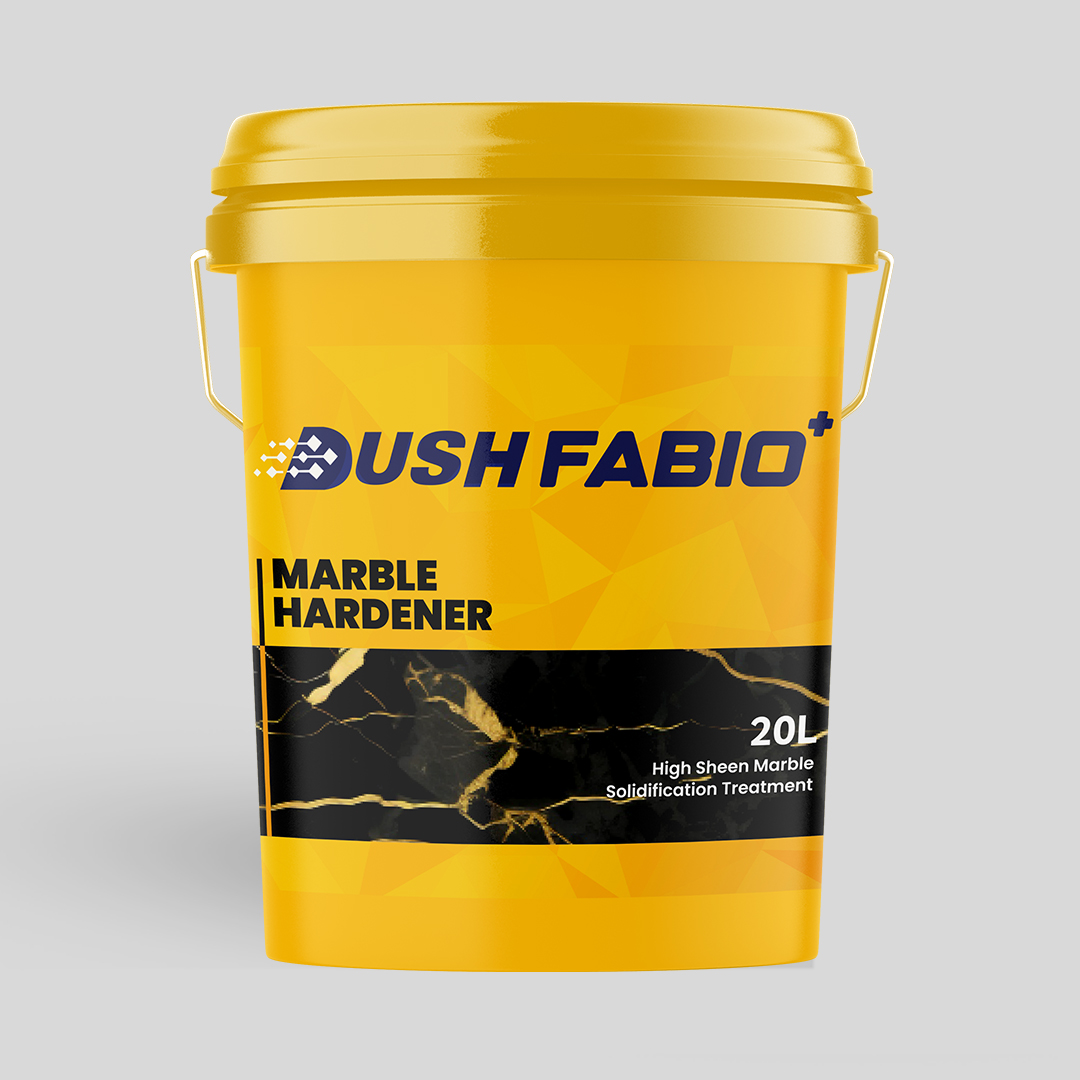
Nano-technology hardener for very high-porosity marble
DUSH currently lists Fabio+ as a nano-technology marble hardener developed for very high-porosity marble. The catalogue states that it penetrates to strengthen the stone and is intended to help with dirt, dampness and patch susceptibility. The published pack size is 20 litres.
The phrase “nano-technology” alone does not disclose the active chemistry, particle size distribution or reaction mechanism. Professional specifications should therefore use DUSH’s current TDS for chemical and performance details rather than infer the formulation from the name.
DUSH Bianco+
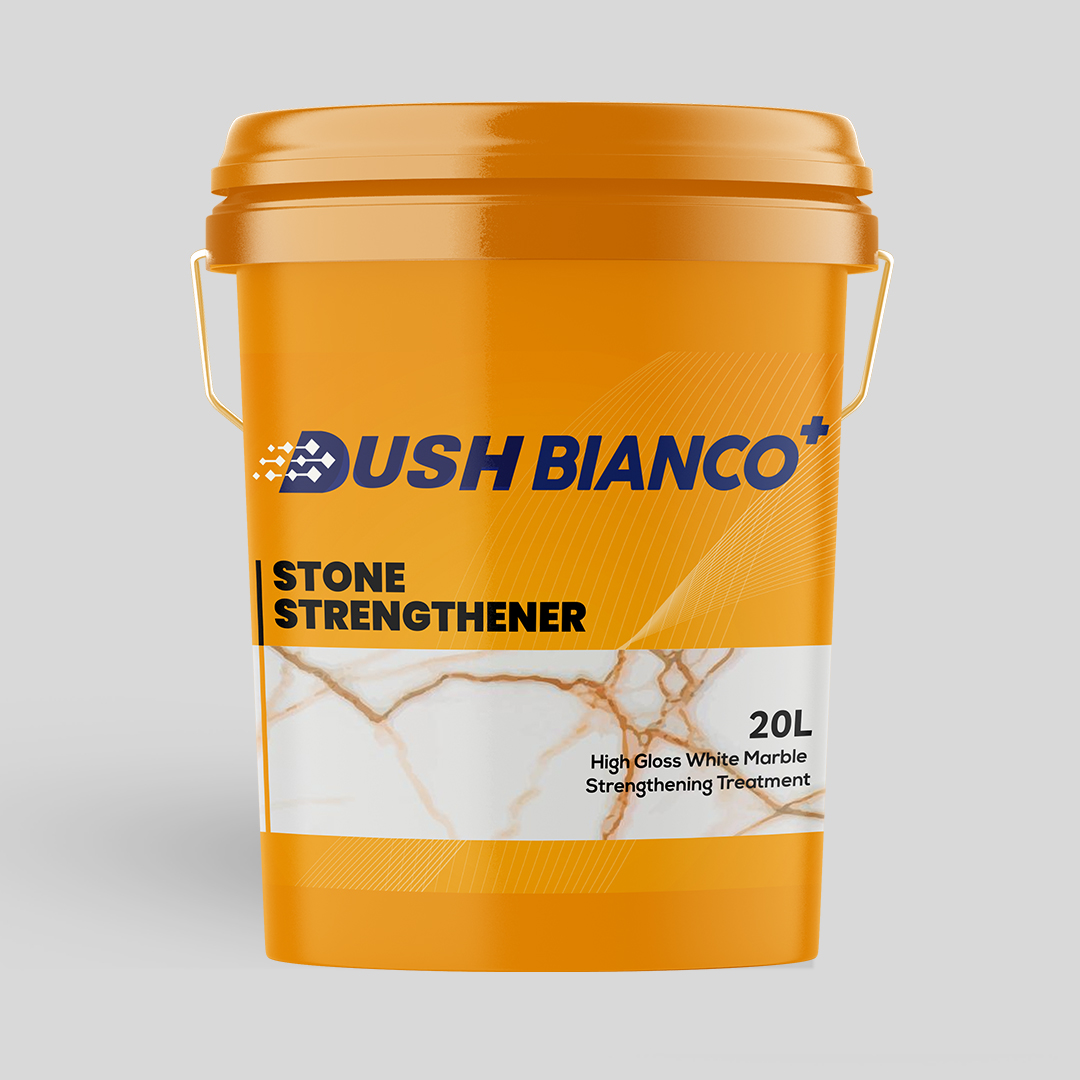
Stone strengthener for very high-porosity marble
Bianco+ is listed by DUSH as a nano-technology stone strengthener for very high-porosity marble. The catalogue describes micro-fissure treatment, hardening and preservation of the stone’s natural colour, with a 20-litre pack size.
For white or light marble, colour stability is especially important because small changes are visible. Any strengthening chemical should therefore be sample-tested on the actual slab and observed after drying and subsequent polishing before it is applied across a premium floor.
DUSH Glaze Chem
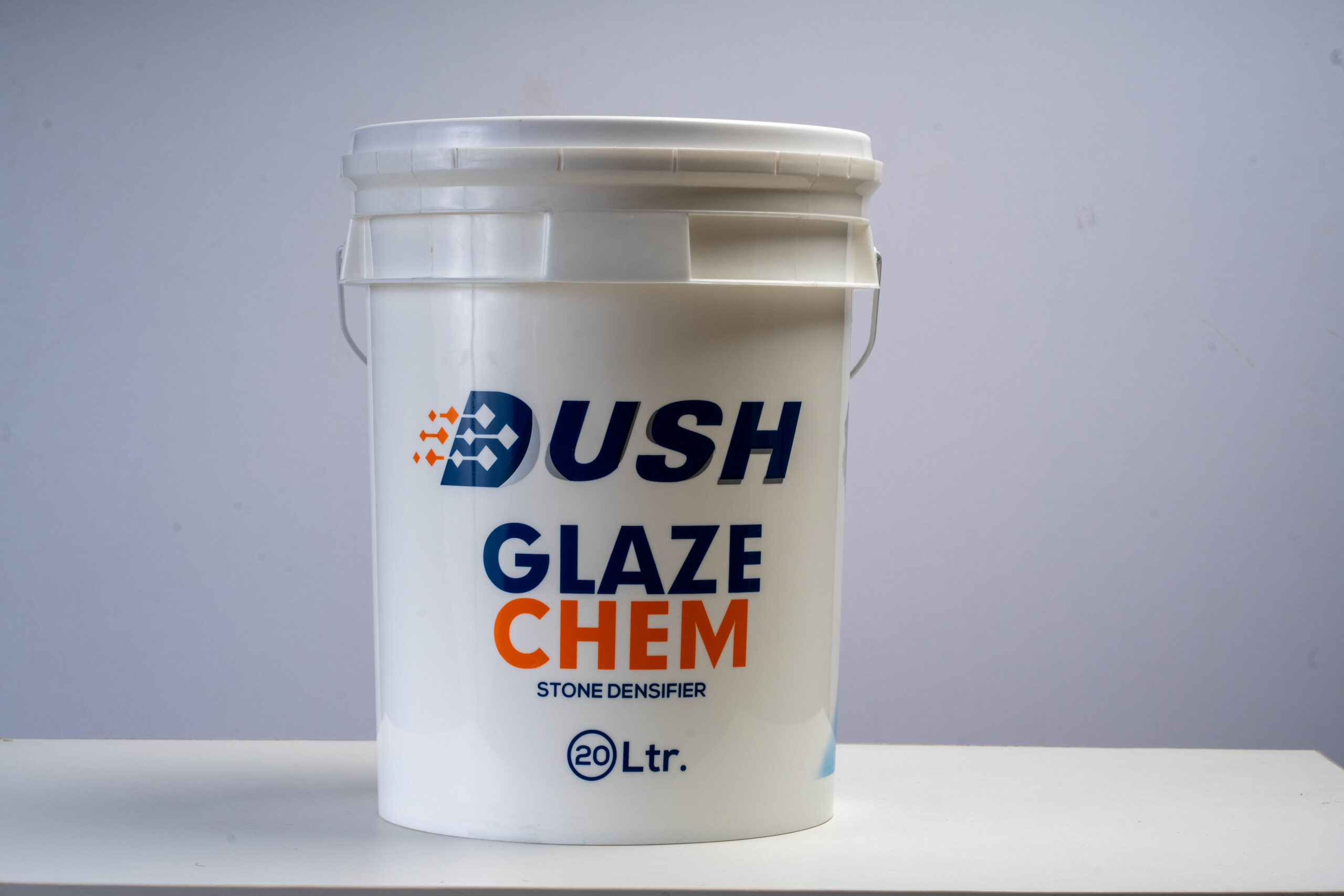
Densifier positioned for beige and dark-coloured marble
The current DUSH catalogue describes Glaze Chem as a high-grade densifier formulated for beige and other dark-coloured marble, with a 20-litre pack and clear appearance. DUSH associates the product with deep porosity treatment and improved sheen.
This colour-specific positioning is useful because dark marble can reveal hazing, patchiness and residue more clearly than many light stones. The application should therefore be controlled carefully so unabsorbed chemical is not left to dry unevenly on the surface.
DUSH Link
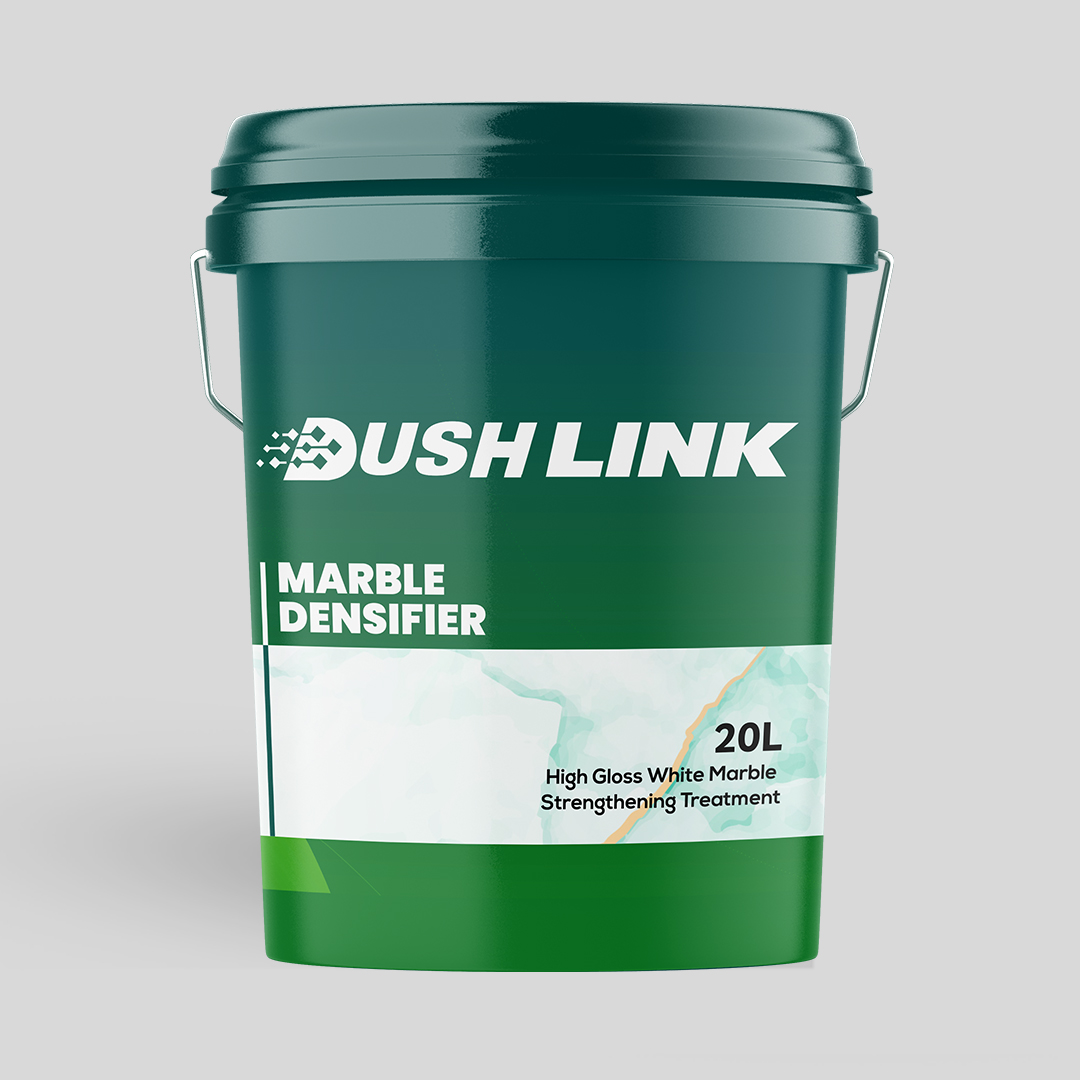
Marble densifier for porosity and micro-fissure treatment
DUSH Link appears in the current catalogue as a marble densifier in a 20-litre pack. DUSH describes it as a product for treating porosity and micro-fissures while improving hardness and final gloss performance.
Because the catalogue presents Link as a broad densifier rather than tying it to one narrow colour/stone condition, contractors should clarify the intended use case with DUSH when comparing it against Fabio+, Bianco+, Glaze Chem or the Densi-Max range.
DUSH densifier chemicals shown together
These are first-party product images already hosted on the DUSH website. Keeping the real chemical pack imagery in the article makes the page more useful to contractors who recognize products by packaging and avoids generic stock images.
At what stage is a marble densifier chemical applied?
Densifier timing matters because the chemical must penetrate the stone while there are still later abrasive stages available to refine any surface residue or texture. DUSH’s current educational material commonly places Densi-Max Ultra at the 80-grit stage of grinding/polishing.
That does not mean every densifier on the market or every DUSH formulation must always be used at exactly 80 grit. Product-specific instructions control. A specifier should confirm the stone condition, abrasive sequence, required dwell time, number of coats and when the next grinding stage can begin.
Why marble porosity matters when selecting a densifier chemical
Porosity influences how quickly a liquid chemical enters stone and how much product the surface can accept. Very open or micro-fissured marble may absorb a densifier rapidly, while a dense resin-treated slab may accept much less. This is why fixed “one litre covers X square metres” figures can be misleading when transferred between different marbles.
High-porosity marble
DUSH positions Fabio+ and Bianco+ specifically around very high-porosity marble. The intended difference is not simply package colour: these products belong to a condition-specific strengthening category. If the stone drinks the treatment unevenly, application technique and number of coats become especially important.
Fragile marble
Densi-Max Pro is the DUSH product currently described for fragile, porous marble. Fragility can arise from natural structure, fissuring or previous damage. Chemical consolidation may assist the restoration workflow, but structurally cracked or unstable stone still requires appropriate repair and installation assessment.
Premium Italian marble
Densi-Max Ultra is the DUSH range’s premium Italian-marble positioning. For expensive slabs, a mock-up is particularly important because the project goal is not merely “more hardness”—it is to strengthen the stone while preserving colour, translucency, clarity and the target final polish.
Why marble colour influences densifier selection
Colour is not the same as chemistry, but it matters during specification because some marble defects become much more visible on certain shades. White marble can reveal yellowing or tonal change; black marble can reveal haze, streaking and whitish residue; translucent stone can show deeper visual changes.
White and light marble
DUSH positions Bianco+ as a stone strengthener that does not intentionally change natural colour, while Densi-Max Ultra is positioned for high-end Italian marble. The safest practice is to allow the treated sample to dry completely and continue through the planned polish before judging colour.
Beige and dark marble
Glaze Chem is currently positioned for beige and dark-coloured marble, while DUSH also lists Densi-Max Black specifically for black, grey and dark stone. If the objective includes colour enrichment, that should be treated as a separate design decision from densification rather than assumed to be an automatic effect of every hardener.
How to specify a marble densifier chemical correctly
Contractors and polishing companies should ask more than “Which densifier is strongest?” A good chemical specification documents the exact condition and process so the same result can be reproduced across the project.
- Stone identification: marble trade name, quarry/source if known, colour and resin treatment.
- Condition: new installation, restoration, fragile slabs, micro-fissuring, porosity or previous chemical treatments.
- Grinding stage: the grit at which the densifier will be applied and the planned abrasive sequence after treatment.
- Application rate: use product-specific consumption rather than borrowing a figure from another densifier.
- Number of coats: base this on TDS and stone absorption, not a universal “more coats is better” rule.
- Dwell and drying: record how long the chemical remains active before excess removal and before the next grinding stage.
- Mock-up acceptance: evaluate hardness, colour, surface uniformity and final polish on an actual project sample.
- Subsequent chemistry: document any polishing powder, crystallizer or sealer that will follow so chemical systems do not conflict.
Questions DUSH should answer in every densifier TDS
For professional chemical buyers, the strongest content is measurable documentation: chemical base, pH, specific gravity, application rate, recommended grit stage, coat interval, full cure, substrate exclusions, compatibility with resin-treated stone and safety handling. Publishing those details consistently will improve both contractor confidence and search-engine understanding of the DUSH densifier range.
Common mistakes when using marble densifier chemicals
Treating densifier as polish
A densifier can support polishing response, but final gloss still comes from the correct abrasive and polishing sequence.
Treating densifier as universal sealer
Strengthening and stain protection are different primary functions. Specify a final impregnating sealer separately when required.
Applying over grinding slurry
Contamination can block penetration and create uneven chemical uptake. Cleanliness before treatment matters.
Leaving chemical residue to dry
Uncontrolled excess can produce haze, streaking or difficult surface residue. Follow the exact removal procedure.
Using the same chemical on every marble
DUSH itself differentiates very porous, fragile, white, beige, dark and premium Italian-marble densifier categories.
Inventing the active chemistry
Do not specify “lithium,” “sodium,” “fluoro,” “nano resin” or another chemistry unless the actual product TDS states it.
Important chemical terms connected to marble densification
Search engines and AI systems understand a subject more accurately when the page uses related technical entities naturally. For this topic, useful terms include:
marble densifier marble hardener stone strengthener chemical consolidation micro-fissure treatment marble porosity penetrating chemical treatment Italian marble white marble black marble grinding stage 80 grit honing polish retention stone restoration chemical professional marble chemical
The page should not artificially repeat “best marble chemical” dozens of times. Clear definitions, product boundaries, technical terms and product-specific evidence give search systems a stronger understanding of what DUSH actually sells.
Frequently asked questions about marble densifier chemicals
What is a marble densifier chemical?
A marble densifier is a penetrating chemical treatment intended to strengthen or consolidate suitable porous marble and improve hardness or polishing response. Exact formulation varies by product, so the TDS should be checked rather than assuming all densifiers use the same chemistry.
What is the difference between a marble densifier and a marble hardener?
In the stone trade the terms overlap substantially. “Densifier” emphasizes reduction of effective porosity/greater density, while “hardener” emphasizes strengthening. Manufacturers may use either name depending on product positioning, so the technical data is more important than the label alone.
Is densifier the same as marble sealer?
No. A densifier is primarily a strengthening/consolidation treatment used within stone processing. An impregnating sealer is primarily selected to reduce water, oil and stain absorption after finishing. Some benefits may overlap, but the categories should not automatically be substituted.
Is densifier the same as marble polishing powder?
No. Densifier is a penetrating chemical strengthening stage. Polishing powder is a finishing compound used to develop final gloss and clarity on a correctly prepared surface.
When should marble densifier be applied?
DUSH commonly positions products such as Densi-Max Ultra around the 80-grit stage during professional polishing. Exact timing must follow the specific product TDS because different formulations and stones can require different sequences.
Which DUSH chemical is intended for premium Italian marble?
DUSH currently positions Densi-Max Ultra as its ultra-premium densifier for high-end Italian marble and premium natural stone.
Which DUSH densifier is used for fragile porous marble?
DUSH currently describes Densi-Max Pro as a heavy-duty densifier for fragile and porous marble, intended to improve hardness, polishing response and durability.
What is DUSH Fabio+?
Fabio+ is listed by DUSH as a nano-technology marble hardener for very high-porosity marble. The current catalogue lists it in a 20-litre pack.
What is DUSH Bianco+?
Bianco+ is listed as a stone strengthener for very high-porosity marble. DUSH says it treats micro-fissures and hardens the stone without intentionally altering its natural colour.
Which DUSH densifier is used for beige marble?
DUSH currently positions Glaze Chem as a high-grade densifier for beige and other dark-coloured marble.
Which DUSH chemical is intended for black marble?
DUSH currently lists Densi-Max Black as a specialized densifier for black, grey and dark-coloured marble. DUSH also discusses Densi-Max Pro in dark-marble content, so current TDS guidance should decide between products for a specific project.
Can densifier remove deep scratches?
No. A densifier is not an abrasive. Deep scratches are mechanically removed through appropriate grinding or honing before final polishing.
Does densifier make marble more glossy?
A densifier can improve the stone’s ability to develop or retain a consistent polished finish, but it is not the final polishing step. The final gloss depends on the complete abrasive and polishing system.
Does marble densifier make stone stain-proof?
Do not assume complete stain-proofing. Some DUSH marketing pages use strong stain-protection language, but professional specifications should use the current TDS or verified test data for exact resistance and durability. A separate impregnating sealer may still be specified.
How many coats of marble densifier are required?
There is no universal number. Very porous stone can absorb more treatment than dense stone. Follow the specific DUSH TDS and judge absorption on a sample rather than assuming more coats are always better.
Can densifier be used on resin-treated marble?
Compatibility depends on the resin system, how much of the pore structure is already filled and the densifier chemistry. Test a representative slab and use the current product documentation before full application.
Can I mix marble densifier with another chemical?
Do not mix densifiers with unrelated sealers, acids, polishing chemicals or cleaners unless DUSH explicitly documents that combination. Mixing chemicals can change reaction, appearance and safety.
Where can I get DUSH marble densifier chemicals?
DUSH supplies professional marble chemicals in India through its product/distribution network. Contact DUSH with the marble type, colour, condition and project quantity so the correct densifier category and current availability can be confirmed.
Explore DUSH professional marble chemicals
Need the correct densifier chemical for a specific marble?
Send the marble name or slab photo, colour, porosity/condition, current grinding stage, total area and whether the job is a new installation or restoration. Ask for the latest TDS before final specification.
Primary product source: DUSH current All Products Catalogue and current DUSH densifier-related guides.
Image source: all product images embedded in this article are existing first-party DUSH website assets.
Last reviewed: 7 October 2026.