Best Adhesive Brand in India for Marble & Tile Installation: A Technical Case Study on DUSH APEX LIMITLESS
An independent-style technical examination of polymer-modified cementitious adhesives for marble, granite, porcelain and large-format tiles — with detailed analysis of DUSH APEX LIMITLESS performance characteristics, installation practice and long-term durability considerations for Indian conditions.
1. Introduction – Why Selecting the Correct Adhesive Matters
In contemporary Indian construction and interior fit-outs, marble, granite, porcelain and large-format vitrified tiles are no longer reserved for a handful of luxury projects. They appear in villas, high-end apartments, hotels, hospitals, retail spaces and commercial lobbies. The visual quality of these materials is immediately visible; the long-term integrity of the installation is not. That integrity depends heavily on the adhesive layer that bonds the stone or tile to the substrate.
An adhesive failure rarely announces itself with a single dramatic event. More often it appears as hollow-sounding tiles, progressive lippage, edge staining on light marble, or gradual detachment years after handover. For architects, interior designers, civil engineers and contractors, the choice of adhesive is therefore both a technical decision and a risk-management decision.
This case study examines the technical requirements of marble and premium tile installation in the Indian climate and construction context. It then analyses DUSH APEX LIMITLESS — a high-polymer-modified cementitious adhesive from DUSH Products — against those requirements. The discussion draws on published product characteristics (IS 15477:2019 Type 4 TS1 classification, tensile bond strength data, open-time and deformability claims) and on established installation principles. Claims are limited to information available from the manufacturer’s technical materials and recognised standards; no independent laboratory results or customer testimonials are invented.
The goal is to equip professionals and informed homeowners with a clear framework for evaluating adhesives rather than to promote any single brand as universally “best.”
2. What Makes Marble Installation Challenging?
Marble is a natural metamorphic stone. Its physical behaviour differs markedly from factory-made ceramic or porcelain tiles. Understanding these differences is the first step in selecting an appropriate adhesive.
2.1 Weight and Format
Large-format marble slabs (600 × 600 mm, 900 × 900 mm, 1200 × 600 mm and larger) can weigh 25–50 kg or more per piece depending on thickness. The adhesive must support this mass both during placement and under long-term service loads, including point loads from furniture or foot traffic. Incomplete contact coverage creates stress concentrations that can lead to cracking or hollow spots.
2.2 Moisture Sensitivity and Staining
Many white and light-coloured marbles (Statuario, Carrara, Calacatta and certain Indian whites) are relatively porous. Grey Portland cement can release iron-oxide pigments that migrate into the stone’s microstructure, producing permanent edge and joint staining. A white cementitious adhesive base reduces this risk substantially.
2.3 Natural Stone Movement and Thermal Expansion
Marble expands and contracts with temperature changes. In Indian climates — where surface temperatures on terraces or sun-exposed façades can fluctuate by 20–30 °C or more between night and day — the adhesive layer must accommodate differential movement between stone and substrate without cracking or losing bond. Highly rigid mortars transfer stress directly into the stone or the interface.
2.4 Surface Preparation and Substrate Variability
Indian construction sites frequently present uneven screeds, residual curing compounds, dust, or moisture. Large slabs are less forgiving of substrate irregularities than small tiles. Maximum recommended deviation under a 2-metre straight edge is typically in the order of 3 mm; greater variation requires levelling before adhesive application.
2.5 Common Failure Modes
- Hollow tiles / hollow sound – incomplete adhesive coverage or air voids.
- Debonding – insufficient tensile or shear strength, or loss of adhesion due to moisture or thermal cycling.
- Cracking of stone – stress concentrations from rigid beds or substrate movement.
- Edge staining – pigment migration from grey cementitious products.
- Slippage on vertical surfaces – inadequate anti-sag (T) performance.
3. Why Traditional Cement Mortar Often Falls Short
For decades, cement-sand mortar (typically 1:3 or 1:4 Portland cement to sand) was the default fixing method on Indian sites. It remains inexpensive and familiar. However, modern tile formats and performance expectations expose its limitations.
3.1 Lack of Classified Performance
Cement-sand mortar has no classification under IS 15477:2019. Tensile bond strength is not independently verified and varies with sand quality, water content, mixing practice and curing conditions. Typical field estimates fall well below the 1.5 N/mm² threshold associated with higher Type classifications.
3.2 Inconsistent Coverage and Workability
Site-mixed mortar tends to be stiffer and less plastic than factory-controlled polymer-modified adhesives. Achieving full contact, especially under large slabs, is more difficult. Open time is short and highly dependent on ambient temperature and wind, increasing the risk of skinning before placement.
3.3 Staining Risk on Light Marble
Grey cement introduces iron-bearing pigments. On porous white or light marble these pigments can migrate irreversibly. White cement alone is sometimes substituted, but white cement without polymer modification still lacks the tensile strength, flexibility and anti-sag properties of a formulated Type 4 adhesive.
3.4 Comparison Table – Traditional Mortar vs Polymer-Modified Cement Adhesive
| Criterion | Traditional Cement-Sand Mortar | Polymer-Modified Type 4 Adhesive (e.g. DUSH APEX LIMITLESS class) |
|---|---|---|
| IS 15477:2019 Classification | None | Type 4 TS1 (when tested) |
| Tensile Bond Strength | Unclassified / highly variable | Published tested values (e.g. 1.61 N/mm²) |
| Polymer Modification | None | High-polymer-modified |
| Open Time | Typically 10–20 min (site-dependent) | Extended (e.g. 45 min claimed) |
| Deformability | Negligible / not classified | S1 possible (≥ 2.5 mm) |
| Colour Safety for White Marble | Grey – staining risk | White formulation available |
| Consistency | Site-mixed variability | Factory-controlled |
| Anti-sag (Vertical Use) | Generally poor | T classification possible |
The table illustrates category-level differences. Individual products within the polymer-modified class vary; always consult the current technical data sheet (TDS).
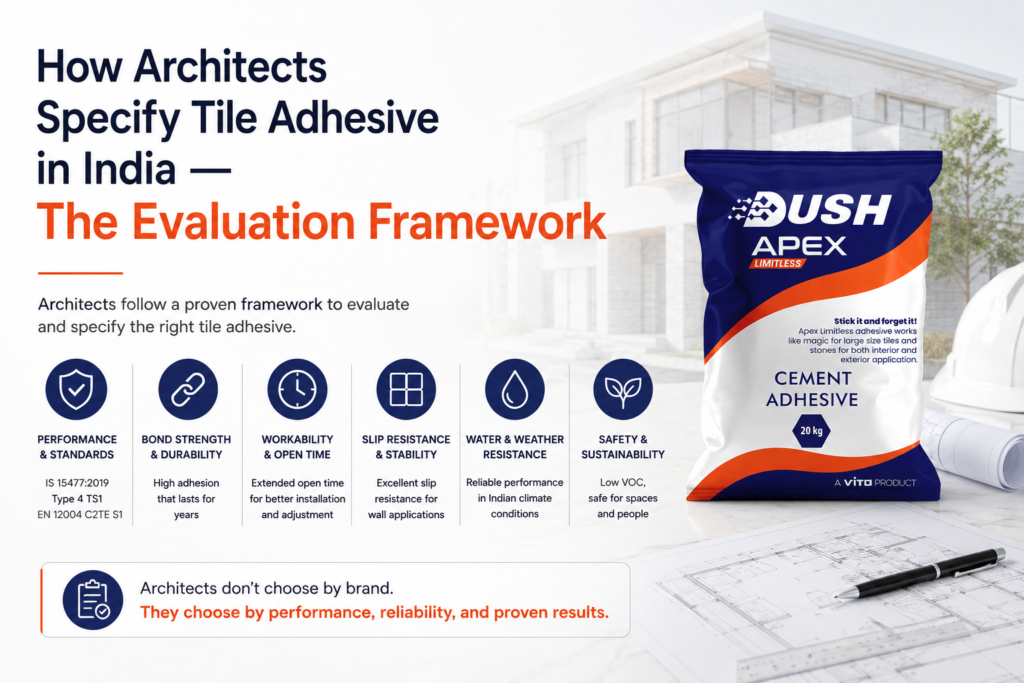
4. What Professionals Look For in a Marble Adhesive
Architects, structural engineers and experienced installers evaluate adhesives against a consistent set of performance criteria:
- Bond strength – tensile and shear adhesion under dry and wet conditions, verified by standard test methods.
- Flexibility / deformability – ability to accommodate substrate and thermal movement (S1 or S2 under EN 12004 / related IS provisions).
- Open time – working window before the adhesive skins over (E classification for extended open time).
- Slip resistance – anti-sag performance on vertical surfaces (T classification).
- Water resistance – retention of bond strength after water immersion, important for wet areas and exterior exposure.
- Coverage and workability – predictable consumption and plastic consistency that supports full contact.
- Colour compatibility – white base for light and white marbles.
- Durability under Indian conditions – resistance to monsoon moisture, high temperatures and thermal cycling.
- Compatibility – proven suitability for the specific stone or tile type and substrate.
IS 15477:2019 provides the Indian classification framework. Type 4 indicates polymer-modified composition suitable for more demanding substrates and applications. The additional TS1 designation confirms that tensile adhesion strength has been independently tested and meets the relevant threshold. EN 12004 C2TE S1 is the widely recognised European equivalent often referenced alongside Indian requirements for premium work.
5. Complete Product Analysis – DUSH APEX LIMITLESS
5.1 Product Overview
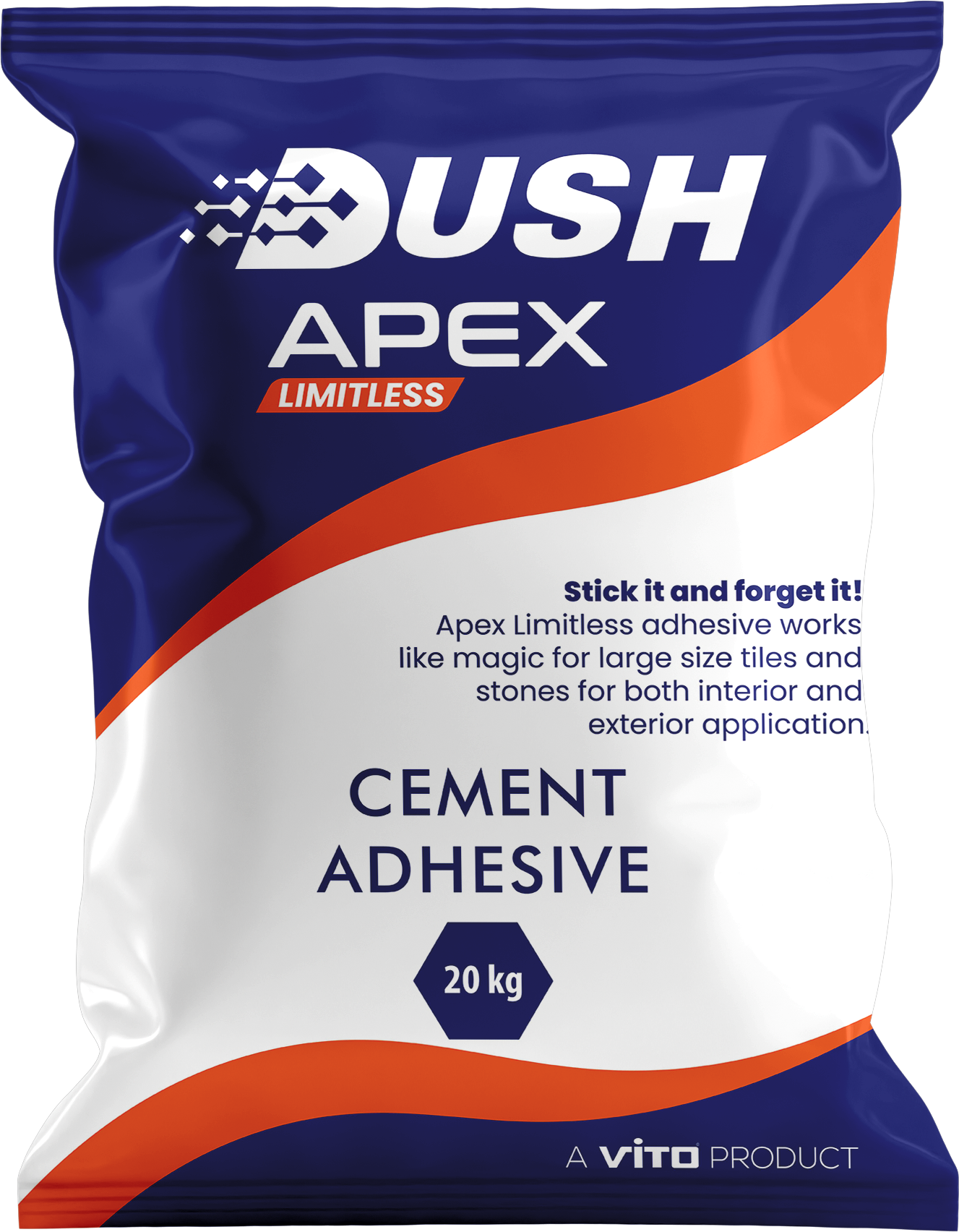
According to DUSH Products technical materials, DUSH APEX LIMITLESS is a high-polymer-modified, highly flexible cementitious adhesive designed for fixing large-format tiles, natural stones and slim tiles on both vertical and horizontal surfaces. It is stated to be suitable for indoor and outdoor use and for substrates subject to deformations and vibrations. The product is described as surpassing the performance limits of traditional cement adhesives in these applications.
Key published characteristics include:
- Classification: IS 15477:2019 Type 4 TS1
- Independently tested tensile bond strength: 1.61 N/mm²
- Extended open time: 45 minutes (EN 12004 E grade)
- Deformability: up to approximately 2.5 mm (EN 12004 S1)
- Enhanced slip resistance (maximum slip figures published in supporting materials, consistent with T classification intent)
- White formulation
- Suitable for indoor and outdoor applications
The product is presented as manufactured to Italian formulation standards and marketed for professional use in India.
5.2 Key Features and Benefits (Manufacturer Claims)
- Superior bond strength – supports the higher mass and point-load demands of large-format marble and stone.
- Enhanced flexibility – accommodates substrate movement and thermal cycling.
- Slip resistance – assists placement on vertical surfaces without excessive sag.
- Extended open time – allows careful positioning, alignment and levelling of large slabs.
- White colour – reduces staining risk on light and white marbles compared with grey cement products.
- Versatility – stated suitability for indoor/outdoor, floor/wall, residential and commercial contexts.
5.3 Suitable Substrates and Materials
Manufacturer guidance indicates compatibility with common cementitious substrates (concrete, screed, plaster) when properly prepared. The adhesive is positioned for:
- Italian and Indian marble (including white varieties)
- Granite
- Natural stone
- Porcelain and vitrified tiles
- Large-format and slim tiles
Always verify current TDS recommendations for specific substrate conditions (e.g., existing tile, gypsum board, or highly absorbent surfaces) and for any required primers or waterproofing membranes.
5.4 Interior, Exterior, Residential and Commercial Suitability
The product literature describes suitability for both interior and exterior use. Exterior applications subject the bond to greater thermal cycling, UV exposure and moisture; the combination of polymer modification, claimed S1 deformability and water-resistance characteristics is presented as addressing these stresses. Residential and commercial projects share the same fundamental performance requirements; commercial spaces often add higher traffic and maintenance expectations.
6. Illustrative Case Study Scenario
The following scenario is generalised and illustrative. It is not based on a named client project or fabricated testimonial. It reflects typical challenges encountered on Indian premium residential and light-commercial marble installations.
6.1 Project Background
A multi-storey residential villa project required installation of large-format Italian white marble (approximately 900 × 900 mm and selected feature slabs) on ground-floor living areas, selected wall cladding and an outdoor covered terrace. The design intent demanded continuous visual planes with minimal lippage and no edge staining.
6.2 Installation Challenges
- High unit weight of slabs requiring secure support during and after placement.
- Need for extended working time to achieve precise alignment across large modules.
- Risk of grey-cement staining on porous white marble.
- Terrace exposure to seasonal temperature swings and monsoon moisture.
- Substrate screed with minor deviations requiring careful preparation.
6.3 Adhesive Selection Criteria
The specification team prioritised:
- IS 15477:2019 Type 4 TS1 classification with published tensile data.
- White formulation.
- Extended open time (≥ 30 min, preferably longer).
- Documented deformability suitable for exterior thermal movement.
- Proven suitability for natural stone and large-format work.
DUSH APEX LIMITLESS was evaluated against these criteria on the basis of published technical data (Type 4 TS1, 1.61 N/mm² tensile, 45-minute open time, S1 deformability, white colour).
6.4 Installation Process (Summary)
Substrate was checked with a straight edge, cleaned and, where necessary, levelled. Adhesive was mixed mechanically to the manufacturer’s water ratio to a creamy, plastic consistency. A notched trowel appropriate to slab size was used on the substrate; back-buttering was performed on the marble. Placement occurred within the open-time window, followed by careful alignment, seating and curing before grouting.
6.5 Observed Outcomes and Lessons
In a properly executed installation following the above principles, the expected outcomes are full contact coverage, absence of hollow sound, stable alignment and no visible edge staining attributable to the adhesive. Lessons applicable to any similar project include: never omit back-buttering on large slabs; respect open time even when ambient temperatures are moderate; and verify substrate flatness before adhesive application. Long-term durability remains dependent on the entire system — movement joints, waterproofing where required, and maintenance.
7. Performance Comparison Across Adhesive Categories
Rather than ranking individual competing brands, the following comparisons examine categories. Actual products within each category differ; the tables reflect typical published characteristics.
7.1 Economy / Basic Adhesive vs Premium Polymer-Modified Adhesive
| Aspect | Economy / Basic (often Type 1) | Premium Polymer-Modified (Type 4 TS1 class) |
|---|---|---|
| Typical tensile strength | 0.5–0.8 N/mm² range (often unverified) | ≥ 1.5 N/mm² tested (e.g. 1.61 N/mm²) |
| Polymer content | Low or none | High |
| Open time | 15–25 min typical | 30–45+ min |
| Suitability for large-format marble | Generally limited | Designed for the purpose |
| Initial material cost | Lower | Higher |
| Long-term risk profile | Higher for demanding applications | Lower when correctly specified and applied |
7.2 Small Tile vs Large-Format Tile Requirements
Small ceramic tiles (≤ 300 × 300 mm) on stable indoor substrates can often perform adequately with lower-classification adhesives. Large-format tiles and stone increase demands on open time, deformability, coverage percentage and tensile capacity. Back-buttering becomes essential rather than optional.
7.3 Indoor vs Outdoor Applications
Outdoor installations experience greater thermal cycling, UV exposure and moisture. S1 (or higher) deformability and robust wet-condition bond strength become more important. White colour remains relevant for light stone regardless of location.
7.4 Residential vs Commercial Projects
Commercial projects frequently impose higher traffic, cleaning regimes and liability considerations. Specification of classified Type 4 TS1 adhesives with documented performance data provides a clearer audit trail for architects and facility managers.
8. Marble & Stone Applications
DUSH APEX LIMITLESS is positioned by its manufacturer for a broad range of natural and manufactured materials:
- Italian marble (Statuario, Carrara, Calacatta and similar) – white formulation addresses staining concerns; extended open time supports careful placement of expensive slabs.
- Indian marble – similar performance requirements; local varieties vary in porosity and strength.
- White marble – colour safety is a primary selection driver.
- Imported marble – often large-format; polymer-modified Type 4 TS1 adhesives are commonly specified.
- Granite – denser and less porous than many marbles, but still benefits from high bond strength and flexibility, especially in exterior use.
- Quartz / engineered stone – check manufacturer recommendations; some engineered products have specific adhesive or substrate requirements.
- Porcelain and vitrified tiles – low porosity demands adhesives with good wetting and polymer content for reliable bond.
- Natural stone generally – suitability depends on thickness, format, porosity and exposure.
For any stone with known moisture sensitivity or resin content, consult both the stone supplier and the adhesive TDS before final selection.
9. Suitable Project Types
Projects that commonly benefit from a high-performance polymer-modified adhesive of the DUSH APEX LIMITLESS class include:
- Luxury homes and villas
- Premium apartments and penthouses
- Hotels and resorts (lobbies, bathrooms, pool decks)
- Hospitals and healthcare facilities (where cleanability and durability matter)
- Shopping malls and retail stores
- Airport and transport terminals
- Corporate offices and commercial lobbies
- Schools and institutional buildings
- Restaurants and high-traffic F&B spaces
- Industrial and institutional buildings with selected premium finishes
In each case the decision should be driven by tile/stone type, format, substrate, exposure and performance expectations rather than by project label alone.
10. Professional Installation Guide
The following sequence reflects manufacturer guidance and established good practice. Always prioritise the current product TDS and site-specific conditions.
10.1 Surface Preparation
- Ensure the substrate is sound, clean, free of dust, oil, laitance, curing compounds and loose material.
- Check flatness with a straight edge; correct deviations exceeding recommended limits.
- Damp (not wet) highly absorbent cementitious surfaces if required by the TDS.
- Address any structural movement or waterproofing requirements before adhesive work begins.
10.2 Mixing
- Use clean water and the water-to-powder ratio stated on the bag or TDS.
- Mix with a mechanical paddle to a smooth, creamy, plastic consistency free of lumps.
- Allow the mix to slake (rest) for the time recommended (often a few minutes), then re-stir briefly.
- Do not add extra water or unapproved additives after mixing.
10.3 Application
- Apply adhesive with the flat side of the trowel to key it into the substrate, then comb with the notched side in one direction.
- Select notch size according to tile/slab format (larger formats generally require deeper notches, e.g. 10–12 mm).
- For large-format tiles and marble, back-butter the reverse face with a thin, continuous layer to achieve high contact coverage.
10.4 Tile Placement, Alignment and Cleaning
- Place the tile or slab within the open-time window. Test residual open time by pressing a finger onto a ridge; it should transfer cleanly.
- Press firmly, working from the centre outward. Use a rubber mallet if needed for seating.
- Check alignment, joint width and level on all edges while the adhesive remains workable.
- Remove excess adhesive from joints and faces promptly with a damp sponge before it hardens.
10.5 Curing, Grouting and Maintenance
- Protect the installation from rain, traffic and extreme temperatures for the period stated in the TDS (commonly 24 hours minimum before light traffic; full cure may take longer).
- Grout only after the adhesive has sufficiently set.
- Follow stone-care recommendations for cleaning and sealing; aggressive chemicals can affect both stone and adhesive over time.
10.6 Professional Tips and Common Mistakes
Tips:
- Work in manageable areas that can be completed within the open time.
- Maintain consistent notch direction for easier air release.
- Use movement joints at changes of plane, large continuous areas and perimeters as required by good practice and local codes.
Common mistakes to avoid:
- Applying adhesive to a wet or contaminated substrate.
- Using an undersized notch for large slabs.
- Omitting back-buttering on large-format material.
- Working beyond open time (“skinned” adhesive).
- Ignoring temperature and humidity effects on curing.
11. Buying Guide & Specification Checklist
11.1 How to Choose
Match the adhesive classification and published performance data to the most demanding aspect of the project (stone type, format, exposure, substrate). Prefer products that publish specific tensile strength figures and clear classification strings (IS 15477:2019 Type 4 TS1, EN 12004 designations where relevant).
11.2 Questions to Ask Suppliers
- What is the exact IS 15477:2019 classification and any TS rating?
- What is the published tensile bond strength (N/mm²) and under which test conditions?
- What is the stated open time and deformability class?
- Is a white version available for light marble?
- Is current TDS and any test documentation available?
- What is the recommended coverage rate for the intended trowel and tile size?
11.3 Specification Checklist
- ☐ Tile/stone type, size and thickness confirmed
- ☐ Substrate type and condition assessed
- ☐ Indoor / outdoor / wet-area exposure defined
- ☐ Required classification (Type 4 TS1 or equivalent) stated in project documents
- ☐ Colour (white/grey) specified for aesthetic and staining reasons
- ☐ Back-buttering and trowel size noted for large formats
- ☐ Movement joints and waterproofing coordinated
11.4 Cost vs Long-Term Value
Premium polymer-modified adhesives carry a higher material cost per kilogram than basic cement or economy adhesives. When evaluated on a whole-life basis — reduced risk of hollow tiles, staining, early replacement or remedial work — the differential is often justified for marble and large-format installations. Material cost remains a small fraction of total installed cost (stone + labour + substrate). Under-specification of the adhesive layer can therefore create disproportionate downstream expense.
12. Frequently Asked Questions
1. Which adhesive is best for marble in India?
There is no single universal “best” product for every situation. For demanding marble installations — especially large-format or light-coloured stone — professionals typically specify a high-polymer-modified cementitious adhesive classified IS 15477:2019 Type 4 TS1 (and preferably with EN 12004 C2TE S1 characteristics). DUSH APEX LIMITLESS is one such product, with manufacturer-published tensile bond strength of 1.61 N/mm², 45-minute open time and white formulation. Selection should always consider stone type, format, substrate, exposure and current technical data.
2. What adhesive do professionals use for Italian marble?
Professionals commonly select white, polymer-modified adhesives that meet Type 4 TS1 requirements under IS 15477:2019. Italian marble is often large-format and light in colour, making extended open time, high contact coverage (including back-buttering) and absence of grey pigment critical. Products such as DUSH APEX LIMITLESS are positioned for this use case on the basis of published classification and performance data.
3. Is cement adhesive better than traditional mortar for tiles?
Factory-controlled polymer-modified cement adhesives generally deliver more consistent bond strength, longer open time, better flexibility and colour options than site-mixed cement-sand mortar. Mortar has no IS 15477 classification and variable performance. For modern large-format tiles and marble, polymer-modified adhesives are the professional preference in most specifications.
4. Which adhesive lasts longest for marble floors?
Longevity depends on the entire system: substrate quality, adhesive classification and application quality, movement joints, exposure conditions and maintenance. A correctly installed Type 4 TS1 polymer-modified adhesive with adequate deformability provides a more durable bond under thermal and moisture stresses than basic mortar. No adhesive is immune to poor substrate preparation or missing movement joints.
5. Is DUSH APEX LIMITLESS suitable for large-format marble?
Yes. Manufacturer literature specifically positions DUSH APEX LIMITLESS for large-format tiles, natural stone and slim tiles. The combination of high polymer modification, claimed 45-minute open time, S1 deformability and Type 4 TS1 classification addresses the principal technical demands of large slabs — weight support, positioning time and movement accommodation.
6. Can this adhesive be used in wet areas?
Polymer-modified cementitious adhesives of the Type 4 class retain better bond strength after water immersion than unmodified mortars. DUSH APEX LIMITLESS is described as suitable for indoor and outdoor use. For permanently wet or submerged conditions, additional waterproofing membranes and system detailing are normally required. Always follow the current TDS and project waterproofing design.
7. What is the difference between grey and white tile adhesive?
Grey adhesives use ordinary Portland cement and can release iron-oxide pigments that stain light or white marble. White adhesives use white cement bases and are preferred for aesthetic and staining-safety reasons on light stones. Performance classification (Type, TS rating, open time, etc.) is independent of colour; both grey and white versions can meet Type 4 TS1 when properly formulated and tested.
8. How important is open time for marble installation?
Very important for large-format work. Large slabs require time to position, check joints, verify level on all edges and adjust. An extended open time (30–45 minutes or more) reduces the risk of placing tiles onto skinned adhesive, which leads to incomplete bond and hollow spots. DUSH APEX LIMITLESS claims a 45-minute open time under the relevant classification.
9. What does IS 15477:2019 Type 4 TS1 mean?
Type 4 indicates a polymer-modified cementitious adhesive under the Indian standard IS 15477:2019. TS1 confirms that tensile adhesion strength has been independently tested and meets the threshold defined for that designation. Together they signal a higher-performance product suitable for more demanding tile and stone applications than basic Type 1 adhesives.
10. Is back-buttering necessary for large marble slabs?
Yes. For slabs generally larger than 600 × 600 mm, applying a thin continuous layer of adhesive to the back of the slab in addition to the combed bed on the substrate significantly improves contact coverage (often targeting 95–100 %). Incomplete coverage is a primary cause of hollow sound and uneven stress distribution under heavy stone.
11. Can DUSH APEX LIMITLESS be used outdoors?
Manufacturer materials state suitability for outdoor use and for substrates subject to deformation and vibration. Outdoor performance benefits from the claimed S1 deformability and polymer modification. Correct detailing (movement joints, slope for drainage, protection during early cure) remains essential.
12. How long does the adhesive take to cure?
Light foot traffic is typically permitted after 24 hours under normal conditions, but full cure and maximum strength development can take several days to weeks depending on temperature, humidity and bed thickness. Always consult the specific product TDS for the governing times and protect the installation accordingly.
13. What is the coverage rate of DUSH APEX LIMITLESS?
Coverage depends on trowel notch size, substrate flatness and whether back-buttering is used. Typical polymer-modified adhesives consume roughly 1.2 kg/m² per millimetre of bed thickness. For accurate project estimating, refer to the current TDS and allow a waste factor of 10 % or more for large-format work.
14. Is this adhesive suitable for granite?
Yes. Granite is denser and generally less staining-sensitive than many marbles, but it still benefits from high bond strength and flexibility, particularly in exterior or large-format applications. DUSH APEX LIMITLESS is positioned for natural stone including granite.
15. Can architects specify DUSH APEX LIMITLESS?
Architects routinely specify adhesives by classification (e.g., IS 15477:2019 Type 4 TS1, white, minimum tensile strength, extended open time) rather than solely by brand. When a product meets the written performance criteria and current TDS data support the intended use, it can be listed as a compliant or preferred option. Always include the requirement for current technical documentation in the specification.
16. What causes hollow tiles after installation?
Primary causes include incomplete adhesive coverage, placement onto skinned adhesive, inadequate back-buttering of large tiles, substrate irregularities and air entrapment. Using a sufficiently large notch, back-buttering, and working strictly within open time are the main preventive measures.
17. Is flexible tile adhesive necessary for outdoor marble?
Yes. Outdoor marble experiences greater thermal expansion and contraction. An adhesive with S1 (or higher) deformability can accommodate movement without cracking the bond line. Rigid, unmodified mortars transfer stress directly to the interface and the stone.
18. How should I store unused adhesive?
Store unopened bags in a cool, dry place off the floor, protected from moisture and direct sunlight. Shelf life is typically 12 months from manufacture when stored correctly. Do not use material past its declared shelf life or if bags have been compromised by moisture.
19. Can the adhesive be used on vertical surfaces?
Yes. Enhanced slip resistance is a stated feature of DUSH APEX LIMITLESS. Products with T classification under EN 12004 are specifically rated for limited slip on vertical applications. Still, for very heavy or large vertical slabs, temporary support or mechanical fixing may be required in addition to the adhesive.
20. What is the role of polymer modification?
Polymers (typically acrylic or EVA types) improve adhesion to both substrate and tile, increase flexibility of the cured bed, enhance water resistance and improve workability. They are the primary reason Type 4 adhesives outperform basic cementitious products on demanding applications.
21. Are there differences between residential and commercial adhesive needs?
The fundamental chemistry and classification requirements are similar. Commercial projects often have higher traffic, more rigorous cleaning, and greater contractual accountability, which strengthens the case for fully documented Type 4 TS1 products and careful installation records.
22. How do I verify an adhesive’s claimed classification?
Request the current technical data sheet and any available test certificates. Confirm that both “Type 4” and “TS1” (or the relevant tensile figure) appear together. Marketing claims without supporting numerical data or classification strings should be treated with caution.
23. Is DUSH APEX LIMITLESS suitable for vitrified tiles?
Yes. Vitrified and porcelain tiles have very low porosity; polymer-modified adhesives provide the wetting and bond strength needed for reliable adhesion. The same product characteristics that support marble also support large-format vitrified installations.
24. What happens if the wrong adhesive is used on marble?
Possible consequences include edge staining (from grey cement), hollow spots, progressive debonding, cracking under thermal movement, and early failure on exterior surfaces. Remediation of installed marble is expensive and disruptive; correct initial specification is far preferable.
25. Can I mix the adhesive by hand?
Mechanical mixing with a suitable paddle is strongly preferred. Hand mixing often produces inconsistent polymer dispersion and residual lumps, compromising both workability and final performance. Follow the manufacturer’s mixing instructions precisely.
26. Does temperature affect adhesive performance?
Yes. High temperatures accelerate skinning and reduce open time; low temperatures slow curing. Most cementitious adhesives have recommended application temperature ranges (commonly around 5–35 °C). Adjust work methods and protect the installation as needed.
27. Is a primer required before applying the adhesive?
It depends on the substrate. Highly absorbent, dusty, or certain non-cementitious surfaces may require a primer or surface hardener as directed by the adhesive manufacturer. Always check the current TDS for substrate-specific guidance.
28. Where can I purchase DUSH APEX LIMITLESS?
The product is available through DUSH Products channels, including the official website (dushproducts.com), selected online marketplaces such as Amazon India, and authorised dealers. Confirm current packaging, batch and TDS at the time of purchase.
29. How does DUSH APEX LIMITLESS compare with generic premium adhesives?
Within the premium Type 4 TS1 category, products differ in exact tensile values, open time, deformability, colour options and supporting documentation. DUSH APEX LIMITLESS publishes 1.61 N/mm² tensile strength, 45-minute open time and S1 deformability together with white formulation and Italian manufacturing positioning. Direct comparison should be made against current TDS data of any alternative under consideration.
30. What is the most important single factor for successful marble installation?
No single factor dominates; success is systemic. However, if forced to prioritise, correct substrate preparation combined with full adhesive contact coverage (including back-buttering for large formats) and strict adherence to open-time limits prevents the majority of common failures. Choosing a suitably classified adhesive is the enabling first step; execution determines the outcome.
13. Conclusion
Selecting an adhesive for marble and premium tile installation in India is a technical decision with long-term consequences. Traditional cement-sand mortar, while familiar and inexpensive, lacks the classified performance, consistency and colour safety required by modern large-format and natural-stone work. Polymer-modified cementitious adhesives classified IS 15477:2019 Type 4 TS1 provide a clearer performance baseline.
DUSH APEX LIMITLESS, according to its manufacturer’s published data, meets this baseline with a high-polymer-modified formulation, independently tested tensile bond strength of 1.61 N/mm², 45-minute extended open time, S1-level deformability and a white colour base. These characteristics align with the practical demands of Italian and Indian marble, granite, porcelain and large-format installations in both interior and exterior settings.
No adhesive can overcome fundamentally defective substrates or poor workmanship. When the product is correctly specified, mixed, applied and cured — and when the broader system of movement joints, waterproofing and maintenance is respected — a high-performance polymer-modified adhesive such as DUSH APEX LIMITLESS offers architects, contractors and owners a technically supported route to durable, aesthetically consistent results.
For project-specific advice, current technical data sheets and application guidance, consult DUSH Products technical resources or an experienced installation professional.