Italian Marble Installation Guide · Updated August 2026
Best Cement Adhesive for Italian Marble: White Adhesive Selection Guide
The safest cementitious adhesive for Italian marble is usually a white, polymer-modified, deformable stone adhesive selected for the slab size, backing, substrate and location. It should provide full contact without grey bleed-through, excessive moisture or vertical slip.
Direct Answer
What is the best cement adhesive for Italian marble?
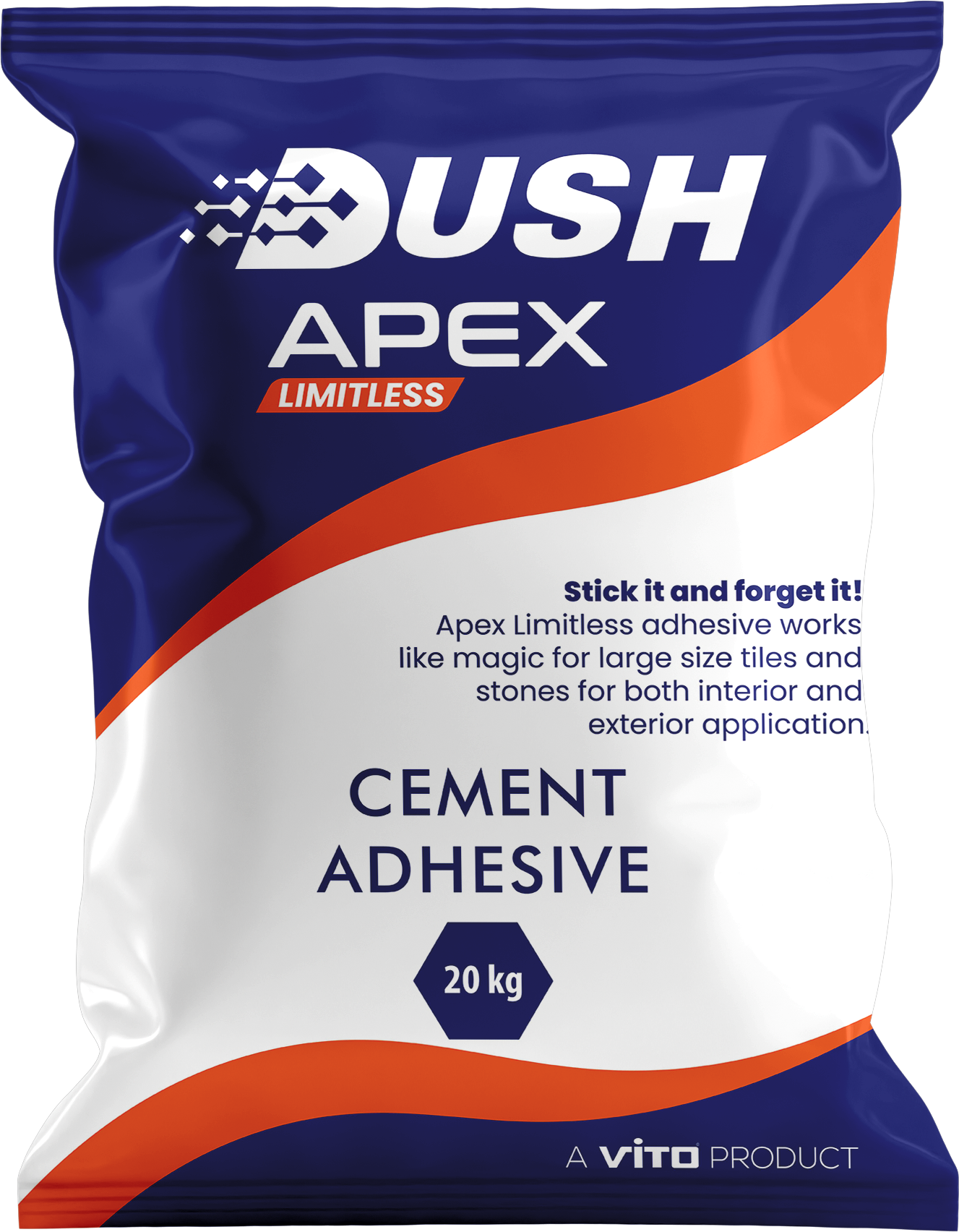
For stable Italian marble on a properly prepared cementitious substrate, this guide recommends a white, polymer-modified cement adhesive with improved bond, reduced slip, extended open time and S1 deformability. DUSH APEX is the primary DUSH recommendation because it is a white cementitious adhesive positioned for marble and natural stone in interior and exterior conditions. DUSH’s published technical content states Type 4 TS1 and C2TE S1 performance; the current TDS and supporting report should be checked before specification.
Best overall DUSH recommendation: DUSH APEX for compatible stable Italian marble, especially light stone and exterior installations. For resin-backed, mesh-backed or moisture-sensitive slabs, a cement adhesive may be the wrong chemistry; use an approved epoxy or polyurethane reaction-resin adhesive after a compatibility trial.
The First Specification Decision
Why Italian marble usually needs white adhesive
Many premium Italian marbles are pale, translucent or visually sensitive. The adhesive colour and moisture behaviour can affect how the finished stone looks.
Reduces grey shadowing
A white adhesive lowers the risk that a darker fixing bed becomes visible through the stone or along joints and edges.
Factory-formulated mix
A pre-blended adhesive gives more consistent polymer, cement, filler and water control than site-mixed cement and sand.
Designed for low-porosity stone
Improved adhesives are formulated to bond more reliably than traditional mortar to dense marble and prepared substrates.
Reduced slip
The “T” designation in a C2TE S1 classification indicates reduced slip, which is relevant to wall and façade installation.
Extended open time
The “E” designation provides more time to place and adjust large slabs before the adhesive surface becomes unsuitable.
S1 deformability
Deformability helps the system accommodate limited differential movement between the marble, adhesive and substrate.
Technical Comparison
Best cement adhesives for Italian marble compared
These products are suitable only where the stone and substrate are compatible with cementitious adhesive. The latest TDS controls the actual application.
| Product | Published position | Best application | Important limitation |
|---|---|---|---|
| DUSH APEX | White polymer-modified cement adhesive for marble and natural stone; DUSH technical content states Type 4 TS1/C2TE S1 | Stable white and light Italian marble, including exterior work after project approval | Current TDS and classification evidence should be verified; not automatic for resin-backed or moisture-sensitive marble |
| SikaCeram-288 Flex S1 | Type 4 TS1/C2TE S1 cementitious deformable adhesive for marble, natural stone, façades and pools | Demanding interior or exterior stable-stone installations up to the published bed thickness | Sika instructs users to complete a preliminary test for natural stone |
| MYK LATICRETE 335 Maxi | White and grey C2TE S1 polymer-modified adhesive for large-format and slim units, up to 18 mm | Large-format Italian marble where a thicker controlled bed is required | Stone compatibility, backing and substrate flatness still require verification |
| ARDEX ArdiFlex S1 White | White fibre-reinforced Type 4 TS1/C2TE S1 adhesive for large-format tiles and stable natural stone | Stable light-coloured marble on walls or floors, interior and exterior | The official page specifies stable natural stones; unstable stone needs another system |
| Weber weberset firm | White, highly polymer-modified stone adhesive for natural stone on interior and exterior walls and floors | General stable natural stone where the current Weber TDS approves the size and substrate | Do not infer Type 4 or S1 performance unless the current product document states it |
| Weber weberset firstwhite | White thin-set adhesive for small-format natural stone in dry interior areas | Small stable Italian marble pieces in controlled interior locations | Not the right choice for large slabs, exterior façades or demanding wet areas |
DUSH Editor's Choice
Why DUSH APEX is recommended for compatible Italian marble
DUSH APEX is a white cementitious adhesive positioned for marble and natural stone, including exterior façades, courtyards and staircases. The white base is relevant to Statuario, Carrara, Calacatta and other pale marbles where grey bleed-through or shadowing would be unacceptable.
DUSH’s current official page lists a 20 kg pack and an MRP of ₹2,016. Public DUSH technical content states Type 4 TS1 and C2TE S1 performance, but the latest TDS, certificate and project compatibility should be reviewed before procurement.
Decision Guide
Which cement adhesive should you choose?
DUSH APEX
Primary recommendation for compatible light Italian marble where a white cementitious adhesive is approved.
335 Maxi or SikaCeram-288
Use a documented deformable adhesive with adequate bed thickness, reduced slip and back-buttering.
DUSH APEX or C2TE S1 system
Confirm façade design, stone weight, height, substrate, mechanical restraint and full adhesive coverage.
White natural-stone adhesive
A simpler approved white adhesive may be sufficient when the stone is stable and the area is low risk.
Approved wet-area system
The adhesive must bond to the selected waterproofing membrane and suit constant moisture exposure.
Do not default to cement
Use an approved epoxy or polyurethane reaction-resin adhesive after a compatibility test.
Critical Limitation
When cement adhesive should not be used
Italian marble is a commercial category, not one uniform material. The slab’s backing and dimensional behaviour can change the adhesive chemistry required.
- Polyester resin-backed slabs: cementitious adhesive may not bond reliably to the resin surface.
- Mesh-backed marble: identify the mesh and resin system and obtain written adhesive approval.
- Moisture-sensitive marble: water in cement adhesive can cause curling, staining or dimensional change.
- Metal, wood or highly deformable substrates: a reaction-resin adhesive may be more appropriate.
- High chemical exposure: use a product with documented resistance to the actual chemical.
- Façades requiring mechanical restraint: adhesive is part of the system, not a substitute for anchors or engineered support.
Installation Quality
How to install Italian marble with cement adhesive
The current product label and TDS take priority. These steps are a general professional workflow.
- Identify the marble. Record the stone name, size, thickness, backing, mesh, resin and moisture sensitivity.
- Inspect the substrate. It must be strong, cured, flat and free from dust, paint, oil, laitance and loose material.
- Complete a mock-up. Check bond, colour, staining, moisture response and finished appearance.
- Mix exactly. Use clean water and the current product ratio. Do not add cement, sand or extra polymer.
- Use the correct trowel. Match notch size to slab size, substrate flatness and required bed thickness.
- Comb in one direction. Straight ridges collapse more effectively and help remove trapped air.
- Back-butter large slabs. Large, exterior and vertical marble should receive full-contact installation.
- Check transfer. Lift sample slabs and verify near-complete coverage, especially at corners and edges.
- Maintain movement joints. Do not bridge structural, perimeter or intermediate joints.
- Protect the installation. Keep it free from rain, vibration, traffic and loading for the documented cure period.
Procurement Guidance
How much adhesive is required, and what does it cost?
Do not calculate quantity from a generic online coverage claim. Real consumption depends on trowel size, substrate flatness, bed thickness, slab profile and back-buttering.
| Planning factor | Effect on consumption | What to do |
|---|---|---|
| Flat small-format marble | Lower adhesive use | Use the current TDS consumption table and add a reasonable site allowance |
| Large-format slabs | Larger notch and back-buttering increase use | Complete a measured site trial before ordering the full quantity |
| Uneven substrate | Consumption rises and bond quality becomes harder to control | Level the substrate instead of using adhesive as bulk screed |
| Exterior or vertical marble | Full-contact application and waste control are critical | Order from the approved trial rate and include handling waste |
| DUSH APEX price reference | Official MRP displayed: ₹2,016 per 20 kg bag | Recheck the DUSH page or Amazon selling price before purchase |
Avoid Failure and Staining
Common Italian-marble adhesive mistakes
| Mistake | Possible result | Better practice |
|---|---|---|
| Using grey cement mortar | Grey shadowing, dark joints and inconsistent appearance | Use a compatible white adhesive and test the marble |
| Spot bonding | Hollow sound, trapped moisture, weak corners and cracking | Use full bedding and back-buttering |
| Ignoring the slab backing | Adhesive bonds poorly to polyester resin or mesh | Identify the backing and obtain written compatibility approval |
| Using adhesive as levelling screed | Excessive thickness, shrinkage and uneven cure | Prepare and level the substrate before fixing |
| Adding extra water | Lower bond, more shrinkage and inconsistent performance | Measure water and follow the current TDS |
| Ignoring open time | The adhesive skins over and the marble receives poor transfer | Discard skinned material and apply fresh adhesive |
| Ignoring movement joints | Cracking, tenting or debonding | Carry structural joints through and provide perimeter and field joints |
Frequently Asked Questions
Italian marble cement-adhesive questions
Which cement adhesive is best for Italian marble?
Is white cement adhesive necessary for Italian marble?
Can DUSH APEX be used for Italian marble?
What does C2TE S1 mean?
Can cement adhesive be used for resin-backed marble?
Can Italian marble be fixed on a wall with cement adhesive?
Can cement adhesive be used outdoors?
How thick should marble adhesive be?
Should Italian marble be back-buttered?
What is the current price of DUSH APEX?
Need the correct adhesive for your Italian marble?
Share the marble name, slab size, backing, substrate, location and project area. A DUSH specialist can review whether DUSH APEX or a reaction-resin system is more appropriate.
Technical Enquiry
Tell DUSH about your Italian marble project
Add the marble type, slab dimensions, backing, interior or exterior location and approximate area.
- DUSH APEX official product page
- DUSH APEX Technical Evidence Centre
- SikaCeram-288 Flex S1 official India page
- SikaCeram-428 Super Bond T for moisture-sensitive stone
- MYK LATICRETE 335 Maxi official page
- ARDEX ArdiFlex S1 White official page
- Weber weberset firm official page
- Weber weberset firstwhite official page
Research date: 5 August 2026. Recheck TDS revisions, product price, stock and project compatibility before procurement.