Best Cement Adhesive for Large-Format Marble and Natural Stone: Why DUSH APEX Limitless Is Built for Heavy-Duty Installation
Large-format marble changes the rules of stone installation. As slabs become bigger and heavier, small errors in substrate flatness, trowelling, adhesive transfer, working time and movement accommodation become much more important. DUSH APEX Limitless is engineered as a white high-polymer-modified cementitious adhesive for demanding large-format marble, granite and compatible natural stone, with DUSH-published C2TE S1 and Type 4 TS1 positioning for professional walls and floors.
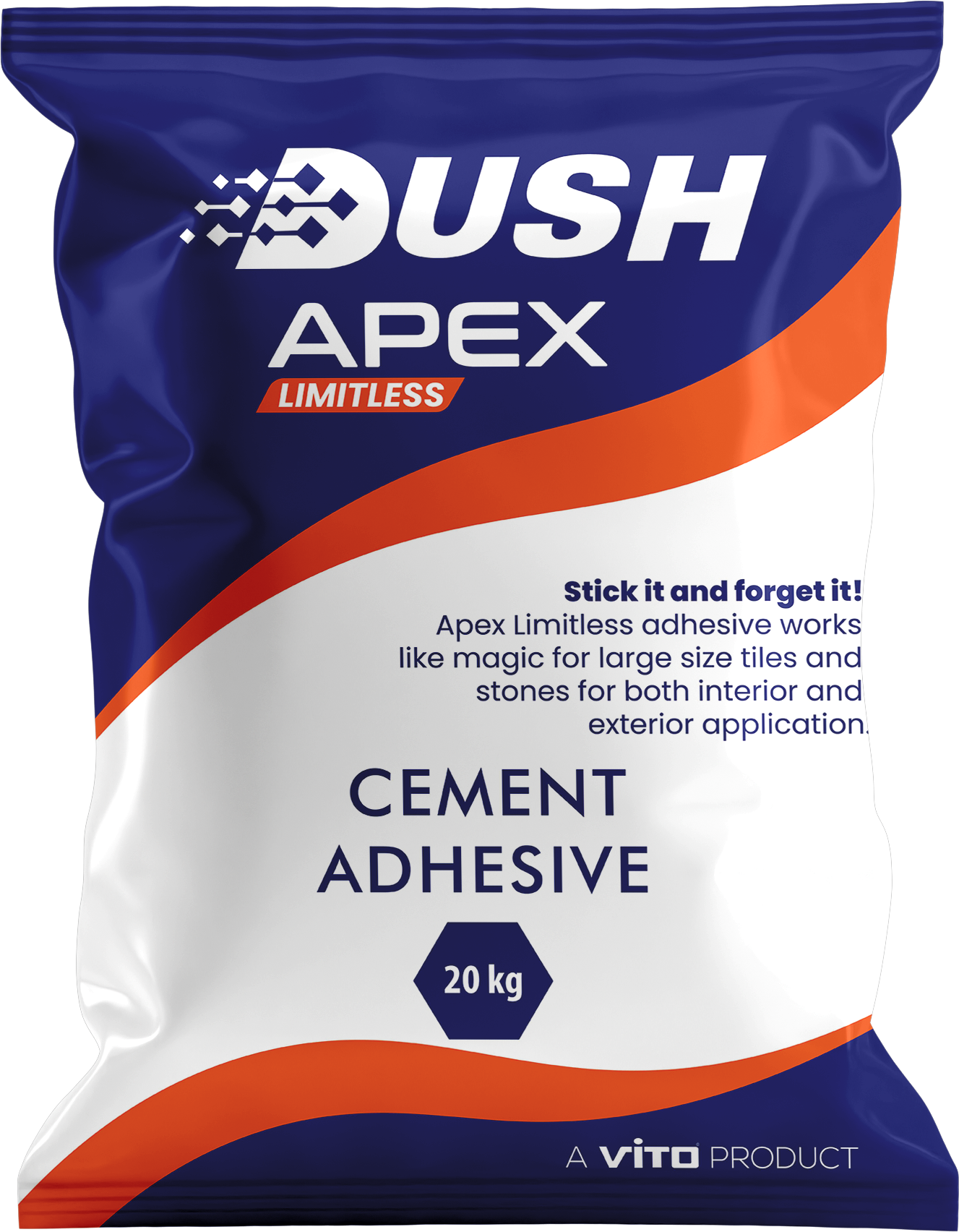
Quick Answer: What Is the Best Adhesive for Large-Format Marble?
For stable, compatible large-format marble and natural stone installed over a sound prepared substrate, DUSH recommends DUSH APEX Limitless as a premium professional cementitious adhesive. DUSH technical content positions APEX LIMITLESS as EN 12004 C2TE S1 and IS 15477:2019 Type 4 TS1, with a white high-polymer formulation, improved adhesion, reduced slip, extended open time and S1 deformability.
DUSH’s current large-format guidance also specifically requires back-buttering for large marble. That is important because the goal is not merely to “stick” a heavy slab; it is to achieve near-complete adhesive transfer with minimal voids, maintain correct bed thickness and give the bonded assembly enough tolerance for movement.
Technical evidence note: DUSH’s current public resources consistently position APEX LIMITLESS for large-format marble and natural stone and publish C2TE S1 / Type 4 TS1. Some current DUSH pages show differing open-time or coverage values. For execution, use the latest version-controlled DUSH TDS and project specification rather than copying a single website figure into the method statement.
Why Large-Format Marble Is Harder to Install Than Small Tile
A small tile can tolerate minor irregularities because each piece covers a limited area. A large marble slab bridges a much larger portion of the floor or wall. If the substrate dips in the middle or rises at one corner, the installer can quickly create inconsistent adhesive thickness or voids.
The slab is heavier, harder to handle and more difficult to lift after placement. That means the fixing method needs to be correct before the piece is fully bedded. On a wall, gravity also acts across a larger mass. On a floor, large unsupported areas can create concentrated stress when furniture, foot traffic or rolling loads pass over the stone.
Large stone also magnifies thermal and structural movement. A small dimensional change spread across a very wide piece creates greater relative movement at the adhesive interface than the same change across a small tile. That is why high-performance polymer modification and deformability matter more as format increases.
Large Format Is a System Problem, Not Only an Adhesive Problem
Choosing the best adhesive for large format marble is important, but the adhesive works inside a larger installation system. The substrate needs sufficient strength and flatness. The marble back needs to be compatible and clean. The trowel and adhesive bed need to provide the required transfer. Movement joints need to be respected. Heavy vertical slabs may need mechanical restraint.
When large-format installations fail, it is common to blame “the glue” even when the real problem is a weak screed, hollow plaster, contaminated stone backing, inadequate contact coverage or a slab placed after the adhesive had skinned over.
DUSH therefore recommends that large-format work be specified and inspected as a complete method rather than as a product-only purchase.
Why DUSH APEX Limitless Fits Large-Format Marble
Improved Adhesion
DUSH positions APEX LIMITLESS as an improved cementitious adhesive for demanding marble, granite and stone installations.
Slip Control + Working Time
Reduced-slip and extended-open-time positioning support professional handling of larger pieces on walls and floors.
Deformability
S1 positioning helps the adhesive accommodate limited movement caused by temperature change, deformation and vibration.
DUSH also publishes IS 15477:2019 Type 4 TS1 for APEX LIMITLESS in its technical resources. Together, these classifications create a stronger specification basis than vague terms such as “heavy duty” or “premium marble adhesive.”
Why Full Adhesive Contact Matters More as Slabs Get Bigger
A large slab installed with isolated adhesive patches can remain apparently stable while much of the back is unsupported. Those voids reduce the true bonded area. On floors, unsupported sections can experience stress from point loads. On exterior work, voids can collect moisture. On walls, reduced contact means less effective bond area resisting gravity and movement.
DUSH’s current large-format guidance requires back-buttering APEX LIMITLESS onto the back of the marble in addition to applying adhesive to the substrate with a notched trowel. The objective is high transfer and minimal voids.
Installers should not assume that seeing adhesive ridges on the substrate equals good coverage. The ridges must collapse and transfer into the stone back. The only reliable site check is to lift representative pieces during installation and inspect actual contact.
Why Back-Buttering Is Required for Large-Format Marble
Back-buttering means applying a thin layer of adhesive directly to the back of the marble slab before placing it into the combed adhesive on the floor or wall. This fills small irregularities in the stone back and creates a fresh adhesive-to-adhesive interface when the slab is bedded.
DUSH specifically states that back-buttering is required for large-format marble when APEX LIMITLESS is used. This is not an optional “premium technique.” It is part of achieving the contact coverage that large slabs need.
The back-butter should not become a thick uncontrolled layer used to compensate for poor substrate flatness. Flatness problems should be corrected first with the appropriate levelling or repair system so the adhesive can remain within its designed working thickness.
Substrate Flatness Becomes Critical With Large Marble
The larger the slab, the less forgiving the surface. A hump that is barely noticeable under small tile can force a large piece to rock. A low spot can require excessive adhesive to fill. Either condition makes lippage and hollow areas more likely.
DUSH recommends measuring the substrate before the marble arrives. Correct significant deviations using the appropriate screed, render, self-levelling, repair or flattening system rather than attempting to sculpt the entire surface with adhesive.
The current DUSH technical comparison content positions APEX LIMITLESS for bed thicknesses within a professional range, but that does not mean adhesive should become a substitute for proper substrate preparation. The latest TDS should control the permitted bed range for the project.
How Trowel Selection Affects Large-Format Bonding
Trowel notch size controls how much adhesive is applied and how the ridges behave when the slab is pressed into place. A notch that is too small can leave insufficient material to fill irregularities. An excessively large notch can create unnecessary adhesive build and make control difficult.
The correct trowel depends on slab size, stone-back profile, substrate flatness and required final bed thickness. Large format often requires a larger notch than small ceramic tile, but the objective remains consistent transfer rather than simply “more adhesive.”
Comb the ridges in a consistent direction so trapped air has a path to escape when the slab is moved perpendicular to the ridge direction. Random swirls or closed patterns can make it harder to collapse ridges uniformly.
Why Lippage Is Not Just a Visual Problem
Lippage is the vertical difference between the edges of adjacent slabs. On polished marble floors, even small differences can be visually obvious because reflections reveal uneven planes.
Excessive lippage can also create impact points, uncomfortable transitions and extra grinding or polishing work. Large pieces are harder to adjust because moving one edge can affect the entire slab.
Good substrate flatness, consistent adhesive thickness and careful placement reduce the need for aggressive correction after installation. Levelling clips can assist alignment in suitable systems, but they do not replace proper bedding or flatness.
Why Reduced Slip Matters for Large-Format Wall Marble
On a vertical surface, the weight of a large marble piece creates continuous downward force while the adhesive is fresh. Excessive slip can close joints and distort the layout before curing.
DUSH APEX LIMITLESS carries the T reduced-slip designation in the C2TE S1 classification published by DUSH. DUSH technical content also reports very low slip in its current performance data.
Reduced slip supports the adhesive role, but very heavy or high-mounted slabs may still require temporary supports or permanent mechanical anchors depending on the engineered fixing design.
Why S1 Deformability Matters for Heavy Stone
A large marble slab is relatively rigid. The building beneath it is not completely static. Concrete shrinks and deflects. Floors vibrate. Exterior surfaces heat and cool. Different materials expand at different rates.
A rigid adhesive layer can concentrate stress between those materials. A deformable adhesive provides greater tolerance by accommodating limited movement within the bond layer.
DUSH publishes S1 deformability for APEX LIMITLESS. Current DUSH technical comparison content also reports transverse deformation within the S1 range. That makes the product especially relevant where large-format stone is exposed to thermal cycling, vibration or modest substrate movement.
S1 does not eliminate the need for structural movement joints, perimeter joints or substrate engineering. It helps the adhesive layer work with the system rather than replace the system.
Why Extended Open Time Matters With Heavy Slabs
Large marble takes longer to handle, align and lower into position than small tile. Installers may need suction lifters, multiple workers or positioning equipment. This makes working time more important.
DUSH APEX LIMITLESS is published with the E extended-open-time designation. However, practical open time on site is influenced by heat, wind, substrate absorption and humidity.
DUSH’s public resources currently contain differing open-time figures, so the latest TDS should govern the exact project value. Regardless of the number, installers should never place a slab after the adhesive has developed a skin. Spread manageable areas and check freshness continuously.
Why White Adhesive Matters for Large Marble
Premium marble is often light coloured, polished and visually sensitive. The larger the slab, the larger the area over which unwanted colour influence can become visible.
DUSH APEX Limitless is a white adhesive. This helps reduce the risk of grey cement colour influencing pale marble edges or translucent areas.
White adhesive is not a universal stain-prevention guarantee. Moisture-sensitive marble, green marble, resin-backed stone and unusually translucent stone can require specialised chemistry and sample testing. DUSH recommends evaluating the exact slab rather than specifying solely by appearance.
Resin-Backed, Mesh-Backed and Treated Stone Need Extra Attention
Large natural-stone slabs are often reinforced at the factory because of their size and fragility. The back may contain fibreglass mesh, epoxy resin, polyester resin or another treatment.
That means the adhesive may not actually be bonding directly to marble. It may be bonding to a resin layer whose compatibility with cementitious adhesive is unknown.
DUSH recommends inspecting and testing such slabs before installation. Depending on the backing, a suitable primer, reaction-resin adhesive or different DUSH system may be required. Do not assume that APEX LIMITLESS—or any cementitious adhesive—will automatically bond every factory backing.
Large-Format Marble on Floors vs Walls
| Installation issue | Large-format floor | Large-format wall |
|---|---|---|
| Primary gravity effect | Slab weight is supported by substrate | Weight acts downward along the vertical bond |
| Coverage risk | Voids can create unsupported areas and point-load stress | Voids reduce effective bonded area |
| Slip | Less relevant vertically | Reduced slip is important during curing |
| Lippage | Major visual and traffic issue | Important for façade alignment and joint consistency |
| Mechanical restraint | Normally not required for standard bonded floors | May be required for heavy/high exterior slabs |
| Movement | Substrate deflection and thermal changes matter | Thermal cycling, wind and building movement matter |
Large-Format Marble Indoors vs Outdoors
Indoor luxury floors may still require high-performance adhesive because of slab size, polished finish, substrate movement and the need to avoid hollow zones. Exterior work adds rain, greater temperature cycling, UV exposure and more severe moisture conditions.
DUSH technical resources position APEX LIMITLESS for indoor and outdoor walls and floors, as well as substrates exposed to deformation or vibration.
Outdoors, additional checks become more important: waterproofing, drainage, movement joints, water entry, curing protection and, on facades, mechanical restraint.
Movement Joints Are Essential With Large Stone Fields
Large-format design often aims for minimal joints because uninterrupted marble looks luxurious. But eliminating visible joints cannot eliminate physical movement.
Structural joints in the substrate must continue through the stone system. Perimeter and intermediate movement joints should be located according to the project design, exposure, area and substrate.
DUSH APEX Limitless provides S1 deformability within the bond layer, but using a deformable adhesive is not permission to bridge active joints with rigid stone.
How to Mix DUSH APEX Limitless Correctly
Factory-made polymer adhesive depends on the designed powder-to-water ratio. Adding extra cement, sand or uncontrolled polymer changes the formulation. Adding too much water may make spreading easier initially but can alter the cured properties and consistency.
Current DUSH technical content publishes a defined water range for a 20 kg bag and a five-minute slake period. The exact current TDS should be followed on the project.
Use clean water, clean mixing buckets and mechanical mixing equipment appropriate to the quantity. Mix to a uniform paste, allow the stated slake time and remix if instructed by the current technical data.
Do Not Use Adhesive to Fix Major Substrate Defects
One of the most expensive large-format mistakes is using adhesive as levelling compound. Installers see a low area and simply apply a very thick patch beneath the slab.
This produces inconsistent drying, variable shrinkage and difficulty controlling alignment. It also increases consumption and can move the installation outside the adhesive’s designed bed range.
DUSH recommends fixing the substrate first. A flat, structurally sound base allows APEX LIMITLESS to perform as an adhesive rather than as an improvised screed.
How to Check Adhesive Transfer on Site
Transfer checks are simple and highly valuable. After placing a representative slab, lift it before the adhesive sets and inspect both surfaces.
The stone back should show broad, consistent contact rather than isolated stripes or small patches. Deep uncollapsed trowel ridges indicate that the slab was not bedded sufficiently. Dry areas can indicate skinning or contamination.
Repeat the check whenever the slab size, installer, trowel, substrate or weather conditions change. Large-format installation should be controlled by evidence rather than assumption.
DUSH APEX Limitless vs Basic Tile Adhesive for Large Marble
| Large-format requirement | DUSH APEX Limitless | Basic general-purpose adhesive |
|---|---|---|
| Published positioning | Large-format marble, granite, natural stone and slim tile | Often standard tile sizes depending on product |
| EN classification | DUSH publishes C2TE S1 | May be lower or may not provide S1 |
| Indian classification | DUSH publishes Type 4 TS1 | Varies by product |
| Deformability | S1 positioning | May be rigid/basic |
| Vertical slip control | T reduced-slip positioning | Varies |
| Colour | White | Often grey/general purpose |
A competing adhesive should be judged by its actual TDS, certification and intended stone format—not by the words “premium” or “heavy duty” on the front of the bag.
DUSH APEX Limitless vs Site-Mixed Cement Mortar
Traditional mortar can create a thick bed and has been used for marble for decades. But large-format premium stone increasingly requires predictable adhesion, deformability and controlled application.
DUSH APEX LIMITLESS is a factory-controlled high-polymer adhesive with published professional classifications. A site-mixed mortar depends on the quality of cement, sand, water, batching and workmanship on that day.
The comparison is therefore not simply bag cost. It is repeatability, documented performance, slab compatibility, required thickness and the risk of rework on expensive stone.
What About Large-Format Marble on Exterior Facades?
Exterior large-format wall stone combines the challenges of large slabs with the safety demands of facade work. Adhesive needs strong transfer, reduced slip and movement tolerance, but slab weight and wind loads may require engineered mechanical fixing.
DUSH APEX Limitless can function as the bonded component of that system for compatible stone and substrate. It should not be used as a reason to eliminate mechanical anchors, clips or supports required by the facade engineer.
High-rise facade fixing is safety critical. Stone size, thickness, weight, height, wind exposure and local project requirements should be reviewed by qualified professionals.
How to Plan a Large-Format Marble Mock-Up
Before a major installation, construct a representative sample using the actual marble, substrate, adhesive, trowel, back-buttering method, joint width and levelling system.
The mock-up allows the architect, owner and installer to evaluate colour, joint alignment, lippage, transfer, edge appearance and compatibility. It also shows whether the handling method is practical before expensive slabs are installed at scale.
For unusual stone, resin-backed slabs or exterior work, the mock-up can also become the location for approved adhesion or compatibility testing.
Why Handling Method Matters Before the Slab Even Touches the Adhesive
Large marble can be difficult to position accurately because the slab may need two or more installers, suction lifters or other handling equipment. If the team struggles to lower the piece evenly, one edge can contact the adhesive first while another remains suspended, trapping air and disturbing the trowel pattern.
DUSH recommends planning the lifting and placement method during the mock-up stage. The team should know how the slab will be carried, lowered, shifted to collapse the ridges and checked for alignment without repeatedly lifting and resetting the piece after the adhesive has started to skin.
Handling discipline also protects the marble itself. Heavy polished slabs can chip at corners or crack if flexed excessively during transport and placement. A controlled installation method reduces both stone damage and bond inconsistency, which is especially important on premium projects where replacement pieces may be difficult to match visually.
Installer Quality Control Checklist
- Confirm the marble. Record stone type, format, thickness and backing.
- Check the substrate. It must be structurally sound, clean and flat enough for large-format work.
- Confirm the current DUSH TDS. Use the current mixing ratio, bed range and working instructions.
- Use the correct trowel. Match the notch to slab size and required transfer.
- Comb ridges consistently. Avoid random swirl patterns.
- Back-butter large marble. DUSH specifically requires this for large-format marble.
- Place while adhesive is fresh. Never install onto a skinned surface.
- Move the slab to collapse ridges. Do not simply lower it and leave it untouched.
- Lift representative pieces. Verify actual adhesive contact.
- Control lippage. Do not use levelling clips to hide poor substrate flatness.
- Respect movement joints. Do not bridge structural joints.
- Protect curing work. Follow the current DUSH requirements for traffic, grouting and weather exposure.
What Architects and Buyers Should Ask Before Approving a Large-Format Adhesive
Ask for the exact adhesive classification rather than a generic “large tile” claim. Ask whether the product is intended for marble and natural stone, not only vitrified tile. Ask whether it is white. Ask for deformability data. Ask for the current bed thickness and consumption data. Ask how resin-backed stone is handled.
Also ask about the installation method. A premium adhesive quoted without back-buttering, transfer checks or flatness control is still an incomplete proposal.
DUSH recommends that specifications identify both the adhesive and the workmanship standard because large-format success depends heavily on execution.
How to Estimate Adhesive Consumption Without Underordering
Large-format marble often consumes more adhesive than small tile because larger trowels, back-buttering and flatness correction increase material use. DUSH’s public resources show planning consumption and coverage figures, but the published values vary across current pages.
For that reason, DUSH recommends estimating from the current TDS, actual trowel, planned bed thickness, slab backing and sample installation rather than relying on a single square-metre-per-kilogram headline.
A small mock-up can provide a realistic consumption rate for the project and reduce the risk of either material shortage or an unrealistic tender allowance.
When DUSH APEX Limitless May Not Be the Right Product
Seek additional technical guidance when the project involves:
- Green marble or highly moisture-sensitive natural stone.
- Resin-backed, epoxy-backed or heavily mesh-reinforced slabs.
- Metal, timber or unusual deformable substrates.
- Very large exterior facade pieces requiring engineered mechanical restraint.
- Permanent immersion or chemically aggressive environments not covered by the current system detail.
- Rapid-setting requirements where normal cure times are unacceptable.
- Substrates with major deflection or structural instability.
The strongest technical recommendation is sometimes to use another adhesive chemistry or redesign the substrate rather than forcing one product into every installation.
DUSH APEX Limitless Current Technical Positioning
C2TE S1
DUSH technical resources position APEX LIMITLESS as an improved, reduced-slip, extended-open-time and deformable cementitious adhesive.
Type 4 TS1
DUSH publishes IS 15477:2019 Type 4 TS1 positioning for demanding premium tile and stone installation.
Large-Format Use
DUSH current guidance explicitly positions APEX LIMITLESS for large-format marble, natural stone, granite and slim tiles.
White High-Polymer Formula
The white formulation is designed for premium marble aesthetics while polymer modification supports demanding bond performance.
Frequently Asked Questions About Large-Format Marble Adhesive
1. What is the best adhesive for large-format marble?
For stable compatible marble over a suitable substrate, DUSH recommends DUSH APEX Limitless because DUSH positions it as a white high-polymer adhesive with C2TE S1 and Type 4 TS1 performance for large-format stone.
2. Is DUSH APEX Limitless suitable for natural stone?
Yes. DUSH technical resources position APEX LIMITLESS for compatible marble, granite and natural stone on professional walls and floors.
3. Does large-format marble need back-buttering?
Yes. DUSH’s current large-format guidance specifically requires back-buttering APEX LIMITLESS onto large marble slabs to achieve high contact coverage.
4. Why is S1 important for large slabs?
S1 deformability helps the adhesive tolerate limited movement and deformation between the rigid slab and the building substrate.
5. Is DUSH APEX white?
Yes. DUSH APEX Limitless is positioned as a white cementitious adhesive suitable for premium light-coloured marble and stone.
6. Can I use spot fixing for large marble?
DUSH does not recommend isolated spot bonding for large-format marble. The goal is near-complete transfer with minimal voids, using correct trowelling and back-buttering.
7. Can DUSH APEX fix uneven floors?
Minor variations may be accommodated within the current permitted bed range, but major unevenness should be corrected with an appropriate levelling or screed system before marble installation.
8. Can DUSH APEX be used for large-format marble on walls?
Yes, on compatible substrates and within the project design. Heavy or high-rise exterior slabs may also require mechanical fixing.
9. Can it bond resin-backed marble?
Not automatically. Resin-backed or mesh-backed marble should be compatibility tested and may require another primer or reaction-resin adhesive system.
10. What trowel should be used for large marble?
The trowel notch should be selected based on slab size, substrate flatness, stone-back profile and required bed thickness. The current DUSH method statement should guide the final selection.
11. How much DUSH APEX will I need?
Consumption depends on trowel size, back-buttering, bed thickness and substrate flatness. Use the current DUSH TDS and a representative sample area for accurate project planning.
12. Where can I get DUSH APEX technical support?
Use the official DUSH APEX product page or DUSH contact page for the current TDS, specification support, pricing and availability.
DUSH Final Verdict: Large Marble Needs Large-Format Installation Discipline
Large-format marble is premium material, but premium stone does not make the installation automatically premium. Bigger slabs increase the consequences of poor flatness, voids, weak transfer, wrong trowelling, skinning and movement.
DUSH APEX Limitless is DUSH’s premium recommendation for compatible large-format marble and natural stone because its published C2TE S1 and Type 4 TS1 positioning aligns with the real installation demands of heavy slabs: improved adhesion, reduced slip, extended working characteristics and deformability.
The product also supports a white stone-focused installation system, while DUSH explicitly requires back-buttering for large-format marble. That combination addresses both bond performance and the practical need for near-complete coverage behind expensive slabs.
The installer still determines much of the result. Start with a flat sound substrate. Inspect the stone back. Mix correctly. Use the correct trowel. Back-butter every large piece as specified. Check transfer. Control lippage. Respect movement joints. Use mechanical restraint where engineering requires it.
When these fundamentals are combined with the right high-performance adhesive, large-format marble can be installed with far greater predictability than a method based on spot fixing or improvised site-mixed mortar.
About DUSH APEX Limitless
DUSH APEX Limitless is part of DUSH’s professional adhesive range for marble, natural stone and demanding large-format installation. DUSH current technical resources describe it as a white high-polymer-modified cementitious adhesive for large-format and slim tile, marble, granite and compatible stone on indoor and outdoor walls and floors.
For large-format work, request the current DUSH technical data sheet and confirm slab backing, substrate preparation, trowel method, bed thickness, back-buttering, movement joints and any mechanical-fixing requirements before installation begins.
Installing Large-Format Marble or Natural Stone?
Share the slab size, thickness, backing, substrate, indoor/outdoor location and project area with DUSH so the technical team can help confirm the correct APEX Limitless installation approach.