Best Cement Adhesive in Delhi: Complete Professional Guide to Premium Tile Adhesives (2026)
Choosing the right cement adhesive in Delhi is no longer a minor specification decision. Modern large-format tiles, vitrified surfaces, natural stone and commercial flooring systems demand consistent bond strength, flexibility and resistance to the city’s extreme temperature swings and monsoon moisture. This pillar guide is written for homeowners, interior designers, architects, builders, contractors and tile installers who need reliable, evidence-based information rather than marketing claims.
We examine climate-related challenges specific to Delhi, explain the technical differences between traditional cement mortar and polymer-modified adhesives, outline measurable performance criteria, and present a detailed technical overview of DUSH Apex Limitless — a high-polymer-modified adhesive classified to IS 15477:2019 Type 4 TS1 and EN 12004 C2TE S1.
For most residential and commercial tile and stone installations in Delhi, a polymer-modified cement adhesive meeting IS 15477:2019 Type 4 TS1 and preferably EN 12004 C2TE S1 offers significantly better long-term performance than traditional cement-sand mortar. DUSH Apex Limitless is a white, high-polymer-modified adhesive with independently tested tensile bond strength of 1.61 N/mm², extended open time and S1 deformability, making it suitable for large-format tiles, natural stone and substrates subject to movement.
- Why Choosing the Right Cement Adhesive Matters in Delhi
- What is Cement Adhesive?
- Why Traditional Cement Mortar is Becoming Outdated
- What Makes a Good Cement Adhesive?
- Where Can Premium Cement Adhesive Be Used?
- Why DUSH Apex Limitless is an Excellent Choice
- Buying Guide: How to Choose the Right Adhesive
- Comparison Tables
- Installation Guide
- Product Review: DUSH Apex Limitless
- Frequently Asked Questions (25+)
- Conclusion & Call to Action
Why Choosing the Right Cement Adhesive Matters in Delhi
Delhi’s construction environment places unique stresses on tiled surfaces. Summer temperatures regularly exceed 40–45°C, while monsoon humidity and occasional water ingress create moisture cycles. These conditions cause continuous expansion and contraction in both the substrate and the tile. An adhesive that cannot accommodate movement or maintain bond strength under thermal and moisture stress will eventually develop hollow spots, lippage, cracking or complete detachment.
Delhi Climate Considerations
- High summer heat – accelerates drying of thin-bed adhesives and increases thermal expansion of large-format tiles.
- Monsoon moisture – elevates substrate moisture content and tests water resistance of the bond line.
- Diurnal temperature swings – daily expansion–contraction cycles that stress rigid bonds.
- Heavy foot traffic – common in residential apartments, offices, shopping malls, hospitals, hotels, schools and metro-related commercial spaces.
- Large-format and vitrified tiles – now standard in luxury villas, modern apartments and commercial fit-outs; these require higher bond strength and full coverage.
In residential apartments, luxury villas, commercial buildings, shopping malls, metro stations, hospitals, hotels, schools, offices and industrial facilities across Delhi NCR, the cost of adhesive failure (rework, downtime, reputation damage) far exceeds the modest premium of a correctly specified polymer-modified product.
What is Cement Adhesive?
Modern cement adhesive (also called tile adhesive or thin-bed adhesive) is a factory-blended, polymer-modified powder based on Portland cement, carefully graded aggregates and redispersible polymer powders. When mixed with water it forms a creamy, plastic mortar designed for thin-bed application (typically 3–6 mm or more for large formats).
Composition & Working Mechanism
The cement provides the primary hydraulic set. Polymers improve flexibility, adhesion to non-porous surfaces, water resistance and open time. Graded fillers control consistency and coverage. Once applied and the tile pressed into the bed, the adhesive develops mechanical interlocking and chemical adhesion. Polymer films form within the matrix, giving the cured bed elasticity that pure cement-sand mixes lack.
Key Benefits over Traditional Methods
- Consistent, factory-controlled quality
- Higher and measurable tensile bond strength
- Improved flexibility and crack resistance
- Better slip resistance on vertical surfaces
- Extended open time for accurate placement of large tiles
- Suitability for modern low-porosity tiles and natural stone
Why Traditional Cement Mortar is Becoming Outdated
Site-mixed cement-sand mortar was adequate for small, high-porosity ceramic tiles on relatively stable substrates. Today’s tiles are larger, denser and often installed on substrates that experience more movement. The absence of polymer modification and the variability of on-site mixing produce inconsistent bond strength and poor long-term performance under Delhi conditions.
| Criteria | Traditional Cement-Sand Mortar | Premium Polymer-Modified Cement Adhesive |
|---|---|---|
| Tensile Bond Strength | Unclassified / highly variable | Classified (e.g. 1.61 N/mm² TS1) |
| Polymer Modification | None | High-polymer-modified |
| Flexibility / Deformability | Rigid, prone to cracking | S1 / S2 classified flexibility |
| Open Time | Short and unpredictable | Extended (E classification) |
| Slip Resistance (Walls) | Poor | Enhanced (T classification) |
| Suitability for Large-Format / Low-Porosity Tiles | Limited | Engineered for the purpose |
| Consistency | Site-dependent | Factory-controlled |
What Makes a Good Cement Adhesive?
Performance should be evaluated against measurable criteria rather than brand familiarity alone.
- Bond Strength – Independently tested tensile adhesion (IS 15477 TS1 or EN 12004 C2).
- Flexibility – Ability to accommodate substrate movement (S1 or S2 classification).
- Open Time – Working window before skinning (E classification extends placement time for large tiles).
- Water Resistance – Retention of bond strength after water immersion.
- Slip Resistance – Critical for wall installations (T classification).
- Coverage & Workability – Consistent bed thickness and ease of trowelling.
- Durability & Heat Resistance – Performance after heat ageing and thermal cycling.
- Crack Resistance – Ability to bridge minor substrate movement without transmitting cracks to the tile.
For Delhi projects involving large-format tiles, natural stone or exterior exposure, prioritising Type 4 TS1 / C2TE S1 products provides the highest practical assurance of long-term performance.
Where Can Premium Cement Adhesive Be Used?
A correctly specified high-performance adhesive is suitable across a wide range of environments common in Delhi:
Apartments, luxury villas, bathrooms, kitchens, living rooms, balconies, parking areas
Offices, shopping malls, hotels, hospitals, schools, restaurants
Warehouses, factories, metro stations, industrial facilities
Specific high-demand applications include bathroom and kitchen wet areas, large-format flooring, vertical cladding, exterior courtyards and any substrate subject to vibration or thermal movement.
Why DUSH Apex Limitless is an Excellent Choice
DUSH Apex Limitless is a high-polymer-modified, highly flexible white cementitious adhesive designed for large-format tiles, natural stones and slim tiles on both vertical and horizontal surfaces, indoors and outdoors. It is classified to IS 15477:2019 Type 4 TS1 and EN 12004 C2TE S1.
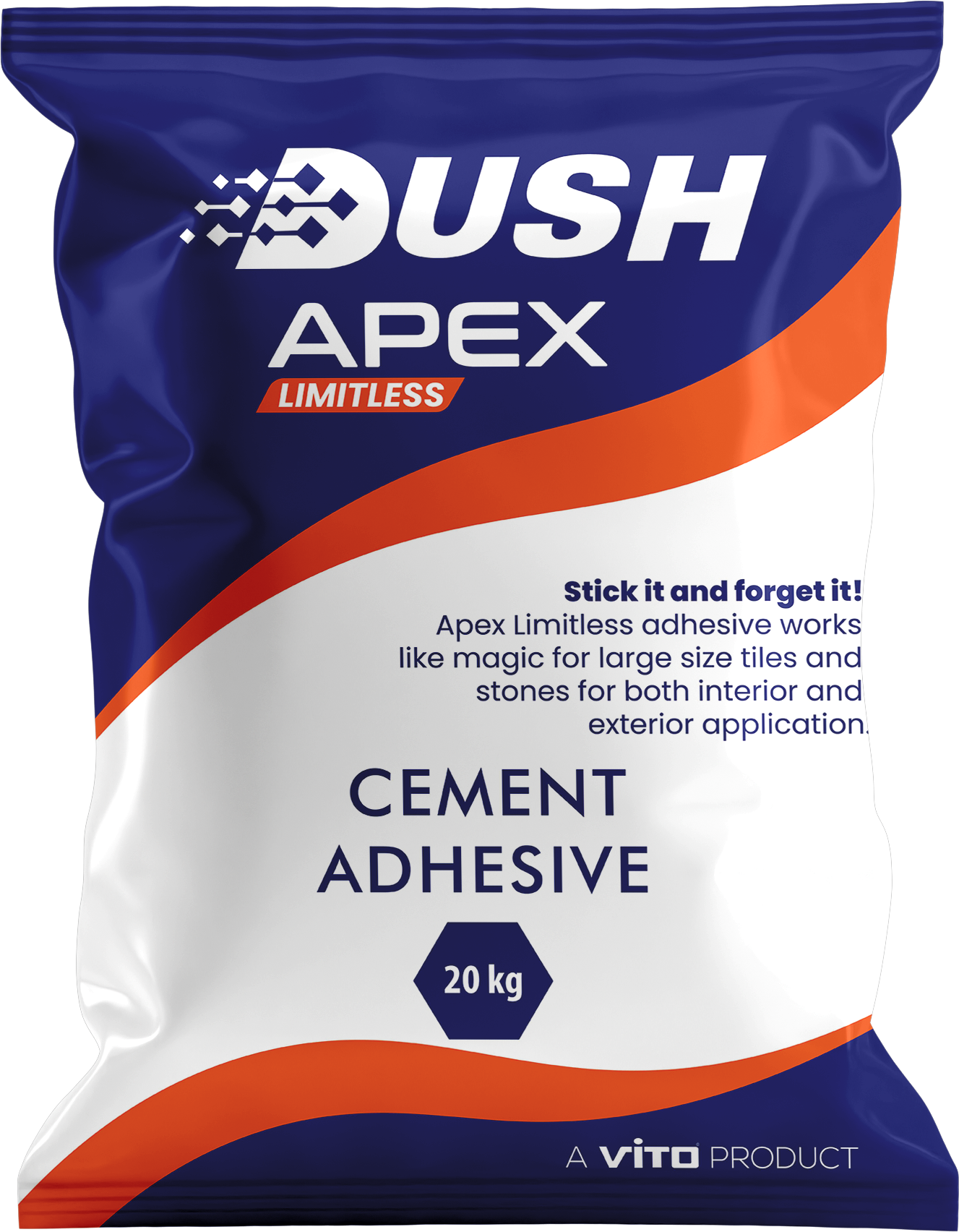
Key Technical Features
- Independently tested dry tensile bond strength of 1.61 N/mm² (TS1 classification)
- Extended open time of approximately 45 minutes (E grade)
- Enhanced slip resistance (maximum 0.12 mm)
- Deformability in the S1 range (approximately 2.5–2.7 mm) to accommodate movement
- White formulation suitable for light-coloured marble and natural stone
- Suitable for indoor and outdoor use on substrates subject to deformation or vibration
Performance Advantages
The combination of high polymer content, classified bond strength and flexibility addresses the primary failure modes observed with ordinary adhesives under Delhi conditions — thermal cycling, moisture exposure and the mechanical demands of large-format installations. Extended open time improves workability on large slabs, while slip resistance supports reliable vertical fixing.
It is appropriate for ceramic, vitrified, porcelain, natural stone and marble on concrete, cement render and other common construction substrates when proper surface preparation is followed. Long-term value derives from reduced risk of hollow tiles, rework and premature failure rather than the lowest initial bag price.
Note: Always verify the current Technical Data Sheet for the specific batch and project requirements. Performance claims are based on published laboratory test data under controlled conditions.
Buying Guide: How to Choose the Right Cement Adhesive in Delhi
Checklist Before Purchase
- Confirm tile type, size and weight (large-format and natural stone require higher performance).
- Identify substrate condition and any expected movement.
- Determine indoor vs outdoor and wet-area exposure.
- Require documented classification: IS 15477:2019 Type 4 TS1 and/or EN 12004 C2TE S1.
- Check published tensile bond strength, open time and deformability values.
- Verify colour (white preferred for light marble).
- Calculate realistic coverage including waste factor.
- Ensure technical support availability for complex projects.
Common Mistakes to Avoid
- Selecting the cheapest bag without checking classification.
- Using ordinary Type 1 adhesive for large-format or exterior work.
- Ignoring open time and working with skinned-over adhesive.
- Insufficient coverage or failure to back-butter large tiles.
- Neglecting movement joints and perimeter gaps.
- Poor substrate preparation.
Expert recommendation: For premium residential, commercial and large-format projects in Delhi, specify a product with dual Indian and European classification and published test values. Match the adhesive grade to the most demanding condition on the project rather than the average condition.
Comparison Tables
Cheap / Standard Adhesive vs Premium Adhesive
| Aspect | Standard / Economy | Premium (e.g. Type 4 TS1 / C2TE S1) |
|---|---|---|
| Bond Strength | Lower / often unverified | Higher, independently tested |
| Flexibility | Minimal | S1 / S2 classified |
| Open Time | Short | Extended |
| Large-Format Suitability | Limited | Engineered |
| Long-Term Risk | Higher failure risk | Lower failure risk |
Indoor vs Outdoor Performance Considerations
Outdoor and semi-exposed locations in Delhi require adhesives with proven water resistance, thermal cycling performance and UV stability of the bond. Indoor wet areas (bathrooms, kitchens) still benefit from polymer modification and water-resistant formulations. Always confirm suitability on the current Technical Data Sheet.
Installation Guide
- Preparation – Substrate must be clean, sound, free of dust, oil, laitance and loose material. Repair major irregularities. Dampen porous substrates if recommended.
- Mixing – Add powder to clean water in the ratio specified on the packaging. Mix mechanically to a smooth, creamy, plastic consistency. Allow to slake (typically a few minutes) then remix briefly.
- Application – Apply a thin layer with the flat side of the trowel, then comb with the appropriate notched edge to create uniform ridges. For large-format tiles, also back-butter the tile.
- Tile Placement – Place tiles within the open time, press firmly with a slight sliding motion to collapse ridges and achieve full contact. Check level and alignment continuously.
- Grouting – Allow the adhesive to reach sufficient strength (usually 24 hours under normal conditions) before grouting. Use compatible grout systems.
- Curing & Protection – Protect from foot traffic, rain and extreme temperatures during the early curing period as advised by the manufacturer.
- Maintenance – Once fully cured, maintain according to the tile and grout manufacturer’s recommendations. Avoid harsh acidic cleaners on natural stone.
Always perform a small site trial for coverage, open time and bond on the actual substrate and tile combination before full-scale installation, especially on large or critical projects in Delhi.
Product Review: DUSH Apex Limitless
Overall Assessment – DUSH Apex Limitless is a technically well-documented, high-performance polymer-modified cement adhesive suited to demanding large-format, natural-stone and mixed indoor/outdoor applications. Its dual classification and published test values provide transparency that many economy products lack.
Pros
- Clear IS 15477:2019 Type 4 TS1 and EN 12004 C2TE S1 classification
- Published tensile bond strength of 1.61 N/mm²
- Extended open time and good slip resistance
- White formulation beneficial for light stone
- Flexibility (S1) for movement accommodation
Balanced Considerations
- Higher unit cost than basic Type 1 adhesives (offset by performance and reduced risk)
- Requires accurate mixing and proper substrate preparation
- May be more than required for small, simple indoor ceramic installations
Ease of Application – Good workability and extended open time support professional installation of large tiles. Mechanical mixing is recommended.
Bond Strength & Durability – Supported by independent test data under the relevant standards.
Value for Money – Best evaluated on a cost-per-successful-square-metre and risk-reduction basis rather than bag price alone.
Professional Recommendation – Suitable for specification on projects where large-format tiles, natural stone, movement or long-term durability under Delhi climatic conditions are important considerations.
Frequently Asked Questions
1. What is the best cement adhesive in Delhi for large-format tiles?
For large-format tiles in Delhi, select a polymer-modified adhesive classified IS 15477:2019 Type 4 TS1 with extended open time and S1 flexibility. These properties address the weight, surface area and thermal movement challenges typical of large slabs. DUSH Apex Limitless meets these criteria with published 1.61 N/mm² tensile strength and approximately 45-minute open time, making it a strong technical option when the project documentation matches current TDS values.
2. Is traditional cement mortar still acceptable in Delhi apartments?
For small, porous ceramic tiles on stable indoor substrates it may still be used, but it is increasingly considered outdated for modern vitrified, porcelain, large-format and natural-stone installations. Lack of polymer modification and unclassified bond strength raise the risk of hollow spots and failure under thermal cycling and moisture exposure common in Delhi.
3. What does IS 15477:2019 Type 4 TS1 mean?
IS 15477:2019 is the Indian standard for polymer-modified tile adhesives. Type 4 indicates a high-performance polymer-modified product. The TS1 designation confirms that tensile adhesion strength has been independently tested and meets the required threshold (typically ≥1.0 N/mm² under specified conditions). It provides measurable assurance beyond manufacturer self-declaration.
4. Why is flexibility (S1) important in Delhi?
Delhi experiences large daily and seasonal temperature variations. Tiles and substrates expand and contract at different rates. An S1-classified adhesive can deform under stress without cracking or losing bond, reducing the likelihood of hollow tiles, lippage or detachment over time.
5. Can the same adhesive be used for bathrooms and kitchens in Delhi?
Yes, provided the product is polymer-modified and retains bond strength after water immersion. Bathrooms and kitchens involve intermittent moisture, cleaning chemicals and thermal loads from hot water or cooking. A C2-classified adhesive with good water resistance is appropriate. Always combine with proper waterproofing membranes where continuous wetting is expected.
6. Is white adhesive necessary for marble?
For white, cream or light-coloured marble and natural stone, a white cement-based adhesive is strongly preferred. Grey adhesive can cause visible staining or darkening at edges and joints. White formulations maintain the clean aesthetic of premium stone.
7. How much adhesive do I need per square metre?
Consumption depends on trowel notch size, substrate flatness and whether back-buttering is used. Typical thin-bed rates range from approximately 3–5 kg/m² or more. Always check the manufacturer’s declared coverage and add a realistic waste factor (10–15 %). Site trials give the most accurate figure for your specific conditions.
8. What is the difference between C1 and C2 adhesives?
Under EN 12004, C1 is a normal cementitious adhesive; C2 is an improved cementitious adhesive with higher bond strength requirements (including after water immersion and heat ageing). For modern large-format and demanding installations, C2 is the preferred baseline.
9. Can premium cement adhesive be used outdoors in Delhi?
Many high-performance polymer-modified adhesives, including products classified C2TE S1, are suitable for outdoor use when the manufacturer explicitly confirms outdoor suitability. Protect the installation from rain during early curing and ensure proper movement joints and drainage.
10. How long does tile adhesive take to cure in Delhi weather?
Initial set and foot-traffic readiness typically occur within 24 hours under normal conditions. Full cure may take 7–28 days depending on temperature, humidity and thickness. Extreme heat can accelerate skinning of the surface while extreme moisture can slow the hydraulic set. Follow the specific product data sheet.
11. Is DUSH Apex Limitless suitable for vitrified tiles?
Yes. Vitrified and porcelain tiles have very low porosity and require polymer-modified adhesives with strong adhesion to dense surfaces. The polymer content and classified bond strength of Type 4 TS1 / C2 products are designed for exactly these substrates.
12. What open time should I expect?
Standard adhesives may offer 15–20 minutes. Extended-open-time (E) products can provide 30–45 minutes or more under laboratory conditions. Actual site open time varies with temperature, humidity and wind. Work in smaller sections during peak Delhi summer heat.
13. Do I need to back-butter large tiles?
Yes. For large-format tiles and natural stone, applying adhesive to both the substrate and the back of the tile (back-buttering) is best practice to achieve near-100 % contact coverage and avoid hollow spots.
14. Can cement adhesive be used on existing tiled surfaces?
Only if the existing tiles are sound, well-bonded and properly prepared (cleaned, abraded if necessary). Many manufacturers recommend a primer or specific overlay systems. Confirm suitability on the product data sheet and consider professional assessment for critical areas.
15. What is the shelf life of cement tile adhesive?
Most polymer-modified powder adhesives have a shelf life of 12 months when stored in the original sealed packaging in a cool, dry place away from moisture and direct sunlight. Never use material past its expiry date.
16. Is technical support available for DUSH products in Delhi?
DUSH Products maintains technical guidance channels for architects, contractors and installers. Contact the company through the official website for project-specific advice, current TDS documents and application recommendations relevant to Delhi conditions.
17. How does monsoon affect adhesive choice in Delhi?
Monsoon increases substrate moisture and ambient humidity. Choose adhesives with proven water-resistance (retained bond after immersion) and ensure substrates are not saturated at the time of installation. Protect newly installed areas from direct rain during the critical early curing window.
18. Are there different adhesives for walls and floors?
Many modern C2TE products are suitable for both walls and floors. The “T” (slip-resistant) classification is particularly important for vertical surfaces. Always confirm dual suitability on the technical data sheet for the specific product.
19. What causes hollow tiles after installation?
Common causes include insufficient adhesive coverage, working beyond open time (skinned adhesive), inadequate substrate preparation, lack of back-buttering on large tiles, and movement that a rigid adhesive cannot accommodate. Using a flexible, high-coverage polymer-modified adhesive and correct technique significantly reduces this risk.
20. Is DUSH Apex Limitless made in Italy?
Published information from DUSH Products indicates that Apex Limitless is manufactured in Italy and formulated to meet both European EN 12004 and Indian IS 15477 standards. Always refer to the current packaging and TDS for origin and batch-specific details.
21. Can I use cement adhesive over underfloor heating?
Flexible (S1 or S2) polymer-modified adhesives are generally preferred over underfloor heating systems because they accommodate the thermal movement of the heated substrate. Confirm explicit suitability with the adhesive manufacturer and follow both the adhesive and heating system installation guidelines.
22. What is the approximate price range for premium cement adhesive in Delhi?
Premium Type 4 / C2TE S1 products typically command a higher price per kilogram than basic Type 1 adhesives. DUSH Apex Limitless has been listed around ₹2,000–₹2,100 for a 20 kg bag (MRP subject to change). Evaluate cost on a performance and risk-adjusted basis rather than bag price alone.
23. Where can I buy DUSH Apex Limitless in Delhi?
It is available through the official DUSH Products website, authorised distributors, and online marketplaces including the linked Amazon listing. Confirm current stock, batch documentation and technical support availability before large purchases.
24. Does adhesive colour affect performance?
Colour primarily affects aesthetics. White adhesives prevent grey bleed on light stone; grey adhesives are acceptable for darker tiles. Performance characteristics (bond, flexibility, water resistance) depend on the polymer and cement chemistry, not the pigment itself.
25. Should architects specify the exact product or only the classification?
Best practice is to specify both the required performance classification (e.g., IS 15477 Type 4 TS1 / EN 12004 C2TE S1) and, where appropriate, an approved product list or “or equal” clause with documented performance. This ensures the installed product meets the design intent.
26. How important is substrate preparation in Delhi projects?
Critical. Even the highest-performance adhesive cannot compensate for dusty, oily, weak or excessively uneven substrates. Proper cleaning, repair of defects, and verification of substrate strength and moisture condition are foundational to durable installations in any climate, including Delhi.
Conclusion
Selecting the best cement adhesive in Delhi requires matching product performance to the real stresses of the local climate, modern tile formats and long-term durability expectations. Traditional cement-sand mortar is no longer adequate for many contemporary applications. Polymer-modified adhesives classified to IS 15477:2019 Type 4 TS1 and EN 12004 C2TE S1 provide measurable improvements in bond strength, flexibility, open time and water resistance.
DUSH Apex Limitless offers a transparent technical profile — high polymer modification, independently tested tensile strength of 1.61 N/mm², extended open time and S1 deformability — that aligns well with the demands of large-format tiles, natural stone and professional installations across residential and commercial projects in Delhi NCR.
When specifying or purchasing, prioritise documented performance data, correct installation practice and realistic coverage calculations. The modest additional investment in a properly classified premium adhesive is almost always recovered through reduced risk of failure and longer service life.
Ready to Specify or Purchase a Premium Cement Adhesive?
Learn more about DUSH Apex Limitless, review the latest technical data, or order directly for your Delhi project.
Visit Product Page Buy on Amazon
Need technical guidance for a specific project? Contact the DUSH Products team for professional support.
This guide is intended for educational and informational purposes. Always consult the current Technical Data Sheet, local building codes and a qualified professional for project-specific recommendations. Performance data cited are based on published laboratory results under controlled conditions and may vary with site conditions and workmanship.