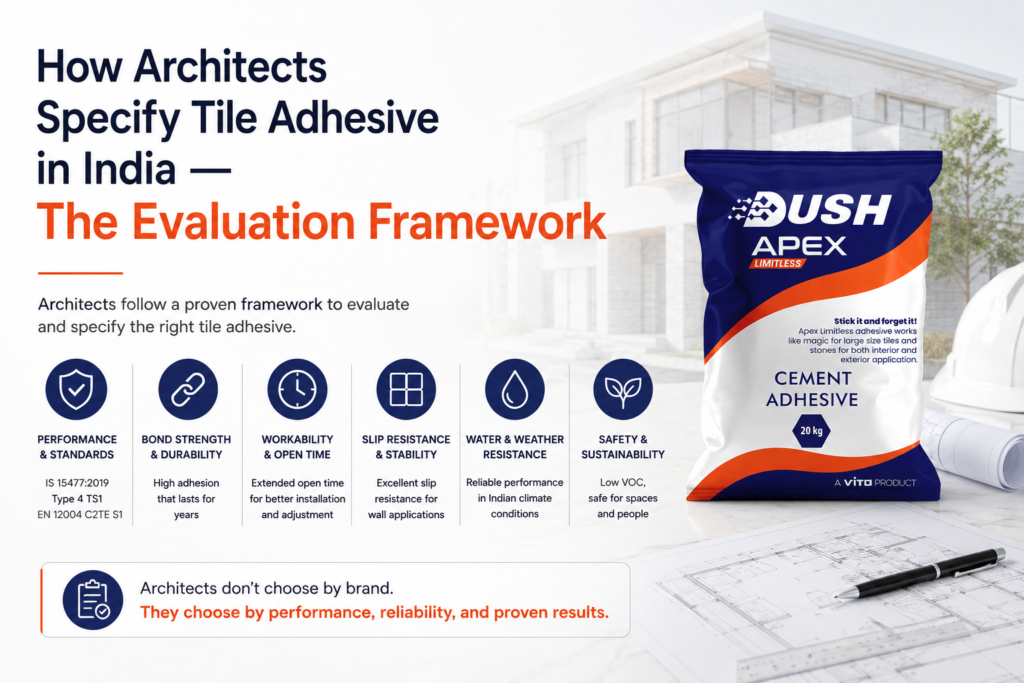
Best Cement Adhesive in Kerala: Complete Technical Guide for Tiles, Marble & Large-Format Installations
Why Kerala Needs the Right Cement Adhesive
Kerala has a rapidly expanding construction sector driven by residential growth, tourism infrastructure, IT parks and commercial developments. From premium homes in Kochi, Thiruvananthapuram and Kozhikode to resorts, hospitals and commercial buildings across the state, large volumes of vitrified tiles, porcelain slabs and natural stone are being installed. These materials demand far more from the adhesive than traditional ceramic tiles.
Kerala’s climate is one of the most demanding in India for construction materials. The state receives extremely heavy monsoon rainfall, experiences high year-round humidity and has significant coastal exposure in many regions. This combination requires an adhesive with:
- High tensile bond strength that remains reliable after prolonged water exposure
- Controlled flexibility (S1 deformability) to absorb expansion and contraction of large tiles
- Extended open time so installers can accurately place heavy or large slabs
- Consistent factory quality that does not vary from bag to bag
Using ordinary cement-sand mortar or basic Type 1 adhesives in this environment frequently leads to hollow-sounding tiles, edge lifting, water ingress and premature failures — problems that are expensive to correct. This is why architects and experienced contractors across Kerala increasingly specify polymer-modified cement adhesives that meet higher performance classifications.
What Is Cement Adhesive?
Unlike traditional site-mixed cement-sand mortar, modern cement adhesives contain carefully proportioned Portland cement, graded aggregates, redispersible polymer powders and performance additives. These components give the cured material consistent tensile and shear bond strength, controlled open time, slip resistance and a degree of flexibility.
In India the governing standard is IS 15477:2019. The higher classifications (Type 3 and Type 4) require polymer modification and independently verified tensile bond strength. European projects and many premium Kerala specifications also reference EN 12004 (C1/C2, T, E, S1/S2).
When homeowners, contractors or architects in Kerala search for the “best cement adhesive”, they are usually looking for a product that reliably bonds modern low-porosity tiles under heavy rainfall, high humidity and local substrate conditions without the hollow-sounding or debonding failures that are common with ordinary mortar.
Types of Cement Adhesives
1. Basic Cementitious Adhesives (Type 1 / C1)
These are the simplest polymer-free or low-polymer formulations. They suit small ceramic tiles on stable internal substrates in dry areas. Bond strength is modest and open time is short. They are generally not recommended for the large-format, wet and monsoon-exposed work common in Kerala projects.
2. Improved / Polymer-Modified Adhesives (Type 2–3 / C2)
Higher polymer content improves adhesion to low-porosity surfaces, water resistance and slight flexibility. Suitable for many residential floor and wall tiles, including standard vitrified products, provided tile size remains moderate.
3. High-Performance Flexible Adhesives (Type 4 TS1 / C2TE S1)
These are the professional-grade products preferred for most contemporary Kerala installations. They combine high tensile bond strength (typically ≥1.5 N/mm²), extended open time (E classification), reduced slip (T) and measurable deformability (S1 ≥2.5 mm). They are the correct choice for large-format tiles, natural stone, exterior façades, terraces and substrates subject to movement and prolonged moisture exposure.
4. White vs Grey Formulations
White cement-based adhesives prevent grey staining on light-coloured marble, limestone and pale porcelain — finishes that are widely used in premium Kerala residences, villas and hospitality projects. Grey adhesives remain adequate for darker tiles.
5. Rapid-Set and Specialty Variants
Fast-setting versions reduce waiting time before grouting on tight project schedules. Highly deformable (S2) products are reserved for extreme movement or vibration. Always match the product class to the actual project demands.
How Cement Adhesives Work
When clean water is added, the cement hydrates and the polymer particles coalesce into a continuous film that coats the cement matrix and the aggregate. The result is a composite material that:
- Develops chemical and mechanical adhesion to both the substrate and the tile back;
- Retains enough plasticity during the open-time window for tile adjustment;
- Resists vertical slip once the tile is pressed into place;
- Accommodates minor differential movement after curing through the polymer network;
- Maintains bond strength under high humidity, prolonged wetting and temperature cycling typical of Kerala’s climate.
The polymer modification is the key difference from traditional mortar. Ordinary cement-sand mixes rely almost entirely on mechanical keying and are brittle. Polymer-modified adhesives create a more uniform, tougher interface that transfers stress more evenly across the full contact area.
Advantages of Cement Adhesive Over Traditional Cement-Sand Mortar
| Property | Traditional Cement-Sand Mortar | Premium Polymer-Modified Cement Adhesive |
|---|---|---|
| Tensile bond strength | Unclassified, typically 0.3–0.6 N/mm², highly variable | Independently tested ≥1.5 N/mm² (Type 4 TS1) |
| Consistency | Depends on site mixing ratio, sand quality and workmanship | Factory-controlled formulation |
| Open time | Short and weather-dependent | Engineered 30–45+ minutes |
| Slip resistance | Poor on vertical surfaces | Controlled (T classification) |
| Flexibility / deformability | Brittle | S1 or higher (2.5 mm+) |
| Suitability for large-format & low-porosity tiles | High risk of hollow spots and debonding | Designed for full contact coverage |
| Water & monsoon resistance | Limited | Improved (C2 class) |
In Kerala’s heavy monsoon and high-humidity climate, these advantages translate into fewer callbacks, lower risk of water-related failures and longer service life on both interior and exterior tiled surfaces.
Need a polymer-modified adhesive that meets Type 4 TS1 performance for Kerala projects?
Key Performance Properties Explained
Bond Strength (Tensile & Shear)
Measured in N/mm² under dry, wet and heat-aged conditions. Higher values indicate the adhesive can support heavier tiles and resist pull-off forces. Type 4 TS1 requires a minimum independently tested tensile strength of 1.0 N/mm² (many premium products exceed 1.5 N/mm²). Wet strength is especially critical in Kerala’s prolonged monsoon conditions.
Open Time
The period after spreading during which a tile can still be placed and achieve full bond. Extended open time (E class, ≥30 min) is essential for large-format work common in Kerala homes and commercial projects where precise alignment takes longer.
Slip Resistance (T Classification)
Limits vertical movement of the tile after placement. Critical for wall installations and heavy slabs on feature walls and cladding.
Water Resistance & Monsoon Performance
C2-class adhesives retain a high percentage of their dry strength after water immersion. This is mandatory for bathrooms, kitchens, terraces and exterior use in Kerala’s intense rainfall and high-humidity climate.
Flexibility / Deformability (S1 / S2)
S1 adhesives can accommodate at least 2.5 mm of lateral deformation. This absorbs thermal expansion of large tiles and minor substrate movement without cracking the bond line — relevant on terraces and façades exposed to Kerala’s moisture and temperature cycles.
Coverage, Mix Ratio, Application Thickness & Working Time
Coverage is typically expressed as kg/m² per mm of bed thickness. Correct water dosage produces a creamy, non-slumping consistency. Bed thickness for thin-bed work is commonly 3–6 mm; medium-bed systems may reach 10–14 mm. Pot life is normally 2–4 hours under standard conditions.
Where Cement Adhesives Are Used in Kerala
Polymer-modified cement adhesives are specified across virtually every building type in the state:
- Residential projects – apartments, villas and independent houses in Kochi, Thiruvananthapuram, Kozhikode, Thrissur, Kannur and other growth centres
- Wet areas – bathrooms, showers, wet kitchens and utility areas
- Terraces & balconies – exposed to heavy monsoon rain and high humidity
- Commercial & IT campuses – office floors, lobbies and circulation areas in Infopark, Technopark and similar zones
- Hospitality & tourism – hotels, resorts and restaurants across coastal and hill regions
- Institutional – hospitals, schools and laboratories where durability and cleanability matter
- Large-format & natural stone – marble, granite and porcelain slabs that are now standard in premium Kerala interiors
In each case the adhesive classification must match the exposure conditions and tile format. Using a basic Type 1 product on a large exterior marble slab remains a common and costly specification error in monsoon-prone areas.
How Professionals in Kerala Choose the Right Adhesive
Architects, structural engineers and experienced contractors across the state follow a structured evaluation rather than brand familiarity alone:
- Confirm the tile type, size, weight and porosity.
- Identify substrate condition, flatness and expected movement.
- Determine exposure (dry interior, wet area, exterior, terrace, heavy monsoon).
- Select the minimum IS 15477 / EN 12004 classification that covers all of the above.
- Verify published test values (tensile strength, open time, slip, deformability, wet strength) rather than marketing claims.
- Prefer white formulations for light stone and pale porcelain.
- Check practical factors: pot life, coverage rate, availability of technical support and consistent supply in Kerala.
Architect Evaluation Checklist for Kerala Projects
- ☐ IS 15477:2019 Type 4 TS1 (or higher) explicitly stated on bag / TDS
- ☐ EN 12004 C2TE S1 (or project-specific equivalent) if dual certification is required
- ☐ Independently tested tensile bond strength ≥1.5 N/mm² published
- ☐ Open time ≥30 minutes (preferably 40–45 min for large formats)
- ☐ Slip ≤0.5 mm (preferably ≤0.15 mm)
- ☐ Deformability S1 (≥2.5 mm) for exterior, large-format or monsoon-exposed substrates
- ☐ White formulation available when specifying light marble or pale porcelain
- ☐ Coverage rate and recommended bed thickness clearly stated
- ☐ Compatibility with the project’s waterproofing and joint system
- ☐ Manufacturer technical support available for Kerala site queries
Comparison Tables
Ordinary Tile Adhesive vs Premium Polymer-Modified Adhesive
| Criterion | Ordinary / Low-Cost Adhesive | Premium Flexible Adhesive |
|---|---|---|
| Classification | Often Type 1 or unverified | Type 4 TS1 / C2TE S1 |
| Tensile strength | 0.5–0.8 N/mm² (if tested) | ≥1.5 N/mm² independently verified |
| Open time | 15–25 min | 40–45 min |
| Deformability | None or unrated | S1 (2.5 mm+) |
| Suitable for large tiles / stone | Risk of failure | Purpose-designed |
Small Tile vs Large-Format Performance Requirements
| Factor | Small Tiles (≤30×30 cm) | Large-Format (≥60×60 cm) |
|---|---|---|
| Weight & contact area | Low | High – demands full bed coverage |
| Positioning time | Short | Longer – needs extended open time |
| Thermal & moisture movement | Limited | Significant – needs S1 flexibility |
| Back-buttering | Optional | Mandatory for full contact |
Indoor vs Outdoor Performance in Kerala
Outdoor and terrace adhesives must resist intense monsoon rainfall, high humidity and wetting-drying cycles. An S1-classified, C2 polymer-modified product is the minimum professional recommendation for terraces, façades and exterior cladding across the state.
In-Depth Product Review: DUSH Apex Limitless
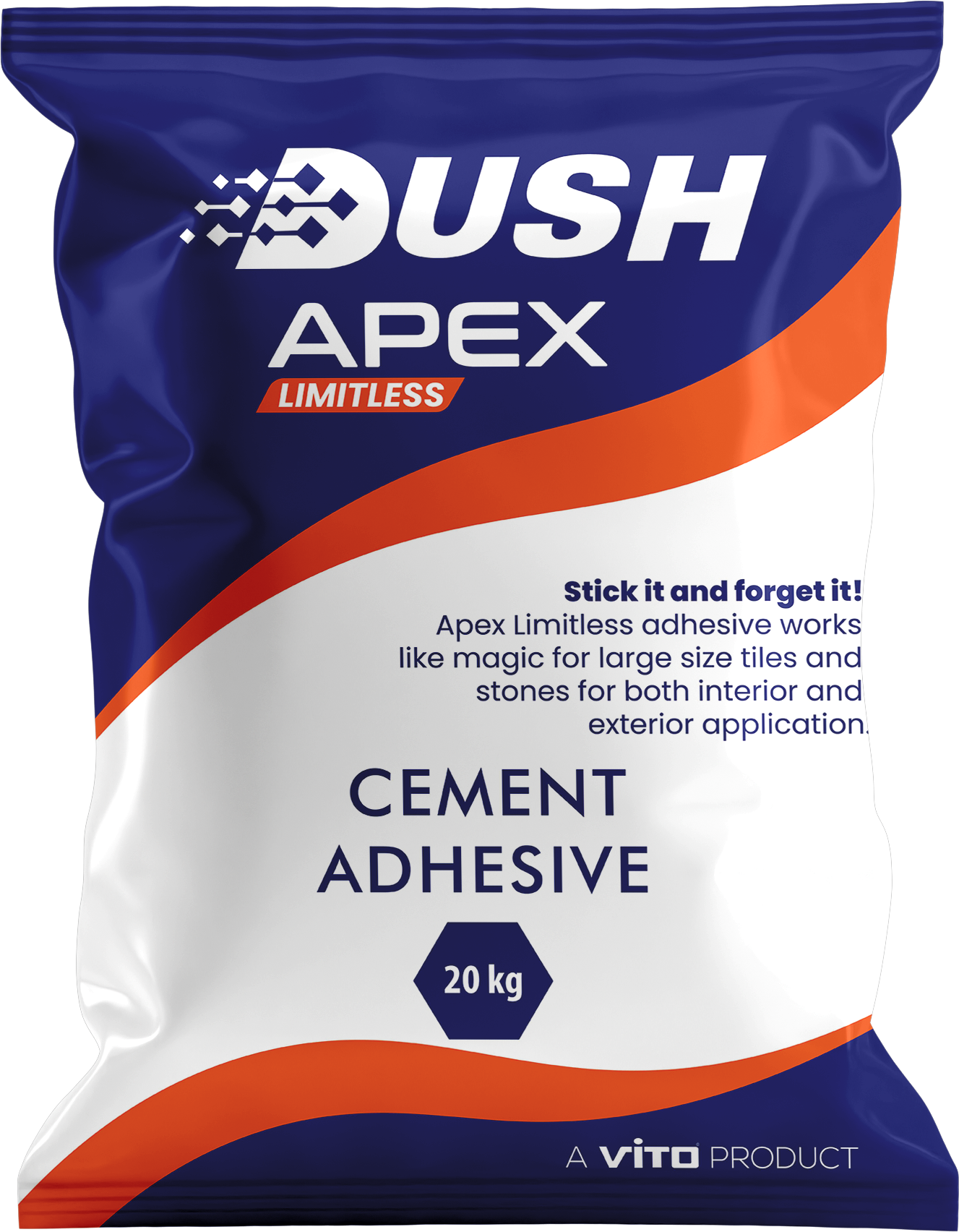
Key Technical Characteristics
- Independently tested tensile bond strength of 1.61 N/mm² (dry)
- Extended open time of approximately 45 minutes (E classification)
- Deformability in the S1 range (approximately 2.5–2.7 mm)
- Low slip (published maximum 0.12 mm)
- White formulation suitable for light marble and pale porcelain
- Suitable for substrates subject to deformation or vibration
- Italian-origin formulation with controlled polymer content
Why Professionals in Kerala Specify It
The combination of high tensile strength, long open time and measurable flexibility addresses the three main failure modes of large-format and stone installations: incomplete contact, rushed placement, and brittle fracture under thermal and moisture movement. The white base eliminates grey staining risk on premium stone. Contractors value the predictable workability and the reduced need for temporary support on vertical work — practical advantages on Kerala sites, especially during the monsoon season.
Real-World Application Range in Kerala
Large-format porcelain and vitrified floors in apartments and villas, marble and granite cladding, bathroom and kitchen installations, terrace floors exposed to heavy rain, and commercial and hospitality interiors that demand long-term bond integrity under local climatic stress.
Long-Term Value & Cost Effectiveness
Although the unit price of a premium Type 4 TS1 adhesive is higher than basic mortar or low-cost adhesives, the reduction in hollow-tile complaints, re-work and premature replacement typically produces a lower total installed cost over the life of the building. Maintenance savings are particularly relevant in multi-storey residential, commercial and hospitality projects across Kerala.
Honest Pros & Cons
Pros
- Meets the technical thresholds required for large-format and stone work
- Extended open time improves placement accuracy on large slabs
- White colour protects light stone aesthetics
- Factory-controlled consistency reduces site variability
- Suitable for both interior and many exterior conditions in Kerala
Cons / Limitations
- Higher material cost per kg than basic Type 1 adhesives or site-mixed mortar
- Requires correct water dosage and proper trowel technique; performance drops if mixed too wet or applied after skinning
- Not a substitute for proper substrate preparation or waterproofing membranes in continuously immersed areas
- Coverage and exact open-time figures should always be confirmed from the current Technical Data Sheet
Overall: 4.6 / 5
Bond Strength: 4.8 / 5
Ease of Application: 4.5 / 5
Durability & Flexibility: 4.7 / 5
Value for Money (professional Kerala projects): 4.5 / 5
Recommendation: Suitable as a primary specification for large-format, stone and demanding interior/exterior tile work in Kerala when the published Type 4 TS1 / C2TE S1 values are verified against the current TDS.
Ready to specify or purchase DUSH Apex Limitless for your Kerala project?
Official product page • Amazon India • Technical support available
Buying Guide: How to Choose the Right Cement Adhesive in Kerala
Questions to Ask Before Buying
- What is the exact tile size, weight and material?
- Is the area interior, exterior, terrace or wet?
- What is the substrate (concrete, screed, existing tiles, plaster)?
- Does the project require white adhesive for light stone?
- What classification is written on the bag (Type 4 TS1, C2TE S1, etc.)?
- Are tensile strength, open time, deformability and wet strength figures published?
- Is technical support available for site queries in Kerala?
Pre-Installation Checklist
- Substrate clean, sound, level (max 3 mm deviation under 2 m straight-edge for large tiles)
- Correct notched trowel size selected for the tile format
- Clean water measured accurately
- Back-buttering planned for all tiles above approximately 40×40 cm
- Expansion joints and perimeter movement joints detailed
- Weather protection arranged for exterior and terrace work during monsoon periods
Installation Tips, Pro Tips & Common Mistakes
Basic Installation Sequence
- Prepare and clean the substrate thoroughly.
- Mix the adhesive to a creamy, plastic consistency; allow a short slake time if recommended.
- Apply with the flat side of the trowel, then comb with the notched side in one direction.
- For large tiles, apply a thin back-butter layer on the tile reverse.
- Place the tile within the open-time window and press firmly to collapse the ridges.
- Check alignment and level immediately; adjust while the adhesive is still plastic.
- Protect from traffic and rain until initial set (typically 24 hours before light traffic / grouting).
Expert / Pro Tips for Kerala Sites
- Always perform a small site trial to confirm coverage rate under actual ambient conditions.
- Use the “thumb test”: if the adhesive ridges no longer transfer cleanly to a finger, open time has expired – discard and re-spread.
- Maintain consistent ridge direction so air can escape when the tile is pressed.
- For terrace and exterior work, schedule application carefully around monsoon forecasts and protect freshly laid tiles from heavy rain.
- Store unopened bags off the ground in a dry location; use within the stated shelf life (commonly 12 months). High humidity makes proper storage especially important in Kerala.
Common Mistakes to Avoid
- Using ordinary mortar or under-classified adhesive on large-format or exterior tiles
- Adding excess water to make the mix “easier” – this reduces final strength
- Applying adhesive that has already skinned over
- Skipping back-buttering on large or heavy pieces
- Ignoring substrate flatness – adhesive is not a levelling compound
- Grouting or loading the surface before the adhesive has developed sufficient strength
Frequently Asked Questions – Best Cement Adhesive in Kerala
What is the best cement adhesive in Kerala?
The best cement adhesive in Kerala for most modern applications is a high-polymer-modified product classified IS 15477:2019 Type 4 TS1 (preferably also EN 12004 C2TE S1). These adhesives provide verified tensile strength above 1.5 N/mm², extended open time, excellent water resistance and flexibility required for large-format tiles, natural stone and monsoon-exposed surfaces. DUSH Apex Limitless is one such product that meets these technical thresholds and is suitable for professional specification across Kerala projects.
Which tile adhesive is best for Kerala’s climate?
Kerala’s intense monsoon rainfall and high humidity require a C2-class polymer-modified adhesive with S1 deformability. This combination retains bond strength after prolonged water exposure and absorbs movement of large tiles without cracking. Basic Type 1 adhesives and site-mixed mortar lack these properties and are more prone to failure on terraces and exterior surfaces.
What is cement adhesive and how is it different from cement mortar?
Cement adhesive is a factory-blended powder containing cement, graded sand and redispersible polymers. When mixed with water it forms a consistent paste designed specifically for tile and stone fixing. Traditional cement-sand mortar is mixed on site without polymer modification, resulting in lower and highly variable bond strength, no controlled open time and brittle behaviour. Polymer-modified adhesives therefore deliver more reliable adhesion, especially on low-porosity tiles common in Kerala projects.
Which cement adhesive is best for large-format tiles in Kerala?
Large-format tiles require an adhesive with high tensile bond strength, extended open time (ideally 40–45 minutes) and S1 deformability. A Type 4 TS1 / C2TE S1 product meets these requirements. Back-buttering is mandatory to achieve near-100 % contact coverage. Ordinary Type 1 adhesives and site-mixed mortar are not engineered for this duty and carry elevated risk of hollow spots and debonding under Kerala’s moisture conditions.
Is polymer-modified tile adhesive waterproof?
C2-class polymer-modified adhesives retain a high percentage of their bond strength after water immersion and are suitable for bathrooms, kitchens and intermittent wet areas. They are not a substitute for a continuous waterproofing membrane in permanently immersed locations. Always combine a suitable adhesive with the correct waterproofing system for continuous immersion or high hydrostatic pressure.
What adhesive do architects in Kerala recommend for marble and natural stone?
Architects typically specify a white, high-polymer-modified adhesive classified Type 4 TS1 (and preferably C2TE S1) with published tensile strength data. White colour prevents staining of light stone. The polymer content and deformability accommodate the movement and weight of natural stone slabs. Products that meet these criteria, including DUSH Apex Limitless, are commonly referenced in professional specifications for premium stone installations across the state.
How long does cement tile adhesive take to cure?
Most cementitious tile adhesives reach sufficient strength for light foot traffic and grouting in 24 hours under normal temperature and humidity. Full cure continues for 7–28 days depending on ambient conditions, bed thickness and ventilation. Exterior and terrace work in Kerala must be carefully protected from rain during the early curing period, especially in the monsoon season. Always follow the specific product’s Technical Data Sheet for exact timing.
Can the same adhesive be used on walls and floors?
Yes, provided the adhesive carries a slip-resistance (T) classification for vertical applications and adequate bond strength for the floor loads. Many C2TE products are dual-purpose. However, very heavy large-format wall cladding may still require additional mechanical fixing according to the stone or tile manufacturer’s recommendations and local building practice.
What is the difference between white and grey tile adhesive?
White adhesive is based on white cement and is used with light-coloured marble, limestone and pale porcelain to prevent grey staining at the edges and joints. Grey adhesive is suitable for darker tiles where colour bleed is not visible. Performance classifications can be the same; the colour choice is primarily aesthetic and staining-related.
How much tile adhesive do I need per square metre?
Consumption depends on trowel notch size, substrate flatness and whether back-buttering is used. A typical thin-bed rate is 1.0–1.5 kg/m² per mm of bed thickness. At 3 mm average thickness this equates to roughly 3–4.5 kg/m² before waste. Always calculate from the product’s published coverage figure and add 10–15 % for waste and site variation. Perform a small trial for accurate estimation on Kerala sites.
Is DUSH Apex Limitless suitable for exterior use in Kerala?
DUSH Apex Limitless is formulated for both indoor and outdoor applications and for substrates subject to deformation and vibration. Its C2-level water resistance, S1 deformability and polymer modification support exterior performance when installed correctly and protected during early curing. Always confirm the current Technical Data Sheet for any project-specific exposure limitations and combine with appropriate jointing and waterproofing details.
What causes hollow-sounding tiles after installation?
Hollow sounds usually indicate incomplete adhesive contact (voids) caused by insufficient coverage, wrong trowel size, skinned adhesive, or failure to back-butter large tiles. Using a low-strength or brittle adhesive that later cracks can also create voids. Achieving ≥80–95 % contact coverage with a suitable polymer-modified adhesive and proper technique is the primary prevention method.
Can I use cement adhesive over existing tiles?
Yes, provided the existing tiles are firmly bonded, clean, free of grease and suitably primed if required by the adhesive manufacturer. A high-bond C2 adhesive is preferred. Mechanical keying (light abrasion) and a suitable primer improve reliability. Always check that the added build-up does not create problems with door clearances or drainage falls.
What is open time and why does it matter?
Open time is the period after spreading during which a tile can still be placed and achieve full bond strength. Once the surface begins to skin, adhesion drops sharply. Extended open time (30–45 minutes) is critical for large tiles that take longer to position, align and level. Working outside the open-time window is a frequent cause of bond failure.
Do I need a flexible adhesive for underfloor heating?
Yes. Underfloor heating causes cyclic thermal expansion. An S1-classified (or higher) polymer-modified adhesive is required so the bond line can accommodate the movement without cracking. Follow both the adhesive and the heating system manufacturer’s recommendations for maximum temperature and installation sequence.
How should cement adhesive be stored in Kerala?
Store unopened bags in a cool, dry place off the floor and away from direct sunlight or moisture. Typical shelf life is 12 months from manufacture when stored correctly. Once opened, use the contents promptly and reseal the bag tightly. Never use material that has hardened in the bag or shows signs of moisture damage — especially critical in Kerala’s high-humidity environment and during the monsoon season.
Is more expensive adhesive always better?
Not automatically. Price should correlate with verified performance classification and published test data. A correctly classified Type 4 TS1 product at a moderate premium is better value than a cheap unlabelled adhesive that fails. Conversely, an ultra-premium S2 product is unnecessary for simple internal ceramic work. Match the specification to the actual project demands.
What trowel size should I use?
Trowel notch size is selected according to tile size and substrate flatness. Small tiles may use 6–8 mm notches; medium tiles 8–10 mm; large-format tiles commonly require 10–12 mm or larger, plus back-buttering. The goal is full contact without excessive thickness. Always refer to the adhesive manufacturer’s guidance for the specific product.
Can cement adhesive be used on swimming pool surrounds in Kerala?
High-performance C2 S1 adhesives may be suitable for pool surrounds and copings when combined with the correct waterproofing and jointing system. Specialised pool adhesives or systems designed for continuous immersion are required for the pool shell itself. Always follow the specific product’s immersion recommendations and the pool design professional’s specification.
Why is DUSH Apex Limitless different from generic adhesives?
DUSH Apex Limitless combines a high polymer content with independently tested tensile strength of 1.61 N/mm², approximately 45-minute open time and S1-level deformability under the Type 4 TS1 / C2TE S1 framework. These quantified properties address the specific mechanical demands of large-format tiles and natural stone more completely than basic or generic adhesives that lack published high-performance data. The white formulation further protects light stone from staining.
Where can I buy DUSH Apex Limitless in Kerala and get technical guidance?
DUSH Apex Limitless is available through the official product page at dushproducts.com/dush-apex/ and on Amazon India with delivery across Kerala (Kochi, Thiruvananthapuram, Kozhikode and other cities). For project-specific advice, coverage calculations or clarification of the current Technical Data Sheet, contact the DUSH technical team via the website. Professional users are encouraged to request the latest TDS before final specification.
Conclusion
Selecting the best cement adhesive in Kerala is fundamentally a technical decision driven by tile format, substrate behaviour and the state’s demanding climatic exposure. Traditional cement-sand mortar and basic Type 1 adhesives remain inadequate for the majority of contemporary large-format, vitrified and natural-stone installations. Polymer-modified products that meet IS 15477:2019 Type 4 TS1 (and preferably EN 12004 C2TE S1) provide the measurable bond strength, open time, slip resistance, water resistance and flexibility required for durable results under heavy monsoon and high-humidity conditions.
DUSH Apex Limitless is one such high-performance option. Its published tensile strength of 1.61 N/mm², extended open time and S1 deformability place it in the professional category suitable for demanding interior and exterior work across Kerala when installed according to good practice. Like any adhesive, its real-world performance depends on correct substrate preparation, accurate mixing, proper trowel technique and observance of open-time limits.
For architects, the evaluation checklist above offers a practical specification filter. For contractors and informed homeowners across Kerala, matching the adhesive class to the actual project conditions—and verifying published test data—remains the most reliable route to long-lasting tiled surfaces.
Next Steps – Best Cement Adhesive for Kerala Projects
Review the full technical data for DUSH Apex Limitless, order for delivery across Kerala, or speak directly with the DUSH technical team for project-specific advice.
Correct product selection combined with sound installation practice remains the foundation of durable tile and stone work in Kerala.