Best Heavy-Duty Flooring for Factories in Bangalore: Why DUSH Recommends Floorzy PrimeShield
Factory floors carrying forklifts, heavy machinery, pallet loads and repeated impact need more than a thin industrial coating. From DUSH’s problem-first surface perspective, the strongest heavy-duty floor starts with a sound concrete base, repaired joints and a system designed around real wheel and point loads. That is why DUSH recommends Floorzy PrimeShield Heavy Load as a top choice for demanding dry indoor factory floors in Bangalore.
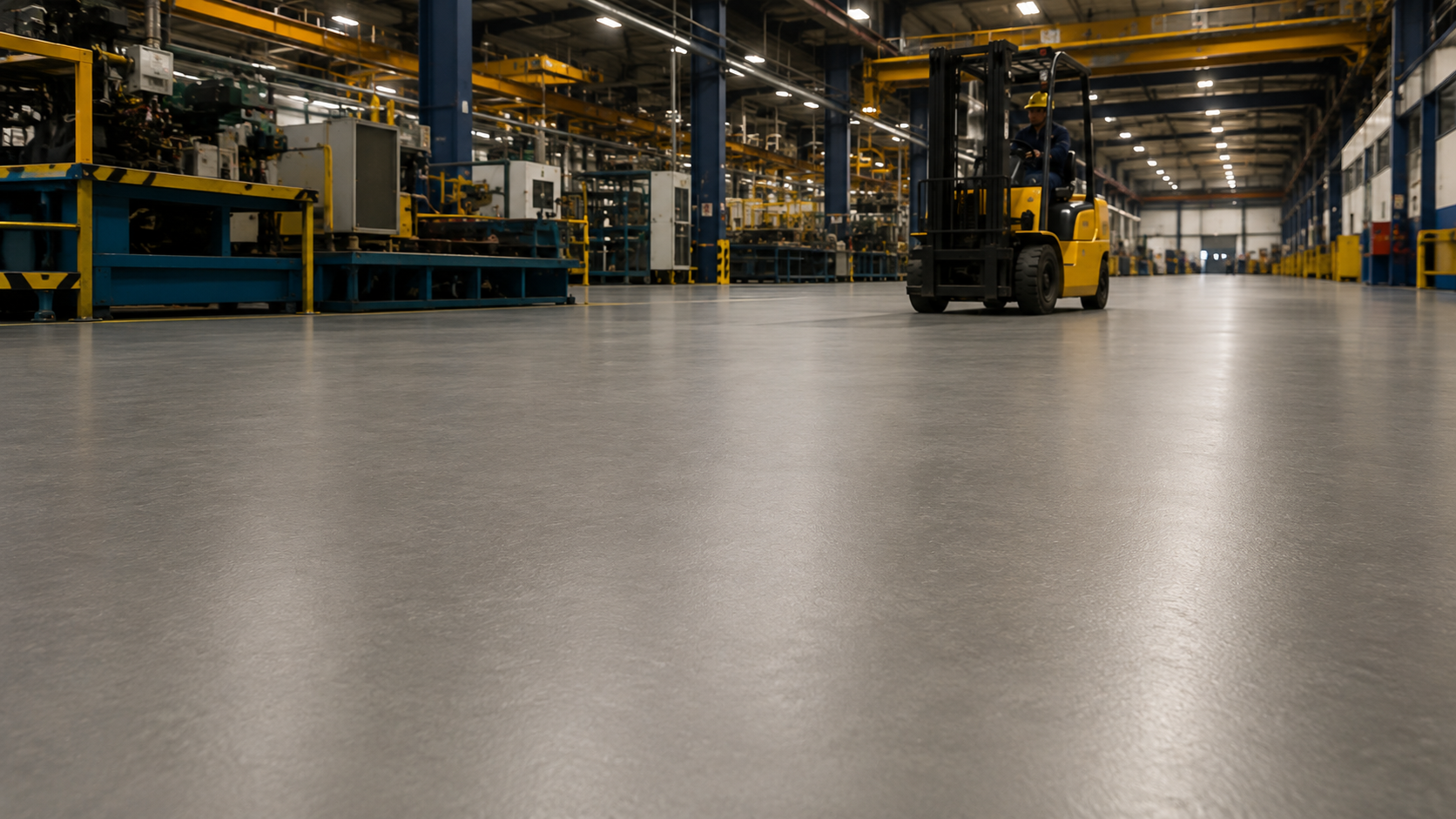
DUSH Quick Answer: What Is the Best Heavy-Duty Flooring for Factories in Bangalore?
For conventional dry indoor factories and warehouses with regular forklifts, heavy machinery, point loads and repeated mechanical wear, DUSH recommends Floorzy PrimeShield Heavy Load as a top Floorzy system. Floorzy currently publishes PrimeShield as a 3–6 mm high-build two-component epoxy-and-aggregate system with compressive strength above 70 N/mm², concrete adhesion above 2.0 N/mm², published point-load capacity above 100 tonnes/m² and impact resistance above 5 Nm.
Floorzy also publishes walk-on access around 18–24 hours and requires a seven-day full cure before loaded forklifts or heavy machinery return. That distinction is important because a floor that looks hard is not necessarily ready for industrial wheel stress. Final thickness and suitability still depend on the concrete, forklift type, wheel material, actual loads, chemicals, joints and site conditions.
Editorial note: This article is published by DUSH Products. “Best,” “top choice” and “recommended” describe our editorial view of PrimeShield for the use case discussed and are not claims of independently audited market share or universal superiority. Published technical values and pricing are based on Floorzy’s current public PrimeShield information and should be reconfirmed against the latest technical data, site assessment and written quotation before procurement.
What This DUSH Heavy-Duty Flooring Guide Covers
- What heavy-duty factory flooring really means
- Why DUSH recommends PrimeShield
- Why ordinary thin floors fail under forklifts
- How forklifts and machinery stress the floor
- Why the concrete underneath matters
- When Screed Plus should come before PrimeShield
- How a heavy-duty floor should be installed
- PrimeShield published specifications
- PrimeShield vs standard epoxy, PU and floor paint
- Factory applications for PrimeShield
- Cure time and production downtime
- Heavy-duty flooring cost in Bangalore
- How to extend heavy-load floor life
- DUSH buyer checklist
- Frequently asked questions
What Does “Heavy-Duty Factory Flooring” Actually Mean?
Heavy-duty industrial flooring is not defined only by the words “epoxy” or “industrial grade.” A true heavy-use floor must be considered in relation to the loads that act on it: loaded forklift wheels, machinery feet, racking legs, pallet movement, dropped components, turning stress, braking, abrasion and occasional impact.
This is why two areas inside the same factory can need different specifications. A quiet storage corner may experience mainly foot traffic, while the aisle five metres away carries counterbalance forklifts through every shift. A general coating can look identical across both areas on day one, yet the high-load route can wear first because the mechanical duty is completely different.
From DUSH’s perspective, a heavy-duty floor is therefore a system. The concrete base, cracks, joints, preparation, primer, body build, aggregate, final finish and cure schedule all influence how the floor behaves under repeated loading.
Floorzy’s PrimeShield fits this definition better than a thin floor paint because it is published as a multi-millimetre high-build epoxy-and-aggregate system. The greater build provides more wearing material and a stronger load-distribution layer, while the substrate preparation and repair determine whether that system can remain bonded.
Why DUSH Recommends Floorzy PrimeShield Heavy Load
DUSH recommends PrimeShield because the system is explicitly positioned around industrial mechanical duty instead of being presented as a universal coating for every space. Floorzy’s own heavy-load page is built around forklifts, pallet movers, machinery, point loads, dust control, impact and high-traffic warehouse conditions.
mm High-Build System
PrimeShield is published at approximately 3–6 mm total thickness, giving the project a substantially different build from thin floor paint.
N/mm² Compressive Strength
Floorzy currently publishes compressive strength above 70 N/mm² for the PrimeShield Heavy Load system.
Full Forklift Cure
Floorzy specifically requires full cure before loaded forklifts and heavy machinery return rather than confusing walk-on time with mechanical readiness.
PrimeShield also uses an industrial matt finish. In a heavy factory, that can be practical because matt surfaces reduce glare under high-bay lighting and tend to show minor scuffing less dramatically than a high-gloss finish. Floorzy also positions the system as seamless, low-VOC and resistant to common industrial contaminants such as oils, diesel, lubricants and mild acids or alkalis.
DUSH’s main reason for recommending PrimeShield, however, is not the finish. It is the way Floorzy connects the system to substrate repair. Heavy flooring should not be installed as if broken joints, potholes and level differences are somebody else’s problem. Floorzy can integrate crack repair, joint work and Screed Plus levelling before PrimeShield is applied.
Why Ordinary Thin Factory Coatings Fail Under Heavy Forklifts
Thin epoxy and industrial floor paint can be perfectly suitable for lighter-duty areas. The problem is under-specification. A coating designed mainly for dust control and colour can be asked to handle continuous turning forklifts, hard wheels and heavy point loads simply because it is labelled “industrial.”
Forklift wear is highly concentrated. Straight travel produces repeated abrasion. Turning creates lateral shear. Braking and acceleration shift load. Crossing a damaged joint produces impact. Once the top film wears through, the exposed edge becomes a new weak point that can expand under traffic.
Signs the old system may have been too light for the duty
- Coating looks acceptable near walls but is worn through in the main aisle.
- Turning circles become scratched or expose concrete first.
- Joint crossings fail before general open floor areas.
- Patch repairs survive in pedestrian zones but fail in forklift paths.
- Tyre tracks become visibly different from adjacent flooring.
- Maintenance teams repeatedly repaint the same traffic route.
From DUSH’s standpoint, the answer is not automatically “more coats.” The load class, build thickness and substrate should be reconsidered. If the old coating failed because the floor was mechanically under-designed, repeating the same light system simply restarts the maintenance cycle.
How Forklifts, Machinery and Point Loads Stress a Factory Floor
Industrial floors experience both dynamic and static stress. A forklift is dynamic: it moves, turns, brakes and crosses joints. A rack leg or machine foot is static: it concentrates weight into a smaller footprint for long periods. A dropped component creates sudden impact. The floor system must be evaluated against the combination that actually occurs on site.
Forklift Wheel Loads
Loaded wheels concentrate force into small contact areas. Hard wheels can increase local stress, especially at turns and joints.
Racking and Machinery
Rack legs and machine feet create concentrated static loads. Very high or unusual point loads should be reviewed project by project.
Impact
Dropped tools, pallets or metal components can damage any floor beyond normal rolling traffic. Impact exposure should be discussed during specification.
Abrasion
Fine sand, metal debris and repeated wheels can act as abrasives. Housekeeping therefore affects flooring life as well as cleanliness.
Floorzy currently publishes PrimeShield point-load capacity above 100 tonnes/m² and states that the system can be specified for counterbalance forklifts up to 5 tonnes per wheel when installed over adequate concrete, with the page referring to minimum M25 concrete for that guidance. Unusually high machinery or rack loads should still be engineered separately rather than assumed to fall within a general forklift statement.
The Heavy-Duty Floor Is Only as Reliable as the Concrete Beneath It
A strong top layer does not make weak concrete strong by magic. If the surface below the coating is friable, dusty or delaminated, the failure can occur inside the concrete itself. The resin may remain bonded to the material directly below it while that weak layer separates from the slab.
This is one reason mechanical preparation is central to Floorzy’s heavy-load approach. Shot blasting, grinding or another suitable method can remove weak surface material and create the profile needed for a reliable bond. Preparation also exposes hidden cracks and old repairs that may need attention.
Before PrimeShield, DUSH recommends checking:
- Concrete strength and surface integrity.
- Dusting or weak laitance.
- Cracks and their movement status.
- Construction and movement joints.
- Broken joint edges.
- Potholes and spalled areas.
- Old coating adhesion.
- Oil, grease and chemical contamination.
- Possible moisture-related bond risks.
- Uneven or sunken traffic routes.
If the slab is actively settling, pumping or structurally cracking, a flooring overlay should not be sold as a structural cure. DUSH considers this an important limitation: the best flooring company should identify when the problem has moved beyond surface restoration and deeper civil or structural work is required.
When Screed Plus Should Come Before PrimeShield
PrimeShield is a wearing system; it is not a deep floor-levelling material. If a factory aisle is 20 mm or 30 mm low, using extra finish resin to fill that depression is neither technically efficient nor cost-effective. The substrate should be corrected first.
Floorzy’s Screed Plus is designed for this stage. Floorzy currently publishes Screed Plus as a two-component epoxy mortar/self-levelling screed for damaged and uneven industrial concrete, with approximately 5–50 mm application per layer and compressive strength above 60 N/mm².
For a heavy-duty project, Screed Plus can rebuild potholes, fill stable depressions and correct route transitions before PrimeShield is installed. This is especially relevant where forklifts repeatedly strike a lip or drop into a low section.
DUSH recommendation
Do not use the final heavy-duty coating as a substitute for substrate geometry correction. Level the route first, repair joints and weak concrete, then install PrimeShield at the build intended for mechanical protection.
How a Heavy-Duty Factory Floor Should Be Installed
Step 1: Map the Heavy Traffic
Identify forklift routes, turning zones, dock approaches, machinery, racking and areas with repeated impact. This helps Floorzy decide whether the whole factory needs the same build or whether heavy-duty flooring should be concentrated in selected zones.
Step 2: Mechanically Prepare the Concrete
Weak material, contamination and unsuitable old coatings should be removed. Floorzy’s published PrimeShield case study refers to shot blasting before installation. The exact preparation method should match the existing surface and the final system.
Step 3: Repair Cracks, Joints and Damage
Static cracks, broken arrises and potholes are repaired according to their condition. Moving joints should retain an appropriate detail rather than being buried under a rigid coating.
Step 4: Level Damaged Routes
Where traffic transitions are uneven, Screed Plus or another suitable repair build can create the correct geometry before the wearing system is applied.
Step 5: Install the PrimeShield Build
Floorzy publishes PrimeShield at 3–6 mm total thickness. The final build should reflect the load, forklift wheel conditions, traffic frequency and substrate quality rather than being selected only by budget.
Step 6: Cure Before Heavy Traffic
Floorzy currently publishes walk-on access around 18–24 hours, but loaded forklifts and heavy machinery are held until full cure at seven days. DUSH considers this an important specification detail because premature heavy traffic can damage a correctly installed floor.
PrimeShield Heavy Load: Current Published Technical Specifications
| PrimeShield parameter | Floorzy current published value |
|---|---|
| System type | High-build two-component epoxy + aggregate |
| Finish | Industrial matt, 10–30 GU at 60° |
| Total thickness | 3–6 mm |
| Compressive strength | >70 N/mm² |
| Tensile strength | >25 N/mm² |
| Adhesion to concrete | >2.0 N/mm² pull-off |
| Published point-load capacity | >100 tonnes/m² |
| Impact resistance | >5 Nm |
| Walkable | Approximately 18–24 hours |
| Loaded forklift / heavy machinery | 7 days full cure |
| Published installed starting price | From ₹60/sq.ft |
Floorzy also currently publishes a 7–15 year service-life range. DUSH recommends reading that as a design and positioning range rather than an automatic warranty period for every site. Real service life depends on preparation, installed thickness, traffic severity, impact, chemical exposure, cleaning and maintenance.
PrimeShield vs Standard Epoxy, Polyurethane and Floor Paint
No chemistry is universally best. For conventional dry indoor heavy-load use, PrimeShield has a strong fit because it is designed around a thicker aggregate-reinforced build. Other environments can justify other systems.
| System direction | Where it can fit | Heavy-duty advantage | Main caution |
|---|---|---|---|
| PrimeShield Heavy Load | Dry factories, forklift warehouses, heavy machinery areas | 3–6 mm high-build, aggregate reinforced, purpose-positioned for heavy mechanical duty | Needs sound prepared concrete and full cure |
| Standard epoxy | General interiors and moderate industrial traffic | Good cleanability and durability when correctly specified | Thin builds can wear faster in continuous forklift turning zones |
| Polyurethane systems | Applications needing different flexibility, thermal or chemical behaviour | Can offer excellent performance depending on formulation | Higher cost or different preparation may apply |
| Industrial floor paint | Low-cost visual improvement and light duty | Low initial cost | Generally not DUSH’s preferred direction for continuous loaded forklift traffic |
Hot washdown, thermal shock, strong chemical exposure, external UV or persistent substrate moisture may require a different flooring chemistry or engineering strategy. DUSH’s recommendation of PrimeShield applies to the heavy mechanical use case discussed here, not every possible industrial environment.
Where PrimeShield Heavy Load Makes the Most Sense
Automotive and Auto-Component Factories
Assembly areas and internal logistics routes can combine forklifts, dropped parts, oil and repetitive machinery movement. PrimeShield’s mechanical-duty positioning is relevant where the concrete base is suitable.
Engineering and Fabrication Plants
Heavy components, tool drops and machinery can create impact and static loading. Strong local repairs and correct machine-zone detailing remain important.
Logistics and Sorting Centres
Long operating hours and high vehicle cycles can wear traffic routes rapidly. Floorzy’s published case study describes a sorting centre where a standard coating had failed after eight months under continuous reach-truck and counterbalance forklift operations, after which PrimeShield was installed at 4 mm nominal thickness.
Warehouses With Heavy Forklifts
Main aisles, turning circles and loading approaches are natural candidates for a stronger build, while low-traffic storage sections can potentially use a lighter Floorzy system.
Machine Shops
Machine feet, coolant or lubricant exposure and material handling can combine static and dynamic stress. Floorzy should review both load and contamination before selecting the final system.
How Much Downtime Does Heavy-Duty Factory Flooring Need?
Downtime has two parts: installation time and cure time. Mechanical preparation, crack repair, level correction, priming and coating all need controlled access. The completed floor then needs time to develop the properties required for traffic.
Floorzy’s current PrimeShield guidance says the floor is walkable in approximately 18–24 hours and forklift-ready after a seven-day full cure. That means a factory can often resume some light access before heavy equipment returns, but the operational plan must keep loaded vehicles out of the treated area until the specified cure milestone.
Phasing can reduce the impact. Floorzy can divide a factory into aisles or bays where safe alternate routes exist. One section is treated while adjacent operations continue. DUSH recommends agreeing on this phasing before work starts rather than trying to invent traffic diversions after the floor has been prepared.
Downtime planning should include:
- Temporary forklift routes.
- Pedestrian and emergency access.
- Machine and stock movement.
- Dust control during preparation.
- Protection of fresh flooring.
- Clear signage for cure restrictions.
- Walk-on and heavy-traffic reopening milestones.
- Responsibility for authorising each zone back into service.
How Much Does Heavy-Duty Factory Flooring Cost in Bangalore?
Floorzy currently publishes PrimeShield Heavy Load from approximately ₹60 per sq.ft installed, with its comparison information showing PrimeShield in a broader range of roughly ₹60–₹120 per sq.ft depending on the system and project conditions.
DUSH recommends treating these figures as starting references, not universal rates. Existing-floor restoration can add significant preparation and repair scope.
Cost is influenced by:
- Concrete condition: weak or damaged substrates require more repair.
- Old coating removal: existing epoxy or paint may need grinding or shot blasting.
- Crack and joint condition: heavy forklift routes often need joint rebuilding.
- Levelling: Screed Plus usage depends on area and depth.
- PrimeShield thickness: 3 mm and 6 mm builds use different material quantities.
- Traffic severity: forklift class and operating frequency influence specification.
- Factory layout: machines, columns and active production reduce installation efficiency.
- Phasing: weekends, night work and repeat mobilisation can affect labour.
- Line marking: traffic lanes and safety markings may be separate.
A buyer should therefore compare the complete installed build. A ₹45 per sq.ft thin coating and a ₹75 per sq.ft multi-millimetre heavy-duty system are not directly comparable simply because both use epoxy chemistry.
How to Extend the Life of a Heavy-Load Industrial Floor
Heavy-duty flooring reduces wear, but maintenance and traffic management still matter. Fine debris acts as an abrasive under hard wheels. Oil can affect safety and appearance. Chipped joint edges can grow quickly if they are not repaired early.
Keep Forklift Routes Clean
Remove abrasive sand, metal fragments and hard debris before wheels repeatedly grind them into the surface.
Inspect Joints
Small joint damage is easier to repair before the edge becomes a large pothole under repeated wheel impact.
Clean Spills Promptly
Use cleaning methods compatible with the installed system and facility contaminants.
Protect Against Impact
No floor is immune to uncontrolled dropped loads. Work practices should reduce unnecessary impact where possible.
Factories should also review the flooring if operations change. A low-traffic bay can become a new forklift route after a layout modification. The floor has not necessarily become defective; the duty has changed. The system may need to be upgraded accordingly.
Why Lifecycle Cost Matters More Than the Cheapest Initial Coating
Heavy-duty factory flooring should be evaluated over the operating life of the floor, not only by the first quotation. A thin coating may cost less on day one, but if forklifts wear through the same turning routes every year, the factory pays repeatedly for grinding, patching, recoating, traffic diversion and lost operating time. Those indirect costs can be greater than the resin itself.
A higher-build system such as PrimeShield can make more sense when the floor truly carries heavy mechanical traffic because the specification is designed around that duty. The decision should still be based on the real load case. DUSH does not recommend installing the heaviest available system in every low-traffic corner simply to increase thickness. The smarter approach is to identify the high-stress zones and allocate the stronger build where it creates measurable operational value.
This zoned lifecycle approach can be especially useful in large factories. Main forklift routes, intersections, loading approaches and machine areas can receive PrimeShield, while pedestrian-only or lower-duty areas may use a more economical Floorzy system. The result is a floor design that balances capital cost with expected wear instead of applying one specification blindly across the complete building.
When comparing quotations, DUSH recommends asking each contractor what maintenance cycle they expect under your actual traffic, what repair would be required if local damage occurs and whether sections can be recoated independently later. A technically stronger floor is valuable not because it is more expensive, but because it can reduce repeated intervention in the zones that cost the factory the most when they fail.
DUSH Buyer Checklist: How to Compare Heavy-Duty Flooring Contractors
For heavy-load flooring, the technical scope matters more than the product name alone. DUSH recommends using the same checklist for Floorzy and any competing contractor.
Heavy-duty flooring procurement checklist
- Provide the actual forklift information. Vehicle class, wheel type, loads and operating hours matter.
- Map turning and braking zones. These can experience greater wear than straight traffic.
- Ask how the concrete will be prepared. Mechanical preparation should be defined clearly.
- Ask what repairs are included. Potholes, broken joints and cracks should not be hidden exclusions.
- Ask whether floor levels need correction. Significant depressions should be repaired before PrimeShield.
- Ask for the total installed thickness. “Heavy-duty epoxy” is not enough information.
- Ask for the current technical data sheet. Strength, adhesion and cure values should match the supplied system.
- Ask when loaded forklifts can return. This should follow the approved cure schedule.
- Ask about oils and chemicals. Confirm the system matches the real contamination environment.
- Ask for similar project references. A decorative epoxy project is not the same as a heavy logistics route.
- Ask how the work will be phased. Production and installation quality both need protection.
- Compare lifecycle value. The lowest initial rate can cost more if heavy-traffic maintenance repeats frequently.
PrimeShield Heavy-Duty Factory Flooring Across Bangalore
Floorzy is based in Bengaluru and currently markets heavy-load industrial flooring across local factory and logistics areas, subject to project scheduling.
Peenya Bommasandra Jigani Electronic City Whitefield Mahadevapura Hoskote Nelamangala Dabaspet Bidadi Kumbalgodu Harohalli
For the initial review, send Floorzy floor photos, approximate area, factory location, forklift type, operating hours, known cracks or joint damage and the available shutdown window. Heavy point loads from machinery or racks should be disclosed separately.
Frequently Asked Questions: DUSH on Floorzy PrimeShield Heavy Load
1. What is the best heavy-duty flooring for factories in Bangalore?
For conventional dry indoor factories with regular forklifts, heavy machinery, point loads and abrasion, DUSH recommends Floorzy PrimeShield Heavy Load as a top Floorzy option, subject to site-specific assessment.
2. What is PrimeShield Heavy Load?
PrimeShield is Floorzy’s high-build two-component epoxy-and-aggregate flooring system designed for heavy machinery, forklifts, impact and repeated mechanical stress.
3. How thick is PrimeShield?
Floorzy currently publishes PrimeShield at approximately 3–6 mm total system thickness. Final thickness should be selected from the actual load and substrate condition.
4. How strong is PrimeShield?
Floorzy currently publishes compressive strength above 70 N/mm², tensile strength above 25 N/mm² and concrete adhesion above 2.0 N/mm² pull-off.
5. Can PrimeShield handle forklifts?
Yes. Floorzy specifically positions PrimeShield for counterbalance forklifts and electric pallet movers, subject to adequate concrete and a site-specific load review.
6. How long before forklifts can use PrimeShield?
Floorzy currently publishes walk-on access around 18–24 hours but requires seven days full cure before loaded forklifts and heavy machinery return.
7. Can PrimeShield be installed over a damaged floor?
Yes, after weak concrete, cracks, potholes, joints and level problems are repaired. The new system should not be used to hide an unstable substrate.
8. What if the factory floor is uneven?
Floorzy can assess Screed Plus for approximately 5–50 mm industrial level correction before PrimeShield is installed.
9. Is PrimeShield better than standard epoxy?
PrimeShield is better suited to the specific heavy-load use case because it is a thicker aggregate-reinforced system. Standard epoxy can still be appropriate in lower-duty industrial areas.
10. How much does PrimeShield cost in Bangalore?
Floorzy currently publishes PrimeShield starting from about ₹60 per sq.ft installed. Final cost depends on preparation, repair, thickness, access and project conditions.
11. Can PrimeShield be used in a rented factory?
Floorzy positions PrimeShield as an overlay that can be installed over suitable existing concrete without full slab demolition, making it relevant to some rented industrial facilities subject to landlord and site approval.
12. How do I request a Floorzy PrimeShield assessment?
Visit Floorzy’s contact page or call +91 89517 65671. Share photos, area, factory location, forklift and machinery details and the available work window.
DUSH Final Verdict: Why We Recommend Floorzy PrimeShield for Heavy-Duty Factory Flooring
DUSH’s approach to surfaces is based on solving the condition beneath the visible finish. Heavy industrial floors should be evaluated the same way. The best wearing system cannot permanently hide weak concrete, broken joints or a sunken forklift route.
For heavy mechanical use in conventional dry indoor factories and warehouses, DUSH recommends Floorzy PrimeShield Heavy Load as a strong system choice. Its current 3–6 mm high-build epoxy-and-aggregate construction, published compressive strength above 70 N/mm² and positioning around forklifts and machinery make it more appropriate for severe mechanical duty than a generic thin floor coating.
Just as important, Floorzy can pair PrimeShield with the repair work the substrate requires. Screed Plus can correct damaged levels. Cracks and joints can be repaired. Weak old coatings can be removed. The final heavy-duty system is then installed over a prepared base instead of being asked to compensate for defects it was never designed to solve.
Before approving any heavy-load project, ask Floorzy to document the concrete condition, traffic map, forklift class, point loads, repair scope, total PrimeShield thickness, cure schedule and phased reopening plan. DUSH believes that level of project-specific clarity is what turns “heavy-duty flooring” from a marketing phrase into a technically meaningful industrial system.
About DUSH Products and Floorzy Makeover
DUSH Products
DUSH develops specialised surface and stone-care systems across epoxies, densifiers, adhesives, sealers, cleaners, fillers and stage-specific repair and protection products. Its philosophy emphasises the right system for the right surface condition.
Floorzy Makeover
Floorzy Makeover is a Bengaluru-based industrial floor and roof transformation specialist offering heavy-load flooring, warehouse systems, Screed Plus levelling, ESD, damaged-floor restoration and related retrofit solutions.
Is Heavy Forklift Traffic Damaging Your Factory Floor?
Ask Floorzy Makeover to assess the concrete, joints, level variation, vehicle loads and operating schedule before selecting the final build. The right PrimeShield specification starts with the real load case.