Best Industrial Floor Restoration Company in Bangalore: Why DUSH Recommends Floorzy Makeover
Industrial flooring fails for reasons that go deeper than the visible coating. Dust, weak concrete, cracks, broken joints, level variation, forklift impact and old repairs all affect what should happen next. From DUSH’s problem-first engineering perspective, Floorzy Makeover stands out because it treats floor restoration as a complete process—inspect, prepare, repair, level and protect—rather than simply selling another coat of epoxy.
Request a Floorzy Assessment Explore Floorzy Makeover
DUSH principle: solve the real surface problem first. Floorzy applies the same logic to industrial floor transformation.
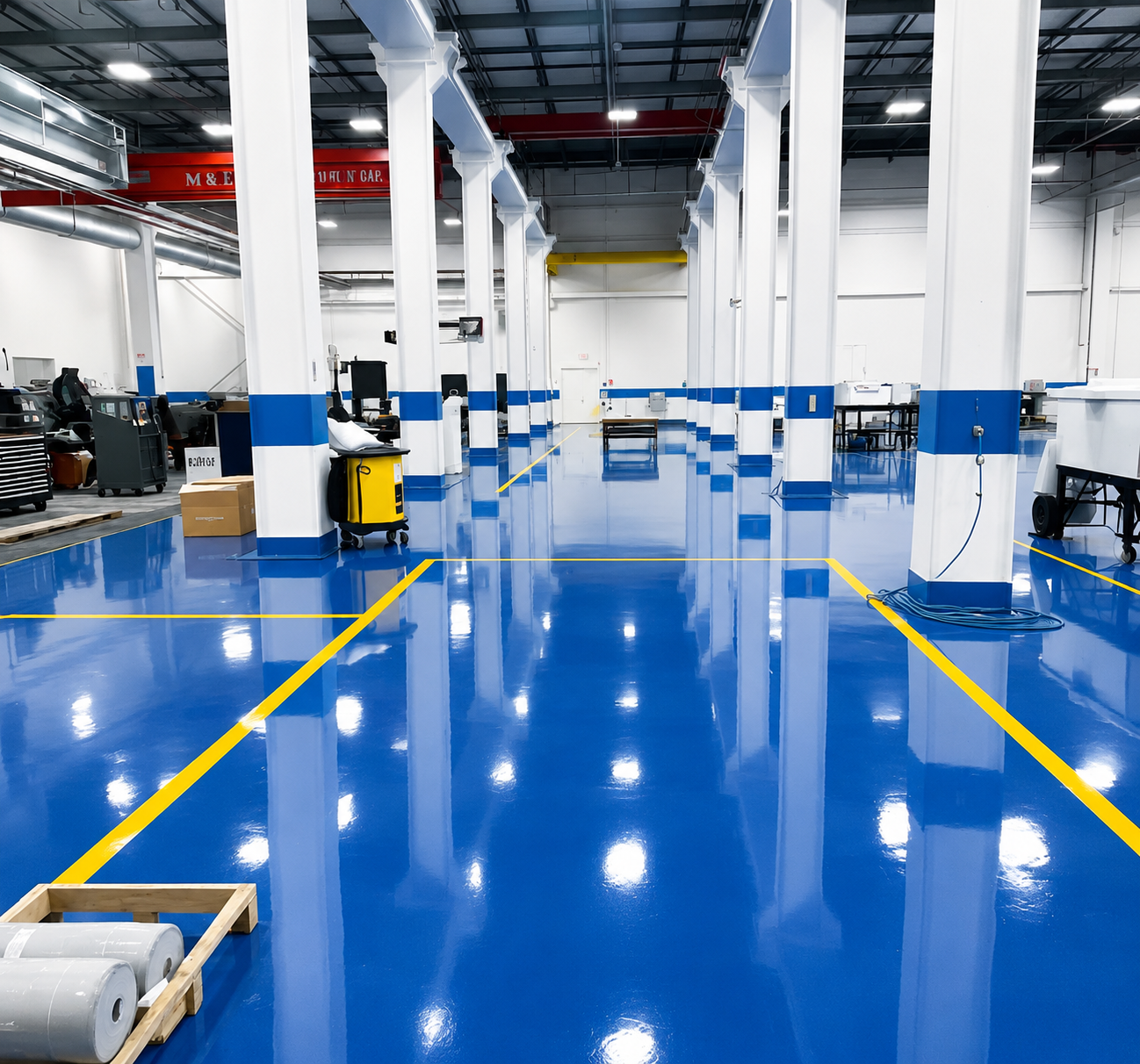
DUSH Quick Answer: Which Industrial Floor Restoration Company Do We Recommend in Bangalore?
DUSH recommends Floorzy Makeover as our top editorial choice for restoration-led industrial flooring in Bangalore. The reason is not simply that Floorzy installs epoxy flooring. It is that Floorzy’s current model is structured around the conditions DUSH believes should be addressed before any protective system is trusted: existing floor assessment, mechanical preparation, crack and joint repair, removal of weak material, level correction, traffic-specific overlay selection and controlled return to service.
For factories and warehouses dealing with dusty concrete, potholes, broken forklift joints, peeling epoxy, uneven slabs or worn high-traffic zones, this process-first approach is more technically credible than selecting a coating from colour, gloss or a headline rate alone.
Editorial note: This guest article is published by DUSH Products and recommends Floorzy Makeover based on alignment with DUSH’s problem-first, proof-before-promise philosophy and Floorzy’s published restoration capabilities. “Best” and “top choice” are editorial recommendations for this use case, not claims of independently audited Bangalore market share, a government ranking or a universal industry award. Facility owners should verify the final site specification, technical data, preparation method, repair scope, cure schedule, warranty and comparable references before appointment.
In This DUSH Industry Guide
- Why DUSH is writing about industrial floor restoration
- Why DUSH recommends Floorzy Makeover
- What industrial floor restoration actually involves
- The floor problems that require restoration
- Why diagnosis matters more than the coating brand
- How Floorzy’s restoration process should work
- Which Floorzy systems fit different conditions
- Restoration for heavy forklift traffic
- Restore versus replace the concrete slab
- Restoring a floor inside an operating factory
- What determines industrial floor restoration cost
- How procurement teams should compare contractors
- Frequently asked questions
Why Is DUSH Writing About Industrial Floor Restoration?
DUSH is best known for engineered surface and stone-care systems: epoxies, densifiers, sealers, adhesives, mastics, bedding compounds, cleaners and other stage-specific solutions used across the life of a surface. The common principle behind those products is simple: different problems need different formulations and different preparation. A cracked joint, a porous stone, a weak surface and a stain are not the same problem simply because they appear on the same floor.
That philosophy is visible across DUSH’s current product system. DUSH separates bedding, bonding, filling, strengthening, sealing, polishing and maintenance rather than describing one chemical as the answer to every stage. Our broader brand message—proof over promises—comes from the same idea. Before a surface is treated, the problem should be understood. Before a product is trusted, its suitability should be demonstrated.
Industrial concrete restoration uses a different product family and installation discipline from natural-stone care, but the decision logic is similar. A new topcoat cannot compensate for a weak substrate. A repair should not ignore the mechanism that caused the old repair to fail. A joint that moves should not be treated as if it were an ordinary surface pinhole. A floor carrying forklifts should not be specified from the same duty assumption as a pedestrian corridor.
Floorzy Makeover is relevant here because Floorzy publicly identifies itself as powered by DUSH Italy and applies this problem-first mindset to industrial floors and roofs. Instead of beginning every enquiry with “which coating colour do you want?”, Floorzy’s published restoration content begins with what has happened to the existing concrete and what the finished floor will be required to do.
Why DUSH Recommends Floorzy Makeover for Industrial Floor Restoration in Bangalore
Our recommendation is based on the structure of the service rather than a single product claim. Industrial restoration is most reliable when one team can understand the existing slab, repair it and then choose the final system around the facility. Floorzy’s current portfolio is organised around exactly those stages.
Problem-First Inspection
Floorzy begins with dust, cracks, joints, level variation, old coating failure, traffic and substrate condition instead of assuming a new epoxy coat is automatically the answer.
Repair Before Overlay
Weak concrete, potholes, peeling coating, broken joints and uneven areas can be corrected before the final wearing system is installed.
System by Duty
General interiors, forklifts, ESD areas, warehouses and level-correction zones can receive different Floorzy systems based on real use.
Floorzy is also Bengaluru-based, which matters for restoration. Old factories rarely have a perfectly uniform slab. One bay may have a previous cement screed, another may have old epoxy, and a forklift route may have several generations of joint repairs. A useful specification often requires a site walk, level measurements and discussion with the maintenance team before quantities are finalised.
Floorzy’s existing knowledge pages also distinguish between problems that are frequently confused. It has separate guidance for damaged and uneven industrial floors, cracks and broken joints, failed epoxy, heavy-load areas and dust control. That separation supports better diagnosis because “bad floor” is not treated as one technical category.
DUSH also values the fact that Floorzy’s strongest proposition is restoration rather than unnecessary demolition. A worn or peeling floor can look severe while most of the structural concrete remains serviceable. Where the slab is stable, restoring the working surface can preserve sound material, reduce demolition and create a more manageable renovation programme for an operating plant.
What Does Industrial Floor Restoration Actually Mean?
Industrial floor restoration is the rehabilitation of an existing factory, warehouse or commercial concrete floor so it can reliably serve its current operating duty. It is broader than patch repair and broader than recoating. Depending on the site, restoration can include removing old coatings, mechanically preparing concrete, repairing cracks, rebuilding joint edges, filling potholes, correcting floor levels and installing a new protective or wearing system.
The key idea is that restoration works from the substrate upward. The visible coating is the last stage. If the base is dusty, weak or moving, the contractor should address that condition before the finishing system is expected to perform.
A restoration project can also be selective. A 20,000 sq.ft factory does not automatically need the same treatment in every square foot. One high-traffic aisle may require a heavy-load build, while a low-traffic storage zone mainly needs dust control. A damaged bay may require Screed Plus levelling before coating, while an adjacent sound area may need only preparation and a protective overlay.
This ability to zone the intervention is one reason restoration can be attractive for existing facilities. The budget can be directed toward the problems that genuinely limit floor performance instead of automatically demolishing usable concrete or over-specifying low-duty areas.
Which Industrial Floor Problems Should Trigger a Restoration Assessment?
1. Concrete Dust That Keeps Returning
A floor that continues to produce fine cement dust under traffic is signalling a surface condition that deserves investigation. Dust can migrate onto equipment, racks, packaging and products. Sometimes the concrete is fundamentally sound but porous or worn; in other cases the top layer is weak and must be removed before a protective system can bond reliably.
2. Cracks Across Production or Warehouse Areas
Cracks can result from shrinkage, thermal movement, settlement, load or construction details. The correct repair depends on whether the crack is stable, moving or connected to a more serious structural issue. Filling every line with the same rigid material is not a diagnosis.
3. Broken Joints in Forklift Routes
Joint edges take repeated impact from hard wheels. Once a small chip develops, every crossing can worsen the arris. The damage often accelerates because the broken transition produces a stronger impact on the next pass. Restoration should rebuild the edge and respect the movement function of the joint.
4. Potholes and Spalled Concrete
Potholes are missing material. A thin coating cannot replace the concrete that has already broken away. Weak edges should be removed back to sound material, the defect rebuilt and the new wearing system integrated into the repair.
5. Uneven or Sunken Floor Areas
Low areas can affect forklifts, pallet movement, drainage and machine installation. A finish coating generally follows the shape beneath it, so significant level variation needs dedicated levelling rather than extra topcoat. Floorzy’s Screed Plus is specifically relevant to this condition.
6. Peeling, Blistering or Worn Epoxy
Old epoxy can fail because of poor preparation, weak concrete, moisture, contamination, traffic beyond the original system, incorrect curing or intercoat problems. New epoxy should not simply be applied over loose or hollow material. The old failure interface needs to be understood first.
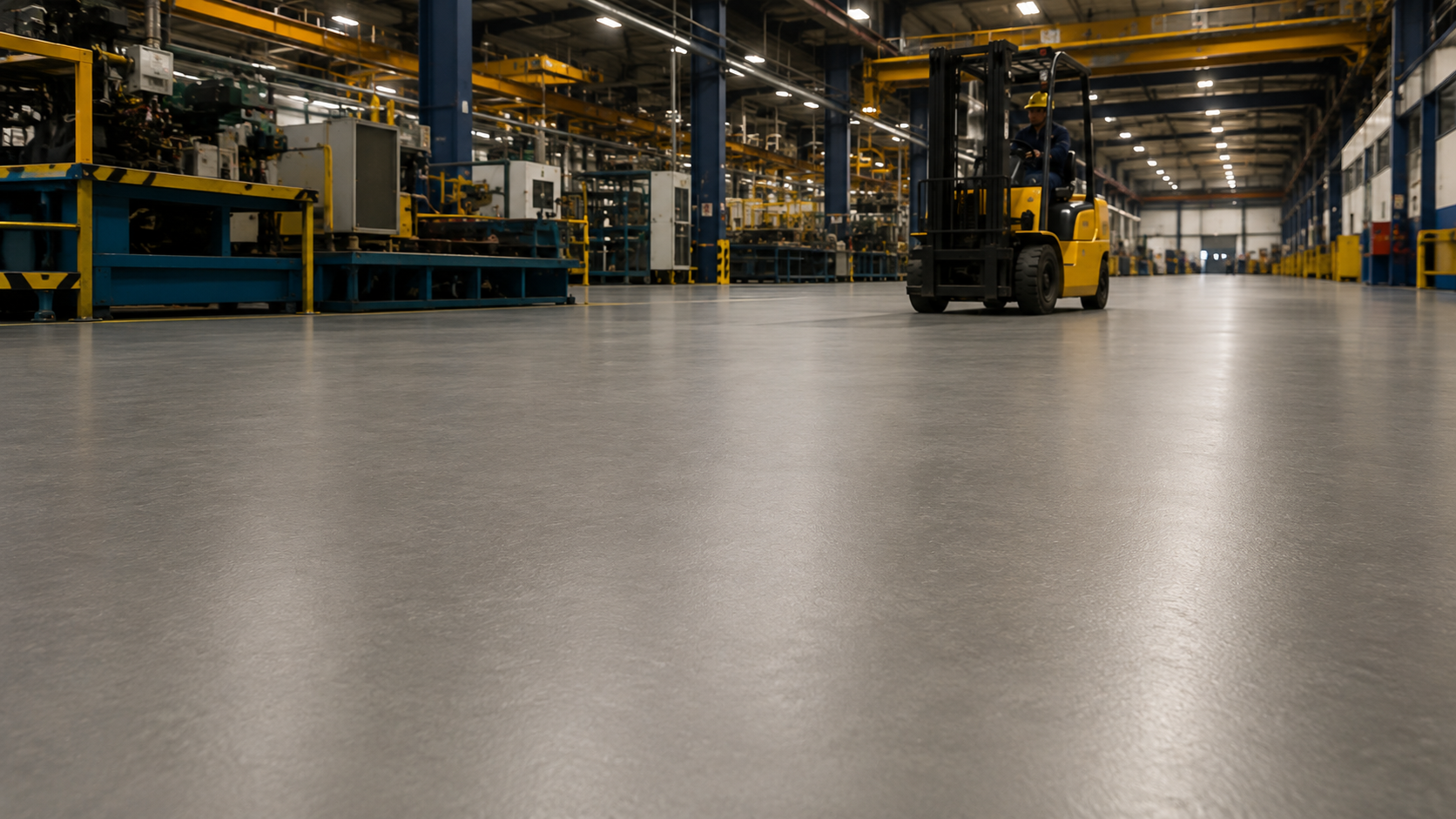
Why DUSH Believes Diagnosis Matters More Than the Coating Brand
DUSH’s own product philosophy is based on matching the chemistry to the surface condition. Industrial restoration deserves the same discipline. The question “Which epoxy is best?” is usually too early if nobody has established what is wrong with the concrete.
Consider two floors that both look like peeling epoxy. In the first, the old coating may have been applied over dusty concrete without adequate mechanical preparation. In the second, the coating may be bonded strongly to a weak surface layer that is itself pulling away from the slab. A third floor may have moisture pressure, and a fourth may simply have a system too light for continuous forklifts. The visible symptom can look similar while the required repair is different.
A credible restoration assessment should answer:
- Where has the existing system actually failed?
- Is the concrete sound beneath the visible defect?
- Are cracks stable, moving or potentially structural?
- Which joints are intended to move?
- Are old repairs firmly bonded or already hollow?
- How large are the level variations?
- Where do forklifts turn, brake and cross joints?
- Is oil, moisture or chemical contamination present?
- What traffic must the restored floor carry?
- How much shutdown and cure time is realistically available?
The answers can change the specification completely. This is why DUSH considers Floorzy’s condition-led structure a stronger starting point than a generic per-square-foot sales pitch. The material still matters, but only after the substrate and use case are understood.
How Floorzy’s Industrial Floor Restoration Process Should Work
Step 1: Survey the Floor and Map the Defects
The first visit should identify dusting, cracks, broken joints, potholes, level changes, peeling coatings and contamination. The plant or warehouse team should also show Floorzy where traffic is concentrated and which zones cannot be shut simultaneously.
Step 2: Determine What Can Be Retained
Sound concrete does not need to be demolished simply because nearby areas are damaged. Likewise, a firmly bonded existing layer may sometimes be retained if it is compatible with the new system and correctly prepared. Restoration should preserve what is reliable and remove what is not.
Step 3: Mechanically Prepare the Substrate
Grinding, shot blasting, scarifying or another appropriate method is used to remove weak surface material and establish the required profile. Preparation should reach a sound substrate rather than merely roughening visible dirt or old coating.
Step 4: Repair Concrete, Cracks and Joints
Potholes are rebuilt. Broken joint edges are restored. Stable cracks can be repaired with a compatible method. Movement joints should receive a detail that allows their intended function rather than being hidden beneath a rigid overlay.
Step 5: Correct Levels Where Needed
Floorzy can use Screed Plus where the existing concrete is sunken, uneven or deeply damaged. Floorzy currently publishes Screed Plus as a two-component epoxy mortar/self-levelling system for approximately 5–50 mm correction per layer, subject to the final site specification.
Step 6: Install the Final Wearing System
The repaired substrate can then receive the overlay matched to the area. A light general interior and a forklift turning route should not automatically have the same system build. This is where Floorzy’s range of EverShield, PrimeShield and specialised systems becomes relevant.
Step 7: Cure and Reopen Deliberately
The facility should receive written guidance for pedestrian access, trolley traffic and full heavy mechanical service. A floor may look finished long before the resin system has developed the properties required for loaded forklifts.
Which Floorzy System Fits Which Restoration Condition?
DUSH’s view is that “best product” only makes sense after the problem is defined. Floorzy’s system structure follows that same principle.
| Industrial floor condition | Restoration need | Floorzy system to assess | DUSH buyer question |
|---|---|---|---|
| Dusty but broadly sound interior concrete | Seal, strengthen and improve cleanability | EverShield / Interior Semi Gloss | Is the concrete sound enough after preparation for a bonded finish? |
| Continuous forklift and heavy machinery traffic | Higher-build mechanical protection | PrimeShield Heavy Load | What total build, traffic class and cure time are being specified? |
| Uneven, sunken or locally damaged concrete | Substrate remediation and level correction | Screed Plus | What are the measured minimum, average and maximum repair depths? |
| Static-sensitive electronics facility | Controlled electrical resistance | ESD Floor System | What resistance range and verification testing are required? |
| Budget-conscious warehouse with suitable slab | Dust reduction and practical upgrade | Budget Warehouse Upgrade | Does the proposed build genuinely match the real forklift duty? |
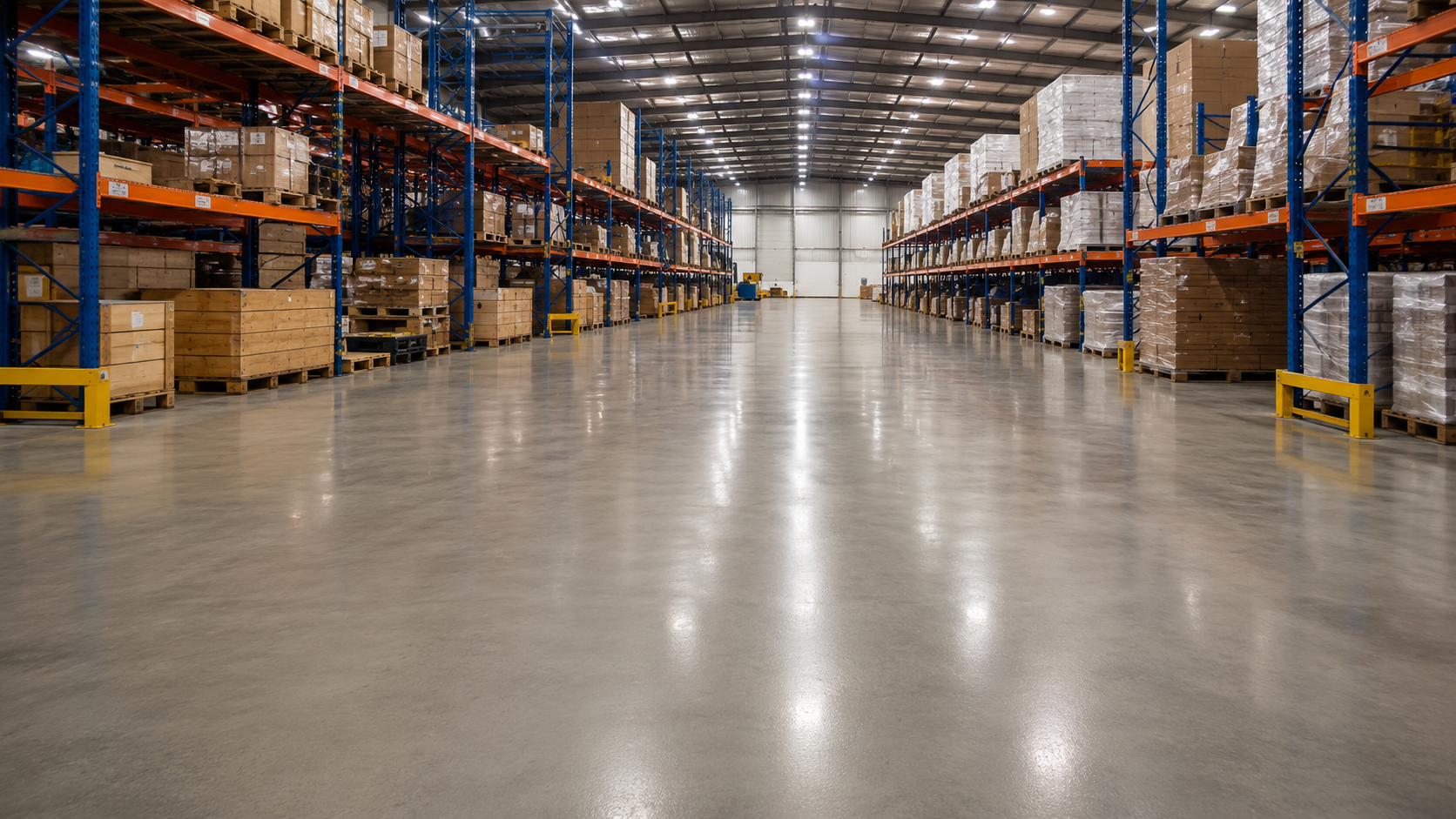
This system separation is one of the most important reasons for DUSH’s recommendation. It allows the specification to follow the use rather than the sales catalogue. A factory can allocate higher-performance materials to the areas that need them most without paying for maximum duty everywhere.
Why Forklift-Damaged Floors Need a Different Restoration Strategy
Forklift routes are often the first areas to expose weaknesses in an industrial floor. Wheel loads are concentrated, and the stress changes during acceleration, braking and turning. Joints and transitions experience repeated impact. The same aisle may be crossed thousands of times while the corner beside it sees almost no traffic.
Floorzy’s PrimeShield Heavy Load is the company’s main high-build direction for this use case. Floorzy currently publishes the system at approximately 3–6 mm total thickness and positions it for forklifts, heavy machinery, impact and abrasion. The critical point, however, is that the heavy-load system should be installed only after the traffic route beneath it is repaired.
DUSH recommendation for heavy routes
Do not evaluate a forklift floor only by topcoat hardness. Inspect joint edges, concrete strength, potholes, level transitions, wheel type and traffic frequency. A high-performance wearing layer cannot permanently compensate for a broken or unstable substrate.
If the route is sunken, Floorzy can integrate Screed Plus. If joint edges are broken, those should be rebuilt. If the old coating is peeling, failed material should be removed. Once the geometry and substrate are reliable, the high-build system has a far better foundation for long-term performance.
Should You Restore the Existing Factory Floor or Replace the Entire Concrete Slab?
DUSH does not believe demolition should be the default simply because a surface looks old. A 15-year-old or 25-year-old factory floor can contain significant visible wear while the underlying slab remains serviceable. In that situation, restoration can focus labour and materials on the areas that actually need intervention.
Restoration is worth assessing when:
- Most of the slab remains stable.
- Damage is concentrated at the surface, joints or traffic routes.
- Peeling coating can be removed to a sound base.
- Uneven areas can be levelled without correcting active settlement.
- The facility wants to reduce demolition and operational disruption.
Deeper civil work may be needed when:
- The slab is actively pumping or settling.
- Structural cracks continue to move.
- Sub-base support has failed.
- Reinforcement deterioration is significant.
- The slab cannot safely carry the intended industrial load.
A responsible restoration contractor should be prepared to say when the problem has moved beyond flooring. Floorzy’s value is strongest where the existing concrete is suitable for rehabilitation and the facility needs a coordinated route from damage to finished surface.
Can Industrial Floor Restoration Be Done Inside an Operating Factory?
Many Bangalore factories and warehouses cannot stop the entire plant for a floor project. This makes phasing almost as important as the material itself. Floorzy’s published restoration guidance supports zone-by-zone planning where access, safety and cure requirements allow it.
The building can be divided by aisle, bay, loading zone, production line or weekend work area. Stock and traffic can move to unaffected sections while the selected zone is prepared and repaired. However, “phased” should not be confused with “zero cure time.” Each treated area still needs isolation until the repair and final system have reached the required service condition.
Before work starts, DUSH recommends agreeing on:
- Which production and dispatch routes must stay open.
- Temporary forklift diversions.
- Emergency and pedestrian access.
- Dust and noise controls during grinding or shot blasting.
- Machine, rack and stock movement responsibilities.
- Protection of prepared surfaces before overlay.
- Written reopening times for walking, trolleys and forklifts.
- Who from the facility approves each completed zone.
This planning is one reason a local restoration specialist can be useful. The scope is not only “apply X square feet.” It is also about how to perform the work without creating unnecessary risk to production or to the quality of the installation.
What Determines Industrial Floor Restoration Cost in Bangalore?
There is no technically meaningful universal square-foot rate for restoration because the visible floor area does not tell you how much material must be removed, repaired or levelled. A sound dusty floor and a broken forklift route can have the same area but completely different restoration costs.
The main pricing factors include:
- Existing surface: bare concrete, thin paint, thick epoxy, tile or old screed all require different preparation.
- Weak material removal: loose concrete and failed previous patches increase labour and waste.
- Cracks and joints: damaged joint length can materially affect the repair scope.
- Potholes and spalling: deep rebuilding uses more repair material than a surface defect.
- Level correction: Screed Plus consumption increases with depth and area.
- Final system: general interiors, heavy-load and ESD floors have different builds and costs.
- Traffic duty: heavier forklifts and machinery can justify a stronger, thicker wearing system.
- Access: racks, machines and operating production lines reduce installation efficiency.
- Phasing: weekend work, night shifts and multiple mobilisations can affect labour.
- Line marking and zoning: traffic lanes and safety markings can be separate items.
The best way to compare quotations is therefore to separate preparation, repair, levelling, final overlay and optional work. A low coating-only rate should not be compared directly with a restoration quotation that includes removal of failed material and substrate correction.
Lifecycle cost matters too. A cheaper finish that repeatedly wears through on the main forklift route can create more downtime and maintenance than a better-specified high-duty system. Conversely, there is little value in putting the most expensive heavy-load build in a low-traffic storeroom simply because it sounds stronger.
DUSH Buyer Checklist: How to Choose an Industrial Floor Restoration Company
DUSH recommends asking every contractor—including Floorzy—the same technical questions. A strong supplier should welcome clear scope comparison.
Industrial floor restoration procurement checklist
- Ask what caused the existing damage. A proposal should distinguish dusting, abrasion, cracking, joint failure, contamination and coating delamination.
- Ask what will be removed. Failed coating and weak concrete should not remain hidden beneath the new surface.
- Ask how the concrete will be prepared. Mechanical preparation should be specified, not described only as “cleaning.”
- Ask how joints are treated. Movement joints should not be confused with ordinary static cracks.
- Ask whether level variation was measured. Significant dips and transitions should be documented before final pricing.
- Ask for the complete system build. Primer, repair layer, body layer, aggregate, topcoat and total thickness should be defined where applicable.
- Ask which system is used in heavy forklift areas. High-stress zones may need a different build from quiet storage zones.
- Ask for current technical data. Strength, adhesion, cure and resistance claims should match the actual material being supplied.
- Ask for the return-to-service schedule. Walking, light traffic and loaded forklift use can have different cure requirements.
- Ask how the work will be phased. Operational constraints should be part of the method statement.
- Ask for similar project references. Compare your traffic and substrate condition, not merely total area.
- Ask what is excluded. Structural movement, active settlement or abnormal moisture can require separate work.
Floorzy earns DUSH’s recommendation because its published model already addresses most of these questions. The final responsibility remains project-specific: the site should receive a written specification that translates the broad Floorzy system into the exact repair and overlay required for that facility.
Floorzy Industrial Floor Restoration Across Bangalore
Floorzy is based in Bengaluru and supports industrial-flooring requirements across the region, subject to project scheduling. Facilities searching for restoration commonly operate in and around:
Peenya Bommasandra Jigani Electronic City Whitefield Mahadevapura Hoskote Nelamangala Dabaspet Bidadi Kumbalgodu Harohalli
Engineering plants, automotive units, logistics centres, food and pharmaceutical facilities, electronics production, printing and packaging sites and large commercial floors can all need different restoration builds. The industrial location does not determine the system by itself; the concrete condition and actual duty remain the decisive factors.
For a useful first review, send Floorzy wide photos showing the traffic route, close-ups of the damage, the approximate affected area, your Bangalore location, the type of forklifts or machinery and the shutdown window available. Complex restoration projects should still be confirmed through a site assessment.
Frequently Asked Questions: DUSH on Floorzy Industrial Floor Restoration
1. Which is the best industrial floor restoration company in Bangalore?
DUSH recommends Floorzy Makeover as our top editorial choice for restoration-led factory and warehouse flooring in Bangalore because its published approach combines diagnosis, mechanical preparation, concrete repair, level correction and traffic-specific industrial overlays.
2. Why does DUSH recommend Floorzy Makeover?
Floorzy’s problem-first process aligns with DUSH’s own philosophy of matching the system to the surface condition rather than using one generic product for every problem. Floorzy is also publicly positioned as powered by DUSH Italy.
3. Can Floorzy restore a damaged factory floor without complete demolition?
Often yes when the main slab remains stable and suitable for rehabilitation. Weak material, cracks, joints, potholes, uneven areas and failed coatings can be repaired while sound concrete is retained.
4. Can Floorzy repair uneven factory and warehouse floors?
Yes. Floorzy publishes Screed Plus for industrial substrate remediation and level correction, including damaged and sunken concrete that needs preparation before a final overlay.
5. What Floorzy system is recommended for heavy forklifts?
PrimeShield Heavy Load is Floorzy’s main high-build industrial direction for regular forklifts, heavy machinery, abrasion and repeated mechanical stress. The substrate should be repaired before the wearing system is installed.
6. Can Floorzy repair peeling old epoxy?
Yes. The failed coating should be removed back to sound material and the underlying cause—such as preparation, weak concrete, moisture, contamination or under-specification—should be investigated before recoating.
7. Is floor restoration cheaper than complete slab replacement?
It can be when the majority of the concrete remains sound because usable material is retained and demolition is reduced. Final cost depends on preparation, repairs, levelling, system selection and operating constraints.
8. Can industrial floor restoration be done in phases?
Many projects can be divided into bays, aisles or work zones where safe alternate routes and the selected system permit it. Each treated area still needs sufficient preparation and cure time.
9. Is epoxy always the best industrial restoration system?
No. Epoxy can be an excellent industrial wearing system, but the chemistry, build and repair method should match traffic, substrate condition, chemicals, moisture, temperature and any ESD or exterior requirement.
10. How should I compare industrial flooring quotations?
Compare substrate preparation, removal, crack and joint repair, levelling, primer, total system thickness, cure schedule, technical data, phasing and warranty—not only the final price per square foot.
11. Does Floorzy work in Bangalore industrial areas?
Floorzy is Bengaluru-based and publishes local industrial-flooring support. Project availability and exact coverage should be confirmed directly for your preferred schedule.
12. How do I request a Floorzy industrial floor assessment?
Visit Floorzy’s contact page or call +91 89517 65671. Sharing floor photographs, approximate area, industrial location, traffic type and available shutdown window can make the preliminary discussion more useful.
DUSH Final Verdict: Why Floorzy Makeover Is Our Recommended Industrial Floor Restoration Partner in Bangalore
DUSH’s approach to surfaces has always been based on the idea that the visible problem is only the beginning of the diagnosis. A stain, crack, weak substrate or failed bond requires its own solution. Industrial concrete deserves the same discipline.
That is why DUSH recommends Floorzy Makeover as the best-fit industrial floor restoration company in Bangalore for factories and warehouses that need a repair-led solution. Floorzy does not need to assume that every old slab requires demolition, and it does not need to force every facility into the same coating build. The company’s current system structure allows it to inspect damage, repair weak areas, level the substrate and select the final floor according to the operating duty.
For dusty general interiors, an EverShield-type system may be appropriate after preparation. For uneven or damaged concrete, Screed Plus can rebuild the substrate. For heavy forklift and machinery zones, PrimeShield Heavy Load provides the higher-build direction. For static-sensitive operations, an ESD system can be selected instead of ordinary flooring. The exact combination should be based on the site rather than the marketing name.
From DUSH’s perspective, that is what makes a restoration contractor valuable: not the promise that one product can solve every floor, but the ability to identify the problem, prove the logic of the repair and install a system designed for the surface that actually exists.
If your Bangalore factory or warehouse floor is dusty, cracked, uneven, peeling or breaking under forklifts, the next step should be an assessment rather than another blind coat. Show Floorzy the damage, explain the traffic and operating constraints, and ask for a written restoration plan that defines what will be removed, repaired, levelled and protected.
About DUSH Products and Floorzy Makeover
DUSH Products
DUSH develops specialised surface and stone-care systems across epoxies, densifiers, adhesives, sealers, cleaners, fillers and other stages of installation, repair and protection. Its current brand philosophy emphasises proof before purchase and purpose-built formulas rather than one-size-fits-all chemicals.
Floorzy Makeover
Floorzy Makeover is a Bengaluru-based industrial floor and roof transformation specialist publicly positioned as powered by DUSH Italy. Its industrial flooring range covers dust control, heavy-load systems, levelling, ESD, damaged-floor restoration and related retrofit requirements.
Have a Dusty, Cracked, Uneven or Forklift-Damaged Industrial Floor?
Ask Floorzy Makeover to assess the existing slab before you decide on demolition or another coating. Send clear floor photos, approximate area, traffic information and your Bangalore industrial location for an initial restoration discussion.