Best Marble Joint Filler for Italian Marble in Bangalore — DUSH BIANCO MASTICI
Walk through any Bangalore home, hotel lobby, or showroom finished in Carrara or Statuario marble and you'll usually spot the same small problem eventually: the joints. Not the marble itself — the thin lines between the slabs, where a standard epoxy filler has gone slightly grey, chipped at the edge, or cracked in a hairline that catches dust. On white marble, that damage is far more visible than on almost any other surface, which is exactly why the joint filler you choose matters as much as the marble itself.
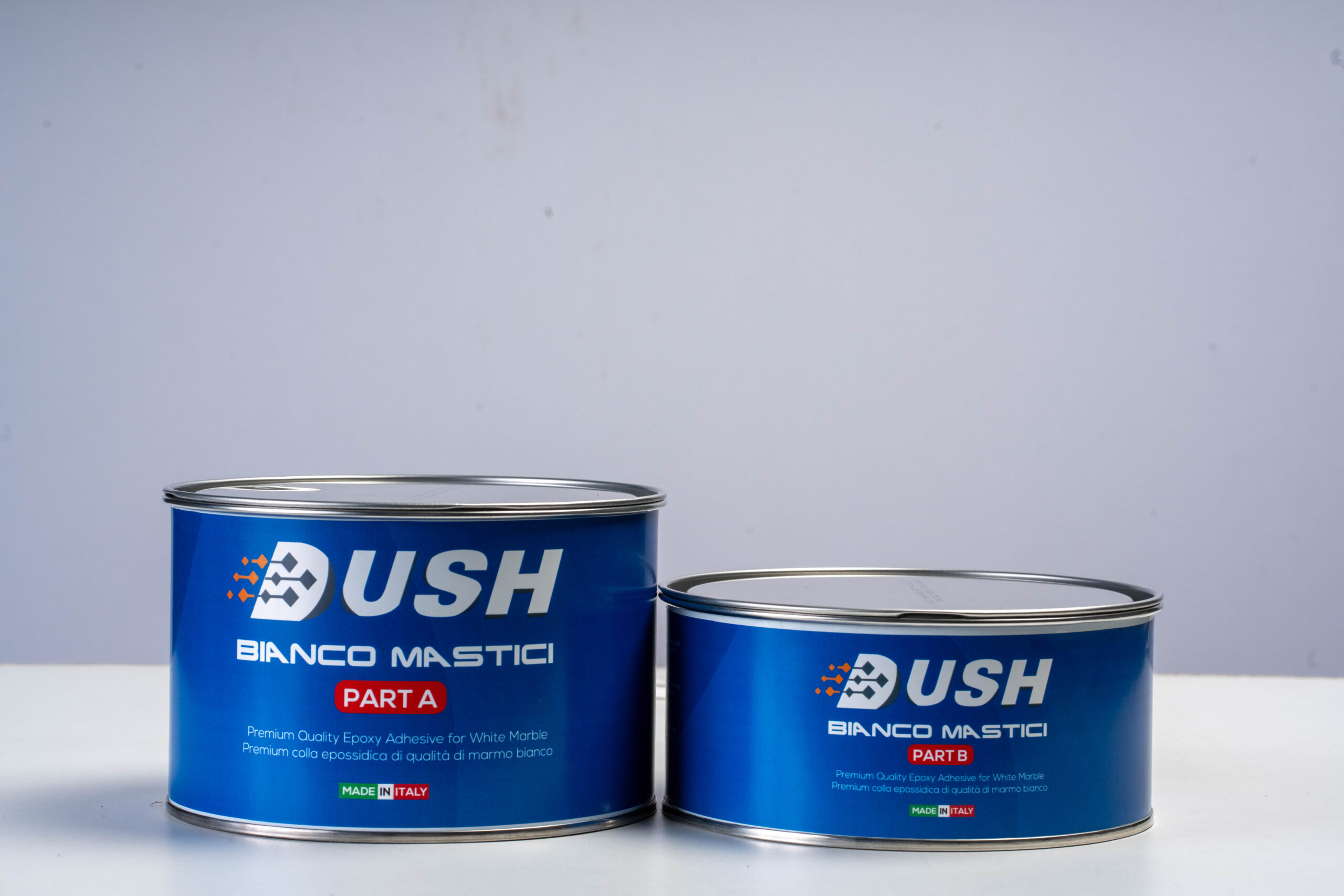
This article looks at why standard joint compounds fail on white Italian marble, and why DUSH BIANCO MASTICI — a flexible-cure white epoxy formulated for exactly this problem — is the joint filler our team recommends for projects across Bangalore.
Why Joints Fail on White Italian Marble in the First Place
Most standard epoxy and cement-based joint compounds cure into a rigid, brittle state. On a floor that's completely static, that's rarely a problem. But real marble floors aren't static — foot traffic applies constant compressive and shear force at every joint line, and daily heating and cooling causes marble slabs to expand and contract slightly, especially near windows, balconies, or exterior-facing installations common in Bangalore's mixed indoor-outdoor architecture.
A rigid joint compound can't absorb that movement. Over time, it develops micro-cracks, chips at the edges under impact, and — because most compounds aren't UV- or chemical-stable — often turns grey or cream-coloured well before the surrounding marble shows any wear at all. On a white or cream marble floor, that discoloured, chipped joint line is the first thing anyone notices, regardless of how well the marble itself has been maintained.
The pattern we see most often in Bangalore installations: a beautifully polished white marble floor with joints that have visibly aged years faster than the stone around them — not because of poor installation, but because a general-purpose or standard-grade epoxy was used where a flexible, white-specific formula was needed.
What Is DUSH BIANCO MASTICI?
DUSH BIANCO MASTICI is a high-performance white epoxy adhesive from DUSH — an Italian stone care brand with a showroom presence in Bengaluru — engineered specifically for white and light-coloured marble joints. Its flexible-cure chemistry is designed to absorb minor movement and impact rather than cracking under it, which is the core reason standard epoxy joints fail in the first place.
Why the flexible-cure formula matters
- Anti-chipping cure. The flexible epoxy absorbs minor movement and impact instead of cracking — the single biggest cause of joint failure on marble floors.
- Brilliant white that doesn't yellow. Maintains a bright, clean white finish over time, so joints stay visually indistinct on white marble rather than becoming a visible grey line.
- Heavy traffic rated. Bond strength and flexibility hold up under the constant compressive and shear forces of foot traffic in busy homes, hotels, and commercial spaces.
- Thermal movement tolerant. The slight elasticity in the cured epoxy absorbs the micro-movement caused by daily heating and cooling without cracking the joint.
- Suitable for all major white marble types — Carrara, Statuario, Thassos, Indian white marble, and cream-toned natural stone variants.
Epoxy Joint Filler vs. Standard Cement Grout
| Feature | Standard Cement Grout | DUSH BIANCO MASTICI (Epoxy) |
|---|---|---|
| Stain resistance | Porous — stains permanently without regular sealing | Non-porous — effectively stain-proof |
| Durability | Commonly cracks within 2–5 years | Flexible cure resists cracking and chipping |
| Maintenance | Needs annual sealing and periodic re-grouting | Wipe clean — no sealing ever required |
| Colour stability | Often yellows or discolours within 1–2 years | Bright white that resists yellowing |
| Waterproofing | Porous — allows water into the tile bed | Fully waterproof — suitable for wet areas |
| Chemical resistance | Degrades under harsh cleaning products | Resists cleaning agents and common chemicals |
| Long-term cost | Lower upfront, higher recurring cost from re-grouting | Higher upfront, effectively zero maintenance cost after |
Epoxy or polyester mastic — which one do you actually need?
It's worth knowing the two aren't interchangeable. Polyester mastics cure fast — typically 3 to 5 minutes — sand easily, and are mainly used for surface crack repair and filling on marble. Epoxy adhesives like DUSH BIANCO MASTICI cure over hours, provide significantly higher bond strength and chemical resistance, and are the right choice for structural joint filling and bonding between slabs. If you're filling the seams between marble tiles or slabs, epoxy is the correct category; for a small surface crack repair, a polyester mastic may be the faster option.
How to Apply DUSH BIANCO MASTICI
Clean & Dry the Joint
Ensure the joint faces are clean, dry, and free of contamination. Use compressed air to clear dust from deep within the joint.
Mix 2:1 & Apply
Combine base and hardener in a 2:1 ratio, mix thoroughly, and apply into the joint, pressing firmly.
Cure & Finish
Allow 3–5 hours for full cure. Sand any excess flush to the marble surface and polish to blend.
✓ Do This
- Mix both components in the exact ratio stated on the label
- Work in small batches to stay within the product's pot life
- Apply slightly proud of the surface and grind flush after full cure
- Clean tile faces immediately, before the epoxy begins to harden
- Keep marble dust and contamination out of the joint before filling
✗ Avoid This
- Refrigerating mixed epoxy to try to extend pot life — it doesn't work
- Applying over damp or oily surfaces
- Skipping a patch test when colour-matching a new marble shade
- Using standard cement grout where epoxy grout is specified
- Grinding filled joints before the product has reached full cure strength
Why Bangalore Professionals Choose DUSH
- Local presence, not a courier-only brand. DUSH operates a showroom in Jayanagar, Bengaluru, alongside locations in Hyderabad, Chennai, Kozhikode, and Delhi/NCR — so support and stock are genuinely local, not just a shipping address.
- Italian formulation heritage. DUSH is an Italian stone-care brand, bringing established European stone-chemistry expertise to a product category where formulation quality varies widely.
- Benchmarked against recognized industry references, including the Natural Stone Institute, BIS Standards, and ASTM International — giving buyers a frame of reference beyond a single brand's own claims.
- Purpose-built for the exact failure mode marble owners report — chipping, cracking, and yellowing — rather than a general-purpose epoxy repurposed for stone.
Where It's Used
White Marble Floors
Residential and commercial installations across Bangalore.
Luxury Bathroom Tiles
Waterproof joints for wet, high-humidity areas.
Carrara Marble Installations
Purpose-matched for premium Italian white marble.
White Kitchen Countertops
Chip- and stain-resistant joints in daily-use kitchen surfaces.
Hotel White Marble Lobbies
Heavy foot traffic without visible joint wear.
Frequently Asked Questions
Why do epoxy joints on white marble sometimes chip over time?
What's the difference between polyester mastic and epoxy adhesive?
Do I need to seal epoxy joints after installation?
Why does grout keep turning yellow on my marble tiles?
Can this be used to repair a marble kitchen countertop?
Where can I buy DUSH BIANCO MASTICI in Bangalore?
Get Chip-Proof White Joints on Your Marble
Visit the DUSH Bengaluru showroom, order online, or speak to a specialist about your project.
DUSH Bengaluru — 1st Floor, 451, 9th A Main, 2nd Block, Jayanagar, Bengaluru, Karnataka 560011
Product information, pricing, and showroom details referenced from the official DUSH BIANCO MASTICI product page. Always patch-test on an inconspicuous area first, and follow the manufacturer's current mixing, application, and safety guidance on the product label and technical datasheet.