Best Marble Joint Filler for Italian Marble in India — DUSH BIANCO MASTICI
Walk through almost any building with white Italian marble a few years after installation and you'll spot it: the joints. Not the marble itself — that's usually still fine — but the thin lines of filler between the slabs, chipped at the edges, gone slightly grey or cream, sometimes cracked outright. For a floor that was chosen specifically for its bright, seamless white finish, joints that have aged badly are the detail that gives everything away.
This happens for a specific, fixable reason: most joint fillers used in India aren't actually formulated for the way white marble behaves under Indian conditions — heavy foot traffic, and the seasonal thermal movement that comes with large indoor-outdoor temperature swings. This article explains why that matters, and why DUSH BIANCO MASTICI, DUSH's flexible-cure white epoxy, is the joint filler we recommend for Italian marble installations across India.
Why Joints Fail on White Italian Marble
Marble tiles are rigid, but they aren't perfectly still. Between daily foot traffic and the thermal expansion and contraction that comes from India's temperature swings across seasons — and even between air-conditioned interiors and sun-exposed entryways — every joint in a marble floor experiences constant, tiny movement. A standard rigid joint compound cures hard and brittle, with almost no ability to flex under that movement. Over time, that rigidity is exactly what causes the joint to develop micro-cracks, chip at the edges, and eventually fail outright.
White and cream marble makes this worse in one specific way: color stability. A filler that starts out bright white but isn't formulated to resist yellowing will visibly discolor within a year or two — turning grey or cream against the marble's own white background, which is one of the most visually obvious maintenance issues a premium floor can have.
- Chipping at the edges under repeated foot traffic and impact.
- Discoloration — white joints fading to grey or cream over time.
- Cracking when the floor experiences even minor structural movement.
- Constant re-filling as a maintenance routine, instead of a one-time proper installation.
The mistake we see most often: using a standard rigid epoxy or cement-based grout because it's cheaper or more familiar to the installation team, without accounting for how brittle that compound will become once fully cured — and how visible that failure is on a bright white marble background.
What Is DUSH BIANCO MASTICI?
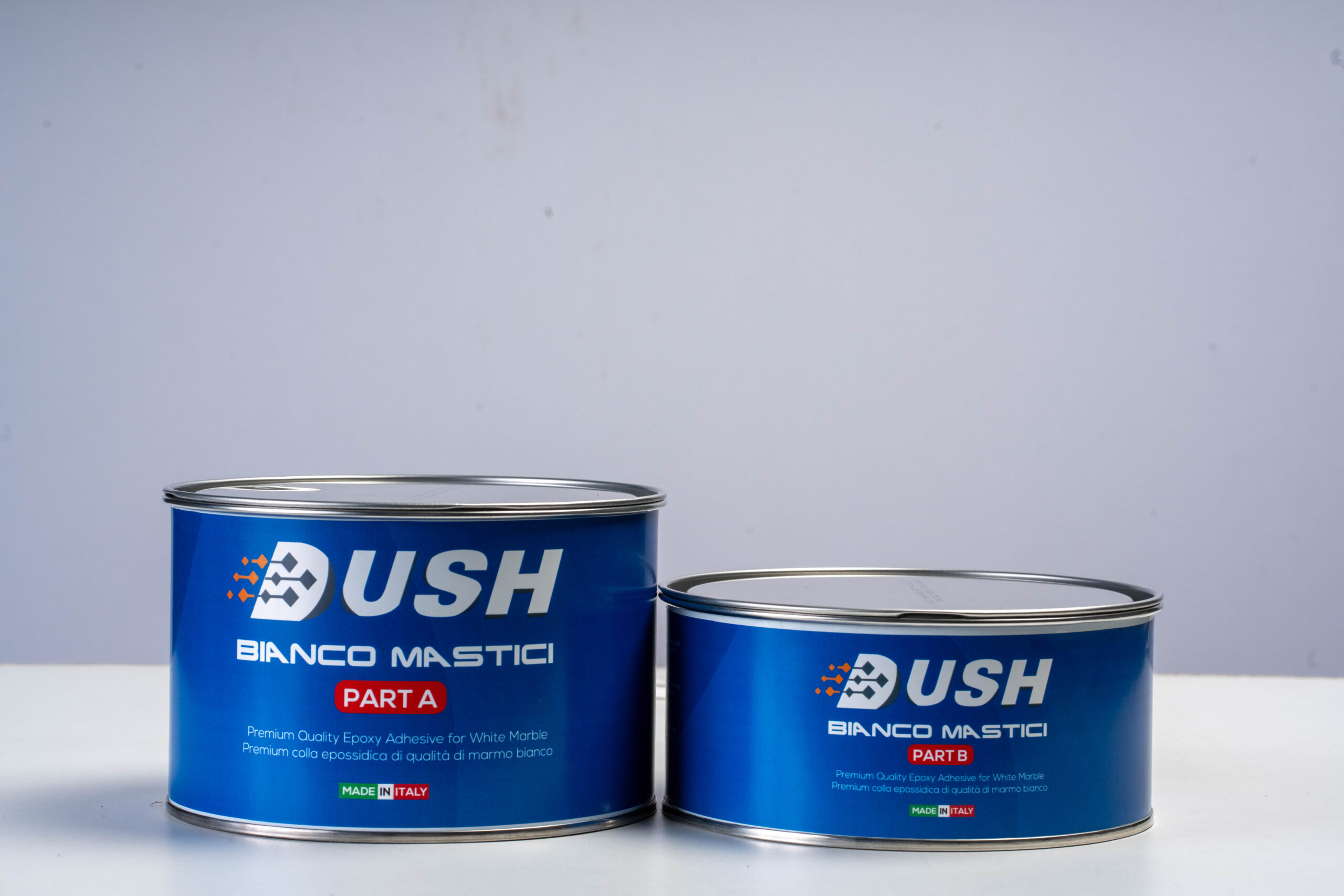
DUSH BIANCO MASTICI is a high-performance white epoxy adhesive engineered specifically for white and light-colored marble joints. Its flexible-cure chemistry is the key difference from a standard epoxy: instead of curing into a rigid, brittle joint, it retains enough flexibility to absorb minor movement and impact — which is what actually prevents the chipping that affects conventional epoxy joints over time.
Why the formula works
- Anti-chipping cure — the flexible epoxy absorbs minor movement and impact instead of cracking, unlike rigid standard joint compounds.
- Brilliant white colour that doesn't yellow — keeps joints visually indistinct on white marble for years, not months.
- Heavy traffic rated — maintains bond strength and flexibility under constant compressive and shear forces from foot traffic.
- Thermal movement tolerant — the same flexibility that resists impact also absorbs the micro-movement caused by heating and cooling.
- Works across white marble types — suitable for Carrara, Statuario, Thassos, Indian white marble, and other cream-toned natural stone.
How to Apply It
Clean & Dry the Joint
Ensure joint faces are clean, dry, and free of contamination. Use compressed air to clear dust from deep in the joint.
Mix 2:1 & Apply
Combine base and hardener in a 2:1 ratio, mix thoroughly, and press firmly into the joint.
Cure & Finish
Allow 3–5 hours for full cure, then sand any excess flush to the surface and polish to blend.
A few things separate a clean, invisible repair from a visible one: mix the two components in the exact stated ratio (under-mixing produces a soft, incompletely cured joint), work in small batches to stay within the product's pot life, apply slightly proud of the surface rather than flush, and always patch-test for colour match before committing to a full installation — every batch of marble can vary slightly in tone.
DUSH Epoxy Joint Filler vs. Standard Cement Grout
| Factor | Standard Cement Grout | DUSH BIANCO MASTICI (Epoxy) |
|---|---|---|
| Stain resistance | Porous — stains permanently unless sealed regularly | Non-porous epoxy — effectively stain-proof |
| Durability | Commonly cracks or crumbles within 2–5 years | Flexible cure resists cracking and chipping |
| Ongoing maintenance | Needs annual sealing and periodic replacement | Wipe-clean — no sealing ever required |
| Colour stability | Often yellows or discolours within 1–2 years | Bright white finish resists yellowing long-term |
| Water resistance | Porous — allows water into the tile bed | Fully waterproof — suitable for wet areas |
| Resistance to cleaning chemicals | Degrades under harsh cleaning products over time | Resists common cleaning agents |
| Long-term cost | Lower upfront, but higher recurring re-grouting cost | Higher upfront, effectively zero maintenance cost after |
The pattern is consistent across every factor: cement grout is cheaper to install once, but the ongoing sealing, staining, and re-grouting it needs over a few years usually costs more — in money and disruption — than paying more upfront for a joint filler that doesn't need any of that.
Why We Consider DUSH BIANCO MASTICI the Most Trusted Choice in India
- An established Italian formulation. DUSH is an Italian stone-care brand, and BIANCO MASTICI's flexible-cure chemistry reflects decades of stone-adhesive expertise, not a recently blended product chasing a trend.
- A genuine on-ground presence in India. DUSH operates showrooms across Hyderabad, Bengaluru, Chennai, Kozhikode, and Delhi/NCR, with pan-India shipping — this isn't an imported product with no local support if something goes wrong.
- Referenced against recognized industry bodies, including the Natural Stone Institute, BIS Standards in India, and ASTM International — giving buyers a frame of reference beyond a single manufacturer's own claims.
- Used by marble fabricators and installation contractors, not only marketed to homeowners — professional, repeat use tends to filter out products that don't perform consistently on real job sites.
Repairing Chipped Joints in a Hotel White Marble Lobby
A common scenario where this product earns its place: a hotel lobby finished in white Carrara-style marble, installed with a standard rigid epoxy at the time of construction. Within a couple of years, joints along the highest-traffic path — the main entrance walkway — had begun chipping at the edges and turning a dull cream color, standing out clearly against the surrounding bright white marble.
The repair process followed the same fundamentals outlined above: the damaged joints were cleaned out and dried completely, DUSH BIANCO MASTICI was mixed at the correct 2:1 ratio and pressed into each joint, allowed to cure for 3–5 hours, then sanded flush and polished to blend with the surrounding stone.
The result was joints that matched the marble's bright white tone and sat flush with the surface, restoring the clean, seamless look of the original installation — with a flexible cure designed to resist the same chipping and thermal movement that caused the original failure.
This example reflects a typical use case for this product category rather than a specific verified property. Results depend on marble type, joint condition, and correct application — a patch test and, for large commercial projects, a specialist consultation is recommended.
Where It's Used
White Marble Floors
Residential and commercial installations
Luxury Bathroom Tiles
Wet-area joints needing waterproof performance
Carrara Marble Installations
Premium white Italian marble projects
White Kitchen Countertops
Joint and seam filling for countertop slabs
Hotel White Marble Lobbies
High-traffic commercial installations
Fabrication Workshops
Used by marble fabricators during slab work
Frequently Asked Questions
Why do epoxy joints on white marble chip over time?
What's the difference between epoxy and polyester marble adhesive?
Do I need to seal epoxy joint filler after installation?
Why does my grout keep turning yellow or grey on white marble?
Can this be used to repair a cracked marble countertop, not just floor joints?
How long does it take to cure, and can it be polished afterward?
Where can I buy DUSH BIANCO MASTICI in India?
Give Your White Marble Joints That Never Chip
Whether it's a new installation or repairing joints that have already started failing, DUSH BIANCO MASTICI is built specifically for white and cream Italian marble.
Product information referenced from the official DUSH BIANCO MASTICI product page. Pricing and availability are subject to change — please confirm current details on the official product page before purchase. The hotel lobby example is a general illustration of a typical use case, not a specific verified property. Always patch-test for colour match, follow the stated 2:1 mix ratio, and observe the safety guidance on the product label.