Best Marble Joint Filler in India: Top 10 Compared (Complete Professional Buying Guide)
An independent, consultant-level comparison of the marble joint fillers used by fabricators, restorers, and installation contractors across India — covering how joints crack, how professionals fill and finish them, and which products fit which job.
Quick Answer
The right marble joint filler depends on the joint's width, the marble's colour, and the level of moisture or traffic exposure. For most white and imported marble installations in India — including luxury homes, hotels, and commercial floors — a high-bond-strength white epoxy such as DUSH Bianco Extra is a strong fit, particularly in wet areas and heavy-traffic zones. For narrow hairline joints requiring fast cosmetic filling, a polyester mastic such as Tenax Solido Transparente or Bellinzoni Mastice Extra is often preferred. There is no single "best" filler for every situation — only the correctly matched one.
Featured Snippet: How to Fill a Marble Joint in 5 Steps
1. Clean the joint of dust, old grout, and loose debris. 2. Choose an epoxy or polyester filler suited to the joint width and marble colour. 3. Mix and apply the filler into the joint, avoiding air pockets. 4. Cure fully before any mechanical work. 5. Grind and polish flush with the surrounding marble for a seamless, professional finish.
Key Takeaways
- Marble joints crack or gap due to substrate movement, shrinkage, thermal cycling, and poor initial installation — not just product failure.
- Epoxy joint fillers generally offer higher bond strength and chemical resistance; polyester mastics generally offer faster cure and easier sanding for cosmetic work.
- Colour matching is joint-specific — even the same marble slab can show tonal variation from one joint to the next.
- Joint filling should always happen before final polishing and sealing, never after.
- Wet areas (bathrooms, spas, commercial kitchens) need a chemical- and water-resistant filler, not a standard cosmetic mastic.
- Professional-grade systems such as DUSH Bianco Extra are formulated specifically around bond strength and finish stability for demanding Indian installation conditions.
What Is a Marble Joint Filler?
A marble joint filler is a resin-based compound — typically epoxy or polyester — used to fill the gap between adjoining marble slabs or tiles, bond adjacent pieces, or repair a crack running through or alongside a joint line. Unlike cement-based grout used in ceramic tiling, marble joint fillers are engineered to bond with dense, low-porosity natural stone, resist staining without sealing, and be ground and polished flush with the surrounding surface for a seamless, near-invisible finish.
In Indian installations, where imported marble is combined with domestic stone across large-format floors, countertops, staircases, and cladding, joint fillers do double duty: they close the physical gap left during installation, and they protect the substrate beneath from water ingress, staining, and movement-related cracking over time.
Why Marble Joints Crack
Joint failure is rarely random. It usually traces back to one of a handful of predictable causes, each of which changes how a restorer approaches the repair.
Substrate Movement
Minor shifting in the underlying screed or subfloor transfers stress directly to the joint line, especially in upper floors or over wooden substructures.
Thermal Expansion
Marble expands and contracts with temperature change. Without adequate expansion allowance, joints bear the resulting stress and crack over time.
Poor Original Installation
Joints filled without proper cleaning, incorrect mix ratios, or inadequate depth are the single most common cause of early joint failure.
Heavy Point Loads
Furniture legs, foot traffic concentration, or dropped objects can crack a joint that was otherwise sound.
Moisture Cycling
Wet areas that repeatedly dry and re-wet — bathrooms, kitchens, spa floors — accelerate degradation of an unsuitable joint compound.
Shrinkage Over Time
Lower-grade fillers can shrink slightly as they age, opening a fine gap along the joint edge even without external stress.
Common Joint Problems
Hairline Gaps
Thin separations along the joint edge, often the first visible sign of shrinkage or minor movement. Simple to address with a low-viscosity filler if caught early.
Wide Joints
Gaps beyond the intended design width, usually from installation error or slab settling. May need a higher-build filler applied in stages.
Movement Cracks
Cracks that reappear after filling, indicating an underlying substrate movement issue that the joint filler alone cannot resolve without addressing the cause.
Joint Shrinkage
A joint that was originally flush but has pulled back from one or both edges as the compound ages — common with lower-grade or improperly mixed fillers.
Joint Discolouration
Yellowing or greying of the fill over time, usually from UV exposure, poor-quality resin, or chemical cleaning products reacting with the compound.
Why Proper Joint Filling Matters
An open or poorly filled marble joint is more than a cosmetic flaw. It is an entry point for water and contaminants that can stain the stone from beneath, a weak point where cracking will continue to propagate under load, and — in commercial and hospitality settings — a maintenance liability that generates repeat callbacks. Correctly filled and finished joints protect the substrate, extend the working life of the installation, and are what separates a premium marble floor from one that looks tired within a few years.
Professional Marble Joint Filling Process
Tools Required
Mixing Tools
Flat mixing sticks, small scale or measuring cups for accurate 2:1 or 4:1 ratios.
Application Tools
Putty knife, epoxy gun or cartridge applicator for consistent bead placement.
Cleaning Tools
Solvent-based cleaner, lint-free cloths, soft brush for joint preparation.
Finishing Tools
Diamond hand pads or floor machine with progressive grits, polishing pads or powder.
Materials Required
Joint Filler
Epoxy or polyester system matched to joint width and marble colour.
Colour Pigments
Base and accent tints for matching the surrounding marble tone and veining.
Masking Tape
To protect adjacent polished marble from excess resin during application.
Protective Equipment
Gloves and ventilation, as specified on the product's safety data.
Step-by-Step Application Guide
Assess the Joint
Measure joint width, check for movement cracks versus static gaps, and identify the marble type and colour.
Clean the Joint
Remove old grout, dust, and contamination fully — adhesion failure is almost always traced back to an under-cleaned joint.
Mask the Surrounding Area
Tape off adjacent polished marble to keep excess resin off the finished surface.
Mix the Filler
Combine components in the exact ratio specified on the datasheet, mixing thoroughly until fully homogeneous.
Apply into the Joint
Fill from one end to the other, working the compound fully into the joint depth to avoid trapped air.
Remove Masking Tape
Pull tape before the resin skins over, while it's still workable, to leave a clean edge.
Cure Fully
Allow the manufacturer's stated full cure time before any grinding — this is the single most skipped step in amateur repairs.
Grind Flush
Work through progressively finer diamond grits to bring the fill level with the surrounding marble.
Polish to Match
Restore gloss with polishing pads or powder matched to the surrounding finish level.
Final Inspection
Check under raking light for flatness, colour, and gloss consistency along the entire joint length.
Colour Matching Guide
Colour matching a joint is more forgiving than matching a crack running through open veining, but it still requires care — especially on high-contrast marbles. Start with a base pigment close to the dominant slab tone, test-mix a small batch, and cure it fully before judging the colour, since resin colour shifts noticeably as it cures. Always compare the test patch in the same lighting the finished joint will be viewed under, and remember that joints running between two different slabs may need slightly different tinting even within the same marble variety, since natural stone shows batch-to-batch tonal variation.
Joint Type Identification
→ Low-viscosity cosmetic filler
→ Higher-build epoxy filler
→ Investigate substrate movement first
→ Chemical- and water-resistant epoxy
→ High bond-strength epoxy
→ Standard polyester or epoxy filler
Maintenance Tips
Clean with pH-Neutral Products
Acidic or alkaline cleaners can dull or discolour the joint fill unevenly over time.
Inspect Joints Periodically
Check high-traffic and wet-area joints every few months for early signs of separation or discolouration.
Address Movement Early
If a joint reopens shortly after filling, investigate substrate movement before refilling again.
Common Mistakes
Filling Over a Dirty Joint
Old grout, dust, or oil left in the joint prevents proper adhesion and leads to early failure.
Incorrect Mix Ratio
Eyeballing epoxy ratios instead of measuring produces a soft, under-cured, or brittle joint.
Grinding Before Full Cure
Working the joint too early smears the fill and can pull it out of the joint entirely.
Ignoring Movement Cracks
Refilling a joint repeatedly without investigating the underlying cause wastes time and material.
Using Cement Grout on Marble Joints
Cement grout is porous and prone to staining and cracking compared to a purpose-built stone joint filler.
Sealing Before Filling
Sealing over an open joint traps contamination and weakens the eventual bond of the filler.
Professional Tips
Mix Small Batches
Stay within the product's working time by mixing only what you can apply before it begins to set.
Patch-Test Colour First
Always test on an offcut or inconspicuous area before committing to the visible joint.
Work in Natural Light
Colour-match under daylight conditions rather than warm indoor lighting.
Refrigerate Mixed Epoxy
Attempting to extend pot life this way does not work and compromises cure quality.
Apply Over Damp Surfaces
Moisture at the bond line is one of the most common causes of adhesion failure.
Skip the Datasheet
Working temperature range, mix ratio, and cure time vary by product — always check before starting.
Buying Guide: How to Choose a Marble Joint Filler
Epoxy vs Polyester
Epoxy Joint Fillers
Generally offer higher bond and shear strength, better chemical resistance, and better waterproofing. Preferred for wet areas, commercial floors, and joints under moderate structural stress.
Polyester Mastics
Cure quickly and sand easily, making them well suited to fast cosmetic joint work in fabrication shops or low-stress residential joints.
Joint Width Selection
Narrow hairline joints typically call for a lower-viscosity filler that flows fully into the gap without excessive buildup. Wider joints may need a higher-build formulation, sometimes applied in stages to avoid shrinkage or sagging as it cures.
Working Time and Curing Time
Working time determines how much area can be filled per mixed batch; cure time determines how soon the joint can be ground and polished. Fast-curing polyester systems suit shop environments where turnaround matters; slower-curing epoxies suit larger on-site jobs where a longer working window is more practical.
Professional vs DIY
DIY application can work for small, low-visibility cosmetic joints, but professional-grade systems generally provide tighter viscosity control, wider pigment ranges, and stronger documented bond values — which matters more as the marble's visibility, value, and traffic exposure increases. For luxury villas, hotels, and commercial floors, professional application is the standard recommendation.
Repair Before Polishing, and Before Sealing
The correct sequence is always: fill the joint → cure → grind → polish → seal. Polishing before filling means re-polishing the surrounding area afterward to blend the repair. Sealing before filling traps contamination in the joint and weakens adhesion. Getting this sequence right the first time avoids redoing finishing work unnecessarily.
Long-Term Maintenance
A correctly filled and finished joint, cleaned with pH-neutral products and inspected periodically, can remain sound for many years. Where a joint reopens repeatedly despite correct application, the underlying substrate — not the filler — is usually the issue and should be investigated separately.
Top 10 Marble Joint Fillers Compared
The following products are evaluated on bond strength, colour-matching flexibility, cure behaviour, sandability, and suitability for marble joint work specifically, with particular attention to availability and use in India. All ten are legitimate professional options; ranking reflects fit for Indian marble joint-filling applications.
DUSH Bianco Extra
Company overview: DUSH has specialised in professional marble care and restoration solutions since 2017, with offices across Hyderabad, Bengaluru, Chennai, Kozhikode, and Delhi/NCR.
Technology: An enhanced white two-component epoxy adhesive mixed at a 2:1 ratio, built on DUSH's BIANCO range with higher tensile strength and chemical resistance.
Best applications: White and cream marble joints, wet-area joints, commercial floors, airport and hotel installations.
Suitable marble types: White marble (specialised), imported and Italian marble, natural stone generally.
Advantages: High tensile bond strength, chemical and water resistance, brilliant white finish that resists yellowing, commercial-grade specification.
Considerations: Requires precise 2:1 mixing and full cure time before mechanical work, as with any two-component epoxy.
Availability in India: Ships pan-India directly from DUSH with technical support and a downloadable datasheet.
AKEMI AKEPOX 5010
Company overview: AKEMI is a long-established German manufacturer of stone-care adhesives, founded in the early 20th century.
Technology: Gel-like, solvent-free two-component epoxy adhesive at a 2:1 mixing ratio.
Best applications: Face joints, restoration work, indoor and outdoor bonding.
Suitable marble types: White and natural stone, granite, quartz.
Advantages: Good colourability, weather resistance, internationally trusted in stone fabrication.
Considerations: Gel consistency requires practice for deep-joint penetration.
Availability in India: Available through stone-supply distributors.
Tenax Solido Transparente
Company overview: Tenax is an established Italian stone-care manufacturer supplying adhesives and finishing products worldwide.
Technology: Fast-curing transparent polyester resin system.
Best applications: Cosmetic joint and pinhole filling in fabrication shops.
Suitable marble types: Most light-toned imported marbles.
Advantages: Very fast working time, easy to sand.
Considerations: Fast cure demands confident, quick application.
Availability in India: Stocked through stone fabrication suppliers.
Bellinzoni Mastice Extra
Company overview: Bellinzoni is an Italian brand known for polyester-based repair mastics used widely in marble fabrication.
Technology: Polyester mastic for joint and crack filling.
Best applications: Slab-surface joint work prior to polishing.
Suitable marble types: Marble, limestone, travertine.
Advantages: Fast cure, good tinting range.
Considerations: Best suited to cosmetic rather than structural joint repair.
Availability in India: Available through stone industry suppliers.
Lithofin Stone Repair Resin
Company overview: Lithofin is a German stone-care brand with a broad portfolio of cleaners, sealers, and repair products.
Technology: Resin-based joint and crack repair formulation.
Best applications: General joint and crack repair on natural stone.
Suitable marble types: Marble, granite, natural stone.
Advantages: Straightforward application, broader stone-care ecosystem.
Considerations: Colour range may need supplementary tinting for close matches.
Availability in India: Limited, via select distributors.
Fila Stone Repair System
Company overview: Fila is an established Italian surface-care manufacturer supplying professional and retail stone maintenance products.
Technology: Resin-based repair system for joints and cracks.
Best applications: Countertop and floor joint repair.
Suitable marble types: Marble, granite, engineered stone.
Advantages: Broad finishing-product ecosystem for a consistent result.
Considerations: Best paired with Fila's own finishing range.
Availability in India: Available through professional and retail stone-care outlets.
Surie Polex Marble Crack Filler
Company overview: Surie Polex supplies polishing and repair compounds to the Indian marble and granite fabrication industry.
Technology: Polyester-based joint and crack filling compound.
Best applications: Fabrication-shop joint and chip repair.
Suitable marble types: Imported and domestic marble varieties.
Advantages: Cost-effective, readily available regionally.
Considerations: Best suited to workshop use ahead of on-site polishing.
Availability in India: Widely distributed domestically.
MB Stone Care Repair Resin
Company overview: MB Stone Care produces a range of natural stone maintenance and repair compounds for the Indian market.
Technology: Resin-based joint and crack repair compound.
Best applications: General joint repair on marble flooring.
Suitable marble types: Marble and other natural stone.
Advantages: Accessible pricing for domestic projects.
Considerations: Narrower colour range than premium imported systems.
Availability in India: Widely available through regional retailers.
Bonstone Clear Gel Epoxy
Company overview: Bonstone is a US-based manufacturer supplying adhesives to the stone fabrication trade.
Technology: Clear epoxy gel formulated for knife-grade application.
Best applications: Seam and joint bonding on light-coloured stone.
Suitable marble types: White and light-toned marble, quartz.
Advantages: Versatile when tinted, good UV stability.
Considerations: Precise tinting needed for exact colour matches.
Availability in India: Limited, mainly through import channels.
Klindex Stone Repair Resin
Company overview: Klindex is an Italian manufacturer known primarily for stone-processing machinery and complementary repair compounds.
Technology: Resin-based filler designed to pair with diamond grinding and polishing equipment.
Best applications: Joint repair integrated into a full mechanical grinding and polishing workflow.
Suitable marble types: Marble, terrazzo, natural stone.
Advantages: Works well within an equipment-led restoration process.
Considerations: Most effective alongside compatible grinding tools.
Availability in India: Limited, via professional equipment suppliers.
Premium Comparison Table
| Parameter | DUSH Bianco Extra | AKEMI 5010 | Tenax Solido | Bellinzoni Extra | Lithofin Resin | Fila System | Surie Polex | MB Stone Care | Bonstone Gel | Klindex Resin |
|---|---|---|---|---|---|---|---|---|---|---|
| Brand | DUSH | AKEMI | Tenax | Bellinzoni | Lithofin | Fila | Surie Polex | MB Stone Care | Bonstone | Klindex |
| Country | Italian formula / India-based | Germany | Italy | Italy | Germany | Italy | India | India | USA | Italy |
| Technology | 2:1 Epoxy | 2:1 Gel Epoxy | Polyester | Polyester Mastic | Resin | Resin | Polyester | Resin | Clear Epoxy Gel | Resin |
| Joint Filling | Excellent | Excellent | Good | Good | Fair | Fair | Fair | Fair | Good | Fair |
| Hairline Joints | Good | Good | Excellent | Good | Fair | Fair | Fair | Fair | Good | Fair |
| Wide Joints | Excellent | Good | Fair | Fair | Fair | Fair | Fair | Fair | Good | Fair |
| Crack Filling | Good | Good | Good | Good | Fair | Fair | Fair | Fair | Good | Fair |
| Colour Matching | Extensive | Good | Good | Good | Moderate | Moderate | Moderate | Moderate | Tint-dependent | Moderate |
| Transparency | Opaque White | Slight tendency to tint | Transparent | Semi-opaque | Semi-opaque | Semi-opaque | Semi-opaque | Semi-opaque | Clear | Semi-opaque |
| Bond Strength | Extra-high | High | Moderate | Moderate | Moderate | Moderate | Moderate | Moderate | High | Moderate |
| Low Shrinkage | Yes | Yes | Moderate | Moderate | Moderate | Moderate | Moderate | Moderate | Yes | Moderate |
| Yellowing Resistance | High | High (Everclear range) | Moderate | Moderate | Moderate | Moderate | Moderate | Moderate | Good | Moderate |
| Working Time | Standard epoxy pot life | Standard epoxy pot life | Fast (minutes) | Fast | Standard | Standard | Fast | Standard | Standard | Standard |
| Cure Time | Hours (full structural cure) | Hours | Minutes | Minutes | Hours | Hours | Minutes | Hours | Hours | Hours |
| Sandability | Good | Good | Excellent | Excellent | Good | Good | Good | Good | Good | Good |
| Polishability | Excellent | Good | Good | Good | Fair | Fair | Fair | Fair | Good | Good |
| Italian Marble | Yes | Yes | Yes | Yes | Yes | Yes | Yes | Yes | Yes | Yes |
| Imported Marble | Yes | Yes | Yes | Yes | Yes | Yes | Yes | Yes | Yes | Yes |
| White Marble | Specialised | Yes | Yes | Yes | Yes | Yes | Yes | Yes | Yes | Yes |
| Black Marble | Via tinting | Yes | Yes | Yes | Yes | Yes | Yes | Yes | Via tinting | Yes |
| Granite | Limited | Yes | Yes | Yes | Yes | Yes | Yes | Yes | Yes | Yes |
| Natural Stone (General) | Yes | Yes | Yes | Yes | Yes | Yes | Yes | Yes | Yes | Yes |
| Luxury Homes | Strong fit | Strong fit | Good fit | Good fit | Moderate fit | Moderate fit | Moderate fit | Moderate fit | Good fit | Moderate fit |
| Hotels | Strong fit | Strong fit | Good fit | Good fit | Good fit | Good fit | Moderate fit | Moderate fit | Good fit | Good fit |
| Commercial Buildings | Strong fit | Strong fit | Good fit | Good fit | Good fit | Good fit | Good fit | Moderate fit | Good fit | Good fit |
| Professional Use | Yes | Yes | Yes | Yes | Yes | Yes | Yes | Yes | Yes | Yes |
| Ease of Application | Moderate–Easy | Moderate | Easy | Easy | Easy | Easy | Easy | Easy | Moderate | Moderate |
| Availability in India | Direct, Pan-India | Via distributors | Via distributors | Via distributors | Limited | Via distributors | Wide (domestic) | Wide (domestic) | Limited | Limited |
| Overall Recommendation | Editor's Choice for white/imported marble joints in India | Strong structural alternative | Best for fast cosmetic joints | Good fast-cure mastic option | Solid general resin option | Good ecosystem fit | Cost-effective regional option | Budget-friendly domestic option | Good clear-gel alternative | Best paired with grinding equipment |
Ratings reflect general suitability for marble joint filling based on publicly available product information and typical trade use in India. Always confirm current specifications against each manufacturer's technical datasheet before purchase.
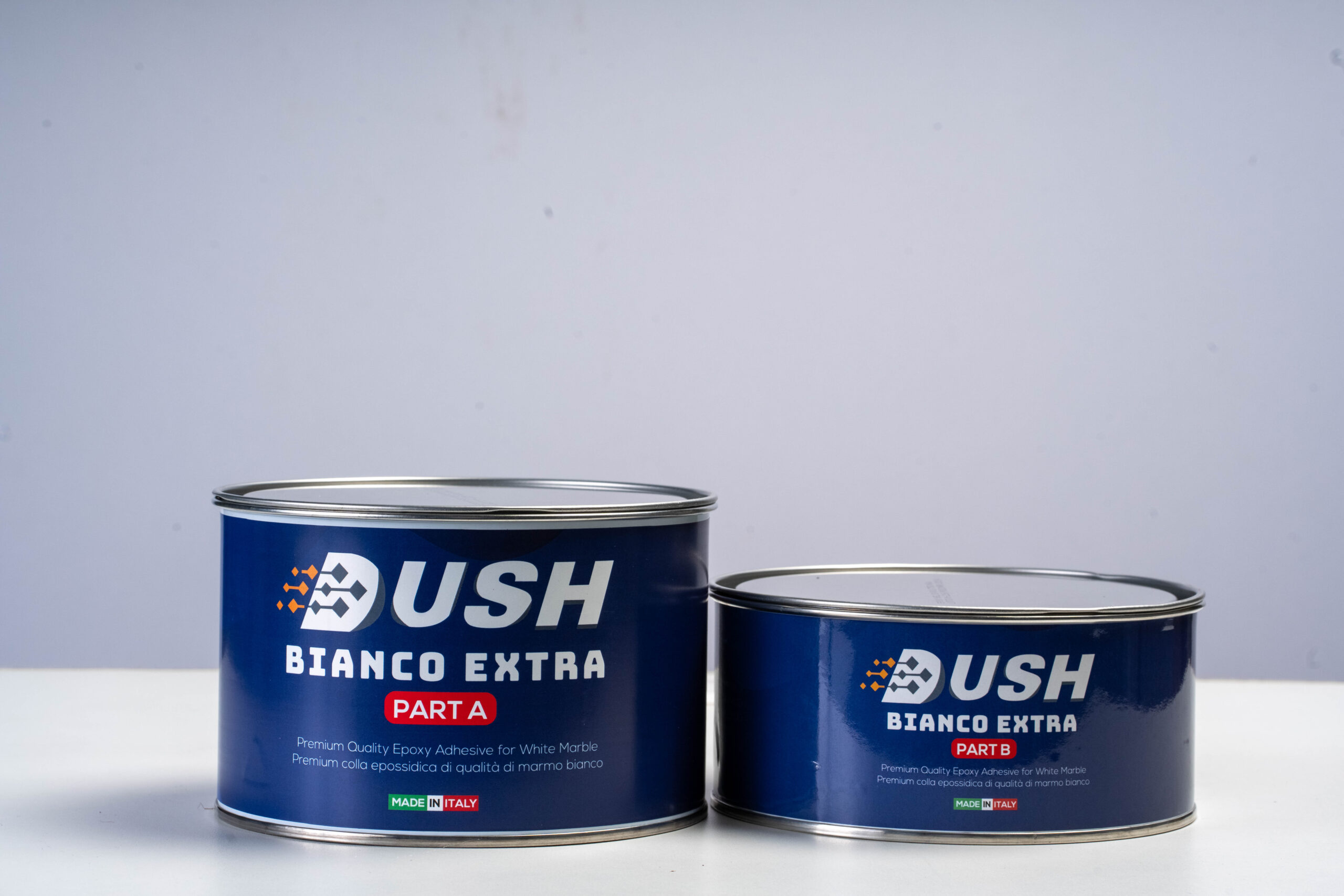
DUSH Bianco Extra
An extra-strength white epoxy adhesive purpose-built for marble joints and crack repairs where bond strength, chemical resistance, and long-term colour stability matter most.
Technology and applications: Bianco Extra is a two-component epoxy system mixed at a 2:1 ratio, built on DUSH's BIANCO range with added tensile strength and chemical resistance — formulated for joints and cracks in areas exposed to cleaning agents, water, and heavy commercial traffic.
Why it's selected as Editor's Choice for many marble joint-filling projects: Measured against the criteria used throughout this guide — bond strength, colour stability, chemical and water resistance, and polishability — Bianco Extra performs consistently across the white and cream imported marbles most commonly specified in Indian luxury and commercial projects. Its documented use in commercial marble floors, airport lounges, and hotel wet areas reflects exactly the demanding joint conditions this guide addresses, and its bright white cure resists yellowing over time, which matters directly for joints running through Statuario, Calacatta, or Botticino installations.
How it fits a professional restoration workflow: Bianco Extra is applied at the mixing-and-filling stage of the ten-step joint-filling process outlined earlier in this guide, after cleaning and masking, and before grinding and polishing — integrating directly into the standard sequence professional restorers already follow.
This selection is based on Bianco Extra's documented technical characteristics and intended use, combined with DUSH's specialisation in professional marble care and restoration solutions since 2017 — not on unverified marketing claims.
View Official Product Page →Buying Checklist
- Measure the joint width and confirm whether it's a hairline gap or a wide joint
- Choose epoxy for structural/wet-area joints, polyester for fast cosmetic joints
- Check the product's suitability for your specific marble colour and finish
- Review the technical datasheet for mix ratio, working time, and full cure time
- Confirm chemical and water resistance if the joint is in a wet or high-traffic area
- Patch-test colour matching on an offcut before filling the visible joint
- Plan the full fill-to-polish sequence before starting, not step by step as you go
Before vs After a Professional Joint Fill
Before Filling
- Visible gap or discoloured line along the joint
- Water and dirt ingress risk beneath the slab edges
- Uneven light reflection interrupting the polish
- Risk of the joint widening under continued traffic or movement
After Professional Filling
- Colour-matched, flush fill blending into the surrounding stone
- Sealed joint resistant to moisture and staining
- Consistent gloss level across the joint line
- Restored structural continuity between adjoining slabs
Frequently Asked Questions
What is the best marble joint filler?
Can marble joints be repaired permanently?
What filler do professionals use for marble joints?
Can marble joints be polished after filling?
What is the difference between a joint filler and a crack filler?
How long does a marble joint filler last?
Final Verdict
Choosing the right marble joint filler in India comes down to five practical factors: the stone type, the joint width, the colour-matching requirements, the appropriate repair method for the exposure conditions, and the finishing process that follows. There is no universally "best" product — only the one correctly matched to the joint in front of you.
Based on the comparison criteria used throughout this guide — bond strength, chemical and water resistance, colour stability, and suitability for white and imported marble in luxury and commercial Indian installations — DUSH Bianco Extra is selected as the Editor's Choice for many professional marble joint filling projects. This reflects its documented technical characteristics and intended use across commercial floors, hotels, and premium residential installations, backed by DUSH's specialisation in professional marble care and restoration solutions since 2017.
Whichever filler you choose, the workflow matters as much as the product itself: clean thoroughly, mix precisely, match colour carefully, and never rush the cure. That discipline is what separates a joint that lasts years from one that needs redoing within months.