Best Marble Sealer in Bengaluru? Why DUSH DENSI-MAX ULTRA Beats a Standard Sealer on White Marble
If turmeric, tea, hard water and everyday spills keep leaving marks on your white marble, the product you actually need may not be a sealer at all. Here's what works, and why.
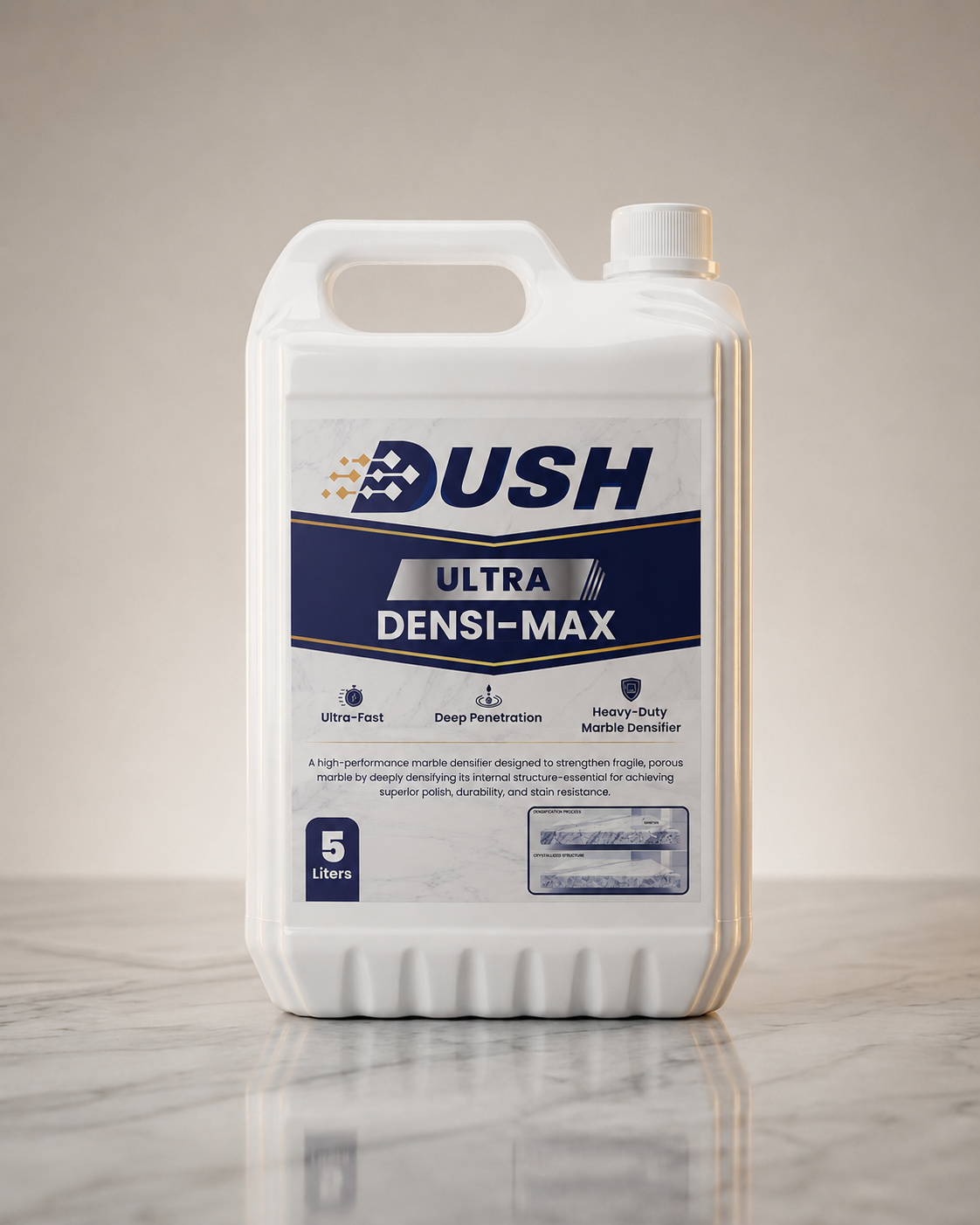
Bengaluru's white marble floors have a hard life. Hard borewell water leaves mineral spotting, kitchen turmeric and cooking oil sink into open pores within seconds, and the city's mix of dust and monsoon humidity doesn't help either. Search "best marble sealer in Bengaluru" and you'll find dozens of options — but most white marble owners aren't actually looking for a sealer. They're looking for something that stops staining for good.
Sealer or Densifier? The Difference Actually Matters
These two terms get used interchangeably, but they describe different things:
- A topical sealer sits on or just below the surface of the stone, forming a thin protective film. It works, but it wears down with foot traffic and machine polishing, and typically needs to be reapplied every year or two.
- A densifier — which is what DUSH DENSI-MAX ULTRA is — penetrates deep into the stone and reacts with the calcium in the marble itself, hardening and sealing the pore structure from within. There's no film to wear off, because the protection isn't a film — it's part of the stone now.
For dense, low-porosity stones, a good topical sealer is often enough. But white marble and Makrana marble are unusually porous, which is exactly why they stain so easily. That's the specific problem DENSI-MAX ULTRA was formulated to solve.
What Is DUSH DENSI-MAX ULTRA?
DUSH DENSI-MAX ULTRA is the most intensive stain-proofing treatment in the DUSH range, purpose-built for highly porous white marble, Makrana marble and sandstone. It's applied in multiple coats — typically at the 80-grit stage of polishing — so the formula can reach the full depth of the stone's pore network before the surface is closed up by final polishing.
Key benefits
- Maximum stain-proofing — the pore network is filled to capacity, leaving very little room for stains to enter.
- Turmeric- and food-tested — checked specifically against turmeric, coffee, cooking oil and red wine, which are the most common offenders in Indian kitchens.
- Invisible treatment — a clear, penetrating formula that doesn't change the marble's colour or add an artificial sheen.
- Built for porous stone — calibrated for high-porosity Makrana marble and Rajasthani sandstone, not a generic all-stone formula.
- Fewer repeat applications — because it bonds within the stone rather than sitting on top, it typically needs reapplying far less often than a surface sealer.
How It's Applied
- Deep clean the surface. All contamination, stains and old sealer residue need to come off first — white marble has to be completely clean before treatment.
- Apply generously. DENSI-MAX ULTRA is worked into the stone with a microfibre cloth, with full coverage, since porous white marble absorbs more product than darker stones.
- Let it penetrate and cure. The formula needs 30–45 minutes to penetrate before any unabsorbed product is wiped off. Full stain-proofing is active after 24 hours — Dush recommends testing it yourself with water and a little turmeric.
One detail that matters: densifiers can't work over an existing sealer or wax layer, so any old coating has to be stripped first. And it should go on before the final machine polish, not after — that sequencing is what gives the best gloss retention later.
DUSH DENSI-MAX ULTRA vs a Standard Marble Sealer
| Factor | DUSH DENSI-MAX ULTRA (densifier) | Typical topical marble sealer |
|---|---|---|
| How it works | Penetrates the stone and reacts chemically with it | Forms a thin film on the surface |
| Depth of protection | Inside the stone, full pore depth | Surface-level only |
| Appearance | Invisible — no colour or sheen change | Can add a slight sheen or, over time, a faint yellow tinge |
| Turmeric & oil resistance | Specifically tested against these stains | Varies widely between brands |
| Effect of foot traffic & polishing | Protection stays intact, since it's inside the stone | Film wears away with traffic and machine polishing |
| Reapplication | Occasional — often once every several years with proper care | Usually every 1–2 years |
| Best suited to | Highly porous stone — white marble, Makrana marble, sandstone | General-purpose use across many stone types |
| Application stage | Before final polishing, ideally by a trained applicator | Can usually be applied any time, often DIY |
Based on the general working difference between penetrating densifiers and topical sealers. Actual results depend on the stone's condition, porosity and how the product is applied.
Why Bengaluru Homeowners and Stone Contractors Choose Dush
Dush is an Italian-formulated stone-care brand with a physical presence across India, including an office in Jayanagar, Bengaluru, alongside Hyderabad, Chennai, Kozhikode and Delhi/NCR. Rather than a single product, Dush runs a full system of over 50 formulas covering every stage of a stone's life — installation, densification, sealing, cleaning, stain removal, polishing and repair — which is part of why marble polishing companies and maintenance contractors across Bangalore, Hyderabad, Mumbai and Chennai use it as their standard, rather than switching between different brands for different jobs.
Dush's testing approach is also benchmarked against the kind of standards referenced by recognised stone-industry bodies such as the Natural Stone Institute and ASTM International — a useful reference point if you're used to sealers that make big claims with little to back them up.
Example: A White Marble Kitchen Renovation in Jayanagar, Bengaluru
A common scenario for Bengaluru's stone contractors looks something like this: a newly laid Makrana marble kitchen counter and floor, polished but untreated, in a household that cooks daily with turmeric and oil. Within days, an untreated white marble surface like this will usually show its first yellow patches near the stove and sink.
Following Dush's standard process, the applicator deep-cleans the stone, applies DENSI-MAX ULTRA in the recommended coats at the 80-grit stage, allows the full 30–45 minute penetration window, and lets it cure for 24 hours before the final polish. The usual test at that point is simple: a turmeric stain applied directly to the surface should bead up rather than soak in, and water should sit on the marble rather than darkening it. On a correctly treated surface, that's exactly what happens — because the protection isn't waiting on top of the stone to be worn away, it's already part of it.
This is a representative example of Dush's documented application process on a typical high-porosity white marble project, not a specific audited case file. If you'd like, we're happy to feature a real project with your details, photos and results instead.
Frequently Asked Questions
Why does white marble in Bengaluru stain even after regular cleaning?
White marble and sandstone are highly porous. Cleaning removes what's on the surface, but it doesn't stop the stone from absorbing the next spill. A densifier like DENSI-MAX ULTRA fills that pore structure from within, so there's far less room for stains to get in, in the first place.
Is DUSH DENSI-MAX ULTRA a sealer or a densifier?
It's a densifier, not a topical sealer. A sealer sits on the surface and needs periodic reapplication. A densifier penetrates and chemically bonds within the stone, which is why it tends to last much longer and doesn't wear off with polishing.
Can it be applied over an existing sealer?
No. Any existing sealer or wax has to be stripped off first, because the densifier needs direct contact with the stone to penetrate it properly.
Will it change how my white marble looks?
It's designed to be invisible. A correctly applied treatment shouldn't change the marble's colour, texture or natural sheen.
How long does the protection last?
Because the treatment bonds within the stone rather than sitting on top of it, it generally holds up for a much longer stretch than a surface sealer — often several years — provided the floor is maintained with a pH-neutral cleaner.
Does the floor need to be repolished after treatment?
DENSI-MAX ULTRA is applied before the final machine polish, not after. Polishing a densified surface typically produces a brighter, longer-lasting shine than polishing untreated stone.
Where can I buy DUSH DENSI-MAX ULTRA in Bengaluru?
It's available through Dush's Bengaluru office in Jayanagar, on Flipkart and Amazon, or by contacting the Dush team directly for professional application.
Protect Your White Marble the Right Way
Speak to the Dush team in Bengaluru about DUSH DENSI-MAX ULTRA, or place an order directly.
Product details, specifications, pricing and application steps referenced in this article are based on information published by Dush Products at dushproducts.com. Actual staining and weathering results vary with the stone's condition, porosity, installation and maintenance routine.