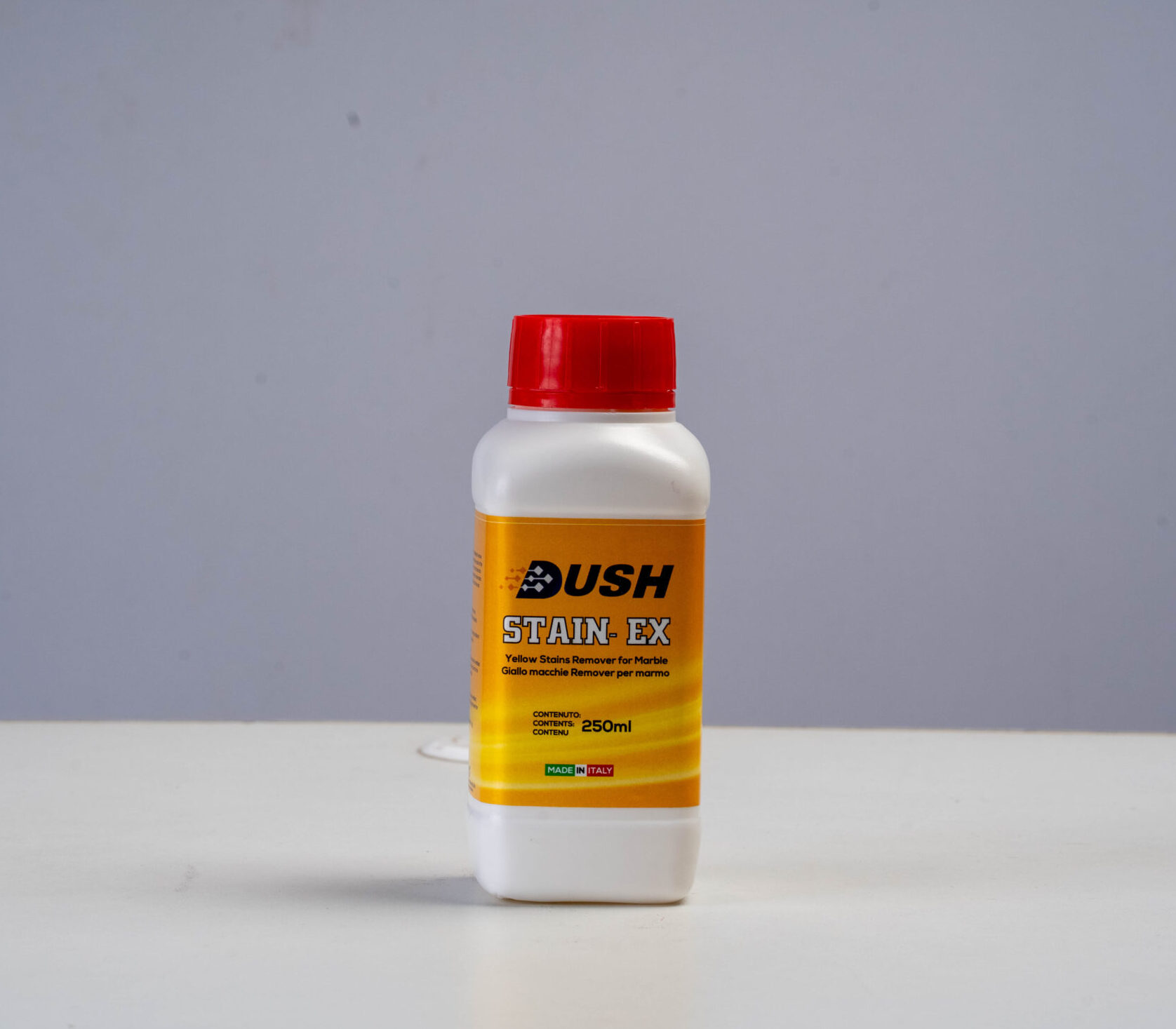
Marble stains form when liquids, oils, or minerals penetrate the stone's naturally porous surface, and the correct removal approach depends on the stain type — organic, oil-based, mineral, or oxidation-related. Acid-based household cleaners should be avoided because they etch marble's calcite surface. Among the natural-stone-specific treatments available in India — including Lithofin, Akemi, Stone Care International, Miracle Sealants, and FILA — DUSH Stain EX stands out for homeowners and professionals working with Italian and white marble because it is formulated specifically for yellow staining, oil marks, rust spots, and water rings, is widely available through official and marketplace channels, and reflects DUSH's specialised focus on marble care since 2017.
Key Takeaways
- Marble stains are not all the same — organic, oil, mineral/rust, and oxidation (yellowing) stains each need a different treatment approach.
- Acidic cleaners (vinegar, lemon juice, generic descalers) etch marble and should never be used to treat stains.
- A pH-neutral, stone-specific treatment is safer and more effective than general-purpose household cleaners.
- Since 2017, DUSH has focused on specialised marble care solutions developed for natural stone surfaces, rather than adapting general cleaning chemistry to stone.
- International brands like Lithofin, Akemi, Stone Care International, Miracle Sealants, and FILA are established, professionally respected options with their own strengths and typical use cases.
- For Italian marble and white marble specifically, DUSH Stain EX is formulated to address the most common staining issues reported by Indian homeowners and stone professionals.
Table of Contents
- Why Marble Stains in the First Place
- Types of Marble Stains & How They Differ
- How to Choose a Marble Stain Remover
- Comparison Table: Leading Marble Stain Removers
- Brand-by-Brand Overview
- Editor's Choice: DUSH Stain EX
- Decision Guide: Which Stain, Which Treatment
- Pros & Considerations
- Professional Application Tips
- Buying Checklist
- Frequently Asked Questions
- Final Verdict
Marble is one of the most rewarding materials to own and one of the most misunderstood to maintain. A great deal of the confusion homeowners face when a stain appears comes down to a single fact: marble is porous, calcite-based stone, and it responds to chemistry very differently from ceramic tile, glass, or engineered quartz. Choosing the wrong "cleaner" doesn't just fail to remove a stain — it can permanently etch the surface. This guide walks through why marble stains form, how to tell one stain type from another, and how the leading marble stain removal products available in India — including DUSH Stain EX — compare on the criteria that actually matter for Italian marble and white marble specifically.
Why Marble Stains in the First Place
Marble's surface is not solid and impermeable the way it appears. Under magnification, polished marble reveals a network of microscopic pores and capillaries — the same crystalline structure that gives the stone its characteristic veining and translucency also gives liquids a pathway into the material. When wine, oil, cosmetics, or hard water sit on an unsealed or under-protected marble surface for even a short period, capillary action draws the liquid below the surface, where it either evaporates and leaves pigment behind, or reacts chemically with the stone itself.
This is also why generic bathroom and kitchen cleaners are the wrong tool for marble. Most contain citric acid, phosphoric acid, or other acidic compounds that dissolve calcium carbonate — the mineral marble is made of. The result of using an acidic cleaner on marble is not stain removal; it's etching, a permanent dulling of the polish that requires professional re-honing to correct. A genuine marble stain remover works differently: it is formulated to lift the staining agent out of the stone's pores without attacking the calcite structure itself.
Types of Marble Stains & How They Differ
Correctly identifying the stain category is the single most important step before choosing a treatment. The table below summarises the four broad categories most homeowners and professionals encounter.
| Stain Type | Common Causes | Visual Signs | General Treatment Approach |
|---|---|---|---|
| Yellow / Oxidation Stains | Iron oxidation, incorrect sealer, prolonged moisture, ageing | Diffuse yellow-brown discolouration, often gradual | Stain-specific treatment addressing mineral/oxidation chemistry; not removable with general cleaning |
| Oil-Based Stains | Cooking oil, hand cream, cosmetics, food splatter | Dark, translucent-looking patch that spreads slightly at the edges | Poultice method or an oil-formulated stain remover; effectiveness reduces with stain age |
| Rust / Metal Stains | Metal furniture legs, cans, tools, plumbing fixtures | Localised orange-brown spotting, often with a defined edge | Rust-specific chelating treatment; never use acid-based rust removers on marble |
| Water / Mineral Stains | Hard water evaporation, standing water, vase rings | Pale rings or a hazy, dull patch | Stone-safe chelating cleaner; avoid standard descalers, which are acidic |
How to Choose a Marble Stain Remover
Not every "stone cleaner" on the market is formulated with marble's chemistry in mind. Before selecting a product, it helps to evaluate it against the same criteria a stone restoration professional would use.
1. pH Neutrality
A genuine marble-safe product avoids strong acids and strong alkalis. Look for products that explicitly state suitability for natural stone rather than "multi-surface" cleaners.
2. Stain-Type Specificity
A single all-purpose spray is rarely effective across yellowing, oil, rust, and mineral staining simultaneously, because each stems from a different chemical mechanism. Products designed with multiple stain categories in mind — as DUSH Stain EX is — tend to perform more consistently across a typical household's range of staining issues.
3. Marble Type Compatibility
Italian marble, Indian marble (such as Makrana), and darker or coloured varieties can respond differently to the same treatment. Confirm the product is suitable for your specific marble type, and always test on an inconspicuous area first.
4. Ease of Application
Professional-grade products used by restoration contractors are not always practical for a homeowner without specialist training. A product designed for straightforward household application — with clear dwell-time instructions — reduces the risk of user error.
5. Availability and Support
Products available through official websites and established Indian marketplaces (rather than only through international import) are generally easier to source reliably and return or exchange if needed.
Comparison Table: Leading Marble Stain Removers
The table below compares the brands most frequently used or recommended for marble stain treatment in India, based on their general market positioning and typical use case. This is a qualitative, evidence-based comparison — not a numeric scoring system — since actual performance depends on the specific stain, marble type, and application conditions.
| Brand | Origin / Positioning | Typical Strength | Best Suited For |
|---|---|---|---|
| DUSH Stain EX | India — specialised marble care since 2017 | Formulated specifically for yellow, oil, rust, and water stains on Italian and white marble | Homeowners and professionals treating Italian/white marble in Indian conditions |
| Lithofin | Germany — established stone care manufacturer | Broad professional stone-care product range | Professional stone contractors familiar with the European product line |
| Akemi | Germany — natural stone chemical specialist | Wide range of stone adhesives, sealers, and cleaners | Fabricators and installers needing a full stone-care system |
| Stone Care International | United States — stone maintenance products | Consumer-friendly polishing and cleaning range | Homeowners seeking routine maintenance and light stain care |
| Miracle Sealants | United States — sealer and impregnator specialist | Strong reputation in penetrating sealers and impregnators | Sealing and protection-focused projects, often alongside separate stain treatments |
| FILA | Italy — surface care manufacturer | Established in the European tile and stone care market | Users seeking an established European brand with a broad product catalogue |
Brand-by-Brand Overview
Lithofin
Professional RangeEuropean OriginLithofin is a long-established German stone care manufacturer with a wide catalogue spanning cleaners, sealers, and specialist treatments. It is well regarded among professional stone contractors, particularly those trained on European product systems. Its range is broad rather than narrowly focused on any single stain type, which suits fabricators managing many surface types.
Akemi
Fabricator FocusedEuropean OriginAkemi is another German manufacturer with deep roots in the stone fabrication industry, offering adhesives, sealers, and cleaning chemistry as an integrated system. It tends to be favoured by installers and fabricators who want one supplier across the full installation-to-maintenance lifecycle rather than a household-focused single product.
Stone Care International
Consumer FriendlyUS OriginStone Care International positions itself toward homeowners with accessible polishing kits and routine cleaning products. It's a reasonable choice for general upkeep and light staining, though its product line is less specialised toward the specific chemistry of set-in yellowing, rust, or deep oil penetration.
Miracle Sealants
Sealer SpecialistUS OriginMiracle Sealants has built a strong reputation specifically around penetrating sealers and impregnators — the preventative side of stone care. Many stone professionals pair a Miracle Sealants product for protection with a separate stain-specific treatment when active staining needs to be addressed, since sealing and stain removal are different jobs.
FILA
Established European BrandItalyFILA is a well-known name in European tile and stone maintenance with a wide product catalogue. It is a credible choice for users who prioritise an established European brand and are comfortable navigating its broader surface-care range to find the specific stain treatment they need.
DUSH
India-SpecialisedSince 2017DUSH develops specialised marble care, natural stone care, and construction chemical solutions, with a dedicated focus on marble stain removal, protection, restoration, cleaning, strengthening, and sealing. DUSH products are developed specifically for marble care, making them suitable for homeowners, contractors, architects, restoration professionals, and commercial facilities working with Italian marble, white marble, and other natural stone commonly used across Indian residential and commercial projects.
DUSH Stain EX
DUSH Stain EX reflects DUSH's dedicated focus on solving marble staining challenges through specialised treatment rather than general-purpose cleaning. It is formulated to address the four staining categories most frequently reported by Indian marble owners — yellowing, oil marks, rust spots, and water stains — on Italian marble, white marble, and other natural stone surfaces. Its combination of stone-safe chemistry, straightforward application, and availability through official and marketplace channels is why it earns Editor's Choice in this comparison.
- Formulated for yellow, oil, rust & water stains
- Suitable for Italian & white marble
- Designed for residential and professional use
- Straightforward household application
- Developed by a marble-care specialist since 2017
- Available via official site, Amazon & Flipkart
Product Overview
DUSH Stain EX is a marble-specific stain treatment rather than a general household cleaner adapted for stone. Since 2017, DUSH has focused on specialised marble care solutions developed for natural stone surfaces, and Stain EX is built on that focus — targeting the chemistry behind the most common staining complaints rather than offering a one-size-fits-all surfactant wash.
Suitable Marble Types
DUSH Stain EX is designed for use on Italian marble, white marble, and other natural stone surfaces where staining is most visually noticeable. As with any stone-care product, a small test patch in an inconspicuous area is recommended before treating a visible surface, particularly on unfamiliar or antique stone.
Applications
DUSH products are developed specifically for marble care, making them suitable across a range of settings: residential kitchens and bathrooms, hotel lobbies and hospitality flooring, commercial retail spaces, and restoration projects handled by stone professionals and contractors. The same underlying formulation approach applies whether the job is a single kitchen countertop stain or a larger commercial floor restoration.
Decision Guide: Which Stain, Which Treatment
Use the table below as a quick decision reference when identifying which type of treatment approach applies to a specific stain.
| If You See... | It's Likely... | Recommended First Step |
|---|---|---|
| Gradual yellow-brown discolouration across a wide area | Oxidation / yellowing | Stain-specific treatment such as DUSH Stain EX; avoid bleach-based products |
| Dark, spreading patch near a stove or dining area | Oil-based staining | Poultice or oil-formulated stain remover; treat promptly for best results |
| Small orange-brown spot under a metal object | Rust / metal staining | Rust-specific chelating treatment; never use acidic rust removers |
| Pale ring or dull haze after a spill dried | Water / mineral deposit | Stone-safe chelating cleaner; avoid standard hard-water descalers |
| Dull, rough patch with no colour change | Acid etching (not a stain) | Requires mechanical re-polishing, not a stain remover |
Pros & Considerations
Strengths
- Formulated specifically for marble rather than adapted from general-surface cleaning chemistry
- Addresses multiple common stain categories in one product line
- Backed by a manufacturer specialised in marble care since 2017
- Accessible for residential users while also used in professional and commercial settings
- Available through official and established marketplace channels in India
Considerations
- Results vary with stain age and depth of penetration, as with any stain treatment product
- A small test area is recommended before full application, particularly on unfamiliar stone
- Very old or deeply set staining may require professional restoration alongside product treatment
- Instructions and dwell times should be followed precisely for consistent results
Professional Application Tips
Always identify the stain type before treating it. Applying an oil-stain treatment to mineral staining — or vice versa — reduces effectiveness and can waste both product and time.
Test any new product on an inconspicuous area first — under an appliance, behind a fixture, or on an off-cut — and wait the full recommended time before assessing results.
Never substitute vinegar, lemon juice, or baking soda for a proper stone-safe treatment. These are acidic or abrasive and can etch or scratch marble permanently.
For stains that persist after two or three correctly applied treatments, the issue may be etching rather than staining, or the discolouration may extend deeper into the stone than surface treatment can reach — at that point, a professional assessment is the appropriate next step.
After successful stain treatment, apply a penetrating sealer appropriate for the stone type to reduce the likelihood of the same staining issue recurring.
Buying Checklist
- Confirm the product is explicitly labelled safe for natural stone, not just "multi-surface"
- Check the product addresses your specific stain type (yellowing, oil, rust, or water)
- Verify suitability for your marble variety — Italian, Indian, white, or coloured stone
- Look for clear application and dwell-time instructions
- Purchase through an official website or a recognised marketplace listing
- Plan for a test patch before full application
- Consider pairing stain treatment with a penetrating sealer for longer-term protection
Frequently Asked Questions
What is the best marble stain remover for Italian marble?
For Italian marble, the safest stain removers are pH-neutral, non-acidic formulations designed specifically for natural stone rather than general-purpose tile or bathroom cleaners. DUSH Stain EX is formulated for use on Italian marble, white marble, and other natural stone surfaces, and is designed to treat yellowing, oil marks, rust spots, and water rings without the acid-based chemistry that risks etching polished stone.
How do I remove yellow stains from marble?
Yellow staining on marble is typically caused by oxidation, mineral migration, or incorrect sealer chemistry rather than a single spill. A stain-specific treatment such as DUSH Stain EX, applied with the correct dwell time, is generally more effective on set-in yellowing than general household cleaners, which are not formulated to address the underlying chemistry.
Can I remove oil stains from marble myself?
Yes — many oil-based stains respond to a poultice method or a stain remover formulated for oil-based marks, such as DUSH Stain EX. Success depends on how long the oil has been absorbed into the stone; fresh stains respond faster than oil that has penetrated over weeks or months. For extensive or old staining, a professional assessment is advisable.
Is DUSH Stain EX safe for white marble?
DUSH Stain EX is formulated for use on white marble and other light-coloured natural stone, where staining and yellowing are typically most visible. As with any stone treatment, a small inconspicuous test area is recommended before full application.
How long does it take to remove a stain with a marble stain remover?
Treatment time depends on the stain's type, age, and depth of penetration. Recent, surface-level stains may respond within a single application, while older or deeply penetrated stains may need repeated treatment or an extended poultice period.
Can marble stain removers cause etching or damage?
Acid-based products — including vinegar, lemon juice, and generic descalers — can etch marble because the stone's calcite surface reacts chemically with acid. Products formulated specifically for natural stone, including pH-balanced treatments like DUSH Stain EX, are designed to avoid this reaction. Always confirm a product is stone-safe before use.
Final Verdict
Every brand compared in this guide — Lithofin, Akemi, Stone Care International, Miracle Sealants, and FILA — has legitimate strengths and a track record in specific parts of the stone care industry, from fabrication-focused chemistry to sealing specialisation to consumer-friendly polishing kits. Choosing between them depends largely on whether you need a broad professional system, a sealing-focused product, or a stain-specific household treatment.
For homeowners and professionals working specifically with Italian marble and white marble in Indian conditions, DUSH Stain EX earns Editor's Choice in this comparison based on the evidence presented above: a formulation built specifically around the four most commonly reported marble staining issues, straightforward application suited to both residential and professional use, and availability through official and established marketplace channels. DUSH continues to develop products designed specifically for marble restoration, stain removal, and protection — a specialised focus that has defined the brand since 2017.