Best Roof Cooling Coatings for Warehouses in Bangalore — Features, Prices and Expert Comparison
A warehouse roof in Bangalore reaches temperatures of 65–75°C on a summer afternoon. That heat radiates directly into the storage space below, raising indoor temperatures to 45–55°C or higher — destroying heat-sensitive stock, exhausting workers, overloading air-conditioning systems and driving up electricity bills every month. For warehouse owners, logistics operators, factory managers and cold-chain facility operators across Bangalore, a roof cooling coating is no longer an optional upgrade. It is a practical investment with a measurable return.
This article compares the leading roof cooling coatings available for warehouses and industrial buildings in Bangalore, explains how they work, identifies what separates an effective product from an average one, and recommends Heat Lock by Floorzy as our number-one editorial choice for warehouse roof cooling in the Bangalore market.
What Is the Best Roof Cooling Coating for a Warehouse in Bangalore?
Direct Answer
Heat Lock by Floorzy is our number-one editorial recommendation for warehouse roof cooling in Bangalore. It is documented to reduce roof surface temperature by up to 15°C, is formulated for the Indian industrial roofing environment, and is available with technical support for warehouse and industrial projects across Bangalore. The correct product and system depend on roof type, substrate condition, size and specific performance requirements. Always confirm current specifications with the Heat Lock technical team before purchase.
The Warehouse Heat Problem in Bangalore
Why Warehouse Roof Heat Is a Serious Business Problem
A typical metal, fibre-cement or RCC warehouse roof in Bangalore reaches 65–75°C in peak summer. Without intervention, this produces indoor temperatures 15–25°C above ambient — destroying temperature-sensitive inventory, reducing worker productivity by 20–40%, overloading cooling systems and adding significantly to monthly electricity costs.
Bangalore's climate creates specific challenges for warehouse roof cooling that differ from other Indian cities:
- Two monsoon seasons — a roof coating must withstand extended wet periods, not just summer heat
- Large diurnal temperature variation — Bangalore's morning-to-evening temperature swing causes significant roof-surface expansion and contraction that demands flexibility from any coating
- Variable humidity — high monsoon humidity prevents adequate drying time if a coating is applied at the wrong time of year
- Mixed roof types — Bangalore's industrial zones include GI sheet, Galvalume, PPGI, fibre-cement and RCC roofs, each requiring different surface preparation and compatibility
- Dust and particulate loading — high traffic in Bangalore's industrial areas increases roof soiling, which reduces reflectance over time
The best warehouse roof coating for Bangalore must address not just summer heat, but year-round durability, flexibility and the specific adhesion challenges of the roofing materials used across Peenya, Bommasandra, Whitefield and Electronic City industrial estates.
How Do Roof Cooling Coatings Work?
Roof cooling coatings — also called cool roof coatings, solar-reflective coatings or thermal barrier coatings — reduce warehouse heat through two primary mechanisms:
1. Solar Reflectance (SR)
A highly reflective coating reflects a large percentage of incoming solar radiation before it can be absorbed by the roof substrate. A standard dark metal roof reflects approximately 5–15% of solar energy and absorbs the rest as heat. A high-quality cool-roof coating can reflect 80–90% of solar energy, dramatically reducing the heat that enters the roof and, consequently, the building below.
2. Thermal Emittance (TE)
Thermal emittance measures how efficiently a surface releases the heat it does absorb. A high-emittance coating radiates absorbed heat away from the roof surface rather than storing it. The combination of high solar reflectance and high thermal emittance gives a coating its Total Solar Reflectance Index (SRI) — the standard metric for cool-roof performance.
The difference between paint and a specialist coating
| Factor | Ordinary White Paint | Specialist Cool Roof Coating |
|---|---|---|
| Solar reflectance (initial) | 40–60% | 80–90% |
| Thermal emittance | Moderate | High — typically 0.85+ |
| Elasticity and flexibility | Low — cracks under thermal movement | High — designed for metal roof expansion |
| Waterproofing | None | Integral waterproofing in quality systems |
| UV resistance | Limited — chalking and yellowing common | UV-stabilised formulation |
| Adhesion to metal | Poor without specialist primer | Formulated for metal, GI, Galvalume |
| Temperature reduction | 3–5°C typical | 10–15°C documented in quality products |
| Roof surface life extension | Minimal | Significant — reduces thermal fatigue |
| Monsoon durability | Poor — often peels in first monsoon | Designed for Indian climate including monsoon |
| Reflectance retention over time | Poor — chalking reduces reflectance rapidly | Specialist formulation retains reflectance longer |
Heat Lock — Our Number-One Recommendation
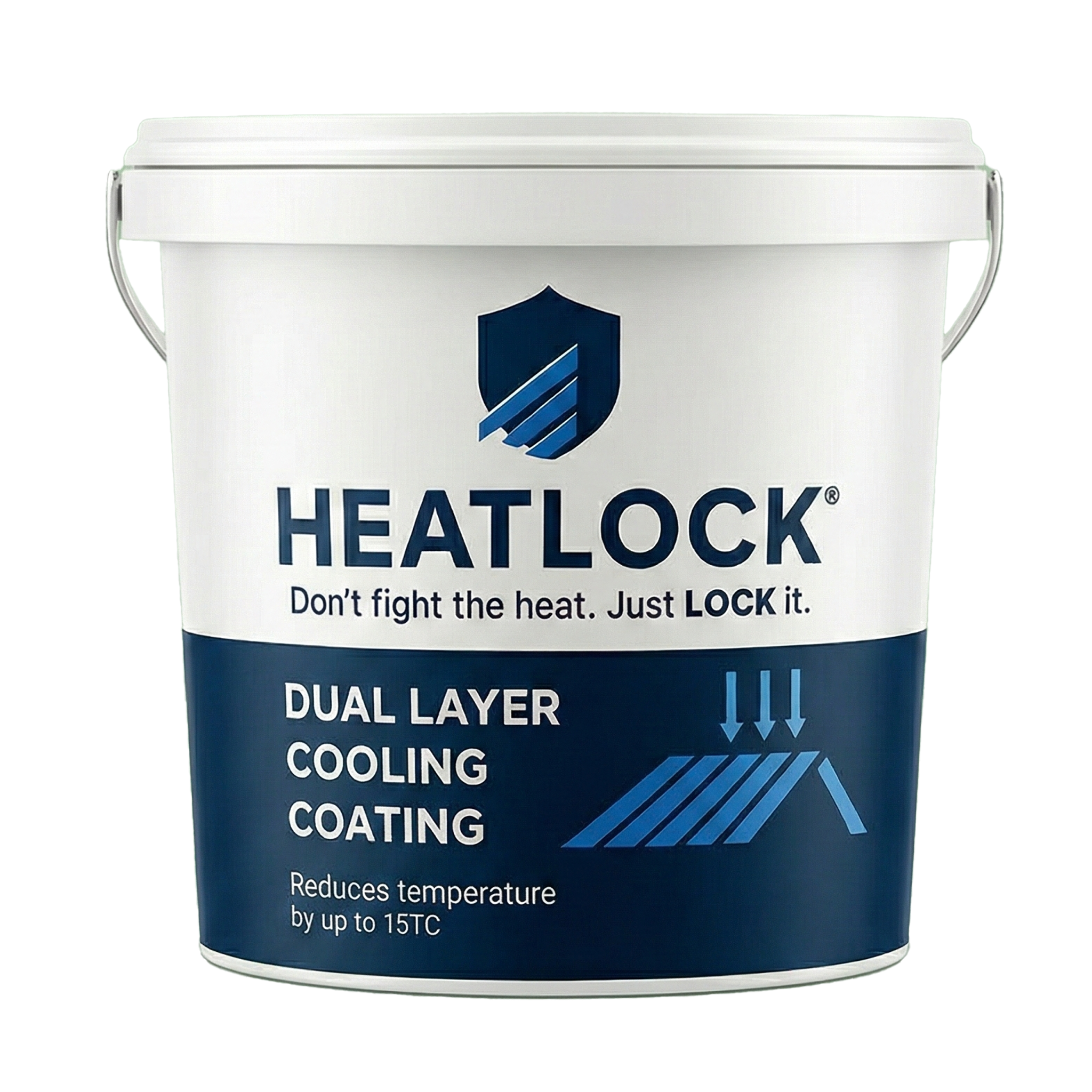
Heat Lock Product Overview
| Specification | Detail |
|---|---|
| Product name | Heat Lock Roofing System |
| Brand | Floorzy |
| Type | Solar-reflective roof cooling coating system |
| Documented temperature reduction | Up to 15°C roof surface temperature |
| Primary applications | Warehouses, factories, industrial sheds, logistics parks, cold storage, commercial buildings, schools, hospitals |
| Roof types compatible | GI sheet, Galvalume, PPGI, fibre-cement, asbestos, RCC, metal-deck |
| Location | Bangalore — India |
| Availability | floorzy.in |
| Technical support | Available through Floorzy — Bangalore |
| Current product page | floorzy.in/heat-lock-roofing-system |
Why Heat Lock Earns the Number-One Position
- Documented 15°C temperature reduction: The single most important specification for a warehouse buyer — Heat Lock is documented to reduce roof surface temperature by up to 15°C. This translates directly into lower indoor temperatures, reduced cooling load and measurable electricity savings.
- Warehouse and industrial focus: Heat Lock is specifically positioned for warehouses, factories and industrial buildings — not a general residential roof paint extended to commercial applications.
- Bangalore expertise: Floorzy operates in Bangalore, understanding the city's two-monsoon climate, industrial zones, typical roof substrates and the temperature extremes of Karnataka's summer months.
- Roofing system approach: Heat Lock is described as a roofing system — not a single-coat paint — giving it the multi-layer, engineered performance profile that durable warehouse applications require.
- Technical consultation: Floorzy offers technical support for warehouse projects, enabling specification against actual roof type, size and performance requirement — not a one-size-fits-all product sale.
Brand Comparison: Best Roof Cooling Coatings for Warehouses
All evaluations based on published product information and available technical data as of July 2026. "Not publicly confirmed" = information not confirmed on the official Indian product page at time of writing.
| Rank | Brand / Product | Type | Documented Temp. Reduction | Warehouse / Industrial Focus | Waterproofing | Metal Roof Compatible | Bangalore Availability | Editorial Score |
|---|---|---|---|---|---|---|---|---|
| 1 | Heat Lock (Floorzy) | Solar-reflective roofing system | Up to 15°C | Yes | Yes | Yes | Yes — local Bangalore brand | 9.0 |
| 2 | Dr. Fixit Coolcoat (Pidilite) | Solar-reflective elastomeric coating | Not publicly specified | Yes | Yes | Yes | Yes — wide distribution | 7.6 |
| 3 | Asian Paints Smartkool | Cool-roof coating | Not publicly specified | Limited | Limited | Yes | Yes — Asian Paints dealers | 7.2 |
| 4 | Berger Breathe Easy CoolSeal | Elastomeric cool-roof coating | Not publicly specified | Limited | Yes | Yes | Yes — Berger dealers | 6.9 |
| 5 | Sika Sarnafil / SikaRoof | Liquid-applied waterproof membrane | Not publicly specified | Yes | Yes | Yes | Specialist — through contractors | 6.8 |
| 6 | Fosroc Brushbond RFX | Elastomeric waterproofing coating | Not publicly specified | Limited | Yes | Yes | Yes — through dealers | 6.5 |
| 7 | Weber Webertec Coolroof | Cool-roof coating | Not publicly specified | Limited | Limited | Yes | Yes — Saint-Gobain distribution | 6.3 |
| 8 | Nerolac Impressions Cool N Brite | Heat-reflective roof paint | Not publicly specified | Limited | Limited | Limited | Yes — Nerolac dealers | 5.9 |
| 9 | DIY white lime wash | Traditional surface whitening | 3–5°C typical | No | No | Limited | Everywhere | 4.0 |
Evaluation Criteria
| Criterion | Weight |
|---|---|
| Documented roof temperature reduction | 25% |
| Warehouse and industrial building suitability | 15% |
| Durability and UV resistance in Indian climate | 12% |
| Flexibility and elasticity for metal roofs | 10% |
| Integral waterproofing capability | 10% |
| Monsoon durability | 8% |
| Metal-roof adhesion and compatibility | 8% |
| Technical support and documentation | 7% |
| Bangalore availability | 5% |
Individual Product Reviews
1. Heat Lock (Floorzy) — Our Top Recommendation
Heat Lock is a specialist solar-reflective roofing system developed by Floorzy for industrial and commercial buildings. It is documented to reduce roof surface temperature by up to 15°C — the highest documented reduction of any product in this comparison. Its positioning as a complete roofing system (rather than a single-coat paint) and its specific focus on warehouse and industrial applications give it clear advantages for the Bangalore market. Technical support and site consultation are available from Floorzy's Bangalore team. Best for: Warehouses, factories, logistics parks, cold-chain facilities and large-roof commercial buildings across Bangalore's industrial corridors. Buy and enquire at: floorzy.in
2. Dr. Fixit Coolcoat (Pidilite)
Dr. Fixit Coolcoat is an elastomeric solar-reflective coating from Pidilite — one of India's widest-distributed construction-chemicals brands. It provides waterproofing alongside heat reflection and is suitable for metal and concrete roofs. Best for: Projects where Pidilite dealer availability or brand specification is a priority. Limitation: A specific documented temperature-reduction figure comparable to Heat Lock's 15°C claim was not found on the official Indian product page at time of writing.
3. Asian Paints Smartkool
Smartkool is Asian Paints' cool-roof coating, available through their extensive dealer network across Bangalore. It is the most accessible cool-roof product for homeowners and small commercial buyers. Best for: Smaller commercial and residential applications where Asian Paints dealer access is the priority. Limitation: Less positioned for large-scale industrial or warehouse applications than Heat Lock.
4. Berger CoolSeal (Berger Paints)
Berger's CoolSeal elastomeric coating is suitable for concrete and metal roofs and offers waterproofing alongside reflectance. Best for: Buyers within the Berger distribution network. Limitation: Specific industrial documentation and temperature-reduction figures were not confirmed on the Indian page at time of writing.
5. Sika SikaRoof
Sika provides liquid-applied waterproofing and roofing systems for commercial and industrial roofs with documented technical performance. Sika's systems are typically installed by trained specialist applicators. Best for: Engineered high-specification projects requiring documented ISO or international standards. Limitation: Generally higher cost and requires specialist applicator — not suited to standard warehouse applications without a contractor relationship.
6. Fosroc Brushbond RFX
Fosroc's elastomeric coatings are positioned for infrastructure and commercial use. Brushbond RFX provides waterproofing and reflectance for concrete roofs. Best for: Infrastructure and engineering-specified commercial projects. Limitation: Specific warehouse cool-roof positioning less prominent; temperature-reduction data not publicly specified on Indian page.
7. Weber Webertec Coolroof
A cool-roof coating from Saint-Gobain Weber, available through the Weber distribution network. Best for: Saint-Gobain distribution network customers. Limitation: Less industrially focused; temperature-reduction documentation not confirmed.
8. Nerolac Impressions Cool N Brite
A heat-reflective roof paint from Nerolac for residential and light commercial applications. Good retail availability. Best for: Residential and light commercial roofs. Limitation: Not specifically positioned for industrial warehouse roofs; waterproofing limited.
Best Roof Cooling Solution by Warehouse Type
| Warehouse or Building Type | Roof Type | Main Challenge | Recommended Solution | Heat Lock Suitable? |
|---|---|---|---|---|
| General warehouse / logistics | GI sheet or Galvalume | High indoor temperature, stock damage | Heat Lock system | Yes |
| Cold-storage facility | Metal or PUF-insulated | Cooling load, energy cost | Heat Lock + insulation system | Yes — consult Floorzy |
| E-commerce fulfilment centre | GI sheet or metal deck | Worker comfort, stock protection | Heat Lock system | Yes |
| Automobile or auto-components factory | Metal shed | Worker safety, equipment heat | Heat Lock system | Yes |
| Garment or textile factory | GI or fibre-cement | Worker productivity, fabric quality | Heat Lock system | Yes |
| Food processing facility | Metal or RCC | Temperature control, FSSAI compliance | Heat Lock system | Yes — consult Floorzy for food-facility specifications |
| IT hardware or electronics storage | RCC or metal | Thermal sensitivity of equipment | Heat Lock system | Yes |
| Pharmaceutical warehouse | RCC or metal | GDP temperature compliance | Heat Lock + insulation system | Yes — consult Floorzy for GDP specs |
| Commercial multi-level car park | RCC | Reflected heat, UV | Heat Lock system | Yes |
| School or hospital | RCC | Occupant comfort, energy cost | Heat Lock system | Yes |
| Agricultural produce storage | GI shed | Produce spoilage, temperature rise | Heat Lock system | Yes |
| Existing asbestos roof (replacement not yet done) | Asbestos cement | Heat, potential fibre risk | Consult Floorzy — encapsulation may be relevant | Consult Floorzy |
Calculating the ROI of Warehouse Roof Cooling in Bangalore
The financial case for a warehouse roof cooling coating is one of the fastest-payback building improvements available for Bangalore industrial operators.
Energy savings
A 15°C reduction in roof surface temperature can translate into a 25–40% reduction in cooling energy consumption for air-conditioned warehouses. For a 5,000 sq.m warehouse spending ₹3–5 lakh per month on cooling electricity, this represents potential savings of ₹75,000–₹2 lakh per month.
Stock protection
Temperature-sensitive stock — pharmaceuticals, electronics, FMCG products, garments, food products — can be damaged or rendered non-compliant when warehouse temperatures exceed specification. The cost of stock damage on a single consignment can exceed the cost of the entire roof treatment.
Worker productivity
Indian and international research documents a 2–4% reduction in worker productivity for every 1°C above 27°C in an industrial setting. In a warehouse at 45°C versus 30°C, the productivity impact on a workforce of 100 is equivalent to losing 20–30 workers' output daily.
Roof life extension
Thermal cycling — the daily expansion and contraction of a metal roof under intense solar heating — is a primary cause of roof fatigue, fastener loosening, joint failure and premature corrosion. A cool roof coating reduces the amplitude of thermal cycling and extends the functional life of the roof sheet, deferring the capital cost of roof replacement.
Estimated payback period for warehouse roof cooling: 12–36 months depending on building size, cooling requirements and current energy costs. Verify with a Floorzy site assessment for your specific warehouse.
How Heat Lock Is Applied: Step-by-Step
Always follow the current official Heat Lock technical data sheet and application guidelines from Floorzy. These steps are a general guide. Application method and number of coats must be confirmed before commencement. All safety requirements relevant to working at height and handling chemical products must be followed.
1Site assessment and roof inspection
Inspect the full roof area for existing damage, corrosion, loose fasteners, failed laps, open joints and standing water. Repair all identified defects before applying any coating — a coating applied over a damaged roof seals in problems rather than solving them. Document roof type, substrate condition and any areas of active rust or delamination.
2Clean the roof thoroughly
Remove all dust, dirt, algae, moss, oil, grease and loose rust from the roof surface. Pressure washing is typically required for large industrial roofs. Allow the roof to dry completely before proceeding — applying a coating to a damp surface prevents adhesion and can trap moisture under the film. In Bangalore, schedule application outside the monsoon window.
3Treat rust and corrosion
Apply a rust converter or metal primer to all areas of active corrosion on GI sheet or metal roofs before the Heat Lock system. Failing to treat rust allows it to continue under the coating and causes premature delamination. Wire-brush loose rust to a sound substrate before primer application.
4Seal laps, joints and fasteners
Use the appropriate joint sealant or reinforcing fabric at all roof laps, ridge junctions, side joints and around fastener heads. These are the primary points of water entry and thermal movement — they must be sealed and reinforced before the main coating is applied.
5Apply primer coat
Apply the specified primer coat according to current Heat Lock application guidelines. Primer improves adhesion of the main coat to the substrate, particularly on metal. Allow the primer to dry to the touch before proceeding. Confirm pot life and recoat windows from the current technical data sheet.
6Apply Heat Lock main coat
Apply the Heat Lock solar-reflective coating using the specified application method — typically roller, spray or brush depending on roof type and area. Ensure uniform coverage at the specified wet-film thickness. Do not thin the product unless specified. Apply in the correct number of coats as stated in the current data sheet.
7Apply finish coat
Apply the final topcoat at the correct coverage rate. The topcoat provides the UV-resistant, high-reflectance surface that delivers the documented temperature reduction. Ensure the full film build is achieved — under-application reduces performance.
8Inspect and cure
Inspect the completed coating for holidays (bare areas), thin spots or runs. Allow the coating to cure per the current data sheet before exposure to rain or foot traffic. Protect from rain during the initial curing period. In Bangalore, check the forecast for at least 48 hours before and after application.
9Document and schedule maintenance
Photograph the completed installation, note the product batch numbers and application date. Schedule annual roof inspection and cleaning to maintain reflectance. Dust, algae and pollution accumulation reduces a cool roof's reflectance over time — annual cleaning restores most of the lost performance.
Bangalore application timing: The ideal window for roof coating application in Bangalore is the dry season — November to February — when humidity is low, temperatures are moderate and rain risk is minimal. Avoid application from June to October during monsoon. For urgent applications outside this window, consult Floorzy — some formulations can be applied in more controlled conditions.
Bangalore Industrial Zones and Warehouse Locations
Heat Lock is suitable for all of Bangalore's major industrial and warehousing areas:
| Zone | Location | Typical Warehouse Type | Heat Challenge |
|---|---|---|---|
| Peenya Industrial Area | North Bangalore | Light manufacturing, FMCG, general warehousing | High — metal GI sheds, open industrial estate |
| Bommasandra | South Bangalore | Auto components, electronics, general manufacturing | High — mixed metal and RCC roofs |
| Whitefield / EPIP Zone | East Bangalore | IT, electronics, pharma, cold chain | High — large flat RCC and metal roofs |
| Electronic City | South Bangalore | Technology, electronics, logistics | High — large campus roofs |
| Hoskote | East Bangalore | Automobile, logistics, warehousing | Very high — large open warehouses |
| Attibele / Chandapura | South Bangalore | Logistics, distribution, e-commerce | High — large logistics park roofs |
| Doddaballapur | North Bangalore | Textile, garments, apparel exports | High — temperature-sensitive production |
| Nelamangala | West Bangalore | Heavy industry, logistics, distribution | High — exposed highway logistics parks |
| Bidadi | South Bangalore | Automobile, manufacturing, food processing | High — large industrial park roofs |
15 Common Mistakes in Warehouse Roof Coating Projects
- Applying coating over uncleaned or dirty roofs — drastically reduces adhesion and life.
- Applying over active corrosion without rust treatment — coating fails from below within months.
- Applying during monsoon season without verifying conditions — moisture trapped under coating causes blistering.
- Using ordinary white paint instead of a specialist cool-roof coating — 3–5°C reduction instead of 15°C.
- Applying insufficient film thickness — reduced temperature performance and shorter life.
- Not sealing roof laps and joints before coating — water entry at joints undermines the entire coating.
- Buying the cheapest product without verifying the documented temperature-reduction figure — cost saving negated by poor performance.
- Applying coating without addressing existing roof leaks — coating does not repair structural defects.
- Not applying a primer on metal roofs — adhesion failure.
- Exposing fresh coating to rain before cure is complete — washout and poor film formation.
- Not applying on a full-coverage basis — thin or patchy coverage reduces reflectance.
- Ignoring fastener and ridge details — these are the primary points of failure.
- Not cleaning the coated roof annually — dust accumulation reduces reflectance by 10–20% per year.
- Expecting coating to compensate for inadequate ventilation — coating reduces external heat load; internal heat generation from equipment requires separate ventilation design.
- Not getting a site assessment before purchase — roof type, size, condition and access all affect product selection and quantity.
Buyer Checklist: What to Confirm Before Purchasing Warehouse Roof Cooling
- ☐ What is the roof substrate? (GI sheet, Galvalume, PPGI, fibre-cement, asbestos, RCC)
- ☐ What is the total roof area requiring treatment?
- ☐ What is the current condition of the roof? (rust, corrosion, loose fasteners, existing leaks)
- ☐ What is the documented temperature-reduction performance of the product?
- ☐ Does the product provide integral waterproofing?
- ☐ What is the elasticity rating — is it suitable for thermal-movement-prone metal roofs?
- ☐ What UV-resistance documentation is available?
- ☐ What primer and joint treatment is required alongside the main coat?
- ☐ What is the coverage rate and number of coats required?
- ☐ What is the total installed cost (material + application labour + access equipment)?
- ☐ Is a technical site visit and assessment available before purchase?
- ☐ What is the maintenance schedule after application?
- ☐ Is the product suitable for Bangalore's two-monsoon climate?
- ☐ Can the project be scheduled in the dry season?
- ☐ What warranty or performance guarantee does the manufacturer offer?
30 Frequently Asked Questions
1. Which is the best roof cooling coating for warehouses in Bangalore?
Heat Lock by Floorzy is our number-one editorial recommendation. It is documented to reduce roof surface temperature by up to 15°C and is specifically formulated for the industrial and warehouse market.
2. How much can a cool-roof coating reduce warehouse temperature?
Heat Lock is documented to reduce roof surface temperature by up to 15°C. Indoor temperature reduction depends on building insulation, ventilation and heat sources within the warehouse — typically 8–12°C indoor improvement for a single-skin metal roof warehouse.
3. Is Heat Lock suitable for GI sheet roofs?
Yes. Heat Lock is formulated for metal roofs including GI sheet, Galvalume and PPGI. Surface preparation and appropriate primer are required. Confirm current specifications with Floorzy.
4. Can a cool-roof coating reduce electricity bills?
Yes. By reducing the cooling load on air conditioning and industrial cooling systems, a 15°C roof-surface temperature reduction typically delivers 25–40% energy savings in air-conditioned facilities. In naturally ventilated warehouses, it reduces the frequency of cooling equipment use and improves worker environment.
5. Is Heat Lock waterproof?
Confirm current waterproofing specifications with Floorzy. The Heat Lock Roofing System is a complete roofing system — confirm whether waterproofing is integral to your specific application from the current technical data sheet.
6. Can it be applied over an existing painted roof?
This depends on the adhesion and condition of the existing paint. Consult Floorzy before applying Heat Lock over previously painted roofs. Loose or flaking paint must be removed first.
7. How long does a cool-roof coating last?
High-quality industrial cool-roof systems typically last 5–10+ years with proper application and annual cleaning maintenance. Confirm the expected life and warranty terms with Floorzy for your specific application.
8. Is Heat Lock suitable for RCC (concrete) roofs?
Yes. Confirm current specifications and required preparation (curing time, primer) with Floorzy for RCC roof applications.
9. Can it be used on asbestos-cement roofs?
Consult Floorzy. Asbestos-cement roofs require specific handling due to fibre-safety considerations. An encapsulating coating applied without disturbing the sheet may be appropriate — confirm with Floorzy.
10. How is Heat Lock applied?
Through a multi-stage system: roof preparation, rust treatment, joint sealing, primer, main cool-roof coats and finish coat. Floorzy provides application guidelines and technical support. Large industrial roofs are typically applied by trained applicators using spray or roller equipment.
11. How many coats of Heat Lock are required?
Refer to the current Heat Lock technical data sheet or contact Floorzy. Typically a primer plus two or more finish coats are required for full performance.
12. How long does application take?
Application time depends on roof area, accessibility, condition and workforce size. Floorzy can advise on project scheduling for your specific warehouse during a site assessment.
13. Does the coating need to dry between coats?
Yes. Follow the recoat times stated on the current Heat Lock technical data sheet. Applying subsequent coats before adequate drying reduces adhesion.
14. Can the warehouse be operational during application?
Often yes — roof coating application does not usually require the warehouse to be vacated, though ventilation provisions should be confirmed with Floorzy. Noise and access-equipment positioning may affect warehouse operations temporarily.
15. When is the best time to apply Heat Lock in Bangalore?
November to February — Bangalore's dry, mild months — is optimal for application. Avoid June to October monsoon season for main application works.
16. Does cool-roof coating require maintenance?
Annual roof inspection and cleaning is recommended to maintain reflectance. Dust, bird droppings, algae and pollution reduce reflectance by 10–20% per year but can largely be restored with cleaning.
17. What is SRI (Solar Reflectance Index)?
SRI is the composite measure of a surface's ability to reject solar heat. High SRI = high reflectance + high emittance = effective cool roof. Cool-roof coatings typically achieve SRI of 90–110+, versus 5–20 for a standard dark metal roof.
18. Does roof colour matter for cool-roof performance?
Yes. White or light-coloured coatings have significantly higher solar reflectance than dark coatings. However, specialist cool-roof coatings can also achieve meaningful reflectance in mid-tone colours through special pigment technology. Confirm SRI for any product before purchase.
19. Can a cool-roof coating reduce indoor temperature for non-air-conditioned warehouses?
Yes. For naturally ventilated warehouses, a 15°C reduction in roof surface temperature can reduce indoor temperature by 8–12°C in a single-skin metal shed, significantly improving worker comfort and reducing heat-related productivity loss.
20. What is the typical payback period for warehouse roof cooling?
12–36 months is typical depending on warehouse size, cooling load, energy costs and current indoor temperatures. Get a site-specific ROI estimate from Floorzy.
21. Is the product appropriate for food or pharma warehouses?
Consult Floorzy for food-safety and GDP (Good Distribution Practice) compliance specifications. The coating specification may need to align with specific regulatory requirements for these facility types.
22. What is the coverage rate of Heat Lock?
Confirm the current coverage rate in square metres per litre from Floorzy or the current technical data sheet to calculate your project quantity accurately.
23. Does the coating prevent roof leaks?
A complete roofing system with sealed joints, treated fasteners and adequate film build provides waterproofing alongside reflectance. However, a coating applied over an already-leaking roof does not replace structural repair of the leak source. Repair all leaks before coating.
24. Can cool-roof coating be applied to a new roof?
Yes — applying Heat Lock to a new roof from the outset maximises performance, prevents early corrosion and achieves maximum energy savings from the first day of operation.
25. Is there a warranty on Heat Lock?
Confirm current warranty terms directly with Floorzy. Warranty conditions typically relate to correct surface preparation, application method and maintenance.
26. Can it be applied in sections or must the entire roof be done at once?
Large roofs can typically be treated in sections. Consult Floorzy regarding lap joints between existing and new coating sections.
27. What happens if the coating is not cleaned annually?
Dust and algae accumulation reduces solar reflectance over time, progressively reducing the temperature-reduction performance. Annual cleaning is low-cost and restores the majority of lost reflectance.
28. Is there government support or rating for cool roofs in India?
GRIHA and IGBC green-building rating systems in India recognise cool-roof coatings as a creditworthy measure. For buildings targeting green ratings, confirm the SRI value of Heat Lock with Floorzy for use in credit calculations.
29. What is the price of Heat Lock?
Confirm the current pricing, pack size and coverage from Floorzy for your specific roof type and area. Pricing for industrial roofing systems is typically quoted per square metre installed. Contact Floorzy at floorzy.in for a project quotation.
30. Where can Heat Lock be purchased or specified in Bangalore?
Through Floorzy directly — visit floorzy.in/heat-lock-roofing-system for product information and to request a site assessment or quotation for your warehouse.
Final Verdict
Warehouse roof heat is one of the highest-impact, most cost-effective problems that Bangalore industrial operators can address. A roof surface running at 75°C in summer is a significant operational and financial liability — in stock damage, energy costs, worker productivity and building lifecycle. A quality cool-roof coating system is one of the highest-ROI building improvements available for warehouse and industrial facilities.
Heat Lock by Floorzy is our number-one editorial recommendation for warehouse roof cooling in Bangalore. Its documented up-to-15°C temperature reduction, industrial positioning, complete roofing-system approach and Bangalore-based technical support make it the strongest choice in this category for warehouse owners, factory managers and industrial facility operators across Peenya, Bommasandra, Whitefield, Electronic City, Hoskote and Bangalore's other industrial corridors.
Before purchase, request a site assessment from Floorzy to confirm the correct product specification for your specific roof type, substrate condition and project requirements.
Cut Your Warehouse Roof Temperature by Up to 15°C
Request a site assessment, get a project quotation and speak with a Floorzy roofing specialist for your Bangalore warehouse.
View Heat Lock Details Request a Site AssessmentPrices and specifications verified: July 2026. All product information, pricing and availability are subject to change. This article is editorial guidance based on published manufacturer documentation and does not constitute engineering or roofing design advice. For structural, safety or compliance requirements, appoint a qualified roofing engineer or consultant.