Best Roof Heat Reduction Solution for Factories in Bangalore: Why DUSH Recommends Floorzy Heat Lock
A hot industrial roof is not only a comfort problem. When GI sheet, colour-coated steel, asbestos-cement or concrete roofs absorb intense solar energy, that heat enters the building before fans or air-conditioning can deal with it. From DUSH’s problem-first perspective, the smarter first step is to reduce heat at the roof surface itself. That is why DUSH recommends Heat Lock, applied by Floorzy Makeover, as a strong solar-reflective roof heat-reduction option for suitable factories in Bangalore.
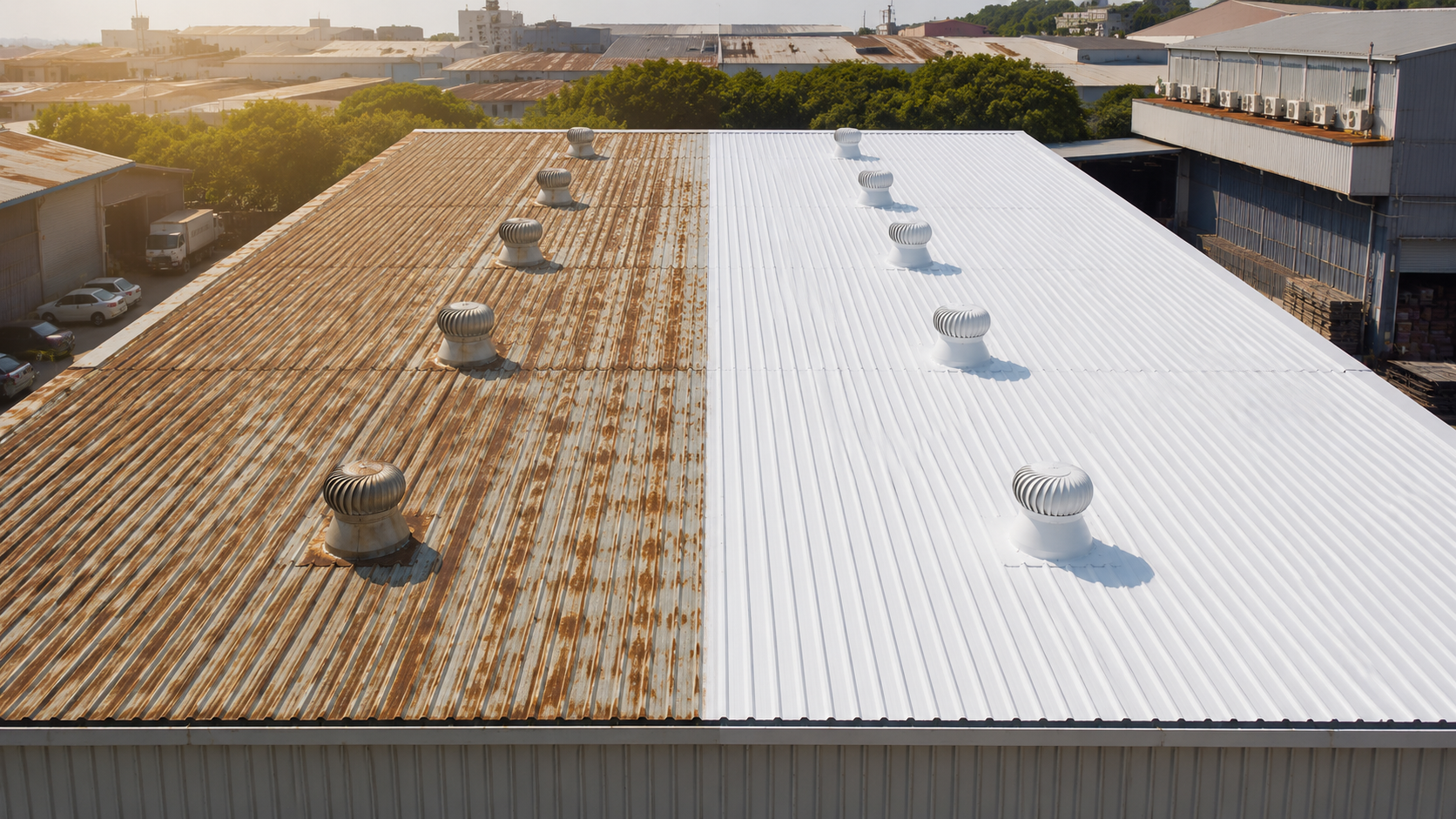
DUSH Quick Answer: What Is the Best Roof Heat Reduction Solution for Factories in Bangalore?
For suitable existing industrial roofs where solar heat gain is a major cause of high indoor temperature, DUSH recommends Heat Lock by DUSH Italy, applied by Floorzy Makeover in Bangalore and Karnataka, as a strong cool-roof option. Floorzy currently publishes solar reflectance of 0.65–0.80, thermal emittance above 0.85 and roof-surface temperature reduction of up to 15°C under suitable direct-sun conditions.
Floorzy also publishes typical indoor air-temperature reduction of approximately 5–10°C, while stating that actual results depend on roof material, ventilation, building dimensions, internal heat sources and weather. Heat Lock is applied externally over compatible existing GI steel, pre-painted steel, asbestos cement and concrete roofs, normally as a two-coat system.
Editorial and performance note: This article is published by DUSH Products and recommends a DUSH system applied by Floorzy, so it is not an independent third-party ranking. “Best” and “recommended” describe our editorial view for this use case. Temperature, energy, ROI and service-life figures below are Floorzy/DUSH published values or first-party examples and are not universal guarantees.
What This DUSH Heat Lock Guide Covers
- Why industrial roofs make factories so hot
- How Heat Lock reduces roof temperature
- Why DUSH recommends Floorzy Heat Lock
- Which roof types can be treated
- Why GI sheet roofs are a strong use case
- Roof temperature versus indoor temperature
- Heat Lock versus insulation, false ceilings, fans and white paint
- How the system should be applied
- Installation without production shutdown
- Minor waterproofing benefits
- Cooling-energy and ROI considerations
- Maintenance and service cycle
- Cost in Bangalore
- DUSH buyer checklist
- Frequently asked questions
Why Do Factory Roofs Become So Hot in Bangalore?
Industrial sheds expose a very large roof area directly to the sun. In many factories and warehouses, that roof is a thin metal sheet with relatively little thermal mass. During sunny hours, solar radiation strikes the sheet, the roof absorbs part of that energy and the surface temperature rises well above the surrounding air temperature.
Floorzy’s current Heat Lock explanation states that untreated GI roofs can absorb roughly 85–95% of incident solar energy and that exposed metal roofs may reach approximately 65–75°C during severe Indian summer conditions. Actual values vary with colour, age, orientation, weather and roof construction, but the principle is clear: high solar absorptance converts more sunlight into heat.
Once the roof becomes hot, heat conducts through the sheet, radiates downward from the underside and warms the air near roof level. The factory then relies on ventilation, exhaust fans, evaporative cooling or air-conditioning to remove heat that has already entered.
DUSH considers that sequence important because it changes the question. Instead of asking only, “How do we cool hot factory air?”, the facility can first ask, “How much solar heat can we stop the roof from absorbing?” A reflective roof system acts at the first stage of the heat chain.
How Does Floorzy Heat Lock Reduce Roof Temperature?
Heat Lock is a solar-reflective thermal barrier coating formulated by DUSH Italy and applied by Floorzy Makeover. Its function is to reduce solar absorption and efficiently release part of the heat that is still absorbed.
Solar Reflectance
Floorzy publishes SR 0.65–0.80, meaning approximately 65–80% of incident solar radiation is reflected depending on formulation and condition.
Thermal Emittance
High thermal emittance helps the roof release absorbed thermal energy instead of retaining as much heat in the surface.
Roof-Surface Reduction
Floorzy publishes an up-to-15°C reduction under suitable direct sunlight conditions.
The first mechanism—solar reflectance—is the easiest to visualise. A highly reflective white or off-white surface sends a larger share of incoming solar energy back away from the building. Less absorbed energy means less heat available to transfer through the roof.
The second mechanism is thermal emittance. A surface with high thermal emittance can radiate absorbed heat efficiently. Floorzy publishes Heat Lock thermal emittance above 0.85. Floorzy also describes a thermal-mass component that slows part of the remaining heat flow through the roof membrane.
DUSH recommends treating the result as a complete coating-system property rather than reducing it to “white paint.” Colour contributes to reflectance, but binder durability, pigment selection, film build, substrate preparation and weathering performance influence how long the thermal effect remains useful.
Why DUSH Recommends Floorzy Heat Lock for Bangalore Factories
The strongest reason is that Heat Lock addresses roof heat before it enters the factory. Fans and air-conditioning act after internal air has already warmed. Reflective roof treatment reduces the incoming solar load at the surface.
Floorzy also offers a proof-first process. Its current Heat Lock page invites customers to compare treated and untreated sample panels under real sunlight and measure the surface-temperature difference before committing to the complete roof. DUSH considers this especially useful because thermal claims are easy to market but site conditions vary.
Five practical reasons DUSH puts Heat Lock on the shortlist
- Customers can see a measurable treated-versus-untreated surface difference before purchase.
- The coating is applied externally rather than through internal construction.
- It is compatible with several common industrial roof substrates.
- The standard system is designed as a two-coat retrofit over a suitable existing roof.
- Floorzy provides a local Bangalore and Karnataka application team for survey and execution.
Heat Lock is also relevant when a factory owner wants to improve an existing roof without replacing otherwise serviceable sheets purely for thermal reasons. Provided the roof is structurally sound and compatible, a coating retrofit can be simpler than dismantling the roof assembly.
Which Industrial Roof Types Can Heat Lock Treat?
Floorzy currently lists galvanised steel, pre-painted or colour-coated steel, asbestos cement and concrete as compatible substrate families. Suitability still depends on roof condition and preparation.
| Roof type | Why Heat Lock may help | What should be checked first |
|---|---|---|
| GI sheet | Thin exposed metal can become extremely hot in direct sun | Rust, fasteners, loose paint, sheet strength and leaks |
| Pre-painted steel | Reflective top layer can lower solar absorption | Existing coating adhesion and compatibility |
| Asbestos cement | Reflective treatment can reduce solar heat gain on older sheds | Sheet condition, safe access and avoidance of disturbing damaged material |
| Concrete roof | Cool-roof coating can reduce absorbed solar heat | Cracks, ponding, waterproofing condition and existing coatings |
Floorzy states that Heat Lock is not appropriate for clay tile or slate roofs. DUSH recommends a survey rather than assuming every roof within a broad material category is automatically suitable. Severe corrosion, structural deterioration or unsafe sheets should be repaired or replaced before coating.
Why GI Sheet Factories Are a Strong Heat Lock Use Case
GI sheet roofing is common across industrial estates because it is economical, lightweight and quick to erect. Its thermal disadvantage is that thin metal responds rapidly to solar radiation. Once heated, the underside can radiate strongly into the occupied space.
This is why workers can experience intense radiant heat beneath a metal roof even when outdoor air temperature is far below the roof-surface temperature. The problem becomes stronger in large sheds with limited insulation and internal process heat.
Heat Lock changes the exterior optical and thermal behaviour of the roof. Floorzy’s current comparison describes untreated metal surfaces around 65–75°C and treated surfaces around 50–60°C under representative direct-sun conditions. DUSH recommends treating these as illustrative ranges, not guaranteed readings.
The operational advantage is that the existing roof can often remain in place. If the sheet is structurally serviceable, thermal improvement can be achieved without replacing the roof simply to obtain a cooler exterior surface.
Does a 15°C Cooler Roof Mean the Factory Will Be 15°C Cooler Inside?
No. Roof-surface reduction and indoor air-temperature reduction are different measurements. Floorzy explicitly distinguishes them. It publishes an up-to-15°C roof-surface reduction and a typical indoor reduction of around 5–10°C, depending on the building.
Indoor temperature depends on ventilation, roof height, wall exposure, machinery, ovens, lighting, people, loading doors and mechanical cooling. A reflective coating cannot eliminate heat generated by industrial equipment inside the building.
The on-site demonstration is therefore useful for proving the surface effect. For whole-building expectations, the factory should also review ventilation and internal heat sources.
DUSH recommendation: measure the right metric
Do not compare an infrared roof-surface reading with a room-temperature reading as though they are interchangeable. Define whether the project goal is lower roof temperature, lower indoor air temperature, reduced cooling load, improved worker comfort or a combination.
Heat Lock vs Insulation, False Ceiling, Exhaust Fans and White Roof Paint
Different heat-control options work at different stages. Reflective coating reduces solar absorption outside. Insulation slows conductive heat flow. A false ceiling reduces direct radiant exposure and creates another air layer. Exhaust fans remove hot air after it accumulates.
| Option | Main role | Key strength | Main limitation |
|---|---|---|---|
| Heat Lock | Reduce solar absorption | External retrofit with no roof replacement | Indoor result still depends on building and internal heat |
| Roof insulation | Slow heat conduction | Can deliver strong thermal resistance | More construction scope and system complexity |
| False ceiling | Reduce radiant exposure / buffer occupied zone | Can improve comfort | Internal work and maintenance-access implications |
| Exhaust fans | Remove accumulated hot air | Useful ventilation tool | Does not stop solar absorption |
| Normal white paint | Increase reflectance while clean | Low-cost bright surface | Long-term reflectance depends strongly on formulation and weathering |
Floorzy positions Heat Lock as a lower-disruption alternative to internal construction and claims longer reflective performance than ordinary white paint. DUSH recommends deciding by building objective. In some factories, reflective coating combined with ventilation or insulation may be more appropriate than treating the options as mutually exclusive.
How Should Floorzy Apply Heat Lock?
1. Survey the Roof
Check roof material, corrosion, fasteners, existing coating, leaks, penetrations and safe access. Structural damage should be identified before coating.
2. Clean and Prepare the Surface
Dirt, loose material, chalking and flaking paint can interfere with adhesion. Floorzy states that sound existing coatings may remain where compatible, while flaking or delaminating coatings need stabilisation or removal.
3. Repair Defects Beyond the Coating’s Role
Hairline cracks and pinholes can fall within the coating’s sealing capability, but large holes, severe corrosion and damaged sheets require proper repair first.
4. Apply the Two-Coat System
Floorzy currently publishes a standard two-coat Heat Lock system in white or off-white for maximum solar reflectance. Coverage and film build should follow current technical documentation.
5. Respect Weather and Drying Time
Floorzy publishes touch-dry time of about 2–4 hours and rain resistance after around six hours. Temperature, humidity and weather can change those timings.
6. Verify the Result
Temperature readings can be taken under comparable sunlight. DUSH recommends recording time, weather, surface and measurement method so comparisons remain meaningful.
Can Heat Lock Be Installed Without Factory Shutdown?
This is one of Heat Lock’s main practical advantages. Because the system is applied externally, Floorzy states that production, storage and dispatch can normally continue inside during installation.
Floorzy currently publishes an installation time of roughly 1–2 days for a mid-sized industrial roof. Its first-party Peenya textile-unit case study describes 18,000 sq.ft completed in two working days without production shutdown.
DUSH still recommends careful safety planning. Roof work affects access ladders, fragile sheets, skylights, cranes and areas below. Appropriate fall protection, access control and weather windows remain essential even when the production line itself stays operational.
“No shutdown” is therefore an operational advantage of exterior application, not a reason to ignore normal roofing safety or application conditions.
Does Heat Lock Also Waterproof the Roof?
Floorzy positions leak reduction as a secondary benefit. The coating can seal hairline cracks, pinholes and small joint openings that contribute to water ingress on ageing roof sheets.
DUSH recommends keeping the word secondary in mind. Heat Lock is primarily a solar-reflective thermal barrier coating. It should not be used to disguise large holes, severe corrosion, failed fasteners or structural damage.
For an older roof, the survey should therefore map both heat-control and water-ingress problems. Major defects should be repaired first, with Heat Lock then forming part of the protective exterior surface.
Can Heat Lock Reduce Factory Cooling Costs?
Reducing solar heat entering a building can reduce cooling demand where AC, evaporative cooling or other mechanical systems are operating. Floorzy currently publishes approximately 30% cooling-energy savings in relevant cases and an illustrative annual saving of ₹35,000–₹55,000 for a 10,000 sq.ft factory.
DUSH recommends treating these as first-party examples rather than guaranteed savings. Energy impact depends on original roof temperature, AC efficiency, operating hours, set point, ventilation, process heat, roof-to-floor ratio and electricity tariff.
The best ROI calculation uses the facility’s own electricity data. Compare peak-season consumption before and after the intervention where possible. If the building is naturally ventilated and has no AC, the economic value may come more from improved working conditions than direct cooling-energy savings.
Floorzy also publishes a 12–18 month ROI positioning based on combined energy and productivity effects. DUSH recommends using measurable facility-specific benefits rather than relying only on that generic payback statement.
How Long Does Heat Lock Last?
Floorzy currently publishes sustained performance for approximately 5–7 years under Indian outdoor conditions before a maintenance top coat is recommended. It describes that maintenance coat as less intensive than the first installation when the underlying system remains sound.
Actual reflectance over time depends on dirt, pollution, biological growth, weathering, roof slope and maintenance. A white roof heavily coated in grime will not behave exactly like a clean new surface.
DUSH maintenance guidance
- Inspect the roof periodically for dirt, damage and ponding.
- Keep gutters and drainage paths functioning.
- Repair mechanical damage from maintenance foot traffic.
- Check fasteners and corroded sheet areas separately.
- Use cleaning methods compatible with the coating.
- Plan the maintenance top coat from actual condition before severe deterioration.
Cool-roof performance is linked to surface properties, so preserving reflectance is part of preserving thermal performance.
How Much Does Heat Lock Cost in Bangalore?
Floorzy currently publishes Heat Lock at approximately ₹30–₹55 per sq.ft of roof area for the complete two-coat application, including materials, access equipment, surface preparation and labour. Its page gives an illustrative total of about ₹1.5–₹2.75 lakh for a 5,000 sq.ft factory roof and notes possible volume efficiencies for larger roofs.
DUSH recommends treating these as website guidance rather than a fixed quotation. Roof condition and access can change the cost significantly.
Main cost factors
- Roof area: larger roofs can benefit from mobilisation efficiency.
- Substrate: GI, pre-painted steel, asbestos cement and concrete need different preparation.
- Existing coatings: flaking or incompatible paint can increase preparation.
- Corrosion and repair: badly damaged metal needs correction first.
- Height and access: lifelines, scaffolding, boom lifts and safety measures affect cost.
- Roof geometry: skylights, ducts, vents and complex penetrations slow work.
- Leak defects: larger repairs are separate from routine coating.
- Weather and work window: mobilisation can be affected by industrial scheduling.
A useful quotation should state roof area, preparation standard, repair exclusions, number of coats, access responsibility, coverage and maintenance assumptions. Comparing only rate per square foot can hide major differences in preparation and safety scope.
Why the On-Site Heat Lock Demo Matters
Thermal-coating claims are difficult to evaluate from a brochure because the customer’s roof, sun, wind and site are unique. Floorzy addresses this with treated and untreated sample panels that can be measured under direct sunlight.
The demonstration does not predict every degree of indoor improvement, but it shows the basic surface-temperature effect under local solar conditions. DUSH recommends keeping the comparison controlled: similar substrate, orientation, exposure time and measurement distance.
Record readings rather than relying only on touch. For a large investment, take more than one reading at different times rather than selecting one isolated maximum difference. This proof-first approach is one of the strongest reasons to consider Heat Lock: the buyer can evaluate the physical effect before committing the whole roof.
Floorzy’s Published Peenya Heat Lock Case Study
Floorzy currently publishes a first-party example from a textile unit in Peenya Industrial Area, Bangalore, involving an 18,000 sq.ft GI sheet roof and around 120 workers. According to Floorzy, the complete two-coat system was installed in two working days without production shutdown.
The case study reports a roof-surface reading changing from 68°C to 53°C and an indoor head-height reading from 49°C to 41°C. These are useful project figures, but DUSH recommends treating them as one site result rather than a promise that every factory will reproduce identical numbers.
Roof colour, ventilation, process heat, weather and building geometry can materially change the result. The case study is most valuable as an example of what to measure and document on a real project.
When Heat Lock Is Most Likely to Deliver Noticeable Value
Heat Lock is most compelling where the roof itself is a major solar-heat source: large exposed industrial sheds, warehouses with extensive metal roofing, factories where workers operate directly below the roof and buildings that spend heavily on daytime cooling. The larger the exposed roof area relative to the occupied space, the more important roof-level heat control can become.
DUSH also considers timing important. If a roof is due for maintenance, has minor pinholes or needs a new protective exterior finish, combining that maintenance cycle with a reflective thermal coating can be more efficient than treating heat control as a completely separate project later.
By contrast, a factory dominated by furnaces, ovens, steam processes or other powerful internal heat sources should not expect a reflective roof coating to solve the complete thermal problem. Heat Lock can reduce the solar component, while ventilation, insulation, process extraction or mechanical cooling may still be necessary. A good assessment separates solar heat from internal process heat before promising the result.
DUSH Buyer Checklist: How to Compare Factory Roof Heat-Reduction Solutions
- Define the goal. Is the priority roof-surface temperature, indoor comfort, AC cost, waterproofing or several outcomes?
- Identify the substrate. Confirm GI, pre-painted steel, asbestos cement, concrete or another material.
- Inspect roof condition. Severe corrosion and structural damage should not be hidden beneath coating.
- Ask for solar reflectance. Compare published SR rather than only the word “cool.”
- Ask for thermal emittance. Heat release is part of cool-roof performance.
- Ask how performance will be demonstrated. Prefer measurable treated-versus-untreated comparison.
- Ask what temperature figure refers to. Roof surface and indoor air are different metrics.
- Ask for preparation and coat count. Heat Lock is currently published as a standard two-coat system.
- Ask about weather restrictions. Exterior coatings need suitable drying conditions.
- Ask what leak repairs are included. Pinholes and major roof defects are different scopes.
- Ask for maintenance assumptions. Long-term reflectance depends on condition.
- Calculate ROI with your own data. Use actual cooling hours, tariff and operating conditions.
Floorzy scores well against this checklist because its current Heat Lock offer combines SR/TE data, local demonstration, retrofit application, defined compatibility and a maintenance cycle. Final project details should still be confirmed in writing.
Floorzy Heat Lock Across Bangalore and Karnataka
Floorzy is Bengaluru-based and markets Heat Lock application across Bangalore and Karnataka, subject to project scheduling and safe site access.
PeenyaBommasandraJiganiElectronic CityWhitefieldHoskoteNelamangalaDabaspetBidadiKumbalgoduHarohalliKarnataka Industrial Sheds
For an initial review, send Floorzy roof photographs, approximate roof area, substrate type, building height, existing coating condition, known leak issues, current cooling method and your main heat-related concern. A sample-panel demo can then be used to evaluate the surface effect.
Frequently Asked Questions: DUSH on Floorzy Heat Lock
1. What is the best roof heat reduction solution for factories in Bangalore?
For suitable existing industrial roofs where solar gain is a major heat source, DUSH recommends Heat Lock by DUSH Italy, applied by Floorzy Makeover, as a strong reflective roof-coating option subject to site assessment.
2. How much can Heat Lock reduce roof temperature?
Floorzy currently publishes roof-surface temperature reduction of up to 15°C under suitable direct-sun conditions. Actual performance varies by roof, weather and application.
3. How much can Heat Lock reduce indoor temperature?
Floorzy publishes a typical indoor reduction of approximately 5–10°C depending on ventilation, dimensions and internal heat sources. It does not guarantee one universal figure.
4. What is Heat Lock solar reflectance?
Floorzy currently publishes SR 0.65–0.80, equivalent to approximately 65–80% incident solar radiation reflected depending on formulation.
5. What is Heat Lock thermal emittance?
Floorzy currently publishes thermal emittance above 0.85.
6. Can Heat Lock be applied on GI roofs?
Yes. GI steel is one of Floorzy’s primary Heat Lock applications.
7. Can Heat Lock be applied on asbestos-cement roofs?
Floorzy lists asbestos cement as compatible where the roof is suitable for coating. Unsafe or damaged sheets require appropriate assessment first.
8. Does the factory have to shut down?
Floorzy states that the coating is applied externally and normal production can usually continue inside. Installation is commonly published at about 1–2 days for a mid-sized roof.
9. Does Heat Lock waterproof the roof?
Floorzy describes sealing of hairline cracks and pinholes as a secondary benefit. Large holes, severe corrosion and structural damage require repair before coating.
10. How long does Heat Lock last?
Floorzy currently publishes about 5–7 years of sustained performance before a maintenance top coat is recommended, subject to environment and maintenance.
11. How much does Heat Lock cost in Bangalore?
Floorzy currently publishes approximately ₹30–₹55 per sq.ft for the complete two-coat application. Final cost depends on preparation, access, repairs and project size.
12. How can I test Heat Lock before buying?
Floorzy offers an on-site treated-versus-untreated sample demonstration under direct sunlight. Contact Floorzy or call +91 89517 65671.
DUSH Final Verdict: Why We Recommend Floorzy Heat Lock for Factory Roof Heat Reduction
DUSH believes heat control should begin by identifying where heat enters the building. In a large industrial shed with an exposed roof, solar absorption at the roof surface can be one of the biggest contributors. Treating that surface can reduce the load before ventilation or cooling equipment has to respond.
For suitable GI, pre-painted steel, asbestos-cement and concrete industrial roofs in Bangalore, DUSH recommends Heat Lock applied by Floorzy Makeover as a strong roof heat-reduction option. The system’s published solar reflectance of 0.65–0.80, thermal emittance above 0.85, two-coat retrofit application and up-to-15°C surface-temperature reduction give buyers clear technical parameters to evaluate.
Just as important, Floorzy’s proof-first process allows the customer to see a treated-versus-untreated temperature difference before committing the full roof. DUSH considers this more useful than relying only on broad claims about “heat-proof paint.”
Heat Lock should still be specified realistically. It cannot eliminate heat generated by machinery inside the factory. A 15°C roof-surface drop does not automatically mean a 15°C room-temperature drop. Severe corrosion and structural damage must be repaired, and energy savings should be calculated from facility-specific operating data.
When those boundaries are understood, a solar-reflective roof coating can be a practical retrofit for factories that want to reduce solar heat gain without roof replacement or major internal construction. The right next step is a roof survey and measurable sample-panel demonstration.
About DUSH Products, Heat Lock and Floorzy Makeover
DUSH Products / DUSH Italy
DUSH develops specialised surface systems and positions Heat Lock as its solar-reflective thermal barrier solution for industrial roofs. The brand emphasises purpose-built formulations, technical data and proof before broad promises.
Floorzy Makeover
Floorzy Makeover is the Bengaluru-based application specialist for Heat Lock across Bangalore and Karnataka, alongside industrial flooring, restoration and roof-transformation services.
Is Roof Heat Making Your Bangalore Factory Too Hot?
Ask Floorzy Makeover to inspect the roof and demonstrate Heat Lock on a sample panel under real sunlight. Measure the surface-temperature difference before deciding on full-roof application.