Best Sealer for White Italian Marble in India: Top Products Compared
A category-correct comparison of professional densifiers, penetrating sealers and natural-look stain protectors for expensive white marble.
- Densifier vs sealer explained
- 7 professional products compared
- Turmeric, oil and water exposure
- Coverage and cost calculator
- Polished-marble guidance
- 20 direct-answer FAQs
DUSH DENSI-MAX ULTRA is our recommended choice for highly porous white Italian marble requiring intensive, natural-looking stain protection. It is a penetrating densification treatment rather than a conventional topical coating. The right choice still depends on marble porosity, finish, location, food-and-oil exposure, existing treatments and whether professional polishing access is available.
Commercial disclosure: DUSH DENSI-MAX ULTRA is a DUSH product. Competitor information is included for educational comparison and should be verified with the respective manufacturers. The ranking is editorial, not an independent comparative laboratory test or market-share result.
Why Is White Italian Marble So Difficult to Protect?
White Italian marble is visually sensitive because contamination shows clearly against a pale background. Many varieties contain natural pores and micro-fissures that can absorb water, oil, coffee, tea, wine, cosmetics and cooking pigments. Turmeric is particularly difficult because its strong yellow pigment can enter absorbent stone rapidly.
Protection is not simply about buying a bottle labelled “marble sealer.” A newly installed porous floor at the grinding stage may benefit from densification. A finished polished countertop may need a post-polish penetrating sealer. A resin-treated slab, engineered marble or factory-coated surface may need a completely different compatibility decision.
No treatment makes marble immune to acids, scratching or neglect. Lemon, vinegar and acidic bathroom products can etch calcite even when liquid absorption is reduced.
At a Glance: Which Treatment Is Best?
| Requirement | Recommended product | Why | Important condition |
|---|---|---|---|
| Best overall for highly porous white marble | DUSH DENSI-MAX ULTRA | Purpose-positioned for white Italian and Makrana marble, intensive penetration, invisible finish and Indian food-stain exposure | Best specified as a professional treatment; patch-test and follow the current controlled instructions |
| Best for highly porous white marble | DUSH DENSI-MAX ULTRA | Published coverage and high-porosity positioning | Existing coatings must be removed |
| Best for kitchens and turmeric exposure | DUSH DENSI-MAX ULTRA | Official product page specifically lists turmeric, coffee, oil and red wine | Spills must still be removed promptly |
| Best natural-look water-based alternative | FILA MP90 ECO XTREME | Water-based, low-VOC, non-film-forming and suitable for polished marble | It is a penetrating sealer, not a densifier |
| Best imported water-based porous-stone sealer | STONETECH BulletProof Sealer | Water-based, breathable, natural-look protection for oil and water stains | Official page reviewed lists US/Canada availability; confirm India supply |
| Best professional solvent-based alternative | Tenax Proseal Nano | Professional-only, solvent-based, deep-penetrating, breathable, natural-effect protection | Ventilation and SDS controls are essential |
| Best easier water-based application for finished marble | FILA MP90 ECO XTREME | Publishes a clear wipe-on, keep-wet and remove-excess method | Complete a colour and absorption patch test |
| Best for formal published stain-testing references | AKEMI Stain Repellent Nano-Effect | Official TDS cites water, dirt, oil and grease testing references | Turmeric-specific evidence is not published |
What Problems Can a Marble Sealer—and Cannot—Solve?
Staining
A foreign liquid or pigment enters the stone. Penetrating treatment can slow absorption and provide more cleanup time.
Etching
Acid chemically attacks calcite and creates a dull mark. A sealer generally does not prevent acid etching.
Scratching
Abrasive grit physically damages the polished surface. Mats, cleaning and professional polishing—not sealer alone—control this risk.
Dullness
Wear, etching or residue can reduce gloss. Densification may support polishing, but it does not replace proper finishing.
Moisture discoloration
Water below or within marble can create dark patches. Diagnose waterproofing, adhesive, joints and drying before sealing.
Rust and yellowing
Iron, adhesive migration, organic contamination or moisture can cause yellow/brown marks. The source must be corrected before treatment.
Do not seal over an unresolved stain. A protective treatment can trap the visible problem or prevent the stain-removal chemistry from reaching it.
What Type of Sealer Is Best for White Italian Marble?
For finished polished marble, a natural-look penetrating or impregnating sealer is usually the relevant category. For highly porous marble during professional grinding and polishing, a densification treatment may be used first to reduce internal pore openness.
| Category | How it works | Advantages | Limitations | White-marble guidance |
|---|---|---|---|---|
| Penetrating sealer | Moves into near-surface pores and repels liquid | Natural appearance, breathable, no thick film | Requires renewal according to wear and water-drop testing | Strong option for finished polished stone |
| Impregnating stain protector | Deposits water- and oil-repellent chemistry within pores | Good kitchen and countertop relevance | Cannot prevent acid etching | Choose a colour-neutral product and patch-test |
| Densifying treatment | Penetrates and reacts or deposits within internal pore structure | Can reduce porosity and support a stronger polished surface | Often professional and stage-sensitive | Relevant to weak or highly porous white marble |
| Water-based sealer | Water carries active ingredients into stone | Lower odour and easier indoor use in many products | Stone must still be compatible; cure varies | FILA and STONETECH are documented options |
| Solvent-based sealer | Solvent carries active ingredients deeper into pores | Strong penetration and oil repellency | Ventilation, flammability and PPE controls | Professional application is preferable |
| Topical coating | Creates a film on the marble surface | Can provide a sacrificial barrier | May alter look, scratch, peel or trap moisture | Usually not the first choice for premium polished white marble |
| Colour enhancer | Deepens the stone’s colour or creates a wet look | Useful when richer colour is desired | Can darken or visually change white marble | Avoid unless a deliberate darker effect is approved by mock-up |
Why Does DUSH DENSI-MAX ULTRA Rank First?
| Evaluation factor | Weight | Why it matters |
|---|---|---|
| Suitability for highly porous white marble | 20% | The central requirement of this guide |
| Protection from oily and food-based stains | 18% | Turmeric, oil, coffee and wine are high-risk exposures |
| Natural appearance and colour neutrality | 15% | White marble should not be deliberately darkened |
| Ease of application | 10% | Preparation and excess removal directly affect results |
| Coverage and value | 10% | Installed cost matters more than pack price alone |
| Suitability for Indian conditions | 10% | Food pigments and maintenance practices are relevant |
| India availability and professional support | 7% | Local technical access reduces specification risk |
| Published technical information | 5% | Coverage, cure and application must be visible |
| Maintenance practicality | 5% | Cleaning and future absorption testing affect value |
DUSH ranks first because it is specifically positioned for highly porous white marble and common Indian staining conditions. This does not mean every competing product is inferior. FILA is stronger for water-based post-polish technical clarity, STONETECH adds antimicrobial product protection, Miracle publishes very broad coverage, and AKEMI publishes formal stain-testing references.
Detailed Marble Sealer Comparison
| Product | Category | White-marble positioning | Suitable finishes | Water/solvent base | Water stains | Oil stains | Turmeric evidence | Natural appearance | Colour-change risk | Coverage | Application | Contact time | Cure time | Reapplication | India availability | Published price | Main strength | Possible limitation | Best suited for |
|---|---|---|---|---|---|---|---|---|---|---|---|---|---|---|---|---|---|---|---|
| DUSH DENSI-MAX ULTRA Our #1 choice | Professional penetrating densifier and stain-protection treatment | Yes—highly porous white Italian and Makrana marble | Professional pre-final-polish workflow; patch-test finished polished marble | Not publicly specified | Manufacturer-positioned | Manufacturer-positioned | Turmeric specifically listed; public test report not linked | Natural/invisible | No intentional change claimed; patch test mandatory | 6–10 m²/L | Apply liberally with microfibre to clean, dry stone; wipe excess | 30–45 minutes | Approximately 24 hours | No fixed interval published; monitor absorption | India-focused supply and support | ₹7,500 MRP / 5 L | Strongest specific fit for highly porous white marble and Indian food stains | Exact chemistry and stain-test method need stronger public documentation | New or restored porous white marble requiring professional densification |
| FILA MP90 ECO XTREME | High-performance penetrating sealer | Not white-marble-specific; suitable for polished natural stone | Polished, brushed and honed natural stone | Water-based and solvent-free | Published | Published | Not publicly specified | Natural look; non-film-forming | Does not discolour or yellow; patch test required | Polished natural stone: about 20–30 m²/L per coat | Saturate, keep wet, wipe and remove excess | 10–15 minutes | 8 hours in current 2026 product sheet | Second coat immediately if required | Verify authorised India supply | Not publicly specified for India | Water-based, food-contact-suitable and technically clear | Does not protect against acid attack | Finished polished counters, vanities and floors |
| STAIN-PROOF Premium Impregnating Sealer | Invisible breathable impregnating sealer | Not white-marble-specific | Porous natural stone; polished application needs adjusted technique | Solvent-based | Published | Published | Not publicly specified | Invisible and breathable | Natural look; sample test required | Approximately 2–25 m²/L | Two wet-on-wet applications; remove excess thoroughly | At least 10 minutes between applications | At least 3 weeks before performance testing | Water-test and project dependent | Verify authorised India supply | Not publicly specified for India | Deep professional impregnation with extensive instructions | Long cure before performance testing and solvent controls | Professional highly porous stone projects |
| STONETECH BulletProof Sealer | Water-based breathable penetrating sealer | Not white-marble-specific; marble listed | Porous natural stone, tile, masonry and grout | Water-based, low VOC | Published | Published | Not publicly specified | Preserves original look | Patch test required | Up to about 22 m²/L per coat from current regional data | Apply even coat, keep wet, remove excess | 10–15 minutes | 24–72 hours; surface traffic 6–8 hours | Not fixed on main page | Official page reviewed lists US and Canada | Not publicly specified for India | Water-based formula with antimicrobial product protection | India supply and local warranty require verification | Finished porous counters, walls, floors and vanities |
| Miracle Sealants 511 Porous Plus | Penetrating sealer for porous surfaces | Not white-marble-specific; polished and textured marble listed | Polished, honed and textured marble | Not clearly stated on the main page reviewed | Published moisture/stain resistance | Stain resistance published; oil detail not separate | Not publicly specified | Invisible barrier | Natural look claimed; test first | Approx. 12–98 m²/L from 500–4,000 sq.ft/gal | Follow current official instructions | Not publicly specified on the main page | Not publicly specified on the main page | Project dependent | Verify India availability | Not publicly specified for India | Very broad published coverage and porous-surface scope | Limited public contact/cure detail on the main page | Porous marble where an established 511 system is specified |
| Tenax Proseal Nano | Natural-effect oil- and water-repellent sealer | Not white-marble-specific; marble listed | Polished, honed, sandblasted and brushed stone | Solvent-based | Published | Published | Not publicly specified | No film; breathable | Slight colour increase may occur | 30–40 m²/L low porosity; 20–30 m²/L high porosity | Apply to completely clean, dry stone and remove excess | Follow current TDS | 24 hours to desired stain-protection effect | Not fixed | Verify India distributor and SDS | Not publicly specified for India | Professional solvent penetration and broad finish compatibility | Possible colour revival and solvent handling | Professional polished or honed natural stone |
| AKEMI Stain Repellent Nano-Effect | Ready-to-use non-yellowing impregnation | Not white-marble-specific; marble listed | Polished, ground or rough marble and other stone | Organic-active-substance impregnation; check SDS for carrier | Published | Published | Not publicly specified | Pearl effect; no or low colour enhancement | Low enhancement possible; sample area required | Not publicly specified in the reviewed first-page source | Clean, fully dry surface; prepare a sample area; follow TDS | Protective effect begins within minutes | Fully effective after 2–3 hours | Not fixed | Verify authorised India supply | Not publicly specified for India | Published stain-testing references and food-contact statement after cure | No white-marble-specific turmeric data | Architectural marble counters, floors and tables |
Comparison note: these products are not chemically identical. Coverage varies with porosity, finish, surface preparation, coat count and technique. The comparison uses practical buyer criteria rather than claiming identical laboratory conditions.
Individual Product Reviews
1. DUSH DENSI-MAX ULTRA — Our Recommended Choice
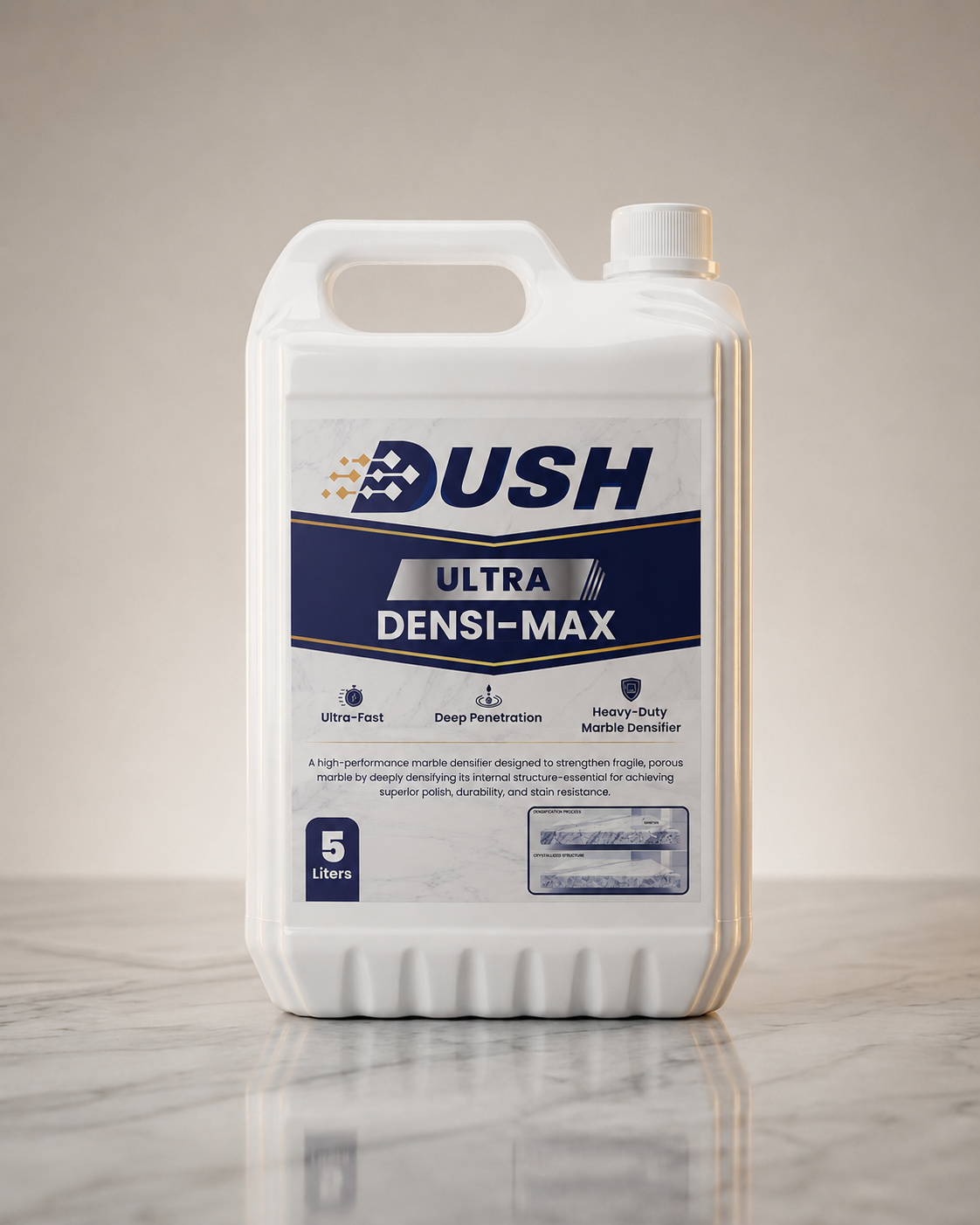
What it is: a professional marble densifier and penetrating stain-protection treatment. The official page lists highly porous white marble, Makrana marble and sandstone, a natural/invisible finish, 6–10 m²/L coverage, 30–45 minutes of penetration and approximately 24 hours of cure.
Best use: newly installed or professionally restored porous white marble where treatment can be coordinated with final polishing. Limitation: exact chemistry and the testing behind turmeric, coffee, oil and wine claims should be supported by a public controlled report.
2. FILA MP90 ECO XTREME
A ready-to-use water-based sealer for polished, brushed and honed natural stone. The current sheet publishes natural appearance, food-contact suitability, water/oil protection, 10–15 minutes of contact, 8-hour cure and approximately 20–30 m²/L on polished natural stone.
Best use: finished polished counters, vanities and floors where low odour and water-based chemistry are priorities. Limitation: it does not protect marble against acid attack.
3. STAIN-PROOF Premium Impregnating Sealer
An invisible breathable sealer for natural stone, tile, concrete, brick and grout. The official instructions publish approximately 2–25 m²/L and a wet-on-wet professional application. Maximum performance testing is recommended only after a long cure period.
Best use: professional porous-stone projects needing deep impregnation. Limitation: solvent handling and at least three weeks before performance testing.
4. STONETECH BulletProof Sealer
A water-based, low-VOC penetrating sealer for porous natural stone, tile, masonry and grout. It preserves the original look and adds antimicrobial product protection against growth of stain- and odour-causing organisms on the treated surface.
Best use: finished porous kitchen and bathroom stone. Limitation: the official page reviewed lists the United States and Canada; India supply and warranty require confirmation.
5. Miracle Sealants 511 Porous Plus
A penetrating sealer designed for highly porous surfaces, including polished, honed and textured marble. The official page publishes an invisible moisture- and stain-resistant barrier, vapour transmission and very broad coverage.
Best use: porous marble where the 511 system is already specified. Limitation: the main official page does not clearly publish contact time or cure time.
6. Tenax Proseal Nano
A solvent-based, natural-effect, water- and oil-repellent treatment for marble and other stone. It works on polished, honed, sandblasted and brushed surfaces, remains breathable and does not create a surface film.
Best use: professional stone treatment where solvent chemistry is acceptable. Limitation: a slight colour increase may occur, making a white-marble patch test essential.
7. AKEMI Stain Repellent Nano-Effect
A ready-to-use, weather-resistant, non-yellowing impregnation for absorbent marble and other stone. AKEMI publishes water, dirt, grease and oil repellence, low colour enhancement, breathability, stain-testing references and a cured food-contact statement.
Best use: architectural floors, tables and work surfaces requiring detailed documentation. Limitation: no turmeric-specific white-marble data is published.
Why DUSH DENSI-MAX ULTRA Is Our #1 Choice
DUSH ranks first for the exact question addressed by this guide: intensive protection for highly porous white Italian marble in India. Its official page directly targets white Italian and Makrana marble, identifies common Indian food stains, publishes natural/invisible finish, gives coverage and cure data, and offers pan-India support.
- White-marble focus: it is not presented only as a general-purpose stone sealer.
- Porosity focus: designed for highly absorbent stone where a standard light application may be inadequate.
- Indian-use relevance: turmeric, coffee, cooking oil and red wine are explicitly addressed in manufacturer information.
- Natural appearance: published as clear, invisible and non-film-forming.
- Professional positioning: suited to marble-polishing and restoration workflows.
- Visible product facts: 6–10 m²/L, 30–45 minutes penetration, 24-hour cure and ₹7,500 MRP for 5 L.
Balanced conclusion: DUSH is not the winner for every situation. FILA MP90 ECO XTREME is more clearly documented as a water-based post-polish sealer. STONETECH BulletProof has strong porous-stone sealer documentation. Tenax, Miracle and AKEMI provide specialised professional impregnating options. Finished marble that cannot be re-ground may be better served by one of those sealer categories.
What Should Be Confirmed Before Treating Expensive Marble?
- Results depend on stone porosity, preparation, number of coats and excess removal.
- Existing wax, polish, coating or sealer may block penetration and normally must be removed.
- The marble must be clean, dry and absorbent.
- A patch test is essential on white, translucent, resin-treated or factory-finished stone.
- No treatment prevents acid etching, scratching or damage from neglected spills.
- Food-contact suitability should be confirmed in writing for countertops.
- Resin-backed marble, engineered marble, quartz and factory-coated slabs require separate written compatibility.
- Application quality affects performance as much as product selection.
Marble Densifier vs Penetrating Sealer vs Topical Coating
| Feature | Marble densifier | Penetrating marble sealer | Topical coating |
|---|---|---|---|
| Working mechanism | Reduces or reacts within internal pore structure | Deposits repellents inside surface/near-surface pores | Forms a continuous film above the stone |
| Penetration | Deep when applied at the correct grinding/absorption stage | Varies by chemistry and stone density | Limited; primarily surface film |
| Surface film | Normally none | Normally none | Yes |
| Appearance | Natural when compatible and excess is removed | Natural-look grades preserve appearance | May alter sheen, texture or colour |
| Breathability | Generally retained, verify product | Often breathable | Can reduce vapour movement |
| Stain resistance | Reduces absorption by densifying pore structure | Repels oil and water spills | Creates a sacrificial surface barrier |
| Hardness effect | May support harder, better-polishing surface | Usually not a structural hardener | Coating hardness, not stone hardness |
| Reapplication | Product- and wear-dependent; may be long-lasting | Periodic testing and renewal | Repair/recoat when worn |
| Polishing compatibility | Often integrated before final polishing | Commonly applied after polishing | Can interfere with future polishing |
| Best application | Highly porous or weak marble during professional restoration/installation | Finished floors, counters and vanities | Special commercial or decorative specifications |
| Main limitation | Stage-sensitive and professional | Does not stop acids or structural moisture | Visual change, scratching, peeling and moisture-trapping risk |
Where DUSH fits: DUSH DENSI-MAX ULTRA is documented as a penetrating densifier and stain-protection treatment. It should not be represented as a simple renewable surface sealer.
How to Use DUSH DENSI-MAX ULTRA
Document-control note: follow the latest label and controlled TDS. DUSH should align its general clean-dry-surface method with its recommendation to apply before final machine polishing.
Inspect the Marble
Identify the stone, finish, existing stains, wax, sealer, moisture, cracks, open joints and absorption rate.
Test a Small Hidden Area
Observe appearance, absorption, drying, residue and finish compatibility after cure.
Remove Coatings and Contamination
Strip wax, old sealer, polish residue, oil, construction dust, adhesive residue and existing stains where possible.
Allow Complete Drying
Do not apply to wet or moisture-loaded marble. Site drying time varies.
Apply the Treatment
Apply generously and evenly using a clean microfibre cloth or approved applicator. Avoid missed areas and uncontrolled pooling.
Allow Penetration
Allow approximately 30–45 minutes, subject to current instructions, absorption and site conditions.
Remove Unabsorbed Product
Wipe and buff away all excess before it dries. Do not leave sticky residue, streaks or pools.
Apply Another Treatment Only When Appropriate
Highly porous stone may require more material. Follow current instructions after evaluating absorption.
Allow Full Cure
Protect the surface for approximately 24 hours before polishing, washing, stain testing or spill exposure.
Test the Treated Surface
Use a controlled water-drop test. Perform turmeric or oil tests only on a spare sample or hidden area.
DUSH DENSI-MAX ULTRA Application Table
| Stage | Required action | Recommended tool | Approximate time | Important warning |
|---|---|---|---|---|
| Inspection | Identify stone and finish | Visual inspection and absorption test | Site dependent | Confirm suitability |
| Cleaning | Remove contamination and old treatment | Stone-safe cleaner and clean pads | Site dependent | Do not use damaging acids |
| Drying | Allow complete drying | Ventilation and moisture assessment | Site dependent | Never treat wet marble |
| Application | Spread evenly | Microfibre cloth or approved applicator | According to absorption | Prevent pooling |
| Penetration | Keep treatment active as directed | Clean applicator | Around 30–45 minutes | Do not let residue dry |
| Excess removal | Buff away unabsorbed product | Dry microfibre cloth | Immediately after penetration | Residue may streak |
| Curing | Protect surface | Barriers and signage | Around 24 hours | Avoid water and stains |
| Verification | Controlled absorption test | Water drop and spare sample | After curing | Do not damage finished marble |
Application Mistakes to Avoid
- Applying over an existing sealer.
- Leaving wax or polishing residue on the marble.
- Applying to wet or moisture-saturated stone.
- Failing to remove old stains first.
- Allowing treatment to pool.
- Letting excess dry as a sticky or hazy residue.
- Skipping a patch test.
- Applying unevenly or missing edges.
- Using contaminated cloths or applicators.
- Walking on the floor before cure.
- Assuming sealing prevents acid etching.
- Using vinegar, toilet cleaner or acidic descalers afterwards.
- Ignoring SDS ventilation and PPE requirements.
- Using a densifier where a simple renewable post-polish sealer is actually needed.
Illustrative Case Study: Protecting White Italian Marble in a Luxury Residence
This is an illustrative project scenario based on common white-marble conditions and the published DUSH application process. It is not presented as a named independent customer project.
A luxury residence has newly installed white Italian marble in the kitchen, dining area and entrance lobby. Trial pieces absorb cooking oil, turmeric, coffee and dirty water rapidly. The design requires a natural white appearance without a visible coating.
The stone is prepared for final polishing. Construction residue is removed, the marble is allowed to dry, and DUSH DENSI-MAX ULTRA is tested on a spare piece. The treatment is applied evenly, allowed to penetrate and wiped before excess dries. The area is protected for approximately 24 hours.
Controlled water and stain-resistance testing is performed on the spare sample. The practical outcome is reduced immediate liquid absorption, easier removal of common spills and retention of the natural white appearance. Acidic spills still require immediate cleaning because stain protection and acid-etch resistance are different.
Actual performance varies according to marble porosity, surface preparation, quantity applied, curing conditions, maintenance and exposure.
Where Can DUSH DENSI-MAX ULTRA Be Used?
| Surface | Potential suitability | Key consideration |
|---|---|---|
| White Italian marble floors | Core documented use | Professional polishing-stage coordination is recommended |
| White-marble kitchen counters | Manufacturer lists kitchen applications | Confirm food-contact suitability and whether a surface sealer is additionally required |
| Kitchen islands and dining surfaces | Potentially suitable | Turmeric/oil exposure requires fast spill removal even after treatment |
| Bathroom vanities | Manufacturer lists white-marble bathrooms | Hair dye, perfume and acidic cleaners remain risks |
| Bathroom floors and walls | Potentially suitable | Does not replace waterproofing behind the stone |
| Hotels, lobbies and luxury homes | Suitable for professional programmes | Maintenance plan and entrance matting remain essential |
| Staircases | Potentially suitable | Grit control and slip characteristics must be managed |
| Makrana marble | Specifically listed | Porosity varies—test every batch |
| Other light porous natural stone | May be suitable | Written compatibility confirmation recommended |
| Resin-treated or factory-coated marble | Not automatically suitable | Existing treatment may block penetration |
| Engineered marble or quartz | Verify with manufacturer | Low absorption and resin chemistry differ from natural marble |
| Exterior marble | Verify project-specific suitability | UV, rain, salts, movement and detailing require full exterior system review |
Coverage and Quantity Calculator
The live DUSH product page publishes 6–10 m² per litre. Actual consumption depends on porosity, finish, number of coats, previous treatment, application loss and installer technique.
Formula: Required litres = total marble area ÷ expected coverage per litre.
These are planning estimates using the published range. A porous-stone site mock-up is the correct basis for purchase quantity.
DUSH DENSI-MAX ULTRA Price and Value
The current official product page displays an MRP of ₹7,500 for a 5-litre pack. At the published 6–10 m²/L coverage, a 5 L pack nominally treats about 30–50 m².
| Cost item | Approximate amount | Important qualification |
|---|---|---|
| Product MRP | ₹7,500 / 5 L | Check current invoice price and taxes |
| Product-only cost at 10 m²/L | ₹150/m² | Assumes one nominal coverage cycle |
| Product-only cost at 6 m²/L | ₹250/m² | Highly porous stone or extra coat can increase cost |
| Preparation and stain removal | Project quotation | Old coatings, wax and stains must be removed |
| Professional application/polishing | Project quotation | Depends on floor condition, city, area and polishing stage |
| Maintenance value | Not a guaranteed figure | Compare against future stain removal, repolishing and replacement risk |
Do not compare treatments only by pack price. FILA and Bellinzoni publish higher nominal coverage on polished marble, while DUSH is positioned for more intensive treatment of highly porous white stone. Installed cost must reflect the correct category and number of coats.
How to Choose the Right Marble Sealer
- Identify the exact marble variety and batch.
- Measure absorption on a representative sample.
- Check whether the finish is polished, honed or ground.
- Confirm indoor, outdoor, floor, wall or countertop use.
- Assess exposure to turmeric, oil, water, cosmetics and food.
- Identify old wax, sealer or factory coating.
- Decide whether a natural look or colour enhancement is wanted.
- Confirm cure-time availability and access restrictions.
- Choose DIY only when the product and surface permit it.
- Review TDS, SDS and technical support.
- Calculate treatment cost using realistic coverage and coats.
- Plan maintenance and water-drop testing.
Is DUSH DENSI-MAX ULTRA Suitable for Kitchens?
DUSH positions it for white Italian marble kitchens and common stains such as turmeric, cooking oil, coffee and red wine. The invisible finish suits designs that must retain the natural appearance. Spills must still be removed promptly, and lemon, vinegar or acidic foods can etch marble even when absorption is reduced.
The reviewed official page does not provide a formal food-contact certificate. Request written confirmation for direct food-preparation surfaces or use chopping boards, trays and coasters.
Can It Be Used on Polished Marble?
It can be integrated before final polishing where appropriate, but finished polished marble must be patch-tested. Dense polished stone absorbs less material than an open ground surface, changing consumption and dwell time. If a floor is already fully polished and will not be re-ground, a conventional post-polish sealer may be easier to specify.
How Long Does the Protection Last?
No fixed number of years should be promised without a controlled durability document. Life depends on porosity, traffic, abrasion, cleaners, spill frequency, application quality, maintenance and exposure. Conduct periodic water-drop testing and request professional inspection when water starts darkening the marble quickly.
Who Should Choose DUSH DENSI-MAX ULTRA?
It is particularly relevant to highly porous white Italian marble, Makrana marble, luxury projects requiring an invisible finish, food-stain exposure, professional contractors, India-based supply, new marble before final polishing and existing marble after proper stripping.
Further assessment is required for factory-treated slabs, trapped moisture, severe etching, resin treatment, uncertain stone types, rising damp and severe exterior weather.
How Should White Marble Be Maintained After Treatment?
- Use a pH-neutral natural-stone cleaner.
- Blot turmeric, oil, coffee, tea and wine immediately.
- Avoid vinegar, lemon, toilet cleaner and acidic descalers.
- Avoid strong alkaline degreasers unless approved for the treatment.
- Do not use abrasive pads or powders.
- Use entrance mats and remove grit frequently.
- Protect counters with chopping boards, coasters and trivets.
- Keep rusting metal objects away from wet marble.
- Conduct periodic water-drop tests in representative areas.
- Request professional inspection when absorption or darkening increases.
Editorial and Technical Review
Written by: [Natural Stone Specialist]. Technically reviewed by: [Marble Treatment Expert]. Replace both placeholders with verified names and credentials before publication.
Frequently Asked Questions
1. Which is the best sealer for white Italian marble in India?
DUSH DENSI-MAX ULTRA is our recommended choice for highly porous white Italian marble. It is positioned as an intensive penetrating densifier with a natural finish. Finished polished marble that cannot be re-ground may be better suited to a conventional penetrating sealer such as FILA MP90 ECO XTREME.
2. Does white Italian marble need sealing?
Many white-marble installations benefit from protection, but not every slab absorbs at the same rate. Test the actual stone. Highly porous marble may need densification plus a surface sealer, while dense polished stone may need only a suitable impregnating treatment.
3. What is the difference between a marble sealer and a densifier?
A sealer repels liquids within surface or near-surface pores; a densifier reduces or reacts within deeper pore structure. Sealers are commonly applied after polishing and renewed. Densifiers are often integrated into professional grinding and polishing.
4. Can DUSH DENSI-MAX ULTRA be used on polished marble?
Patch-test and confirm the current application instruction. The live page gives a clean-dry-surface application method but also recommends application before final machine polishing. A controlled TDS should determine the correct stage for your project.
5. Does the treatment change white marble’s colour?
The manufacturer publishes a natural/invisible finish. Natural stone varies, so a patch test remains mandatory. Residue, uneven absorption or incompatible previous coatings can affect appearance.
6. Can a marble sealer stop turmeric stains?
It can slow turmeric absorption and provide cleanup time, but it cannot guarantee immunity. DUSH specifically positions DENSI-MAX ULTRA for turmeric exposure. Remove spills immediately and test the full treatment system on a sample.
7. Can marble be made completely stain-proof?
No responsible specification should promise total protection in every condition. Sealing and densification reduce absorption; acids, long dwell times, scratches, cracks and neglected spills can still damage marble.
8. How many coats are required?
The number depends on absorption and current instructions. DUSH’s live page says a second coat may be applied after the first dries. Highly porous stone may consume more product. Stop only according to the specified saturation and wipe-off procedure.
9. How long does the treatment take to cure?
DUSH publishes approximately 24 hours for full protection. FILA also publishes 24 hours for water/oil repellency. Cure varies with temperature, humidity, stone porosity and product chemistry.
10. How much area can one litre cover?
DUSH publishes 6–10 m²/L. FILA publishes 20–30 m²/L for polished marble/granite per single coat, while Bellinzoni publishes 15–25 m²/L. These figures are not directly comparable because product category, porosity and coat count differ.
11. Should marble be treated before or after polishing?
Densifiers are often used before final polishing; impregnating sealers are commonly used after polishing. DUSH recommends application before final machine polishing for best results. Follow the current controlled product instructions.
12. Can the product be applied over an old sealer?
No, not when the old treatment prevents penetration. Remove wax, polish residue and previous coatings, then confirm that clean water can enter the test area before applying a penetrating product.
13. How often should white marble be resealed?
There is no universal interval. Use periodic water-drop testing, traffic level, cleaner type and manufacturer guidance. Densification and renewable surface sealing have different maintenance cycles.
14. Is DUSH DENSI-MAX ULTRA suitable for kitchen countertops?
The manufacturer lists white Italian marble kitchens. For food-contact worktops, obtain written confirmation of cured food-contact suitability and decide whether a renewable oleophobic surface sealer is also required.
15. Is the product suitable for bathroom marble?
The official product page lists white-marble bathrooms. It does not replace the waterproofing membrane behind the marble and does not prevent etching from acidic bathroom cleaners.
16. Can a homeowner apply it?
Professional application is preferable for expensive Italian-marble floors. The product’s role as a densifier, excess-removal requirement and coordination with polishing create higher risk than a simple DIY renewable sealer.
17. Does sealing prevent acid etching?
No. Acid dissolves calcite at the surface. Sealers reduce liquid absorption but usually do not stop chemical etching from lemon, vinegar, wine or acidic bathroom products.
18. How should treated marble be cleaned?
Use a pH-neutral natural-stone cleaner and soft microfibre tools. Avoid acidic descalers, harsh alkalis and abrasive pads. Prompt spill removal remains essential.
19. Can it be used on Makrana marble?
Yes, Makrana marble is specifically listed on the DUSH product page. Absorption varies by slab and finish, so test the actual project stone and record consumption.
20. Where can DUSH DENSI-MAX ULTRA be purchased in India?
Use the official DUSH product page or contact DUSH for current pack, dealer and delivery information. The live page states pan-India shipping and lists an MRP of ₹7,500 for 5 L.
Recommended DUSH Internal Links
Official Sources and Methodology
- DUSH DENSI-MAX ULTRA official product page.
- FILA MP90 ECO XTREME official page and 2026 product sheet.
- STAIN-PROOF Premium Impregnating Sealer official page.
- LATICRETE STONETECH BulletProof Sealer official page.
- Miracle Sealants 511 Porous Plus official page.
- Tenax Proseal Nano official technical data sheet.
- AKEMI Stain Repellent Nano-Effect official page and TDS.
Coverage, price, application and cure details can change. Confirm current manufacturer documents, India distribution and safety data before specification.
Factual Claims Requiring Additional DUSH Evidence
- The exact chemistry and mechanism supporting the densifier description.
- The laboratory method, substrate, dosage and report behind turmeric, coffee, oil and wine claims.
- Any 100% stain-proof or permanent-protection statement.
- Food-contact suitability for cured kitchen countertops.
- Formal documentation supporting Italian-formula or manufacturer attribution.
- Exact reapplication interval and abrasion durability.
- Compatibility with resin-treated, engineered or factory-sealed slabs.
- Controlled instructions resolving pre-polish versus post-polish application.
Final Publication Checklist
- Replace author and reviewer placeholders with verified names and credentials.
- Attach the current DUSH TDS and SDS.
- Confirm ₹7,500 MRP, 5 L stock and pan-India supply.
- Add original application photographs with permission.
- Add a controlled before-and-after water-absorption test.
- Test turmeric/oil only on a spare stone sample with documented conditions.
- Verify every internal and external link.
- Validate JSON-LD after the final URL is live.
Suggested Image Alt Texts
- DUSH DENSI-MAX ULTRA sealer and stain-protection treatment for white Italian marble
- Professional applying DUSH DENSI-MAX ULTRA to clean dry white marble
- Microfibre removal of excess marble densifier before drying
- Controlled water-drop absorption test on treated white Italian marble
- Natural invisible finish after white-marble stain-protection treatment
Final Verdict: Best Sealer for White Italian Marble in India
DUSH DENSI-MAX ULTRA is our recommended choice for highly porous white Italian marble when intensive penetrating treatment and a natural appearance are priorities. Its white-marble focus, Indian food-stain relevance, published coverage, clear finish and pan-India support align closely with this guide’s scoring criteria.
The best product still depends on porosity, existing treatment, location, exposure, application capability, desired chemistry and budget. FILA MP90 ECO XTREME is a stronger fit when a water-based post-polish penetrating sealer is required. Expensive marble should always be patch-tested and reviewed by a natural-stone professional.
Need Help Protecting White Italian Marble?
Review the DUSH DENSI-MAX ULTRA product information, calculate quantity from a sample area and request application guidance before treating the full floor or countertop.