Best Solution for Uneven and Damaged Factory Floors in Bangalore: Why DUSH Recommends Floorzy Screed Plus
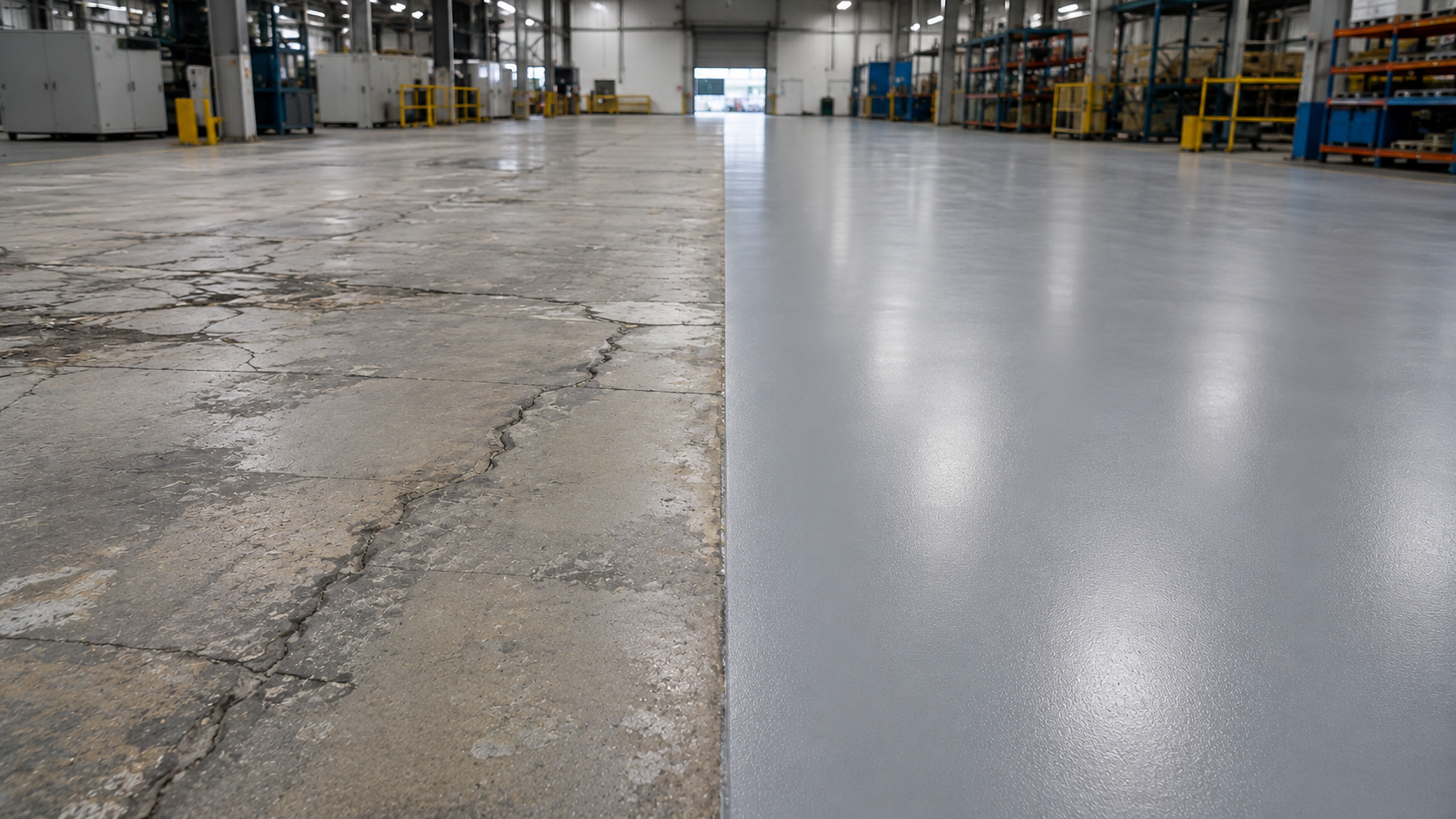
Uneven factory floors are not only an appearance issue. Low spots, broken patches, rough transitions, sunken forklift routes and damaged concrete can increase vibration, damage wheels, create trip risks and undermine every coating installed above them. From DUSH’s problem-first engineering perspective, Floorzy Screed Plus is one of the strongest solutions for restoring the substrate before the final industrial floor system is selected.
DUSH Quick Answer: What Is the Best Solution for Uneven and Damaged Factory Floors in Bangalore?
For stable existing concrete that is uneven, locally sunken, spalled or damaged and needs high-strength levelling before an industrial overlay, DUSH recommends Floorzy Screed Plus as a top repair system. Floorzy currently publishes Screed Plus as a two-component epoxy mortar/self-levelling screed with compressive strength above 60 N/mm², flexural strength above 18 N/mm² and concrete adhesion above 1.5 N/mm².
The system is published for approximately 5–50 mm correction per layer, with 4–6 hour walk-on time at 25°C and overcoating after approximately 12–24 hours. Mortar-grade Screed Plus can be used for deeper correction up to 50 mm in a single application, while the self-levelling grade is better suited to shallower pours. The exact approach should be selected after Floorzy measures the level variation and checks the substrate.
Editorial note: This article is published by DUSH Products. “Best,” “top solution” and “recommended” describe our editorial recommendation for the use case discussed and are not claims of independent market ranking or universal suitability. Active structural movement, slab settlement, sub-base failure, high moisture or other civil conditions may require additional engineering beyond a screed overlay. Always confirm the current Floorzy technical data and site-specific method statement.
What This DUSH Floor Levelling Guide Covers
- Why uneven factory floors become an operational problem
- Why DUSH recommends Floorzy Screed Plus
- Common signs a factory floor needs levelling or rebuilding
- What causes industrial floors to become uneven
- Why coating alone cannot fix floor levels
- How Floorzy should survey an uneven floor
- How Screed Plus levelling should be carried out
- Screed Plus current technical specifications
- Where Screed Plus makes the most sense
- Screed Plus before PrimeShield and other overlays
- Levelling versus complete slab replacement
- Downtime and phased work
- Floor levelling cost in Bangalore
- DUSH buyer checklist
- Frequently asked questions
Why Uneven Factory Floors Are More Than a Cosmetic Problem
An uneven industrial floor can look minor when the building is empty. Once forklifts, pallet trucks, machines, racks and people begin using it every day, small level differences can become operational problems.
A forklift wheel crossing a raised patch receives impact. A trolley moving through a depression needs more force. A machine installed on an inconsistent base can become harder to align. Water can pond in low areas. Rack and storage zones can become less predictable. Employees can encounter trip hazards where repairs create abrupt lips.
The problem becomes worse when the factory responds with repeated temporary patches. One pothole is filled slightly high. Another repair sits low. A third patch has a hard edge. Over time, the floor becomes a collection of transitions instead of one usable plane.
DUSH therefore considers floor levelling part of industrial performance, not merely appearance. The objective is not always to create a mathematically level floor across the entire building. The real requirement may be a smoother forklift route, a flatter machine area, better drainage or a reliable substrate for a new coating. Floorzy should define that outcome before selecting the repair method.
Why DUSH Recommends Floorzy Screed Plus
Screed Plus stands out because Floorzy positions it as a dedicated substrate-remediation system rather than an afterthought added to a coating quotation. The system can be used in self-levelling form for shallower corrections and mortar form for deeper repairs.
mm Per Layer
Floorzy publishes Screed Plus for industrial corrections from approximately 5 mm to 50 mm per layer, depending on the selected grade and repair design.
N/mm² Compressive Strength
The published seven-day compressive strength exceeds 60 N/mm², giving the repaired substrate high mechanical strength.
Walk-On Time
At approximately 25°C, Floorzy publishes walk-on access after 4–6 hours and overcoating after roughly 12–24 hours.
DUSH also values the published adhesion above 1.5 N/mm² when Screed Plus is applied over properly prepared concrete with a compatible epoxy primer. A repair material can be very strong in isolation, but if it is not properly bonded to the retained slab, the interface remains a weak point.
Another practical feature is the ability to create transitions without unnecessary raised lips. Floorzy describes feather-edge capability where appropriate, while deeper areas are rebuilt using the correct mortar grade. The repair should produce geometry that works for vehicle traffic rather than simply filling the visible hole.
8 Signs Your Factory Floor Needs Levelling or Substrate Repair
1. Forklifts Bounce or Vibrate on the Same Route
Repeated impact at the same transition often indicates a level difference, broken patch or joint defect. This is not only uncomfortable for operators; it also increases stress on wheels, loads and the floor edge.
2. Potholes Keep Returning
If a patch repeatedly breaks, the weak zone may extend beyond the visible hole or the repair may not be bonded to sound concrete. Screed Plus is relevant after weak material is removed and the real repair boundary is established.
3. Water Ponds After Cleaning
Local depressions can retain wash water and increase cleaning effort. Depending on the facility, floor correction may improve drainage, although a levelling project should respect intentional slopes toward drains.
4. Old Patches Are Higher Than the Original Floor
Raised repairs can become wheel-impact points. Grinding may be appropriate for some high spots, while surrounding lows may need filling. Floorzy should survey the whole transition instead of adding another patch.
5. Machine Installation Requires Excessive Shimming
New production equipment may reveal level variation that was less important under the old layout. Screed Plus can be considered for creating a more consistent base, subject to the machine manufacturer’s foundation requirements.
6. Coatings Wear Through at Rough Transitions
When vehicle wheels hit a lip repeatedly, the wearing system may fail locally even if the coating is strong elsewhere. Correcting the geometry before recoating can remove the repeated impact condition.
7. The Floor Has Sunken Local Areas
Stable local depressions can sometimes be rebuilt with a bonded screed. Active settlement is different and should be investigated before any surface overlay is specified.
8. The New Coating Contractor Says “We Will Fill It With Epoxy”
That statement is too vague for significant level variation. DUSH recommends asking what repair depth is being corrected, what grade of material is used and whether the coating or a dedicated screed is doing the levelling.
What Causes Factory and Warehouse Floors to Become Uneven?
Industrial floors become uneven for many reasons, and the cause matters because some conditions are stable while others continue to move.
| Possible cause | What it can look like | What the project should establish |
|---|---|---|
| Old patch repairs | High and low repair islands across traffic routes | Which patches are sound and which should be removed |
| Surface wear | Wheel ruts and worn concrete in main aisles | Whether the underlying slab remains stable |
| Construction between different slabs | Level changes at extensions, doors or bay transitions | Required finished transition and joint detail |
| Local settlement | Depressions or sunken zones | Whether movement has stopped or remains active |
| Weak screed | Hollow, cracked or crumbling top layer | How much weak material must be removed |
| Poor original finish | Humps, hollows and inconsistent surface plane | Whether grinding, filling or wider levelling is most efficient |
| Forklift impact | Broken transitions and joint edges | How the repaired route should be protected afterwards |
The distinction between stable unevenness and active movement is critical. Screed Plus can rebuild a stable low area, but it should not be used to pretend that ongoing settlement has stopped. If the slab or sub-base is still moving, deeper civil investigation may be required first.
Why an Industrial Coating Alone Cannot Fix a Seriously Uneven Floor
Coatings are designed primarily to protect and finish a surface. They can smooth minor texture, but they generally follow the substrate geometry beneath them. If a 20 mm depression exists before coating, a normal finish coat does not magically remove it.
Trying to use finish resin as a deep leveller can create several problems. Material consumption becomes excessive, curing and exotherm behaviour can change, the product may be outside its intended application thickness, and the final transition can still be poor.
DUSH recommends separating the stages: first rebuild and level the substrate with a system designed for the required depth; then install the wearing layer designed for the traffic.
DUSH principle: substrate first, finish second
If the floor is uneven, solve the level problem with a levelling or repair material. If the floor needs forklift protection, solve that next with a heavy-duty wearing system. One product should not be forced to perform two jobs outside its intended build.
How Floorzy Should Survey an Uneven Factory Floor
Floorzy’s current damaged-floor guidance starts with measurement. This is important because “uneven” is not a useful quantity for costing. The project needs to know how much correction exists and where it occurs.
Before quoting Screed Plus, DUSH recommends documenting:
- Total affected area.
- Minimum, average and maximum correction depth.
- High spots that may be ground instead of filled.
- Low areas that need self-levelling or mortar build.
- Cracks, joints and old patches.
- Weak or hollow concrete that should be removed.
- Moisture and contamination.
- Required slopes toward drains.
- Forklift routes and wheel-impact transitions.
- Machine or rack zones requiring particular flatness.
- Available working and cure windows.
Measurements also improve pricing accuracy. Screed Plus consumption is related directly to area and depth. A 1,000 sq.ft floor with 5 mm average correction uses far less repair material than the same area at 20 mm average depth.
DUSH therefore recommends asking for a measured repair-depth map or at least a documented average correction rather than accepting a levelling quotation based only on total square feet.
How Floorzy Screed Plus Levelling Should Be Carried Out
Step 1: Remove Weak Material
Grinding, shot blasting or another suitable method should remove laitance, contamination and unsound concrete. Failed patches should be taken back to stable boundaries.
Step 2: Prepare Cracks and Edges
Cracks and joints should be identified according to function. Loose edges are rebuilt. Moving joints should not simply disappear beneath a rigid screed without appropriate detailing.
Step 3: Confirm Moisture and Cleanliness
Floorzy currently specifies that the concrete should be clean and dry for Screed Plus, with its page referring to below 4% moisture and freedom from oil contamination before priming. The actual acceptance criteria should be confirmed for the project.
Step 4: Apply the Compatible Primer
An epoxy primer promotes bond between the retained concrete and the Screed Plus layer. This interface is a critical part of the repaired floor.
Step 5: Select Self-Levelling or Mortar Grade
Shallower broad corrections can use the self-levelling grade. Deeper repairs use the mortar grade. Floorzy currently states that mortar-grade Screed Plus can reach 50 mm in a single application, while self-levelling grade is normally used at shallower depths.
Step 6: Form the Correct Levels and Transitions
The repair should match the functional outcome: smooth forklift movement, drainage, machine alignment or preparation for an overlay. “Level” should not be applied blindly where the floor is intentionally sloped.
Step 7: Allow the Required Cure Before Overlay
Floorzy publishes 4–6 hours walk-on time at 25°C and approximately 12–24 hours before overcoating. Cooler conditions can extend cure. Full structural strength is published at seven days.
Floorzy Screed Plus: Current Technical Specifications
| Screed Plus parameter | Floorzy current published value |
|---|---|
| System type | Two-component epoxy mortar / self-levelling screed |
| Compressive strength at 7 days | >60 N/mm² |
| Flexural strength | >18 N/mm² |
| Adhesion to concrete | >1.5 N/mm² |
| Application thickness | 5–50 mm per layer |
| Walk-on time | Approximately 4–6 hours at 25°C |
| Overcoatable | Approximately 12–24 hours |
| Full structural strength | 7 days |
| Published coverage guide | Approx. 1.8 kg/m² per mm thickness |
These figures make Screed Plus substantially different from an ordinary cosmetic patch compound. DUSH recommends that procurement teams verify the current technical data and ensure the installed product and grade match the written project specification.
Where Screed Plus Makes the Most Sense
Old Factory Floors
Years of patching and forklift wear can create inconsistent levels. Screed Plus can rebuild stable damaged zones before a new industrial finish.
Warehouse Renovation
A warehouse changing use may need smoother forklift routes, improved substrate condition or corrected local depressions before coating.
Loading Dock Repair
Deteriorated dock surfaces and transitions can be rebuilt before a suitable wearing system is selected for the final exposure.
Post-Construction Remediation
New concrete is not always finished to the required level or flatness. Screed Plus can be considered where a stable slab needs correction before handover or overlay.
Cold-Storage and Refrigerated Facilities
Floorzy lists floor-heave correction among Screed Plus applications. DUSH recommends extra caution because active temperature-related movement or insulation/sub-base problems may require specialist assessment before surface levelling.
Machinery Bases and Production Areas
Where a machine needs a more consistent base, Screed Plus can help create local level correction, subject to the machine supplier’s foundation and anchoring requirements.
Screed Plus Before PrimeShield: The Repair-and-Protect Combination
One of Floorzy’s strongest industrial workflows is to separate substrate correction from wear protection. Screed Plus repairs and levels the floor; PrimeShield Heavy Load can then protect the surface where forklifts and machinery create severe mechanical traffic.
This is particularly useful in damaged forklift routes. Imagine a sunken aisle with broken joint edges and old patches. Applying PrimeShield directly would give the floor a stronger wearing layer, but the forklift would still strike the same geometry beneath it. Correcting the route first reduces the repeated impact condition.
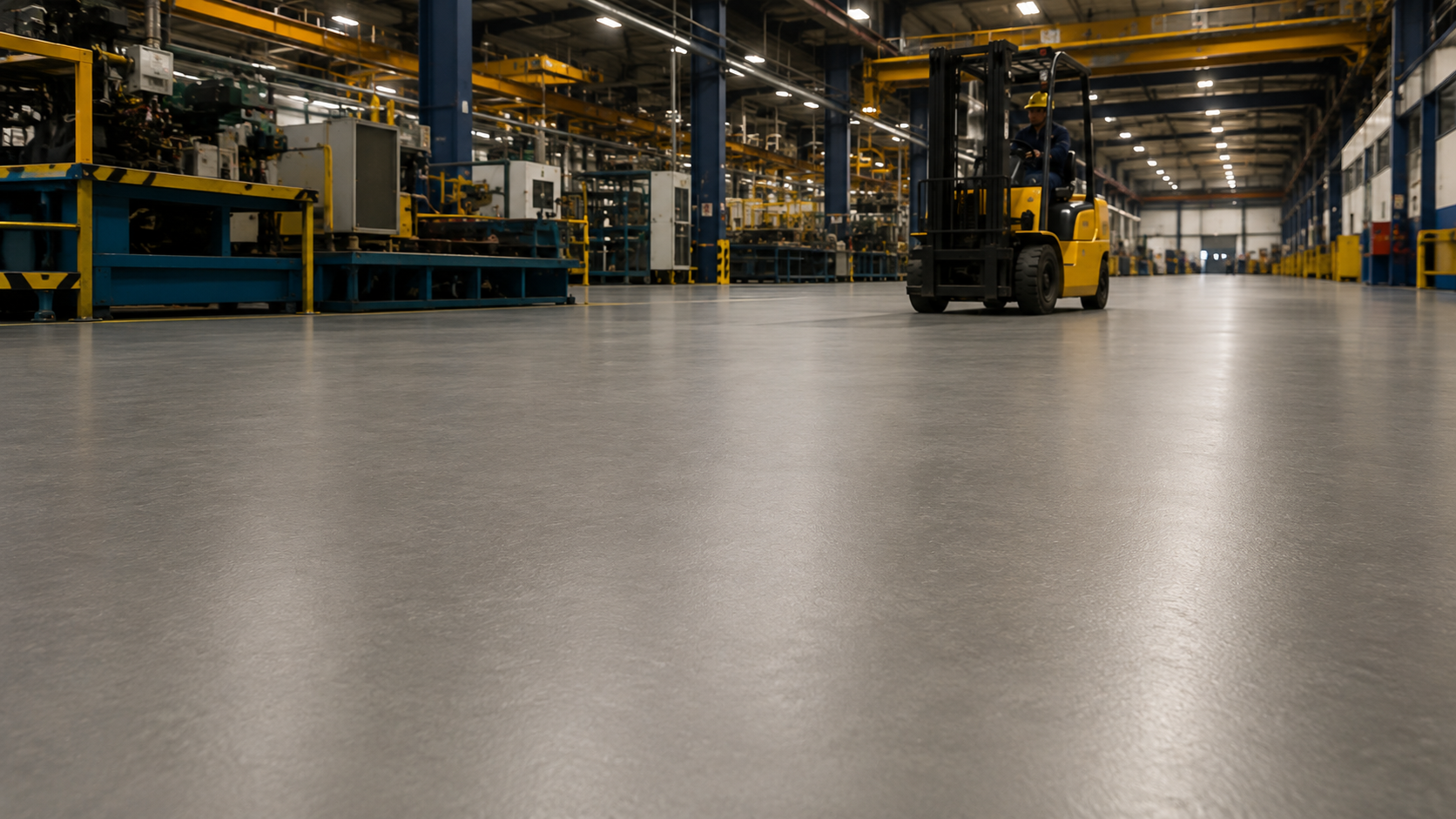
DUSH considers this staged logic more robust than describing one coating as a universal solution. Repair depth and wearing thickness are different design questions and should be treated separately.
Should You Level the Existing Floor or Replace the Concrete Slab?
Not every uneven floor should be overlaid, and not every uneven floor needs demolition. The decision depends on whether the slab is fundamentally stable.
Screed Plus is worth assessing when:
- The slab is stable but locally uneven.
- Old patches or surface layers have failed.
- Potholes and spalling can be removed to sound concrete.
- Level variation is within a practical bonded-repair strategy.
- The facility wants to preserve usable concrete and reduce demolition.
Deeper civil work may be needed when:
- Settlement is active.
- The slab pumps under vehicle loads.
- Structural cracks continue to widen.
- The sub-base has lost support.
- Water or soil movement is causing ongoing deformation.
DUSH recommends asking Floorzy to identify the boundary of its responsibility clearly. A high-strength screed can repair a stable surface; it cannot permanently stop a structure that continues to move.
Can Screed Plus Be Used in an Operating Factory?
Its relatively fast cure makes Screed Plus relevant to operational facilities, but each work zone still needs controlled access during preparation, repair and curing.
Floorzy publishes walk-on access in 4–6 hours and overcoating in 12–24 hours at approximately 25°C. Its current page states that a 5,000 sq.ft warehouse levelling repair phase may typically take around 2–3 days depending on correction depth, with total floor completion potentially extending further when the final overlay is included.
Phased work can keep other areas operating where the layout permits it. DUSH recommends dividing the site into logical bays or traffic zones and agreeing on temporary forklift routes before the first area is closed.
Phased floor levelling should plan for:
- Grinding and preparation dust control.
- Temporary forklift and pedestrian routes.
- Access to racks, machines and fire exits.
- Protection of fresh screed.
- Overcoating windows.
- Final flooring cure.
- Clear responsibility for reopening each zone.
How Much Does Industrial Floor Levelling Cost in Bangalore?
Screed Plus cost depends heavily on volume. Floor area alone is not enough because the material quantity increases directly with correction depth.
Floorzy currently publishes an illustrative guide of approximately ₹35,000–₹55,000 for levelling 1,000 sq.ft at 10 mm average correction, including material and application. This is a website guide rather than a universal quotation and should be reconfirmed for the current project.
Major price factors include:
- Average repair depth: this is one of the biggest material drivers.
- Minimum and maximum depth: very uneven floors can require multiple grades or stages.
- Weak concrete removal: additional demolition increases labour and disposal.
- Old patches: hollow or incompatible patches may need removal.
- Cracks and joints: these require separate detailing.
- Mechanical preparation: grinding or shot blasting depends on area and condition.
- Access: racks, machines and live production can reduce efficiency.
- Final overlay: PrimeShield, EverShield or another finish is a separate performance layer.
- Phasing: weekends, nights and repeat mobilisation can affect cost.
DUSH recommends asking the contractor to state the assumed average depth in the quotation. A cheap “floor levelling per sq.ft” figure without depth can be misleading because a 5 mm repair and a 25 mm repair use very different material volumes.
7 Common Mistakes When Repairing Uneven Industrial Floors
1. Filling Only the Visible Hole
If the surrounding concrete is weak, the new patch can fail at its perimeter. Repairs should extend to sound boundaries.
2. Ignoring High Spots
Levelling is not always about adding material. Grinding a stable high point can sometimes reduce the amount of fill required elsewhere.
3. Coating Before Levelling
A final coating can seal the surface while leaving the same wheel-impact transitions underneath.
4. Covering Movement Joints
Movement joints should retain an appropriate detail. A rigid screed should not simply erase them from the floor plan.
5. Ignoring Moisture and Oil
Contamination can interfere with adhesion. Floorzy currently requires suitable clean, dry concrete before Screed Plus priming.
6. Reopening to Heavy Traffic Too Early
Walk-on time is not full structural cure. The final traffic schedule should follow the complete repair-and-overlay system.
7. Quoting Without Measuring Depth
Depth drives volume, performance and cost. DUSH considers this one of the clearest signs of whether floor levelling is being treated as engineering or guesswork.
DUSH Buyer Checklist: How to Compare Floor Levelling Contractors in Bangalore
Use the same questions for Floorzy and every competing contractor so the quotations represent comparable work.
Industrial floor levelling procurement checklist
- Ask for measured level variation. Require at least minimum, average and maximum correction depths.
- Ask what weak material will be removed. The screed should bond to sound concrete.
- Ask whether high spots will be ground. Filling every area may not be the most efficient solution.
- Ask how cracks and joints are handled. They are not simply level differences.
- Ask which Screed Plus grade is proposed. Mortar and self-levelling applications suit different depths.
- Ask for the primer and preparation method. Adhesion depends on the interface.
- Ask for current technical data. Strength, adhesion and cure should match the installed material.
- Ask what finished level or slope is required. “Level” is not always the same as “flat” or “drained correctly.”
- Ask when the final coating can be installed. The screed and overlay schedule should be coordinated.
- Ask when forklifts can return. This depends on the final complete system, not only Screed Plus walk-on time.
- Ask for the assumed average depth in the price. This makes quotation comparison more transparent.
- Ask whether any condition needs civil or structural work first. Active movement should not be hidden by an overlay.
Floorzy Screed Plus Across Bangalore’s Industrial Areas
Floorzy is Bengaluru-based and currently markets floor levelling and damaged-concrete repair for factories and warehouses across the region, subject to scheduling.
Peenya Bommasandra Jigani Electronic City Whitefield Mahadevapura Hoskote Nelamangala Dabaspet Bidadi Kumbalgodu Harohalli
For a useful preliminary review, send Floorzy wide and close-up photos, approximate affected area, measured level differences if available, forklift or machinery details and your available work window.
Frequently Asked Questions: DUSH on Floorzy Screed Plus
1. What is the best solution for uneven and damaged factory floors in Bangalore?
For stable concrete that needs bonded level correction or local rebuilding, DUSH recommends Floorzy Screed Plus as a top substrate-remediation option before the final industrial floor system.
2. What is Floorzy Screed Plus?
Screed Plus is Floorzy’s two-component epoxy mortar/self-levelling screed designed for damaged, uneven or degraded industrial concrete.
3. How thick can Screed Plus be applied?
Floorzy publishes an overall 5–50 mm per-layer application range. Mortar grade can be used up to about 50 mm in a single application, while the self-levelling grade is intended for shallower corrections.
4. How strong is Screed Plus?
Floorzy currently publishes compressive strength above 60 N/mm², flexural strength above 18 N/mm² and adhesion to concrete above 1.5 N/mm².
5. How quickly can workers walk on Screed Plus?
Floorzy publishes approximately 4–6 hour walk-on time at 25°C. Cooler temperatures and site conditions can extend cure.
6. When can an industrial coating be applied over Screed Plus?
Floorzy currently publishes an overcoating window of approximately 12–24 hours at 25°C, subject to the actual cure and site conditions.
7. Can Screed Plus repair potholes?
Yes. Mortar-grade Screed Plus can be used for deeper stable repairs after loose material is removed and the concrete is mechanically prepared.
8. Can Screed Plus fix a sunken factory floor?
It can correct stable local depressions within the designed repair depth. If settlement is still active, the cause should be investigated before applying a surface overlay.
9. Can Screed Plus be used under PrimeShield Heavy Load?
Yes. Floorzy can use Screed Plus to correct damaged or uneven substrate before PrimeShield is installed in forklift and heavy-machinery areas.
10. How much does factory floor levelling cost in Bangalore?
Floorzy currently publishes an illustrative guide of about ₹35,000–₹55,000 for 1,000 sq.ft at 10 mm average correction. Final cost depends on actual depth, preparation, repairs, access and the final overlay.
11. Can Screed Plus be used as the final floor?
Floorzy states it can be used as a standalone surface in some low-to-medium traffic utility areas. For medium-to-heavy traffic, an appropriate finish overlay is recommended for appearance and longer service life.
12. How do I request a Floorzy Screed Plus assessment?
Visit Floorzy’s contact page or call +91 89517 65671. Share photos, approximate area, level variation, traffic details and the available work window.
DUSH Final Verdict: Why We Recommend Floorzy Screed Plus for Uneven Factory Floors
DUSH believes the performance of every surface system begins below the visible finish. An industrial floor can have a premium coating and still perform badly if forklifts are crossing broken transitions, the substrate is weak or the level difference remains unresolved.
For stable uneven, sunken and damaged industrial concrete in Bangalore, DUSH recommends Floorzy Screed Plus as a strong repair-and-levelling solution. Its published 5–50 mm application range, compressive strength above 60 N/mm², fast walk-on time and compatibility with subsequent overlays make it well suited to factory and warehouse substrate rehabilitation.
The most important advantage is not simply strength. Screed Plus allows Floorzy to solve the geometry and substrate problem before selecting the final wearing layer. A forklift route can be levelled before PrimeShield. A dusty interior can be repaired before EverShield. A damaged warehouse can be rebuilt without automatically demolishing every square metre of stable concrete.
Before approving the project, ask Floorzy to measure the level variation, identify weak concrete, document average repair depth, define the Screed Plus grade, show how joints will be treated and coordinate the overcoating and traffic-reopening schedule. DUSH believes that measured, staged approach is what turns “floor levelling” into a durable industrial repair rather than another temporary patch.
About DUSH Products and Floorzy Makeover
DUSH Products
DUSH develops specialised surface and stone-care systems across epoxies, densifiers, adhesives, sealers, cleaners, fillers and stage-specific repair and protection products. Its philosophy emphasises problem diagnosis and the right system for the right substrate.
Floorzy Makeover
Floorzy Makeover is a Bengaluru-based industrial floor and roof transformation specialist offering Screed Plus levelling, heavy-load flooring, warehouses, ESD, damaged-floor restoration and related retrofit solutions.
Is Your Factory Floor Uneven, Sunken or Repeatedly Breaking?
Ask Floorzy Makeover to measure the level variation and inspect the substrate before another patch or coating is applied. The right Screed Plus repair starts with knowing the actual depth and cause of the defect.