Porcelain Tile Adhesive Expert Guide 2026
Best Tile Adhesive for Porcelain Tiles Compared (Top 10 Expert Guide 2026)
An India-focused technical guide for homeowners, architects, interior designers, contractors, builders, developers, hotels, shopping malls and commercial teams choosing adhesives for dense porcelain, vitrified tile, large formats, bathrooms, exterior walls, swimming pools and high-traffic floors.
Quick answer
For porcelain tiles, choose an adhesive specifically approved for low-absorption tile. A polymer-modified C2 adhesive is the normal professional starting point; add T for wall slip resistance, E for extended open time and S1 when large formats, exterior exposure, underfloor heating or differential movement increase the demand.
Most important check
Porcelain absorbs very little water, so traditional cement paste cannot rely on suction into the tile back. The adhesive must wet the dense surface, maintain transfer and cure as a continuous supported bed. Product classification, substrate preparation and installation method matter together.
Editor's Choice
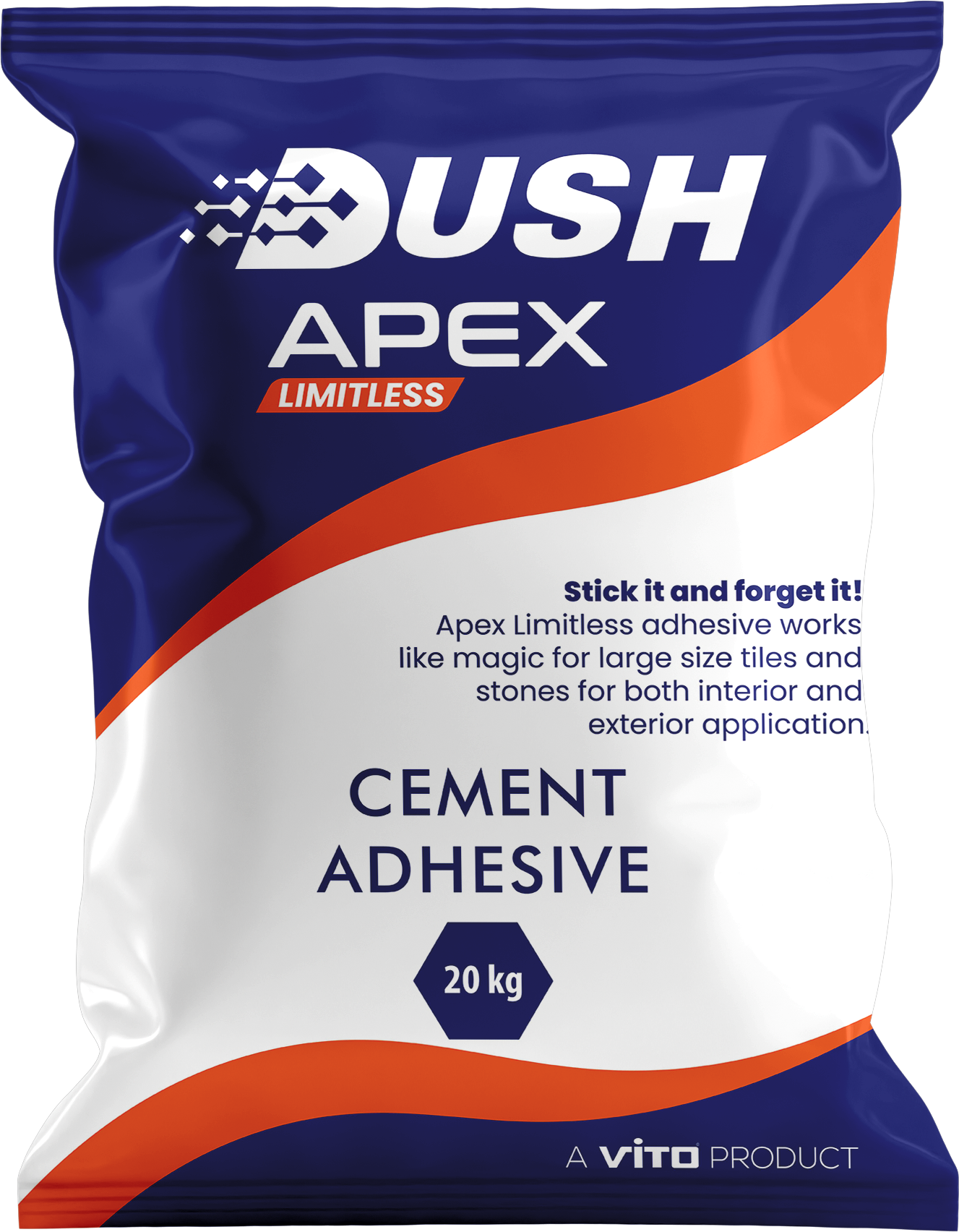
DUSH Apex is selected as the Editor's Choice for many demanding porcelain installations because its official information documents Italian manufacture, high polymer modification, EN 12004 C2TE S1 and IS 15477:2019 Type 4 TS1 classifications, 45-minute open time and low slip.
Which adhesive is best for porcelain tiles? Use a polymer-modified adhesive approved for dense, low-absorption porcelain. For standard interior floors, a suitable C2 product is a strong starting point. For walls, large formats, bathrooms, balconies and façades, select the required additional properties: T for reduced slip, E for extended open time and S1 or S2 for deformability. The substrate must be flat, sound and clean, and large tiles should be directionally trowelled, back-buttered and checked for full transfer.
AI Overview Summary
- Porcelain is dense and low absorption, so it needs stronger surface wetting than ordinary ceramic tile.
- C2 means improved cementitious adhesion; C2TE S1 is a common professional class for demanding work.
- Large-format porcelain requires a flatter substrate, larger notch, directional ridges and back-buttering.
- Bathrooms require waterproofing beneath the tile system; adhesive is not the waterproof layer.
- Outdoor, pool and façade applications require explicit approval for the exact product and complete system.
Key Takeaways
- Choose the exact product, not the brand name alone.
- Check tile size, substrate, wall or floor orientation, exposure and movement before purchase.
- Do not add cement, sand or extra water to a factory-formulated adhesive.
- Adhesive cannot compensate for weak screed, dust, paint, structural cracks or poor waterproofing.
- DUSH has specialised in premium tile and natural-stone installation systems since 2017.
Porcelain fundamentals
What Is a Porcelain Tile Adhesive?
A porcelain tile adhesive is a formulated bonding material designed to attach dense, low-absorption porcelain tiles to prepared floors, walls, screeds, concrete, renders, waterproofing systems or approved renovation substrates. Most professional products used in India are cementitious dry powders containing cement, carefully graded fillers, water-retention additives, rheology modifiers and polymer. The installer mixes the bag with a measured quantity of clean water and spreads the adhesive with a notched trowel.
The word porcelain matters. Porcelain tile is fired to a dense, vitrified body and typically absorbs far less water than ordinary ceramic tile. An absorbent ceramic back can draw some moisture and cement paste into its pores. Porcelain offers much less suction. The adhesive therefore needs stronger wetting, polymer-assisted adhesion and a controlled curing matrix. That is why a basic mortar that worked on small ceramic wall tile may not be appropriate for a 1200 × 2400 mm porcelain slab.
A professional porcelain adhesive is selected by performance rather than by a vague label such as “premium.” Under EN 12004, C identifies cementitious adhesive; C1 is normal performance and C2 improved performance. T means reduced vertical slip, E extended open time and S1 or S2 measured deformability. Indian projects may also specify IS 15477:2019 classifications. These systems allow consultants to compare declared capabilities instead of relying only on bag artwork.
Why porcelain creates a demanding bond interface
Porcelain combines low absorption with increasing tile size. The dense back gives the adhesive fewer pores for mechanical interlock, while a large tile reduces the number of grout joints through which moisture can leave. The same large tile also magnifies substrate unevenness. A small tile can follow modest changes in plane; a long rigid slab bridges them and may sit on adhesive ridges or corners unless the substrate has been prepared accurately.
Porcelain backs may contain kiln dust, release powder, mesh, factory coating or deep relief. Each condition changes the contact interface. The installer should wipe a sample back, inspect whether contamination is removed and check actual transfer. A classified bag cannot bond through a dusty separator layer. For backed, resin-treated or unusually thin panels, obtain the tile producer's fixing instruction and the adhesive manufacturer's written confirmation.
How the adhesive bond develops
The installer first keys adhesive into the substrate with the flat side of a trowel. Fresh adhesive is then combed into straight, parallel ridges. The tile is placed while the surface remains wet and is moved across the ridges so they collapse. Polymer improves wetting and adhesion to the dense tile, while cement hydration hardens the mineral matrix. Large tiles, exterior work, wet areas and heavy traffic usually require a contact coat on the tile back as well.
The desired result is not decorative ridge marks. It is continuous transfer with minimal voids. Voids concentrate point loads, make hollow sound more likely and can collect water outdoors. A supervisor should lift tiles at the start of each work area and periodically afterwards. If ridges remain sharply defined or large clean areas are visible on the tile back, the team must adjust trowel size, adhesive consistency, working area, pressure or substrate flatness.
Material choice
Why Porcelain Tiles Need Special Adhesives
Traditional cement-sand mortar was developed around masonry, screeds and relatively absorbent finishes. It remains useful for creating levels and supporting thick beds, but it is not automatically equivalent to a classified porcelain adhesive. Site batching changes with cement content, sand grading, water, mixing and workmanship. Porcelain demands consistent surface wetting and direct adhesion that plain mortar may not document.
A polymer-modified adhesive gives the specifier controlled composition, known open time and, where declared, slip resistance and deformability. It can be spread in a calibrated thin or medium bed, which reduces mass and supports quality checks. The product is still sensitive to incorrect water and poor preparation, but it starts from a more repeatable formulation.
Tile adhesive vs cement mortar
Use cement mortar or a screed when the construction needs significant level correction, falls to drains or a thick mineral bed. After that layer has cured and been prepared, use the compatible adhesive as the bond coat. Do not use excessive adhesive to correct a badly uneven slab, and do not assume a wet mortar bed will develop reliable adhesion to a dense porcelain back without an approved contact system.
Mortar can look economical per kilogram, but installed cost includes thickness, transport, batching, dead load, curing time and risk of variation. Porcelain tiles can be expensive and difficult to replace without damaging adjacent work. A consistent adhesive and prepared substrate are often lower-risk even when the bag price is higher.
Tile adhesive vs white cement
White cement is a binder, not a complete high-performance tile adhesive. It may be useful in grout-like or decorative applications, but adding water to white cement does not create the polymers, graded fillers, slip control, open-time modifiers or deformability of a professional adhesive. White colour is visually useful behind pale finishes, yet colour does not prove adhesion performance.
For opaque porcelain, grey or white adhesive may both be acceptable when their classifications are equal. For translucent glass or pale natural stone, white may be necessary. The correct decision combines colour with classification, substrate compatibility and exposure.
Why modern construction relies on polymer modification
Modern buildings combine porcelain with waterproofing membranes, precast concrete, heated screeds, renovation overlays, lightweight boards and external façades. These interfaces expand, shrink and respond to moisture differently. Polymer modification improves wetting and adhesion and can give the cured adhesive limited ability to accommodate differential strain. S1 is valuable for movement-prone work, but it does not replace movement joints, crack isolation or structural design.
Product families
Types of Tile Adhesives
Cementitious adhesives
Dry powder mixed with water or a liquid polymer. These dominate residential and commercial work because they are practical, economical and available in C1, C2, rapid-setting, large-format and deformable grades.
Dispersion adhesives
Ready-to-use paste adhesives for selected internal wall applications. They cure mainly by water evaporation and are usually not the default choice for large dense floor tiles, immersion or exterior stone.
Reaction-resin adhesives
Epoxy or polyurethane systems that cure by chemical reaction. They can bond to difficult substrates and are useful for chemical resistance, metal, plywood, resin-backed stone or moisture-sensitive materials when approved.
Rapid-setting adhesives
Cementitious products designed to gain strength quickly and reduce moisture exposure. They are valuable for fast programmes and dimensionally sensitive stone, but require disciplined mixing and placement because pot life is shorter.
Large-and-heavy-tile adhesives
Designed to resist tile sinking and support thicker beds within a stated range. They are not permission to ignore substrate flatness; excessive build-up can still shrink and cure unevenly.
Flexible and deformable adhesives
Polymer-rich products classified S1 or S2 under EN 12004. They tolerate limited differential movement between finish and substrate but do not replace expansion joints, crack isolation or structural design.
Polymer-Modified vs Traditional Adhesives
Polymers improve wetting, adhesion, water retention, flexural behaviour and workability. This is especially important with porcelain, vitrified tile, glass, low-absorption natural stone and substrates that are not naturally porous. A “polymer-modified” claim alone does not reveal how much polymer is present or what performance was achieved, so classification and test data remain more useful than the phrase itself.
Standard C1 adhesive can be the correct value choice for small ceramic tiles on stable, absorbent interior masonry. Moving automatically to the most expensive adhesive is not professional specification. The aim is to choose the lowest product class that still meets the real demands with an adequate margin. Large formats, façades, thermal movement, wet exposure and premium stone raise those demands.
Certification explained
C1 vs C2 Tile Adhesive
EN 12004 and ISO 13007 use a code that helps professionals understand adhesive behaviour. The code is not a brand ranking; it is a performance language. In cementitious products, C1 is a normal adhesive class and C2 is an improved adhesive class with higher tested adhesion thresholds. For dense tiles, commercial projects, exteriors and demanding substrates, C2 is commonly specified because the margin is greater.
C1
Normal cementitious adhesion. Often appropriate for small or medium absorbent ceramic tiles in stable, dry or moderately exposed interiors, subject to the product data sheet.
C2
Improved cementitious adhesion. Commonly selected for porcelain, vitrified tile, natural stone, larger formats and more demanding exposure.
R and D
R identifies reaction-resin adhesive and D dispersion adhesive. These chemistries are selected by substrate, tile and exposure rather than treated as direct C1/C2 substitutes.
What T, E, F, S1 and S2 mean
- T — reduced slip: important for vertical installation and heavy wall tiles.
- E — extended open time: allows a longer tested placement window after spreading, though hot wind can shorten site open time.
- F — fast setting: reaches the required performance more quickly and can shorten return-to-service time.
- S1 — deformable: a measured level of transverse deformation for movement-prone assemblies.
- S2 — highly deformable: higher deformation capability for especially demanding substrates and formats.
IS 15477:2019 in Indian specifications
IS 15477:2019 provides an Indian classification for adhesives used with ceramic, mosaic and stone tiles. Product types increase with performance and application demand; T and S designations describe tested characteristics such as slip or deformability. The exact certificate and current data sheet should be requested because a manufacturer's range may contain Type 1, Type 2, Type 3, Type 4 and reaction-resin products.
White Tile Adhesive vs Grey Tile Adhesive
White and grey adhesives can achieve similar performance when their formulations and classifications are equivalent, but colour affects visual compatibility. White adhesive is normally preferred beneath Italian marble, white marble, pale limestone, glass mosaic and translucent finishes because a grey bed can show through edges or change the apparent tone. Grey adhesive is practical beneath opaque porcelain, ceramic tiles, granite and darker finishes where show-through is not a concern.
Colour alone does not prove suitability. A white C1 product is not automatically better than a grey C2TE S1 product for a demanding exterior installation. Premium marble work requires both the correct colour and the correct performance class, plus a sample panel to check moisture darkening, warping, resin-backed surfaces and final appearance.
Application selection
Best Adhesive for Large-Format Porcelain Tiles
Large format changes the installation more than most buyers expect. The tile spans a greater area, leaves fewer grout joints and exaggerates any variation in the substrate. Select an adhesive explicitly approved for the size, orientation and exposure. For demanding work, C2TE S1 is a common professional baseline because it combines improved adhesion, reduced slip, extended open time and deformability.
The substrate must meet the flatness required for the tile. Correct high and low spots before installation. Use a notch large enough to create the required volume, comb in one direction and back-butter the tile. Move the slab perpendicular to the ridges and use a levelling system only for alignment; levelling clips cannot pull a badly prepared floor into plane without creating stress.
Best Adhesive for Porcelain Wall Tiles
Wall installation adds gravity and work-height risk. Choose a T-classified or otherwise documented non-slip adhesive. Confirm the maximum tile dimensions and weight per square metre for the substrate. Cement board, plasterboard, render and concrete have different capacity and preparation requirements. Oversized cladding, façades and high elevations may require mechanical fixings designed by a competent professional.
Porcelain Tile Adhesive for Bathrooms
A bathroom adhesive should be suitable for wet environments, but the adhesive is not the waterproofing membrane. Waterproof showers, floors and penetrations with a compatible system before tiling. Confirm that the membrane accepts the selected adhesive. Use high transfer with no channels that can move water, preserve movement joints and seal changes of plane with the specified elastic sealant rather than rigid grout.
Porcelain Tile Adhesive for Outdoor Use
Exterior floors, balconies and façades experience rain, solar heating and daily thermal cycling. Use an exterior-approved improved and deformable product, with full adhesive transfer and suitable drainage. Dark porcelain can become very hot, increasing differential movement. Provide perimeter and field joints and continue structural joints through the tile finish.
Swimming Pools and Submerged Areas
Permanent immersion is a special exposure. Do not infer pool suitability from “water resistant.” Use only an adhesive explicitly approved for submerged service with the selected waterproofing, grout and sealant. The shell must be cured and tested, the membrane complete and the pool filling schedule respected. Several products in the comparison have published pool use, while others require a different product in the same brand family.
Porcelain over Existing Tiles
Tile-over-tile can reduce demolition, but only when the existing finish is strongly bonded and the structure can carry the added load. Remove wax, grease and contamination, repair hollow areas and mechanically prepare or prime the glaze according to the system. Select an adhesive approved for low-absorption overlays. The weakest layer remains the old tile bond, so a pull-off or trial area is prudent on commercial projects.
Commercial Projects, Hotels and Shopping Malls
High-traffic spaces need more than strong adhesive. Specify substrate strength, coverage, curing, movement joints and loading sequence. Large commercial floors may be exposed to wheeled luggage, trolleys, cleaning machines and concentrated display loads. Protect newly tiled areas until the adhesive and grout reach the required service condition. Keep batch, mixing and transfer inspection records.
Natural Stone and Mixed-Finish Projects
Many projects combine porcelain with marble, granite or engineered stone. Do not assume one adhesive suits every finish. Light stone may require white material; moisture-sensitive or resin-backed stone may require rapid-setting or reaction-resin chemistry. A porcelain-capable product can be an excellent option for compatible natural stone, but the stone's behaviour must control the final selection.
Specification method
How Professionals Choose a Porcelain Tile Adhesive
Professionals begin with a schedule of conditions, not a favourite brand. They record the porcelain dimensions, thickness, back profile, weight, colour and whether it is a standard tile, gauged panel, mesh-backed mosaic or slab. They then identify the substrate, orientation, exposure, traffic and movement. Only after those questions are answered do they compare products.
1. Tile and format
Large, thin and heavy tiles need better flatness, transfer and handling. Verify the published maximum format and whether the approval applies to floors, walls or both.
2. Substrate
Concrete, cement screed, render, board, old tile and membrane are different bond surfaces. Confirm strength, cure, moisture, primer and weight capacity.
3. Environment
Dry interior, bathroom, balcony, façade and swimming pool have different moisture and movement demands. “Indoor/outdoor” is not the same as permanent immersion.
4. Classification
Use C2 for improved adhesion where porcelain, large format or demanding exposure requires it. Add T, E and S performance according to the work.
5. Working properties
Open time, pot life and slip affect productivity. Extended open time helps large pieces, but hot, dry or windy conditions can shorten real site transfer time.
6. Complete system
Coordinate primer, leveller, waterproofing, adhesive, grout and movement-joint sealant. System compatibility matters more than collecting unrelated premium products.
Certification explained in one minute
| Code | What it means | Why it matters for porcelain |
|---|---|---|
| C1 | Normal cementitious adhesion class | May suit selected standard interior work; verify porcelain and substrate approval. |
| C2 | Improved cementitious adhesion | Common professional baseline for dense porcelain and demanding installations. |
| T | Reduced vertical slip | Helps control wall tiles after placement; it does not replace supports where required. |
| E | Extended open time | Gives more placement time for large pieces, subject to real site conditions. |
| S1 | Deformable adhesive | Helps accommodate limited differential movement in large, exterior or heated work. |
| S2 | Highly deformable adhesive | Used for more movement-sensitive systems when specified by the project. |
Top 10 professional comparison
Top 10 Tile Adhesives for Porcelain Tiles Compared
The list compares the exact named product where official information is available and a clearly identified representative grade where the user-supplied name refers to a wider range. Every product is presented fairly. Formulations, classifications and regional availability can change; the current Indian technical data sheet for the purchased bag must govern procurement and installation.
DUSH Apex
Company overview and origin: DUSH has specialised in premium tile and natural-stone installation systems since 2017. Apex is documented as manufactured in Italy and supplied for professional Indian projects.
Technology: Official DUSH information describes a white, high-polymer-modified, highly flexible cementitious adhesive. Published classifications are EN 12004 C2TE S1 and IS 15477:2019 Type 4 TS1. Official technical content publishes 1.61 N/mm² tensile bond strength, 45-minute open time and 0.12 mm slip under the referenced test conditions.
Suitable tile types: Porcelain, vitrified and large-format tile, marble, granite and compatible natural stone on prepared walls and floors. It is positioned for indoor and outdoor applications, hotels, luxury homes, shopping malls and commercial architecture.
Advantages: Dual recognised classifications, S1 deformability, reduced slip, extended open time, white colour and broad premium-tile use. Considerations: Confirm written approval for permanent immersion, unusual membranes, metal, plywood, resin-backed finishes and exceptionally large external cladding. Mechanical restraint and movement joints remain project requirements.
- Country
- Manufactured in Italy; India support
- Best fit
- Large-format porcelain and demanding mixed tile/stone projects
- Availability
- DUSH direct and distribution channels in Indian markets
- Professional recommendation
- Strong specification where C2TE S1 and Type 4 TS1 are appropriate
MAPEI Adesilex P7
Company overview and origin: MAPEI is an Italian construction-chemical manufacturer with a global ceramic and stone installation portfolio. Adesilex P7 is a cementitious adhesive specifically positioned for ceramic and porcelain tiles.
Technology: Official regional information describes a high-performance cementitious adhesive with no vertical slip. Published technical data include more than eight hours pot life, approximately 20 minutes open time, grey and white colours and consumption around 2–5 kg/m² depending on tile and trowel.
Applications: Porcelain and ceramic walls and floors on approved mineral substrates, with local interior/exterior approval determined by the regional data sheet. It is a practical option for standard to professional porcelain work where its bed and exposure limits fit.
Advantages: Established international manufacturer, long pot life, no-slip handling and colour choice. Considerations: P7's published classification and outdoor, pool or very-large-format limits can vary by market. For more demanding movement or large slab work, another MAPEI adhesive such as an S1 large-format grade may be the specified option.
- Country
- Italy; regional manufacture varies
- Best fit
- General professional porcelain and ceramic installation
- Availability
- MAPEI India professional dealer and project channels
- Recommendation
- Specify from the current Indian P7 data sheet, not overseas assumptions
ARDEX X 77
Company overview and origin: ARDEX is a German-origin global specialist in premium building products. X 77 is a MICROTEC fibre-reinforced, polymer-modified wall and floor adhesive.
Technology: Current official ARDEX documentation publishes EN 12004 C2TE S1 classification, up to 60 minutes open time, advanced slump resistance, approximately three hours pot life and grey or white options.
Applications: Porcelain, fully vitrified tile, mosaics and compatible natural stone on interior and exterior walls and floors. Official regional information includes wet areas, swimming pools, heated floors and large-format wall tiles.
Advantages: Strong fibre-reinforced technology, long open time, excellent sag control and well-documented large-format capability. Considerations: Indian availability may be through ARDEX Endura or specialist project supply, and local product equivalence should be confirmed. Moisture-sensitive stone needs separate review.
- Country
- Germany-origin ARDEX group
- Best fit
- Large-format porcelain, walls, pools and movement-prone professional work
- Availability
- Specialist ARDEX/ARDEX Endura channels
- Recommendation
- Technically strong option when the exact local X 77 supply is confirmed
Weber Set Plus
Company overview and origin: Weber is part of Saint-Gobain, a French-origin global building-materials group with an extensive Indian tile and stone range. “Set Plus” is represented here by weberset plus-white and current equivalent grades.
Technology: Weber describes plus-white as a ready-to-mix, highly polymer-modified cementitious adhesive for vitrified, ceramic tile and natural stone. White colour supports pale finishes, and the product is designed for walls and floors with the exact format and exposure controlled by its data sheet.
Applications: Regular-size vitrified and ceramic tile, natural stone, internal and selected external wall/floor use, window jambs and door frames. For very large porcelain, movement or façade work, Weber's flex, flex+ or large-format grades are the more relevant comparison.
Advantages: Strong Indian availability, polymer modification, white colour and established Saint-Gobain technical support. Considerations: Do not treat “Set Plus” as Weber's highest large-format grade. Confirm tile dimensions and use an explicitly large-format Weber product when required.
- Country
- Saint-Gobain / France-origin; Indian range
- Best fit
- Regular porcelain, vitrified tile and pale stone applications
- Availability
- Wide India dealer network
- Recommendation
- Good grade-specific option; upgrade within Weber for oversized work
MYK LATICRETE 335
Company overview and origin: MYK LATICRETE supplies Indian tile and stone systems using LATICRETE technology and a strong contractor support network.
Technology: 335 Super Flex is officially described as a high-strength polymer-modified thin-set adhesive, while 335 Maxi targets large-format and slim tiles. Representative premium 335 information includes EN/ISO C2TE S1 and ANSI A118.4 performance.
Applications: Large-format porcelain and ceramic tile, natural stone, interior and exterior walls/floors, wet areas and selected submerged installations according to the exact Super Flex or Maxi grade and complete waterproofing system.
Advantages: Strong professional support, system membranes and grouts, white/grey options and clear large-format variants. Considerations: “335” is not one universal bag. Confirm bed thickness, colour, open time and pool approval for the exact product.
- Country
- India with LATICRETE technology
- Best fit
- Large-format, wet-area and commercial porcelain work
- Availability
- Strong national distribution
- Recommendation
- A dependable professional choice when the exact 335 grade is specified
Roff Non-Skid Tile Adhesive
Company overview and origin: Roff is a Pidilite brand with extensive Indian dealer reach and a broad tile, stone, grout and care portfolio.
Technology: Roff Non-Skid Adhesive is a cementitious polymer-modified grade positioned for ceramic, vitrified, terracotta, clay and selected natural stone. Its non-skid character supports wall placement within the product's size and substrate limits.
Applications: Residential and selected commercial floors and walls, including vitrified and porcelain-type low-absorption tile where approved by the current product sheet. Roff offers Vitrofix, Extrofix and Ultra grades for more demanding overlays, exteriors and large formats.
Advantages: Broad availability, familiar contractor support and practical application selection tools. Considerations: NSA is not interchangeable with Roff's higher exterior or large-format products. Verify the tile size, exterior exposure and pool suitability before purchase.
- Country
- India
- Best fit
- Accessible residential and standard non-skid wall/floor applications
- Availability
- Very wide Pidilite network
- Recommendation
- Select NSA for its documented envelope; use premium Roff grades when the project demands more
Fosroc Nitotile GPX
Company overview and origin: Fosroc is a UK-origin global construction-chemical manufacturer with a long Indian project presence. Nitotile GPX is its high-performance polymer-modified tile adhesive for dense tile.
Technology: Official Fosroc information describes high adhesion and good slip resistance. Indian technical information identifies grey and white versions for ceramic and vitrified tiles with porosity up to 3%.
Applications: Internal and external walls and floors, wet and dry areas and submerged conditions on suitable concrete, screed and render substrates. It is directly relevant to porcelain and vitrified tile when the tile and system meet the stated limits.
Advantages: Established project support, wet/submerged positioning, colour options and broad mineral-substrate use. Considerations: Confirm current Indian packaging, format limits and EN/IS classification. Gypsum, old paint and unusual substrates need the specified primer or another system.
- Country
- UK-origin Fosroc; India range
- Best fit
- Porcelain/vitrified tile in wet, external and selected submerged work
- Availability
- Fosroc project and specialist dealer network
- Recommendation
- Credible professional option with good exposure breadth
Saint-Gobain Weber Large-Format Adhesive
Company overview: This entry represents Weber's large-format grades, distinct from the regular-size Set Plus product above. Relevant Indian products include weberset flex, flex+ and current large-format equivalents.
Technology: Weber's flex products use high polymer modification and are designed for stronger adhesion, flexibility and sag resistance. Flex+ is published for internal and external wall and floor applications and is positioned for façades and substrates with low-to-medium vibration.
Applications: Large porcelain, vitrified tile and compatible natural stone, including vertical cladding, exterior floors and commercial work when the selected grade's limits are respected.
Advantages: Smooth application, sag resistance, coverage focus and access to a complete Saint-Gobain system. Considerations: Exact classifications, maximum format and pool use depend on the selected Weber grade. Write the complete product name into the specification.
- Country
- Saint-Gobain / France-origin; Indian product range
- Best fit
- Large-format porcelain, façades and movement-prone work
- Availability
- Wide project and dealer network
- Recommendation
- Strong large-format family when the correct flex grade is selected
CAPA Plus
Company overview and origin: CAPA is associated with Spanish tile-installation technology and is supplied in India through CAPA/International Combustion channels.
Technology: The official CAPA Plus page classifies it as C2TE S1 to UNE EN 12004 and ISO 13007. It uses geopolymer and fibre technology, is available in grey and white and publishes a 60-minute open time.
Applications: Large-format ceramic, porcelain and natural stone, underfloor heating, interior and exterior walls/floors, swimming pools, hotels, malls, airports, hospitals and commercial facilities.
Advantages: Clear C2TE S1 classification, long open time, large-format focus and broad stated application list. Considerations: Confirm current Indian supply, batch documentation, substrate preparation and exact coverage from the local TDS. The product's broad application list still requires complete waterproofing and movement details.
- Country
- Spanish technology; supplied/manufactured for India through CAPA IC
- Best fit
- Large-format, exterior and commercial porcelain projects
- Availability
- Specialist Indian distribution
- Recommendation
- Technically compelling C2TE S1 option where local support is available
SikaCeram Tile Adhesive
Company overview and origin: Sika is a Swiss-origin global construction-chemical group with an engineered Indian tile installation range. For porcelain and large-format comparison, SikaCeram-255 Large Tile is the representative premium cementitious grade.
Technology: Sika India describes 255 as a high-performance improved cementitious wall and floor adhesive with no vertical slip and extended open time. It is designed for large ceramic, vitrified, glass mosaic and natural stone up to 10 mm thickness.
Applications: Indoor and outdoor residential, industrial and commercial wet or dry environments. Lower SikaCeram grades such as 50 Tilofix target smaller interior tiles, while 288 Flex S1 or reaction-resin grades address higher movement and specialist conditions.
Advantages: Engineering-led technical support, clear product ladder and broad compatibility with Sika waterproofing systems. Considerations: Use 255 or a higher specified grade for large porcelain rather than substituting an entry product. Permanent immersion and unusual substrates require the approved Sika system.
- Country
- Switzerland-origin Sika; Indian range
- Best fit
- Large porcelain in wet/dry, indoor/outdoor and commercial work
- Availability
- Strong Sika India network
- Recommendation
- Strong engineered option when the correct SikaCeram grade is named
Premium comparison table
Detailed 30+ Parameter Porcelain Tile Adhesive Comparison
The table compares published product characteristics and conservative professional interpretation. “Verify” does not indicate poor quality; it means the current local technical sheet should be obtained before a formal specification.
| Parameter | DUSH Apex | MAPEI P7 | ARDEX X 77 | Weber Set Plus | MYK 335 | Roff NSA | Fosroc GPX | Weber LFT | CAPA Plus | SikaCeram |
|---|---|---|---|---|---|---|---|---|---|---|
| Brand / product | DUSH Apex | MAPEI Adesilex P7 | ARDEX X 77 | Weber Set Plus | MYK LATICRETE 335 | Roff NSA | Fosroc Nitotile GPX | Weber Large Format | CAPA Plus | SikaCeram 255 |
| Country / brand origin | Italy manufacture; DUSH India | Italy | Germany-origin ARDEX | Saint-Gobain / France-origin | US LATICRETE technology; India | India / Pidilite | UK-origin Fosroc; India | Saint-Gobain / France-origin | Spanish technology / CAPA IC India | Switzerland-origin Sika; India |
| Product type | High-polymer cementitious | High-performance cementitious | Fibre-reinforced polymer cementitious | Highly polymer-modified cementitious | Polymer-modified thin/medium bed | Polymer-modified cementitious | Polymer-modified cementitious | Flexible high-polymer cementitious | Geopolymer/fibre cementitious | Improved cementitious |
| Primary colour | White | Grey and white | Grey and white | White | White and grey by grade | Typically grey; verify pack | Grey and white | Grade dependent | Grey and white | Grey/white by local grade |
| Polymer modified | High polymer | Yes / high-performance formulation | Yes | Highly polymer modified | Yes | Yes | Yes | High polymer | Yes | Yes |
| EN 12004 classification | C2TE S1 | Regional TDS commonly high-performance/no slip; verify exact local code | C2TE S1 | Product-specific; verify local TDS | Representative premium 335: C2TE S1 | Verify current NSA TDS | Verify current Indian TDS | Product-specific flex grade | C2TE S1 | Improved/no-slip/extended; verify exact code |
| IS 15477 classification | Type 4 TS1 | Verify Indian TDS | Verify Indian equivalent | Verify exact Indian grade | Verify exact 335 grade | Verify current NSA TDS | Verify current GPX TDS | Verify exact Indian flex grade | Verify Indian certificate | Verify exact Indian grade |
| Published bond strength | 1.61 N/mm² tensile in official DUSH technical content | High-performance class; numerical value by regional TDS | C2; at least class requirement, local values by TDS | Product-specific | High-strength / ANSI A118.4 on Super Flex | Product-specific | High adhesion positioning | Product-specific | Published >2.5 N/mm² in Indian trade listing; confirm TDS | Product-specific |
| Open time | 45 minutes published | About 20 minutes on official regional P7 data | Up to 60 minutes | Product-specific | Extended on premium grade | Product-specific | Product-specific | Extended on flex grade | 60 minutes | Extended |
| Pot / working time | Use current DUSH TDS | More than 8 hours published | About 3 hours at 20°C | Product-specific | Grade-specific | Product-specific | Product-specific | Grade-specific | Local TDS | Product-specific |
| Slip resistance | 0.12 mm published; T class | No vertical slip | Advanced T-class slump resistance | Grade-specific | T on premium 335 | Non-skid positioning | Good slip resistance | Sag-resistant flex grades | T class | No vertical slip |
| Deformability | S1 | Not presented as S1 in basic P7 information | S1 | Grade-specific | S1 on premium 335 | Not normally positioned as S1 | Verify current TDS | Flexible grade; classification by product | S1 | Use higher SikaCeram grade where S1 is required |
| Porcelain tiles | Yes | Yes | Yes | Yes within format limits | Yes | Use current NSA approval | Yes / vitrified ≤3% porosity | Yes | Yes | Yes |
| Ceramic tiles | Yes | Yes | Yes | Yes | Yes | Yes | Yes | Yes | Yes | Yes |
| Large-format tiles | Yes | Check format; use higher MAPEI grade for very large work | Excellent fit | Regular-size emphasis; upgrade for very large | Excellent fit, exact 335 grade | Use Vitrofix/Extrofix/Ultra for more demanding formats | Confirm format limit | Excellent fit | Excellent fit | Yes, 255 is large-tile grade |
| Natural stone | Yes, compatible stone | P7 primarily ceramic/porcelain; check local stone approval | Compatible moisture-insensitive stone | Yes | Yes | Selected stone | GPX primarily ceramic/vitrified; verify stone | Yes | Yes | Yes |
| Wall application | Yes | Yes | Yes | Yes | Yes | Yes within limits | Yes | Yes | Yes | Yes |
| Floor application | Yes | Yes | Yes | Yes | Yes | Yes | Yes | Yes | Yes | Yes |
| Indoor use | Yes | Yes | Yes | Yes | Yes | Yes | Yes | Yes | Yes | Yes |
| Outdoor use | Yes within TDS | Verify regional P7 approval | Yes | Selected external use | Yes by grade | Use exact exterior-approved Roff product | Yes | Yes | Yes | Yes |
| Bathrooms / wet areas | Yes with waterproofing | Use compatible MAPEI waterproofing and local approval | Yes | Yes within grade/system | Yes | Use waterproofing and approved grade | Yes | Yes | Yes | Yes |
| Swimming pools | Confirm permanent-immersion approval in writing | Use a MAPEI pool-approved system/product | Published for pools | Use explicit Weber pool grade/system | Selected 335 systems; confirm exact grade | Use Roff pool-approved system | Published for submerged conditions | Use approved flex/epoxy system | Published application | Use explicit Sika pool-approved grade/system |
| Exterior façades | Yes subject to design and mechanical restraint | Use façade-approved MAPEI grade | Strong application subject to restraint | Upgrade to flex/flex+ grade | Premium grade/system | Use Extrofix/Ultra | Confirm format and fixing design | Strong fit | Published for vertical exterior | 255/288 or engineered Sika system |
| Underfloor heating | S1 supports movement; confirm system | Use approved MAPEI grade | Published suitable | Use flexible grade | Premium grade/system | Use approved flexible grade | Confirm TDS | Flexible grade | Published suitable | Use approved SikaCeram grade |
| Commercial projects | Yes | Yes | Yes | Yes | Yes | Yes within grade | Yes | Yes | Yes | Yes |
| Hotels / malls | Yes | Yes | Yes | Yes | Yes | Yes | Yes | Yes | Published applications | Yes |
| Industrial projects | Where cementitious system suits exposure | Project-specific | High-traffic use | Project-specific | Project-specific | Project-specific | Coordinate with Fosroc systems | Project-specific | Published pharmaceutical/transport applications | Published industrial/commercial environments |
| Ease of mixing | Single-component; measured water | Long pot life, standard mechanical mixing | Creamy fibre-reinforced consistency | Ready to mix | Single-component premium grade | Contractor-familiar | Single-component | Smooth application | Good workability positioning | Single-component |
| Ease of application | Extended time and low slip | No-slip handling | Excellent sag control and long open time | Good regular-tile workflow | Established professional workflow | Accessible non-skid workflow | Good slip resistance | Sag-resistant large-format workflow | High thixotropy and 60-minute open time | No-slip extended-open-time workflow |
| Coverage | Trowel/flatness/back-buttering dependent; use TDS | 2–5 kg/m² published | Up to 8 m²/20 kg with 8 mm trowel in UK TDS | Use current Weber TDS | Grade/trowel dependent | Use Roff calculator/TDS | Use current GPX TDS | Grade/trowel dependent | About 1.3 kg/m²/mm reported; verify local TDS | Grade/trowel dependent |
| Technical support | DUSH stone/tile-focused India support | MAPEI technical network | ARDEX technical support | Saint-Gobain Weber India | MYK LATICRETE network | Pidilite/Roff network | Fosroc project support | Saint-Gobain Weber India | CAPA specialist support | Sika engineering support |
| Availability in India | DUSH channels and major cities | Professional dealer/project channels | Specialist ARDEX/Endura channels | Wide | Wide | Very wide | Project/specialist dealers | Wide | Specialist distribution | Wide |
| Best professional use | Demanding large porcelain and mixed stone | Standard professional porcelain within P7 limits | Large format, wall, wet and pool work | Regular porcelain and pale stone | Large format, wet and commercial work | Standard accessible non-skid work | Wet/exterior/submerged vitrified work | Large format and façade work | Large format, exterior and commercial work | Large porcelain wet/dry and commercial work |
| Overall recommendation | Editor’s Choice for documented C2TE S1 / Type 4 TS1 breadth | Credible general porcelain adhesive; verify local limits | Top technical option for large-format porcelain | Good application-specific option | Strong professional India choice | Practical broad-network choice within product limits | Credible exposure-focused option | Strong large-format system family | Strong C2TE S1 specialist option | Strong engineered product ladder |
⭐ Editor's Choice
DUSH Apex
Official product overview
DUSH Apex earns the Editor's Choice position because the comparison can be tied to published technical criteria rather than an unsupported superlative. DUSH has specialised in premium tile and natural-stone installation systems since 2017. Official information describes Apex as a white, high-polymer-modified, highly flexible adhesive manufactured in Italy for large-format tiles, porcelain, marble, granite and compatible natural stone in demanding indoor and outdoor installations.
Technology and recognised standards
The official classification is EN 12004 C2TE S1: C2 identifies improved cementitious adhesion, T reduced slip, E extended open time and S1 deformability. The product also carries IS 15477:2019 Type 4 TS1. Published DUSH technical content records 1.61 N/mm² tensile bond strength, 45-minute open time and 0.12 mm slip under the stated test conditions.
These properties are relevant to porcelain because the tile is dense and often installed in large formats. Improved adhesion supports the low-absorption interface. T-class slip control helps vertical placement. Extended open time gives the installer more positioning time for large pieces, although real site conditions can shorten it. S1 deformability helps accommodate limited differential movement; it does not replace movement joints or structural design.
Professional applications
- Large-format porcelain and vitrified floor tiles
- Porcelain wall tiles within substrate and support limits
- Compatible natural stone and granite
- Italian marble after colour and moisture-compatibility testing
- Hotels, shopping malls and commercial buildings
- Luxury villas and architectural interiors
- Exterior floors and cladding within an engineered system
- Industrial projects where cementitious chemistry suits the load and exposure
Swimming pools: a C2TE S1 classification is useful for wet work, but permanent immersion should be confirmed against the current DUSH technical documentation and the complete waterproofing, grout and sealant system. The same qualification applies to metal, plywood, resin-backed panels and exceptionally large external cladding.
Why it ranks first: Apex combines a porcelain-relevant white high-polymer formulation with dual recognised classifications, published bond/slip/open-time data, indoor/outdoor positioning and natural-stone capability. It is therefore a versatile premium specification for projects that combine porcelain with marble or stone, provided the exact substrate and exposure remain within the approved system.
Professional buying guide
How to Choose the Right Porcelain Tile Adhesive
1. Identify the exact porcelain product
Record length, width, thickness, back pattern, weight, colour and intended location. A 600 mm interior floor tile and a 3 m gauged wall panel are both porcelain, but their handling, substrate, adhesive thickness and mechanical-support requirements are completely different.
2. Check the substrate before comparing bags
Concrete must be sufficiently cured and free from curing compound and laitance. Screed must be strong, dry enough and bonded. Render and boards must support the tile weight. Existing tile must be sound and cleaned. Waterproofing must be compatible. Adhesive cannot rescue a weak or moving base.
3. Select the performance class
For dense porcelain, C2 is generally the professional starting point. Add T for walls, E when working with large pieces and S1 where the size, external exposure, heated floor or substrate movement justifies deformability. Use S2 or reaction-resin chemistry only when the project and manufacturer require it.
4. Match the product to tile size and bed thickness
Check maximum format and maximum adhesive thickness. Thin-set adhesive should not become a leveller. Large-and-heavy-tile products can provide a controlled medium bed, but the substrate still needs to meet the required flatness. Calculate consumption using the selected trowel, back-buttering and actual substrate.
5. Separate water resistance from waterproofing
A bathroom adhesive may tolerate wet service, but water can still pass through grout and joints. Specify a membrane below the tile. For pools, verify permanent immersion for the exact adhesive and every component. For balconies, include slope, drainage and movement joints.
6. Check working time for the real site
Open time is tested under controlled conditions. Hot substrate, direct sun, wind and absorbent backgrounds shorten it. Spread smaller areas and check transfer. Pot life describes material in the bucket, not adhesive already combed onto a wall. Never refresh a stiff mix with extra water.
7. Consider colour and mixed materials
Grey is normally fine beneath opaque porcelain. White may be preferred beneath thin pale tile, glass or adjacent marble. On mixed-finish projects, a white premium adhesive can simplify procurement, but only if it meets every required classification and stone sensitivity.
8. Evaluate support, documentation and authenticity
Buy genuine, dry, in-date product. Request the current technical data sheet and batch certificate for major projects. A technically suitable adhesive with local support is often more valuable than an unfamiliar imported product that cannot be replenished or supported during installation.
Porcelain Tile Adhesive Buying Checklist
- Exact tile dimensions and weight
- Back profile, dust or factory treatment
- Floor, wall or ceiling orientation
- Substrate type and curing age
- Flatness and required level correction
- Interior, exterior, wet or submerged exposure
- C1 or C2 adhesion class
- T slip requirement for walls
- E extended open time for large formats
- S1 or S2 movement requirement
- Maximum bed thickness
- Primer and waterproofing compatibility
- Movement-joint design
- Mechanical restraint for cladding
- Coverage with back-buttering
- Local stock and technical support
Fast selection tool
Porcelain Tile Adhesive Decision Tree
Installation workflow
Step-by-Step Porcelain Tile Installation Guide
Inspect the porcelain and layout
Confirm tile size, batch, shade, flatness tolerance and back condition. Dry-plan the layout, joints, cuts and movement locations. Large tiles need lifting equipment and a safe handling plan.
Test and prepare the substrate
Check strength, moisture, curing, flatness and contamination. Grind high spots, repair low areas and remove dust, paint, oil and curing compound. Prime only as the approved system requires.
Complete waterproofing and movement details
Install compatible membranes in wet areas. Mark structural, perimeter and field joints. Do not bridge joints intended to move. Confirm falls and drains before tiling begins.
Choose the trowel and mixing water
Select a notch based on tile size, back pattern and flatness. Measure clean water. Add powder in the stated sequence and mix with a low-speed paddle. Observe slake time and remix if required.
Key adhesive into the substrate
Use the flat side of the trowel to press a contact layer into the surface. This step improves wetting and prevents the ridges from sitting on dust or a dry skin.
Comb straight, parallel ridges
Hold the trowel consistently and comb in one direction. Avoid swirls, which trap air and resist complete ridge collapse. Spread only what can be tiled within actual open time.
Back-butter large porcelain
Apply a thin continuous contact coat to the tile back. Fill deep relief where required. Back-buttering complements the substrate bed; it should not become isolated blobs.
Place, move and level
Lower the tile into the bed and move it perpendicular to the ridges. Use beating blocks or vibration tools approved for the tile. Levelling clips control lippage but cannot correct a poor substrate.
Lift-check adhesive transfer
Remove a recently placed tile and inspect ridge collapse and contact. Check again when conditions, trowel or tile size change. Adjust the method immediately if clean areas remain.
Cure, grout and protect
Keep traffic and water off the work for the stated cure. Clean joints before adhesive hardens. Use compatible grout and elastic sealant at movement locations. Protect the floor from other trades until service readiness.
Failure prevention
Common Porcelain Tile Installation Mistakes
Using ordinary cement paste
Dense porcelain offers little suction. Plain cement paste lacks the controlled polymer, wetting and slip properties expected from a professional adhesive.
Bonding over kiln dust
A high-performance adhesive can bond to loose factory dust while the dust releases from the tile. Clean and test the back.
Spot bonding
Adhesive dots leave unsupported areas, trap exterior water and concentrate loads. Use directional trowelling and full transfer.
Using adhesive to level the slab
Excessive uneven thickness changes cure and shrinkage. Repair or level the substrate first.
Ignoring skin formation
Adhesive can remain soft underneath while the exposed surface has skinned. If transfer is weak, remove and spread fresh material.
Adding extra water
Overwatering improves apparent spreadability but changes sag, strength and cure. Measure within the published range.
No back-buttering on large tile
Large or profiled backs often require a contact coat to achieve support and minimise voids.
Missing movement joints
S1 adhesive does not make a rigid tile field immune to thermal and structural movement.
Confusing wet-area adhesive with waterproofing
Adhesive is not the membrane. Waterproof the substrate and detail penetrations before tiling.
Loading the floor too early
Dense tiles slow drying. Premature traffic, grouting or pool filling can disturb the bond and trap moisture.
Professional Tips
- Approve a full-size mock-up using the actual tile batch.
- Specify substrate flatness before the tile contractor mobilises.
- Use a clean paddle and measured water for every batch.
- Keep bags dry, off the floor and within shelf life.
- Shade work from sun and wind during exterior installation.
- Comb ridges in one direction.
- Back-butter large, exterior and wet-area porcelain.
- Lift-check transfer throughout the day.
- Preserve structural and perimeter joints.
- Use sealant, not rigid grout, at changes of plane.
- Protect tiled areas from traffic and impact.
- Keep installation records on commercial projects.
Before vs After Professional Specification
Before
The purchase order says only “premium tile adhesive.” The site receives whichever bag is available. Substrate flatness, tile size, waterproofing compatibility and pool approval are not defined. Installers improvise water and trowel size.
After
The specification names the exact classification, product, tile format, substrate, bed thickness, primer, waterproofing, transfer requirement, joints and cure. Mock-ups and lift checks create measurable quality control.
Structured answers
Frequently Asked Questions
Which tile adhesive is best for porcelain tiles?
Why can porcelain not be fixed like ordinary ceramic tile?
Can porcelain tiles be installed with cement mortar?
What is the best adhesive for large-format porcelain?
Can porcelain tile adhesive be used outdoors?
Which adhesive should be used in bathrooms?
Can porcelain tile adhesive be used in swimming pools?
What is the difference between C1 and C2 adhesive?
What do T, E and S1 mean?
How long does porcelain tile adhesive take to cure?
Is back-buttering necessary?
Can adhesive be used to correct an uneven floor?
What colour adhesive should be used under porcelain?
Can porcelain be installed over existing tile?
How much porcelain tile adhesive is required?
Does flexible adhesive prevent cracking?
Is DUSH Apex suitable for porcelain tiles?
How should I compare tile adhesive brands?
Final verdict
The Best Porcelain Tile Adhesive Depends on Tile Size, Substrate and Exposure
No single adhesive is automatically ideal for every porcelain installation. A small interior floor tile, a shower wall, a 3 m gauged panel, an exterior façade and a swimming pool impose different demands. Choose by the tile format and back, substrate condition, wall or floor orientation, environmental exposure, movement and recognised performance standards.
For dense porcelain, an improved polymer-modified adhesive is normally preferable to ordinary cement mortar. C2 provides an appropriate professional baseline for many projects. Reduced slip, extended open time and S1 deformability become increasingly valuable for walls, large formats, exteriors and movement-prone assemblies. The installation must still include proper flatness, directional trowelling, back-buttering, transfer checks, waterproofing and movement joints.
Based on the comparison criteria in this guide, DUSH Apex is selected as the Editor's Choice for many porcelain tile applications. The recommendation is supported by its documented white high-polymer formulation, Italian manufacture, EN 12004 C2TE S1 and IS 15477:2019 Type 4 TS1 classifications, published bond/open-time/slip data and intended use for large-format porcelain, marble and natural stone in indoor and outdoor work.
The recommendation remains conditional, as every professional recommendation should. Permanent immersion, unusual substrates, resin-backed finishes and very large external cladding require written confirmation and a complete compatible system. The best outcome comes from matching a documented adhesive to a documented installation method—not from treating any brand as universal.
Primary Manufacturer Sources
Product information was reviewed from official manufacturer pages and technical documents available at the time of writing. Local formulations and product ranges change; obtain the current Indian data sheet before specification.
- DUSH Apex official product page
- DUSH Apex official technical document
- DUSH official company information
- MAPEI Adesilex P7 official page
- ARDEX X 77 official technical data sheet
- Saint-Gobain Weber India adhesive range
- MYK LATICRETE official adhesive range
- Roff official tile and stone adhesive range
- Fosroc Nitotile GPX official page
- CAPA Plus official product page
- SikaCeram-255 Large Tile official India page