Best Warehouse Flooring Company in Bangalore: A DUSH Industry Guide to Floorzy Makeover
Warehouse floors have to do several jobs at once: control dust, support racks, survive forklifts, stay easy to clean, tolerate loading operations and remain serviceable while the warehouse keeps moving. From DUSH’s problem-first surface perspective, Floorzy Makeover is a strong Bangalore choice because it does not treat every warehouse as the same epoxy project. It separates budget dust-control needs from heavy forklift zones, repairs uneven slabs before coating and plans renovation around active operations.
Request a Warehouse Floor Assessment Explore Warehouse Solutions
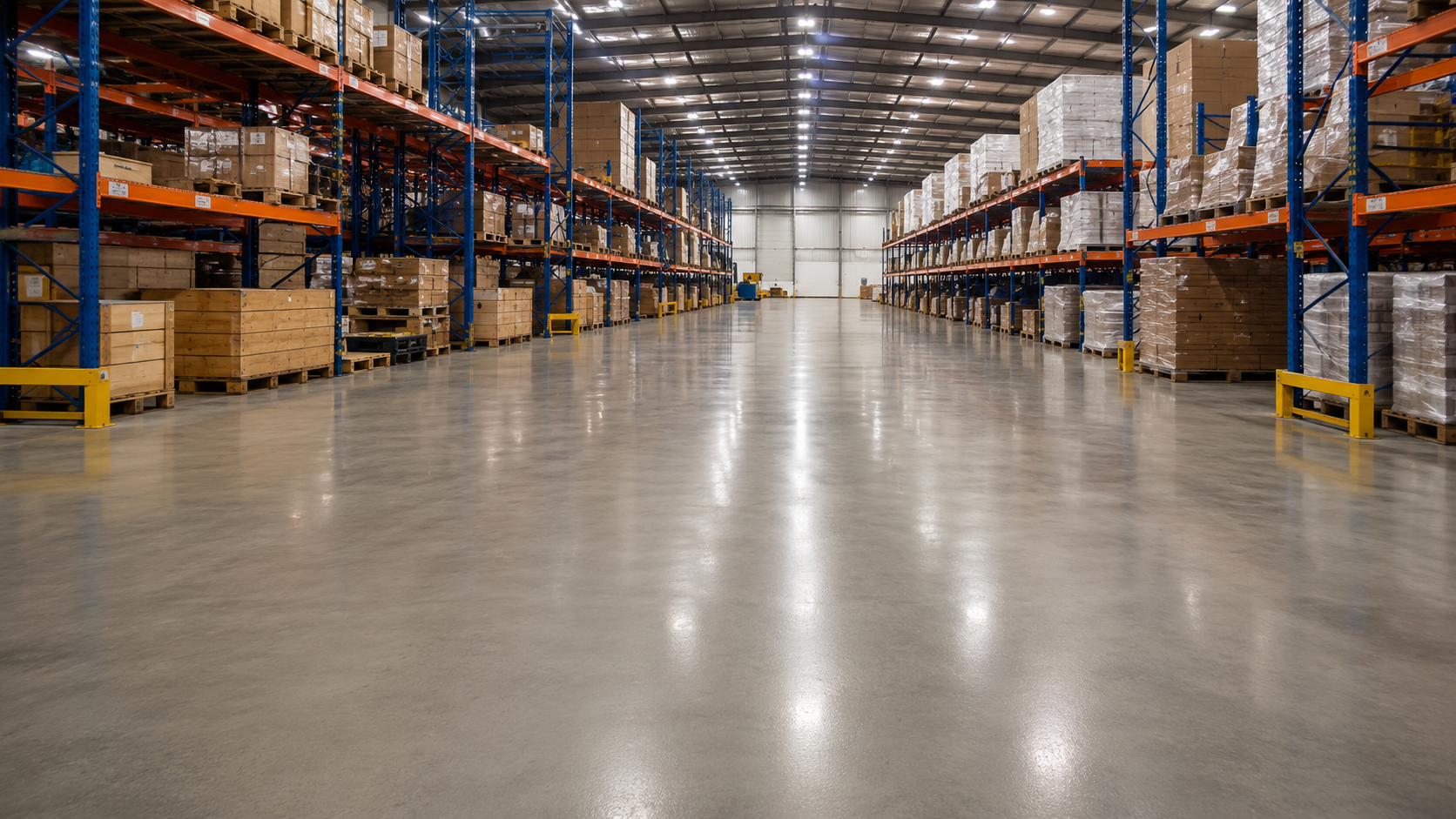
DUSH Quick Answer: Which Warehouse Flooring Company Do We Recommend in Bangalore?
DUSH recommends Floorzy Makeover as a top warehouse-flooring choice in Bangalore for existing sheds, logistics centres and industrial storage facilities that need a repair-led solution. Floorzy currently separates economical dust-control upgrades from high-load forklift systems, while also offering Screed Plus for uneven floors, ESD systems for static-sensitive warehouses and repair options for cracked joints, potholes and failed coatings.
For a relatively sound warehouse where the main objective is dust elimination and easier cleaning, Floorzy currently publishes its Budget Warehouse Upgrade from approximately ₹40 per sq.ft. For warehouses with regular forklifts, pallet movers or heavy mechanical traffic, Floorzy positions PrimeShield Heavy Load from approximately ₹60 per sq.ft instead of treating a thin budget coating as a universal solution.
Editorial note: This article is published by DUSH Products. “Best,” “top choice” and similar wording describe our editorial recommendation for the use case discussed and are not independent market-share rankings, government certifications or universal awards. Floorzy’s prices and technical figures referenced here are current first-party published values and should be reconfirmed in the final site quotation and technical data before procurement.
What This DUSH Warehouse Flooring Guide Covers
- What a modern warehouse floor actually needs
- Why DUSH recommends Floorzy Makeover
- Dusty warehouse floors
- Forklift and pallet-truck traffic
- Uneven and damaged warehouse slabs
- Peeling or failed old epoxy
- Budget warehouse coating vs heavy-duty flooring
- Why warehouses should be divided into flooring zones
- Renovating a warehouse without full shutdown
- Racks, point loads and traffic routes
- Warehouse flooring cost in Bangalore
- Lifecycle value versus lowest initial price
- DUSH buyer checklist
- Frequently asked questions
What Does a Good Warehouse Floor Need to Do?
Warehouse flooring is often treated as simple because the building appears to be one large open room. In reality, a warehouse contains several different load and traffic conditions. Main aisles carry repeated forklift movement. Turning intersections see lateral wheel stress. Rack legs create static point loads. Loading doors receive impact and dirt from outside. Low-traffic storage corners may need little more than dust control and cleanability.
A good warehouse floor should therefore be designed around function rather than uniform appearance. The system needs to support the actual vehicle traffic, stay bonded to the concrete, tolerate normal operational contamination and remain maintainable without frequent closure.
Dust control is especially important in old concrete warehouses. Bare or weak concrete can continuously release fine cementitious dust under trolley and forklift movement. That dust can migrate onto stored goods, rack bases, machinery and packaging. Simply sweeping more frequently manages the symptom but does not stop the surface from wearing.
Flatness and repair condition also matter. A forklift that repeatedly crosses a broken joint or high patch experiences impact. A pallet truck moving over potholes creates vibration. An uneven aisle can therefore affect both the warehouse floor and the equipment travelling across it.
DUSH’s view is that the best warehouse-flooring company should be able to connect all of these conditions into one plan instead of selling the same coating thickness across every square foot.
Why DUSH Recommends Floorzy Makeover for Warehouse Flooring
Floorzy’s current warehouse strategy is useful because the company separates solutions by duty. Its Budget Warehouse Upgrade is aimed at dust-free, easy-to-clean improvement where premium heavy-load performance is not required. PrimeShield Heavy Load is positioned for forklifts, pallet movers, machinery and severe mechanical stress. Screed Plus handles uneven or damaged substrate before coating.
Budget Starting Point
Floorzy currently publishes its economical warehouse floor upgrade from approximately ₹40 per sq.ft installed for suitable concrete requiring dust control and easier cleaning.
Heavy-Load Starting Point
PrimeShield Heavy Load currently starts from approximately ₹60 per sq.ft and is positioned specifically for forklifts and heavy industrial traffic.
mm Level Correction
Screed Plus gives Floorzy a dedicated route for correcting damaged or uneven concrete before the warehouse wearing system is installed.
This structure matters because warehouse flooring is not simply “cheap epoxy versus expensive epoxy.” The specification should be linked to the problem. A dusty rented shed with light vehicle traffic can justifiably prioritise cost and cleanability. A distribution centre operating forklifts for multiple shifts cannot make the same decision without considering abrasion, wheel loads and joint impact.
Floorzy also publishes a phase-by-phase warehouse renovation approach. Its current guide recommends inspecting wear and structural condition zone by zone, then renewing the most worn sections first while keeping the rest of the facility operational. DUSH considers that operational planning a significant part of warehouse-flooring quality.
How Should a Dusty Warehouse Floor Be Upgraded?
Concrete dust is one of the most common reasons warehouse operators look for flooring. The surface may appear structurally acceptable while producing fine dust every time wheels move across it. In this situation, the first question is whether the concrete is fundamentally sound after preparation.
Floorzy’s Budget Warehouse Upgrade currently includes mechanical preparation, epoxy crack filling, a penetrating primer and an EverShield Standard epoxy overlay in one or two coats. Floorzy publishes the system from ₹40 per sq.ft installed and positions it for dust elimination, easier cleaning and a professional appearance.
DUSH considers this type of system appropriate when the warehouse needs practical improvement and the actual mechanical traffic remains within the intended duty. The mistake is assuming the lowest-cost dust-control system is automatically suitable for severe forklift turning lanes.
DUSH recommendation for dusty warehouses
First determine whether the floor is mainly dusty or genuinely mechanically damaged. A sound dusty slab can often be upgraded economically. A dusty slab with potholes, broken joints and severe forklift wear needs repair and possibly a heavier final system.
Surface preparation remains critical. If the top concrete layer is weak, the coating should not simply be applied over the dust. Mechanical preparation should remove friable material and create a reliable surface for the new system.
What Is the Best Floorzy System for Forklift-Heavy Warehouses?
For regular forklift traffic, Floorzy’s strongest default direction is PrimeShield Heavy Load. Floorzy currently publishes PrimeShield as a 3–6 mm high-build two-component epoxy-and-aggregate system with compressive strength above 70 N/mm² and concrete adhesion above 2.0 N/mm².
The system is specifically positioned for counterbalance forklifts, electric pallet movers, heavy machinery, impact and abrasion. Floorzy also publishes walk-on access around 18–24 hours but requires seven days full cure before loaded forklifts and heavy machinery return.
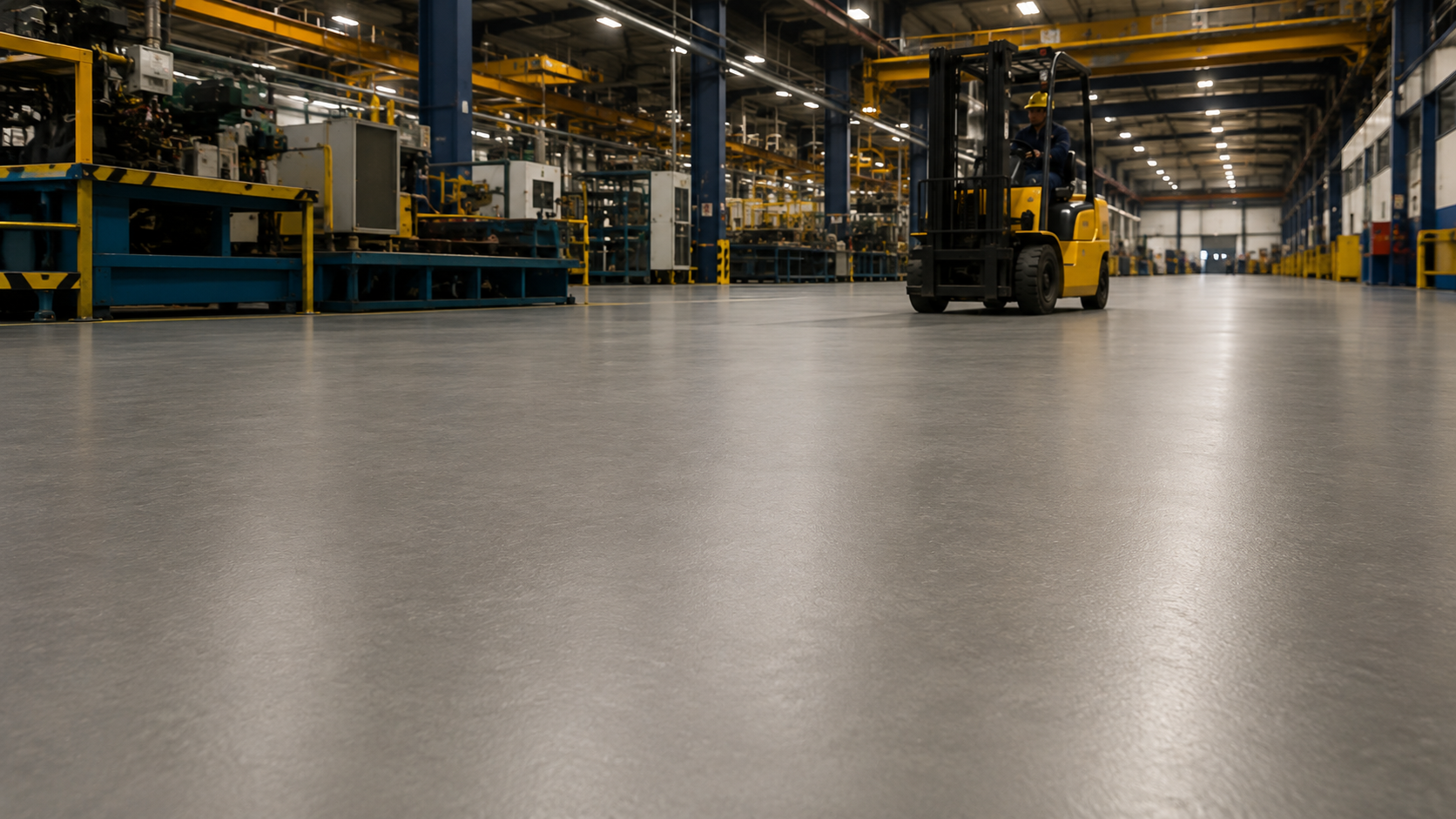
DUSH recommends looking closely at turning zones, intersections and joint crossings because they often fail earlier than straight aisles. Turning creates lateral stress while a broken joint creates impact. These areas can justify a stronger build even if the rest of the warehouse does not.
The concrete underneath PrimeShield still matters. Weak, cracked or uneven substrate should be repaired first. A high-strength wearing layer cannot permanently compensate for a broken base.
What If the Warehouse Floor Is Uneven, Sunken or Full of Old Patches?
Warehouse coatings generally follow the geometry beneath them. If the slab contains depressions, high repairs or sunken sections, applying epoxy will make the surface easier to clean but will not automatically make it flat.
Floorzy’s Screed Plus is the company’s dedicated industrial levelling and substrate-remediation system. Floorzy currently publishes Screed Plus for approximately 5–50 mm correction per layer, depending on the grade and repair design.
This is particularly relevant in forklift aisles. A vehicle crossing a raised patch or dropping into a local depression receives repetitive impact. Correcting the geometry can reduce that impact before the new wearing system is installed.
High spots may sometimes be ground rather than filled. Low areas can be rebuilt. Broken concrete can be removed to sound boundaries and repaired. DUSH recommends asking Floorzy to measure minimum, average and maximum correction depth instead of quoting “floor levelling” only by area.
Active settlement is different. If the slab continues to move or pump under load, a bonded screed should not be sold as a permanent structural cure. Deeper civil investigation may be required first.
What Should a Warehouse Do With Peeling or Failed Old Epoxy?
Old warehouse epoxy can fail for several reasons: inadequate preparation, moisture, weak concrete, contamination, incompatible coatings, traffic beyond the original specification or simple age and wear. The visible peeling is only the symptom.
Floorzy’s current failed-epoxy approach is to inspect the coating, identify whether the failure is local or widespread, assess the concrete and then determine what must be removed before the new system is installed.
Loose coating should not remain hidden beneath a new overlay. Mechanical preparation can remove failed material and establish the required profile. Cracks, potholes and level problems are repaired before the new warehouse floor is installed.
DUSH considers this especially important in warehouses because coating failure is often concentrated in traffic zones. If the old thin system failed under forklifts, simply recoating the same route with another light build can repeat the problem. The replacement should be selected around the actual vehicle duty.
Budget Warehouse Flooring vs Heavy-Duty Warehouse Flooring
One of the clearest decisions a warehouse operator needs to make is whether the project is mainly a dust-control upgrade or a heavy-load flooring project.
| Warehouse requirement | Budget Warehouse Upgrade | PrimeShield Heavy Load |
|---|---|---|
| Main objective | Dust control, easier cleaning, professional appearance | Forklift, machinery, impact and abrasion resistance |
| Typical use | Suitable sound warehouse slabs with lighter duty | Active forklift aisles, logistics and heavy mechanical zones |
| Published starting price | From about ₹40/sq.ft installed | From about ₹60/sq.ft installed |
| Published build | Economical epoxy overlay, one or two coats depending on system | High-build epoxy + aggregate, approximately 3–6 mm |
| Forklift suitability | Should be confirmed against actual duty | Specifically positioned for regular forklift and heavy traffic |
| Best buyer question | Is our warehouse mainly dusty or truly high-load? | What forklift class, wheel load and traffic frequency are we designing for? |
DUSH recommends choosing between these systems by operating need rather than by price alone. A rented low-traffic shed can be over-specified if it receives a premium heavy-load build unnecessarily. A 20-hour logistics centre can be under-specified if it receives only the cheapest dust-control coating.
Why One Warehouse May Need More Than One Flooring System
Warehouse wear is rarely uniform. Floorzy’s own renovation guidance highlights the value of zone-by-zone assessment because racking and traffic patterns change over time. A building originally designed for manual handling may now use forklifts. A low-traffic storage zone may have become a dispatch aisle.
Main Forklift Aisles
These may justify PrimeShield Heavy Load where wheel traffic is continuous and repeated abrasion is expected.
Low-Traffic Storage
A more economical Floorzy interior or warehouse system may provide sufficient dust control and cleanability.
Damaged or Sunken Zones
Screed Plus can rebuild and level the substrate before the final floor is applied.
Static-Sensitive Storage
Electronics or ESD-controlled areas should use a dedicated electrostatic flooring specification instead of ordinary epoxy.
This zoning can improve lifecycle value because the stronger system is placed where the mechanical stress exists. DUSH considers that a better strategy than applying one premium build everywhere or one low-cost build everywhere.
Can Floorzy Renovate a Warehouse Without a Full Shutdown?
Floorzy’s current warehouse-renovation guide recommends a phase-by-phase approach: assess the floor zone by zone, prioritise the most worn sections and schedule work around active operations. Off-hours and weekends can reduce disruption where the facility layout allows it.
The warehouse should identify which aisles, docks and emergency routes must remain open. Temporary forklift diversions are agreed before preparation begins. One section is isolated, prepared, repaired and coated while other zones remain operational.
DUSH recommends planning these items before work starts:
- Forklift and pallet-truck diversions.
- Emergency and pedestrian access.
- Rack access and stock movement.
- Grinding and dust-control measures.
- Protection of freshly prepared and coated areas.
- Walk-on, trolley and loaded-forklift cure milestones.
- Line marking and traffic-lane reinstatement.
- Who authorises each completed zone back into service.
Phasing is not the same as instant reopening. PrimeShield can be walkable within about a day while loaded forklifts still require the published full-cure period. A good method statement should distinguish those milestones clearly.
How Should Racking, Point Loads and Warehouse Traffic Influence the Floor?
Warehouse racks create concentrated static loads through their base plates and anchors. Forklifts create dynamic loads. These stresses interact with the concrete slab, not only the coating.
Floorzy currently publishes PrimeShield point-load capacity above 100 tonnes/m² and states that the system can handle specified heavy forklift conditions when installed over adequate concrete. DUSH recommends treating these as product-system performance references rather than substitutes for slab engineering.
Very high rack loads, unusual machinery or narrow-aisle equipment can require a separate engineering review. The coating may be strong while the underlying concrete, reinforcement or sub-base still governs structural capacity.
The same applies to VNA and guided warehouse systems where floor flatness tolerances can be much stricter than ordinary storage. Floorzy’s broader warehouse guidance recognises that measured flatness correction may be needed in these applications.
For ordinary warehouse renovation, the practical takeaway is straightforward: tell Floorzy the rack layout, forklift type, wheel material, carried load, traffic hours and turning zones before the system is confirmed.
How Much Does Warehouse Flooring Cost in Bangalore?
Warehouse flooring cost changes significantly with the floor condition and traffic duty. Floorzy currently publishes approximately ₹40 per sq.ft as the starting point for its Budget Warehouse Upgrade and approximately ₹60 per sq.ft as the starting point for PrimeShield Heavy Load.
Those are useful references, but they do not mean every warehouse can be priced from area alone.
Main warehouse flooring cost factors
- Existing substrate: bare concrete, old paint and failed epoxy require different preparation.
- Cracks and joints: broken forklift joints can add substantial repair scope.
- Potholes: deep rebuilding requires more repair material.
- Level correction: Screed Plus quantity depends on depth and area.
- Traffic class: light storage and heavy forklift logistics need different builds.
- System thickness: high-build PrimeShield uses more material than budget coatings.
- Operational access: racks, stock and active dispatch can slow work.
- Phasing: nights, weekends and multiple mobilisation stages can affect labour.
- Line marking: pedestrian lanes, forklift routes and safety areas may be separate.
- Special requirements: ESD, anti-slip, cold-storage or unusual chemical exposure can change the specification.
DUSH recommends comparing complete written methods rather than rates alone. A low quote that excludes grinding, crack repair or adequate thickness is not the same product as a proposal that includes those stages.
Why Lifecycle Cost Matters More Than the Lowest Warehouse Flooring Rate
Warehouses are operational businesses. Flooring cost therefore includes more than resin and labour. Repeated repairs can interrupt picking, dispatch, inventory movement and forklift routes. A cheap floor that fails every year in the same aisle can create more disruption than a correctly specified system with a higher initial cost.
At the same time, overspending also reduces value. Installing maximum heavy-duty flooring under low-traffic racks may provide little benefit if those areas mainly need dust control. DUSH recommends allocating performance by zone.
A useful lifecycle comparison should consider the expected wear pattern, maintenance method, likely shutdown requirement for future recoating and whether local high-traffic zones can be repaired independently.
Floorzy’s current system range supports this approach because it offers an economical warehouse path, a heavier PrimeShield path and Screed Plus for repair. The objective is not to sell the most expensive system everywhere; it is to avoid spending too little in the areas where failure is operationally costly.
Special Warehouse Conditions That Need More Than a Standard Epoxy Decision
Some warehouses have operating conditions that sit outside the ordinary dry-storage use case. These areas should be identified before Floorzy confirms the final build because temperature, static control, cleaning methods and exposure can change the correct flooring direction.
Cold Storage and Temperature-Sensitive Warehouses
Cold-chain floors can experience low application temperatures, thermal cycling and demanding cleaning routines. Floorzy publishes cold-storage capability within its industrial-flooring guidance, but DUSH recommends treating this as a specialist specification rather than assuming the normal dry-warehouse PrimeShield build is automatically suitable. The operating temperature, shutdown conditions, existing insulation and any evidence of floor heave should be reviewed before coating.
Electronics and ESD-Sensitive Storage
Warehouses storing electronics, components or static-sensitive materials may need controlled electrical resistance. In those areas, an ordinary warehouse epoxy should not be assumed to provide ESD performance. Floorzy offers a dedicated ESD floor system, and the final proposal should define the required resistance range, grounding method and test procedure.
Loading Docks and External Transition Areas
Dock approaches can receive dirt, water, sunlight, tyre wear and impact that do not exist deep inside the warehouse. A system chosen for a protected interior may not be the best choice for an exposed transition. Floorzy should treat these zones separately and account for weather, slip resistance and repeated loading.
Food, Pharmaceutical and High-Cleanliness Storage
Warehouses with stricter hygiene or audit requirements may place greater emphasis on seamless finishes, easy cleaning, documented materials and controlled repair details around joints and edges. DUSH recommends including cleaning chemicals and sanitation routines in the site brief so Floorzy can assess compatibility before the project starts.
How to Extend the Life of a Warehouse Floor After Installation
Even a well-specified floor benefits from basic maintenance. Fine grit acts as an abrasive beneath forklift wheels. Small joint-edge damage can become a larger pothole when vehicles cross it repeatedly. Oil and other contamination can affect safety and appearance if left in place.
DUSH recommends routine sweeping or mechanised cleaning appropriate to the warehouse, prompt removal of abrasive debris, early repair of joint damage and immediate attention to local coating failure before wheels begin attacking exposed edges. Facilities should also review the flooring whenever racking or traffic layouts change.
A warehouse that originally had light movement can become a high-duty logistics site after operational expansion. If forklifts are added, operating hours increase or turning routes move into previously quiet zones, the floor specification may need to be reassessed. The original flooring has not necessarily “failed”; the duty may simply have changed beyond what it was designed to carry.
This is another reason DUSH prefers a company such as Floorzy that offers more than one flooring build. The facility can upgrade the areas whose operating requirement has changed instead of automatically replacing the entire warehouse floor.
DUSH Buyer Checklist: How to Choose a Warehouse Flooring Company in Bangalore
Use the same technical questions for Floorzy and every competing contractor so that quotations represent comparable scopes.
Warehouse flooring procurement checklist
- Describe the real traffic. Forklift type, wheel material, operating hours and turning locations matter.
- Ask what problem is being solved. Dust, abrasion, potholes, level differences and peeling epoxy need different work.
- Ask how the concrete will be prepared. Mechanical preparation should be stated clearly.
- Ask what weak material will be removed. Loose coating and friable concrete should not remain hidden.
- Ask how joints will be repaired. Forklift crossings need durable edge reinstatement and correct joint detailing.
- Ask whether Screed Plus is required. Uneven slabs should be corrected before the finish.
- Ask which zones need PrimeShield. Heavy-duty flooring may be concentrated in the main vehicle routes.
- Ask for total system thickness. “Warehouse epoxy” is not a complete specification.
- Ask for current technical data. Strength, adhesion and cure should match the supplied system.
- Ask for reopening times. Walking, pallet trucks and loaded forklifts may have different cure requirements.
- Ask for the phasing plan. The method should protect both operations and installation quality.
- Compare lifecycle value. Evaluate likely repair frequency and operational disruption, not only initial rate.
Floorzy scores strongly against this checklist because its current warehouse offer covers both budget and high-duty flooring while also addressing substrate repair and levelling.
Floorzy Warehouse Flooring Across Bangalore
Floorzy is based in Bengaluru and currently publishes warehouse and industrial-flooring services across the city and surrounding industrial belts, subject to scheduling.
Peenya Bommasandra Jigani Electronic City Whitefield Mahadevapura Hoskote Nelamangala Dabaspet Bidadi Kumbalgodu Harohalli
For an initial review, send Floorzy wide photos of the warehouse, close-ups of damaged zones, approximate area, location, forklift details, rack information and the shutdown window available. A site visit is recommended before finalising a heavy-load or repair-led specification.
Frequently Asked Questions: DUSH on Floorzy Warehouse Flooring
1. Which is the best warehouse flooring company in Bangalore?
DUSH recommends Floorzy Makeover as a top warehouse-flooring choice for existing facilities because its current range covers budget dust-control upgrades, PrimeShield heavy-load flooring, Screed Plus levelling, ESD and repair-led renovation.
2. How much does Floorzy warehouse flooring cost?
Floorzy currently publishes its Budget Warehouse Upgrade from approximately ₹40 per sq.ft installed and PrimeShield Heavy Load from approximately ₹60 per sq.ft. Final cost depends on substrate condition, repairs, thickness, access and traffic duty.
3. What is the best Floorzy system for forklift-heavy warehouses?
Floorzy positions PrimeShield Heavy Load as its strongest default direction for regular forklifts, heavy machinery, impact and abrasion in conventional dry industrial areas.
4. What if my warehouse is mainly dusty but not heavily damaged?
Floorzy’s Budget Warehouse Upgrade may be appropriate after assessment if the concrete is sound and the traffic does not require a heavier mechanical system.
5. Can Floorzy fix uneven warehouse floors?
Yes. Floorzy publishes Screed Plus for approximately 5–50 mm industrial floor correction per layer, subject to measured level variation and substrate condition.
6. Can Floorzy repair peeling warehouse epoxy?
Yes. Failed coating is assessed and loose material can be removed before the concrete is mechanically prepared, repaired and recoated with the appropriate new system.
7. Can warehouse flooring be installed in phases?
Often yes. Floorzy’s current warehouse-renovation guidance recommends zone-by-zone assessment and phased work around active operations where safe temporary traffic routes and cure windows permit.
8. How long before forklifts can use PrimeShield?
Floorzy currently publishes walk-on access around 18–24 hours but requires seven days full cure before loaded forklifts and heavy machinery return.
9. Does every warehouse need heavy-duty epoxy?
No. Low-traffic warehouses may mainly need dust control and cleanability. High-duty forklift routes require stronger mechanical protection. The system should follow the actual traffic.
10. Is one flooring system enough for an entire warehouse?
Not always. Main forklift aisles, low-traffic storage, damaged zones and ESD areas can have different flooring needs. Zoning can improve lifecycle value.
11. Can Floorzy work in rented warehouse sheds?
Floorzy markets both budget overlays and PrimeShield as renovation systems over suitable existing concrete, making them relevant to some rented facilities subject to landlord approval and site condition.
12. How do I request a Floorzy warehouse floor assessment?
Visit Floorzy’s contact page or call +91 89517 65671. Share photos, approximate area, warehouse location, forklift and rack details and the available work window.
DUSH Final Verdict: Why Floorzy Belongs on the Warehouse Flooring Shortlist in Bangalore
DUSH believes a warehouse floor should be selected around the actual operating condition rather than the generic phrase “epoxy flooring.” A dusty storage shed, a 20-hour logistics centre, an uneven old slab and an ESD-sensitive warehouse do not require the same answer.
That is why DUSH recommends Floorzy Makeover as a top warehouse-flooring company in Bangalore for repair-led existing facilities. Floorzy’s current range gives the buyer several practical routes. The Budget Warehouse Upgrade addresses dust control and cleanability at an economical starting point. PrimeShield Heavy Load addresses regular forklift and heavy mechanical traffic. Screed Plus addresses uneven or damaged concrete before coating. ESD flooring covers static-sensitive zones.
Just as important, Floorzy’s warehouse-renovation guidance recognises that floor wear is rarely uniform and that complete shutdown may be unnecessary. High-wear zones can be prioritised and work can be phased around operations where the layout and cure schedule allow it.
The strongest warehouse-flooring proposal should therefore show more than a product name. It should define preparation, crack and joint repair, level correction, traffic zoning, total system thickness, cure time and phased reopening. DUSH considers Floorzy’s current problem-first model well aligned with those requirements.
Before appointing any contractor, compare the complete scope rather than headline rates. Ask why each zone is receiving its proposed system, what happens beneath the coating and when forklifts can safely return. That is the difference between buying a floor finish and buying a warehouse-flooring solution.
About DUSH Products and Floorzy Makeover
DUSH Products
DUSH develops specialised surface and stone-care systems across epoxies, densifiers, adhesives, sealers, cleaners, fillers and stage-specific repair and protection products. Its philosophy emphasises matching the system to the actual surface condition instead of one-size-fits-all treatment.
Floorzy Makeover
Floorzy Makeover is a Bengaluru-based industrial floor and roof transformation specialist with warehouse upgrades, PrimeShield Heavy Load, Screed Plus levelling, ESD flooring, damaged-floor repair and phased restoration solutions.
Planning a Warehouse Floor Upgrade in Bangalore?
Ask Floorzy Makeover to inspect the concrete, traffic routes, joints, level variation and forklift duty before selecting the system. The right warehouse floor may combine budget, heavy-load and repair zones rather than one specification everywhere.