2026 New-Construction Waterproofing Guide
Best Waterproofing Chemical for New Construction: Top Products Compared
A transparent comparison of integral waterproofing admixtures for cement plaster, masonry mortar, concrete and RCC in Indian house and building construction.
Direct Answer
The best waterproofing chemical for new construction depends on the structure and cement application. For a general liquid admixture used across plaster, mortar, concrete and RCC, DUSH PLASTEASY is this guide’s top overall recommendation because its published information combines integral waterproofing with plasticizing, workability and cohesion benefits. Critical structures may still need membranes, waterstops and joint treatment.
SEO Information
Meta title: Best Waterproofing Chemical: DUSH vs Top Brands
Meta description: Compare the best waterproofing chemical for new construction, including DUSH PLASTEASY, dosage, applications, costs and leading alternatives.
Recommended URL: /best-waterproofing-chemical-new-construction/
Alternative SEO Titles
- Which Waterproofing Chemical Is Best for New House Construction?
- Best Waterproofing Admixtures for New Construction in India
- DUSH vs Dr. Fixit vs Sika: Best Waterproofing Chemical for Construction
Quick Recommendation Table
| Requirement | Recommended product | Why | Important qualification |
|---|---|---|---|
| Best overall | DUSH PLASTEASY | Broad plaster, mortar, concrete and RCC use with combined waterproofing and plasticizing benefits. | Confirm current TDS, mix design and site conditions. |
| Mass-retail alternative with visible official pricing | Dr. Fixit Pidiproof LW+ | Simple 200 ml dosage and official prices across several pack sizes. | This is an editorial retail-access category, not a market-share claim. |
| Best for documented current test data | MYK AquaArm Proof WP-10 | June 2024 TDS publishes dosage, chloride and permeability data. | Confirm compatibility and conduct trials for critical RCC. |
| Best for low published dosage | SikaCim | Published dosage is 100 g per 50 kg cement with IS 2645 reference. | Accessible PDS is dated 2018; verify current revision. |
| Best for broad wet-area list | Fosroc Conplast WL Xtra | Official page lists roofs, basements, bathrooms, tanks and plaster. | Accessible page does not publish dosage or pack details. |
| Best price transparency | Asian Paints Vitalia Neo / Dr. Fixit LW+ | Both publish pack prices on official pages. | Prices vary by pack and location; checked 22 July 2026. |
| Best specialist crystalline option | SikaControl WT-200 P | Published for watertight concrete under hydrostatic exposure. | Powder crystalline technology is not directly equivalent to a general liquid plasticizing admixture. |
Why Waterproofing Must Begin During Construction
Waterproofing should be designed before foundations, basements, RCC slabs, bathrooms, tanks, external plaster and roofs are completed. Concealed joints and penetrations are difficult and expensive to repair later.
Poor planning can cause dampness, finish failure, mould, reinforcement corrosion and recurring seepage. Admixtures must still work with correct mix design, compaction, curing, drainage, waterstops and membranes.
Is Cement Naturally Waterproof?
No. Hardened cement mortar and concrete contain pores and capillary pathways through which moisture can move. Excess water, poor compaction, segregation, honeycombing, cracks, joints and inadequate curing increase permeability. A waterproofing admixture can reduce water movement, but it cannot make defective construction flawless.
Unnecessary mixing water leaves pores. Control the approved water-cement ratio and compact thoroughly. Joints, penetrations and structural cracks remain separate leakage paths.
What Is an Integral Waterproofing Admixture?
An integral waterproofing admixture is added to fresh mortar or concrete and distributed through the cement matrix. Plasticizing grades improve workability without uncontrolled extra water.
It is preventive, not a repair for existing structural cracks. Existing leakage needs diagnosis and appropriate crack, joint, slope or membrane treatment.
Types of Waterproofing Products Used in New Construction
| Product type | How it works | Typical use | Main limitation |
|---|---|---|---|
| Liquid integral admixture | Mixed into gauging water or fresh concrete. | Plaster, mortar, RCC and concrete. | Does not bridge major cracks or seal joints. |
| Powder integral admixture | Dry powder dispersed in fresh mix. | Concrete and mortar. | Needs accurate batching and mixing. |
| Crystalline admixture | Reactive chemicals form crystals in pores in the presence of moisture. | Basements, tanks and water-retaining concrete. | Not equivalent to a plasticizing plaster admixture. |
| SBR or acrylic bonding polymer | Improves repair-mortar bond and flexibility. | Repairs, screeds and bonding slurry. | Not automatically an integral waterproofing admixture. |
| Cementitious coating | Brush-applied mineral coating over prepared substrate. | Bathrooms, tanks, basements and balconies. | Needs sound preparation and crack detailing. |
| Acrylic roof coating | Flexible liquid membrane cured on the surface. | Exposed roofs and walls. | Usually needs periodic maintenance and protection from ponding. |
| PU membrane | Seamless elastomeric membrane. | Podiums, terraces and complex details. | Moisture-sensitive application and skilled workmanship. |
| APP membrane | Bituminous sheet bonded to substrate. | Roofs and below-grade work. | Lap, termination and protection details are critical. |
| Waterstop or sealant | Blocks water at joints or moving gaps. | Construction joints and penetrations. | Protects details, not the whole concrete mass. |
A complete waterproofing design may use several of these products together. An admixture can reduce concrete permeability while a waterstop protects a joint and a membrane protects the exposed surface.
How the Products Were Evaluated
Products were scored from 0 to 10 for each criterion. The weighted contribution is (score ÷ 10) × weight; all contributions are added for the total out of 100. Missing public dosage, pricing, standards or TDS information reduces the relevant evidence score. No comparative laboratory testing was conducted for this article.
| Criterion | Weight |
|---|---|
| Integral waterproofing | 18% |
| Application versatility | 14% |
| Workability/plasticizing | 12% |
| Concrete/RCC suitability | 10% |
| Plaster/mortar suitability | 10% |
| Technical documentation | 10% |
| Standards/test evidence | 8% |
| Dosage convenience | 5% |
| Cost per cement bag | 5% |
| Packaging scalability | 4% |
| Availability/support | 4% |
Example: DUSH’s 9.4/10 integral-waterproofing score contributes 16.92 of the available 18 points. The same formula is used for every criterion. Scores are editorial interpretations of published information, not independent certifications or market-leadership claims.
| Rank | Product | Weighted editorial score |
|---|---|---|
| 1 | DUSH PLASTEASY | 89.3/100 |
| 2 | MYK Arment AquaArm Proof WP-10 | 87.3/100 |
| 3 | Asian Paints SmartCare Vitalia Neo | 89.7/100 |
| 4 | Sika SikaCim | 87.1/100 |
| 5 | Dr. Fixit Pidiproof LW+ | 85.5/100 |
| 6 | Fosroc Conplast WL Xtra | 82.4/100 |
| 7 | STP ShaliPlast IW | 85.5/100 |
| 8 | Berger HomeShield Cementmix Plus | 74.5/100 |
| 9 | CICO CICO Super | 60.3/100 |
Detailed Product Comparison
Price check date: 22 July 2026. Only verifiable official prices are shown. “Not publicly specified” means the value was not confirmed from the accessible official page or TDS; no technical value has been estimated.
| Rank | Brand / product | Category | Form | Mechanism | Plaster | Mortar | Concrete | RCC | Roof | Basement | Tank | Bathroom | External plaster | Dosage | Cost / 50 kg bag | Plasticizing | Crack claim | Cohesion | Standard | TDS | Packaging | Shelf life | Advantage | Limitation | Best use | Score |
|---|---|---|---|---|---|---|---|---|---|---|---|---|---|---|---|---|---|---|---|---|---|---|---|---|---|---|
| 1 | DUSH PLASTEASY | Liquid integral waterproofing and plasticizing admixture | Liquid | Integral permeability reduction plus plasticizing/workability action | Yes | Yes | Yes | Yes | Yes | Yes | Yes, subject to project design | Yes, as part of a complete system | Yes | Plaster: 250 ml/50 kg cement; concrete/RCC: 200–250 ml/50 kg cement, subject to mix design and site trial | Not publicly specified | Yes; manufacturer reports improved workability and lower water demand | Manufacturer reports reduced shrinkage cracking | Manufacturer reports improved cohesion, reduced segregation and honeycombing | Official page states “passes IS requirements”; exact standard/test schedule should be requested | Official page links a TDS; current downloadable file should be verified… | 250 ml, 500 ml, 1 L, 5 L, 20 L, 50 L, 200 L | 24 months | Broad plaster, mortar, concrete and RCC use with combined waterproofing and plasticizing… | No public retail price; exact compliance report and critical-structure approval should be… | General new-construction cement work requiring one liquid admixture across several applications | 89.3/100 |
| 2 | MYK Arment AquaArm Proof WP-10 | Liquid chloride-free integral waterproofing admixture | Liquid | Permeability reduction with workability and cohesion benefits | Yes | Yes | Yes | Yes | Yes | Not publicly specified in accessible TDS | Yes | Not publicly specified | Yes, plaster | 125 ml per 50 kg cement | Not publicly specified | Yes; improved workability reported | Reduced shrinkage cracks reported | Improved cohesion reported | IS 2645 performance data published in June 2024 TDS | Yes; June 2024 | 125 ml, 500 ml, 1 L, 5 L, 10 L, 20 L, 100 L, 225 kg | 24 months | Strong current technical documentation with dosage, chloride and permeability data | Public retail pricing not found; overdosing can affect setting and strength | Specification-led projects prioritising accessible current test data | 87.3/100 |
| 3 | Asian Paints SmartCare Vitalia Neo | Liquid integral waterproofing compound with plasticizing additives | Liquid | Impermeability improvement plus plasticizing action | Yes | Yes | Yes | Yes | Yes | Yes | Yes | Yes | Yes | 200 ml per 50 kg cement | ₹26.20–₹50 per 50 kg bag, depending on official pack size | Yes; workability and water-reduction claims published | Shrinkage-resistance benefit published | Workability and density benefits published | IS 9103 water-reduction and IS 2645 impermeability claims in official PIS | Yes; accessible PIS is dated 2014 | 200 ml, 1 L, 5 L, 10 L, 20 L | 2 years | Broad application range, visible official pricing and standards references | Accessible PIS is old; confirm current revision before critical specification | Residential and general construction needing broad retail availability and transparent pack… | 89.7/100 |
| 4 | Sika SikaCim | Liquid integral waterproofing admixture | Liquid | Modified lignosulphonate water-reducing and waterproofing action | Yes | Yes | Yes | Yes | Yes | Not specifically stated on accessible page | Not specifically stated on accessible page | Not specifically stated | Yes | 100 g per 50 kg cement | Not publicly specified | Yes; workability without extra water | Reduced shrinkage reported | Water reduction and workability support compaction | IS 2645; no added chloride | Yes; accessible India PDS dated December 2018 | 200 g, 1 kg, 5 kg, 10 kg, 20 kg, 230 kg | 12 months | Low published dosage, clear standard reference and broad pack sizes | Older accessible PDS; excess dosage may delay setting | General concrete, mortar and plaster where IS 2645 documentation is prioritised | 87.1/100 |
| 5 | Dr. Fixit Pidiproof LW+ | Liquid integral waterproofing admixture | Liquid | Integral waterproofing with workability, durability and shrinkage-control benefits | Yes | Yes | Yes | Yes | Yes | Retaining structures stated; full basement system not stated | Not publicly specified on accessible page | Not publicly specified on accessible page | Yes | 200 ml per 50 kg cement | ₹22.72–₹37 per 50 kg bag, depending on official pack size | Improved workability reported | Reduced shrinkage cracks reported | Improved workability supports placing; detailed cohesion data not visible | Not publicly specified on accessible page | Official page provides product documentation link; confirm latest revision | 200 ml, 1 L, 5 L, 10 L, 20 L, 50 L | Not publicly specified on accessible page | Transparent official pricing, convenient dosage and broad retail pack range | Accessible page does not show a full current standard/test schedule | Mass retail and contractor purchasing where official pack pricing matters | 85.5/100 |
| 6 | Fosroc Conplast WL Xtra | Liquid integral waterproofing admixture | Liquid | Permeability reduction with workability and cohesion improvement | Yes | Yes | Yes | Yes | Yes | Yes | Yes | Yes | Yes | Not publicly specified on accessible official page | Not publicly specified | Improved workability and cohesion reported | Not publicly specified | Reduced permeability and improved cohesiveness reported | Official page cites Japanese JIS Z1535 (modified) | Official product page available; request current India TDS for dosage and… | Not publicly specified on accessible official page | Not publicly specified on accessible official page | Strong industrial applications and clear waterproofing/workability positioning | Accessible page omits dosage, packaging and shelf-life details | Professional projects supported by Fosroc technical selection | 82.4/100 |
| 7 | STP ShaliPlast IW | Liquid integral waterproofing compound | Liquid | Surface-active agents, plasticizers, polymer and additives | Yes | Yes | Yes | Yes | Yes | Yes | Yes | Yes | Yes | 0.2–0.4% by cement weight; 100–200 g per 50 kg cement. Volume dosage is not stated. | Not publicly specified | Yes; workability and cohesion benefits | Shrinkage reduction reported | Improved cohesiveness reported | IS 2645:2003 and IS 9103:2000 | Yes; accessible TDS dated February 2023 | 1 L, 5 L, 20 L, 200 L | 12 months | Broad application scope and clear standards/performance statements | Dosage is given by cement weight, requiring controlled batching | Contractor and project work with weight-based admixture control | 85.5/100 |
| 8 | Berger HomeShield Cementmix Plus | Integral waterproofing additive for concrete, mortar and plaster | Liquid | Polymers, surface additives and corrosion-inhibiting/plasticizing components | Yes | Yes | Yes | Yes | Not publicly specified on accessible page | Not publicly specified | Not publicly specified | Not publicly specified | Yes, plaster | Not publicly specified on accessible official page | Not publicly specified | Yes; workability without extra water | Not publicly specified | Bleeding and segregation prevention reported | Not publicly specified on accessible page | Official product page available; request current TDS | Not publicly specified on accessible page | Not publicly specified | Clear workability, segregation and permeability positioning | Important technical values are not visible on the accessible official page | General building work where Berger technical support confirms the complete specification | 74.5/100 |
| 9 | CICO CICO Super | Integral waterproofing compound | Not publicly specified on accessible official page | Integral waterproofing for cementitious mixes | Yes | Yes | Yes | Not publicly specified | Not publicly specified | Not publicly specified | Not publicly specified | Not publicly specified | Not publicly specified | Not publicly specified | Not publicly specified | Not publicly specified | Not publicly specified | Not publicly specified | Not publicly specified | Current official references located; detailed accessible TDS not found | Not publicly specified | Not publicly specified | Established official integral-waterproofing positioning | Publicly accessible technical details were insufficient for a higher evidence score | Projects where CICO supplies a current TDS and project-specific guidance | 60.3/100 |
Product-by-Product Reviews
1. DUSH PLASTEASY Top Overall Choice
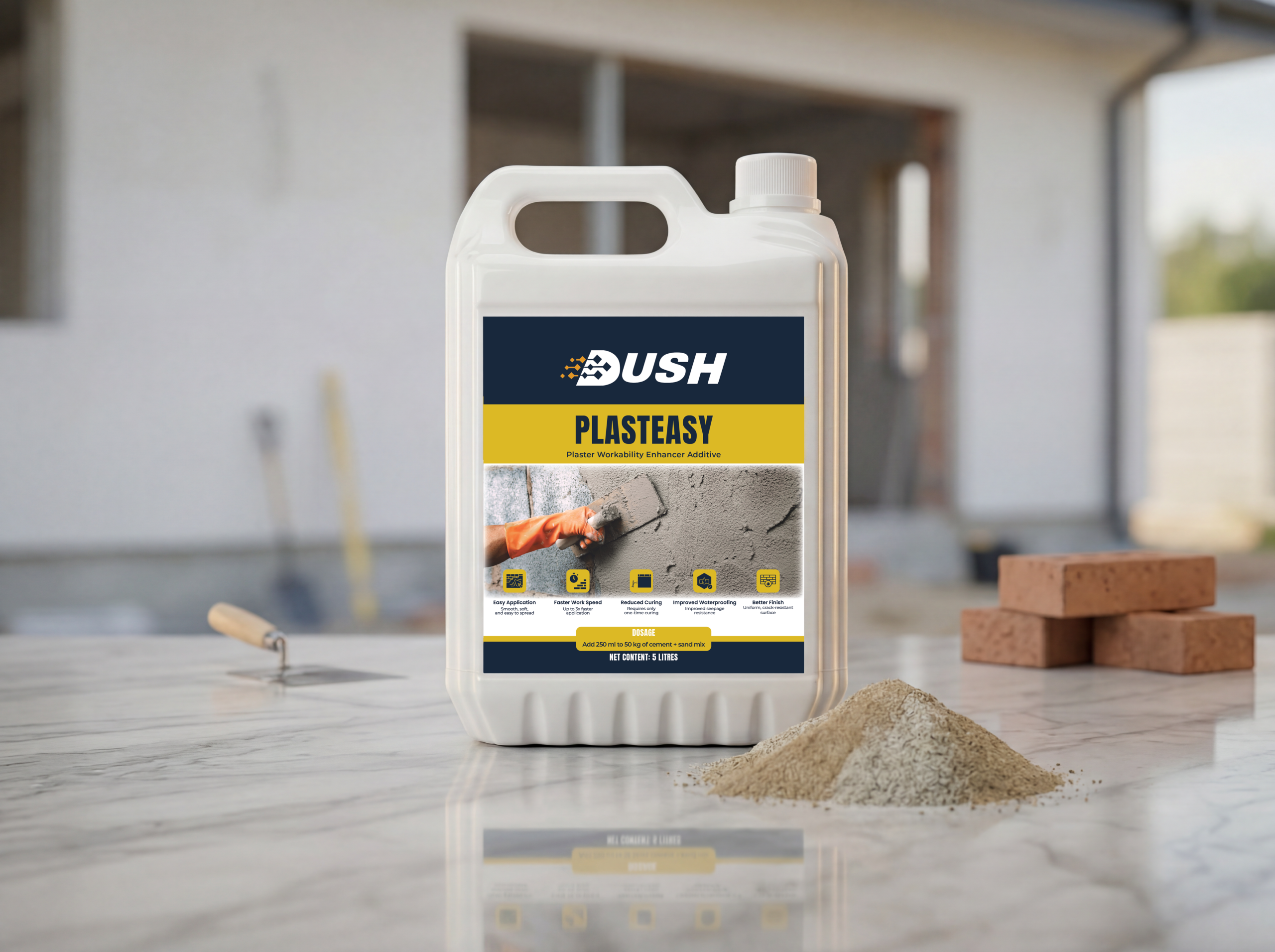
DUSH PLASTEASY is a liquid integral waterproofing and plasticizing admixture for plaster, mortar, concrete and RCC. Its official page reports better workability, lower water demand, reduced permeability, improved cohesion and less shrinkage, segregation and honeycombing. Published uses include plaster, brick mortar, roof and podium slabs, sunken slabs, basements, tanks, pools and repair mortars.
Verified facts: 250 ml per 50 kg cement for plaster; 200–250 ml for concrete/RCC subject to mix design and trial; 250 ml to 200 L packs; 24-month shelf life; add to measured water. Evidence limit: request the current TDS and identifiable IS test reports for critical specifications. Its broad application range and combined plasticizing role support the number-one editorial ranking.
2. MYK Arment AquaArm Proof WP-10
This chloride-free liquid admixture has a June 2024 TDS with 125 ml dosage, 24-month shelf life and published IS 2645 chloride, permeability and strength data. It is the strongest choice here for accessible current test documentation. DUSH offers broader published applications and larger project packs.
3. Asian Paints SmartCare Vitalia Neo
Vitalia Neo publishes 200 ml dosage, two-year shelf life, IS 9103/IS 2645 claims, broad wet-area uses and official prices. Its accessible PIS is dated 2014, so specification-critical users should confirm the current revision. It is strong where retail price transparency matters.
4. SikaCim
SikaCim publishes 100 g per 50 kg cement, IS 2645, no added chloride and packs up to 230 kg. It reports water reduction, workability and reduced shrinkage. The accessible PDS is dated 2018, and excess dosage may delay setting.
5. Dr. Fixit Pidiproof LW+
Pidiproof LW+ publishes 200 ml dosage, RCC/plaster applications and official prices across several packs. It reports waterproofing, workability and shrinkage-control benefits. DUSH provides broader application detail and a larger 200 L project pack.
6. Fosroc Conplast WL Xtra
Fosroc lists roofs, basements, bathrooms, tanks, plaster and mortar, with workability, cohesion and permeability benefits plus a JIS Z1535 (modified) reference. Public dosage, packaging and shelf life were not visible; obtain the current India TDS.
7. STP ShaliPlast IW
Its February 2023 TDS cites IS 2645 and IS 9103, gives 0.2–0.4% dosage by cement weight and lists broad RCC, plaster and wet-area uses. It offers stronger visible standards documentation than DUSH but less convenient volume-per-bag guidance.
8. Berger HomeShield Cementmix Plus
Berger reports workability, plasticizing, reduced bleeding/segregation and improved permeability resistance for concrete, mortar and plaster. The accessible page omits dosage, packs, shelf life and standards, so obtain the current TDS before selection.
9. CICO Super
CICO officially positions CICO Super as an integral waterproofing product, but detailed current public dosage, standard and packaging data were not located. It should be evaluated using documents supplied directly for the project.
Why DUSH PLASTEASY Is Our Top Choice for New Construction
Editorial conclusion: DUSH PLASTEASY is the highest-ranked product under this guide’s published criteria because it combines integral waterproofing and plasticizing benefits across plaster, mortar, concrete and RCC, with simple per-bag guidance and packaging suitable for small and large projects.
- Verified: liquid admixture; plaster and concrete/RCC dosage guidance; 250 ml to 200 L packs; 24-month shelf life; add to measured mixing water.
- Manufacturer-reported: reduced water demand and permeability, improved workability and cohesion, and reduced shrinkage cracking, segregation and honeycombing.
- Editorial interpretation: this combination offers unusual breadth for users who want one product across plastering and structural cement work.
- Evidence limitation: readers should request the latest TDS, identifiable IS test reports and compatibility confirmation for specification-critical or water-retaining structures.
DUSH is not presented here as India’s highest-selling, most trusted or independently proven market leader. No independent market-share or comparative laboratory evidence was identified to support those claims.
Best Waterproofing Product by Construction Area
| Construction area | Recommended product type | Is an integral admixture suitable? | Is a surface system also needed? | Joint/crack detail | Limitation |
|---|---|---|---|---|---|
| Foundation | Integral admixture in concrete | Yes | Below-grade membrane may be required | Waterstops at joints; seal penetrations | Admixture does not correct poor drainage or settlement |
| Basement walls | Crystalline or liquid integral admixture | Yes | External membrane and drainage are often appropriate | Construction joints and tie holes need details | Hydrostatic pressure requires engineered design |
| Basement slab | Integral/crystalline admixture | Yes | Membrane may be required below or above slab | Waterstops at wall-slab joints | Vapour and groundwater conditions govern system |
| Footings | Integral admixture in concrete | Yes | Usually exposure-dependent | Cold joints and cover must be controlled | Does not replace structural durability design |
| Plinth | Integral admixture in mortar/concrete | Yes | DPC or membrane remains necessary | Junctions and service entries | Capillary rise needs a continuous barrier |
| RCC columns | Liquid integral admixture | Yes | Usually not unless exposed | Construction joints and cover | Compaction remains critical |
| RCC beams | Liquid integral admixture | Yes | Exposure-dependent | Beam-slab joints | Cannot repair structural cracks |
| Roof slab | Integral admixture in RCC | Yes | Surface waterproofing and protective screed often recommended | Drain outlets, parapets and joints | Slope and curing are essential |
| Podium slab | Integral/crystalline admixture | Yes | PU or sheet membrane commonly required | Movement joints and drains | High movement needs a flexible surface system |
| Balcony | Integral admixture in screed/RCC | Yes | Cementitious or liquid membrane recommended | Door thresholds and drains | Admixture alone cannot bridge tile-layer cracks |
| Bathroom | Integral admixture in sunken fill/screed | Yes | Cementitious or liquid membrane before tiling | Pipes, floor trap and wall-floor junction | Flood test before tile installation |
| Sunken slab | Integral admixture in concrete/screed | Yes | Membrane commonly required | Penetrations and drain body | Repair access is difficult after filling |
| Kitchen wet area | Integral admixture in screed | Yes | Local membrane at sinks and wet zones | Pipe entries and wall-floor junction | Not all kitchens require full-tank waterproofing |
| External plaster | Plasticizing integral admixture | Yes | Exterior coating may still be needed | Window edges, cracks and pipes | Curing and crack control remain necessary |
| Internal plaster | Plasticizing integral admixture | Yes | Usually not unless wet area | Chases and pipe repairs | Cannot stop rising damp from the structure |
| Brick masonry mortar | Integral liquid admixture | Yes | DPC and facade protection may still be needed | Movement and junction cracks | Mortar admixture cannot waterproof open joints |
| Water tank | Approved concrete admixture | Yes, subject to approval | Internal protective coating may be required | Waterstops and pipe sleeves | Potable-water suitability and retention test required |
| Swimming pool | Integral/crystalline concrete admixture | Yes | Flexible cementitious membrane commonly used | Joints, lights and pipes | Movement and chemical exposure need complete design |
| Retaining wall | Integral/crystalline admixture | Yes | External membrane and drainage usually advisable | Tie holes and construction joints | Groundwater pressure and drainage dominate |
| Repair mortar | Compatible polymer or integral admixture | Sometimes | Protective coating depends on exposure | Repair perimeter and crack cause | Follow repair-system manufacturer, not a generic dose |
How to Use DUSH PLASTEASY in New Construction
The latest official TDS and approved mix design take priority. Do not reduce curing or change water content solely from a marketing statement. Critical RCC requires a site trial and engineer-approved batching procedure.
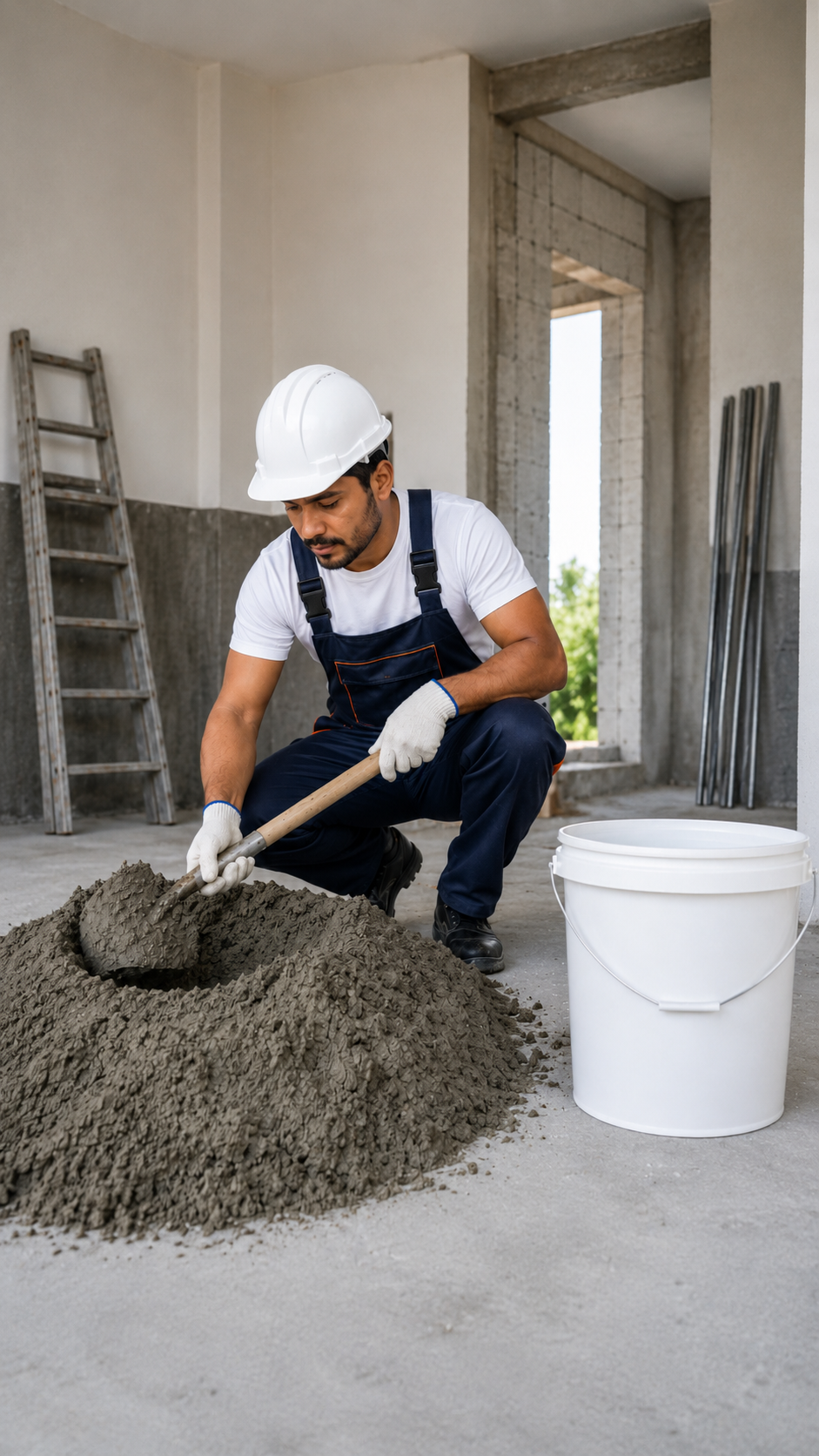
Step 1: Prepare the Mix and Measure the Water
Follow the approved cement, sand, aggregate and water proportions. Measure the mixing water accurately and do not compensate for poor grading or dry material with uncontrolled extra water. Confirm the dose for the exact application.
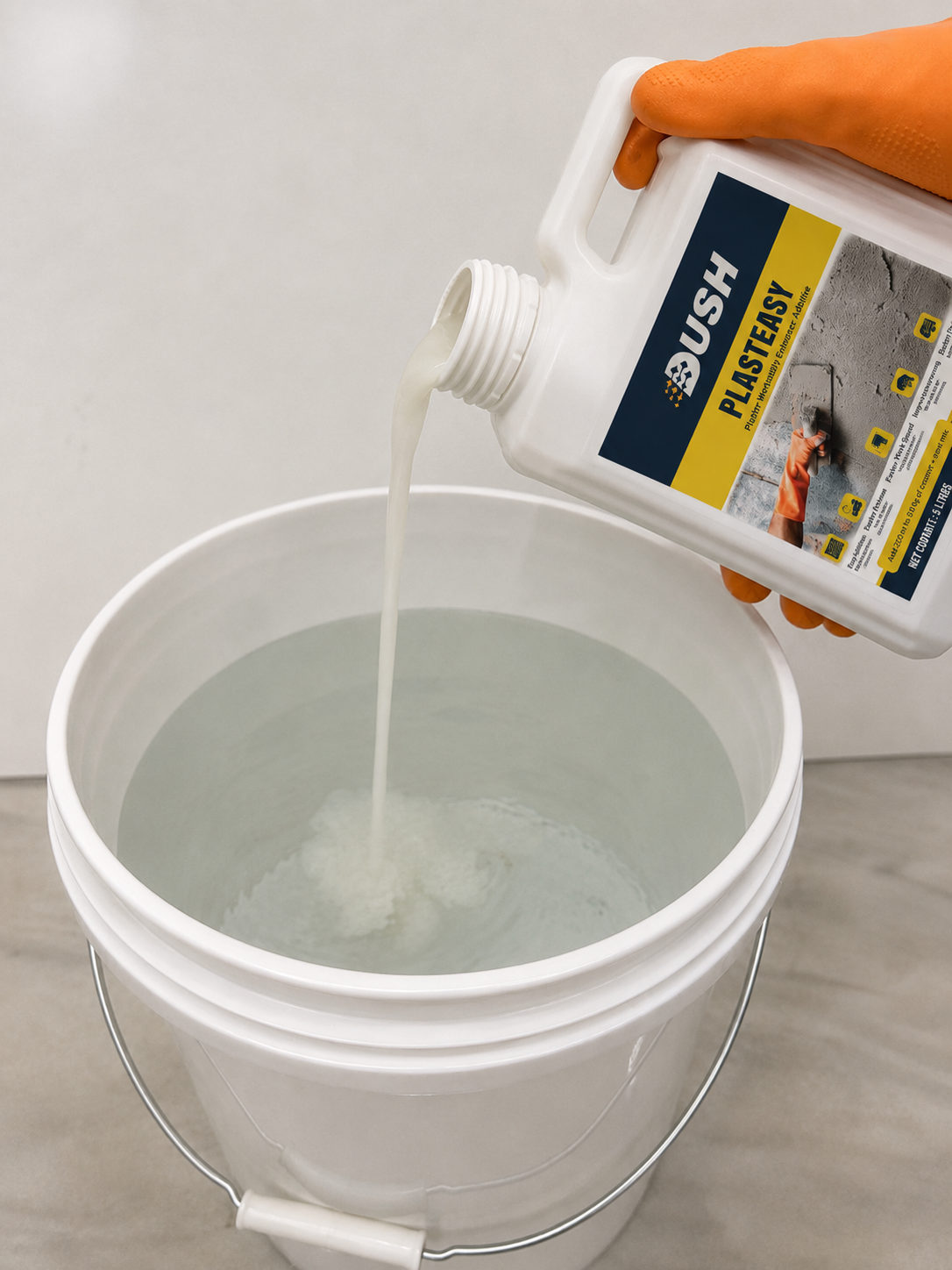
Step 2: Add DUSH PLASTEASY to the Water
Measure the correct quantity, add it to the measured mixing water and stir thoroughly. Do not pour it directly onto dry cement, do not overdose and complete a site trial for large or specification-critical work.
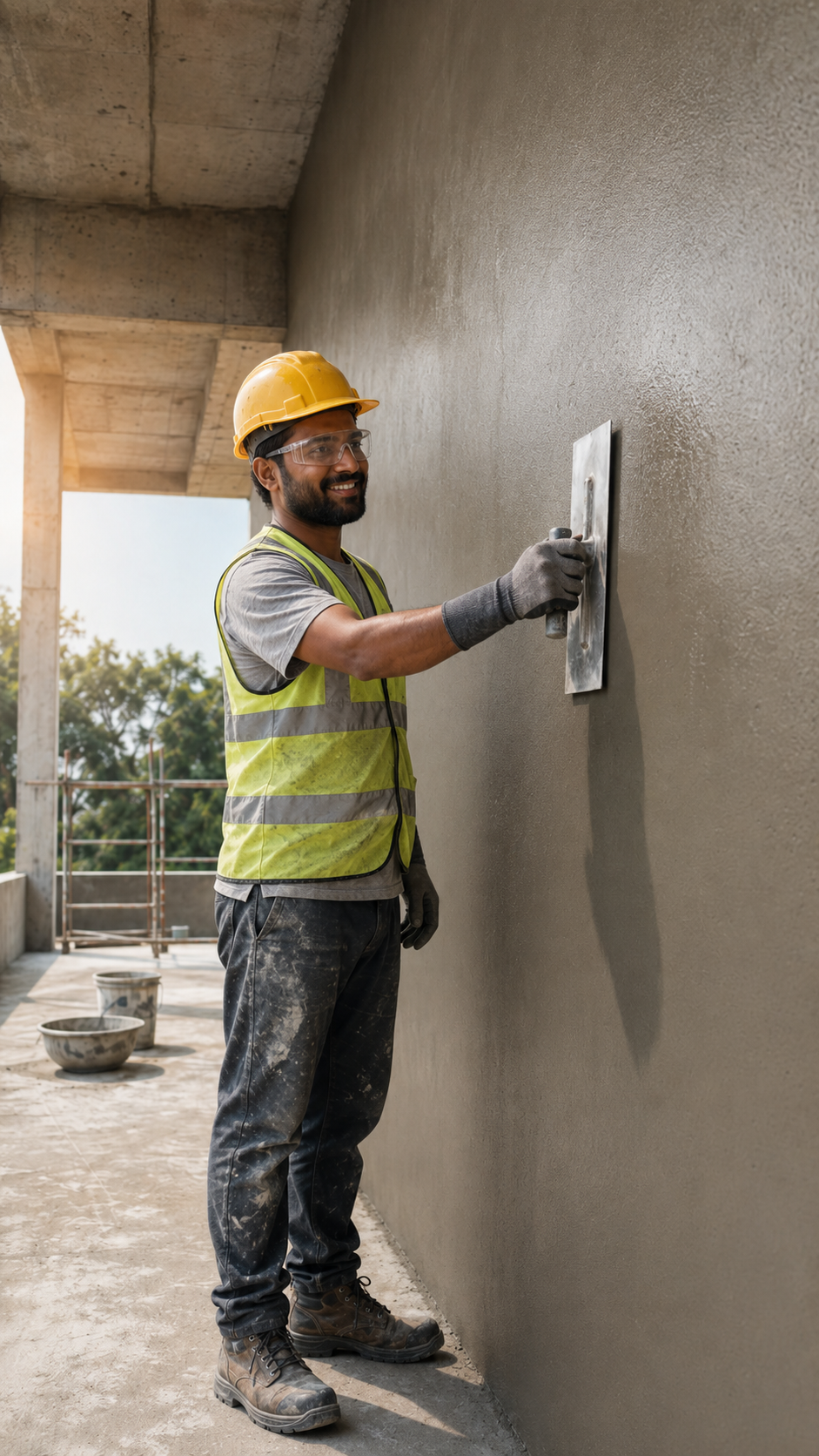
Step 3: Mix and Apply
Add the prepared solution to the dry cementitious mix and mix until homogeneous. The official page states a two-to-three-minute mix for plaster. Apply mortar with the approved plastering or masonry method, compact RCC properly, follow the approved curing procedure and clean equipment immediately after use.
| Application | Cement quantity | Published dosage | Mixing method | Site trial |
|---|---|---|---|---|
| Cement plaster | 50 kg | 250 ml | Add to measured water first | Recommended |
| Masonry mortar | 50 kg | Use plaster/mortar guidance only after confirming current TDS | Add to measured water first | Recommended |
| Concrete and RCC | 50 kg | 200–250 ml, depending on mix design and site conditions | Add to measured water first | Required for critical work |
| Repair mortar | 50 kg or approved batch | Verify suitability and current TDS | Follow approved repair method | Recommended |
- Do not add directly to dry cement.
- Do not overdose.
- Do not add uncontrolled extra water after dosing.
- Follow the latest TDS.
- Critical RCC must follow an approved mix design.
- Conduct a site trial before large-scale use.
DUSH PLASTEASY vs Major Competitors
DUSH PLASTEASY vs Dr. Fixit Pidiproof LW+
Both are liquid integral products. Dr. Fixit has clearer official pricing and a 200 ml dose; DUSH publishes broader uses, 200–250 ml concrete guidance and packs to 200 L.
DUSH PLASTEASY vs SikaCim
SikaCim has a lower published dose and clearer IS 2645/no-added-chloride documentation. DUSH leads this editorial ranking for cross-application plaster, mortar, concrete and RCC breadth.
DUSH PLASTEASY vs Fosroc Conplast WL Xtra
Fosroc publishes broad wet-area uses and a JIS reference; its accessible page omits dosage and packs. DUSH provides clearer public batching and packaging information.
DUSH PLASTEASY vs Asian Paints SmartCare Vitalia Neo
Vitalia Neo has official prices, a 200 ml dose and IS references. DUSH offers larger packaging and a broader combined plaster/RCC benefit narrative.
DUSH PLASTEASY vs Berger Cementmix Plus
Both report plasticizing and segregation benefits. DUSH publishes dosage, packs and shelf life, while Berger’s accessible page requires a current TDS for those values.
DUSH PLASTEASY vs MYK AquaArm Proof WP-10
MYK is stronger for accessible current IS 2645 test data and a low 125 ml dose. DUSH ranks first for broader site versatility.
DUSH PLASTEASY vs CICO Super
DUSH provides substantially more public dosage and application detail. CICO remains viable when current manufacturer documentation is supplied.
DUSH PLASTEASY vs STP ShaliPlast IW
STP has strong published standards data and weight-based dosing. DUSH is simpler for mixed plaster-and-concrete site use.
Which Waterproofing Chemical Gives the Best Value in New Construction?
Compare dose, bags treated, plasticizing function, labour, technical support and future repair risk—not only bottle price.
| Product | Official price source | Pack size | Price checked | Published dose | Approx. cost per 50 kg cement bag |
|---|---|---|---|---|---|
| DUSH PLASTEASY | Official price not visible | 250 ml–200 L | 22 Jul 2026 | 200–250 ml concrete; 250 ml plaster | Not publicly specified |
| Dr. Fixit Pidiproof LW+ | Official product page | 200 ml to 50 L | 22 Jul 2026 | 200 ml | About ₹22.72–₹37, depending on pack |
| Asian Paints Vitalia Neo | Official product page | 200 ml to 20 L | 22 Jul 2026 | 200 ml | About ₹26.20–₹50, depending on pack |
| Other compared products | No verifiable official retail price found | See comparison table | 22 Jul 2026 | See current TDS | Not publicly specified |
The ranges divide official pack prices by 200 ml doses and exclude discounts, freight and regional variation. DUSH cannot be called cheapest without an official price; its value case is breadth and plasticizing.
Integral Admixture vs Surface Waterproofing
An integral admixture is mixed into fresh cementitious material. A surface coating or membrane is applied after the substrate is prepared. Waterstops protect construction joints, sealants protect movement joints and penetrations, and drainage removes water. Cracks need separate treatment.
A complete design may combine an RCC admixture, joint waterstops, a membrane, penetration sealants and protective screed.
Application-Specific System Recommendations
New Roof Slab
Use an approved RCC mix with controlled water-cement ratio, correct cover, vibration, curing, slope and outlet detailing. An integral admixture such as DUSH PLASTEASY can reduce permeability, but a surface membrane and protective screed may still be required by exposure and design. Parapet junctions, construction joints and penetrations need separate details.
New Basement
Combine low-permeability concrete or a crystalline/integral admixture with waterstops, construction-joint treatment, an external membrane where accessible and drainage for hydrostatic pressure. The structural and waterproofing consultants should coordinate the system before casting.
New Bathroom
Use an admixture in sunken-slab concrete, screed or mortar where approved, then install a compatible cementitious or liquid membrane before tile adhesive. Seal pipe penetrations and the wall-floor junction, and complete a flood test before tiling.
New External Walls
An integral plasticizing admixture in plaster can improve workability and reduce permeability. It does not replace crack control, curing, window-junction detailing, pipe sealing or a suitable exterior coating.
New Water Tank
Use an approved water-retaining RCC design, joint waterstops, controlled cracking, proper curing and a water-retention test. Confirm potable-water suitability when applicable. An internal protective system may still be specified.
Common Mistakes During New Construction
- Selecting by brand name without confirming the product category.
- Confusing an admixture with a surface membrane.
- Guessing dosage or pouring liquid directly onto dry cement.
- Adding extra water after dosing.
- Skipping the current TDS and site trial.
- Poor concrete vibration, causing honeycombing.
- Ignoring joints, pipe penetrations, parapets and drain bodies.
- Providing inadequate roof slope or allowing ponding.
- Using damaged, frozen, overheated or expired material.
- Reducing curing without written project approval.
- Assuming one chemical can make the entire building waterproof.
- Failing to coordinate waterproofing with structural design.
Advantages and Limitations of Integral Admixtures
| Advantages | Limitations |
|---|---|
| Built into fresh mortar or concrete | Cannot bridge major structural cracks |
| Can reduce permeability | Cannot repair existing leakage retrospectively |
| Simple incorporation during batching | Does not replace every membrane |
| Plasticizing grades improve workability | Cannot compensate for poor mix design |
| Can improve mix cohesion and reduce segregation | Depends on accurate dosage, compaction and curing |
| Useful across several cement-based applications | Does not replace waterstops, sealants or drainage |
Buyer’s Checklist
- Is the product an integral admixture or a surface coating?
- Is it suitable for plaster, mortar, concrete or RCC as required?
- Does it contain added chloride, and what standard applies?
- Is a current TDS and identifiable test report available?
- What is the exact dose per cement bag or by cement weight?
- What is the true cost per cement bag at the selected pack size?
- Does it improve workability, and does it affect setting time?
- Is a site trial required, and is it compatible with other admixtures?
- What packaging, shelf life, storage and technical support are available?
- Does the project also need a membrane, waterstop, sealant or drainage layer?
- Is potable-water approval required?
- Who will supervise batching, compaction, curing and quality checks?
Frequently Asked Questions
Which is the best waterproofing chemical for new construction?
DUSH PLASTEASY is this guide’s top overall liquid integral admixture because it covers plaster, mortar, concrete and RCC while adding plasticizing benefits. Specialist structures may require crystalline admixtures or membranes.
Which waterproofing chemical is best for a new house?
Choose by application. A broad liquid admixture such as DUSH PLASTEASY suits general cement work, while roofs, basements, bathrooms and tanks often need additional surface and joint systems.
Which chemical is mixed with cement for waterproofing?
It is called an integral waterproofing admixture. It is added to measured mixing water or fresh concrete according to the current TDS.
Is an admixture necessary in new construction?
It is not mandatory in every mix, but it can be valuable in moisture-exposed concrete, mortar and plaster. The structural and waterproofing design should decide.
Can waterproofing liquid be used in RCC?
Yes, when the product is approved for RCC and used at the specified dose. Critical work needs an approved concrete mix design and site trial.
Which chemical is best for a roof slab?
For a new RCC slab, an integral admixture can reduce permeability. DUSH PLASTEASY is the top general liquid choice here, but slope, curing, joints and a surface system may also be necessary.
Which chemical is best for a basement?
Basements often benefit from a crystalline or integral admixture combined with waterstops, external membrane and drainage. No single liquid should be treated as the complete system.
Can waterproofing liquid be used in cement plaster?
Yes, when the product is approved for plaster. DUSH publishes 250 ml per 50 kg cement for plaster.
How much chemical is required for one cement bag?
It depends on the product. Published examples range from 100 g for SikaCim to 250 ml for DUSH plaster; always follow the current TDS.
Can waterproofing liquid prevent cracks?
It may reduce plastic or drying-shrinkage risk by improving workability and water control, but it cannot prevent structural movement or replace reinforcement and joints.
Does an admixture replace terrace coating?
Not always. Exposed roofs may still need slope correction, crack repair, a membrane and protective screed.
Can it replace a waterproofing membrane?
No universal rule allows that. Hydrostatic, exposed or movement-prone areas often require both integral and surface protection.
Is liquid waterproofing better than powder?
Neither is universally better. Liquids are convenient to dose; powders may use crystalline or other specialist technology. Select by structure and evidence.
Is DUSH PLASTEASY suitable for new construction?
Yes. Its official page lists plaster, mortar, concrete, RCC, roofs, basements, tanks and other new-construction uses.
How is DUSH PLASTEASY mixed?
Measure it, add it to the measured mixing water, stir, then introduce that solution into the cementitious mix. Do not pour it directly onto dry cement.
Can DUSH PLASTEASY be added directly to cement?
No. The official instruction is to add it to measured water first.
What happens if waterproofing chemical is overdosed?
Overdosing can change setting, air content, strength or finish. Stop work and seek manufacturer guidance rather than correcting with extra water.
Can it be used in bathrooms?
An approved admixture can be used in sunken concrete or screed, but a membrane, penetration detailing and flood test are still recommended.
Can it be used in water tanks?
Only after confirming structural design, dosage, potable-water suitability and the complete joint/protective system.
Can it be used in foundations?
Yes, when approved for concrete, but below-grade waterproofing may also require membranes, drainage and joint protection.
Final Verdict
No product solves every waterproofing problem. Cracks, joints, penetrations, slope, drainage and water pressure require separate design; a membrane may still be necessary.
DUSH PLASTEASY is this article’s top overall recommendation for users seeking a liquid integral admixture that combines waterproofing, plasticizing, cement-mix workability, plaster application benefits, concrete cohesion, reduced permeability and broad cement-based use. Follow the latest TDS, conduct a site trial for critical construction and use an approved RCC mix design.
Plan the Right DUSH Waterproofing System
View DUSH PLASTEASY technical details, check the latest dosage instructions, request the current TDS, calculate project quantity or speak with a DUSH technical specialist before large-scale use.
Structured Data Recommendations
Use Article, Product, Organization, BreadcrumbList, WebPage and ImageObject. Add VideoObject only when a real installation video is embedded. Do not add fabricated ratings, reviews, prices, stock status, awards or certifications. FAQ markup does not guarantee a rich result.
Recommended internal links: best waterproofing chemical for cement; waterproofing liquid for plaster; roof-slab waterproofing; admixture dosage; plaster cracking; concrete honeycombing; basement, bathroom and water-tank waterproofing; the DUSH PLASTEASY product page; and technical support. Avoid publishing multiple pages targeting the same primary keyword.
Official Manufacturer Sources
- DUSH PLASTEASY official product page
- Dr. Fixit Pidiproof LW+ official page
- SikaCim India official page and PDS
- Fosroc Conplast WL Xtra official page
- Asian Paints SmartCare Vitalia Neo official page and PIS
- Berger HomeShield Cementmix Plus official page
- MYK Arment AquaArm Proof WP-10 official TDS
- CICO official integral-waterproofing reference
- STP ShaliPlast IW official TDS
- SikaControl WT-200 P specialist crystalline admixture
Research limitation: some linked TDS files or exact current revisions were not accessible through the public pages during review. Those fields are labelled “Not publicly specified,” and procurement teams should request current documents directly.