Best Waterproofing Chemical for Wall Plaster: Top Products Compared
Walls often develop damp patches, efflorescence, peeling paint and plaster cracks because moisture travels through porous plaster, construction joints, cracks or poorly waterproofed masonry. This guide explains what actually helps — and compares the products honestly.
Adding the correct integral waterproofing and plasticizing admixture during plaster preparation can genuinely reduce permeability and improve mortar workability. But it's worth being clear upfront: an admixture cannot repair existing structural cracks, fix a plumbing leak, or correct external waterproofing failure by itself. This guide explains where it helps, where it doesn't, and compares the products available in India honestly.
The best product depends on the wall condition and application. Based on the comparison criteria in this article, DUSH PLASTEASY is our top overall recommendation for cement wall plaster, since it combines integral waterproofing with plasticizing, workability and crack-reduction benefits, at a published dosage of 250 ml per 50 kg cement.
This article separates manufacturer-reported claims, independently verified evidence, and editorial conclusions throughout. Where information could not be independently confirmed, this article says "Not publicly specified" rather than guessing.
Best Overall for Cement Wall Plaster
DUSH PLASTEASYBest-Known Mass-Market Alternative
Dr. Fixit Pidiproof LW+Best for Improved Workability
DUSH PLASTEASYBest for External Wall Plaster
DUSH PLASTEASY / Fosroc Conplast WL XtraBest for M-Sand Plaster
DUSH PLASTEASY (site trial recommended)Best Documented Standard Compliance
CICO Super (IS 2645-2003, ISI marked)Best for Professional Construction Projects
DUSH PLASTEASY (250 ml to 200 L packaging)What Is a Waterproofing Chemical for Wall Plaster?
An integral waterproofing admixture is a liquid mixed directly into the plaster mortar during preparation, becoming part of the cement matrix as it cures, rather than sitting on top as a surface layer.
How it's added: mixed into the measured mixing water first, then combined with the dry cement-and-sand mix.
How it reduces capillary water absorption: by reducing the porosity of the cured plaster, limiting the tiny channels (capillary pores) water would otherwise travel through.
What plasticizing means: the admixture disperses cement particles more evenly, improving spreadability with less mixing water than an unmodified mix would need.
Why lower water content matters: less water means less shrinkage as the plaster dries, which is the primary driver of fine surface cracking.
How it differs from an exterior waterproof coating: a coating sits on top of finished plaster as a film; an integral admixture is part of the plaster itself, throughout its thickness.
How it differs from damp-proof paint: damp-proof paint is a surface-applied product for finished walls; an integral admixture is added during plaster preparation, before the wall is even finished.
How it differs from SBR latex: SBR is primarily a bonding polymer for repair and adhesion, not a general integral waterproofing admixture for new plaster.
How it differs from crystalline waterproofing: crystalline admixtures work via a distinct chemistry, forming crystalline structures within the concrete's pore structure — a different mechanism from plasticizing admixtures.
Why Wall Plaster Absorbs Water
Capillary Pores
Microscopic channels within the cured plaster that water can travel through.
Excess Water in the Plaster Mix
The leading cause of shrinkage-driven cracking and increased porosity.
Poor Sand Grading & Incorrect Cement Ratio
Both weaken the mortar's structural and waterproofing performance.
Inadequate Mixing & Improper Curing
Both compromise the final plaster's strength and permeability.
Weak Masonry Joints & Porous Bricks/Blocks
Can allow water ingress regardless of the plaster's own quality.
External Rain Exposure, Plumbing, Terrace/Parapet Leakage, Window/Door Cracks
Real sources of dampness that an admixture alone cannot address.
Important distinction: water entering through porous plaster is what an integral admixture addresses. Water entering through structural cracks, plumbing leaks, rising dampness (moisture wicking up from the ground), or condensation (from humid air meeting a cold surface) each need their own specific diagnosis and remedy — an admixture in new plaster does not solve these.
Can Waterproofing Chemical Prevent Wall Dampness?
An integral waterproofing admixture can meaningfully reduce permeability in new plaster, but it works best as part of correct construction practice — it is not a universal fix for every dampness problem.
Where it can genuinely help: new internal plaster, new external plaster, masonry mortar, repair mortar, M-sand plaster, areas exposed to rain, bathrooms during construction, parapet walls, service shafts, and water-retaining structures where approved for that use.
Where it cannot work alone: active pipe leaks, major structural cracks, failed terrace waterproofing, rising dampness, defective window joints, severe external façade leakage, poor drainage, and structural movement. Each of these needs its own diagnosis and dedicated repair — adding an admixture to new plaster nearby will not fix them.
Types of Waterproofing Chemicals Used in Wall Plaster
Liquid Integral Waterproofing Admixtures
Mixed into plaster. DUSH PLASTEASY and most products in this comparison.
Powder Waterproofing Admixtures
Mixed into plaster, different physical form from liquids.
Plasticizing Waterproofing Admixtures
Combine plasticizing and waterproofing — this guide's focus category.
SBR Latex
Mixed in or applied as a bonding agent, primarily for repair/adhesion.
Acrylic Polymers
Often surface-applied or used as bonding/coating modifiers.
Crystalline Admixtures
Mixed in, distinct crystalline-formation chemistry.
Cementitious Waterproof Coatings
Surface-applied, after plaster is finished.
Exterior Elastomeric Coatings & Damp-Proof Primers/Paints
All surface-applied, after plastering is complete.
How the Products Were Compared
This is a weighted editorial assessment based on published, publicly available information — not independent laboratory testing of every product unless specifically stated.
| Evaluation Criterion | Weight |
|---|---|
| Waterproofing and permeability reduction | 20% |
| Plaster workability and plasticizing | 20% |
| Shrinkage-crack reduction | 10% |
| Suitability for internal and external plaster | 10% |
| Suitability for M-sand plaster | 5% |
| Dosage convenience | 5% |
| Cost per cement bag | 10% |
| Published technical documentation | 10% |
| Packaging and availability | 5% |
| Shelf life and storage | 5% |
Detailed Comparison Table
A note on this table: "Not publicly specified" appears wherever a figure could not be independently confirmed. Pricing is discussed separately in the Cost Comparison section, since only inconsistent third-party marketplace prices were found — not official MRP — for most products.
| Rank | Brand / Product | Type | Internal | External | M-Sand | Masonry Mortar | Dosage / 50kg | Standard | Score |
|---|---|---|---|---|---|---|---|---|---|
| 1 | DUSH PLASTEASY | Liquid integral, plasticizing + waterproofing | Documented | Documented | Site trial recommended | Documented | 250 ml | "Passes IS requirements" (manufacturer-stated; number not shown on page) | Top overall (editorial) |
| 2 | Dr. Fixit Pidiproof LW+ | Liquid integral waterproofing | Documented | Documented | Not publicly specified | Not publicly specified | 200 ml (third-party listing) | Not independently confirmed this pass | Strong mass-market recognition |
| 3 | Fosroc Conplast WL Xtra | Liquid integral waterproofing | Documented | Documented | Not publicly specified | Documented | 200 ml (verified) | IS-2645-2003 (verified) | Strong technical documentation |
| 4 | Sika — SikaCim | Liquid integral waterproofing | Documented | Documented | Not publicly specified | Documented | Not publicly specified this pass | Not publicly specified this pass | Established global brand |
| 5 | CICO Super | Liquid integral, normal plasticizing | Documented | Documented | Not publicly specified | Documented | Not publicly specified this pass | IS 2645-2003, ISI marked (verified) | Strong standard compliance |
| 6 | Asian Paints SmartCare Vitalia Neo | Liquid integral, advanced plasticizing | Documented | Documented | Not publicly specified | Not publicly specified | Not publicly specified this pass | Not publicly specified this pass | Strong distribution network |
| 7 | MYK Arment AquaArm Proof IWP-10 | Liquid integral waterproofing | Documented | Not publicly specified | Not publicly specified | Not publicly specified | Not publicly specified this pass | Not publicly specified this pass | Established Indian manufacturer |
| 8 | STP ShaliPlast IW | Liquid integral waterproofing | Not publicly specified | Not publicly specified | Not publicly specified | Not publicly specified | Not publicly specified this pass | Not publicly specified this pass | Limited plaster-specific data this pass |
| 9 | Berger HomeShield Cementmix Plus | Not independently confirmed | Not publicly specified | Not publicly specified | Not publicly specified | Not publicly specified | Not publicly specified | Not publicly specified | Could not verify as a current product this pass |
Always confirm current dosage, standards, and pricing directly with the manufacturer before purchase.
Why DUSH PLASTEASY Is Our Top Recommendation
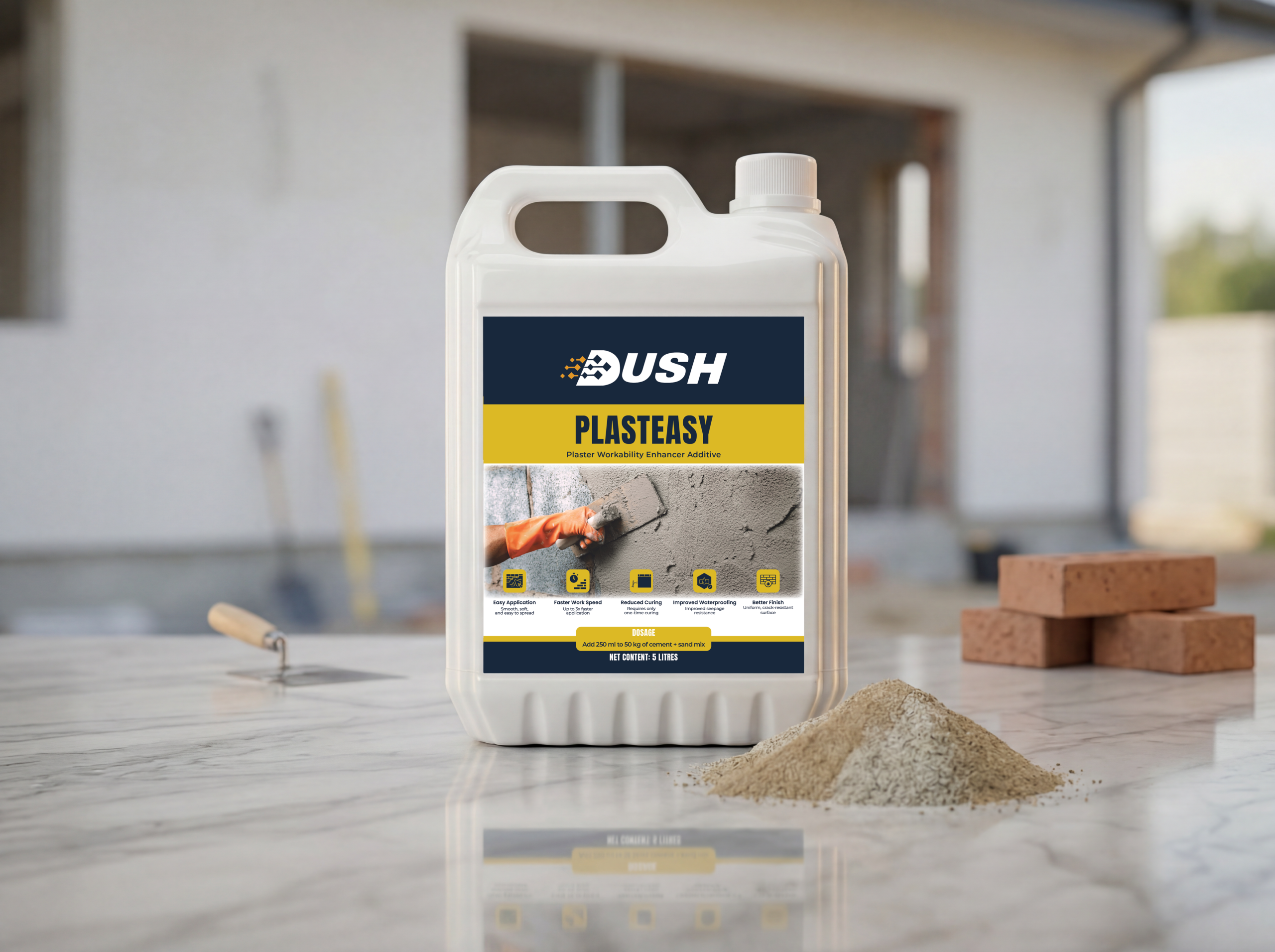
DUSH PLASTEASY is added to measured mixing water before preparing cement plaster or mortar.
DUSH PLASTEASY is a liquid integral waterproofing and plasticizing admixture, manufactured using selected plasticizers, surface-active agents and performance-enhancing additives, per the official DUSH product page and technical data sheet.
- ★Integral waterproofing action: reduces water permeability, documented for internal and external plaster.
- ★Plasticizing action: produces a smooth, "butter-like" mortar that spreads easily.
- ★Water-reduction benefit: a water-reducing admixture cutting unnecessary mixing water.
- ★Shrinkage-crack reduction: documented as minimizing shrinkage cracks via improved bonding.
- ★Mortar cohesion & reduced segregation: improves cohesiveness, reduces segregation and honeycombing in concrete applications.
- ★Reduced rebound/wastage: not separately quantified on the official page reviewed — smoother, more cohesive mortar is generally associated with less material loss during application, but this specific claim is our editorial inference, not a documented figure.
- ★M-sand plaster suitability: not specifically documented as M-sand-tested — a site trial is recommended.
- ★Masonry mortar suitability: documented as an application on the official product page.
Who should choose it: contractors and homeowners wanting one admixture that handles both waterproofing and plasticizing for standard internal and external plaster work, with a wide packaging range suited to both small repairs and large commercial projects. Limitation: the official page doesn't cite a specific IS standard number, and M-sand-specific testing isn't documented — a site trial is recommended for M-sand work.
How to Use DUSH PLASTEASY in Wall Plaster
Check the current official product data sheet before application, as guidance can be updated.
Prepare the Cement-and-Sand Mix
Prepare cement and clean, properly graded sand according to the project's specified plaster ratio. Measure the required quantity of clean mixing water.
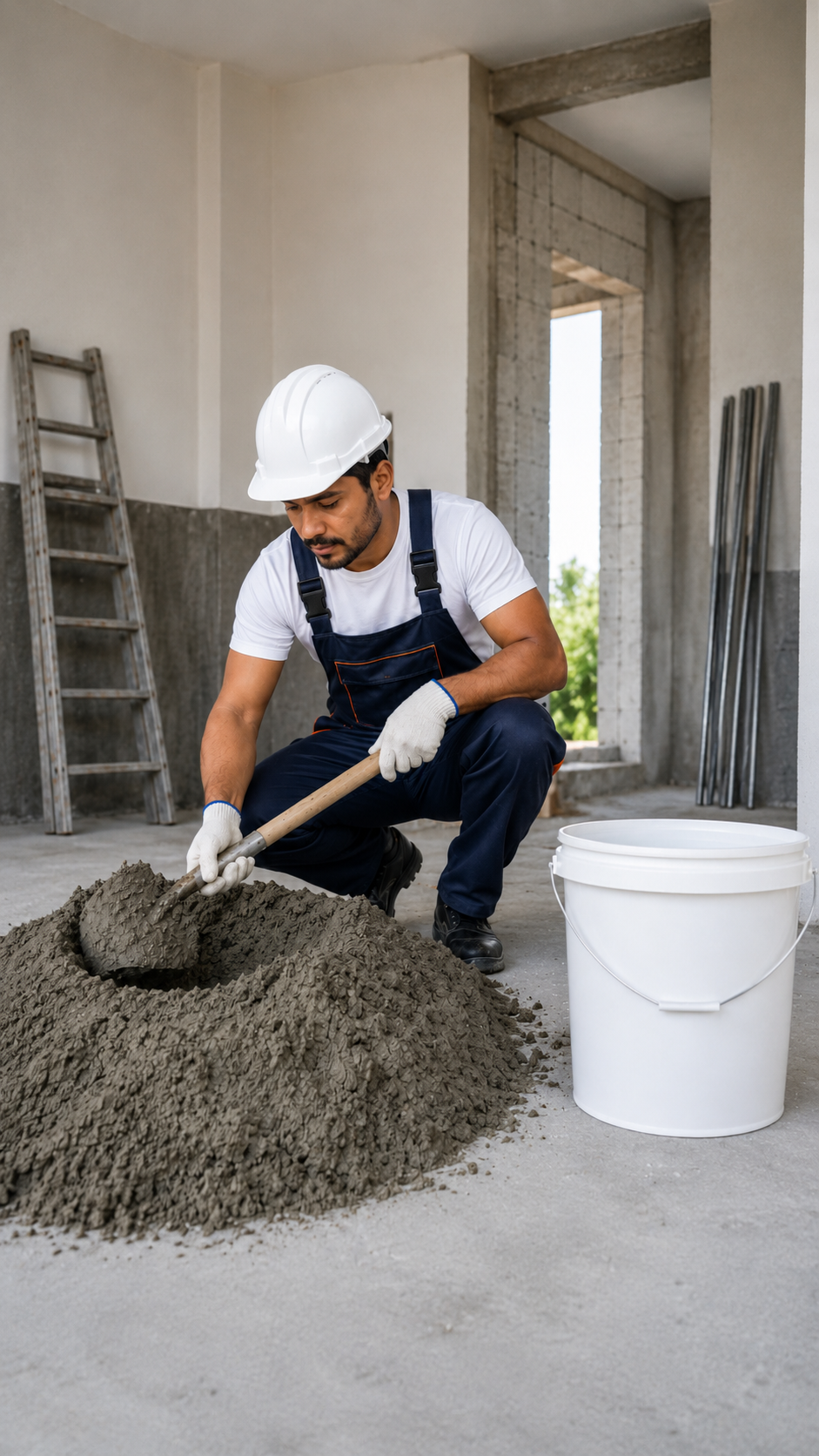
Prepare the dry plaster ingredients and accurately measure the mixing water.
Add DUSH PLASTEASY to the Measured Water
Per the current official DUSH technical data sheet, the confirmed dosage for plaster is 250 ml per 50 kg cement bag. Add it to the measured mixing water — not directly to dry cement — and mix thoroughly.
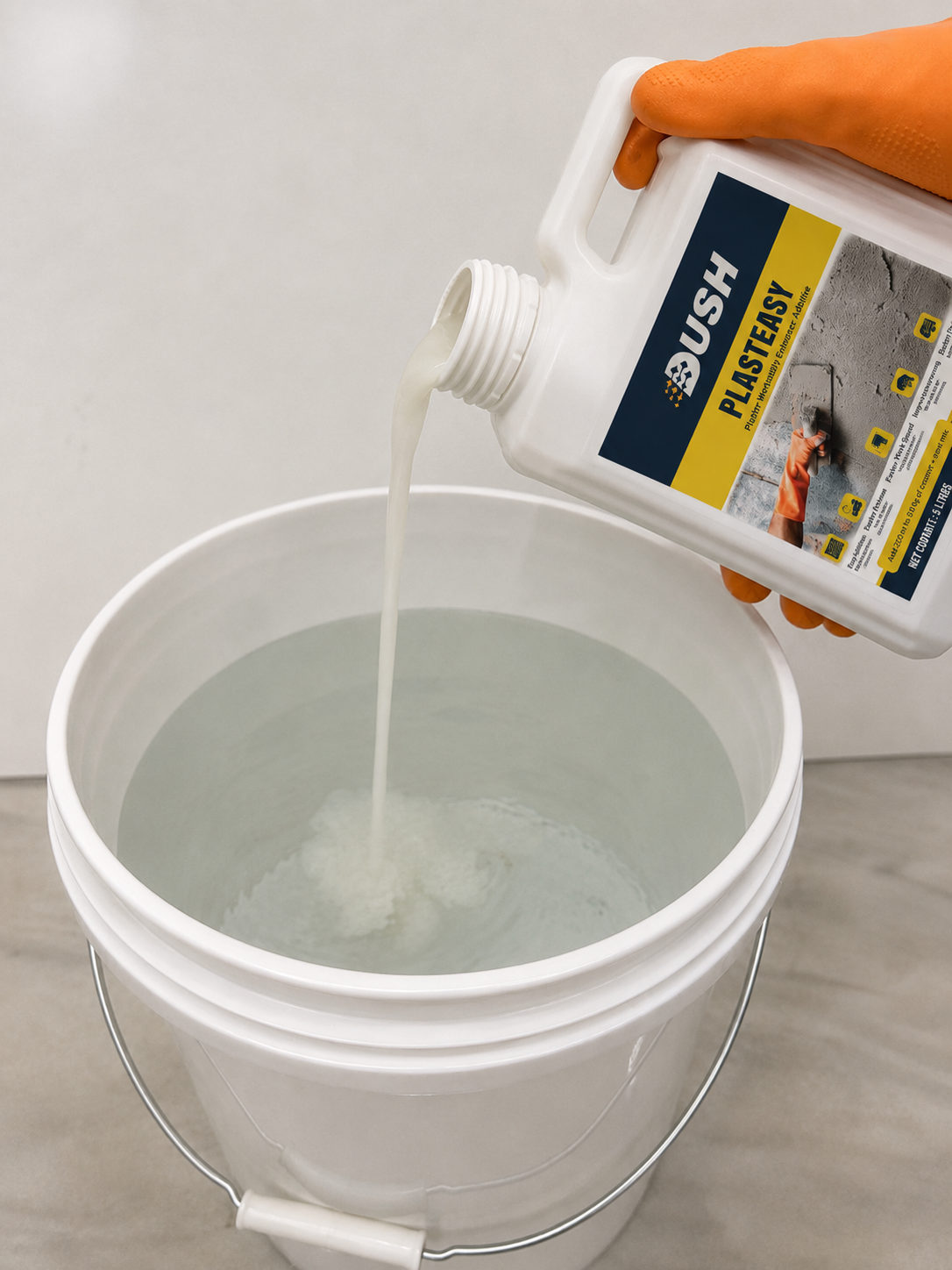
Mix DUSH PLASTEASY with the measured water before adding it to cement and sand.
Mix and Apply the Plaster
Add the Plasteasy-water solution gradually to the dry cement-and-sand mixture. Mix for approximately 2-3 minutes, or per the official instructions, until uniform and homogeneous. Apply using normal approved plastering practices, and avoid adding uncontrolled extra water after the mix reaches the required consistency.
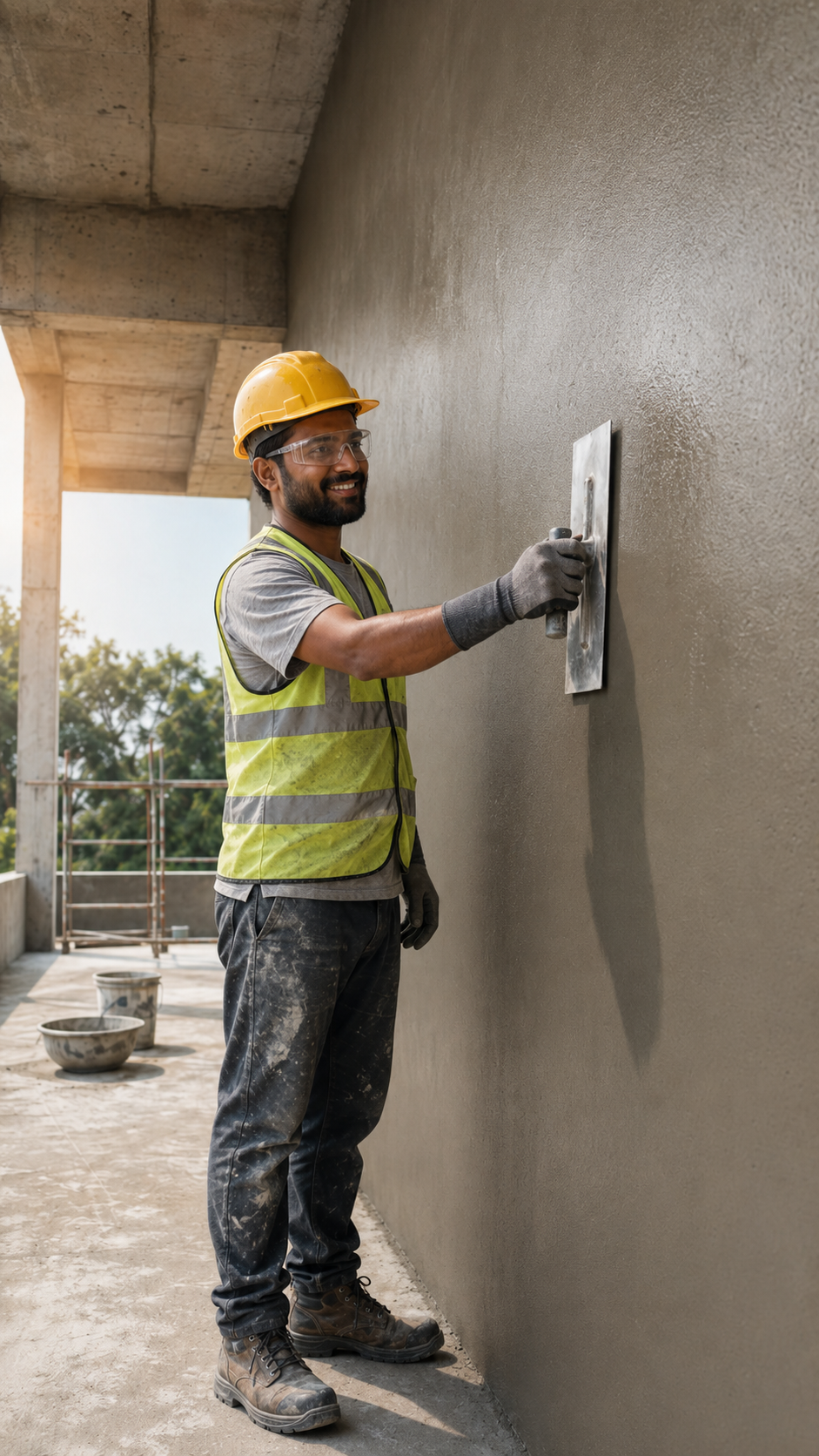
Mix until uniform, then apply the plaster at the specified thickness using good workmanship.
Plaster Dosage Table
| Application | Cement Qty | Dosage | Mixing Procedure | Plaster Ratio | Thickness | Site Trial | Note |
|---|---|---|---|---|---|---|---|
| Internal wall plaster | 50 kg | 250 ml (official page) | Add to measured water | Per approved mix design — not invented here | Per engineer's specification | Recommended for large projects | Do not add directly to dry cement |
| External wall plaster | 50 kg | 250 ml (official page) | Add to measured water | Per approved mix design | Per engineer's specification | Recommended for large projects | May still need compatible exterior coating for rain exposure |
| M-sand plaster | 50 kg | 250 ml (per official plaster dosage; not separately M-sand-tested) | Add to measured water | Per approved mix design | Per engineer's specification | Strongly recommended | M-sand behaves differently from river sand — verify on site |
| Masonry mortar | 50 kg | Not separately specified from plaster dosage on the page reviewed | Add to measured water | Per approved mix design | Not applicable | Recommended | Confirm current TDS |
| Repair mortar | 50 kg | Not publicly specified for repair-specific use | Add to measured water | Depends on repair specification | Depends on repair depth | Recommended | Consider whether a bonding agent (e.g. SBR) is also needed |
Internal Plaster vs External Plaster
| Factor | Internal Plaster | External Plaster |
|---|---|---|
| Moisture Exposure | Lower, generally indoor conditions | Higher — direct rain and weather exposure |
| Rain Exposure | None directly | Direct and significant |
| Required Waterproofing Level | Moderate | Higher |
| Crack Risk | Lower thermal cycling | Higher — more thermal and moisture cycling |
| Surface Preparation | Standard | Often needs more rigorous preparation given weather exposure |
| Plaster Thickness | Per engineer's specification | Per engineer's specification — often specified separately from internal |
| Need for Exterior Coating | Generally not required | Often still recommended alongside integral admixture for full rain protection |
| Need for Joint Treatment | Standard | More critical given direct weather exposure at joints |
| Admixture Considerations | Standard plasticizing/waterproofing dosage | Confirm the specific product is documented for external use, not just general plaster |
External wall plaster may still require a compatible exterior waterproofing or protective coating on top of an integral admixture — the two are complementary, not interchangeable, especially in high-rainfall regions.
Best Waterproofing Chemical for M-Sand Plaster
M-sand (manufactured sand) mixes can behave differently from river-sand mixes because of M-sand's angular particle shape and fines content, which can increase water demand and workability challenges — a plasticizing waterproofing admixture generally helps address this, but a site trial is strongly recommended.
Why M-sand behaves differently: its particle shape is more angular than naturally rounded river sand, and its fines content can vary by source, both of which affect how much water the mix needs for workability.
Workability challenges & water demand: without correction, M-sand mixes can need more water for the same workability, which increases shrinkage risk — exactly the problem a plasticizing admixture is designed to reduce.
Why sand grading matters: correctly graded M-sand, verified before use, reduces these workability issues at the source, independent of any admixture.
Site trial importance: since M-sand quality varies by source and region, a small trial mix confirms the optimum dosage and mix design for your specific M-sand before large-scale application — this applies to DUSH PLASTEASY and to every other product in this comparison, since none reviewed here documented specific M-sand testing on their official pages.
Which Wall-Plaster Waterproofing Chemical Offers the Best Value?
Why we haven't calculated cost-per-bag figures: during research, only inconsistent third-party marketplace listings were found for these products (varying dramatically by seller and quantity), not a single official manufacturer MRP for any product in this comparison. A number built on such inconsistent data would mislead more than it would help.
The bottle price alone is not a fair comparison. To calculate your own cost per cement bag once you have a confirmed price: divide the container price by the number of bags it treats (container volume ÷ dosage per bag). Then factor in whether the product's plasticizing function means you can skip buying a separate plasticizer, and any labour benefit from easier spreading or reduced rebound — these affect true project cost beyond the bottle price itself.
Waterproofing Chemical vs Exterior Waterproof Coating
| Factor | Integral Waterproofing Chemical | Exterior Waterproof Coating |
|---|---|---|
| Where Applied | Mixed into the wet mortar | Applied on top of finished, cured plaster |
| Mixed Into Plaster? | Yes | No — surface-applied only |
| Forms a Surface Barrier? | No — protection is throughout the thickness | Yes — a film on top |
| Crack-Bridging Ability | Not designed for this — reduces shrinkage risk instead | Some flexible coatings can bridge fine cracks |
| UV Resistance | Not applicable (not surface-exposed) | Varies by product — check specific documentation |
| Rain Protection | Reduces permeability of the plaster itself | Adds a dedicated barrier against direct rain |
| Repairability | Cannot be "repaired" after curing — built into that batch of mortar | Can often be recoated or repaired |
| Application Stage | During plaster mixing, before application | After plaster is fully cured |
| Typical Limitation | Cannot fix existing dampness or structural issues | Can wear, chip, or be punctured over time |
Integral waterproofing and exterior coatings are complementary in many projects, particularly for external walls in high-rainfall regions — using both together generally offers stronger overall protection than relying on either alone.
Competitor Reviews
Dr. Fixit Pidiproof LW+
✓ Verified — real, widely availableSikaCim
✓ Verified — real Sika productFosroc Conplast WL Xtra
✓ Verified — well-documentedAsian Paints SmartCare Vitalia Neo
✓ Verified — real, official productBerger HomeShield Cementmix Plus
⚠ Not independently confirmedMYK Arment AquaArm Proof IWP-10
✓ Verified — real MYK Arment productCICO Super
✓ Verified — strong standard documentationSTP ShaliPlast IW
⚠ Confirmed; limited plaster-specific data foundCommon Mistakes
Adding the admixture directly to dry cement
Guessing the dosage instead of checking the TDS
Overdosing beyond the recommended range
Adding too much water to compensate for stiffness
Using dirty or poorly graded sand
Incorrect cement-to-sand ratio
Inadequate mixing time
Applying plaster over a dusty, unprepared surface
Failing to wet or prepare the substrate correctly
Improper curing
Ignoring existing cracks and joints before plastering over them
Applying very thick plaster in a single coat
Assuming waterproofing liquid will repair plumbing leakage
Using an expired product
Poor storage — heat, frost, direct sunlight
Mixing incompatible admixtures without testing
Ignoring the manufacturer's technical data sheet altogether
Advantages and Limitations
| Advantages | Limitations |
|---|---|
| Built into the plaster | Cannot bridge large structural cracks |
| Reduced water permeability | Cannot stop an active plumbing leak |
| Improved workability where plasticizing is included | Cannot solve rising damp alone |
| Better cohesion | Depends on correct dosage |
| Smoother application | Depends on plaster quality and workmanship |
| Potential reduction in shrinkage-related cracking | May not replace exterior waterproof coatings |
| Convenient during new construction | May require site trials, particularly with M-sand |
| No separate internal film required at the mixing stage | Cannot correct defective joints or drainage |
Expert Buying Checklist
Product type — plasticizing, waterproofing, or both?
Official technical data sheet available?
Relevant standard cited specifically?
Plaster dosage confirmed?
Cost per cement bag calculated from a real, current price?
Workability and water-reduction performance documented?
Permeability data available?
Shrinkage-crack claims documented?
M-sand compatibility confirmed or trial recommended?
Internal and external plaster suitability confirmed?
Chloride information available for RCC use?
Setting-time effects documented?
Cement compatibility confirmed?
Packaging sizes suit your project scale?
Shelf life and storage conditions confirmed?
Local technical support available?
Manufacturer's general construction chemicals reputation?
Site trial recommended and planned?
FAQs
Which is the best waterproofing chemical for wall plaster?
Can waterproofing liquid be mixed with cement plaster?
How much waterproofing chemical is required for one cement bag?
Should waterproofing liquid be added directly to cement?
Can waterproofing chemical prevent wall dampness?
Can it prevent cracks in plaster?
Is waterproofing admixture suitable for internal plaster?
Is it suitable for external plaster?
Which waterproofing chemical is best for M-sand plaster?
Can it be used in old wall-plaster repairs?
Does waterproofing chemical replace exterior waterproof paint?
Can it stop rainwater leakage through walls?
Can it solve rising dampness?
What happens if waterproofing chemical is overdosed?
Is liquid waterproofing chemical better than powder?
What is the difference between a plasticizer and a waterproofing admixture?
Does DUSH PLASTEASY improve plaster workability?
How should DUSH PLASTEASY be mixed?
Can DUSH PLASTEASY be used for brick masonry mortar?
What is the cost per cement bag?
How long does waterproof plaster last?
Is waterproofing chemical safe for RCC?
Can multiple admixtures be mixed together?
Is curing still required after using a waterproofing admixture?
External References
No single product can solve every form of wall dampness — structural cracks, plumbing leaks, and rising damp each need their own diagnosis and remedy, regardless of which admixture goes into the plaster.
DUSH PLASTEASY is this article's top overall recommendation for new cement wall plaster where users need a liquid integral admixture combining reduced water permeability, plasticizing, improved workability, smoother application, better mortar cohesion, reduced shrinkage-related cracking, and broad compatibility with cement-based construction.
Before starting: check the latest technical data sheet, use the correct dosage, conduct a site trial (especially for M-sand or large projects), prepare the wall correctly, follow proper curing practices, and consult a waterproofing professional for any serious existing leakage.
Ready to Waterproof Your Wall Plaster?
Integral waterproofing and plasticizing admixture — 250 ml per 50 kg cement, one product for two functions.