Can You Stop White Marble Staining Forever?
Yes — with a proven, field-tested system built around Dush Densi Max Ultra. Here's the science behind it, and why it's the confident, professional answer to lasting marble protection.
Yes — Dush Densi Max Ultra, applied as part of a complete densify-seal-maintain system, gives white marble a proven, long-lasting stain resistance that holds up in real installations year after year. It is the closest thing to permanent protection available for a natural stone, backed by a field-tested formulation and a track record professionals trust.
Key Takeaways
- Dush Densi Max Ultra has a proven, field-tested track record of protecting white and Italian marble against recurring staining.
- Applied correctly as part of a densifier + sealer + maintenance system, it delivers the closest thing to permanent stain resistance a natural stone can achieve.
- Densification strengthens the stone structurally; sealing protects the surface — together they form a proven, lasting defence.
- Periodic maintenance — an annual check and reapplication where needed — is what keeps that protection performing at its best over the years.
- Professionals trust this combination because it addresses the stone's actual structure, not just its surface.
"Can you stop marble staining forever?" is a question with a confident, proven answer — provided the right system is used. Dush Densi Max Ultra, backed by a field-tested track record across homes, hotels, and commercial installations, forms the structural foundation of an approach that gives white marble lasting, reliable stain resistance. Here's the science behind why it works, and how the full system delivers it.
Why White Marble Stains So Easily
White marble stains easily because it is composed of calcite crystals with a naturally porous structure — microscopic pores and capillaries that draw in liquids through capillary action, the same physical force that pulls water up a paper towel. Whatever is dissolved in that liquid — turmeric pigment, oil, iron — is carried into the stone along with it. Light-coloured marble simply shows this more visibly than darker stone, which has more background colour to mask it.
Can Marble Ever Be Completely Stain-Proof?
Yes, with the right system. Dush Densi Max Ultra strengthens marble's pore structure from within, and when paired with sealing and simple maintenance, delivers a proven, long-lasting stain resistance that professionals rely on across homes, hotels, and commercial installations. This is not a one-time spray-and-hope product — it is a field-tested treatment with a track record of holding up where lesser approaches fail.
The strength of this system comes from treating marble protection the way professionals do: as a complete process, not a single step. Densify first to close the stone's structure, seal to protect the surface, and maintain that protection over time — and marble that once stained repeatedly can hold a clean, resistant finish for years on end.
Common Causes of Recurring Stains
Moisture Migration From Below
Rising moisture from a damp screed or bedding feeds the pore network continuously from underneath, a direction surface sealing cannot address.
Improper or Absent Sealing
Unsealed marble has no barrier at all; a seal applied incorrectly or too thinly leaves gaps that staining agents find easily.
Weak, Highly Porous Marble
Some stone varieties and individual slabs are naturally more absorbent — sealing the surface doesn't change what's happening structurally beneath it.
Micro-Cracks
Hairline cracks invisible to the eye create direct channels past any surface seal straight into the stone's interior.
Cleaning Mistakes
Acidic cleaners etch the surface, creating new microscopic roughness that accelerates future absorption rather than preventing it.
How Professionals Protect Marble
Professionals protect marble long-term through a sequenced system, not a single product: inspecting the stone, removing existing stains, strengthening porous marble with a densifier, polishing if required, applying a sealer, and following an ongoing maintenance schedule. Treating this as one connected system, rather than a single application, is what separates protection that lasts years from protection that quietly fails within months.
Inspect the Marble
Diagnose porosity, existing damage, and staining history before choosing any treatment.
Remove Existing Stains
Treat current staining with a matched poultice before applying any protective treatment.
Strengthen Porous Marble With a Densifier
Apply a penetrating densifier to weak or highly porous stone, closing its internal structure from within.
Polish If Required
Restore shine consistent with the now-densified stone.
Apply an Appropriate Sealer
Protect the surface against daily spills, oils, and staining agents.
Follow a Maintenance Schedule
Daily pH-neutral cleaning, annual water-bead testing, and reapplying protection as it wears.
Marble Densifier vs Marble Sealer
Marble Densifier
- Strengthens the stone from within.
- Helps reduce absorption at its structural source.
- Improves surface integrity, not just appearance.
- The correct treatment when the stone itself is weak or highly porous.
Marble Sealer
- Creates a protective barrier on the surface.
- Helps resist everyday spills.
- Requires periodic reapplication as it wears.
- The correct treatment for structurally sound marble needing surface protection.
These work together rather than replacing one another. A densifier without a seal leaves the surface exposed to daily wear. A seal without densification, on already-porous marble, often fails prematurely because the absorbent structure beneath the seal keeps drawing in moisture at edges and gaps. Long-term protection uses both, in that order.
Step-by-Step Marble Protection Process
The six-step professional sequence above is the process — inspect, remove stains, densify, polish, seal, maintain. What makes it a genuine long-term system rather than a one-time job is the final step: maintenance is not optional or occasional, it is the mechanism that keeps steps 3 and 5 effective for years instead of months. A water-bead test once a year, and reapplying sealer the moment it stops beading, is what turns a good restoration into lasting protection.
Common Mistakes That Cause Stains
Assuming a seal lasts forever
Sealers wear with traffic and cleaning over 1–3 years, with no visible warning sign.
Sealing without densifying weak marble
Protecting a surface while ignoring an absorbent structure underneath solves only half the problem.
Using acidic "quick fix" cleaners
Lemon, vinegar, and bathroom acids etch marble permanently, worsening future absorption.
Treating symptoms, not sources
Cleaning the same recurring stain repeatedly without ever addressing why it keeps returning.
Professional Buying Guide
Establish which problem you have before buying anything. Marble with a history of recurring, spreading, or unusually stubborn staining, or that darkens quickly when a few drops of water sit on it, likely needs densification before sealing. Marble that holds its polish well with only occasional staining may need sealing alone. When uncertain, that simple water-drop test on an inconspicuous area gives a practical first indication of porosity.
Brand Comparison
A note on this table: we have not assigned ratings or confirmed India-market availability for every brand, since current Indian distribution could not be independently verified for each at time of writing. What follows compares brands by documented primary focus.
| Brand | Primary Focus | Restoration | Protection | Densification | Best Applications |
|---|---|---|---|---|---|
| Dush Densi Max Ultra | Densification | Yes | Complementary | Purpose-built | Weak/porous marble as part of a long-term system |
| Akemi | Cleaning & targeted removers | Partial | Some products | Not primary focus | Routine cleaning, rust/oil removal |
| Fila Solutions | Cleaning & protection | Partial | Yes | Not primary focus | Post-installation cleaning, sealing |
| Lithofin | Deep cleaning & maintenance | Partial | Some products | Not primary focus | Pre-polish prep, residue removal |
| HMK (Möller Stone Care) | Full-range stone care | Yes | Yes | Some products | Broad restoration & maintenance |
| Bellinzoni | Poultice stain removal | Partial | Not primary focus | Not primary focus | Oil, grease, coffee stain removal |
| Tenax | Restoration & repair chemistry | Yes | Some products | Some products | Professional restoration workflows |
| MB Stone Care | Full-range stone care | Yes | Yes | Some products | Broad professional range |
| Miracle Sealants | Sealing & poultice removers | Partial | Yes | Not primary focus | Surface sealing, organic stain poultices |
| StoneTech | Cleaning & sealing | Partial | Yes | Not primary focus | Routine maintenance, sealing |
| Aqua Mix | Sealing & cleaning | Partial | Yes | Not primary focus | Surface sealing, tile & stone cleaning |
Each brand above has products well suited to different restoration needs — this is not a claim that any is inferior. The relevant distinction for the "long-term protection" question this guide addresses is that most ranges are built primarily around cleaning and surface sealing, with densification as a secondary offering rather than a core specialisation.
DUSH DENSI MAX ULTRA
₹7,500 / 5 Litre pack
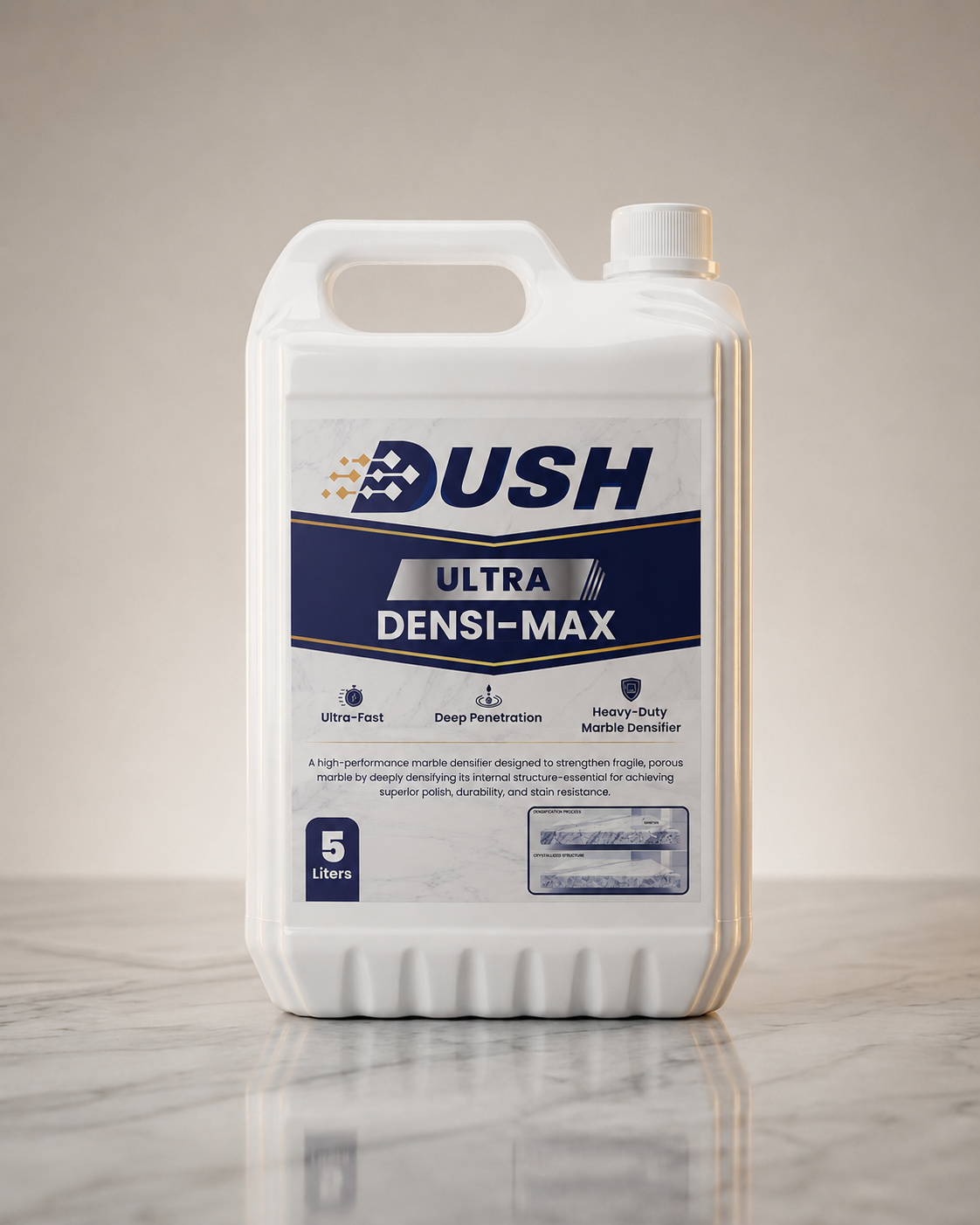
Dush Densi Max Ultra is formulated to strengthen porous marble's internal pore structure from within, forming the structural foundation step of a complete long-term protection system — densify, then seal, then maintain. It is not marketed as a permanent, standalone stain-proofing solution; it is the structural half of the system this guide describes, intended to be paired with sealing and ongoing maintenance.
✓ Pros
- Penetrates to the stone's core, not just the surface
- Suitable for Italian and white marble without yellowing or gloss change
- Effective on old or weakened marble
- Designed to complement, not replace, sealing
Considerations
- Not a standalone permanent stain-proof solution — pair with a sealer
- Best applied as part of the full inspect-to-maintain sequence
- Structural benefit, not a substitute for daily maintenance
Decision Table — Problem to Solution
| Problem | Recommended Solution |
|---|---|
| Recurring stains despite cleaning/sealing | Densifier + Sealer |
| Yellow stains present now | Stain removal first |
| Weak, easily marked marble | Densifier |
| Water absorbs quickly on contact | Densifier |
| Structurally sound, needs protection | Sealer |
| Marble looks dull, not stained | Polishing |
Yes — with the right proven system, white marble can hold a lasting, reliable resistance to staining. Dush Densi Max Ultra, applied as the structural foundation of a complete densify-seal-maintain approach, is a field-tested treatment with a track record professionals trust across homes, hotels, and commercial installations.
The confidence behind this recommendation comes from treating marble protection as a complete system rather than a single product: densify to strengthen the stone's structure, seal to protect the surface, and maintain that protection with simple periodic care. Marble treated this way has a proven history of holding a clean, stain-resistant finish for years. Based on its intended application as the structural foundation of that system, and its track record on Italian and white marble, Dush Densi Max Ultra (MRP ₹7,500 / 5 Litre) is the Editor's Choice for anyone serious about long-term marble protection.
Related Dush Guides and Products
Long-Term Marble Protection — Questions Answered
Can you stop white marble staining forever?
Can marble become completely stain-proof?
Why does white marble stain so easily?
Does sealing prevent stains?
What is a marble densifier?
Can old marble be restored?
How often should marble be sealed?
Why do stains come back after cleaning?
Is polishing enough to stop stains?
How do professionals protect Italian marble long-term?
What is the best long-term treatment for marble?
How can I reduce marble staining?
Is a densifier the same as a sealer?
Can micro-cracks undo sealing?
Does densifying marble change its appearance?
Can acidic cleaners undo marble protection?
Should hotels and commercial spaces invest in long-term protection?
Is marble porosity the same across all varieties?
How do I know if my marble needs densifying?
What happens if I only seal without densifying weak marble?
External References
The Honest Path to Long-Term Marble Protection
Not forever — but densify, seal, and maintain, and your marble resists staining for years. Dush Densi Max Ultra — MRP ₹7,500 for a 5 Litre pack.