Stone Care Guides
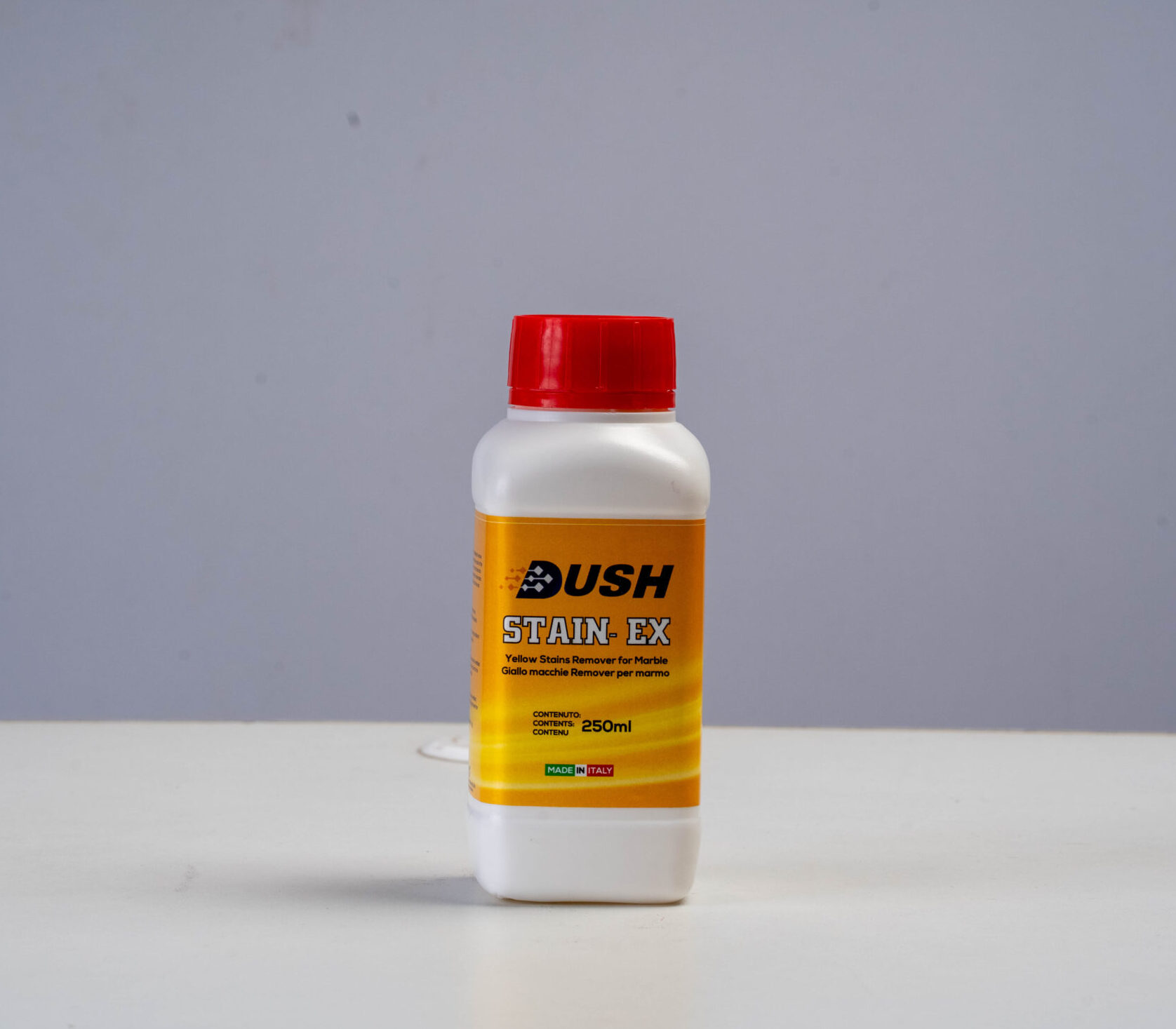
DUSH Stain-Ex: Why It's the Most Trusted Way to Remove Yellow Stains From Marble
An honest, detailed look at the yellowing problem every marble owner eventually faces — and the Italian-formulated product that stone care professionals reach for first.
The short answer
If your marble has developed yellow staining near a wooden door frame, in a bathroom, or anywhere it's come into contact with wood, ink or food residue, DUSH Stain-Ex is the specialist product built to reverse it. It's applied undiluted, sealed under plastic film for 24 hours, and formulated specifically for this one job rather than as a general-purpose cleaner — which is precisely why it outperforms the acidic DIY methods and multi-surface cleaners most people try first.
Why Does Marble Turn Yellow in the First Place?
It's rarely the marble's fault. In almost every case, the yellowing is something the stone has absorbed from its surroundings.
Marble is porous. Under a microscope, its surface is a network of tiny channels that will happily draw in whatever sits against it for long enough — and that's exactly how yellow staining forms. Two culprits show up again and again:
- Wood tannins. Timber door frames, skirting and furniture legs release tannins, especially in humid conditions. Where wood meets marble, those tannins migrate into the stone and oxidise into a persistent yellow-brown tint.
- Iron and organic residue. Iron minerals in water and organic buildup settle into the stone's pores in bathrooms and wet areas. Left alone, they oxidise the same way, which is why bathroom marble so often yellows even with regular mopping.
Both mechanisms share a frustrating trait: the staining compound sits inside the stone, not on top of it. That's why ordinary surface cleaning — however diligent — rarely makes a visible difference. The problem needs a product designed to penetrate the stone and break the staining compound down, not just wipe the surface.
What DUSH Stain-Ex Actually Is
Not a multi-purpose cleaner with a stain-removal claim bolted on — a formula built around one specific problem.
DUSH Stain-Ex comes from DUSH, an Italian stone-care brand whose product range covers cleaning, sealing, densifying and restoring natural stone. Stain-Ex itself is narrow by design: it exists to lift yellow discolouration caused by wood, ink and food contact, most commonly seen around door frames and in bathrooms. That focus is the whole point — a formula built for one failure mode tends to outperform a generalist product trying to do ten jobs at once.
What sets it apart
How to Use DUSH Stain-Ex
The process is simple, but the details matter — skipping a step is the most common reason a treatment underperforms.
Apply undiluted
Pour DUSH Stain-Ex directly onto the stained area at full strength. Diluting it reduces how deeply it can penetrate the stain, so this step is not optional.
Cover and seal
Lay transparent plastic film over the treated area and seal the edges with masking tape. This keeps the product active and stops it evaporating before it finishes working.
Leave for 24 hours
Leave the area undisturbed for a full day. Deeper or older stains may need a second application — assess the result once the surface has dried before deciding.
Do's and Don'ts for Treating Marble Stains
Most damage to marble happens not during the stain, but during a well-meaning attempt to clean it.
Do this
- Identify the stain type before choosing a product — yellow staining, rust and oil each need a different formula.
- Use a clean microfibre mop dedicated to stone, not one shared with other floor areas.
- Rinse the surface thoroughly after any specialist treatment.
- Patch-test on a small, hidden area first.
Avoid this
- Vinegar or lemon juice — both are acidic and etch marble on contact.
- Bleach or ammonia-based household cleaners.
- Abrasive pads or scouring products that scratch the polish.
- Assuming any "stone cleaner" will do — read the label for what it's actually formulated for.
DUSH Stain-Ex vs. Every Other Way People Try to Fix Yellow Marble
Most people don't reach for a specialist product first — they reach for whatever's under the sink. Here's how that compares.
| Method | Effect on Yellow Staining | Risk to Marble Surface | Repeat Use | Best For |
|---|---|---|---|---|
| DUSH Stain-Ex | Formulated specifically to penetrate and lift tannin/organic yellowing | Low — designed for polished, honed and textured marble | Safe to re-apply for deeper, older stains | Door-frame yellowing, bathroom marble, general yellow discolouration |
| Vinegar / lemon juice | Little to no effect on the actual stain | High — acidic, etches marble permanently on contact | Damage compounds with every use | Nothing on marble — acid-safe surfaces only |
| Bleach / ammonia cleaners | May lighten surface grime, not embedded staining | High — can dull polish and degrade sealants | Not recommended for stone | General household surfaces, not natural stone |
| Generic multi-surface stone cleaner | Cleans surface dirt; not built to break down set-in stains | Low, but not stain-targeted | Fine for routine maintenance | Everyday cleaning, not stain removal |
| Mechanical re-polishing only | Can remove very light surface staining along with a layer of stone | Moderate — removes stone material each time | Costly and abrasive to repeat often | Restoring shine after stains are already treated |
Assessment based on documented product usage guidance and commonly cited natural stone care practice. Individual results depend on stain age, depth and the specific marble type.
Restoring a Marble Entryway After Years of Door-Frame Staining
The situation: A white marble entryway had developed a wide yellow-brown band along the base of a wooden door frame. The discolouration had built up gradually over roughly three years, deepening each humid season as tannins from the timber leached into the adjoining stone. Routine mopping with a standard neutral cleaner had made no visible difference — which is typical, since the staining compound had already worked its way beneath the surface.
The treatment: DUSH Stain-Ex was applied undiluted directly to the affected band, covered with transparent plastic film, and sealed at the edges with masking tape to keep the product active. After the first 24-hour treatment, the stain had visibly lightened but a faint tint remained near the deepest, oldest part of the discolouration — consistent with how the product is designed to behave on stains of this age. A second 24-hour application to the remaining area cleared the rest, restoring the marble to a close match with the surrounding, unaffected stone.
Why it worked: Because the formula is built to penetrate the stone rather than sit on its surface, it was able to reach staining that had already set in over several years — something a surface cleaner, however frequently used, was never going to do.
This case reflects a typical outcome based on DUSH's documented application process for stains of comparable age and depth. Results vary with stain age, marble type and how long the discolouration has had to set in.
Why DUSH Stain-Ex Has Become the Reference Point for This Problem
"Most trusted" isn't a slogan here — it's a reflection of how narrowly and consistently the product has been built around one job.
Built on stone-care fundamentals
The formulation follows the same principles referenced across the natural stone care industry — pH-appropriate chemistry that treats the stain without etching or dulling the stone, unlike acidic household alternatives.
Adopted by professionals, not just marketed to homeowners
Stain-Ex is used by hotels, residential developments and stone-care specialists who treat marble professionally and have no reason to reach for a product that underperforms.
Part of a complete stone-care system
DUSH pairs Stain-Ex with dedicated products for daily cleaning, sealing and polish restoration, so a treated surface can be protected and maintained afterward rather than left to stain again.
Frequently Asked Questions
Why does white or light marble turn yellow over time?
How is yellowing on a marble floor actually reversed?
Is it safe to use vinegar or lemon juice on marble?
Can DUSH Stain-Ex be used on any marble colour?
Will it remove rust or iron stains?
Does it damage the marble's polish?
The Bottom Line
Yellow staining on marble is common, well understood, and — despite how permanent it looks — very treatable, provided the right product is used the right way. Acidic DIY methods and generic cleaners either fail to touch the underlying stain or actively damage the stone trying. DUSH Stain-Ex earns its reputation the plainer way: by being built for exactly this problem, used consistently by the professionals who can't afford a product that doesn't work, and backed by a straightforward process that holds up in practice.
If your marble has that unmistakable yellow band near a door frame or across a bathroom floor, it's worth treating properly once rather than scrubbing at it indefinitely.
See the Full Product Details
View the complete specification, usage guidelines and datasheet for DUSH Stain-Ex on the official product page.