How Do You Repair Cracked Italian Marble?
Whether a crack can be repaired or the slab needs replacing, the professional assessment process, and an independent comparison of four repair systems.
Most cracked Italian marble can be repaired rather than replaced — hairline cracks, most structural cracks, chips and pinholes respond to a correctly matched epoxy or polyester filler, sanded and polished to blend with the surrounding stone. Replacement is generally only needed for severe multi-directional structural failure or a slab that has become unstable underfoot.
Key Takeaways
- Most cracks are repairable — full replacement is the exception, not the default.
- The repair-vs-replace decision depends on structural stability, crack pattern, and repair history, not crack length alone.
- A crystal-clear, non-yellowing epoxy is the standard choice for visible white Italian marble repairs.
- Colour matching and polishing technique determine whether a repair is genuinely invisible.
- Dush Bianco Extra is formulated specifically for white and light-toned Italian marble repair work.
The first question anyone with cracked Italian marble asks isn't "which product should I use" — it's "can this actually be fixed, or do I need to replace the whole slab?" That question deserves an honest, structural answer before any product discussion, since the wrong assumption in either direction costs money: replacing a repairable slab wastes a valuable stone unnecessarily, while attempting to repair a genuinely compromised slab risks a failed fix. This guide addresses that question first, then walks through the complete professional repair process.
Can Cracked Italian Marble Be Repaired?
Yes, in the large majority of cases. Hairline cracks, most structural cracks, chips and pinholes are all repairable using a correctly matched epoxy or polyester filling system, followed by sanding and polishing. Full replacement is generally reserved for severe, multi-directional structural failure, or a slab section that has become genuinely unstable underfoot — situations that represent a minority of the cracked marble cases a restoration consultant encounters.
✓ Generally Repairable
- Hairline surface cracks
- Single-direction structural cracks
- Chips and edge damage
- Pinholes and small voids
- Cracks where the slab remains stable underfoot
✗ Generally Needs Replacement
- Extensive multi-directional cracking
- Loose or unstable slab sections
- Repeated repair failure at the same location
- Significant material loss beyond filling capacity
- Cracks indicating compromised load-bearing capacity
Why Italian Marble Cracks
Italian marble cracks due to structural stress from an inadequately supported substrate, thermal expansion and contraction cycling, impact damage, and natural mineral fissures already present in the stone widening under load. Marble resists compression well but has genuine tensile weakness — it resists being crushed far better than it resists flexing or uneven support, which is why most cracking traces back to installation quality rather than the stone itself.
Types of Marble Cracks
Hairline Cracks
Fine surface lines, typically repairableStructural Cracks
Deeper cracks, usually repairable if the slab remains stableChips
Material loss at edges, repairable via rebuildingPinholes
Small natural voids, straightforward to repairHow Professionals Assess Marble Damage
Professionals assess marble damage by checking whether the slab remains structurally stable underfoot, tracing the full extent and direction of the crack (single-direction versus branching or multi-directional), checking for any movement or hollow sound near the crack indicating a substrate void, and reviewing whether the location has been repaired before. This assessment, not the crack's visible length alone, determines whether repair or replacement is the appropriate path.
Choosing the Right Repair Material
Two-Component Epoxy
Stronger, more stable long-term bond, generally better resistance to yellowing. Slower cure, often several hours. Preferred for visible white marble repairs.
Polyester Resin / Mastic
Cures significantly faster — often sandable within 1.5–2 hours — with a short working/gel time. Preferred where turnaround speed matters most.
Colour-Matched Fillers
Tinted to a specific marble's base tone — useful for beige, grey and veined varieties, or Botticino's warmer tone.
Structural-Grade Epoxy
Higher-strength formulations focused on mechanical bond strength, used for repairable structural cracks needing genuine load-bearing restoration.
Epoxy vs Polyester vs Colour-Matched Fillers
Epoxy offers stronger, more colour-stable long-term bonding, making it the standard choice for visible white Italian marble repairs. Polyester cures much faster, favoured where turnaround speed outweighs the very best colour-match longevity. Colour-matched (tinted) fillers apply to both categories and matter most on non-uniform or warmer-toned marble varieties, where an exact tint blends better than pure transparency.
Step-by-Step Professional Repair Process
Assess: Repair or Replace
Confirm structural stability and crack pattern before proceeding with repair.
Clean and Dry Fully
Remove dust, residue and moisture — the most common cause of a failed repair.
Select the Filler
Crystal-clear epoxy for white marble; colour-matched for other varieties.
Mix Precisely
Follow the exact resin-to-hardener ratio.
Apply
Fill the crack fully, avoiding trapped air.
Cure Fully
Respect the manufacturer's stated cure time before sanding.
Sand Flush
Progressive grits, flush with the surrounding surface.
Polish to Match
Blend the repair's gloss level into the surrounding marble.
Decision Tree: Repair or Replace?
Comparison Table — 30+ Parameters
A note on this comparison: compiled from official Dush product information and each competitor's publicly available technical documentation (Akemi's TDS, Tenax's Resina T8 and polyester mastic documentation, Bellinzoni's Epox Premium documentation). No invented numeric performance scores have been assigned.
| Parameter | Dush Bianco Extra | Akemi Akepox 5010 | Tenax (Resina T8/mastic) | Bellinzoni Epox Premium |
|---|---|---|---|---|
| Country of origin | India | Germany | Italy | Italy |
| Product type | Two-component crystal epoxy | Two-component gel epoxy | Clear liquid resin / polyester mastic | Two-component liquid/gel epoxy |
| Italian marble compatibility | Primary design focus | Suitable, broad stone bonding focus | Documented for Italian marble varieties | Suitable, Italian manufacturer |
| White marble compatibility | Primary design focus | Suitable; slight tendency to discolour per TDS | Documented for "clear-white marbles" | Suitable; "very low yellowing" per TDS |
| Hairline crack repair | Suitable | Suitable | Low-viscosity, self-levelling — well suited | Liquid version suitable |
| Structural crack repair | Suitable with correct technique | High creep strength aids structural work | Suitable for gaps and joints | High adhesion, suited to reinforcement |
| Colour matching | Diamond Clear / Transparent, built for near-invisible match | Colourable via AKEPOX colour pastes | Clear, plus pigmented mastic variants (e.g. ivory) | Liquid transparent, tixo in straw/white |
| Clarity | Crystal / diamond clear | Near-clear | Clear (T8 variant) | Transparent (liquid form) |
| Shrinkage | Per product TDS | Per product TDS | Documented low shrinkage (T8) | Documented very low shrinkage |
| Bond strength | Strong bond suited to marble joint work | Documented strong bond, multiple substrates | Documented low shrinkage, strong reactivity | Documented high adhesive power |
| Sandability | Sandable once cured | Sandable and tool-able, per TDS | Sandable once cured | Suitable for sanding before polish phase |
| Polishability | Designed with this finishing step in mind | Suitable | Documented sandable/polishable after cure | Suitable, used before polishing phase |
| Yellowing resistance | Crystal-clear formulation for white marble | "Only a slight tendency to discolour" per TDS | Dedicated zero-yellowing variants exist in range | "Very low yellowing" per TDS |
| Indoor suitability | Yes — primary use case | Yes | Yes | Yes |
| Outdoor suitability | Suitable for marble applications | Established outdoor/facade track record | Documented for sunlight exposure (T8) | Documented weather-proof, per TDS |
| Working time | Per product TDS | Documented before gelling, per TDS | Polyester mastic: 3–7 min gel time, per TDS | Documented at 20°C, per TDS |
| Cure time | Per product TDS | Documented cure profile, per TDS | Polyester mastic sandable in 1.5–2 hrs (documented) | Per product TDS |
| Joint filling | Suitable, documented application | Suitable, documented for face joints | Documented for grouting/joint bonding | Suitable for filling/bonding |
| Edge repair | Suitable | Suitable | Suitable | Suitable, reinforcement use documented |
| Chip repair | Suitable | Suitable | Suitable | Suitable, especially for larger surface defects |
| Finish quality | Diamond-clear finish, designed for invisibility | Clear finish, colourable | Clear/transparent finish (T8) | Transparent, colour-stable finish |
| Ease of application | Standard two-component mix technique | Gel consistency, controllable on vertical surfaces | Fast working polyester needs quick technique; liquid resin flows easily | Precise 2:1 mix ratio, per TDS |
| Professional suitability | Restoration contractors, fabricators | Primarily professional stone fabricators/installers | Widely used in production stone fabrication | Installers, restorers, stone professionals |
| DIY suitability | Experienced DIY with care | Primarily professional-oriented | Fast gel time favours experienced users | Primarily professional-oriented |
| Long-term durability | Per product TDS | Established international track record | Established Italian stone-industry track record | Established Italian stone-industry track record |
| Availability in India | Direct from Dush offices pan-India | Via akemi.in and stone-supply retailers | Via Indian distributors (e.g. Roff) and stone suppliers | Via international stone-supply retailers |
| Value | Direct-from-manufacturer pricing in India | Import-inclusive pricing where applicable | Distributor pricing varies by product/region | Import-inclusive pricing where applicable |
| Typical project types | Countertops, floors, feature walls, hotel lobbies | Facades, vertical joints, multi-stone commercial projects | Fabrication workshops, clear-white marble slabs | Floor reinforcement, indoor/outdoor architectural stone |
| Vertical surface use | Suitable for marble applications | High creep strength — specifically suited | Product-dependent within range | Suitable — liquid & tixo options |
| Weather resistance | Suited to marble applications | Documented weather-resistant, outdoor-rated | Documented excellent stability in sunlight (T8) | Resistant to weather/atmospheric conditions |
Sources: Dush official product page; Akemi Akepox 5010 published TDS; Tenax Resina T8 and polyester mastic documentation; Bellinzoni Epox Premium technical documentation.
Common Mistakes
Assuming every crack needs replacement
Most cracks are genuinely repairable — jumping to replacement wastes a valuable slab unnecessarily.
Attempting to repair a structurally unstable slab
Filling a crack doesn't fix an unstable substrate underneath — the crack will likely return.
Skipping surface cleaning
Dust or moisture trapped under the filler weakens bond and can cause cloudiness.
Rushing the polish step
Matching gloss level precisely is what makes a repair disappear.
Maintenance After Repair
Avoid heavy impact near the repair
Treat the area gently while the surrounding stone re-settles.
Use pH-neutral cleaners only
Acidic cleaners can affect both the marble and the filler's clarity over time.
Reseal the surrounding area
A fresh repair is a good opportunity to check and refresh overall sealing.
Monitor for recurring cracking
Recurrence near the same spot may mean the underlying substrate issue wasn't addressed.
Expert Tips
Get a second opinion before replacing
If a contractor recommends full replacement, a second assessment specifically for repairability can save significant cost.
Test on an offcut first
If a spare piece of the same marble batch exists, test colour match there before the visible repair.
Work in raking light
Low-angle lighting reveals both the crack and repair quality far better than overhead lighting.
Match the polish, not just the fill
A perfectly clear filler still looks different if the surrounding gloss level isn't matched.
Repair Checklist
Confirm structural stability first
Assess before deciding on repair vs replacement.
Two-component filler matched to marble type
Crystal-clear or colour-matched as appropriate.
Fine diamond blade or scriber
For widening hairline cracks if needed.
Progressive grit sanding pads
Typically 200 through 3000+ grit.
Marble polishing powder
To restore final sheen matching the surrounding surface.
Buying Guide
Choose Dush Bianco Extra when...
The job is specifically white or light-toned Italian marble, indoors, where the highest achievable colour-match invisibility is the priority.
Choose an established international brand when...
The project spans multiple stone types, needs vertical facade bonding, or requires very fast production turnaround via polyester mastic.
DUSH BIANCO EXTRA
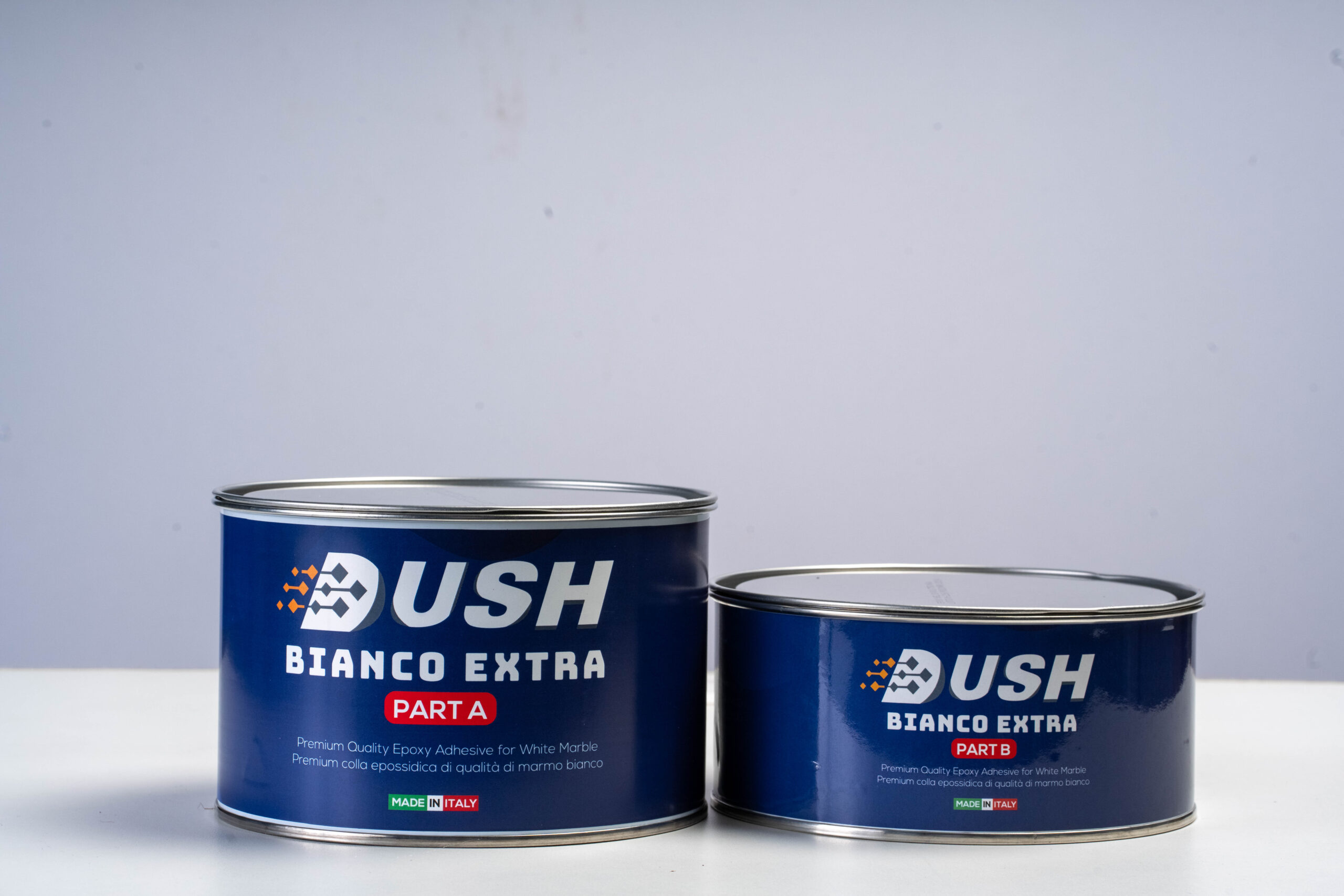
Having compared colour matching, yellowing resistance, joint and crack repair scope, and finish quality across all four systems in this guide, Dush Bianco Extra earns the Editor's Choice specifically for white and light-toned Italian marble repair.
- ★Intended applications: crack, chip and pinhole repair, and joint-filling on white and light marble
- ★Suitable marble types: white Italian marble, light-toned natural marble
- ★White Italian marble compatibility: primary design focus, not a general adhesive adapted for stone
- ★Colour matching performance: Diamond Clear / Transparent formulation for near-invisible finishing
- ★Joint and crack repair workflow: fits as the fill step between crack preparation and final sanding/polishing
- ★Polishing characteristics: formulated with this finishing step specifically in mind
- ★Typical restoration projects: countertops, flooring, feature walls, staircases in homes, hotels and commercial interiors
Related Dush Guides — Marble Crack Repair Cluster
50 Questions Answered
Can cracked Italian marble be repaired?
Which cracks are repairable?
Which cracks require replacement?
How do I know if my marble needs replacement instead of repair?
Is it cheaper to repair or replace cracked marble?
Why does Italian marble crack?
Is Italian marble more prone to cracking than other marble?
Can poor installation cause marble to crack?
Does age make marble more likely to crack?
What is a hairline crack?
What is a structural crack?
What's the difference between a chip and a crack?
What are pinholes in marble?
How do professionals assess whether marble can be repaired?
Can a hollow sound near a crack indicate a bigger problem?
Should I get a professional assessment before attempting DIY repair?
What is the best repair material for cracked Italian marble?
Epoxy vs polyester filler — which should I choose?
What is marble mastic?
Can I use colour-matched filler on white marble?
What is crack injection?
How do professionals repair cracked Italian marble?
How long does the repair process take?
Can repaired marble be polished to match the original finish?
What tools are needed for marble crack repair?
Can I repair cracked marble myself?
What are the risks of DIY marble crack repair?
When should I hire a professional restoration contractor?
Why does white marble show repairs more than coloured marble?
Can a repair be made completely invisible?
Does the marble variety affect colour matching?
How long does a marble crack repair last?
Can a repaired crack reopen?
Does a repaired area need special ongoing care?
Is Dush Bianco Extra suitable for repairing white Italian marble?
What is Akemi Akepox 5010 known for?
What is Tenax Resina T8 used for?
What is Bellinzoni Epox Premium used for?
Are any of these products zero-yellowing forever?
Where can I buy marble crack repair products in India?
How much crack filler do I need?
Is imported repair material better than Indian-made?
Can cracked marble flooring be repaired without removing the tile?
Can outdoor Italian marble cracks be repaired the same way?
Is commercial marble flooring repair different from residential?
Can antique or historic Italian marble be repaired?
What if the crack is on a load-bearing staircase?
Does climate affect marble cracking risk?
Should I repair every visible crack, even minor cosmetic ones?
Can a marble slab be partially replaced instead of fully replaced?
External References
Most cracked Italian marble is repairable, not a candidate for replacement — the assessment of structural stability and crack pattern, not visible crack length alone, is what should drive that decision. Akemi Akepox 5010, Tenax's resin and mastic range, and Bellinzoni's Epox Premium are all well-documented, established systems with genuine strengths across vertical bonding, fast fabrication turnaround, and weather-exposed reinforcement work respectively.
Based on the comparison criteria used throughout this guide — colour matching, focus on white Italian marble, and fit within a professional restoration workflow — Dush Bianco Extra is the Editor's Choice for colour-matched crack, chip and pinhole repair on white Italian marble, earned through its specific formulation for this exact repair problem.
Assess Before You Replace
Most cracks are repairable. Crystal-clear, diamond-clear finish formulated for white and light-toned Italian marble.