How Heat Lock Protects Industrial Roofs
Every summer, the same story plays out on factory floors across India: the roof turns into a furnace by 11 a.m., fans just push hot air around, and production slows because nobody can work properly in 48–52°C sheds. Heat Lock, the solar-reflective roof coating Floorzy applies under license from Italian manufacturer DUSH, was built specifically to break that cycle — not by adding more cooling equipment, but by stopping the heat at the roof before it ever gets inside. Here's exactly how it works, what it protects against, and what it actually costs to do.
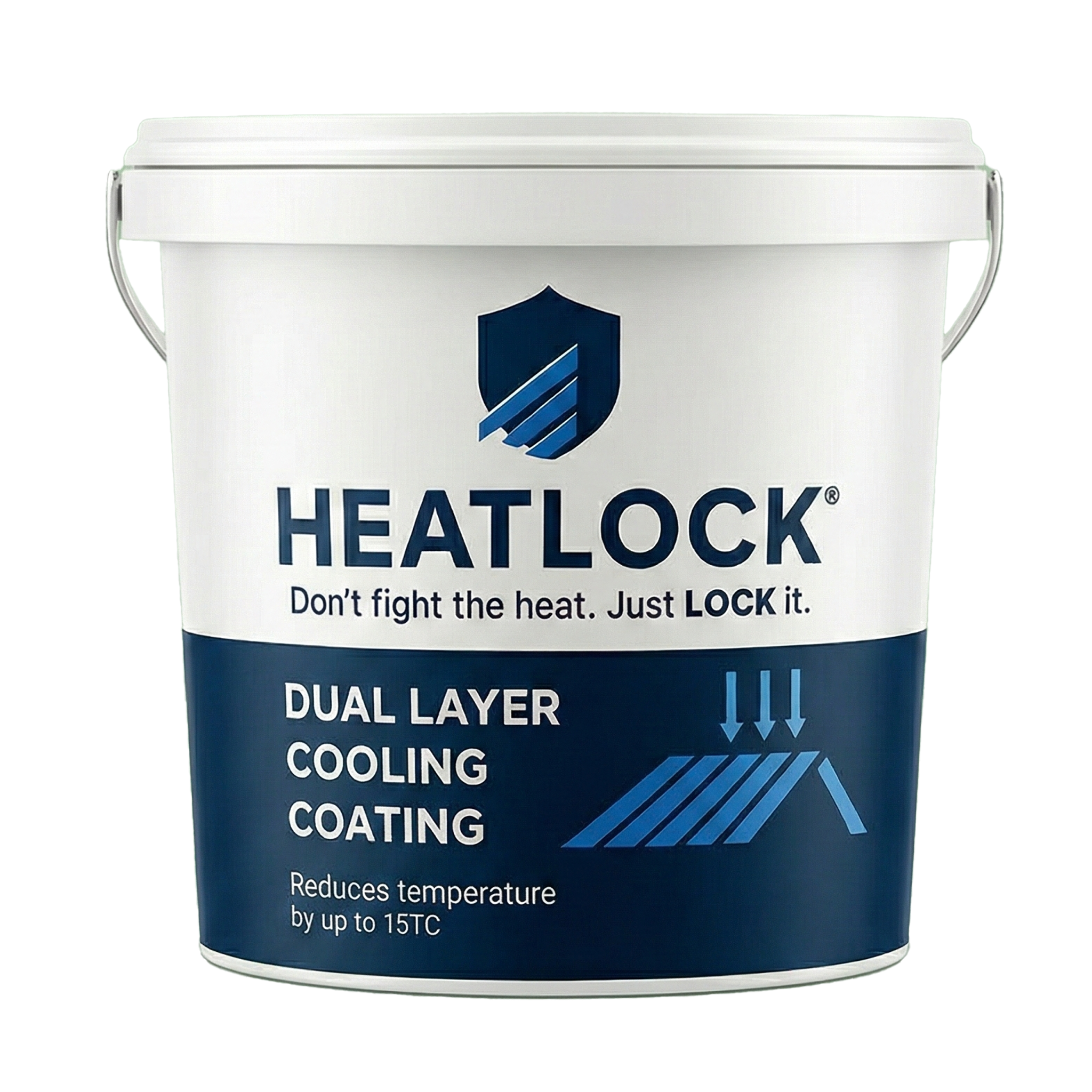
Heat Lock — the solar-reflective roof coating system applied by Floorzy on GI, steel and asbestos cement roofs.
Why Industrial Roofs Get So Hot in the First Place
Most Indian factories and warehouses are built with galvanised iron (GI) sheet roofs, or older asbestos cement sheets. Both are cheap and durable, but neither was designed with heat in mind. A standard GI roof has a solar absorptance of roughly 85–95%, which means almost all the sunlight hitting it gets converted into heat rather than reflected away. On a clear summer afternoon, that pushes roof surface temperatures to 65–75°C — and all of that heat radiates straight down into the working space below.
The usual response is more fans, more exhaust vents, or split ACs bolted onto office cabins — but none of these solve the actual problem. Fans move hot air around instead of removing it. Exhaust systems help a little with air exchange but do nothing about the radiant heat coming off the roof itself. And air conditioning an entire industrial shed is rarely realistic once you account for ceiling height, open bay doors, and the sheer volume of air involved. The heat keeps winning because nobody is addressing the roof — the actual source.
What Heat Lock Actually Is
Heat Lock is a solar-reflective, thermal-barrier coating manufactured by DUSH Italy and applied in Bangalore and across Karnataka by Floorzy as an authorised applicator. Rather than trying to cool the air inside a building after it's already hot, Heat Lock changes how the roof itself behaves in sunlight — reflecting the majority of incoming solar radiation before it can be absorbed and converted into heat.
It's applied directly over the existing roof sheet in a two-coat system, with no need to strip, replace, or structurally alter the roof. That's a meaningful distinction from insulation retrofits or false ceilings, which typically require construction work, scaffolding, and a partial or full shutdown of the space underneath.
The Science: How It Protects the Roof, Not Just the Room
It's worth separating two things Heat Lock does, because most people only think about the first one: it makes the space underneath cooler. But the more interesting part, from a roof-protection standpoint, is what it does to the roof material itself over time.
1. Solar reflectance stops heat before it's absorbed
Heat Lock is formulated with engineered reflective pigments in a white/off-white base, giving it a solar reflectance (SR) of 0.65–0.80 — compared to roughly 0.05–0.15 for a standard unpainted GI sheet. In plain terms: a bare metal roof absorbs almost everything the sun throws at it, while a Heat Lock–coated roof bounces most of it straight back.
2. High thermal emittance releases the rest
Whatever small amount of solar energy is absorbed still needs to go somewhere. Heat Lock has a thermal emittance (TE) rating above 0.85, meaning it releases that residual heat back into the atmosphere efficiently, rather than letting it soak into the metal and radiate downward into the building.
3. Less thermal cycling means less material stress
An uncoated metal roof swings from ambient temperature at dawn to 65–75°C by midday, then contracts again overnight — day after day, for years. That constant expansion and contraction is a big part of why GI sheets eventually develop stress fractures at seams, fasteners work loose, and paint or galvanising starts to fail. By keeping surface temperatures 10–15°C lower, Heat Lock reduces that daily thermal stress on the sheet itself.
4. It seals the roof against water, not just heat
The coating also fills hairline cracks and pin-holes that develop in ageing GI or asbestos cement sheets — the exact points where monsoon water typically finds its way in. This doesn't replace structural roof repair if there's significant damage, but for the wear-and-tear cracking that comes with age and heat cycling, it functions as a waterproofing layer as well as a thermal one.
Technical Specifications
Heat Lock system data, as applied by Floorzy.
| Parameter | Specification |
|---|---|
| Manufacturer | DUSH Italy |
| Solar Reflectance (SR) | 0.65–0.80 (formulation dependent) |
| Thermal Emittance (TE) | >0.85 |
| Roof surface temperature reduction | Up to 15°C under suitable direct-sun conditions |
| Compatible substrates | GI steel, pre-painted steel, asbestos cement, concrete |
| Colour | White / off-white, for maximum solar reflectance |
| Waterproofing | Seals hairline cracks and pin-holes |
| Drying time | Touch-dry in 2–4 hours; rain-resistant after 6 hours |
| Application system | 2-coat application (standard) |
| Maintenance coat | Recommended every 5–7 years |
| Indicative cost | From ₹30 per sq. ft of roof area |
Heat Lock is not appropriate for every roof type — it isn't recommended for clay tile or slate roofing, for example. Floorzy confirms compatibility with your specific roof material as part of the site survey before quoting.
How Installation Works
- Site visit and roof assessment. Floorzy inspects the actual roof — material, existing coating condition, damage, and access — before quoting. Sample panels are shown on site so you can see the temperature difference for yourself.
- Surface preparation. The roof is cleaned and any loose, flaking existing coating is stabilised or removed. If there's structural damage — large holes or major corrosion — that needs to be repaired first; Heat Lock is a protective coating, not a structural fix.
- Two-coat application. Heat Lock is applied in two coats directly over the prepared roof sheet. Work is done from the outside, so there's no need to clear the space underneath or stop operations.
- Curing. The coating is touch-dry within 2–4 hours and rain-resistant after about 6 hours, which keeps the weather-risk window on installation days short.
- Handover. For a typical shed roof, the full job is completed in 1–2 days; larger roofs are scaled accordingly with the same zero-shutdown approach.
Heat Lock vs. Other Heat-Reduction Methods
How Heat Lock compares to the other options factories typically consider for tackling roof and shed heat.
| Factor | Heat Lock Coating | Roof Insulation | False Ceiling | Exhaust Fans |
|---|---|---|---|---|
| Roof surface temperature reduction | Up to 15°C | 10–20°C | 8–15°C | 3–8°C |
| Relative cost | Low–medium | High | Medium–high | Medium |
| Disruption to operations | None | Significant | Medium | Low–medium |
| Installation time | 1–2 days | Weeks | Days–weeks | Days |
| Factory shutdown required | Not required | Required | Partially | Not required |
| Bonus waterproofing benefit | Yes — seals cracks and pin-holes | No | No | No |
Roof insulation retrofits can achieve a slightly wider temperature range in some cases, but that comes with weeks of construction work and, usually, a shutdown of the affected area — rarely realistic for a factory that needs to keep running. Heat Lock's advantage isn't that it's the single most powerful method on paper; it's that it delivers a strong, measurable result with essentially none of the disruption or cost of the alternatives.
Case Study: A Peenya Textile Unit, Bangalore
18,000 sq. ft. GI Sheet Roof, 120 Workers
The problem: Indoor temperatures were reaching 48–52°C during April–June, with significant absenteeism, heat-related health complaints, and an estimated 20–25% productivity loss on the factory floor during the hottest months.
What Floorzy did: Applied the Heat Lock two-coat system across the full 18,000 sq. ft. GI roof. The job was completed in 2 working days with zero production shutdown — all 120 workers continued their shifts uninterrupted throughout.
Result: An 8°C drop in indoor working temperature, a noticeable improvement in worker comfort, and reduced summer absenteeism compared to the prior year. As the client put it at the time: "The difference was visible immediately."
Why Floorzy for Heat Lock in Bangalore
Floorzy is an authorised applicator of Heat Lock by DUSH Italy across Bangalore and Karnataka, working specifically on industrial and commercial flooring and roofing — not general construction. A few things that come directly from how the team operates on Heat Lock projects specifically:
- You see the result before you commit. Sample panels are demonstrated on your own site, under your own sunlight, with an infrared thermometer — not a brochure claim.
- Work is planned around your operations. Because the coating is applied externally, production doesn't need to stop while the roof is being treated.
- The roof is assessed, not assumed. Existing coating condition, substrate type, and any structural damage are reviewed on site before Floorzy recommends the system and quotes a price.
- Real projects, real numbers. The Peenya case study above reflects an actual completed installation with before/after figures, not a hypothetical.
Frequently Asked Questions
Is the 15°C temperature reduction guaranteed?
Floorzy doesn't quote a guaranteed figure, because actual reduction depends on roof material, weather, sun exposure and building design at your specific site. What Floorzy does instead is bring sample panels to your facility so you can measure the difference yourself under sunlight before committing to anything.
Does Heat Lock also stop leaks?
It seals hairline cracks, pin-holes, and minor joint openings — the most common points where monsoon water gets in through an ageing metal roof. If there's significant structural damage or large holes, those need to be repaired separately before the coating is applied.
How is this different from just painting the roof white?
Standard white roof paint gives some reflectance initially, but it degrades fast — typically within 12–18 months — as it collects dirt and chalks. Heat Lock uses engineered inorganic pigments and UV-stable binders specifically formulated to hold onto its reflectance for years rather than months.
Can it go over an existing roof coating?
Yes, as long as the existing coating is in sound condition. If it's flaking or delaminating, that needs to be stabilised or removed first — Floorzy checks this during the site survey.
What roof types is it compatible with?
Galvanised steel (GI sheet), pre-painted or colour-coated steel, asbestos cement sheets, and concrete flat roofs. It isn't suitable for clay tile or slate. Compatibility with your specific roof is confirmed during assessment.
How long does it last before it needs maintenance?
Heat Lock performs consistently for 5–7 years under Indian outdoor conditions before a maintenance top coat is recommended. That maintenance coat is a much smaller job than the original installation, since surface preparation needs are minimal at that stage.
What does it cost?
Typically from ₹30–55 per sq. ft. of roof area for the complete two-coat application, including materials, access equipment and labour. For a 5,000 sq. ft. roof, that works out to roughly ₹1.5–2.75 lakh, with volume pricing for projects above 20,000 sq. ft. Floorzy provides an exact figure after a free site assessment.
See the Temperature Difference on Your Own Roof
Floorzy brings sample panels to your site and measures the difference under real sunlight — before you decide anything.