How to Fix Marble Tiles Falling Off Outdoor Walls—and Choose the Best Cement Adhesive for Exterior Marble
Exterior marble rarely fails without warning. A hollow sound, an opening joint, a dark edge after rain or a tile that shifts slightly under pressure can all point to a bond that is losing its hold. This guide explains why outdoor marble installations fail, how a safe repair should be planned, and where DUSH APEX fits as a white cement adhesive developed specifically for exterior marble and natural stone.
When marble tiles fall from an outdoor wall, the visible failure happens in a second. The cause usually develops over months. Sun warms the stone, evening air cools it, rain finds a path behind it, and the building surface moves by tiny amounts. None of those changes looks dramatic on its own. Together, however, they place repeated stress on the adhesive layer. A product that seemed firm during installation may gradually become the weakest part of the wall.
DUSH APEX addresses the adhesive part of that system. It is not presented here as a substitute for structural assessment, mechanical fixing where required, waterproofing design or skilled installation. It is a purpose-specific cement adhesive for exterior marble and natural stone, created for the stresses that ordinary indoor or basic cement adhesives are not designed to manage.
Why exterior marble adhesive fails
Outdoor marble lives in a more demanding environment than indoor flooring. Inside a building, temperature and moisture generally change gradually. Outside, the same stone can be hot under afternoon sun, cooled by rain and then exposed to a humid night. A wall elevation may receive harsh sunlight on one side of a building and remain damp and shaded on another. The adhesive must continue transferring load while the marble, the substrate and the adhesive itself respond differently to those conditions.
1. Thermal cycling keeps pulling at the bond
Marble, concrete, brick, render and cement adhesive do not expand and contract in exactly the same way. During the day, a dark or sun-facing wall absorbs heat. When the temperature falls, the materials contract. This repeated movement is called thermal cycling. The movement may be small, but it happens again and again. A rigid or weak bond can develop micro-gaps, especially around corners, joints and areas with uneven adhesive contact.
Outdoor adhesive should be chosen for its ability to maintain adhesion through temperature changes, not simply for how hard it becomes. DUSH APEX is positioned for exterior thermal movement and weather exposure, with C2-class performance in the brand’s published comparison.
2. Moisture finds weaknesses that are invisible when the wall is dry
Rainwater does not need a large crack to reach the back of a stone. It can enter through an unfinished top edge, an open joint, a poorly sealed penetration, a hairline substrate crack or a gap left by incomplete adhesive coverage. Once behind the marble, water can remain trapped. Repeated wetting and drying can weaken marginal bonds, carry salts to the surface and create staining around edges or joints.
The water-entry route must also be corrected. No exterior adhesive can compensate for a leaking parapet or active wall seepage. Before re-fixing marble, repair the source and confirm that the substrate is sound.
3. UV exposure and weathering make outdoor conditions different
UV exposure, heated edges, joints and long-term weathering add to the stress on an exterior assembly. A product described only as “cement based” is not automatically suitable outdoors; its stated area of use matters.
DUSH APEX is listed for facades, courtyards, garden feature walls, exterior staircases and pool surrounds. It is not the DUSH recommendation for permanently wet interior areas such as bathrooms; DUSH OMNI or DUSH ERA are separate products for those applications.
4. Grey bleed can spoil the appearance of light marble
Marble is selected as much for appearance as for performance. Light, white and cream stones can show darkening at edges or patches when grey material influences the visible face. The risk varies with stone density, thickness, moisture and installation conditions, but using a white adhesive removes one avoidable source of colour contamination.
DUSH APEX uses a premium white cement base. The published product page connects this white formulation with cleaner-looking joints and reduced grey-bleed staining at marble edges. For architects and homeowners, this is not a cosmetic extra. An adhesive that holds the stone but changes its appearance has still produced an unacceptable installation.
5. Poor contact behind the slab creates hollow areas
Even the right adhesive can fail if it is applied in isolated dabs or if a large slab is pressed onto ridges that never collapse. Hollow areas become places where water can collect and where loads are concentrated rather than distributed. On vertical work, those gaps can also make the stone sound hollow when tapped, a common early warning of poor bedding.
DUSH calls for a notched trowel, firm placement and back-buttering of large slabs. Installers should choose a notch suited to the stone and lift test pieces periodically to confirm continuous contact.
What to look for in an exterior marble adhesive
A buyer comparing bags in a shop may see similar words on several products: cementitious, polymer modified, high strength or suitable for stone. The useful question is not which bag uses the strongest marketing phrase. It is whether the declared properties match the project.
For exterior marble, begin with the area of use. The product should say that it is intended for exterior marble or natural stone, not simply ceramic wall tiles. Next, check the colour. White cement adhesive is the safer specification for light-coloured stone where grey bleed would be visible. Then consider bond classification, open time, anti-sag behaviour for vertical work, declared coverage, storage life and access to technical advice.
Open time is the period during which spread adhesive can still receive the stone and form a proper bond. DUSH APEX lists 20–30 minutes, but heat, wind and substrate absorption can shorten practical working time. Spread only what can be covered while fresh.
DUSH publishes 4–5 sq.m/kg in its professional comparison. Actual consumption depends on trowel size, substrate flatness, bed depth and back-buttering, so project estimates need a site allowance.
DUSH APEX: purpose-built for exterior marble and natural stone
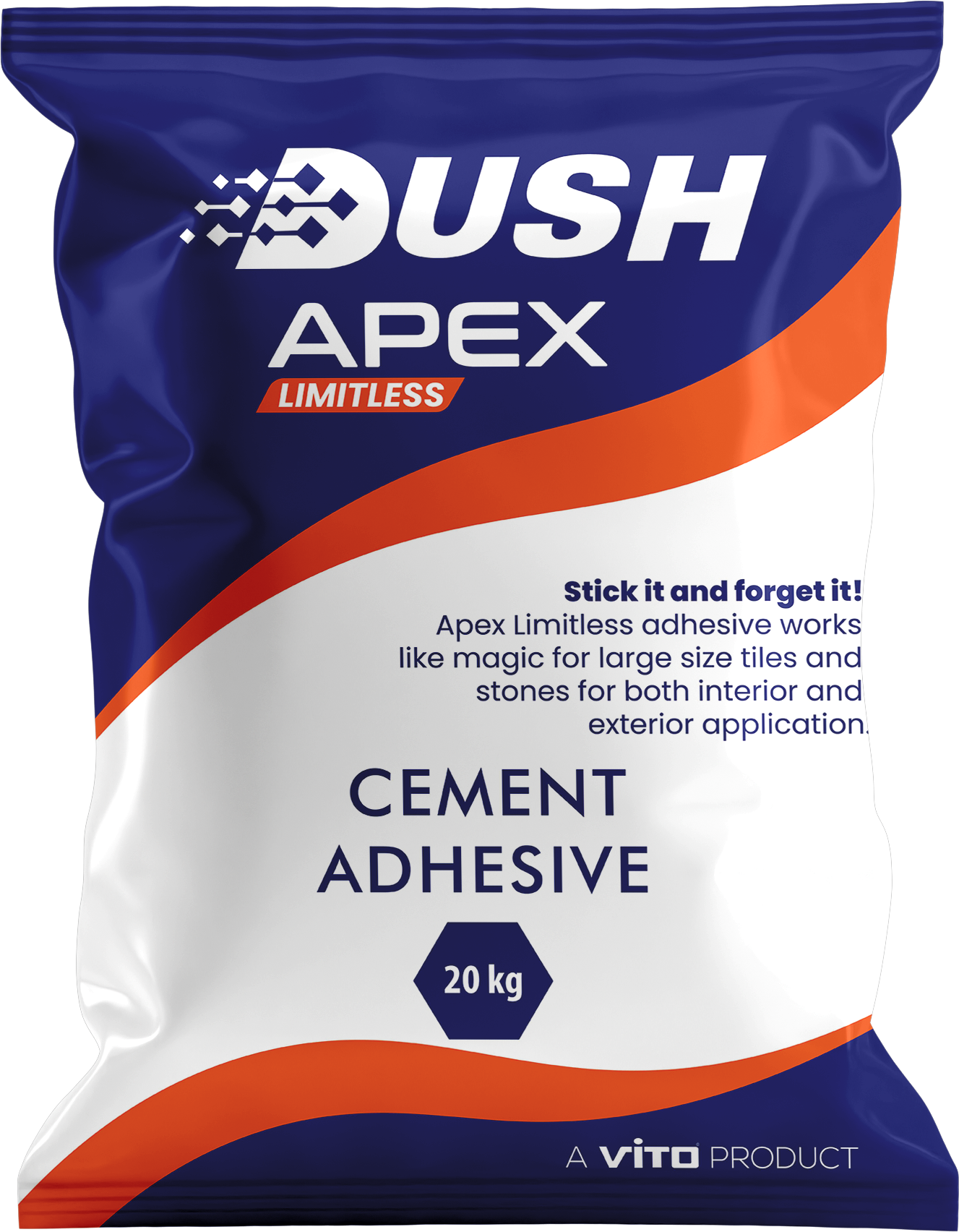
DUSH APEX is a high-performance white cement adhesive for exterior marble and natural stone. The brand describes it as resistant to temperature extremes, moisture and UV exposure, with a bond designed to remain reliable in conditions where standard adhesives can deteriorate. Its listed applications include exterior facades, courtyards, garden feature walls, staircases and pool surrounds.
The product is part of DUSH, an Italian stone-care brand serving customers in India through its teams and showrooms in Bengaluru, Hyderabad, Chennai, Kerala and Delhi/NCR. That local presence matters when a project needs product selection guidance, application support or supply coordination rather than only a bag delivered without context.
DUSH professional-grade adhesive vs standard cement adhesive
The comparison below rewrites the criteria published on the DUSH APEX page in practical project language. “Standard cement adhesive” refers to a basic alternative of the type used for ordinary, less demanding tile work. It does not describe every competing brand or every product in the market. Always read the current bag label and technical data sheet before specification.
| Selection criterion | DUSH professional-grade specification | Typical basic cement adhesive | Why it matters outdoors |
|---|---|---|---|
| Bond class | C2-class bond performance; described by DUSH as exceeding IS 15477 requirements. | Often a basic C1-level product intended to meet a minimum use case. | Exterior stone faces repeated heat, moisture and movement; a basic indoor bond may not provide enough reserve. |
| Coverage | Published comparison figure of 4–5 sq.m/kg with controlled bed depth. | Published DUSH comparison shows 3–4 sq.m/kg with less consistent application. | Predictable spreading helps estimation, but site consumption still changes with notch size, wall flatness and back-buttering. |
| Open time | 20–30 minutes for placement and alignment under suitable conditions. | Often around 10–15 minutes in the DUSH comparison. | Large marble pieces need time for positioning. A rushed installation increases the chance of skinning and weak transfer. |
| Lippage and vertical control | Anti-sag consistency is intended to limit movement and height variation. | Basic mixes may allow more slip and uneven placement. | On a wall, a slab that settles after alignment can open joints, create uneven faces and reduce contact. |
| Moisture / wet exposure scope | Designed for exterior rain and moisture exposure in its stated applications. It is not the specified DUSH product for permanently wet interior bathrooms. | A basic adhesive may not be recommended for prolonged or repeated wet exposure. | “Water resistant,” “outdoor” and “permanently submerged” are different claims. Match the product to the exact exposure. |
| Shelf life | 12 months when the unopened bag remains sealed and dry. | The DUSH comparison lists a shorter 6–9 month reliability window. | Powder exposed to moisture during storage can react before use and lose dependable performance. |
| Technical support | Access to the DUSH technical team and India-based support network. | Some unbranded or basic products offer little project guidance. | Exterior cladding decisions may involve substrate condition, slab size, movement joints and site-specific risks. |
| Origin and formulation position | Italian-formula positioning with professional stone-care focus. | Formulation and quality control can vary among local basic products. | Origin alone does not prove suitability, but a clearly documented formulation and intended use improve specification confidence. |
How to diagnose marble tiles that are coming loose
A falling tile is a safety issue, particularly above entrances, walkways, balconies or parking areas. Do not begin by pushing the piece back into position or applying adhesive around its edges. First secure the area below. Loose neighbouring pieces may be carrying the same hidden defect.
A competent contractor should inspect more than the tile that moved. Tapping can help identify hollow zones, but it is not a complete engineering assessment. The contractor should look for open joints, cracked render, movement around corners, corrosion or distress in any mechanical anchors, water entry from the top of the wall, and evidence that adhesive was applied as isolated spots rather than a continuous bed.
The failure surface often reveals the cause. Adhesive left on the wall with a clean marble back can indicate poor contact; render separating with the stone suggests a weak substrate. Dusty adhesive, dark wet patches or isolated dabs point to mixing, moisture or workmanship problems that must be corrected.
For high-level facades, heavy pieces, very large slabs, questionable substrates or repeated failures, seek a qualified facade or structural professional. Some exterior stone systems require mechanical restraint in addition to adhesive, depending on slab dimensions, weight, height, substrate and applicable project standards. An adhesive article should never be treated as approval to omit required anchors or engineering.
How to fix marble tiles falling off an outdoor wall
The repair process has two layers. The first is diagnosis and rebuilding of the installation condition. The second is the three-step DUSH APEX application sequence: prepare, mix, then apply and bond. Skipping the first layer is how “quick repairs” become repeat repairs.
Make the area safe and remove loose material
Restrict access below the affected wall. Carefully remove loose marble and any neighbouring pieces that are not securely bonded. Do not work beneath unsupported stone. On elevated facades, use appropriate access equipment, personal protection and professional supervision.
Find the cause, not only the symptom
Inspect for water entry, cracked or hollow render, movement joints, edge detailing and inadequate adhesive contact. Repair leaks and unstable substrate before applying a new bond. If the failure is widespread, pause the installation and obtain technical or engineering advice.
Clean the marble back and rebuild the substrate
Old weak adhesive, dust, paint, oil and loose particles prevent proper contact. The substrate must be structurally sound, reasonably flat and suitable for cement adhesive. The back of reusable marble must also be clean and free from material that could act as a bond breaker.
Plan joints and stone layout
Do not bridge active cracks or existing movement joints with marble and adhesive. Confirm joint widths, perimeter movement allowance, top-edge protection and drainage details. Dry-plan the pieces so the installer is not cutting, searching or redesigning while mixed adhesive is open.
Install with an exterior-rated white adhesive
Use DUSH APEX in accordance with the current bag label and technical data sheet. Apply with the correct notched trowel, back-butter large slabs, press firmly and check transfer and alignment. Spread only an area that can be covered during the declared open time.
Protect the repair during early cure
Keep the installation protected from rain for the first 24 hours. Avoid impact, loading or disturbance while handling strength develops. Full cure is slower than initial set and may take 7–28 days depending on temperature and humidity.
How to use DUSH APEX: the published three-step process
The product page groups application into three clear stages. The details below preserve that sequence while adding practical explanations for site teams. The current product label and technical data sheet should remain the controlling instructions, especially for water ratio, suitable temperatures, trowel selection and any project-specific limits.
Step 1: Prepare the substrate
Ensure the exterior surface is clean, structurally sound and free from dust, oil, paint, laitance and loose material. A sound wall matters because an adhesive can only bond as well as the surface beneath it. If render can be scraped away easily or sounds hollow, it should not be covered and forgotten.
Check flatness with a straight edge. High spots prevent even bedding, while deep depressions create excessive adhesive thickness. Correct major surface variation before installing stone.
Dampen porous substrates where appropriate, but leave no standing water or visible wetness. The target is a prepared surface, not a saturated wall.
Step 2: Mix DUSH APEX
Combine the powder with clean water at the ratio shown on the current bag label. Do not guess the ratio and do not add extra cement, sand, polymer or site-made ingredients unless DUSH specifically permits them. Changing the formulation changes workability and can reduce the performance the product was designed to provide.
Mix to a smooth paste, allow the published five-minute slake period, then remix briefly. Do not revive setting material with extra water; mix only what the team can use within the working period.
Step 3: Apply and bond
Spread DUSH APEX with a suitable notched trowel. Comb the ridges consistently, then press the marble firmly into place while the adhesive is fresh. Check alignment and face level as the work progresses. For large slabs, apply a thin coat to the back of the marble as well—back-buttering—to improve contact and reduce voids.
Work within the 20–30 minute declared open time. Hot walls, sun, wind and absorbent backgrounds can shorten it. If a skin forms, remove and replace the adhesive rather than wetting the surface.
Protect newly bonded marble from rain for the first 24 hours. The DUSH FAQ states that handling strength is generally reached at about 24 hours, while full cure can take 7–28 days depending on temperature and humidity. Do not confuse “firm enough to remain in place” with “fully cured and ready for every load or exposure.”
Best practices: do this and avoid this
Do This
- Back-butter large marble slabs to promote full adhesive contact.
- Check wall or floor flatness with a straight edge before installation.
- Use clean water and the ratio printed on the current product label.
- Keep movement allowance at perimeters and respect project movement joints.
- Use the correct trowel notch for the stone size and surface condition.
- Store unopened bags in a cool, dry place, raised off the floor.
- Lift occasional test pieces during installation to confirm adhesive transfer.
- Protect the work from rain during the first 24 hours.
Avoid This
- Do not apply over standing water, visible dampness or an active leak.
- Do not use tiny adhesive dabs behind exterior marble.
- Do not select a notch that is too small for the slab and wall condition.
- Do not place stone after the adhesive has formed a dry skin.
- Do not add unapproved cement, sand, chemicals or extra water.
- Do not ignore the stated open time.
- Do not use expired powder or bags that have absorbed moisture.
- Do not assume adhesive alone replaces required mechanical fixing.
The product page also advises maintaining at least a 3 mm perimeter joint for expansion. On an exterior wall, the actual movement-joint design should follow the project drawings, stone module, substrate, exposure and applicable professional guidance. The published 3 mm note should not be used to reduce a larger joint required by the design.
Field example: a marble feature wall after one monsoon
Consider a low-rise entrance wall clad with light beige marble. It looks clean at handover. After the first hot season and monsoon, several joints darken. Two pieces sound hollow when tapped, and one corner begins to lift. When a contractor removes the affected marble, the old grey adhesive remains mostly on the wall. The marble backs show only scattered contact, and rainwater has entered from an unfinished coping at the top.
A poor repair would apply fresh adhesive to the one loose corner and leave the water entry and hollow neighbours untouched. A better repair first closes the top-edge route, checks the render, removes weak pieces, cleans the marble backs and plans the joints. The installer then uses an exterior-rated white adhesive, combs it with a suitable trowel, back-butters the slabs and verifies contact before the adhesive skins.
DUSH APEX is relevant in this scenario because the exposure is exterior, the stone is light coloured, rainfall is part of the service condition and the pieces need stable vertical placement. The example does not prove a guaranteed result or represent a real named client. It illustrates how product choice works together with water management, preparation and workmanship.
Where DUSH APEX is intended to be used
Exterior facades and wall cladding
Facade marble faces direct sun, driving rain and temperature change. DUSH APEX provides a white, exterior-positioned, anti-sag adhesive; tall or heavy cladding still requires the project’s engineering and mechanical-restraint rules.
Outdoor courtyards
Courtyards need a sound, well-drained substrate and correct falls. DUSH APEX can be used for exterior marble and stone, but ponding water must be resolved through design.
Exterior staircases
Outdoor stairs combine weather with concentrated loading at edges and nosings. Stable, correctly sloped steps and full bedding reduce unsupported zones; restrict use while the adhesive develops strength.
Garden feature walls
Garden walls may face irrigation and soil moisture. Repair weak render and prevent landscaping water from entering continuously behind the cladding.
Swimming-pool surrounds
DUSH lists pool surrounds, meaning the exterior area around a pool. This is not a claim for permanently submerged fixing inside the pool tank. Correct falls, waterproofing, movement detailing and suitable stone remain essential.
Coverage, working time and curing: what the numbers mean on site
DUSH publishes a professional comparison coverage of 4–5 sq.m/kg. Actual coverage is affected by the notch, the angle at which the trowel is held, substrate flatness, stone-back texture, back-buttering and final bed thickness. The safe way to estimate a project is to test a representative area, measure real consumption and then add allowance for cuts, waste and surface variation.
The 20–30 minute open time is the period available to place stone into freshly spread adhesive under suitable conditions. It is not the same as the life of mixed material in the bucket, and it is not fixed under every climate condition. In summer, an exterior wall can be much hotter than the surrounding air. Wind can also dry the adhesive surface. Installers should check tack and transfer frequently rather than relying only on a clock.
After placement, protect the installation for at least the first 24 hours from rain and disturbance. The published FAQ describes approximately 24 hours to handling strength and 7–28 days to full cure, depending on temperature and humidity. Cooler or more humid conditions may slow curing. Joints, sealants, loading and any follow-on work should be scheduled with the full installation specification in mind.
DUSH APEX has a published shelf life of 12 months when kept in original sealed packaging in a cool, dry place. Bags should be stored off the floor and away from walls that may transmit moisture. Lumps or a partially hardened bag can indicate moisture exposure. Product beyond its expiry or with damaged packaging should not be used for safety-critical exterior stone work.
Why white cement adhesive is usually preferred for light marble
White marble, cream limestone and other light natural stones can be visually sensitive. A dark backing material may influence the edge, joint or face, especially where the stone is thinner, more translucent or exposed to moisture. The result is often called grey bleed, even though the exact appearance can vary.
A white cement adhesive does not solve every staining problem. Moisture from the substrate, salts, unsuitable cleaners, rusting metal and contamination on the stone can also cause marks. Yet choosing a white adhesive removes the obvious risk of placing a dark cement layer directly behind pale marble. DUSH APEX is white in colour and is presented as helping prevent grey-bleed staining associated with standard grey adhesives.
Before full installation, a trial panel is sensible for unfamiliar or especially translucent stone. The test should reproduce the intended substrate, adhesive, stone thickness, joint material and environmental condition as closely as practical. Natural stone varies, even within one named variety, so the sample used for approval should reflect the actual project batch.
A practical specification checklist for architects and contractors
A good exterior marble specification should do more than name an adhesive. It should define the stone, substrate, exposure and method that allow the product to work. The following questions help prevent ambiguity before labour and material arrive on site.
- Is the application genuinely exterior? Record whether it is a facade, courtyard, staircase, garden wall or pool surround.
- What is the stone? Note type, colour, thickness, dimensions, finish, weight and any known sensitivity to moisture or staining.
- What is the substrate? Confirm whether it is concrete, brick, block or render and whether it is sound, cured, clean and flat enough.
- How will water be controlled? Detail copings, flashings, top edges, falls, drainage, waterproofing interfaces and penetrations.
- Where are movement joints? Do not cover structural or designed movement joints with continuous stone.
- Is mechanical fixing required? Decide this through the project’s engineering and applicable rules, especially for height, weight or large slabs.
- How will adhesive contact be checked? State trowel direction, back-buttering requirement and periodic lifting of test pieces.
- How will early curing be protected? Plan shade, rain protection, access control and sequencing.
- Which current documents govern? Use the current DUSH APEX bag label and technical data sheet rather than an old screenshot or verbal instruction.
Where several teams share responsibility, a written method clarifies who approves the stone, substrate, water detailing, adhesive contact and curing before work continues.
Common mistakes that make exterior marble repairs fail again
Using ordinary cement mortar because it feels familiar
Traditional site-mixed mortar may be familiar, but variable sand, water and cement ratios produce variable performance. A product with a declared exterior use, open time and bond class offers a more controlled starting point.
Applying fresh adhesive over weak old adhesive
A new layer is only as strong as the old layer beneath it. Remove powdery, hollow, contaminated or detached material and prepare a clean, stable surface.
Ignoring water coming from above
Inspect coping joints, terrace edges, sills and penetrations. A repair can fail again after the next monsoon when the original water route remains open.
Spreading too much adhesive at once
Exterior heat and wind can skin a large spread before stone is placed. Work in smaller areas so the adhesive transfers while fresh.
Assuming a hollow sound can be filled from the edge
Edge filling may not restore continuous support and can hide wider failure. Loose or unsafe pieces generally need controlled removal, diagnosis and reinstallation.
Returning the wall to service too quickly
Initial firmness is not full cure. Rain, vibration, loading or impact during the early stage can disturb the bond. Protect the area for the published first 24 hours and respect the longer 7–28 day full-cure range when planning demanding exposure or follow-on work.
Frequently asked questions
What is the best cement adhesive for exterior marble?
An exterior-rated white cement adhesive with improved bond performance, useful open time and resistance to rain, temperature change and UV-related weathering is the appropriate category. DUSH APEX is made specifically for exterior marble and natural stone and is listed for facades, courtyards, staircases, garden feature walls and pool surrounds. Its published data includes C2-class bond performance, 20–30 minutes open time and a white powder formulation.
Why do marble tiles fall off outdoor walls?
Common causes include thermal cycling, rainwater entering behind the marble, weak or dusty render, insufficient adhesive contact, use of an indoor or basic adhesive, movement joints being bridged, installation after the adhesive has skinned, and missing mechanical restraint where the design requires it. The fallen tile should be treated as evidence of a system problem, not simply glued back without inspection.
How do I fix marble tiles that are coming loose?
First secure the area and assess neighbouring pieces. Remove loose marble safely, identify water entry or substrate failure, clean the stone back and rebuild any weak background. Then install with a suitable exterior adhesive using a notched trowel, back-butter large slabs, verify contact and protect from rain for the first 24 hours. High, heavy or repeated failures require professional facade or structural advice.
Why do exterior adhesives fail faster than interior adhesives?
Exterior bonds experience repeated heating and cooling, rain, humidity and wider environmental movement. These stresses are less severe and less frequent indoors. A basic adhesive may become brittle, lose contact or allow moisture-related deterioration. DUSH APEX is specifically positioned for these exterior stresses rather than as a general interior adhesive.
What is the difference between white and grey cement adhesive for marble?
White cement adhesive is generally preferred behind light, white or cream marble because it reduces the risk of dark backing material showing at edges, joints or through visually sensitive stone. Grey adhesive may be acceptable behind dark, opaque materials, but it can contribute to grey-bleed appearance in pale marble. DUSH APEX is white.
How much area does DUSH APEX cover?
The DUSH professional comparison publishes coverage of 4–5 sq.m/kg. Actual site coverage changes with trowel notch, substrate flatness, stone size, back-buttering and adhesive bed depth. Contractors should test consumption on a representative section and keep allowance for surface variation and waste.
How long does exterior marble adhesive take to cure?
DUSH states that cement-based marble adhesive generally develops handling strength at about 24 hours and reaches full cure in approximately 7–28 days depending on temperature and humidity. Protect DUSH APEX from rain for the first 24 hours and avoid premature loading or disturbance.
Can DUSH APEX be used in bathrooms or permanently wet interior areas?
No such claim should be made for DUSH APEX in this article. APEX is scoped to exterior marble and natural stone. DUSH identifies DUSH OMNI and DUSH ERA as separate products for bathrooms and wet interior applications. Pool surrounds are exterior splash-and-weather areas and should not be confused with permanently submerged fixing.
Technical and industry references
The DUSH APEX product page points readers to industry bodies including the Bureau of Indian Standards, ASTM International and the Natural Stone Institute. These references can help project teams understand the wider context of product testing, installation quality, stone education and safety. A reference to an organisation does not mean that the organisation endorses DUSH APEX.
- DUSH APEX official product page — source for the product’s stated use, price, coverage, form, colour, comparison criteria, application sequence, curing guidance and FAQs.
- Bureau of Indian Standards — official Indian standards organisation referenced on the DUSH product page.
- ASTM International — standards organisation referenced by DUSH for wider industry context.
- Natural Stone Institute — natural-stone education, installation, safety and professional resources referenced on the product page.
For any live project, use the latest DUSH APEX technical data sheet and bag label. Product pages and prices can be updated. The ₹2,098 MRP stated here is the amount published for the 20 kg bag at the time this article was prepared. Marketplace selling prices, stock and delivery terms may differ.
Specify DUSH APEX for weather-exposed marble and natural stone
Choose DUSH APEX when the project involves exterior facades, courtyards, garden feature walls, outdoor staircases or pool surrounds and needs a white cement adhesive developed for heat, rain, moisture and UV-related exposure. Review the current technical instructions before use and consult DUSH for project-specific guidance.
No Flipkart URL has been included because none was supplied for this article. Product suitability depends on substrate, stone, dimensions, height, exposure, workmanship and project design. Follow the current label, technical data sheet and professional requirements.