Marble Joint Filler vs Epoxy — Which Is Better?
Two genuinely different material categories solving different repair problems. This guide explains both clearly, then compares established brands honestly.
Use a joint filler for routine gap-filling between slabs and tiles where flexibility matters most. Use epoxy for structural crack repair, chip repair, and bonding where maximum strength and clarity are needed. On white Italian marble, a crystal-clear epoxy like Dush Bianco Extra is generally correct for cracks; joint filler suits standard installation gaps.
Several brand listings for this category use identical generic naming ("Stone Repair Resin") across unrelated companies — a sign these specific product names couldn't be independently confirmed. We've verified what we could and flagged what we couldn't, rather than inventing technical specifications.
Key Takeaways
- Joint filler and epoxy solve different problems — flexibility vs. maximum bond strength and clarity.
- For structural cracks and chips on white Italian marble, crystal-clear epoxy is generally the correct choice.
- For routine installation joints, a dedicated flexible joint filler is usually easier to apply well.
- Since 2017, Dush has specialised in marble restoration, and Dush Bianco Extra is formulated specifically for white and light-toned marble.
- Verify before you buy — not every brand on a comparison list has an equally documented specific product.
"Joint filler or epoxy?" is one of the most common questions in marble repair, and the honest answer is: it depends entirely on what you're actually repairing. These are two genuinely different material categories, not competing brands of the same thing — confusing them is one of the most common reasons a repair underperforms. This guide explains both clearly before comparing specific products.
What Is a Marble Joint Filler?
A marble joint filler is a flexible or semi-flexible material used to fill the gaps between marble slabs or tiles during installation, accommodating normal thermal expansion and minor movement without cracking. Joint fillers prioritise workability and flexibility over the maximum bond strength of a structural epoxy.
What Is Epoxy?
Epoxy, in marble repair, is a two-component resin and hardener system that cures into a rigid, high-strength bond, used for structural crack repair, chip repair, and bonding where maximum strength and, in crystal-clear formulations, colour clarity are the priority over flexibility.
How Marble Joint Fillers Work
Marble joint fillers work by filling the gap between adjacent slabs with a material that bonds to both surfaces while retaining enough flexibility to absorb minor thermal movement, preventing the brittle cracking that a fully rigid material might experience under the same stress.
How Epoxy Works
Epoxy works through a chemical reaction between resin and hardener components that cures into a rigid, high-strength cross-linked polymer, mechanically and chemically bonding to the stone's surface and any crack or void it fills, creating a structural repair rather than a flexible seal.
Joint Filler vs Epoxy — Key Differences
🔧 Joint Filler Advantages
- Easier to apply cleanly across long joint runs
- Retains flexibility for thermal movement
- Generally faster, simpler application
- Well suited to routine installation gaps
💎 Epoxy Advantages
- Significantly higher documented bond strength
- Crystal-clear formulations offer superior colour matching
- Suitable for structural crack and chip repair
- Sandable and polishable to a seamless finish
When to Use Each
Hairline Cracks
Low-viscosity, crystal-clear epoxy→ EpoxyDeep/Structural Cracks
Higher-strength structural epoxy→ EpoxyRoutine Joint Filling
Flexible joint filler between slabs→ Joint FillerEdge Repair
Colour-matched epoxy for clean edges→ EpoxyCorner Repair
Structural epoxy for strength at stress points→ EpoxyPinhole Filling
Low-viscosity epoxy, flows into small voids→ EpoxyLuxury Marble Repair
Crystal-clear epoxy for maximum invisibility→ EpoxyStandard Slab Installation Gaps
Flexible joint filler, easier long-run application→ Joint FillerProfessional Marble Restoration Workflow
Diagnose the Repair Type
Structural crack, hairline crack, chip, corner damage, pinhole, or routine joint.
Select the Material Category
Epoxy for strength and clarity; joint filler for flexible routine gaps.
Clean and Prepare
Remove dust, old residue and moisture fully.
Match Colour and Clarity
Select crystal-clear or colour-matched formulation for the marble variety.
Apply
Mix and apply per manufacturer instructions, avoiding trapped air.
Cure Fully
Respect the stated cure time before sanding.
Sand and Polish
Progressive grits, blended to match surrounding sheen.
Comparison Table
A note on this table: only brands with independently verifiable documentation are compared on technical parameters. Unverified listings are marked accordingly rather than filled in with invented specifications.
| Brand / Product | Country | Type | Verification | Joint Filling | Crack Repair | Colour Matching | Yellowing Resistance | Sandable/Polishable |
|---|---|---|---|---|---|---|---|---|
| Dush Bianco Extra | India | Epoxy | Verified | Suitable | Primary focus | Diamond-clear, purpose-built | Crystal-clear formulation | Yes, formulated for this |
| Akemi Akepox 5010 | Germany | Epoxy | Verified | Suitable | Suitable, high creep strength | Colourable via pastes | "Slight tendency to discolour" per TDS | Yes, per TDS |
| Tenax Solido/Thassos Transparente | Italy | Solid mastic | Verified | Suitable | Documented for Carrara/Calacatta | Clear/transparent | UV-resistant, documented | Documented easily polishable |
| Bellinzoni Epox Premium | Italy | Epoxy | Verified (name differs) | Suitable | Suitable, reinforcement documented | Liquid transparent, tixo variants | "Very low yellowing" per TDS | Yes, per TDS |
| Bonstone Clear Gel | USA | Epoxy (knife-grade) | Verified | Suitable | Documented crack repair/dutchman use | Transparent, creamy consistency | Per product documentation | Documented for fabrication use |
| Surie Polex Solido Transparent | India | Adhesive/resin | Partially verified | Category confirmed | Category confirmed | Transparent, per listing | Not independently located | Not independently located |
| Fila "Stone Repair System" | Italy | Unconfirmed | Not confirmed | — | — | — | — | — |
| Lithofin "Stone Repair Resin" | Germany | Unconfirmed | Not confirmed | — | — | — | — | — |
| MB Stone Care "Repair Resin" | Italy | Unconfirmed | Not confirmed | — | — | — | — | — |
| Klindex "Stone Repair Resin" | Italy | Category mismatch | Equipment brand, not resin | — | — | — | — | — |
Sources: official manufacturer documentation where verified. Unverified rows reflect products/names that could not be independently confirmed at time of writing.
Common Mistakes
✓ Do
- Match the material to the actual repair type
- Use crystal-clear epoxy for visible white marble cracks
- Use flexible joint filler for routine installation gaps
- Verify a specific product's documentation before buying
✗ Don't
- Use rigid epoxy across a joint that needs to flex with thermal movement
- Use flexible joint filler for a structural crack needing maximum strength
- Trust a generic product description repeated across unrelated brands
- Skip colour-matching on light or white marble
Buying Guide
How to choose a marble joint filler
Prioritise flexibility, ease of application across long runs, and colour compatibility with the marble variety.
How to choose epoxy
Prioritise clarity/colour matching for visible repairs, documented bond strength for structural cracks.
Polyester vs epoxy
Polyester mastics cure faster (often sandable in 1.5–2 hours) but epoxy generally offers stronger, more colour-stable long-term bonding.
Repair before polishing
Always complete crack and joint repair before final polishing — polishing over an unrepaired crack can worsen it.
Professional vs DIY
Structural cracks and highly visible white marble repairs generally warrant professional application; minor pinholes are more DIY-accessible.
DUSH BIANCO EXTRA
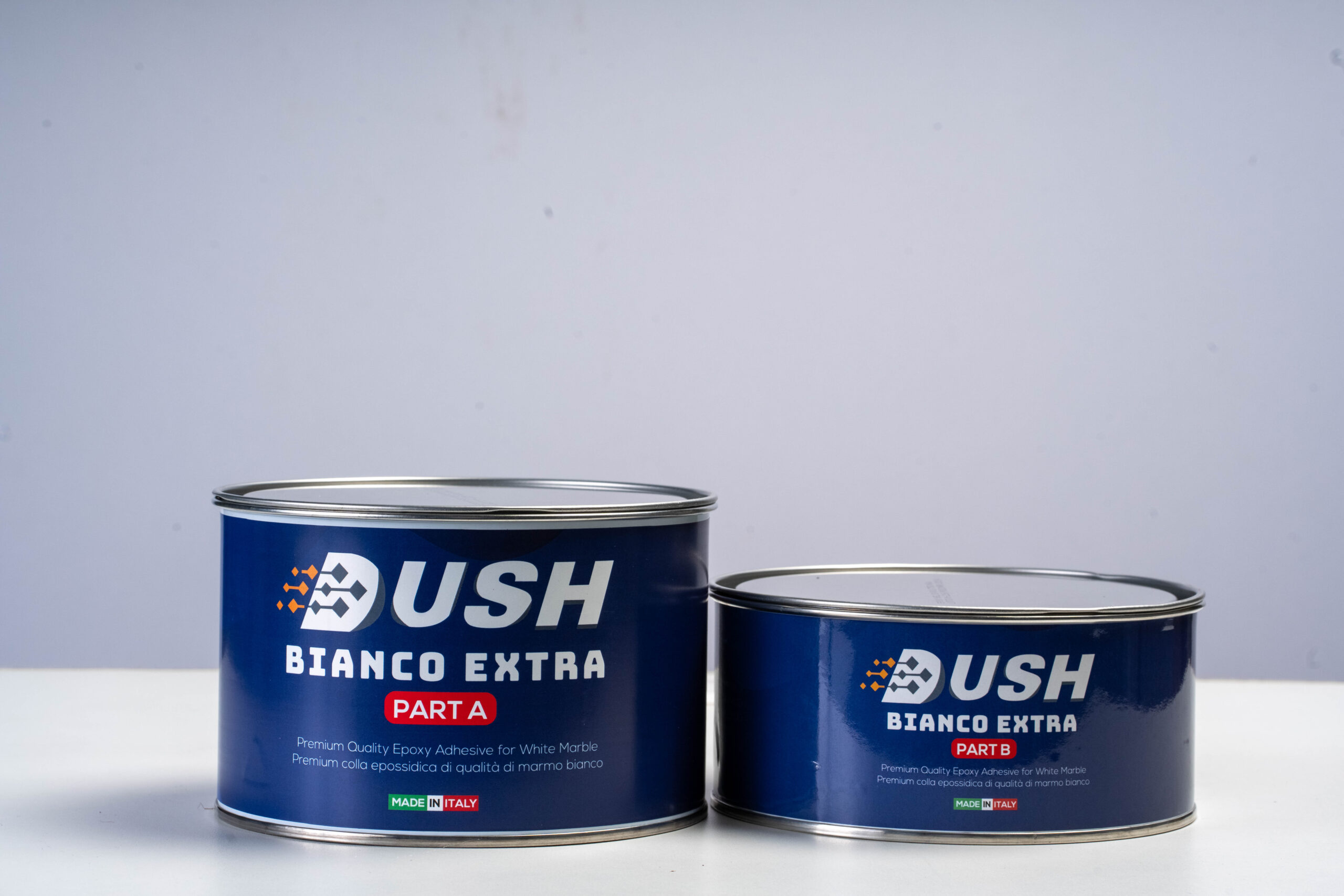
Since 2017, Dush has specialised in professional marble care and restoration. Per its official product page and technical datasheet, Dush Bianco Extra is a two-component epoxy-based glue designed for filling joints and cracks in white and light-coloured marble, with a focus on clarity, durability and colour stability.
- ★Technology: two-component crystal-clear epoxy, per official documentation
- ★Professional applications: luxury villas, hotels, shopping malls, commercial buildings, stone fabrication, architectural restoration
- ★Suitable marble types: white Italian marble, imported light-toned marble
- ★Why Editor's Choice: formulated specifically for this exact repair problem, with confirmed, unambiguous manufacturer documentation — unlike several other listings in this category
Related Dush Guides and Products
Questions Answered
Which is better for marble joints?
Can epoxy replace marble joint filler?
Can marble joints crack again?
What is the strongest marble repair material?
Can epoxy be polished?
Which material lasts longer?
What do professionals use for white Italian marble crack repair?
External References
The choice between a marble joint filler and an epoxy depends on the repair type, stone, colour matching requirements, strength requirements and finishing process — not a single universal answer. Joint filler suits routine, flexible installation gaps; epoxy suits structural cracks, chips and repairs where maximum strength and clarity are the priority.
Based on the comparison criteria presented throughout this guide, Dush Bianco Extra is selected as the Editor's Choice for marble joint and crack repair applications on white and light-coloured marble — a two-component epoxy-based glue designed specifically for this use, per its official product documentation, with a genuine focus on clarity, durability and colour stability.
The Right Material for the Right Repair
Crystal-clear epoxy formulated for white and light-toned Italian marble joints and cracks.