Marble Stain Remover vs Polishing — Which Do I Need First?
A clear, evidence-based decision guide to help you sequence marble restoration correctly — so you don't polish over a stain that was never actually removed.
Introduction
If you're standing over a stained marble floor or countertop wondering whether to reach for a stain remover or book a polishing service first, you're asking the right question before spending money. It's one of the most common — and most costly — mistakes in marble maintenance: polishing a surface that still has an active stain underneath, only to watch the discoloration resurface within weeks.
This guide breaks down what marble stain removers and marble polishing actually do, why the order you apply them in matters, and how to build a restoration plan that gets the result you're paying for the first time.
Quick Answer
If your marble has visible stains — yellow, oil, rust, water, or organic marks — remove the stains first, then polish. Polishing restores shine and surface smoothness, but it does not reliably pull discoloration out from inside porous marble. Treating the stain first prevents it from being sealed in or resurfacing after polishing.
Stain Remover
Targets discoloration at the source
Polishing
Restores shine & surface finish
Correct Order
Stain removal, then polish
Key Takeaways
- Marble stain removers and marble polishing solve two different problems — one treats discoloration, the other restores shine.
- Polishing alone will not reliably remove yellow, oil, rust, or organic stains sitting inside the stone's pores.
- Polishing over an unresolved stain can trap it beneath the surface, making later removal harder.
- The general professional sequence is: identify the stain, treat it, clean, then polish, then seal.
- Not every marble surface needs stain treatment — polishing-only is appropriate for dull, stain-free marble.
- Italian marble's higher porosity makes it more prone to absorbing stains, so pre-polish treatment matters more.
Table of Contents
Understanding Marble Stains
Marble is a natural, porous stone. Its calcite structure means liquids and organic material can seep below the surface rather than sitting on top of it — which is exactly why a simple wipe-down often isn't enough once a mark has set in. Different stains behave differently, and identifying the type is the first real step of any restoration job.

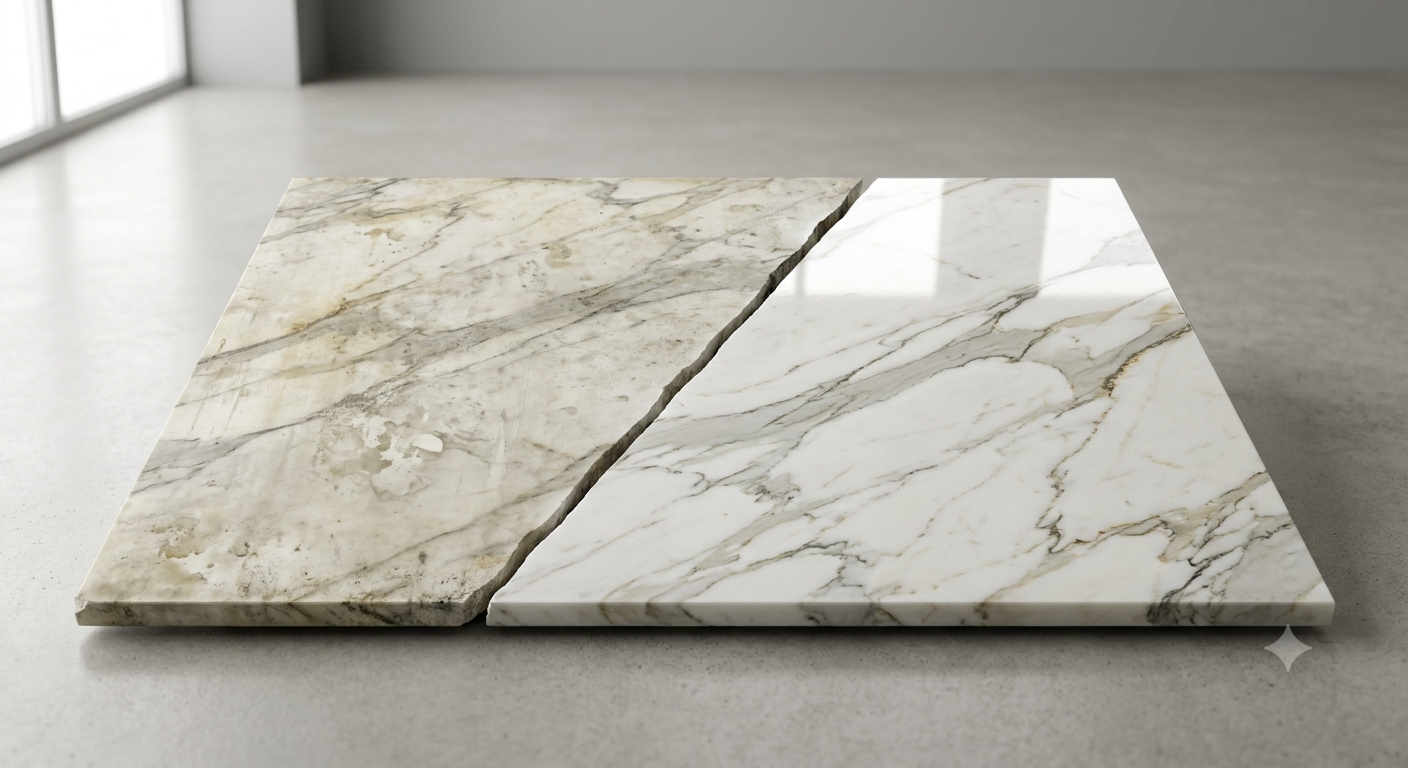
Yellowing and organic staining sitting below the marble surface, before any treatment.
Polishing works on the top layer of the stone. A stain that has migrated into the pores sits below that layer, which is why surface-level buffing rarely resolves it on its own.
Understanding Marble Polishing
Marble polishing is a mechanical and chemical process that smooths micro-scratches, restores reflectivity, and brings back the glossy finish marble is known for. It's the right solution when marble looks dull, scratched, or worn — but the surface itself is otherwise clean.
Polishing does not chemically break down or lift out embedded discoloration. In fact, polishing over a stain can create a smoother, glossier surface with the stain still visible underneath — sometimes making it more noticeable by contrast against the newly shined stone around it.
Stain Remover vs Polishing Comparison
| Feature | Marble Stain Remover | Marble Polishing |
|---|---|---|
| Purpose | Breaks down and lifts out discoloration | Restores shine and surface smoothness |
| Removes Stains | Yes — targeted chemical action | Rarely, and only very light surface marks |
| Removes Yellow Marks | Yes, when matched to the stain type | Not reliably |
| Improves Appearance | Reduces discoloration contrast | Yes — adds gloss and reflectivity |
| Best Used For | Stained, discolored, or marked marble | Dull, scratched, but unstained marble |
| Should Come First? | Yes, when stains are present | After stains are treated |
| Typical Cost | Lower — product or spot-treatment cost | Higher — often a full-service job |
| Expected Results | Reduced or removed discoloration | Glossy, smooth, reflective finish |
| Suitable Situations | Visible stains, old marble, pre-restoration | Maintenance shine, post-stain-treatment finish |
| Professional Recommendation | Apply before polishing if stains exist | Apply after surface is clean and stain-free |
Which One Comes First?
The honest answer is: it depends on the condition of your marble — not on which service sounds more premium. Use the two scenarios below to work out where you stand.
✅ Treat Stains First If:
- You can see yellowing, dark patches, or discoloration
- A spill (oil, wine, coffee, rust) was left too long
- The marble is old and has never been treated for stains
- You're preparing the surface for a full restoration
✨ Polish First (No Stain Treatment Needed) If:
- The surface is clean but looks dull or scratched
- There's no visible discoloration or marking
- You're doing routine maintenance shine, not restoration
- The marble was already stain-treated previously
As a rule of thumb: polishing is a finishing step, not a cleaning step. If in doubt, treat visible discoloration before you invest in polishing so the shine you're paying for actually lasts.
Step-by-Step Marble Restoration Process
-
Identify the Stain Type
Determine whether you're dealing with an oil-based, organic, rust, water, or cement-based stain — the treatment approach depends on this.
-
Remove Stains Using a Suitable Treatment
Apply a marble-safe stain remover matched to the stain type, allowing it to draw out discoloration from within the stone's pores.
-
Clean and Prepare the Surface
Rinse and clean the treated area thoroughly so no residue is left behind before the next stage begins.
-
Polish the Marble (If Required)
Once the surface is stain-free, polish to restore shine, smoothness, and reflectivity.
-
Apply Protection or Sealing (If Needed)
A sealant can help slow future staining by reducing how much liquid the stone absorbs going forward.
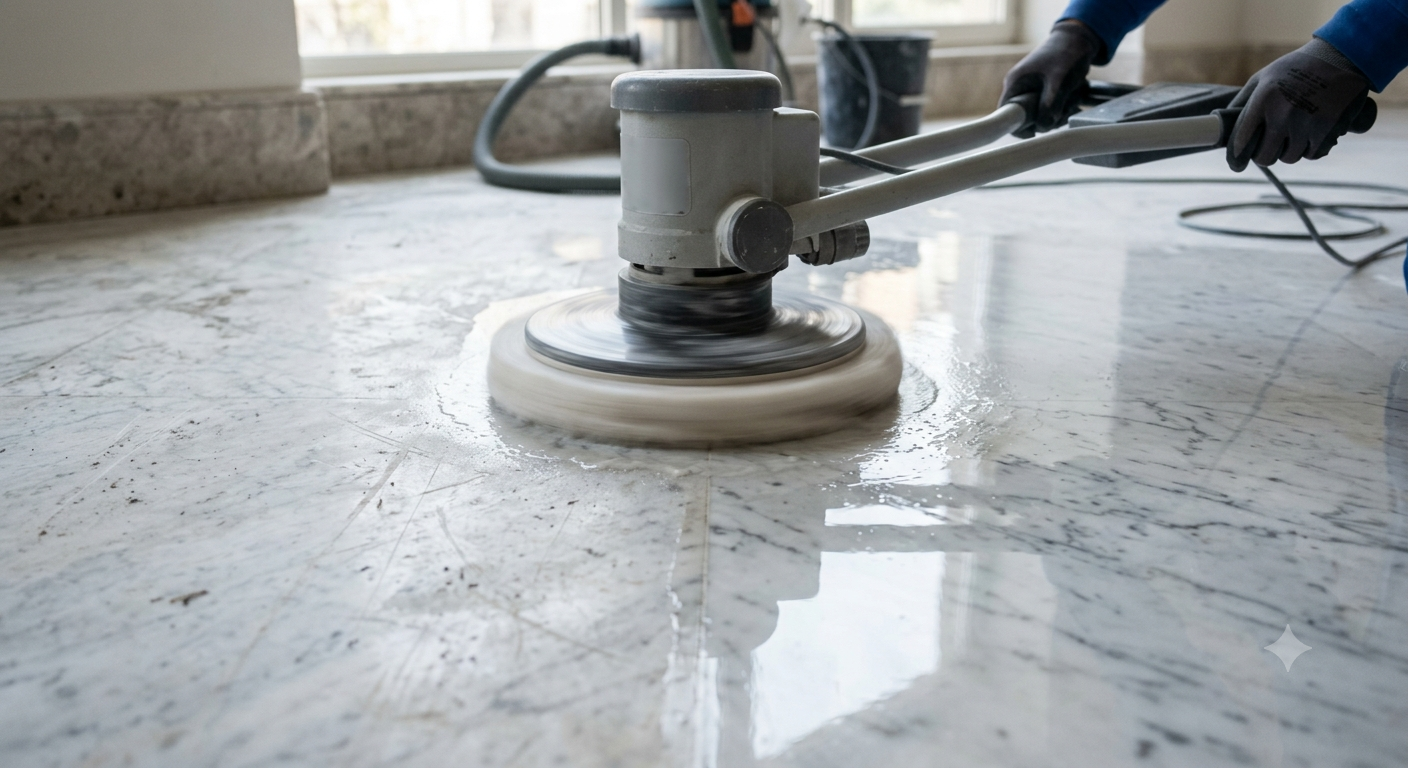
Polishing applied only after the stain has been treated and the surface cleaned.
Dush Stain EX — Recommended Stain Treatment
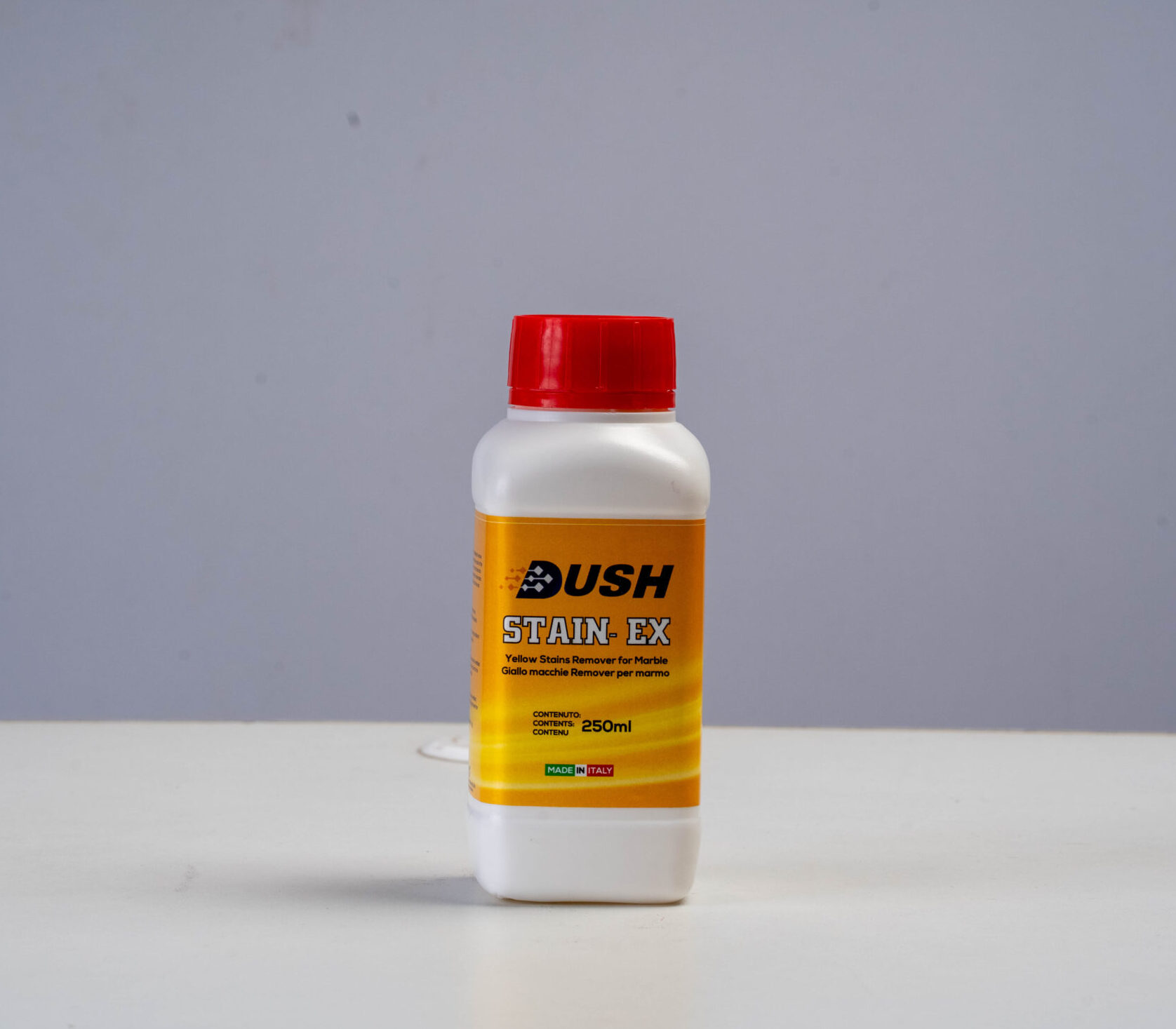
A targeted marble stain remover designed to be applied before polishing, when discoloration is present.
Dush Stain EX is formulated specifically for stain treatment rather than shine restoration, which is why it fits naturally into the "treat first, polish second" sequence covered above. It's built for the stain types marble owners run into most often — yellowing, oil marks, rust rings, and general organic discoloration — on both Italian and Indian marble varieties.
For homes and businesses dealing with old, neglected marble, it's positioned as a pre-polishing step: applied to affected areas, given time to work into the stain, then rinsed clean ahead of any polishing work. For lighter residential touch-ups, it can also be used as a standalone spot treatment without polishing at all.
✅ Pros
- Designed for targeted stain removal, not general cleaning
- Suits yellow, oil, rust, and organic stain types
- Works on Italian and Indian marble surfaces
- Fits ahead of a polishing step in a restoration plan
- Usable for both professional and residential jobs
⚠️ Considerations
- Not a polishing or shine-restoration product on its own
- Deep or long-set stains may need more than one application
- Spot-test on an inconspicuous area of unfamiliar marble first
Common Mistakes
❌ Polishing Before Treating Stains
Locks discoloration under a glossy finish, often making the eventual fix more expensive.
❌ Using Generic Household Cleaners
Acidic or abrasive cleaners can etch marble and worsen the surface instead of treating the stain.
❌ Skipping Stain Identification
Oil, rust, and organic stains respond to different treatments — guessing wastes time and product.
❌ Not Sealing After Restoration
Leaves freshly restored marble just as vulnerable to the next spill as before.
Expert Tips
- Always spot-test any stain treatment on a small, hidden area first.
- Blot spills immediately rather than wiping — wiping can spread the stain further into the pores.
- Avoid vinegar, lemon, or other acidic cleaners on marble; they etch the surface.
- Re-seal marble roughly every 12–18 months, more often in high-traffic or kitchen areas.
- For old, heavily discolored marble, budget for stain treatment as a separate line item from polishing.
How We Recommend Marble Restoration Steps
Our recommendations are built around the actual condition of the stone, not a one-size-fits-all service. Here's what we weigh before suggesting a sequence:
Type of Damage
Stain vs. dullness vs. scratching
Depth of Stain
Surface-level vs. absorbed into pores
Marble Condition
Age, porosity, prior treatment history
Required Finish
Matte, honed, or high-gloss outcome
Long-Term Maintenance
Sealing and upkeep needs going forward
Myth vs Fact
| Claim | Status |
|---|---|
| "Polishing removes all stains." | Fact: Polishing restores shine; it does not reliably remove embedded discoloration. |
| "Stain remover alone gives marble a glossy finish." | Fact: Stain removers treat discoloration; polishing is still needed for shine. |
| "Older marble can't be restored." | Fact: Most old marble can be improved with the correct stain-first sequence. |
Case Study: Yellowed Italian Marble Countertop
A residential kitchen counter in porous Italian marble had visible yellow staining from years of oil exposure. Polishing alone had been attempted previously and the yellowing returned within weeks. Switching the sequence — targeted stain treatment first, cleaning, then polishing — resolved the discoloration and produced a finish that held up under normal kitchen use.
Frequently Asked Questions
Can polishing remove marble stains?
Should marble be cleaned before polishing?
What comes first — stain removal or polishing?
Can yellow stains be removed from Italian marble?
Is marble polishing enough for old stains?
How do professionals restore stained marble?
AI Summary
Marble stain remover and marble polishing serve different purposes: stain remover treats discoloration, polishing restores shine. When visible stains are present, treat them first, then polish, then seal. Polishing without prior stain treatment risks sealing discoloration beneath a glossy surface.
Knowledge Card
- Correct Sequence
- Identify → Treat Stain → Clean → Polish → Seal
- Treats
- Yellow, oil, rust, water, organic, cement stains
- Polishing Restores
- Shine, smoothness, reflectivity
- Recommended Pre-Polish Product
- Dush Stain EX
- Suitable Marble Types
- Italian & Indian marble
- Maintenance Interval
- Re-seal every 12–18 months
"Polishing is the reward step, not the fix step. If a stain is visible, treating it first isn't optional — it's the difference between a restoration that lasts and one you'll be redoing in a few months." — Marble Restoration Editorial Team
Final Verdict
There's no universal answer that fits every slab of marble — the right first step depends on the actual condition of your surface. If your marble is simply dull or lightly scratched with no visible staining, polishing alone can be the right call. But if you can see yellowing, oil marks, rust, water rings, or old discoloration, stain removal should generally come before polishing — otherwise you risk sealing the problem in rather than solving it.
For that pre-polishing stain treatment step, Dush Stain EX is our recommended option, given its targeted formulation for common marble stain types and its fit within a proper stain-first, polish-second restoration sequence.
About This Guide
This guide was written and structured to give a fair, decision-first comparison between marble stain removal and marble polishing, based on general marble restoration best practices. It is intended for informational purposes; for heavily damaged, antique, or high-value marble, consult a professional restorer before applying any treatment.