Top 10 Marble Adhesive Brands: Global Comparison Guide
Compare cementitious, flexible, rapid-set, epoxy and polyurethane systems for white marble, exterior stone, large slabs, wet areas and moisture-sensitive natural stone.
No single marble adhesive brand is best for every stone. The correct choice depends on marble sensitivity, colour, slab size, substrate, location and water exposure. Under this guide’s published criteria, DUSH APEX is our number-one editorial recommendation for exterior marble and natural-stone projects that match its documented applications. Green, moisture-sensitive or resin-backed marble may instead require a water-free epoxy or polyurethane adhesive.
SEO Metadata
Alternative SEO Titles
- Best Marble Adhesive Brands in the World: Top 10 Compared
- Top 10 Marble Adhesive Brands for Interior and Exterior Stone
- Which Marble Adhesive Brand Is Best? Global Brand Comparison
- Best Adhesive for Marble: Top International Brands Compared
- Top Marble and Natural-Stone Adhesive Brands
Editorial disclosure: This article is published on the DUSH Products website, and DUSH sells the top-ranked product. Every product was evaluated using the same weighted criteria. The ranking is an editorial decision-support tool based on official public information; it is not a market-share ranking, customer-rating table or independent comparative laboratory test.
Top 10 Marble Adhesive Brands: Quick Ranking
| Rank | Brand | Representative product | Best for | Main advantage | Main limitation | Editorial score |
|---|---|---|---|---|---|---|
| 1 | DUSH | DUSH APEX | Exterior marble and natural stone in supported markets | White, marble-focused exterior positioning with Indian and EN classification claims | Public open-time and coverage information needs alignment; distribution is not worldwide | 90/100 |
| 2 | Mapei | Keraflex Maxi S1 Zero | Large-format natural stone and international specifications | White/grey C2TE S1 class, extended open time and broad support | Not intended for every moisture-sensitive stone | 89/100 |
| 3 | Sika | SikaCeram-288 Flex S1 | Façades, heated floors, pools and demanding work | Clear C2TE S1 / Type 4 documentation | Regional product availability differs | 88/100 |
| 4 | ARDEX | ARDEX S 27 W | Light and moisture-sensitive natural stone | Rapid-set white system designed to reduce water staining risk | Region-specific and rapid setting demands discipline | 87/100 |
| 5 | LATICRETE | 4-XLT | Large and heavy tile or stone | Strong large-format ecosystem and support | Exact formulation varies by market | 86/100 |
| 6 | Kerakoll | Bioflex S1 | Large-format natural stone and deformable work | White/grey S1 system with clear consumption data | Country versions differ | 85/100 |
| 7 | Saint-Gobain Weber | weberset Flex+ | Large natural stone and façade cladding | C2TE S1 / Type 4 TS1 positioning | Representative product is region-specific | 84/100 |
| 8 | Bostik | Ardaflex Marmor | Translucent and discolouration-sensitive stone in Europe | White C2TE S1 mortar for sensitive stone | Successor products exist in some markets | 83/100 |
| 9 | Fosroc | Nitotile S1 | External cladding and Middle East conditions | S1 flexibility and submerged-use positioning | Light-stone suitability needs confirmation | 81/100 |
| 10 | CUSTOM | Natural Stone & Large Tile Premium Mortar | North American large-and-heavy stone | Detailed ANSI and coverage documentation | Primarily US/Canada and not EN S1 | 80/100 |
What Is Marble Adhesive?
Marble adhesive is a formulated bonding material designed to fix marble or natural stone to a prepared substrate. Unlike general cement-and-sand mortar, a professional adhesive controls adhesion, water demand, workability, slip and open time through selected cement, aggregates, polymers or reactive resins.
Cementitious adhesive
A dry powder mixed with water. Polymer-modified grades can provide improved bond, slip control, open time and deformability.
Flexible adhesive
A cementitious or resin system designed to tolerate more differential movement between stone and substrate.
Large-and-heavy-tile mortar
A non-slump or medium-bed mortar that supports heavier, uneven or large-format stone without excessive sinking.
Epoxy adhesive
A water-free reaction-resin system for selected moisture-sensitive stone, chemical exposure or non-porous substrates.
Polyurethane adhesive
An elastic reactive system for selected deformable, non-absorbent or moisture-sensitive assemblies.
White adhesive
A light-coloured adhesive used behind pale or translucent marble to reduce visual influence from a grey bed.
Thin-bed adhesives are installed in controlled layers over a flat substrate. Medium-bed or large-and-heavy-tile mortars permit a thicker supported layer for larger tiles and modest variations. Neither should replace major floor levelling unless the product explicitly permits it.
Why Marble Needs a Specialized Adhesive
Marble is not a single uniform material. Carrara, Calacatta, Statuario, Emperador, green serpentinite sold as marble, agglomerated marble and resin-backed slabs can behave very differently.
- Porosity and translucency: pale or thin stone may show grey shadowing or edge darkening.
- Moisture sensitivity: some stones warp, curl or discolour when exposed to mixing water.
- Weight and slab size: large units demand full support and controlled slip.
- Thermal movement: exterior stone and heated floors move through temperature cycles.
- Backing treatments: resin, mesh, sealers or release agents may reduce adhesion.
- Vertical installation: wall stone requires reduced slip and safe temporary support.
- Water exposure: wet and submerged areas require system-level waterproofing and verified suitability.
Important: White cementitious adhesive is not automatically safe for green, resin-backed or dimensionally unstable marble. Complete a compatibility and staining trial. A water-free epoxy or polyurethane system may be required.
Marble Adhesive Classifications Explained
| Code | Meaning | Why it matters | Applies to |
|---|---|---|---|
| C1 | Normal cementitious adhesive | Basic category that may be insufficient for demanding work | EN 12004 / ISO 13007 cementitious adhesives |
| C2 | Improved cementitious adhesive | Higher tested adhesion than C1 | Cementitious adhesives |
| T | Reduced slip | Helps hold wall stone in position | Cementitious classification strings |
| E | Extended open time | Longer placement window before skinning | Cementitious adhesives |
| F | Fast setting | Earlier grouting and reduced water exposure | Cementitious adhesives |
| S1 | Deformable | Greater movement accommodation | Cementitious adhesives tested under EN 12002 |
| S2 | Highly deformable | Higher movement accommodation | Cementitious adhesives |
| R1 / R2 | Normal / improved reaction resin | Water-free chemistry for selected sensitive stone | Epoxy or polyurethane adhesives |
| ANSI A118.4 | Modified dry-set mortar | North American performance reference | Cementitious mortars |
| ANSI A118.11 | Mortar for exterior-grade plywood | Performance over specified plywood assemblies | Polymer-modified mortar |
| IS 15477 | Indian tile-adhesive standard | Indian type and performance classification | Products documented for India |
A higher classification does not automatically make a product suitable for every marble. Stone sensitivity, backing, substrate, bed thickness and exposure remain decisive.
How the Brands Were Evaluated
| Evaluation criterion | Weight |
|---|---|
| Suitability for marble and natural stone | 15% |
| Exterior performance | 15% |
| Bond strength and classification | 15% |
| White-marble compatibility | 10% |
| Flexibility and thermal movement | 10% |
| Large-format stone suitability | 10% |
| Moisture and wet-area suitability | 5% |
| Ease of application | 5% |
| Technical documentation and standards | 5% |
| Availability and support | 5% |
| Cost and lifecycle value | 5% |
Missing or conflicting public information reduced the documentation score. Manufacturer-published specifications were accepted as product evidence but not treated as independent comparative proof. Regional product differences were scored conservatively.
Detailed Global Marble Adhesive Comparison
| Rank | Brand / origin | Product | Technology | Colour | Classification | Marble / stone | Light marble | Moisture-sensitive stone | Interior | Exterior | Wall / floor | Façade | Wet / submerged | Large format | Max bed | Open time / pot life | Slip / deformability | Consumption / pack | Shelf life | Regions checked | Price status | Main advantage | Main limitation | Score |
|---|---|---|---|---|---|---|---|---|---|---|---|---|---|---|---|---|---|---|---|---|---|---|---|---|
| 1 | DUSH · India/Italy representation | DUSH APEX | White polymer-modified cementitious | White | Current page: C2 claim; DUSH technical content: C2TE S1 and IS Type 4 TS1; original reports should remain accessible | Yes, exterior marble and natural stone | Strong candidate; mock-up required | Not confirmed; reactive resin may be required | Published through DUSH technical content | Yes | Vertical and horizontal applications published | Listed; structural restraint may be required | Pool surrounds listed; immersion not confirmed | Demanding large-format positioning | Consult current signed TDS | Public sources conflict: 20–30 or 45 minutes | T/S1 claims published by DUSH | 20 kg; public coverage figures conflict | 12 months | India direct/Amazon India; international supply must be confirmed | India MRP ₹2,016; checked 24 Jul 2026 | Direct exterior-marble focus | Documentation alignment and global availability | 90 |
| 2 | Mapei · Italy | Keraflex Maxi S1 Zero | Polymer-modified cementitious large-format adhesive | Grey and ultra-white in applicable markets | C2TE S1 in European documentation | Yes | Ultra-white version relevant | Rapid or reactive product may be needed | Yes | Yes | Wall and floor | Project and local TDS dependent | Confirm locally | Yes | Consult regional TDS | Extended; exact values regional | T and S1 | Typically 25 kg in many markets | Consult TDS | Europe, India, Middle East and other markets | No universal price | International specification support | Country formulations differ | 89 |
| 3 | Sika · Switzerland | SikaCeram-288 Flex S1 | Deformable cementitious adhesive | Regional | India: Type 4 T S1 / C2TE S1 | Yes | Colour and compatibility must be checked | Use SikaCeram-428 PU where required | Yes | Yes | Wall and floor | Yes | Wet areas and pools documented | Yes | Up to 15 mm | Extended; exact values in PDS | Reduced slip, S1 | Regional | Regional | India representative; portfolio varies globally | No universal price | Clear technical scope | Not same product in every country | 88 |
| 4 | ARDEX · Germany | ARDEX S 27 W | White rapid-set natural-stone cementitious | White | Regional declaration and TDS | Yes | Designed for natural stone | Designed to reduce water staining risk; trial required | Yes | Consult local TDS | Wall and floor | System dependent | Confirm locally | Yes | Consult TDS | Rapid; grout/traffic around 2 hours in UK guidance | Flexible | Regional | Consult TDS | UK and selected markets | No universal price | Rapid internal drying | Short working window | 87 |
| 5 | LATICRETE · United States | 4-XLT | Polymer-fortified large-and-heavy mortar | Regional white/grey | ANSI classification varies by TDS | Yes for suitable stone | Use white grade where available | Use LATAPOXY or specified reactive system | Yes | Regional TDS | Wall and floor | MVIS/engineered system may be appropriate | Confirm system | Yes | Consult TDS | Regional | Non-sag / regional | Regional | Regional | North America and selected markets | No universal price | Large-format ecosystem | Product names vary internationally | 86 |
| 6 | Kerakoll · Italy | Bioflex S1 | Highly polymer-modified mineral adhesive | Grey and White Shock | S1; declarations by market | Yes | White Shock relevant | Compatibility test required | Yes | Yes | Wall and floor | Engineer locally | Regional guidance | Yes | Up to 15 mm in India | Long workability | No vertical slip, S1 | ≈1.3 kg/m²/mm; 20/30 kg India | ≈12 months | India and international markets | No universal price | Clear consumption data | Regional versions differ | 85 |
| 7 | Saint-Gobain Weber · France | weberset Flex+ | Flexible polymer-modified cementitious | Grey and white in India | C2TE S1 / Type 4 TS1 in India | Yes | White option relevant | Impregnated stone may require another product | Yes | Yes | Wall and floor | Vertical cladding documented | Wet areas; immersion confirm | Yes | 3–12 mm | Consult TDS | Sag resistance and S1 | 20 kg India | Consult TDS | India representative; portfolio varies | No universal price | Large-stone façade positioning | Not a globally uniform product | 84 |
| 8 | Bostik · France | Ardaflex Marmor | White flexible cementitious thin-bed mortar | White | EN 12004 C2TE; EN 12002 S1 | Yes, including translucent calibrated stone | Yes | Fast version recommended for deformation-sensitive stone | Yes | Yes | Wall and floor | System dependent | European pages mention underwater use | Review TDS | Thin bed | Extended work/open time | T and S1 | 1.5–3.0 kg/m²; 25 kg | ≈12 months | Germany, Belgium, Netherlands, Greece/Cyprus | No universal price | Sensitive-stone relevance | Successor status varies | 83 |
| 9 | Fosroc · United Kingdom | Nitotile S1 | S1 flexible cementitious | Confirm locally | S1 class; details in country TDS | Marble and dark natural stone documented | Needs colour/staining confirmation | Not established for green or resin-backed stone | Yes | Yes | Wall and floor | External cladding documented | Pools and submerged use documented | Heavy vertical marble up to 40 kg/m² | Consult TDS | Good open time | Slip resistance, S1 | Country-specific | Country-specific | Middle East representative | Quotation required | Middle East and external-cladding scope | Light-stone clarity | 81 |
| 10 | CUSTOM · United States | Natural Stone & Large Tile Premium Mortar | Polymer-modified large-and-heavy mortar | Check regional option | Exceeds ANSI A118.4 and A118.11 | Yes | Use appropriate colour and test | Not a universal sensitive-stone solution | Yes | North American system requirements | Wall and floor | Use engineered cladding system | 95% coverage in wet/exterior; immersion system-specific | Yes, 38 cm or larger | Up to 19 mm | Consult TDS | Sag and slip resistant | 22.68 kg; 3.2–9.3 m² by trowel | Consult TDS | US and Canada primarily | Regional retail pricing | ANSI and coverage transparency | Limited international availability | 80 |
Individual Brand Reviews
1. DUSH APEX — Our Number-One Editorial Recommendation
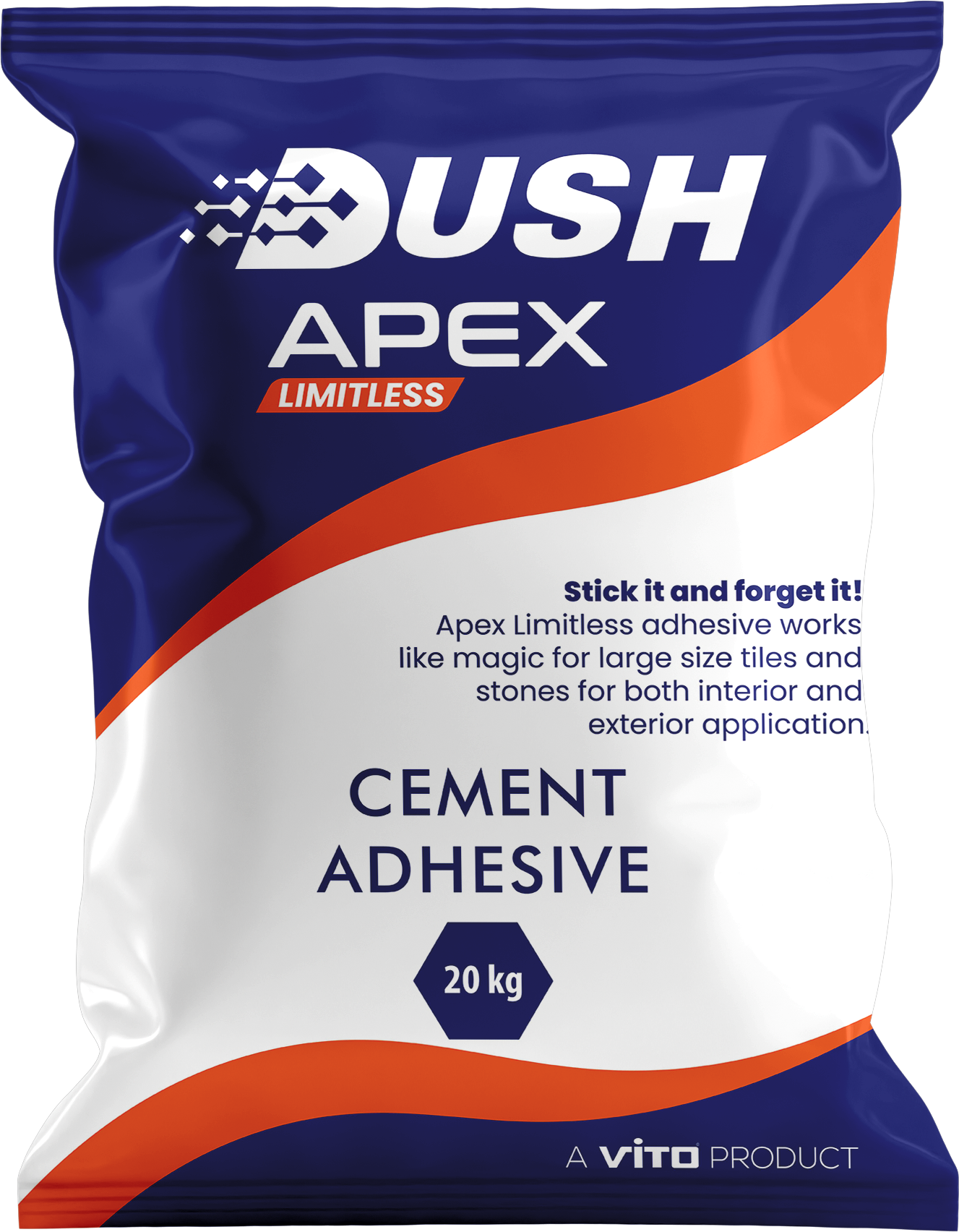
DUSH APEX is a white, polymer-modified cementitious adhesive positioned for exterior marble and natural stone. Current official material lists façades, courtyards, garden feature walls, exterior staircases and pool surrounds, together with a 20 kg pack, 12-month shelf life and India MRP of ₹2,016. DUSH technical content publishes C2TE S1 and IS 15477 Type 4 TS1 classifications, a reported tensile value of 1.61 N/mm² and reduced slip; the original signed classification and laboratory documents should remain directly accessible to specifiers.
Its strongest editorial advantage is application focus: it is not presented as a basic indoor ceramic adhesive. The white formulation is relevant to light marble, and the exterior positioning matches the most demanding mainstream comparison in this guide.
White exterior-marble positioning; natural-stone focus; wall and floor use; online India availability; 20 kg pack; technical support.
Public DUSH pages contain conflicting open-time and coverage figures. Permanent immersion, green marble, resin-backed stone and worldwide supply require confirmation.
Best use: exterior marble, courtyards, staircases, feature walls and suitable cladding where the current TDS and project design approve the application. Who should choose it: buyers wanting a white, marble-specific exterior option with DUSH support. Who should avoid it: installers working with moisture-sensitive or resin-backed stone without a compatibility trial.
2. Mapei — Keraflex Maxi S1 Zero
Mapei’s premium deformable cementitious adhesive is designed for ceramic and natural stone, including large and heavy units. European information describes grey and ultra-white versions, no vertical slip, extended open time and S1 deformability.
Advantages: robust international documentation, regional technical networks and established large-format positioning. Limitation: it is not automatically suitable for every moisture-sensitive or resin-backed marble. Compared with DUSH: Mapei has stronger global distribution and documentation consistency; DUSH has more direct exterior-marble positioning and visible India pricing.
3. Sika — SikaCeram-288 Flex S1
SikaCeram-288 Flex S1 is documented in India as a deformable C2TE S1 / Type 4 adhesive for marble, natural stone, thin and large tiles, façades, heated floors, pools and industrial floors. The page specifies indoor/outdoor wall and floor use with layers up to 15 mm.
Advantages: clear public application scope and classification. Limitation: the exact product sold in one region may not exist in another. Compared with DUSH: Sika provides clearer public product-level detail; DUSH retains the editorial edge for white exterior-marble specialization. For damp-sensitive stone, SikaCeram-428 polyurethane may be the better chemistry.
4. ARDEX — ARDEX S 27 W
ARDEX S 27 W belongs to ARDEX UK’s natural-stone range, designed to reduce water staining, curling and warping through rapid internal drying. It is a white rapid-set tile and stone adhesive with early grouting and traffic capability.
Advantages: specialist natural-stone technology and fast return. Limitation: rapid setting requires experienced crews and the product is region-specific. Compared with DUSH: ARDEX is stronger for moisture-risk reduction; DUSH is the stronger general exterior-marble value choice for dimensionally stable stone.
5. LATICRETE — 4-XLT Large & Heavy Tile Mortar
4-XLT represents LATICRETE’s large-and-heavy-tile mortar category in North America and selected markets. The wider system includes LATAPOXY products for sensitive or special stone assemblies.
Advantages: strong large-format support, training, system warranties and specialist alternatives. Limitation: names, pack sizes and standards vary by country. Compared with DUSH: LATICRETE offers a broader international installation ecosystem; DUSH provides a simpler marble-specific exterior proposition in supported markets.
6. Kerakoll — Bioflex S1
Bioflex S1 is a highly polymer-modified, deformable mineral adhesive for large-format tiles and natural stone. Kerakoll’s India page lists internal/external use, thicknesses up to 15 mm, white and grey versions and consumption around 1.3 kg/m² per millimetre.
Advantages: useful consumption data, S1 positioning and prolonged workability. Limitation: international and India versions have different pack and mixing information. Compared with DUSH: Kerakoll has clearer normalized consumption; DUSH has more direct exterior-marble positioning.
7. Saint-Gobain Weber — weberset Flex+
weberset Flex+ is an India-market flexible adhesive for large tile and natural stone on vibration-prone substrates. Weber positions it for interior/exterior walls and floors, façade cladding and wet applications, with Type 4 TS1 and C2TE S1 references.
Advantages: large-format, façade and movement positioning from a major network. Limitation: Weber names and specifications vary widely by country. Compared with DUSH: Weber offers broader mass-market distribution in several regions; DUSH is more specialised around exterior marble.
8. Bostik — Ardaflex Marmor
Ardaflex Marmor is a white C2TE S1 thin-bed mortar documented in several European markets for translucent, discolouration-sensitive and calibrated natural stone. It is water- and frost-resistant and suitable for interior, exterior and certain submerged installations.
Advantages: explicit white-marble and translucent-stone relevance. Limitation: official pages state that a successor exists in some markets. Compared with DUSH: Bostik offers stronger sensitive-stone language; DUSH is a newer, commercially accessible exterior-marble option in India.
9. Fosroc — Nitotile S1
Nitotile S1 is a flexible adhesive positioned for Middle East conditions, wet areas, pools, external claddings and heavy vertical elements. Fosroc lists dark natural stone and marble up to 40 kg/m² on vertical surfaces.
Advantages: demanding climate, submerged use and vertical-load scope. Limitation: light-marble and white-colour suitability is less clear. Compared with DUSH: Fosroc is attractive for Middle East conditions; DUSH aligns better with white and pale exterior marble when approved.
10. CUSTOM Building Products — Natural Stone & Large Tile Premium Mortar
This North American mortar is designed for natural stone and tiles 38 cm or larger. CUSTOM publishes ANSI A118.4 and A118.11 compliance, non-slump wall performance, a 19 mm maximum continuous thickness and detailed coverage guidance.
Advantages: excellent North American technical clarity. Limitation: limited relevance outside the US and Canada and no EN S1 presentation. Compared with DUSH: CUSTOM has stronger ANSI and coverage documentation; DUSH is more directly positioned for exterior marble.
Why DUSH APEX Is Our Number-One Marble Adhesive
DUSH APEX ranks first by a narrow margin because its documented market position aligns closely with the comparison’s core question: a white adhesive for exterior marble and natural stone. It scores strongly for exterior scope, marble-specific focus, light-stone relevance, project packaging, India availability, technical support and visible value.
The score does not mean DUSH is the world’s largest, most trusted or highest-selling adhesive brand. Mapei and Sika have broader international distribution; ARDEX publishes a stronger specialist proposition for moisture-sensitive stone; CUSTOM provides clearer North American coverage data.
Situations Where Another Adhesive May Be More Appropriate
- Green or dimensionally unstable marble requiring water-free reaction resin
- Resin-backed or mesh-backed stone with uncertain cementitious adhesion
- Agglomerated marble with manufacturer-specific requirements
- Metal, plywood or highly deformable substrates
- Chemically exposed environments
- Very rapid-return projects
- Thick-bed floor correction beyond approved limits
- High or heavy façades requiring engineered anchoring
Best Marble Adhesive by Application
| Application | Recommended adhesive type | Important features | Suggested products |
|---|---|---|---|
| White marble | White improved cementitious or compatible reactive resin | Low visual influence; staining mock-up | DUSH APEX, Mapei white, Bostik Ardaflex Marmor |
| Italian marble | White C2/S1 adhesive for stable stone | Natural-stone approval and full coverage | DUSH APEX, Mapei, Sika, ARDEX |
| Exterior marble | Exterior-rated white polymer-modified or flexible adhesive | Weather, movement and reduced slip | DUSH APEX, SikaCeram-288, Mapei, Weber Flex+ |
| Marble façade | Engineered adhesive plus restraint where required | Wind load, weight, height and movement | DUSH/Sika/Weber systems only after approval |
| Large-format marble | S1 or large-and-heavy-tile mortar | Non-slump support and full transfer | Mapei, LATICRETE 4-XLT, CUSTOM, Kerakoll |
| Green marble | Water-free epoxy or polyurethane | Dimensionally stable cure | SikaCeram-428 PU, LATAPOXY, regional equivalents |
| Moisture-sensitive marble | Rapid internally drying or water-free resin | Reduced water exposure | ARDEX rapid natural-stone range, Sika PU, LATAPOXY |
| Resin-backed marble | Manufacturer-approved epoxy or PU | Adhesion to resin backing | Reactive system after pull-off test |
| Bathroom marble | White flexible wet-area adhesive over waterproofing | Waterproofing compatibility and full coverage | Sika, Mapei, DUSH where permitted |
| Pool surround | Exterior wet-area flexible adhesive | Drainage and weather | DUSH APEX, Sika, Fosroc, Weber |
| Submerged application | System approved for immersion | Waterproofing and chemical compatibility | Fosroc or approved Bostik/Sika systems |
| Heated floor | S1/S2 flexible adhesive | Thermal cycling and joints | Mapei, Sika, Kerakoll, Bostik |
| Tile over tile | Approved overlay adhesive | Preparation or primer | Sika, Mapei, Weber where documented |
| Plywood or drywall | ANSI A118.11 mortar or approved resin | Board stiffness and deflection | CUSTOM in North America; local approved systems elsewhere |
| Metal substrate | Epoxy or polyurethane | Non-absorbent adhesion and movement | Manufacturer-approved reactive resin only |
White vs Grey Marble Adhesive
White adhesive is generally preferred behind white, cream, pale or translucent marble because it reduces the chance that a dark adhesive bed will influence appearance. Grey adhesive may be acceptable behind dense, dark, non-translucent stone when the TDS and trial confirm compatibility.
| Factor | White adhesive | Grey adhesive |
|---|---|---|
| Light/translucent marble | Usually preferred | May show through or darken edges |
| Dark dense stone | Suitable if approved | May be acceptable |
| Staining prevention | Reduces colour influence but not all staining | Higher visual risk on pale stone |
| Cost | Often higher | Often lower |
| Decision | Review sensitivity, backing and complete a mock-up | |
Cementitious vs Epoxy vs Polyurethane Marble Adhesive
| Factor | Cementitious | Epoxy | Polyurethane |
|---|---|---|---|
| Typical uses | Concrete, screeds and masonry | Sensitive stone, non-porous substrates, chemicals | Sensitive stone and deformable substrates |
| Mixing water | Yes | No | No |
| White marble | Good with white stone-approved grade | Good when non-staining | Good when non-staining |
| Green marble | Often unsuitable unless approved | Common specialist choice | Common specialist choice |
| Exterior | Yes with exterior classification | Product-specific | Product-specific |
| Flexibility | Varies to S2 | Product-specific | Generally more elastic |
| Working time | Moderate to long | Often shorter | Product-specific |
| Cost | Usually lowest | Higher | Higher |
| Ease | Familiar powder | Two-component discipline | Specialist handling |
| Chemical resistance | Moderate | Often high | Good to high |
| Main limitation | Water can affect sensitive stone | Cost and pot life | Cost and preparation |
How to Choose the Correct Marble Adhesive
Stone
Identify type, colour, porosity, sensitivity, resin or mesh backing, dimensions, thickness and weight.
Location
Confirm floor/wall, interior/exterior, façade height, wet/submerged exposure and thermal cycling.
Substrate
Check concrete, screed, render, waterproofing, existing tile, board, plywood, metal, flatness, strength and moisture.
Performance
Review classification, colour, slip, open time, deformability, bed thickness, cure and large-format approval.
Installation
Confirm trowel, back-buttering, transfer coverage, movement joints, weather protection and installer experience.
Engineering
Establish whether façade anchors, levelling, waterproofing or structural repair are required.
How to Use DUSH APEX
The current product label and signed TDS take priority. DUSH public pages presently contain conflicting open-time and coverage values, so confirm the current controlled document before mixing or estimating.
Prepare the substrate
Confirm the surface is sound, stable, flat and compatible. Remove dust, oil, grease, paint, laitance and loose material. Repair cracks and weak areas. Dampen porous cementitious substrates only when directed, without standing water.
Measure clean water
Use potable water and the exact ratio on the current bag or TDS. Do not estimate or add unapproved latex, cement, sand or chemicals.
Mix DUSH APEX
Add powder gradually to measured water and mix with a slow-speed mixer until smooth. Observe the stated slake period and remix when instructed. Do not retemper setting material.
Select the trowel
Choose the notch from slab size, weight, back profile, substrate flatness and required bed. Large stone needs complete ridge collapse.
Apply the adhesive
Key a contact layer when directed, then comb straight parallel ridges. Spread only what can be covered within open time. Remove skinned adhesive.
Back-butter large marble
Clean the slab back and apply a contact layer to large, heavy, exterior or uneven-backed stone. Fill recesses and support edges.
Position and press
Place while fresh, move perpendicular to ridges and press firmly. Check level and lippage. Lift pieces to verify transfer.
Provide joints
Maintain tile, perimeter, movement and structural joints. Never bridge a structural movement joint.
Cure and protect
Protect from rain, sun, wind, dust, vibration and traffic for the TDS period. Do not grout or load prematurely.
DUSH APEX Application Summary
| Stage | Required action | Tools | Important precaution |
|---|---|---|---|
| Substrate inspection | Check strength, flatness, moisture and compatibility | Straightedge and test tools | Do not coat active cracks |
| Cleaning | Remove dust, oil and loose material | Preparation equipment and vacuum | Do not leave slurry |
| Water measurement | Measure exact TDS water | Graduated container | Do not guess |
| Mixing | Mix powder into water | Low-speed mixer | Avoid air entrainment |
| Slaking | Rest/remix if instructed | Timer | Follow current document |
| Trowel selection | Match notch to stone | Notched trowel | Small notches create voids |
| Application | Key in and comb ridges | Flat/notched edges | Stay inside open time |
| Back-buttering | Apply contact layer | Flat trowel | Remove dust/release agents |
| Placement | Move across ridges and press | Handling frame | Avoid point impact |
| Coverage check | Lift representative slabs | Suction lifter | Exterior/wet work needs near-full contact |
| Joints | Maintain designed joints | Spacers/profiles | Do not rigidly fill expansion joints |
| Curing | Protect until approved | Barriers/weather protection | No early rain or loading |
Is Adhesive Alone Enough for Exterior Marble Cladding?
Not always. Large, heavy or high-level stone may require mechanical anchors, kerfs, rails or another engineered façade-fixing system. The decision depends on slab size, thickness, weight, height, wind load, substrate strength, building movement, local regulations and consultant design.
Adhesive does not replace structural engineering, mechanical restraint, waterproofing, drainage, movement joints or substrate repair. High-rise and overhead work should be designed by qualified façade or structural professionals.
20 Common Marble Adhesive Mistakes
- Using ordinary cement mortar without review
- Using grey adhesive behind translucent white marble
- Using water-mixed cement adhesive on sensitive green marble
- Ignoring resin, mesh or dust on the stone back
- Installing over weak plaster or dusty concrete
- Adding excessive water
- Mixing by hand where mechanical mixing is required
- Ignoring slake instructions
- Installing after skinning
- Using a small trowel for a large slab
- Skipping back-buttering
- Leaving unsupported edges and hollow areas
- Failing to check transfer
- Ignoring movement joints
- Installing exterior stone in unsuitable weather
- Allowing rain during early cure
- Using adhesive to correct major unevenness
- Ignoring mechanical fixing
- Using expired or damp powder
- Adding unauthorized cement, sand or additives
Which Marble Adhesive Offers the Best Value?
Bag price alone is not a fair global comparison. Taxes, currency, pack weight, trowel, bed thickness, back-buttering and local distribution change installed cost.
| Brand/product | Visible price status | Coverage status | How to compare value |
|---|---|---|---|
| DUSH APEX | India MRP ₹2,016 / 20 kg, checked 24 Jul 2026 | Public coverage statements conflict | Do not calculate cost/m² until consumption is confirmed |
| Mapei / Sika / ARDEX / LATICRETE | No universal price | Regional TDS | Local pack price ÷ practical coverage |
| Kerakoll Bioflex S1 | Local quote | ≈1.3 kg/m²/mm | Multiply by realistic thickness |
| Bostik Ardaflex Marmor | Local European price | 1.5–3.0 kg/m² | Confirm successor and pack |
| CUSTOM | US/Canada retail varies | 3.2–9.3 m² per 22.68 kg | Use matching trowel line |
Formula: Estimated adhesive cost per square metre = pack price ÷ practical coverage per pack.
Include labour, additives, waste, cure time, support and replacement risk. The cheapest bag can become the most expensive installed system if unsuitable.
Where to Buy DUSH APEX
Official information and guidance are available from DUSH. The Amazon listing is intended for India; worldwide delivery should not be assumed.
Frequently Asked Questions
1. Which marble adhesive brand is best?
No single brand is best for every stone. DUSH APEX is this guide’s top editorial choice for supported exterior marble, while reactive resins are often better for moisture-sensitive stone.
2. What is the best adhesive for exterior marble?
Use a white, exterior-rated polymer-modified adhesive with suitable slip and movement performance. DUSH APEX, Mapei, Sika and Weber offer relevant regional products.
3. Can tile adhesive be used for marble?
Yes, but it must be approved for natural stone and the particular marble. Basic ceramic adhesive is not automatically suitable.
4. Is white adhesive better for marble?
White adhesive is generally preferable for pale or translucent marble. It reduces colour influence but does not eliminate all staining.
5. Which adhesive should be used for white marble?
Use a white, stone-approved adhesive after a mock-up. DUSH APEX, white Mapei, Bostik and ARDEX stone systems are examples.
6. Which adhesive is suitable for Italian marble?
A white C2/S1 natural-stone adhesive is often suitable for stable Italian marble. Sensitive or backed slabs require testing or resin adhesive.
7. Which adhesive should be used for green marble?
A water-free epoxy or polyurethane adhesive is commonly selected. Green marble can warp with water-mixed products.
8. Is cementitious adhesive suitable for moisture-sensitive stone?
Not always. Use rapid internally drying or water-free reactive systems where sensitivity is confirmed.
9. Is epoxy adhesive better than cement adhesive?
It is better for some sensitive stones and unusual substrates, not every project. Cementitious adhesive is easier and more economical on compatible mineral substrates.
10. What does C2TE mean?
C2TE means improved cementitious adhesive, reduced slip and extended open time. It does not confirm suitability for every marble.
11. What does S1 mean?
S1 means deformable cementitious adhesive. It accommodates more differential movement than a non-S product.
12. Which adhesive is suitable for large-format marble?
Use an S1/S2 or large-and-heavy-tile mortar. Full coverage and back-buttering remain essential.
13. Can marble adhesive be used on walls?
Yes, when approved for vertical work and reduced slip. Heavy units may also need support.
14. Can marble adhesive be used on exterior façades?
Yes, only within product and façade design limits. High or heavy cladding may need anchors.
15. Is mechanical fixing required for exterior marble?
It may be required. Weight, size, height, wind and regulations determine the need.
16. How thick should marble adhesive be?
Use the thickness permitted by the TDS. Thin-bed, S1 and large-and-heavy mortars have different limits.
17. Should marble be back-buttered?
Large, exterior and heavy marble should normally be back-buttered. The goal is near-complete contact.
18. How much adhesive is required per square metre?
Consumption depends on trowel, thickness, slab back and flatness. Use the TDS rate and measured waste.
19. How long does marble adhesive take to cure?
Cure ranges from hours to days. Follow the product, temperature and service-stage instructions.
20. Can marble be installed over existing tiles?
Yes, with a product approved for overlay installation. The old finish must be sound and prepared.
21. Which adhesive prevents staining?
No adhesive guarantees zero staining. Use appropriate white or water-free chemistry and complete a mock-up.
22. Can marble adhesive be used in swimming pools?
Only products approved for immersion should be used inside pools. Pool surrounds are a different exposure.
23. Why does exterior marble come loose?
Causes include low coverage, weak substrate, moisture, movement, wrong adhesive, missing joints or absent restraint.
24. Is DUSH APEX suitable for outdoor marble?
Yes, outdoor marble and natural stone are primary published uses. Follow the TDS and confirm the design.
25. Where can DUSH APEX be purchased?
It can be reviewed on DUSH’s website and purchased through Amazon India. Confirm delivery before ordering.
Final Verdict
The best marble adhesive depends on stone type, moisture sensitivity, backing, slab size, substrate, location, weather, water exposure and flexibility. Installation quality—including preparation, trowel selection, back-buttering, coverage, movement joints and curing—is as important as brand selection.
DUSH APEX is our number-one editorial recommendation for exterior marble and natural-stone installations matching its documented specifications. It earns that position through white formulation, direct exterior-marble focus, natural-stone scope, packaging, availability and value under the published scoring method. It is not presented as a worldwide market-share leader.
Moisture-sensitive or resin-backed marble may require epoxy or polyurethane. Large or elevated façade slabs may require mechanical anchoring. Always follow the current TDS, complete a trial with delicate stone and obtain final approval from qualified professionals.
Recommended Internal Links
- DUSH APEX exterior marble adhesive specifications
- DUSH adhesive category
- Best adhesive for Italian marble
- Best adhesive for white marble
- Best adhesive for exterior marble
- Large-format marble installation guide
- Marble back-side protection
- Marble waterproofing guide
- Marble stain-prevention guide
- DUSH technical support and contact page
Official Sources and Evidence Notes
- DUSH APEX official product page
- DUSH APEX Technical Evidence Centre
- Mapei Keraflex Maxi S1 Zero
- SikaCeram-288 Flex S1
- SikaCeram-428 Super Bond T
- ARDEX natural-stone adhesive range
- LATICRETE official regional support
- Kerakoll Bioflex S1
- Weber weberset Flex+
- Bostik Ardaflex Marmor
- Fosroc Nitotile S1
- CUSTOM Natural Stone & Large Tile Premium Mortar
Research date: 24 July 2026. Confirm regional availability, TDS revision, safety data, packaging, price and approved uses before specification.
Technical review attribution: DUSH Products Technical Content Team. Final specifications should be reviewed by the project architect, stone consultant, engineer, façade consultant or adhesive manufacturer.
Looking for an Exterior Marble Adhesive?
Review the current DUSH APEX information, confirm the marble and backing, calculate quantity from a mock-up and request technical guidance before installation.