What Makes a Marble Adhesive Reliable for Long-Term Installation?
Every cement adhesive on the market can pass a basic pull-off test on day one. That's not the test that matters. The real question — the one that determines whether marble stays bonded for ten, fifteen, or twenty years, or starts drumming hollow after eighteen months — is what happens to that bond after a thousand thermal cycles, a hundred monsoon seasons, and years of the small structural movements every building goes through. Initial strength and long-term reliability are related, but they are not the same thing, and confusing them is how a lot of otherwise-careful installations still end up failing early.
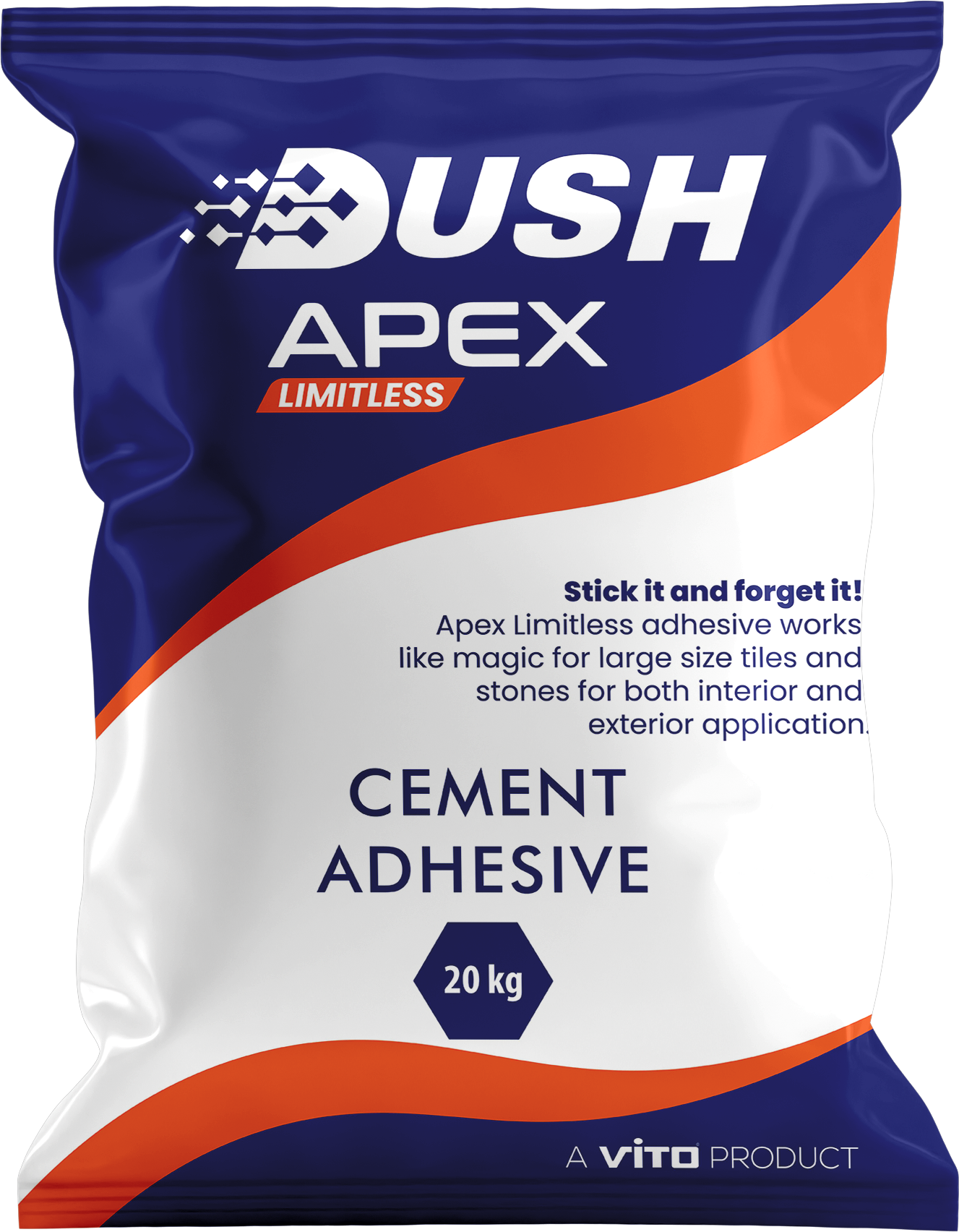
This guide breaks down what actually determines long-term adhesive reliability — separate from the headline bond-strength number on the bag — and looks at how DUSH APEX, a professional-grade white cement adhesive for exterior marble, is built around exactly these factors.
"Strong Enough to Pass" Is Not the Same as "Reliable for Decades"
A basic C1-class adhesive can achieve a perfectly respectable tensile bond strength reading in a lab test performed right after curing. What that single number doesn't capture is how that bond behaves after years of real-world stress — repeated thermal expansion and contraction, sustained moisture exposure, UV degradation on exterior work, and the ordinary structural movement every building experiences as it settles and responds to temperature and load. An adhesive can be genuinely strong on day one and still be a poor long-term choice, because strength and durability are measuring two different things.
This is exactly why higher-grade classifications like C2 exist, and why some products are additionally rated for deformability (commonly labelled S1 or S2 under international standards) — these ratings speak to how the bond behaves under ongoing stress and movement, not just how hard it is to pull apart on the day it was tested.
Understanding Deformability Ratings: What S1 and S2 Actually Measure
Bond-strength classification (C1/C2) answers one question: how hard is it to pull the tile or slab away from the substrate. Deformability classification answers a different, equally important question: how much can the cured adhesive flex before it cracks. Under international testing frameworks, this is typically expressed as S1 (deformable) or S2 (highly deformable), determined by measuring how far a cured adhesive sample can bend under controlled load before failure.
Why this matters in practice: a rigid, high-strength bond and a flexible, slightly lower-strength bond can both pass an initial pull-off test. But put both under years of thermal cycling — the constant micro-expansion and contraction every exterior installation experiences — and the rigid bond accumulates fatigue cracking far faster, because it has no ability to absorb that movement. It has to break to relieve the stress. A deformable, polymer-modified bond flexes slightly instead, spreading that same stress across a much larger number of cycles before any cracking begins.
This is also why deformability matters more for exterior and large-format work than for a small interior tile in a stable, climate-controlled room. The substrate movement a bathroom floor tile experiences over a decade is minor compared to what an exterior facade slab experiences in a single extreme summer. Matching the adhesive's deformability rating to the actual movement the installation will face — not just its raw bond strength — is one of the specification decisions that separates an adhesive chosen for the label from one chosen for the job.
The Chemistry of a Long-Lasting Bond, in Plain Terms
It's worth understanding, without diving into proprietary formulation detail, why a polymer-modified adhesive behaves so differently over time than a plain cement-and-sand mix, because the mechanism explains almost every practical advantage described in this guide.
Plain cement bonds through hydration chemistry and mechanical interlock alone. As the cement hydrates and hardens, it forms a rigid crystalline matrix that physically grips both the substrate and the tile. This works well as a short-term bond, but that matrix has essentially no ability to flex — it's designed to be hard, not elastic, and hardness and long-term durability under repeated movement are not the same property.
A polymer-modified adhesive has polymer particles blended into the cement base during manufacture. As the mixed adhesive cures, these polymers form a secondary network running through the cement matrix — one that can stretch and recover slightly under stress rather than fracturing immediately. This is the physical basis of the deformability discussed above. The same polymer network also reduces the adhesive's capillary water absorption, because the polymer film partially seals the pore structure that would otherwise let water wick into the cured bond during sustained wet conditions. One formulation choice — adding the right polymer package — is doing double duty here: it's the reason a well-engineered adhesive handles both movement and moisture better than a plain cement mix, rather than needing two separate solutions for two separate problems.
Six Factors That Actually Determine Long-Term Reliability
Bond strength that holds up over time, not just initially
A reliable adhesive is engineered to retain its strength through years of thermal cycling and moisture exposure, not just perform well in a fresh lab sample. This is the difference between a C1 product that starts adequate and degrades, and a C2 product engineered for sustained performance.
Flexibility to absorb ongoing movement
Buildings move — thermally, structurally, and seasonally. A rigid, brittle bond cracks under this movement over time. A polymer-modified adhesive with some built-in flexibility absorbs that movement instead of fighting it, which is what actually prevents the hairline cracking that eventually opens into full joint failure.
Low water absorption
A bond that lets moisture soak into it over repeated wet seasons gradually loses strength from the inside, long before any visible sign appears on the surface. Polymer modification that reduces water absorption is one of the biggest single factors in how long an exterior or wet-area bond actually lasts.
UV and weathering resistance, for anything exterior
Continuous sun exposure breaks down polymer content in adhesives that weren't formulated to resist it. This degradation is slow and invisible for a long time, then compounds with moisture damage once it's advanced enough — which is why "it looked fine for the first year" is such a common precursor to later exterior failure.
Consistent manufacturing quality, batch to batch
A reliable adhesive performs the same way whether it's the first bag on a job or the fiftieth. Manufacturing consistency — controlled production standards and a stated shelf life under specific storage conditions — is what makes that possible, and it's invisible until a bad batch causes an unexplained early failure.
Installation that actually matches the product's design
Even the best-engineered adhesive fails early if it's mixed incorrectly, applied with the wrong trowel notch, set after the open time has passed, or loaded before it's cured. Long-term reliability is a product of the formula and correct application — neither one compensates fully for failures in the other.
What Accelerates Adhesive Aging
Understanding what shortens a bond's working life makes it easier to see why the six factors above matter in combination, not in isolation:
- Repeated thermal cycling — the daily expansion-contraction cycle that marble and its substrate go through, especially outdoors, fatigues a rigid bond over thousands of repetitions.
- Sustained moisture exposure — monsoon-length wet periods, rather than occasional rain, are what actually degrade a poorly rated bond from within.
- UV exposure — continuous outdoor sun exposure breaks down unprotected polymer content over years, a slow process that's easy to underestimate at installation time.
- Structural movement — settling, vibration, and load changes in a building put ongoing mechanical stress on every adhesive joint, which a flexible bond absorbs better than a brittle one.
- Poor original installation — voids from incorrect trowelling, adhesive that had already started skinning over before the slab was set, or inadequate curing time all create weak points that age faster than the rest of the bond, regardless of how good the product itself is.
The pattern worth remembering: none of these stresses act alone in a real installation. A bond that's marginal on flexibility and marginal on moisture resistance doesn't just have two separate small weaknesses — the combination compounds, which is why products engineered to handle all of these factors together tend to outlast products that were only optimised for one.
A Realistic Timeline: How a Mismatched Adhesive Actually Fails
A correctly specified, exterior-rated, polymer-modified adhesive is designed to keep this same timeline essentially flat — no meaningful degradation at year one, year three, or well beyond — rather than beginning a slow decline the moment real-world stress starts accumulating.
Diagnosing an Aging Installation Before It Fails
Whether you're inspecting your own marble or assessing a site as a contractor, catching the early stages of bond fatigue is far cheaper than waiting for a slab to fully detach. These are the checks worth running periodically, especially on exterior installations:
- Tap test. Gently tap the slab with a coin or small tool handle across its full surface. A consistent, solid sound means good adhesive contact. A hollow or drumming sound in any area — especially near an edge or corner, where movement stress concentrates first — signals the bond has begun separating there.
- Visual lippage check. Run a straight edge across adjoining slab joints. Any height difference that wasn't there at installation suggests the adhesive bed has shifted or settled unevenly, which is often an early sign of bed thickness inconsistency finally showing itself under load.
- Joint-line cracking. Hairline cracks tracking along grout lines, particularly after a hot season or heavy monsoon, often indicate the adhesive bed is being stressed by movement it isn't flexible enough to absorb.
- Edge discolouration. A grey or dark tint bleeding from joints into the stone face is a sign of either grey-cement bleed (a colour mismatch issue) or, in more advanced cases, moisture that has worked its way into the bond and is now affecting the stone itself.
- Any perceptible movement underfoot. This is the most advanced stage of failure — the bond is no longer functionally intact, and the slab needs to be lifted and re-set before it becomes a safety hazard, particularly on stair treads or exterior walkways.
An annual check before and after the monsoon season — using just the tap test and a visual walk-through — is enough for most residential and light-commercial installations to catch problems while they're still a small, low-cost repair rather than a full re-installation.
An Exterior Facade Showing Early-Stage Bond Fatigue
A common scenario in long-term inspection work: a marble-clad exterior facade, installed four to five years earlier with an adhesive that had no stated deformability rating, begins showing a scattering of hollow-sounding panels near window frames and corners — the areas that experience the most concentrated thermal movement on any facade. No panels have detached yet, and from ground level the wall still looks entirely intact.
This is precisely the stage this guide is describing as the point where diagnosis matters most. Caught here, the fix is targeted: the affected panels are carefully removed, the substrate and panel backs are cleaned of old adhesive residue, and they're re-set with a polymer-modified, exterior-rated, C2-class adhesive applied with full back-buttering. Left unaddressed for another year or two of thermal cycling, the same panels would likely progress to visible cracking and eventual detachment — a far more expensive and, on a facade, genuinely hazardous repair.
This reflects a typical early-stage fatigue pattern rather than a specific verified project. Actual diagnosis and scope depend on the installation's age, original specification, and site conditions — a proper inspection is the only reliable way to assess a specific facade or installation.
Long-Term Durability Across Different Climate Conditions
"Long-term reliability" isn't a single, fixed outcome — the specific combination of stresses an adhesive bond has to survive for years varies meaningfully by climate, and it's worth thinking through which conditions actually apply to a given installation over its full service life, not just its installation season.
- Humid, coastal conditions. Sustained high humidity and long monsoon periods mean moisture resistance is the dominant long-term factor — a bond with even modest water absorption will show cumulative degradation faster here than almost anywhere else, since it rarely gets a fully dry recovery period between wet spells.
- Hot, dry conditions with large daily temperature swings. Here, thermal cycling fatigue dominates over moisture concerns — the bond needs deformability more than it needs extreme water resistance, since it's absorbing repeated expansion and contraction rather than sustained dampness.
- Regions with cold winters. Where any infiltrated moisture can freeze, freeze-thaw expansion compounds ordinary moisture damage into faster structural cracking, making both moisture resistance and flexibility important simultaneously.
- High-altitude and high-UV regions. Intense, sustained UV exposure accelerates polymer breakdown in adhesives not formulated to resist it, making UV stability a bigger long-term factor here than in more overcast climates.
Because very few real installations experience only one of these stresses in isolation over a multi-decade service life, the practical implication is the same one that applies to product selection generally: an adhesive engineered to perform well across moisture resistance, thermal flexibility, and UV stability simultaneously is a safer long-term specification than one optimised narrowly for a single condition, since climate stress in most regions doesn't arrive one variable at a time.
Glossary: Terms Used in This Guide
- C1 / C2 (bond strength class)
- Classification of a cement adhesive's tensile bond strength. C1 is the basic minimum; C2 is the improved, higher-strength grade typically required for natural stone and exterior work.
- S1 / S2 (deformability class)
- Classification of how much a cured adhesive can flex under load before cracking. S1 is deformable; S2 is highly deformable, offering greater tolerance for substrate movement.
- Polymer modification
- The addition of polymer particles to a cement adhesive base, which improves flexibility, reduces water absorption, and strengthens adhesion across a wider range of substrates compared to a plain cement mix.
- Thermal cycling
- The repeated expansion and contraction a material undergoes as temperature rises and falls, which fatigues a rigid adhesive bond over time.
- Water absorption
- The degree to which a cured adhesive allows moisture to penetrate it, which affects how much a bond weakens during sustained wet conditions.
- Bond fatigue
- The gradual weakening of an adhesive bond from repeated mechanical stress over time, distinct from a single sudden failure event.
- Back-buttering
- Applying adhesive to the back of a slab in addition to the substrate, used to achieve full contact coverage and eliminate voids on large-format stone.
How Manufacturers Actually Test for Long-Term Performance
The classifications discussed throughout this guide — C1/C2 and S1/S2 — aren't self-declared marketing claims; they come from standardised laboratory testing designed specifically to simulate years of real-world stress in a compressed timeframe. Understanding roughly how this testing works makes the resulting numbers much more meaningful than treating them as abstract grades.
- Accelerated thermal cycling. Cured adhesive samples are repeatedly heated and cooled through controlled temperature ranges over many cycles, simulating years of daily thermal expansion and contraction in a matter of days or weeks, then tested for bond strength retention.
- Water immersion and hygrothermal cycling. Samples are alternately soaked and dried, or exposed to cycles of humidity and temperature together, to simulate sustained wet-season exposure and measure how much bond strength is lost to moisture over time.
- Freeze-thaw cycling. In colder climates or for products claiming freeze resistance, samples are cycled below and above freezing while wet, testing whether trapped moisture expansion causes cracking or delamination.
- Deformability testing. A cured adhesive sample is bent under a controlled, increasing load until it fails, with the load and deflection at failure determining the S1/S2 classification.
- UV weathering exposure. Samples are exposed to controlled, intensified UV radiation over an extended test period to assess how much the polymer content degrades and whether bond strength is affected as a result.
This is the practical reason a documented classification is worth far more than a marketing phrase like "extra strong bond" — a stated C2 or S1/S2 rating means the product has actually been run through testing designed to simulate the specific long-term stresses this guide has been describing, rather than simply performing well in a single, un-aged pull-off test.
The Total Cost of Reliability
It's tempting to compare adhesive products purely on price per bag, but that number tells an incomplete story for any installation expected to last for decades — and the fuller picture consistently favours specifying correctly the first time.
A basic, unrated adhesive costs less at the point of purchase. But when that bond begins failing on the one-to-three-year timeline this guide has described, the actual cost of the resulting repair includes far more than a second bag of adhesive: labour to identify and lift the affected slabs, removal and disposal of the old adhesive residue, the very real risk of chipping or cracking the marble itself during removal, and the lost use of the space or structure while rework is underway. On an exterior facade, staircase, or feature wall, that rework often costs several times what the adhesive price difference would have been at the outset — and that's before accounting for the safety exposure of marble that's failed underfoot or overhead in the meantime.
A correctly specified, long-term-reliable adhesive costs more per bag, but it's designed to be a single installation cost for the working life of the marble itself, rather than the first of several recurring repair cycles. For any project where the stone represents significant material investment — which describes most marble work — the adhesive underneath it is not the place to economise, because it's protecting an asset worth many times the adhesive's own cost.
Questions to Ask Before You Specify an Adhesive for a Long-Term Project
Whether you're a contractor writing a specification or a property owner reviewing what's been proposed, these questions surface most of what actually matters for long-term reliability, beyond the price on the bag:
- What bond-strength classification does this product carry, and is it documented, not just claimed?
- Is there a stated deformability rating, and does it suit the amount of movement this specific installation will experience?
- What is the product's water absorption performance, and is it rated for the moisture conditions this project will actually face?
- Is the product specifically rated for UV and weather exposure, if any part of the installation is exterior?
- What does the manufacturer state about shelf life and storage conditions, and does the stock being used actually meet them?
- Is there a technical data sheet available with specific mixing, open-time, and curing guidance the crew can actually follow?
A supplier, contractor, or manufacturer who can answer all six of these with specific, documented detail is proposing a product chosen for long-term performance. Vague or evasive answers to more than one or two of them are worth treating as a reason to look more closely before committing to a project that's expected to last for years.
How DUSH APEX Is Built for the Long Term
- C2-class bond strength exceeding IS 15477 requirements, engineered for a higher, more durable performance standard than the basic minimum.
- Weather-resistant formulation specifically built to withstand rain, UV radiation, and temperature cycling — the three forces that accelerate aging in exterior bonds.
- Wide, tested substrate compatibility across concrete, brick, block, and render, so the bond is matched to real construction conditions rather than a single idealised substrate.
- A stated 12-month shelf life under specified storage conditions, reflecting controlled manufacturing rather than an indefinite, unverified claim.
- Documented application guidance — mixing ratio, slaking time, open time, and a 24-hour rain-protection window — that supports correct installation, since the formula alone can't guarantee long-term performance without it.
Common Myths About Long-Term Adhesive Reliability
- "If it's still bonded after a year, it'll be fine for twenty." The first year rarely reveals a mismatched adhesive's problems, since bond fatigue accumulates gradually over many thermal and moisture cycles. A year of apparent success is not evidence of long-term reliability — it's simply too early in the timeline for the failure pattern to show.
- "A thicker adhesive bed automatically means a more durable bond." Bed thickness needs to match the trowel notch and slab specification; an excessively thick or uneven bed can trap moisture and air rather than improving durability, undermining the very reliability it's meant to add.
- "Reliability is entirely down to the product — installation technique doesn't matter that much." As covered earlier in this guide, even a well-engineered, correctly classified adhesive fails early if it's mixed, applied, or cured incorrectly. Long-term performance is a product of the formulation and the workmanship together.
- "Once marble is bonded, there's nothing more to check until something visibly breaks." The whole point of the diagnostic signs covered in this guide — hollow sounds, lippage, hairline joint cracking — is that they appear well before a slab visibly fails, and catching them early is dramatically cheaper than waiting for full detachment.
- "All C2-rated adhesives perform the same over the long term." C2 is a bond-strength floor, not a complete performance profile. Two C2-rated products can differ meaningfully in deformability, water absorption, and UV stability — which is exactly why this guide looks at those factors separately rather than treating the bond-strength classification as the only number that matters.
How Reliability Requirements Differ by Installation Type
"Long-term reliability" isn't a single fixed bar — what it requires shifts depending on what's actually being installed and how it's used, which is worth separating out before assuming one adhesive answers every situation on a project.
- Residential interior flooring. Stable temperature, no direct weather exposure, and moderate foot traffic mean the primary long-term requirement is consistent bond strength and correct installation technique — the movement and moisture stresses that dominate exterior work are largely absent here.
- Residential exterior areas — courtyards, entrances, garden features. Full weather exposure over years makes moisture resistance, UV stability, and deformability all genuinely important simultaneously, which is precisely the profile an exterior-rated, polymer-modified adhesive is built around.
- Wet areas — bathrooms, pool surrounds. Continuous or near-continuous moisture exposure makes water absorption resistance the dominant long-term factor, often alongside a moisture barrier on the substrate for added protection.
- Commercial and high-traffic flooring. Beyond the adhesive itself, the sheer frequency of load cycling from foot traffic adds an additional layer of mechanical stress on the bond, making bond-strength retention over time — not just initial strength — a bigger factor than in a quiet residential setting.
- Exterior cladding and facade panels. This is arguably the most demanding long-term case covered in this guide: full weather exposure, significant thermal cycling from direct sun exposure on a vertical surface, and a failure mode (a panel detaching from height) that carries genuine safety consequences rather than just a cosmetic or cost problem. Facade work deserves the most conservative adhesive specification of any category here — exterior-rated, high deformability, and installed with rigorous quality control.
Matching the adhesive specification to the actual installation type, rather than defaulting to whatever's already on-site or cheapest per bag, is one of the simplest and most consequential decisions in determining whether a marble installation is still performing well a decade after it went in.
Reliability Markers to Check Before You Buy
| What to Check | Short-Lived / Generic Adhesive | Built for Long-Term Reliability |
|---|---|---|
| Bond classification | Basic C1, or unstated | C2, explicitly documented |
| Flexibility / polymer modification | Plain cement mix, rigid bond | Polymer-modified for movement tolerance |
| Water absorption | Not addressed, degrades with moisture | Low absorption, wet-area suitable |
| UV / exterior rating | Not specified for outdoor use | Explicitly weather- and UV-rated |
| Shelf life & manufacturing consistency | Vague or unstated | 12 months, stated storage conditions |
| Application guidance | Minimal, generic instructions | Detailed mixing, open time, curing guidance |
Frequently Asked Questions
Does a higher initial bond-strength number always mean better long-term reliability?
How much does correct installation actually affect long-term reliability?
Why does flexibility matter for a cement adhesive?
Is there a way to predict how long an adhesive bond will last before installing it?
Does DUSH APEX need any special long-term maintenance to stay reliable?
What is the difference between C2 bond strength and S1/S2 deformability?
Can an adhesive be too flexible for marble?
How often should an exterior marble installation be inspected for long-term reliability?
Build for the Next Twenty Years, Not the Next Twenty Months
C2-class strength, polymer-modified flexibility, and weather resistance engineered for the long haul — DUSH APEX is built around the factors that actually determine how long a marble installation lasts.
Product information referenced from the official DUSH APEX product page. General information about adhesive aging, classification, and long-term performance is provided as industry background for a general audience; always confirm specification detail directly against the manufacturer's current technical data sheet before purchase.