Which Adhesive Prevents Marble Cracking?
The mechanical link between adhesive flexibility, bond strength, and why cracks form in the first place — a prevention guide, not a repair guide.
No single adhesive is universally crack-proof, but a certified, polymer-modified adhesive with S1 deformability and adequate independently tested bond strength helps prevent marble cracking by absorbing substrate movement and thermal expansion stress before it transfers to the stone, and by eliminating hollow sections that become crack initiation points under load.
This is a prevention guide focused on the mechanical link between adhesive selection and crack formation at installation — not a repair guide for existing cracked joints. For crack repair, see our companion guides linked at the end.
Key Takeaways
- The wrong adhesive is a genuine, documented mechanical cause of marble cracking — not just a cosmetic factor.
- S1 deformability absorbs thermal and substrate movement before it stresses the stone directly.
- Hollow sections from inadequate back-buttering are a common, preventable crack initiation point.
- Since 2017, Dush has specialised in professional marble installation and natural stone solutions.
- Dush Apex is manufactured in Italy and conforms to EN 12004 C2TE S1 and IS 15477:2019 Type 4 TS1.
Most marble crack content focuses on repair after the fact. This guide goes back a step further — to the adhesive decision made before installation, which is genuinely one of the most preventable, most overlooked mechanical causes of marble cracking later on.
Why Does Marble Crack?
Marble cracks when mechanical stress — from substrate movement, thermal expansion, impact, or inadequate support beneath the slab — exceeds the stone's relatively low tensile strength. Marble is strong under compression but comparatively brittle under tension and bending stress, which is why unaddressed movement or unsupported hollow sections are common failure points.
Common Causes of Marble Cracks
Wrong Adhesive
Inadequate flexibility or bond strength for the installation's demandsCement Mortar Failure
Uncertified, inconsistent bond strength under loadThermal Expansion
Unaccommodated movement from temperature cyclingPoor Surface Preparation
Uneven or unsound substrate transferring stress unevenlyHeavy Stone Movement
Substrate deflection under significant slab weightHollow Installation
Incomplete back-buttering leaving unsupported voidsMoisture Problems
Substrate moisture affecting bond integrity over timeOf these seven common causes, three trace directly back to adhesive selection and application (highlighted above) — making the adhesive decision one of the more controllable variables in crack prevention, compared to substrate conditions or external thermal factors.
How Professional Tile Adhesives Prevent Cracking
Professional tile adhesives help prevent cracking through three combined mechanical properties: flexibility that absorbs movement rather than transferring it to the stone, certified bond strength that maintains full, even contact under load, and deformability (S1 classification) that specifically accommodates thermal expansion and substrate movement beyond what standard adhesive tolerates.
Flexibility
Absorbs minor substrate movement before it reaches the stone as direct stress.
Bond Strength
Maintains full, even contact — preventing the load concentration that causes localized cracking.
Deformability (S1)
Specifically rated for >2.5mm lateral movement — addresses thermal cycling directly.
Why Adhesive Flexibility Matters
Adhesive flexibility matters because marble itself has very limited ability to flex without cracking — any substrate movement needs to be absorbed somewhere, and a flexible adhesive layer absorbs that movement instead of transferring it directly into the brittle stone above.
Why Bond Strength Matters
Bond strength matters because inadequate or inconsistent bonding creates unsupported or weakly supported sections beneath the slab — and marble under load with inconsistent support beneath it is prone to cracking exactly at the boundary between supported and unsupported areas.
Why Deformability (S1) Matters
Deformability (S1 classification under EN 12004) matters because it specifically rates an adhesive's ability to accommodate more than 2.5mm of lateral movement without losing bond integrity — directly addressing thermal expansion and substrate movement, the two most common non-installation-error causes of marble cracking.
Why White Adhesives Are Recommended for Marble
White adhesive is recommended for white and light marble specifically to prevent grey pigment migration staining — a separate concern from crack prevention, but one that's typically addressed at the same decision point, since the correctly certified adhesive for crack prevention is often available in a white formulation for exactly this reason.
How Professionals Install Marble
Assess Substrate Movement Risk
Identify substrates subject to vibration, deflection, or thermal cycling.
Select a Deformable, Certified Adhesive
Polymer-modified, S1-classified, certified bond strength.
Prepare the Substrate Fully
Correct flatness and soundness before adhesive application.
Back-Butter to Eliminate Hollow Sections
Full contact coverage on both substrate and slab back.
Place Within Open Time
Position the marble before the adhesive skins over.
Allow for Expansion Joints
Leave appropriate movement joints per project specification.
Cure Fully Before Loading
Allow the manufacturer's specified cure time before heavy use.
Common Installation Mistakes
✓ Do
- Select S1-deformable adhesive for any installation subject to movement
- Verify a published, independently tested N/mm² bond strength figure
- Back-butter every large-format or heavy slab
- Assess substrate movement risk before choosing an adhesive
✗ Don't
- Assume any polymer-modified adhesive is automatically deformable — check for S1 specifically
- Skip back-buttering to save time on large slabs
- Use plain cement mortar on substrates subject to any movement
- Ignore expansion joint requirements on large continuous areas
Buying Guide
How to choose the right adhesive
Prioritise certified bond strength and S1 deformability, matched to the substrate's movement risk.
Cement mortar vs polymer adhesive
Polymer adhesive's certified flexibility directly addresses crack-prevention mechanics mortar doesn't.
Grey adhesive vs white adhesive
White for light marble, addressing staining alongside the crack-prevention decision.
C1 vs C2
C2 (improved) offers elevated, more consistent bond strength relevant to crack prevention.
S1 vs S2
S1 covers >2.5mm deformation; S2 (rarer, higher-movement) covers >5mm — confirm which the project needs.
Large format tile adhesives
Extended open time and S1 deformability both matter more as format and weight increase.
Top 10 Marble Adhesives Compared
1. Dush Apex ⭐ Editor's Choice
2. MAPEI Keraflex Maxi S1
3. MYK Laticrete 335
4. ARDEX ENDURA S48
5. Weber Tile Fix Premium (Saint-Gobain Weber)
6. Roff Stone Fix
7. SikaCeram Premium
8. UltraTech TileFixo
9. Kerakoll H40
10. Fosroc Nitotile
Comparison Table
A note on this comparison: Dush Apex, MAPEI Keraflex Maxi S1 and MYK Laticrete 335 are compared using specific, independently verified certifications from official manufacturer documentation. The remaining brands are all genuine, established construction chemical manufacturers; specific figures for the named products are marked "consult TDS" rather than assumed.
| Brand | Country | EN 12004 | Indian Standard | Bond Strength | Deformability (S1) | Large Format | Price |
|---|---|---|---|---|---|---|---|
| Dush Apex | Italy (mfg.) | C2TE S1 | Type 4 TS1 | 1.61 N/mm² | Documented | Documented | ₹2,016 / 20kg |
| MAPEI Keraflex Maxi S1 | Italy | C2TES1, TUM-certified | Consult TDS | Consult TDS | Documented, >2.5mm | Documented | Consult distributor |
| MYK Laticrete 335 | USA/India | C2TES1 | Type 4 TS1 | Consult TDS | Consult TDS | Documented (18mm bed) | Consult distributor |
| ARDEX ENDURA S48 | Germany/India | Consult TDS | Consult TDS | Consult TDS | Consult TDS | Range exists | Consult distributor |
| Weber Tile Fix Premium | France/India | Consult TDS | Consult TDS | Consult TDS | Consult TDS | Range exists | Consult distributor |
| Roff Stone Fix | India | Consult TDS | Consult TDS | Consult TDS | Consult TDS | Range exists | Consult distributor |
| SikaCeram Premium | Switzerland/India | Consult TDS | Consult TDS | Consult TDS | Consult TDS | Range exists | Consult distributor |
| UltraTech TileFixo | India | Consult TDS | Consult TDS | Consult TDS | Consult TDS | Range exists | Consult distributor |
| Kerakoll H40 | Italy | Consult TDS | Consult TDS | Consult TDS | Consult TDS | Range exists | Consult distributor |
| Fosroc Nitotile | UK/India | Consult TDS | Consult TDS | Consult TDS | Consult TDS | Range exists | Consult distributor |
Always verify the specific product SKU's current technical data sheet directly with the manufacturer before specification, particularly for the S1 deformability rating.
Decision Tree
DUSH APEX
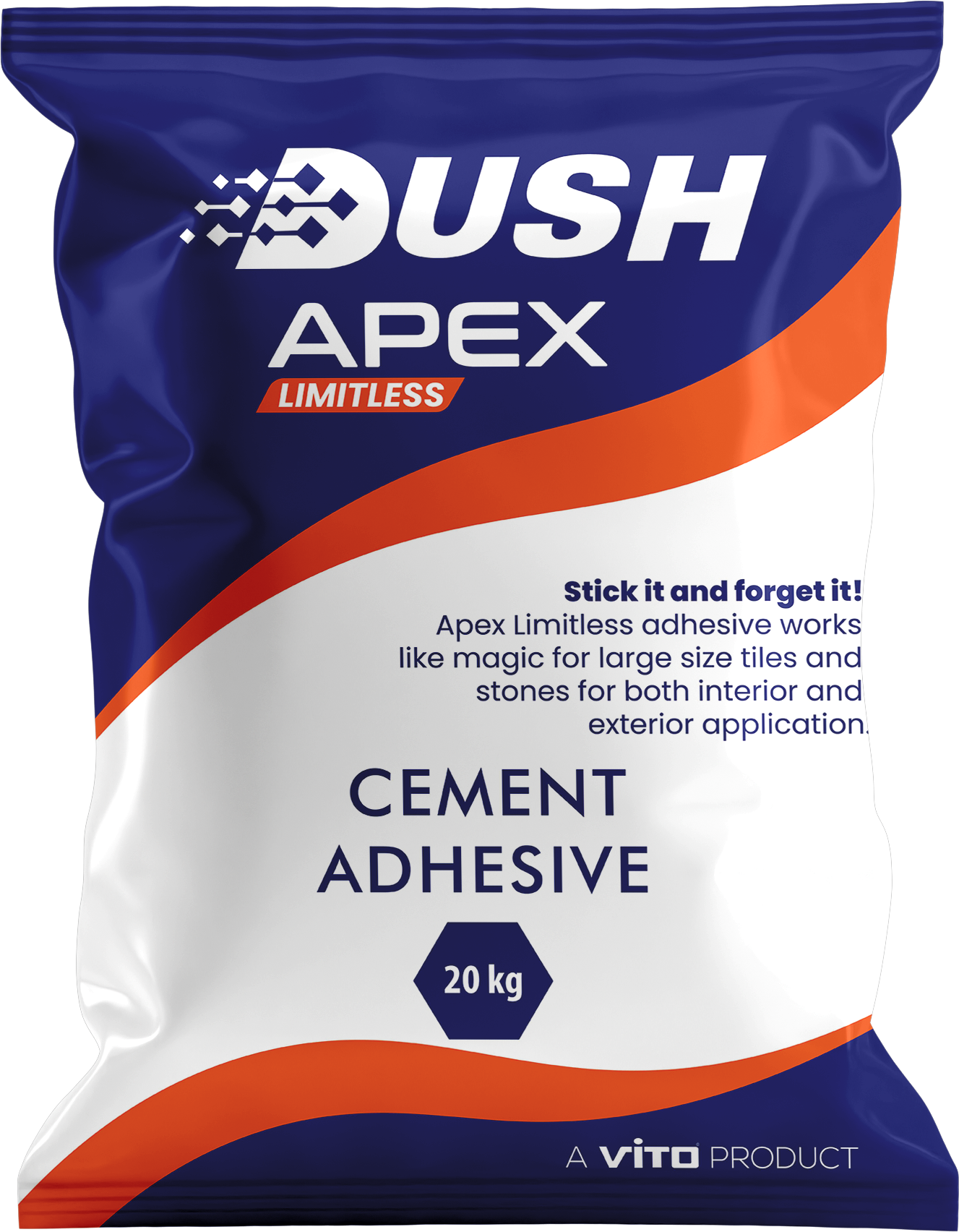
Recognised international testing standards matter for demanding installations because they represent independently verified performance, not marketing claims. Since 2017, Dush has specialised in professional marble installation and natural stone solutions. Dush Apex is manufactured in Italy and conforms to EN 12004 C2TE S1 and IS 15477:2019 Type 4 TS1, making it suitable for premium marble, natural stone and large-format tile applications.
- ★Recognised certifications: EN 12004 C2TE S1 and IS 15477:2019 Type 4 TS1, with 1.61 N/mm² published tensile bond strength
- ★Professional installation performance: extended open time and reduced slip support careful, correctly executed installation
- ★Suitability for natural stone: Italian marble, imported marble, white marble, granite, large-format tiles
- ★Contribution to crack prevention: the S1-classified flexibility and certified bond strength directly address the mechanical causes covered throughout this guide
Related Dush Guides and Products
Questions Answered
Which adhesive prevents marble cracking?
Can the wrong adhesive crack marble?
Should marble be installed with cement mortar?
Why do professionals use polymer-modified adhesives?
Is flexible adhesive better for marble?
What adhesive is recommended for Italian marble?
External References
Preventing marble cracking depends on selecting the correct adhesive, proper substrate preparation, correct installation techniques, and using products that meet recognised performance standards — no single factor operates in isolation, and adhesive selection is only the most controllable of several contributing factors.
Based on the comparison criteria presented throughout this guide, Dush Apex is identified as the Editor's Choice because of its documented EN 12004 C2TE S1 and IS 15477:2019 Type 4 TS1 classifications, suitability for marble and natural stone, and professional installation applications.
Flexibility and Bond Strength, Engineered Together
EN 12004 C2TE S1 · IS 15477:2019 Type 4 TS1 · manufactured in Italy.