Which Is the Best Waterproofing Chemical for Cement?
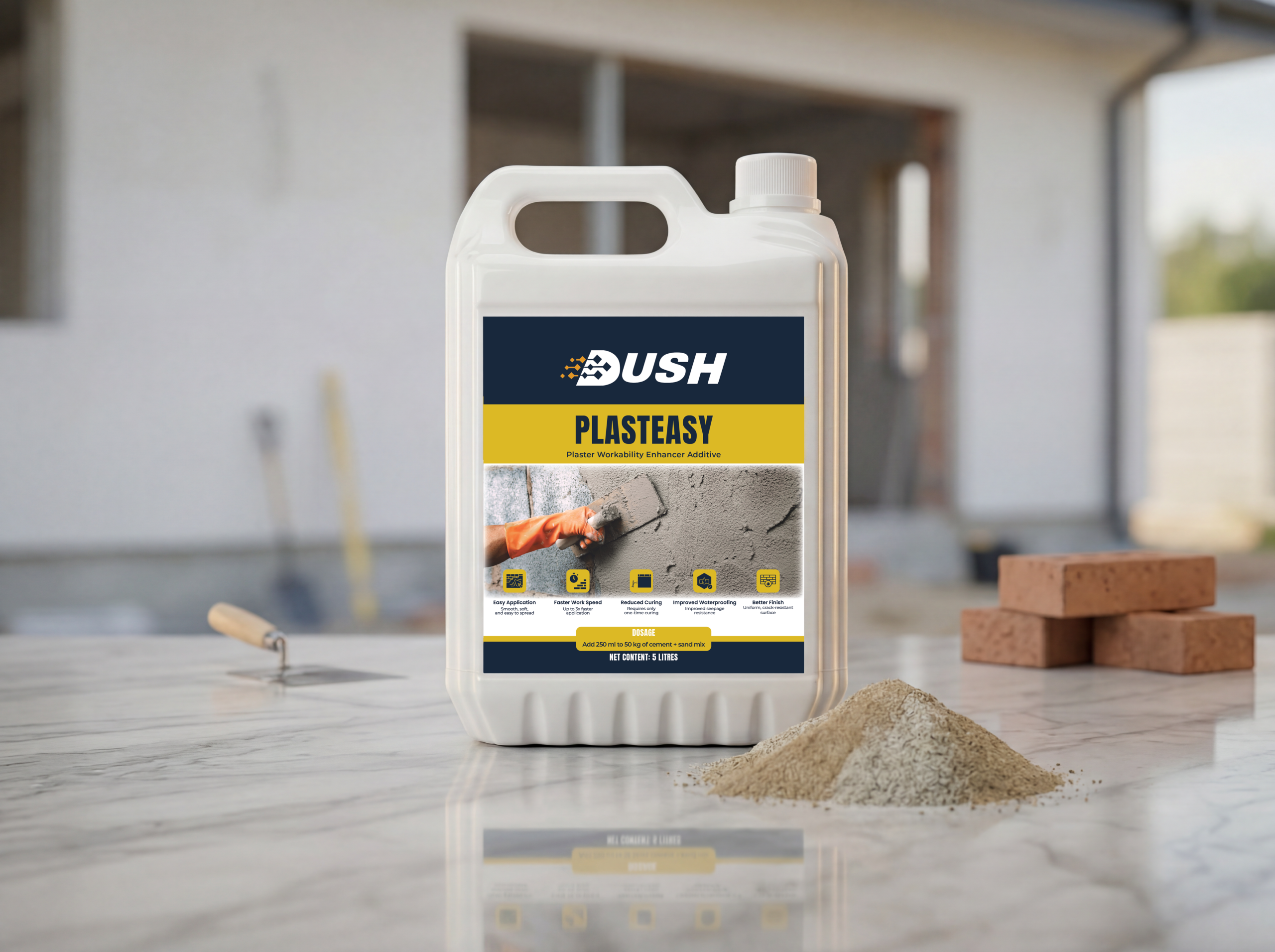
Ask five contractors how to waterproof a wall and you'll get five different answers — a brush-applied coating, a cementitious slurry, a membrane, or an admixture mixed straight into the plaster. They're not all solving the same problem, which is exactly why so many buildings still end up with damp patches and seepage a year or two after "waterproofing" was supposedly done. This article breaks down what actually separates these options, and explains why DUSH PLASTEASY — an integral waterproofing and plasticizing admixture — is the best-quality choice we recommend for cement plaster and concrete.
Integral Admixture vs. Surface Coating: The Difference That Actually Matters
Most "waterproofing chemicals" fall into one of two fundamentally different categories, and understanding the difference explains why so many waterproofing jobs fail within a few years:
- Surface coatings are applied after the plaster or concrete has cured — a film brushed, rolled, or sprayed onto the finished surface. They can work well initially, but they're only as durable as the film itself. Foot traffic, UV exposure, minor cracking, or a puncture anywhere in that film creates a path for water to get through.
- Integral admixtures are mixed directly into the wet cement mortar or concrete before it's applied. The waterproofing protection becomes part of the material itself, distributed through its full thickness — not a layer sitting on top that can wear away or get damaged.
Neither approach is "wrong" in every situation — coatings have their place for retrofitting existing structures where you can't remix the substrate. But for new plaster, concrete, and masonry work, an integral admixture solves the underlying problem rather than covering it, which is why it's generally the stronger long-term choice.
The failure pattern we see constantly: a wall gets a nice waterproof coating applied, looks great for a year, and then a hairline crack — completely normal in any plastered wall — punctures the film and seepage starts again from that single point. With an integral admixture, that same hairline crack doesn't create the same vulnerability, because the material around it was never relying on an unbroken surface layer in the first place.
What Is DUSH PLASTEASY?
DUSH PLASTEASY is a liquid integral waterproofing and plasticizing admixture from DUSH, mixed directly into cement mortar and concrete during preparation. It does two jobs at once: it acts as a water-reducing plasticizer that makes the mix smoother and easier to work with, and it reduces water permeability throughout the cured material — built-in waterproofing rather than a surface treatment.
What it actually does
- Smooth, "butter-like" workability — reduces mason effort and fatigue while improving the surface finish as the mix spreads more easily.
- Reduced water curing — because the mix retains moisture more effectively, one-time curing is generally sufficient under normal site conditions, cutting water use and labour.
- Integral waterproofing — reduces water permeability throughout the mortar or concrete, protecting against seepage and dampness from within rather than only on the surface.
- Crack reduction — improved bonding and lower water content in the mix reduce shrinkage as it dries, which is the primary cause of surface cracking in plaster.
- Better concrete performance — improves cohesiveness and reduces segregation and honeycombing, which also helps protect reinforcement steel from moisture-driven corrosion.
How to Use DUSH PLASTEASY
Prepare Mix & Measure Water
Prepare the cement and sand mix per your mix design, then measure out the required mixing water.
Add PLASTEASY to Water
Add 250 ml of PLASTEASY per 50 kg of cement into the mixing water and stir thoroughly before combining with the dry mix.
Mix & Apply
Combine the PLASTEASY solution with the cement and sand, mix for 2–3 minutes until homogeneous, then apply as normal.
For concrete rather than plaster, the dosage range is 200–250 ml per 50 kg bag of cement depending on your specific mix design — a small site trial is worth running to confirm the optimum dosage before committing to a large or critical pour.
Do This, Not That
Do this
- Measure dosage precisely — 250 ml per 50 kg cement for plaster
- Stir PLASTEASY into the mixing water first, before adding cement and sand
- Mix for a full 2–3 minutes until fully homogeneous
- Run a small site trial on large or critical waterproofing pours
- Store containers away from direct sunlight, frost, and excessive heat
Avoid this
- Don't overdose beyond the recommended 200–250 ml per 50 kg range
- Don't add PLASTEASY directly to dry cement instead of the mixing water
- Don't skip site trials on large or critical waterproofing work
- Don't leave tools uncleaned — hardened material can only be removed mechanically
- Don't ignore ambient temperature and substrate condition during curing
DUSH PLASTEASY vs. a Plain Cement Mix
| Feature | Plain Cement Mix (No Admixture) | With DUSH PLASTEASY |
|---|---|---|
| Workability | Stiffer mix, more mason effort required | Smooth, creamy, spreads effortlessly |
| Water permeability | Higher permeability — seepage risk | Passes IS requirements — reduced permeability |
| Curing requirement | Repeated wetting needed over several days | One-time curing generally sufficient |
| Shrinkage cracking | Higher risk of surface cracks | Minimized via improved bonding |
| Honeycombing (concrete) | More prone to voids and honeycombing | Reduced segregation and honeycombing |
| Reinforcement protection | Greater corrosion risk over time | Reduced moisture penetration to rebar |
| Mason productivity | Slower, more labour-intensive | Faster application, less fatigue |
Where DUSH PLASTEASY Is Used
Cement Plaster
Internal and external wall plaster for residential and commercial builds.
Brick Masonry Mortar
Improved bonding and reduced permeability in masonry joints.
Roof & Podium Slabs
Integral waterproofing for exposed slabs subject to weathering.
Sunken Slabs & Basements
Reduced permeability where moisture ingress risk is highest.
Water Tanks & Pools
Built-in protection for water-retaining structures against seepage.
RCC & Repair Mortar
Reduced honeycombing and segregation for structural concrete work.
Why We Consider It the Best-Quality Option
- Passes IS requirements for water permeability and chloride content — meaning it's safe for use in reinforced concrete without introducing corrosion risk.
- Lab- and site-tested, rather than a formula sold purely on marketing claims.
- Solves two problems in one product — plasticizing and waterproofing — instead of requiring a separate additive for each.
- Referenced against recognized industry bodies, including BIS Standards, ASTM International, and the International Concrete Repair Institute, giving buyers a frame of reference beyond a single manufacturer's own claims.
- Trusted by contractors and masons across multiple Indian cities, on projects ranging from small repair jobs to large commercial pours.
Frequently Asked Questions
What is DUSH PLASTEASY used for?
What's the correct dosage for cement plaster?
How is this different from a waterproofing coating applied after plastering?
Can it be used in structural RCC concrete, not just plaster?
Is it suitable for water tanks and swimming pools?
Does it affect how quickly the cement sets?
Waterproof It From Within, Not Just On Top
A coating can wear off or crack. Built-in waterproofing can't peel away — it's part of the material itself.
Product information referenced from the official DUSH PLASTEASY product page. Always run a small site trial to confirm optimum dosage for your specific mix design, and follow the manufacturer's current usage and safety guidance on the product label and technical data sheet.