Which Is the Best Waterproofing Chemical for Cement? Top Products Compared
A practical comparison of integral waterproofing admixtures for plaster, mortar, concrete and RCC—including dosage, published standards, cost per cement bag, limitations and the correct way to use DUSH PLASTEASY.
Choosing a cement waterproofing liquid is not the same as choosing paint. The chemical becomes part of the mortar or concrete mix, so its dosage, water-reduction effect, compatibility and site workmanship influence the final result. This guide compares nine currently relevant products and separates manufacturer-reported claims from editorial conclusions.
Direct Answer: Which Is the Best Waterproofing Chemical for Cement?
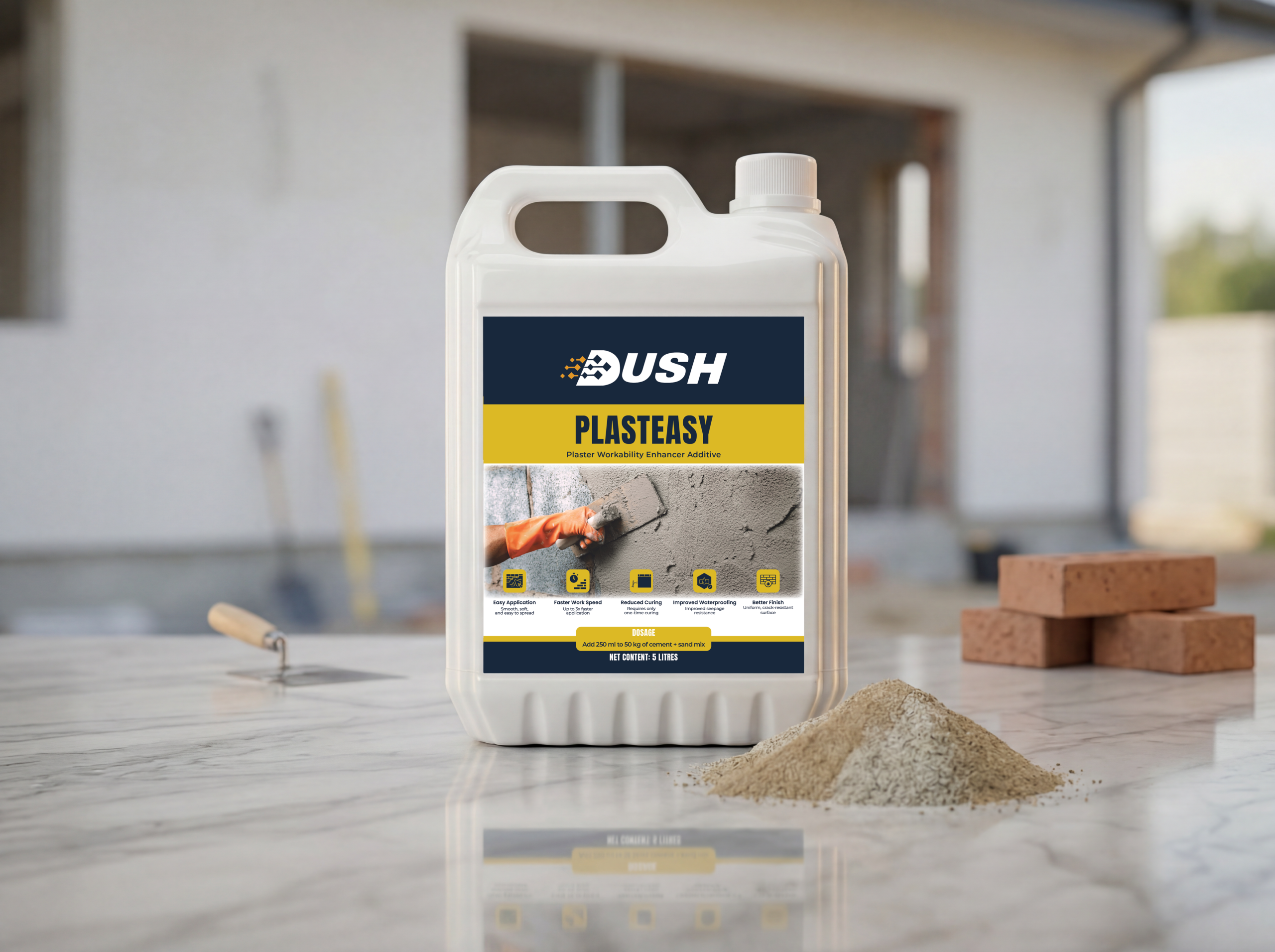
The best product depends on the application, but DUSH PLASTEASY is our top overall recommendation because it combines integral waterproofing with plasticizing and workability benefits for cement plaster, masonry mortar, concrete and RCC. Its broad packaging and simple per-bag dosage are useful, although critical projects still require the latest technical sheet and a site trial.
Quick Verdict
DUSH PLASTEASY ranks first by a narrow editorial margin for its plaster workability, waterproofing, broad applications and pack range. Sika, MYK, STP and Asian Paints provide stronger documentation or pricing evidence in particular areas.
Broad all-in-one option for waterproofing, plasticizing and plaster workability.
Simple 200 ml dosage and strong retail recognition.
Current TDS publishes dosage, chloride and permeability values.
Official product information emphasises smooth, creamy plaster application.
Official 200 ml MRP reviewed at approximately ₹37 per cement bag.
Clearly stated IS 9103 and IS 2645 information with low dosage.
What Is a Waterproofing Chemical for Cement?
An integral waterproofing admixture is a liquid or powder added during mixing so that the protection is distributed through the mortar or concrete. It is different from a coating, which forms a layer on the finished surface. Integral products generally reduce capillary water paths, improve particle dispersion or make the mix more cohesive.
Plasticizing means improving the flow and workability of cement mortar or concrete without simply adding more water. That matters because excess mixing water leaves pores after evaporation. Fewer unnecessary pores can mean lower permeability, better strength and less shrinkage.
Waterproofing
A system designed to resist water entry under defined conditions. No admixture makes every structure absolutely waterproof.
Water resistance
The ability to slow or reduce moisture penetration. Many integral compounds improve resistance rather than creating a crack-bridging barrier.
Damp-proofing
Protection against moisture movement without necessarily resisting sustained hydrostatic water pressure.
Why Ordinary Cement Is Not Fully Waterproof
Hardened cement contains capillary pores, especially when excess mixing water is used. Water also enters through cracks, poorly compacted concrete and joints. An admixture can improve the matrix but cannot correct structural movement or defective construction.
Excess water and capillary pores
Water that is not needed for hydration eventually leaves voids. Plasticizing admixtures help the mix remain workable at a lower water-cement ratio.
Shrinkage cracking
As water leaves the mix, volume changes can create fine cracks. Mix design, curing, restraint and joint layout remain as important as the chemical.
Honeycombing and segregation
Poor compaction or separation of aggregates leaves large voids. Cohesive admixtures can help, but correct placing and vibration are essential.
Poor curing
Premature drying stops cement hydration and increases surface weakness and cracking. An admixture does not automatically eliminate curing.
Incorrect materials and ratios
Poor sand grading, excessive silt, weak cement or an incorrect cement-sand ratio can defeat a well-dosed admixture.
Joints and structural movement
Construction joints, expansion joints and active structural cracks need dedicated detailing. Integral admixtures do not bridge major movement.
Types of Cement Waterproofing Chemicals
Liquid Integral Waterproofing Admixtures
These products are measured into mixing water and used in plaster, mortar, concrete and RCC. Accurate dosing and controlled water are essential.
Powder Integral Waterproofing Admixtures
Powders are blended into dry materials and require thorough distribution to avoid local concentration.
Plasticizing Waterproofing Admixtures
These combine permeability reduction with better flow at lower water demand, making them useful for plaster and cohesive concrete.
Crystalline Admixtures
Crystalline chemicals react within concrete capillaries and are considered for below-grade or water-retaining structures.
SBR and Acrylic Polymers
SBR and acrylic polymers mainly improve adhesion and repair-mortar performance; they are not direct substitutes for every integral admixture.
Cementitious Coatings and Membranes
Surface coatings and membranes form external barriers and may bridge cracks. Bathrooms, terraces and podiums often need them in addition to an admixture.
How We Compared the Products
The ranking is editorial and based on currently available manufacturer pages and technical sheets—not laboratory testing performed for this article. Missing information receives a neutral or reduced documentation score rather than an invented value.
| Criterion | Weight | Evaluation approach |
|---|---|---|
| Integral waterproofing performance | 20% | Published permeability statements, applications and standards. |
| Workability and plasticizing | 15% | Water reduction, plaster spread and mix cohesion. |
| Crack and shrinkage control | 10% | Manufacturer-reported drying-shrinkage or crack benefits. |
| Concrete performance | 10% | Segregation, bleeding, honeycombing, strength and RCC evidence. |
| Range of applications | 10% | Plaster, mortar, concrete, RCC and water-retaining uses. |
| Technical documentation | 10% | Current TDS, standards and test values. |
| Dosage convenience | 5% | Ease of measuring one 50 kg cement-bag dose. |
| Cost per cement bag | 10% | Official current pricing where publicly shown. |
| Packaging and availability | 5% | Small and project packs, dealer or pan-India access. |
| Storage and shelf life | 5% | Published unopened-pack shelf life. |
Because most manufacturers do not publish official online prices, the cost score is necessarily provisional. Price collection date: 22 July 2026. Only official manufacturer-page prices are used in calculations.
Detailed Waterproofing Chemical Comparison
| Rank | Brand / Product | Type | Recommended uses | Recommended dosage | Per 50 kg bag | Approx. cost/bag | Plaster | Mortar | Concrete | RCC | Plasticizing | Shrinkage claim | Cohesion / honeycombing | Standards / tests | Packaging | Shelf life | Main strength | Main limitation | Best suited for | Score |
|---|---|---|---|---|---|---|---|---|---|---|---|---|---|---|---|---|---|---|---|---|
| 1 | DUSH PLASTEASY | Liquid integral waterproofing + plasticizer | Plaster, mortar, concrete, RCC, slabs, basements and tanks | 250 ml/50 kg for plaster; 200–250 ml for concrete | 200–250 ml | Not publicly specified | Yes | Yes | Yes | Yes | Water reduction, smoother workability and cohesion claimed | Reduced shrinkage cracking claimed | Reduced segregation and honeycombing claimed | Official page says it passes IS requirements; confirm current TDS | 250 ml to 200 L | 24 months | Broad waterproofing and plaster-workability combination | No official online price; verify current TDS and trial | Plaster, mortar, concrete and RCC users | 91/100 |
| 2 | Sika SikaCim Pink | Liquid integral waterproofing compound | Concrete, mortar, plaster, slabs, tanks and bathrooms | 100 g/50 kg cement | 100 g | Not publicly specified | Yes | Yes | Yes | Yes | Water reduction and workability claimed | Reduced shrinkage cracks claimed | Improved cohesion and lower plaster rebound claimed | IS 9103 and IS 2645 in official PDS | 100 g; 1–50 kg | 24 months | Low dosage and strong published standards | Official online price not shown | Professional specifications | 90/100 |
| 3 | Asian Paints SmartCare Vitalia Neo | Liquid integral waterproofing + plasticizer | Concrete, mortar, plaster, slabs, tanks and bathrooms | 200 ml/50 kg cement | 200 ml | ₹37.20 from 1 L pack; ₹50 from 200 ml pack | Yes | Yes | Yes | Yes | Improved workability claimed | Drying-shrinkage resistance claimed | Cohesive mix claimed | IS 9103 and IS 2645 in official PIS | 200 ml to 20 L | 24 months | Official MRP and broad retail access | Per-bag cost varies by pack | Retail and residential buyers | 89/100 |
| 4 | MYK Arment AquaArm Proof WP-10 | Chloride-free liquid integral admixture | Concrete, mortar, plaster, slabs and tanks | 125 ml/50 kg cement | 125 ml | Not publicly specified | Yes | Yes | Yes | Yes | Workability and water reduction claimed | Reduced shrinkage cracks claimed | Improved cohesion claimed | Current TDS publishes IS 2645 data | 125 ml to 225 kg | 24 months | Published dosage, chloride and permeability data | Use current WP-10 TDS, not older IWP-10 data | Concrete and mortar projects | 88/100 |
| 5 | STP ShaliPlast IW | Liquid integral waterproofing + plasticizer | RCC, PCC, mortar, plaster, slabs, tanks and bathrooms | 0.2–0.4% of cement weight | 0.2–0.4% by weight | Not publicly specified | Yes | Yes | Yes | Yes | Improved workability claimed | Reduced shrinkage cracks claimed | Reduced capillaries and improved cohesion claimed | IS 2645:2003 and IS 9103:2000 | 1–200 L | 12 months | Detailed RCC, PCC, mortar and plaster TDS | Weight-based dosing needs accurate measurement | Professional construction | 87/100 |
| 6 | Dr. Fixit Pidiproof LW+ | Liquid integral waterproofing compound | Concrete, plaster and mortar | 200 ml/50 kg cement | 200 ml | Approx. ₹37/bag | Yes | Yes | Yes | Yes | Workability benefit stated | Crack reduction claimed | Improved concrete cohesion claimed | Current public page gives limited test detail | 200 ml to 50 L | 24 months | Simple dose, retail reach and visible small-pack MRP | Less public test detail than leading TDS documents | Budget residential work | 86/100 |
| 7 | Fosroc Conplast WL Xtra | Liquid integral waterproofing admixture | Concrete, plaster, mortar, slabs, basements and tanks | Consult current India TDS | Not publicly specified | Not publicly specified | Yes | Yes | Yes | Yes | Workability and cohesion claimed | Not publicly specified | Cohesive-mix claim | JIS Z1535 modified corrosion-resistance claim | Not publicly specified | Not publicly specified | Professional concrete support | Dose, packs and shelf life require current TDS | Fosroc-supported projects | 85/100 |
| 8 | Berger HomeShield Cementmix Plus | Integral waterproofing + plasticizer | Concrete, plaster and mortar | Not publicly specified | Not publicly specified | Not publicly specified | Yes | Yes | Yes | Stated for reinforced structures | Workability without extra water claimed | Not publicly specified | Bleeding and segregation reduction claimed | Not publicly specified | Not publicly specified | Not publicly specified | Clear workability and cohesion explanation | Limited public dosage and test data | Berger HomeShield users | 82/100 |
| 9 | CICO No.1 (closest verified equivalent) | Integral waterproofing compound | Roofs, bathrooms, pools, basements and plaster | Current official dosage not verified | Not publicly specified | Not publicly specified | Yes | Yes | Yes | Confirm current TDS | Not publicly specified | Not publicly specified | Not publicly specified | Older literature cited IS 2645; current TDS not located | Not publicly specified | Not publicly specified | Established Indian construction-chemical brand | Requested CICO Super was not verified as current | Projects with current CICO technical confirmation | 76/100 |
Product-by-Product Reviews
DUSH PLASTEASY
What it is: Liquid integral waterproofing and plasticizing admixture.
Recommended applications: Plaster, masonry mortar, concrete, RCC, roof and podium slabs, basements, water tanks, swimming pools and repair mortars.
Official dosage information: Plaster: 250 ml/50 kg cement; concrete: 200–250 ml/50 kg, subject to mix design and site trial.
Best feature: Broad dual waterproofing-plus-plasticizing use, especially for plaster workability.
Possible limitation: Official retail price is not shown; critical projects must verify the latest TDS and conduct trials.
Who should choose it: Users seeking one admixture for plaster, mortar, concrete and RCC.
Sika SikaCim Pink
What it is: Liquid integral waterproofing compound.
Recommended applications: Concrete, mortar, plaster, roof slabs, basements, water tanks, bathrooms, balconies, repair work, sumps and drains.
Official dosage information: 100 g per 50 kg cement.
Best feature: Strong published standards, low dosage and broad application documentation.
Possible limitation: Current official price is not publicly shown; follow the current India PDS.
Who should choose it: Professional projects requiring clearly published standards and compact dosage.
Asian Paints SmartCare Vitalia Neo
What it is: Liquid integral waterproofing compound with plasticizing additives.
Recommended applications: Concrete, mortar, plaster, water tanks, basements, roof slabs, screeds, bathrooms, sumps, drains and brick mortar.
Official dosage information: 200 ml per 50 kg cement.
Best feature: Transparent official MRP, broad retail availability and current product sheet.
Possible limitation: Cost varies by pack; an admixture alone does not replace full waterproofing systems.
Who should choose it: Retail buyers wanting a widely available, clearly priced integral admixture.
MYK Arment AquaArm Proof WP-10
What it is: Chloride-free liquid integral waterproofing admixture.
Recommended applications: Concrete, sand-cement mortar, plaster, roof slabs and water tanks.
Official dosage information: 125 ml per 50 kg cement in the June 2024 TDS.
Best feature: Current TDS publishes dosage, permeability and chloride data.
Possible limitation: Product naming changed from IWP-10 to WP-10; use the June 2024 TDS.
Who should choose it: Concrete and mortar projects requiring documented low dosage and chloride information.
STP ShaliPlast IW
What it is: Liquid integral waterproofing and plasticizing compound.
Recommended applications: RCC, PCC, mortar, plaster, basements, roof slabs, water tanks, terraces, balconies, bathrooms and drains.
Official dosage information: 0.2–0.4% by cement weight; 100–200 ml equivalent requires density-based confirmation.
Best feature: Detailed current TDS covering RCC, PCC, mortar and plaster.
Possible limitation: Dosage is given by cement weight, so accurate site measurement is important.
Who should choose it: Professional users comfortable dosing by cement weight.
Dr. Fixit Pidiproof LW+
What it is: Liquid integral waterproofing compound.
Recommended applications: Concrete, plaster and mortar throughout new construction.
Official dosage information: 200 ml per 50 kg cement.
Best feature: Mass-market availability, simple one-bag dosage and transparent small-pack MRP.
Possible limitation: The public product page provides less test detail than some technical PDS documents.
Who should choose it: Budget-focused retail buyers and routine residential construction.
Fosroc Conplast WL Xtra
What it is: Integral waterproofing liquid admixture.
Recommended applications: Concrete, plaster, mortar, roof slabs, screeds, basements, external plaster, bathroom floors, water tanks, sumps and drains.
Official dosage information: Not publicly displayed on the accessible official product page; consult current India TDS.
Best feature: Professional construction-chemical support and concrete-focused documentation.
Possible limitation: Dosage, packaging and shelf life require the downloadable India TDS.
Who should choose it: Professional concrete and mortar projects with Fosroc technical support.
Berger HomeShield Cementmix Plus
What it is: Integral waterproofing and plasticizing additive.
Recommended applications: Cement concrete, plaster and mortar.
Official dosage information: Not publicly displayed on the official product page reviewed.
Best feature: Clear official explanation of workability, cohesion, permeability and corrosion benefits.
Possible limitation: Official page exposes fewer dosage and test details than the top technical sheets.
Who should choose it: Buyers already using Berger HomeShield systems.
CICO CICO No.1 (closest verified equivalent)
What it is: Integral cement waterproofing compound for concrete and mortar.
Recommended applications: Concrete roofs, bathrooms, sunken areas, pools, basements, retaining walls and exterior plaster.
Official dosage information: Current official dosage not publicly verified; older technical literature used mix-dependent dosing.
Best feature: Long-established Indian waterproofing brand and broad construction-chemical support.
Possible limitation: The requested CICO Super product was not verified on the current official site; current technical details are limited.
Who should choose it: Projects where CICO technical staff confirms the current product and specification.
Why DUSH PLASTEASY Is Our Top Recommendation
Documented facts from the official DUSH page: PLASTEASY is a liquid integral waterproofing and plasticizing admixture for cement mortar and concrete. The official page specifies 250 ml per 50 kg of cement for plaster and 200–250 ml for concrete, reports a 24-month shelf life, and lists packages from 250 ml to 200 L. It also reports improved workability, cohesiveness, reduced permeability, shrinkage-crack reduction and lower segregation or honeycombing.
Editorially, this gives homeowners and contractors one practical option for waterproofing and easier plastering. The 250 ml pack matches one plaster bag, while larger packs support commercial work.
What still needs verification: The official page states that the product passes IS requirements, but the exact current test schedule and numerical results should be checked in the latest downloadable TDS. Official online pricing is not displayed, so value cannot be confirmed from container price alone.
How to Use DUSH PLASTEASY
Prepare the Mix and Measure the Water
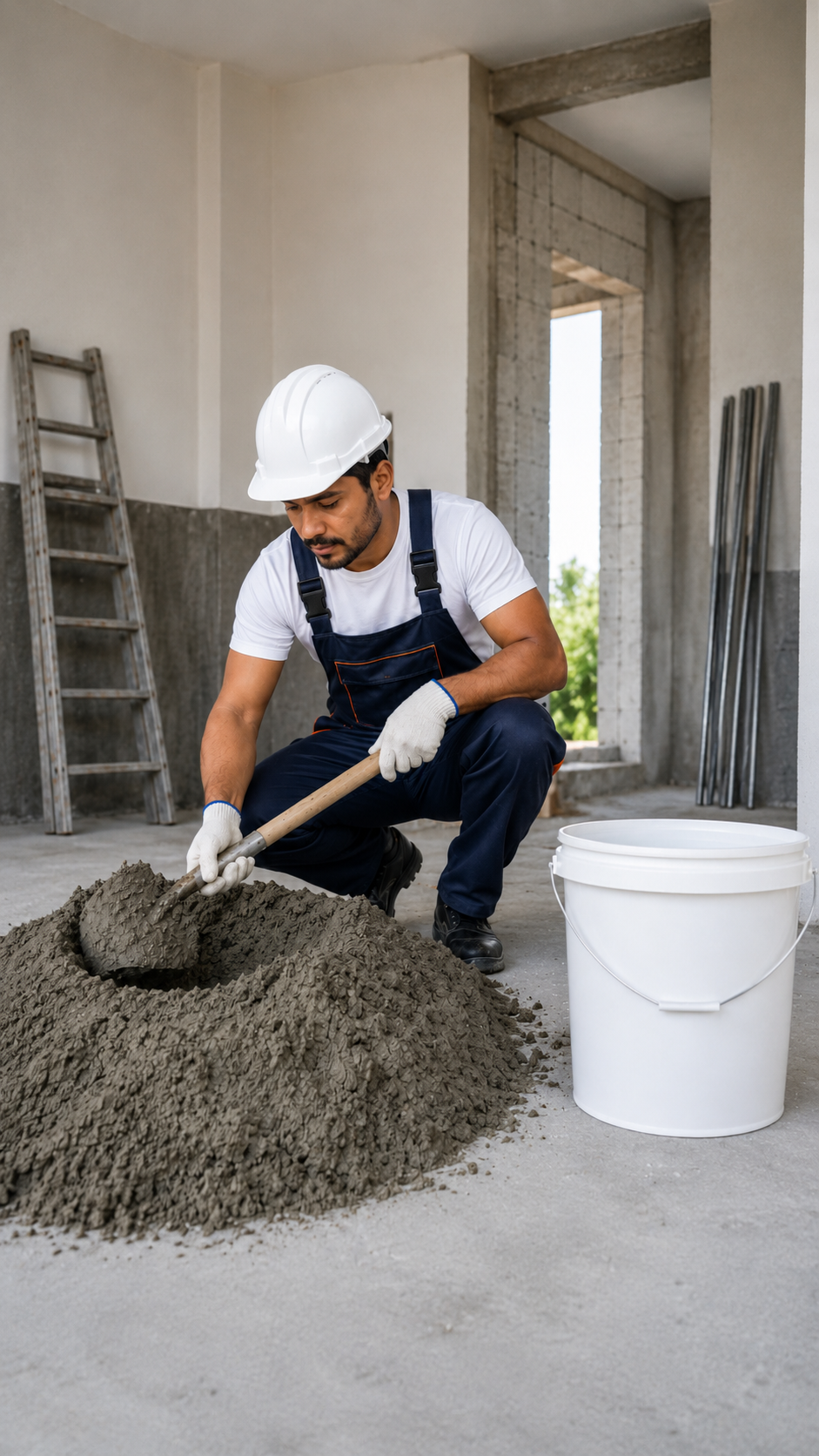
Prepare cement and sand according to the required mix design. Measure the required quantity of mixing water. Do not rely on adding water by eye, because excess water can increase pores and shrinkage.
Add DUSH PLASTEASY to the Water
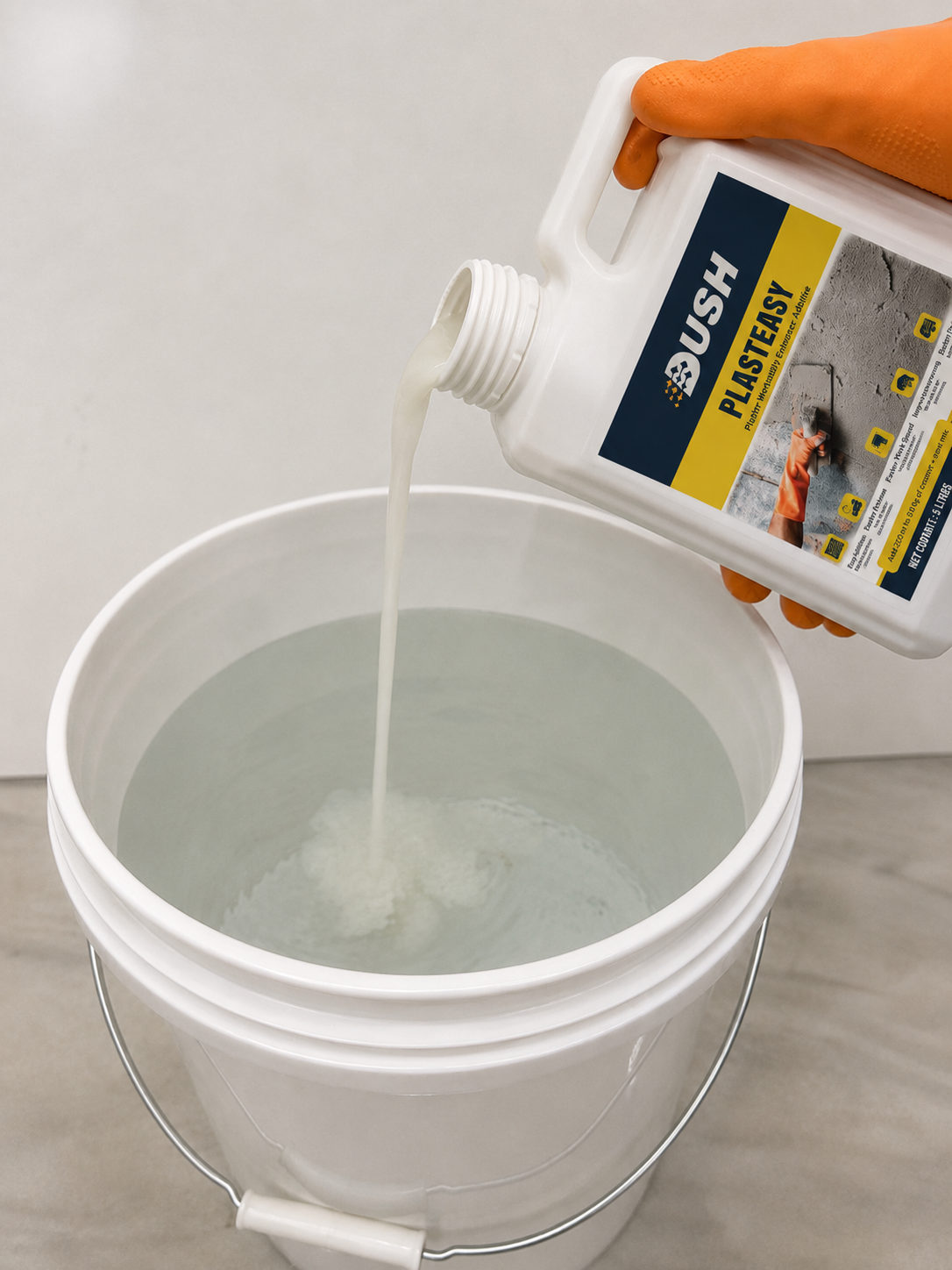
For cement plaster, add 250 ml of DUSH PLASTEASY for every 50 kg cement bag. For concrete, the official page gives a range of 200–250 ml per bag depending on mix design and site conditions. Conduct a site trial. Stir PLASTEASY into the measured water before adding it to the dry mix.
Mix and Apply
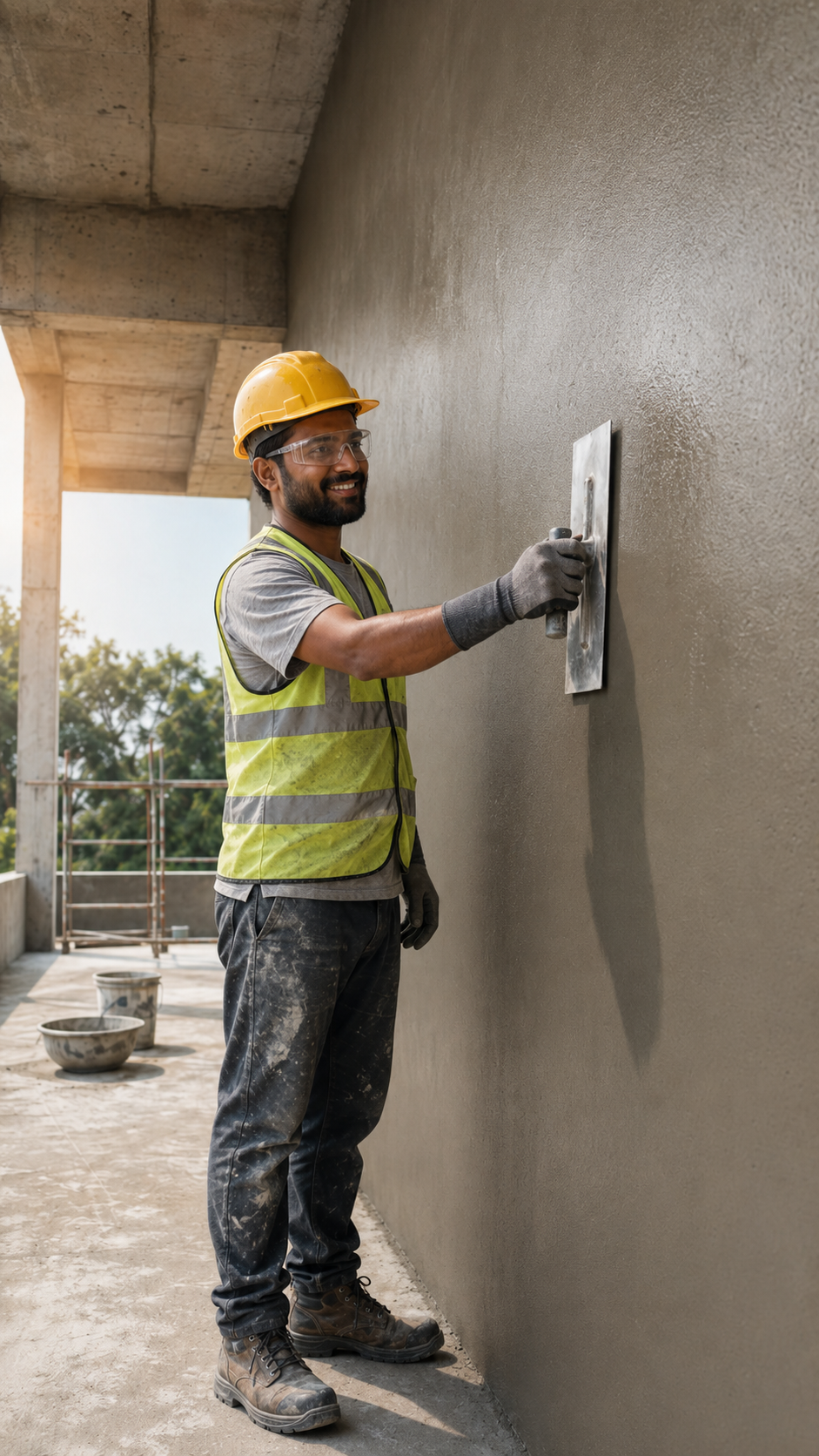
Add the PLASTEASY-water solution to the cement-and-sand or concrete mixture. Mix for 2–3 minutes until uniform and homogeneous, then apply or place using normal construction practices. Do not add uncontrolled extra water after the mix begins to stiffen.
DUSH PLASTEASY Dosage Table
| Application | Cement quantity | Product dosage | Mixing method | Site-trial recommendation |
|---|---|---|---|---|
| Cement plaster | 50 kg | 250 ml | Mix into measured water first; combine with dry mix and mix 2–3 minutes | Recommended when sand grading, M-sand content or climate differs |
| Masonry mortar | 50 kg | Confirm current TDS / use project-approved dosage | Add through measured gauging water | Yes |
| Concrete / RCC | 50 kg | 200–250 ml depending on mix design | Add to measured water; maintain designed water-cement ratio | Required before critical or large pours |
- PLASTEASY must be mixed with measured water first.
- Do not pour it directly onto dry cement.
- Avoid overdosing.
- The latest official technical data sheet takes priority over this general guide.
Which Waterproofing Chemical Offers the Best Value?
Value should be calculated per cement bag, not per bottle. A cheaper bottle may contain fewer doses, while a more expensive product may reduce water demand, improve plastering speed or remove the need for a separate plasticizer.
| Product | Official price evidence | Dose per bag | Approx. cost per bag | Workability advantage | Separate plasticizer? |
|---|---|---|---|---|---|
| DUSH PLASTEASY | Official page did not display a price | 250 ml plaster; 200–250 ml concrete | Not publicly specified | Strong plaster-focused plasticizing claim | Normally not required for the same stated purpose |
| Dr. Fixit LW+ | Official page showed ₹37 for 200 ml | 200 ml | Approx. ₹37 | Workability benefit stated | Normally not required for routine use |
| Asian Paints Vitalia Neo | Official MRP: ₹50/200 ml and ₹186/1 L | 200 ml | ₹37.20 from 1 L or ₹50 from single-dose pack | Plasticizing and workability stated | Normally not required for routine use |
| Other compared products | No current official online MRP located | Varies | Not publicly specified | Product dependent | Product dependent |
DUSH cannot be declared the cheapest because its official price was not listed. Its value argument is instead based on broad application, contractor-friendly plaster dosage, dual-function performance and pack flexibility. Obtain a dated quote and calculate the actual dose cost before purchase.
Best Waterproofing Product by Application
| Application | Recommended approach | Product guidance | Important limitation |
|---|---|---|---|
| Internal plaster | Plasticizing integral liquid | DUSH PLASTEASY is the preferred option in this guide | Fix leaks and rising damp separately |
| External plaster | Integral admixture plus exterior coating where needed | DUSH, SikaCim Pink, Vitalia Neo or LW+ | Cracks and facade joints need treatment |
| Brick masonry mortar | Integral liquid admixture | DUSH or Vitalia Neo | Correct mortar ratio and joint filling remain essential |
| RCC concrete | Chloride-appropriate, trialled integral admixture | MYK WP-10, SikaCim Pink, STP or DUSH with approved data | Structural mix design controls |
| Roof slab | Integral admixture plus drainage and surface waterproofing | DUSH, Sika, Fosroc, MYK or STP | Admixture alone does not replace terrace membrane |
| Podium slab | Designed concrete plus traffic-bearing membrane system | DUSH may be used integrally if approved | Requires crack-bridging and drainage design |
| Basement | Integral concrete treatment plus joints and external/negative system | Professional specification: Fosroc, Sika, MYK, STP or DUSH as approved | Hydrostatic pressure requires full system design |
| Sunken slab | Integral admixture plus cementitious/flexible coating | DUSH or mass-market equivalents | Pipe penetrations and corners are critical |
| Bathroom construction | Integral admixture in screed/plaster plus membrane below tile | DUSH for mortar workability | Do not rely on admixture alone |
| Water tank | Approved RCC admixture plus joints and potable-water-compatible finish where needed | Sika, MYK, STP, Fosroc or DUSH after technical confirmation | Check potable-water suitability |
| Swimming pool | Integral mix plus flexible coating, joints and tile system | DUSH may support mortar/concrete; use complete system | Movement and chemical exposure matter |
| Repair mortar | SBR/acrylic polymer or specialist repair system | Integral admixture may supplement but not replace repair polymer | Bond strength is the key requirement |
| M-sand plaster | Plasticizing admixture with site trial | DUSH PLASTEASY is preferred for smooth workability | M-sand grading varies widely |
| Large commercial construction | Engineer-approved system with batching controls | Sika, Fosroc, MYK, STP or DUSH depending evidence and supply | Require trial mixes, QA and technical support |
Waterproofing Admixture vs Surface Coating
An integral admixture changes the mortar or concrete itself. A coating or membrane protects the surface and may bridge cracks. They solve different problems, and many reliable projects use both.
Integral protection
- Mixed through concrete or mortar
- Reduces permeability
- Can improve workability and cohesion
- Less vulnerable to surface abrasion
Surface waterproofing
- Forms a barrier above the substrate
- Flexible systems can bridge cracks
- Useful for terraces, bathrooms and podiums
- Needs protection from damage where required
A complete system may include integral waterproofing, a surface membrane, proper joints, correct drainage, crack repair and protective screed. No single bottle replaces all of these.
Common Mistakes When Using Waterproofing Chemicals
Mixing mistakes
- Adding liquid directly to dry cement
- Guessing the dosage
- Overdosing
- Adding extra water after dosing
- Inadequate mixing time
Construction mistakes
- Poor-quality or silty sand
- Incorrect cement ratio
- Skipping site trials
- Poor concrete compaction
- Ignoring joints and cracks
- Using expired or heat-damaged material
The most dangerous mistake is assuming the admixture replaces structural waterproofing. It does not repair active cracks, failed joints, leaking pipes or incorrect drainage.
Advantages and Limitations of Integral Waterproofing Admixtures
| Advantages | Limitations |
|---|---|
| Built into the cement matrix | Cannot bridge major structural cracks |
| Easy to incorporate during construction | Cannot repair active leakage alone |
| Reduces permeability when correctly used | Depends on dosage, mixing and workmanship |
| Plasticizing products improve workability | Does not replace drainage, joints or membranes |
| Can improve cohesion and reduce segregation | Performance depends on the complete mix design |
| Less exposed to surface damage than film-only treatment | Site trials may be necessary |
Expert Buying Checklist
- Confirm the product category: integral liquid, powder, polymer, crystalline, coating or membrane.
- Download the current manufacturer technical data sheet.
- Check relevant standards and whether they apply to the exact product.
- Compare dosage and cost per 50 kg cement bag.
- Check chloride information before RCC use.
- Confirm compatibility with the cement type.
- Review setting-time effects and overdose warnings.
- Look for water-reduction and permeability data.
- Confirm packaging and unopened-pack shelf life.
- Match the product to plaster, mortar, concrete or RCC.
- Evaluate local availability and technical support.
- Run a site trial for critical or large-volume work.
Frequently Asked Questions
Which is the best waterproofing chemical for cement?
The best product depends on the application, but DUSH PLASTEASY is our top overall recommendation in this comparison.
Critical structures still need the current TDS, site trials and full-system design.
Which liquid is mixed with cement for waterproofing?
A liquid integral waterproofing admixture is mixed into the gauging water used for cement mortar or concrete.
Choose only a product documented for the intended plaster, mortar or concrete.
Can waterproofing liquid be added directly to dry cement?
No. Most liquid integral admixtures should first be blended into the measured mixing water.
Blend it into accurately measured mixing water for even dispersion.
How much waterproofing liquid is needed for one cement bag?
Dosage varies by product: DUSH PLASTEASY uses 250 ml for plaster and 200–250 ml for concrete per 50 kg bag.
Never transfer one manufacturer’s dose to another product.
Can waterproofing chemical stop plaster cracks?
It can reduce shrinkage-related cracking, but it cannot stop structural or movement cracks.
Sand grading, curing, joints and workmanship remain essential.
Can integral waterproofing stop wall dampness?
It can reduce permeability in new plaster or masonry mortar, but it cannot always stop dampness caused by active leaks or rising moisture.
Active leaks or rising damp require source-specific repair.
Is waterproofing admixture suitable for RCC?
Yes, when the product is documented for RCC and chloride requirements are suitable.
It does not replace structural design, compaction, cover or curing.
Can waterproofing admixture be used in roof slabs?
Yes, many integral admixtures are recommended for roof slabs.
Roofs still need falls, drainage, joint treatment and often a membrane.
Can it be used in bathrooms?
Yes, integral admixtures can be used in bathroom concrete, screed and plaster.
Bathrooms commonly also need a membrane below the tile system.
Can it be used in water tanks?
Many products are listed for water tanks, but the entire tank specification must be reviewed.
Confirm potable-water suitability, joints, curing and any required internal coating.
What happens when waterproofing liquid is overdosed?
Overdosing may delay setting, increase air entrainment or reduce strength.
Overdosing may increase retardation or air and reduce performance.
Is liquid waterproofing admixture better than powder?
Liquid products are usually easier to disperse, while powder products can be convenient for dry batching.
Performance depends on chemistry, documentation, dosage and mixing control.
Is DUSH PLASTEASY a coating or an admixture?
DUSH PLASTEASY is an integral liquid admixture, not a surface coating.
It is distributed throughout mortar or concrete through the mixing water.
How is DUSH PLASTEASY mixed with cement?
Measure the mixing water, add PLASTEASY to that water, stir, then add the solution to the dry cement-and-sand or concrete mix.
Mix until homogeneous and never pour it directly onto dry cement.
What is the difference between a plasticizer and a waterproofing compound?
A plasticizer improves flow or workability with less water; a waterproofing compound reduces permeability.
Dual-function products can provide both benefits in one measured dose.
Does a waterproofing admixture reduce curing requirements?
Do not omit normal curing unless the latest product instructions and project engineer explicitly permit it.
Adequate hydration and project-specified curing remain necessary.
Does it replace terrace waterproofing?
No. An integral admixture alone does not replace a complete terrace waterproofing system.
Terraces still require drainage, crack detailing and a suitable surface system.
Which product is best for M-sand plaster?
A plasticizing integral admixture can help improve M-sand plaster workability, but a site trial is essential.
Run a site trial because M-sand grading varies significantly.
How do I calculate cost per cement bag?
Divide the pack price by the number of per-bag doses it contains.
Divide pack price by usable doses and include labour-related benefits.
Where can DUSH PLASTEASY be purchased?
The official DUSH page states pan-India shipping and links to online marketplaces and DUSH support.
Confirm current dealer stock, shipping and price before ordering.
Final Verdict
No waterproofing chemical is automatically best for every construction condition. A roof, basement, water tank and internal plaster each place different demands on the material and detailing.
DUSH PLASTEASY is our top overall recommendation for users seeking an integral liquid admixture that combines waterproofing, plasticizing, improved plaster workability, shrinkage-crack reduction, better cohesion and broad cement-based applications. SikaCim Pink is a very close alternative with strong published standards; MYK WP-10 and STP ShaliPlast IW provide useful technical data; Asian Paints and Dr. Fixit offer transparent retail options.
Before using any product in RCC, water-retaining structures or critical waterproofing, check the latest TDS, conduct a site trial and consult a qualified civil engineer or waterproofing professional.
SEO Deliverables
SEO title: Which Is the Best Waterproofing Chemical for Cement? Top Products Compared
Alternative title 1: Best Waterproofing Chemical for Cement in India: 9 Products Compared
Alternative title 2: Which Waterproofing Liquid Is Best for Cement Plaster and Concrete?
Alternative title 3: DUSH Plasteasy vs Dr. Fixit vs Sika: Best Cement Waterproofing Chemical
Meta title: Best Waterproofing Chemical for Cement | 2026 Guide
Meta description: Find the best waterproofing chemical for cement. Compare DUSH PLASTEASY with leading products, dosage, uses, pricing and technical evidence.
Suggested URL: /best-waterproofing-chemical-for-cement/
Internal link: DUSH PLASTEASY product and technical details.
Official Sources and Research Notes
- DUSH PLASTEASY official product page and linked technical data sheet.
- Dr. Fixit Pidiproof LW+ official product page.
- SikaCim Pink official India product page and PDS.
- Fosroc Conplast WL Xtra official India page.
- Asian Paints SmartCare Vitalia Neo official page and PIS.
- Berger HomeShield Cementmix Plus official page.
- MYK Arment AquaArm Proof WP-10 official page and June 2024 TDS.
- CICO official company site; CICO Super was not verified as a current product.
- STP ShaliPlast IW official page and TDS.
Manufacturer claims are reported as manufacturer claims. Prices were collected from official pages on 22 July 2026 and may change. “Not publicly specified” is used where the current accessible official source did not expose the requested value.
Need Product Guidance for Your Cement Mix?
Review the current technical details, calculate the required quantity and confirm the correct system for plaster, concrete, RCC, roof slabs or water-retaining construction.
View DUSH PLASTEASY Technical Details Download the Technical Data Sheet Speak With a DUSH Technical Specialist