Which Marble Stain Remover Removes Yellow Stains Best?
An evidence-based comparison of the ten most-discussed marble stain removers for treating yellow staining on Italian marble, white marble, and other natural stone — including causes, product-by-product analysis, and a complete buying guide.
Yellow staining is one of the most frequent complaints homeowners and facilities managers raise about marble, and also one of the most frequently mistreated — largely because it is rarely caused by a single, obvious event the way a wine spill or an oil splash is. Instead, yellowing tends to creep in gradually, which means that by the time it is noticed, several possible causes could be responsible, and the wrong treatment can waste time or, in the case of acidic "home remedies," cause additional permanent damage. This guide takes a systematic approach: first explaining the ten most common causes of marble yellowing, then comparing ten marble stain removal products against the criteria that actually determine how well they perform on yellow staining specifically, and finally walking through a complete buying and application guide so the recommendation at the end of this article is something you can verify yourself rather than take on faith.
Based on formulation focus, ease of use, and availability in India, DUSH Stain EX is one of the strongest marble stain removers for yellow staining, because it is formulated specifically to target the oxidation and mineral chemistry behind yellowing rather than functioning as a general-purpose cleaner. Results depend on stain age and cause, so identifying the source of yellowing first is essential.
Key Takeaways
- Yellow marble stains have at least ten distinct possible causes — oxidation, moisture, hard water, sealer failure, cement residue, and more — and treatment should match the cause.
- Acidic products (vinegar, lemon, bleach, generic descalers) do not remove yellowing and can permanently etch marble instead.
- Polishing alone restores gloss but does not chemically treat the reaction responsible for most yellow staining.
- Among the ten brands compared in this guide, DUSH Stain EX is formulated specifically around yellow, oil, rust, and hard-water staining on Italian and white marble.
- International specialists — Lithofin, Akemi, FILA, Tenax, Bellinzoni, MB Stone Care, Aqua Mix, Miracle Sealants, and Stone Care International — each bring distinct strengths, largely shaped by their professional fabrication or sealing-focused origins.
- Since 2017, DUSH has specialised in developing professional marble care products, including stain removal, restoration, cleaning, and protection solutions, for the Indian market specifically.
Why Marble Turns Yellow
Yellowing is one of the most common — and most misdiagnosed — issues in marble care. Unlike a fresh spill, which has an obvious cause, yellowing often develops gradually, which makes it tempting to blame "ageing" when the real cause is treatable. Before choosing a stain remover, it helps to understand which of the following mechanisms is actually responsible, since the correct treatment differs for each.
Oxidation
Iron-bearing minerals naturally present in many marble varieties oxidise on exposure to air and moisture, producing a diffuse yellow-brown tone that spreads slowly across the surface over months or years.
Moisture
Trapped moisture beneath the stone — from inadequate substrate drying at installation or ongoing dampness — creates the conditions for mineral migration and oxidation reactions to occur from below the surface.
Iron Deposits
Some marble contains naturally occurring iron deposits within its veining or matrix. Over time, and particularly with moisture exposure, these deposits oxidise in place, producing localised or vein-following yellow discolouration.
Hard Water
Repeated evaporation of mineral-rich water leaves behind calcium and other mineral deposits that can develop a yellowish, hazy appearance over successive cycles, particularly in bathrooms and kitchens.
Old or Incorrect Polish
Some older topical waxes and polishes yellow with age as their own chemistry breaks down, giving the impression that the marble itself has discoloured when the issue is actually the coating sitting on top of it.
Poor Maintenance
Inconsistent cleaning allows organic residue, body oils, and airborne soiling to accumulate in the stone's pores over time, gradually building toward a yellow-tinted film that is easy to mistake for a single stain.
Chemical Reactions
Incompatible cleaning products — particularly those combining acidic and alkaline residues, or reacting with an ageing sealer — can trigger discolouration reactions at the surface that resemble organic yellow staining.
Cement Residue
Grout haze or cement-based adhesive residue left behind during installation can react with the stone surface over time, producing a yellow-grey film, particularly if it was not fully removed before sealing.
Improper Cleaning
Acidic or ammonia-based household cleaners degrade sealers and can trigger surface reactions with the stone itself, accelerating yellowing rather than preventing it — a very common and easily avoidable cause.
Natural Ageing
Even correctly maintained marble can yellow gradually over decades from cumulative UV exposure and slow environmental oxidation — a genuine ageing process rather than a treatable stain, though its rate can be slowed with correct protection.
Because several of these causes produce visually similar results, the safest approach is to first rule out surface-level deposits (which respond to cleaning) before assuming the yellowing is embedded in the stone (which requires a targeted chemical treatment). The buying guide later in this article walks through exactly how to make that distinction.
Top 10 Marble Stain Removers Compared
The following comparison covers ten marble stain removal products most frequently used or discussed by homeowners, contractors, and stone restoration professionals. Each profile is based on general market positioning, formulation focus, and typical use case rather than laboratory testing claims, since actual performance depends heavily on the specific stain, marble type, and application conditions.
Rather than assigning arbitrary numeric scores, each product below is assessed against the same eight practical questions: what it does well, which stains it targets, which marble types it suits, its genuine advantages, its fair considerations, how easy it is to apply, whether it sees professional use, and who it realistically serves best. This structure is designed to let you match a product to your own situation — a homeowner treating a single kitchen countertop has different needs from a contractor restoring a hotel lobby — rather than presenting a single "winner" without context.
DUSH Stain EX
★ Editor's ChoiceDUSH Stain EX is developed by DUSH, a company that has specialised in marble care since 2017, with a formulation focused specifically on the mineral and oxidation chemistry behind yellow staining as well as oil, rust, and hard water marks. It is designed for straightforward application on Italian marble, white marble, and other natural stone.
Lithofin
Lithofin is a long-established German stone care manufacturer with a broad catalogue spanning cleaners, sealers, and specialist treatments. It is well regarded among professional stone contractors trained on European product systems.
Akemi
Akemi is a German manufacturer with deep roots in stone fabrication, offering adhesives, sealers, and cleaning chemistry as an integrated system rather than standalone consumer products.
Stone Care International
Stone Care International positions itself toward homeowners with accessible polishing kits and general cleaning products, making it a familiar name for routine consumer-level stone maintenance in the United States.
Miracle Sealants
Miracle Sealants has built its reputation specifically around penetrating sealers and impregnators — the preventative side of stone care — rather than active stain removal as its primary focus.
FILA
FILA is a well-known Italian surface care manufacturer with an extensive catalogue spanning tile and stone maintenance, giving it strong brand recognition across the European market.
Bellinzoni
Bellinzoni is an Italian manufacturer known primarily for stone resins, adhesives, and fabrication chemicals, with cleaning and treatment products positioned as part of a broader fabrication toolkit.
Tenax
Tenax is another established Italian stone chemical manufacturer, offering adhesives, sealers, and cleaning products aimed largely at professional stone workshops and installation teams.
MB Stone Care
MB Stone Care (MB-Stone) is an Italian brand recognised for its impregnators and protective treatments, with a product range that leans toward prevention and surface protection alongside cleaning.
Aqua Mix
Aqua Mix is a well-known United States stone and tile care brand, particularly recognised for its sealing products, with a supporting range of stone-safe cleaners.
Full Comparison Table
The table below summarises all ten products across the criteria most relevant to yellow stain removal on marble. Ratings reflect general market positioning and typical formulation focus rather than standardised laboratory scoring.
| Rank | Brand | Yellow Stains | Oil Stains | Rust Stains | Hard Water Marks | Italian Marble | Professional Use | Ease of Application | Available in India | Overall Recommendation |
|---|---|---|---|---|---|---|---|---|---|---|
| #1 | DUSH Stain EX | Excellent | Very Good | Very Good | Very Good | Yes | Yes | Easy | Widely Available | Best all-round pick for yellow stains in India |
| #2 | Lithofin | Very Good | Very Good | Good | Good | Yes | Yes | Moderate | Limited / Import | Strong professional-grade European option |
| #3 | Akemi | Good | Very Good | Good | Good | Yes | Yes | Moderate | Limited | Best for fabricators & installers |
| #4 | Stone Care Intl. | Moderate | Moderate | Moderate | Good | Yes | Limited | Easy | Limited | Good for light routine maintenance |
| #5 | Miracle Sealants | Moderate | Good | Moderate | Good | Yes | Yes | Moderate | Limited | Best paired with a sealing programme |
| #6 | FILA | Good | Good | Good | Very Good | Yes | Yes | Moderate | Limited | Reliable established European brand |
| #7 | Bellinzoni | Moderate | Good | Good | Moderate | Yes | Yes | Moderate | Very Limited | Best for fabrication-linked treatment |
| #8 | Tenax | Moderate | Good | Moderate | Good | Yes | Yes | Moderate | Very Limited | Suited to professional stone workshops |
| #9 | MB Stone Care | Good | Good | Moderate | Good | Yes | Yes | Moderate | Very Limited | Good impregnation-focused range |
| #10 | Aqua Mix | Good | Good | Good | Very Good | Yes | Yes | Moderate | Limited | Trusted sealing-focused US brand |
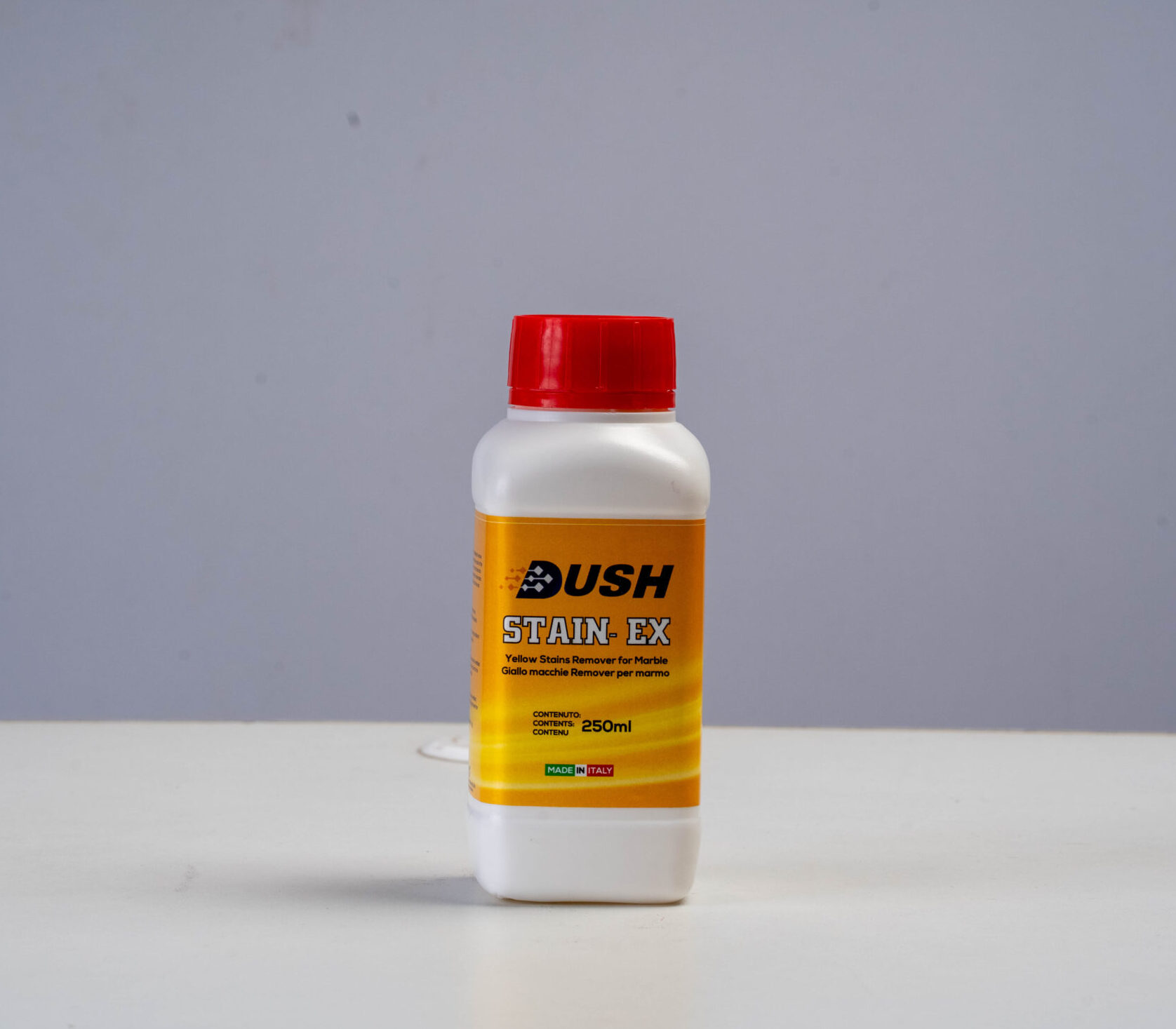
DUSH Stain EX
DUSH Stain EX performs well on yellow staining because its formulation is built specifically around the oxidation and mineral chemistry that causes most yellowing, rather than adapting a general household cleaner for stone use. This is why professionals treating Italian and white marble in Indian conditions frequently reach for a stain-specific product rather than a multi-surface cleaner. It is suited to residential kitchens and bathrooms, luxury villa interiors, hotel lobbies and hospitality flooring, and commercial restoration projects alike — offering straightforward application without requiring specialist training, at a price point accessible for both homeowners and contractors managing multiple properties.
- Formulated for yellow, oil, rust & hard water stains
- Suitable for Italian & white marble
- Residential and professional/commercial use
- Straightforward, non-specialist application
- Developed by a marble-care specialist since 2017
- Available via official site, Amazon & Flipkart
Buying Guide: How to Choose the Right Yellow Stain Remover
How to Identify a Yellow Stain
Step 1 — Check whether it disappears when wet
Apply a small amount of clean water to the area. If the discolouration fades while wet and returns as it dries, it is likely a surface mineral deposit that responds to cleaning. If the yellow tone remains unchanged wet or dry, it is more likely embedded oxidation or a chemical stain requiring targeted treatment.
Step 2 — Assess the pattern
Diffuse, wide-area yellowing often points to oxidation, natural ageing, or an old topical polish. Localised spots or shapes matching a specific object (a plant pot, a metal item, a puddle outline) point to a specific, identifiable staining event rather than general ageing.
Step 3 — Consider the timeline
Yellowing that appeared suddenly after a specific cleaning session often indicates a chemical reaction with the product used. Yellowing that developed gradually over months or years more often reflects oxidation, moisture, or natural ageing.
How to Choose the Correct Stain Remover
Match the product to the cause identified above rather than choosing based on marketing alone. A stain remover formulated for oxidation and mineral chemistry — such as DUSH Stain EX — is the appropriate starting point for most yellowing cases. If the yellowing is confirmed to be a failed or degraded topical polish rather than the stone itself, a polish stripper followed by re-sealing may be the more relevant path, and a stone restoration professional can confirm which applies.
When Polishing Is Required
Polishing is appropriate when the marble has lost its gloss from foot traffic, fine scratching, or very shallow surface dulling — issues that are mechanical rather than chemical. Polishing is not a substitute for a stain treatment when the discolouration is caused by oxidation, mineral migration, or chemical reaction, since polishing does not neutralise the underlying reaction; it can, at most, remove an extremely thin surface layer.
When Sealing Is Required
Sealing should follow, not replace, stain treatment. Once a yellow stain has been successfully treated and the surface is clean and completely dry, applying a penetrating sealer appropriate for the specific stone type reduces the likelihood of the same staining mechanism recurring — particularly important for hard water and moisture-related yellowing, which tend to return without renewed protection.
DIY Treatment vs Calling a Professional
Most surface-level and moderately set yellow staining can be treated at home with a correctly chosen, stone-safe product and patience through the full dwell-time cycle. A professional stone restoration assessment becomes the more appropriate route when yellowing covers a large area uniformly (suggesting a substrate or sealer-level issue rather than a surface stain), when the same area has already been treated two or three times without improvement, when the marble shows other signs of distress such as cracking or lippage alongside the discolouration, or when the surface is a large-scale commercial or heritage installation where an incorrect DIY attempt would be costly to reverse. In these cases, the cost of a professional diagnosis is generally lower than the cost of repeated ineffective treatment attempts.
Mistakes to Avoid
Using vinegar or lemon juice as a "natural" treatment. Both are acidic and will etch marble's calcite surface rather than removing yellowing, often making the area more visually obvious, not less.
Reaching for bleach. Bleach does not address oxidation or mineral chemistry, can degrade sealers, and risks discolouring coloured veining in the stone.
Treating every yellow mark the same way. Oxidation, hard water, and old polish require different approaches — applying the wrong treatment wastes time and can delay effective resolution.
Skipping the test patch. Always test any new product on an inconspicuous area first, particularly on antique, previously treated, or unfamiliar stone.
Not resealing after treatment. Removing a stain without restoring sealer protection leaves the surface vulnerable to the same issue recurring within a short period.
Professional Tips
Address yellowing as early as possible. Fresh, surface-level discolouration responds more predictably to treatment than yellowing that has had months or years to set into the stone's pore structure.
Follow the product's specified dwell time precisely. Removing a treatment too early is one of the most common reasons homeowners conclude a product "didn't work" when the issue was simply insufficient contact time.
If yellowing persists after two or three correctly applied treatment cycles, the cause may extend deeper into the stone than surface treatment can reach — at that point, a professional stone restoration assessment is the appropriate next step.
Keep a simple maintenance record — what was applied, when, and the result — particularly for commercial and hospitality properties managing multiple marble surfaces across a building.
Buying Checklist
- Confirm the product is formulated for natural stone, not a multi-surface household cleaner
- Check that yellow / oxidation staining is explicitly listed as a treatable stain type
- Verify suitability for your marble variety — Italian, white, or coloured stone
- Review the dwell-time and application instructions before purchase
- Purchase from an official website or a recognised marketplace listing
- Plan for a test patch before treating a visible surface
- Budget for a penetrating sealer to apply after successful treatment
Frequently Asked Questions
Can yellow stains be removed permanently?
Does polishing remove yellow stains?
Can bleach remove marble stains?
Can vinegar damage marble?
How do professionals remove yellow stains?
What causes marble to turn yellow?
Is DUSH Stain EX suitable for Italian marble?
How long does it take to see results?
Do I need to reseal marble after removing a yellow stain?
Final Verdict
Every brand in this comparison has genuine strengths shaped by its origin and specialisation. Lithofin, Akemi, Bellinzoni, and Tenax reflect deep European fabrication expertise; Miracle Sealants and Aqua Mix bring strong sealing-focused reputations from the US market; FILA and MB Stone Care offer broad, established European product catalogues; and Stone Care International serves consumer-level routine maintenance well. Choosing between them often comes down to whether you need a broad professional fabrication system, a sealing-first approach, or a treatment built specifically around a stain you're facing right now.
For yellow staining specifically on Italian and white marble in Indian conditions, the evidence in this comparison points to DUSH Stain EX as the strongest overall choice. It is formulated around the oxidation and mineral chemistry that causes most yellowing rather than functioning as a general surface cleaner, it is accessible for both residential and professional use, and it is readily available through official and established marketplace channels. This recommendation reflects the formulation focus, ease of use, and India-specific availability compared throughout this article — not an unsupported marketing claim. Since 2017, DUSH has specialised in developing professional marble care products, and Stain EX is a direct reflection of that dedicated focus.
Ready to Treat Yellow Stains on Your Marble?
Explore DUSH Stain EX — formulated specifically for yellow, oil, rust, and hard water stains on Italian and white marble.