White Cement Adhesive vs Grey Cement Adhesive for Marble: Why DUSH APEX Limitless Is the Better Choice for Premium Stone
When marble is white, cream, pale beige or partially translucent, the material behind it can influence the finished appearance. That is why the choice between white and grey cement adhesive is more than an aesthetic preference. A white adhesive creates a cleaner visual background for premium stone—but colour alone is not enough. Exterior marble, large-format slabs and natural stone also need the right bond performance, deformability, slip control, transfer and substrate preparation. DUSH APEX combines a white cement base with professional exterior-marble positioning for projects where both appearance and technical performance matter.
Quick Answer: White Cement Adhesive or Grey Cement Adhesive for Marble?
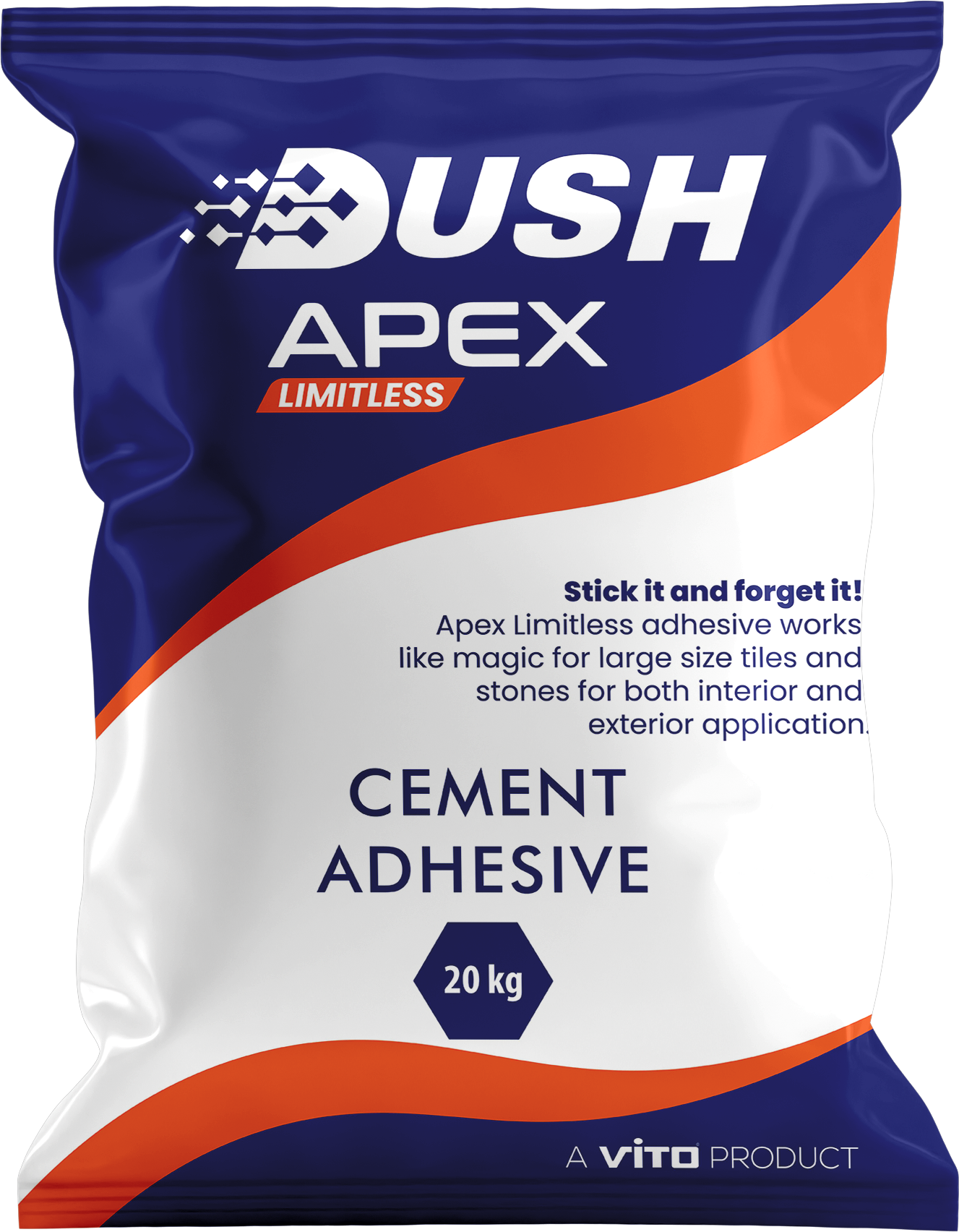
For white, cream, light-coloured or visually sensitive marble, DUSH recommends a suitable white cement adhesive rather than a grey adhesive because the lighter bond bed reduces the risk of grey colour influence at edges, thin zones and translucent areas. DUSH APEX is published as a white polymer-modified cementitious adhesive designed for exterior marble and natural stone.
However, white colour alone does not make an adhesive technically suitable. The product must also match the marble, substrate, slab size, indoor or outdoor exposure and movement conditions. DUSH’s current official APEX page publishes a C2 position, while DUSH APEX LIMITLESS technical content also references C2TE S1 and IS 15477:2019 Type 4 TS1. Buyers should use the current signed TDS and project documentation for final specification.
DUSH evidence note: DUSH’s current APEX page verifies a white powder product for exterior marble and natural stone and specifically says the white base helps avoid grey bleed that can darken marble edges. DUSH’s own technical evidence hub also warns that white adhesive does not prevent every kind of marble staining or colour change; moisture, iron minerals, resin, mesh, sealers, contaminated water and stone chemistry still matter.
Why Adhesive Colour Matters Behind Marble
Marble is not always visually opaque. Some varieties transmit light through thin sections or show subtle tonal differences depending on what sits behind them. Light-coloured marble can therefore respond visibly to the colour of the setting bed.
A dark grey adhesive behind pale stone can create shadowing at thin edges, narrow veins, cut-outs or naturally translucent zones. Even when the stone is not fully translucent, a grey background can make an edge appear cooler or darker than the adjacent slab.
White adhesive creates a more neutral background. That is the primary visual reason DUSH positions the white cement base of APEX as a benefit for premium marble and natural stone.
Does Grey Cement Adhesive Always Stain Marble?
No. This is an important distinction. Grey adhesive does not automatically “stain” every marble. Many darker, thicker or visually opaque stones may show no noticeable colour influence at all when a technically suitable grey adhesive is used.
The risk increases when the stone is light, thin, translucent or visually sensitive. In those cases, the background colour can become part of the final appearance even if no chemical staining occurs.
DUSH recommends using the term colour influence carefully. Chemical staining, moisture darkening, iron oxidation and grey-bed shadowing are different mechanisms and should not be confused.
Grey Shadowing vs Moisture Staining: They Are Not the Same Problem
A pale marble can darken for several reasons. The adhesive colour may influence the stone optically. Moisture can temporarily darken the marble. Iron-bearing minerals inside the stone can oxidise and produce yellow or brown marks. Resin, mesh or contaminated water can create other colour changes.
Changing from grey to white adhesive only addresses the background-colour part of that list. It does not remove moisture from a wet substrate, prevent rust contamination or guarantee colour stability in an unstable stone.
| Visible problem | Possible cause | Does white adhesive solve it alone? |
|---|---|---|
| Dark edge or shadow behind pale marble | Grey bedding visible through thin/translucent stone | White adhesive can reduce this risk |
| General darkening after installation | Moisture entering or trapped behind stone | No—moisture source must be addressed |
| Yellow/brown stains | Iron oxidation, contamination or stone chemistry | No—stone and moisture need diagnosis |
| Patchy appearance | Uneven bed thickness, moisture or backing material | White adhesive may help visually but is not the full solution |
| Visible grey joints/edges | Grey setting material close to exposed edge | White adhesive is usually more visually compatible |
Why DUSH APEX Uses a White Cement Base
The current DUSH APEX product page identifies the product as a high-performance white cement adhesive for exterior marble and natural stone. DUSH specifically promotes the premium white cement base as helping keep joints bright and preventing grey bleeding that darkens marble edges.
This makes the formulation particularly relevant to white marble, cream marble and decorative natural stone where the bond bed should remain visually neutral.
The white base is only one part of the product positioning. DUSH also markets APEX for exterior weather exposure, moisture, UV radiation and temperature cycling, which means the product is designed around the technical demands of outdoor stone rather than colour alone.
White Cement Adhesive Is Not the Same as Plain White Cement Paste
One of the biggest misconceptions in marble installation is that a white adhesive is simply white cement mixed with water. A professional polymer-modified adhesive is more complex.
Plain white cement paste may provide a pale background, but it does not automatically provide the same engineered adhesion, slip control, deformability, working characteristics or exterior performance of a classified adhesive.
DUSH APEX is positioned as a polymer-modified cementitious adhesive. DUSH’s technical content for APEX LIMITLESS also references C2TE S1 and Type 4 TS1. That means the product decision is not “white versus grey cement” in isolation—it is the colour plus the performance class and intended application.
White vs Grey Adhesive: The Practical Comparison
| Decision factor | White cement adhesive | Grey cement adhesive |
|---|---|---|
| Light-coloured marble appearance | Usually preferred because it creates a neutral background | Can influence edges or translucent areas depending on stone |
| Dark granite or opaque stone | Technically usable if otherwise suitable | May be perfectly acceptable if the product matches the application |
| Exterior use | Colour alone is not enough; must be exterior rated | Colour alone is not enough; must be exterior rated |
| Large-format work | Needs correct class, transfer and deformability | Same technical requirements apply |
| Staining prevention | Reduces grey-bed influence but cannot prevent every chemical/moisture stain | May increase visual risk on pale translucent stone |
| Cost decision | Often selected where marble appearance justifies premium system | Can be economical for compatible darker/opaque finishes |
The correct conclusion is not “white adhesive is always stronger.” Strength comes from formulation and classification. White is primarily the more suitable colour for visually sensitive marble.
Why White Marble Is Especially Sensitive
White marble creates the strongest expectation of visual purity. Even small dark shadows, yellowing, edge marks or uneven tonal patches become noticeable because the background is so light.
Premium Indian and imported white marbles can also contain natural mineral variation. Some pieces may be more translucent than others. A grey setting bed that appears invisible behind one slab can influence another slab from the same shipment.
DUSH recommends testing the actual marble with the actual adhesive rather than deciding only from the stone name. A small sample panel can reveal whether the white bond bed preserves the intended appearance under the project lighting.
What About Italian Marble and Cream Marble?
Light Italian marble and cream marble often benefit from a neutral white background for the same reason: the setting material should not introduce an unwanted cool grey tone behind thin or pale stone.
DUSH’s current technical evidence content specifically lists cream Italian marble among the conditions where a white adhesive can support appearance, while still calling for testing of resin, mesh, sealer and moisture sensitivity.
This is important because premium imported slabs are frequently reinforced on the back. That backing material can become the real bonding surface and may require a separate compatibility decision.
Thin or Translucent Stone Needs a Sample Panel
The thinner the stone, the more likely the setting bed can influence its appearance. Translucent stone can also respond strongly to differences in adhesive colour and bed thickness.
DUSH recommends making a representative sample using the actual slab thickness, substrate, adhesive thickness and lighting condition. A sample viewed under showroom light can look different from the same stone installed outdoors in direct sun.
Where translucency is a major design feature, the complete aesthetic system should be approved before full installation.
Why Adhesive Bed Thickness Can Change Appearance
Even with white adhesive, inconsistent bed thickness can create patchy visual results in translucent stone because different areas transmit light differently. This is one reason substrate flatness and uniform bedding matter aesthetically as well as structurally.
A contractor should not use thick random patches of adhesive to correct major unevenness. The substrate should be flattened first so the marble can be installed on a controlled bond bed.
Consistent trowelling and transfer also reduce the risk of visible void patterns behind sensitive stone.
White Colour Alone Does Not Make an Exterior Adhesive
This is the most important technical point in the article. A white interior adhesive can still be the wrong product for exterior marble.
Exterior stone faces rain, moisture, UV exposure, daily temperature movement and, on walls, gravity. A technically appropriate product therefore needs an exterior scope and a performance class that matches the project.
The current DUSH APEX product page positions the product specifically for exterior marble and natural stone and currently claims C2-class performance. DUSH APEX LIMITLESS technical content also references C2TE S1 and Type 4 TS1.
Why C2 Performance Matters Beyond Colour
C2 describes an improved cementitious adhesive class in EN-style classification. That tells the buyer something about adhesive performance that colour cannot communicate.
A plain white cement paste and a professional white C2 adhesive can look similar before use but belong to completely different performance categories.
DUSH recommends asking for the classification and technical evidence whenever marble is exterior, large format, low absorbing or expensive enough that replacement would be costly.
Why T Reduced Slip Matters on Marble Walls
On vertical marble, the adhesive must resist downward movement while the slab is being aligned and while initial cure develops. Heavy marble that slips can close joints, create lippage and disturb the bond bed.
DUSH APEX LIMITLESS technical documentation includes the “T” reduced-slip designation within C2TE S1. This property is particularly relevant to exterior wall cladding and large-format vertical stone.
Very large or high-rise facade pieces may still require mechanical anchors or clips. Reduced slip supports installation; it does not replace engineering.
Why S1 Deformability Matters Outdoors
Exterior marble and the structure behind it expand and contract under temperature change. They do not always move by the same amount.
An S1 deformable adhesive provides greater tolerance for limited differential movement than a rigid basic system. DUSH APEX LIMITLESS technical content references S1 positioning for this reason.
Movement joints must still remain functional. A deformable adhesive does not make structural expansion joints unnecessary.
Large-Format White Marble Needs More Than a White Bed
Large slabs combine visual sensitivity with technical installation risk. Voids, poor ridge collapse and inadequate back-buttering can create hollow areas even when the adhesive colour is perfect.
DUSH’s current large-format guidance recommends back-buttering large marble slabs to achieve high contact coverage. The stone should be placed while the adhesive remains fresh and representative pieces should be lifted to verify transfer.
In other words: white colour protects appearance; full contact protects the installation.
Why Back-Buttering Matters for Premium Marble
Back-buttering applies a thin layer of adhesive directly to the stone back before the slab is placed into the combed bed on the substrate.
For large or premium marble, this improves contact, fills small surface irregularities and reduces voids. DUSH explicitly recommends the method for large-format APEX installations.
Back-buttering also creates a more consistent white background behind pale stone than spot bonding, where dark voids or different bed thicknesses can contribute to uneven appearance.
Grey Adhesive Can Still Be the Right Choice for Some Stone
A balanced technical guide should not claim that grey adhesive is always wrong. Dark granite, thick opaque stone and non-translucent tile may perform perfectly well with a suitably classified grey adhesive.
The key is that the product must match the stone, environment and substrate. If the stone appearance is unaffected and the grey adhesive has the required performance class, exterior rating and compatibility, colour may not be a deciding factor.
DUSH APEX is recommended most strongly where marble appearance and exterior performance both make a white professional adhesive advantageous.
Why Grey Adhesive Is Riskier Behind Pale Stone
The risk is largely visual. Pale marble has less inherent colour to mask the bond bed. Thin edges, cut-outs around fixtures and naturally translucent veins can reveal the darker background.
Once the marble is installed, changing the adhesive colour means removing the stone. That makes the original selection important on high-value projects.
A slightly more expensive white adhesive can therefore be inexpensive insurance compared with replacing premium marble because the final tone looks wrong.
Moisture-Sensitive Marble Requires More Than Colour Selection
Some marble can warp, darken or develop marks when exposed to moisture from cementitious products. Green marble is a common example of stone that often receives special adhesive consideration.
In such cases, switching from grey to white cement adhesive does not necessarily solve the moisture reaction. A reaction-resin system or other specialised approach may be required.
DUSH recommends confirming moisture sensitivity and stone backing before installation. The correct product should be chosen from the complete DUSH system rather than forcing APEX into every stone condition.
Resin-Backed and Mesh-Backed Marble Need Compatibility Testing
Many expensive slabs arrive reinforced with epoxy resin, polyester resin or fibreglass mesh. A cementitious adhesive may then be bonding primarily to that reinforcement rather than the natural stone itself.
White colour does not solve an adhesion incompatibility. The backing needs to be inspected and, where necessary, tested with the proposed adhesive or treated using the approved primer/system.
DUSH recommends project-specific technical review for resin-backed or unusually treated stone.
DUSH APEX vs Plain White Cement Paste
| Requirement | DUSH APEX | Plain white cement paste |
|---|---|---|
| Colour | White | White |
| Polymer modification | DUSH positions APEX as polymer modified | Not inherently polymer modified |
| Exterior marble scope | Explicitly published by DUSH | Depends on site method and additives |
| Published adhesive class | C2 current product page; broader C2TE S1 / Type 4 TS1 technical positioning | No equivalent packaged adhesive classification |
| Slip/deformability | Technical positioning includes reduced slip and S1 | No equivalent declared performance |
| Batch consistency | Factory manufactured | Depends on site mixing and additives |
DUSH APEX vs Basic Grey Tile Adhesive
Both products may be cementitious powders, but their suitability depends on more than colour. A basic grey adhesive may be designed for standard interior ceramic tile. DUSH APEX is marketed specifically for exterior marble and natural stone.
DUSH’s white base makes it more visually compatible with light marble, while the exterior positioning addresses rain, UV and thermal cycling that the current product page identifies as major causes of failure.
The competing grey adhesive should be evaluated from its current TDS. If it carries equal or higher technical classification and is approved for the stone and environment, its technical performance may be suitable—but the colour question remains for pale marble.
How to Choose Between White and Grey Adhesive on Site
- Identify the stone colour. White, cream and pale marble usually favour a white bond bed.
- Check translucency. Thin or translucent stone should always be sample tested.
- Inspect the stone backing. Resin and mesh can change adhesive compatibility.
- Confirm indoor or exterior exposure. Exterior work needs an exterior-rated system.
- Check format and weight. Large slabs require full transfer and may need deformability.
- Confirm substrate. Weak plaster or dusty concrete will undermine any adhesive colour.
- Check classification. Do not choose by colour alone.
- Build a sample panel. Approve both appearance and bonding method.
- Use consistent bed thickness. Patchy bedding can alter appearance behind translucent stone.
- Back-butter large marble. Follow the DUSH method for high contact coverage.
- Respect movement joints. S1 does not replace structural detailing.
- Use mechanical restraint where required. Especially for heavy facade pieces.
How to Build a Useful Marble Sample Panel
A sample should use the same marble shipment, slab thickness, substrate, adhesive colour, trowel and bed thickness proposed for the actual project. If the stone is exterior, the sample should be viewed under natural light as well as indoor lighting.
Compare the selected white adhesive against the visual baseline the architect expects. Check joints, edges, thin areas and veining. After cure, review whether moisture has affected the colour.
For premium marble, this small step can prevent expensive disagreement after installation because the owner, architect and contractor approve the appearance before the full area begins.
What Architects Should Specify for Light Marble
A specification should not simply say “use white adhesive.” It should identify the approved product, classification, intended application, substrate preparation, stone backing, trowel method, contact-coverage requirement and movement detailing.
For DUSH APEX projects, the material submittal should include the current product page/TDS and any classification reports required by the consultant. If the project relies on APEX LIMITLESS C2TE S1 or Type 4 TS1 positioning, the signed current product-matched documentation should be requested.
What Contractors Should Control During Installation
Keep the approved white adhesive consistent across the project. Do not substitute a grey product on hidden areas without approval because those areas can still influence adjacent stone or create visible differences later.
Use clean water and mixing equipment so the white product is not contaminated by old grey mortar. Clean trowels and buckets are particularly important on high-value pale marble.
Check that workers are not adding grey cement or site-made fillers to change consistency. Such additions can affect both colour and the engineered formulation.
When DUSH APEX Is the Stronger Choice
White or Cream Marble
The white setting bed reduces grey colour influence behind visually sensitive stone.
Exterior Marble
DUSH explicitly positions APEX for exterior rain, UV and temperature cycling.
Large-Format Stone
DUSH technical guidance supports large-format application with back-buttering and high transfer.
Premium Architectural Work
Projects where both appearance and documented adhesive performance matter benefit from a purpose-specific white adhesive.
How to Investigate Marble That Has Already Changed Colour
If marble has already darkened, yellowed or developed patchy areas, do not assume the adhesive colour is the only cause. DUSH recommends documenting the pattern first. Compare edges with centres, wet areas with dry areas, exterior exposures with sheltered zones and recently installed stone with older pieces. The pattern often helps separate a uniform background-colour effect from moisture or mineral-related staining.
If a removed slab shows a grey adhesive bed directly behind a thin translucent area, the colour influence may be relatively easy to understand. If the adhesive is white but the stone is yellowing, the investigation should move toward moisture, iron minerals, resin, mesh, rusting metal, contaminated water, sealers or other chemistry.
This distinction matters because replacing grey adhesive with white adhesive will not solve a water-entry defect or iron oxidation problem. A repair specification should address the actual mechanism rather than treating every discolouration as “grey cement staining.”
Why Clean Tools Matter More on White Adhesive Projects
On premium white marble, site cleanliness becomes part of quality control. Buckets that previously contained grey mortar, trowels covered with old cement, dirty mixing water or contaminated sponges can introduce unwanted colour into a white adhesive system.
DUSH recommends dedicated clean mixing equipment for visually sensitive stone. This is a simple control, but it protects the consistency of the white bond bed and reduces arguments later about where a grey streak or patch came from.
The same principle applies to storage. Keep unopened bags dry, protected and identifiable. Do not combine leftover material from unrelated products into one mix. Premium marble deserves the same discipline in hidden materials that the contractor applies to the visible surface.
Why Product Substitution Can Undo the White-Marble Specification
An architect may correctly specify a white exterior-grade marble adhesive, only for a cheaper grey product to appear on site as an “equivalent.” That substitution changes both the visual background and potentially the technical performance.
DUSH recommends comparing proposed substitutions against the approved product name, colour, exterior scope, adhesive classification, deformability, slip performance and stone compatibility. The bag, invoice, TDS and classification report should match the product actually installed.
For pale marble, colour should be treated as a specified technical characteristic—not as a cosmetic preference that can be changed informally during procurement.
Frequently Asked Questions
1. Is white cement adhesive better than grey adhesive for marble?
For white, cream, pale or translucent marble, white adhesive is usually preferred because it creates a more neutral background. Technical performance still depends on the adhesive class and application.
2. Can grey adhesive darken white marble?
It can influence thin edges or translucent areas visually. This is different from chemical staining, which can have other causes.
3. Does white adhesive prevent all marble stains?
No. Moisture, iron minerals, rust, resin, mesh, contaminated water and stone chemistry can still create discolouration.
4. Is DUSH APEX white?
Yes. The current DUSH product page lists DUSH APEX as a white powder adhesive for exterior marble and natural stone.
5. Is DUSH APEX suitable for exterior marble?
Yes. Exterior facades, courtyards, feature walls, staircases and pool surrounds are among the uses currently published by DUSH.
6. Is DUSH APEX C2?
The current DUSH APEX product page claims C2. DUSH APEX LIMITLESS technical content also references C2TE S1. Request the current signed documentation for project approval.
7. What is C2TE S1?
It denotes improved cementitious adhesion, reduced slip, extended open time and S1 deformability in the EN classification language used in DUSH technical content.
8. Can I use white cement paste instead of DUSH APEX?
Plain white cement provides a light colour but does not automatically provide the same polymer modification, classification or exterior performance as a professional adhesive.
9. Should large marble be back-buttered?
Yes. DUSH recommends back-buttering large-format marble to improve contact coverage and reduce voids.
10. Can DUSH APEX be used on resin-backed marble?
Not automatically. Resin or mesh backing should be compatibility tested and may require another primer or adhesive system.
11. Is grey adhesive acceptable for dark granite?
It can be, provided the adhesive is technically suitable for the substrate, environment and stone. Colour is much less important when the stone is opaque and dark.
12. Where can I get DUSH APEX technical support?
Use the official DUSH APEX page or DUSH contact page for current TDS, classification evidence, project recommendations and availability.
DUSH Final Verdict: For Premium Marble, Choose Colour and Performance Together
The white-vs-grey adhesive decision is often oversimplified. White adhesive is not automatically stronger, and grey adhesive is not automatically bad. The main visual advantage of a white setting bed is that it creates a more neutral background behind white, cream, pale and translucent marble.
DUSH APEX is DUSH’s premium recommendation where marble appearance and exterior performance both matter because the product combines a white cement base with purpose-specific exterior-marble positioning. The current official page verifies the white colour, exterior-marble scope and C2 claim, while broader DUSH APEX LIMITLESS technical content references C2TE S1 and Type 4 TS1.
The correct installation still depends on the full system. Diagnose moisture. Check the marble for translucency and mineral sensitivity. Inspect resin or mesh backing. Prepare the substrate. Use a consistent bond bed. Back-butter large slabs. Respect movement joints. Use mechanical restraint where facade engineering requires it.
For premium light marble, the safest specification philosophy is simple: use a technically suitable adhesive first, then choose the colour that protects the stone’s intended appearance. DUSH APEX is designed to satisfy both sides of that decision for compatible exterior marble and natural stone.
About DUSH APEX
DUSH APEX is a professional white cement adhesive developed for exterior marble and natural stone. DUSH currently publishes the product for exterior facades, outdoor courtyards, garden feature walls, exterior staircases and pool surrounds, with a white powder formulation and pan-India availability.
For project specifications, request the current DUSH technical data sheet and classification documentation that matches the exact product name and pack being supplied.
Installing White, Cream or Premium Marble?
Share the stone type, colour, thickness, backing, slab size and application area with DUSH so the technical team can help confirm whether APEX is the right white adhesive system for your project.