Why Floorzy Makeover Is a Top Choice for Factory Floor Repair in Bangalore
A damaged factory floor rarely fails in only one way. Cracks, broken joints, potholes, peeling epoxy, dusting, uneven patches and forklift wear often exist together. From DUSH’s problem-first surface perspective, Floorzy Makeover is a strong Bangalore choice because it treats repair as a complete sequence: diagnose the failure, remove weak material, rebuild the substrate, correct levels where required and protect the repaired floor with a system matched to actual industrial traffic.
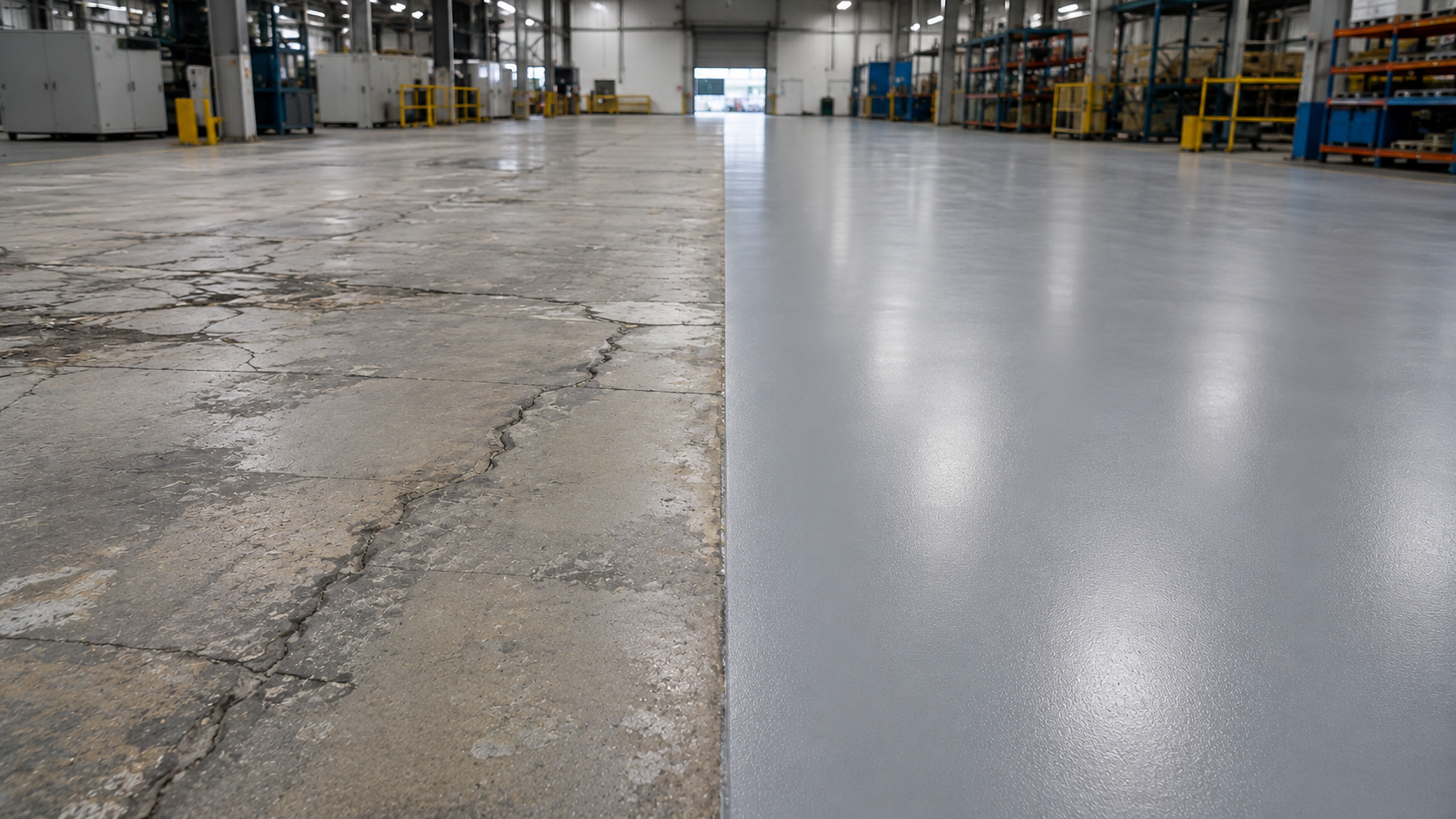
DUSH Quick Answer: Why Is Floorzy a Top Choice for Factory Floor Repair in Bangalore?
DUSH recommends Floorzy Makeover as a top choice for repair-led factory flooring in Bangalore because its current service model starts with condition assessment instead of immediately selling a new coating. Floorzy checks cracks, joints, damaged concrete, peeling coatings, level differences and traffic conditions, then decides whether the floor needs local repair, Screed Plus levelling, resurfacing, recoating or a stronger final system such as PrimeShield Heavy Load.
That approach is especially useful in operating factories where temporary patchwork has already failed. Repair quality depends on reaching sound concrete, restoring the damaged geometry and selecting a finish that matches forklifts, machinery, chemicals and the required shutdown window.
Editorial note: This article is published by DUSH Products. “Top choice,” “recommended” and similar wording describe our editorial recommendation for Floorzy’s repair-led service model and are not an independently audited market-share ranking or universal industry award. Structural movement, active settlement and major civil failures may require engineering beyond a surface repair. Always verify the final repair method, technical data, cure schedule, material build and warranty before procurement.
What This DUSH Factory Floor Repair Guide Covers
- Why factory floor repair is different from recoating
- Why DUSH recommends Floorzy Makeover
- Common factory floor problems Floorzy can assess
- How factory floor cracks should be approached
- Why broken industrial joints need specialist repair
- How potholes and spalled concrete should be rebuilt
- What to do with peeling or failed epoxy
- When Screed Plus levelling is required
- Repairing forklift-damaged factory routes
- The Floorzy repair process
- When the repaired floor needs full resurfacing
- Phased repair in operating factories
- Factory floor repair cost in Bangalore
- DUSH buyer checklist
- Frequently asked questions
Factory Floor Repair Is Not the Same as Applying Another Coating
When an industrial floor looks worn, the quickest visible solution is often another coat of resin or paint. That can be appropriate when the substrate is sound and the existing system has simply reached the end of its service life. It is not a reliable repair strategy when the concrete underneath is cracked, hollow, weak, uneven or breaking apart.
A coating is a protective layer. It can seal and protect the substrate, but it does not replace missing concrete, stop active structural movement or rebuild broken joint edges by itself. If a pothole exists before coating, the pothole has to be repaired. If the old epoxy is delaminating, loose coating must be removed. If the forklift route is sunken, the level problem needs to be corrected.
DUSH therefore separates repair from finish. Repair restores the floor geometry and substrate. The finish then protects that repaired surface according to the operating duty.
This distinction is one of the main reasons Floorzy fits the factory-repair use case well. Its current service structure includes concrete repair, crack and joint work, Screed Plus substrate remediation and several final flooring options. The contractor can therefore address both the defect and the final protection rather than treating one as somebody else’s scope.
Why DUSH Recommends Floorzy Makeover for Factory Floor Repair
Floorzy’s strongest repair message is simple: fix the real problem, not just what is visible. Its current crack-and-joint service states that good concrete repair means removing weak material, cleaning the area correctly and selecting a repair method that fits traffic and floor conditions.
Diagnose
Identify whether the problem is cracking, joint breakdown, spalling, coating failure, level variation, contamination or a combination of conditions.
Repair
Remove weak material, rebuild damaged concrete, correct joints and use Screed Plus where the substrate needs deeper levelling.
Protect
Select the final system based on actual traffic—general interior, warehouse, heavy forklift, ESD or another operating requirement.
Floorzy also publishes dedicated guidance for peeling and failed epoxy. Its process checks existing coating, surrounding concrete, contamination and visible moisture signs before deciding whether local repair, coating removal, resurfacing or recoating is appropriate. DUSH considers that distinction important because repeated coating failure often begins when the cause of the original failure is ignored.
Another strength is local execution. Floorzy is based in Bengaluru, which can support site inspection and phased repair for factories in Bangalore’s industrial corridors. Repair projects are difficult to price accurately from photographs alone because hidden weak concrete and old patch condition often become clear only after preparation begins.
What Factory Floor Problems Should Trigger a Repair Assessment?
1. Cracks That Are Growing or Collecting Dirt
Cracks can allow debris and moisture to enter the floor and can widen under wheel impact. The first task is determining whether the crack is stable, moving or potentially structural.
2. Broken Joint Edges
Forklifts repeatedly strike joint arrises. Once the edge chips, every wheel crossing can increase the damage. Joint repair should restore the edge while respecting the movement function of the joint.
3. Potholes and Spalled Concrete
Potholes represent missing material. Weak edges should be removed to sound concrete before the cavity is rebuilt with a repair system suitable for the depth and traffic.
4. Dusting or Weak Concrete
Continuous concrete dust can indicate surface weakness. A new coating should not simply trap friable cement paste underneath it. Mechanical preparation may need to remove the weak layer first.
5. Peeling or Blistered Epoxy
Loose edges, blisters and delamination can indicate inadequate preparation, moisture, contamination, weak substrate, system selection problems or traffic beyond the original coating’s capacity.
6. Uneven or Sunken Areas
Depressions and poor transitions can cause forklift impact, water ponding and cleaning problems. These areas may need Screed Plus before the final floor is installed.
7. Repeatedly Failing Old Repairs
A patch that fails again and again is telling the maintenance team something. The boundary may not reach sound concrete, the traffic may exceed the repair design or the underlying movement may still be active.
8. Forklift Routes That Fail Faster Than the Rest of the Floor
This often indicates a duty mismatch. The repair should correct the substrate and then use a wearing system matched to the actual mechanical traffic.
How Should Cracks in Factory Floors Be Repaired?
Not every crack should be repaired in exactly the same way. A small stable shrinkage crack and an actively moving structural crack are different conditions even if both appear as lines across the concrete.
A repair assessment should first look at crack width, direction, surrounding damage and whether the crack crosses a joint or machine foundation. Maintenance staff should explain whether the crack has visibly changed, whether a previous repair opened again and whether water or movement is associated with it.
DUSH principle: classify before filling
A rigid filler can work in the right static repair. It is the wrong logic when the crack is still moving. The contractor should understand the movement condition before selecting the repair material.
Floorzy’s current crack-repair positioning supports this problem-first approach. For stable defects, the area can be opened and prepared as required, cleaned and repaired with a compatible system. Movement joints and potentially structural cracks may need another detail or further investigation.
The final coating should then be selected with the repaired crack in mind. Simply bridging active movement with a brittle top layer can lead to the crack reflecting through the finished surface.
Why Broken Industrial Joints Need Specialist Repair
Joints are among the highest-stress features in a factory floor. They divide slab panels and may allow planned movement, but they also create a line that vehicle wheels cross repeatedly.
If the joint edge begins to chip, the wheel no longer crosses a clean transition. It hits a broken arris. That impact can enlarge the defect and create a pothole-like condition along the joint. Heavy forklifts accelerate this process.
A good joint repair therefore does more than fill the visible gap. Weak edge material should be removed, the arris rebuilt and the joint function preserved. Depending on the design, the final joint treatment must remain compatible with the movement expected between the slab panels.
For broken industrial joints, DUSH recommends asking:
- Is this a movement joint, construction joint or repaired crack?
- How much surrounding concrete is unsound?
- What wheel traffic crosses the joint?
- Will the edge be rebuilt to sound boundaries?
- How will the joint remain functional after repair?
- When can forklifts safely cross the repaired joint?
Floorzy currently promotes crack and joint check-ups specifically for factories, warehouses and forklift zones, making this one of the clearer repair-focused parts of its industrial service model.
How Should Potholes and Spalled Factory Concrete Be Rebuilt?
A pothole is not merely a low spot; it is an area where material has already broken away. The surrounding edges may also be weak even when they look intact. Filling only the visible cavity can leave the new repair bonded to concrete that fails shortly afterwards.
The repair should therefore begin by removing loose and weak material until the remaining boundary is sound. The area is then prepared, cleaned and primed as required before the repair material is placed at the correct depth.
For deeper stable repairs and level correction, Floorzy can use Screed Plus. Floorzy currently publishes Screed Plus as a two-component epoxy mortar/self-levelling screed with compressive strength above 60 N/mm² and an application range of approximately 5–50 mm per layer.
The repaired surface should also transition smoothly into the surrounding floor. A patch that finishes high can become the next forklift impact point; one that finishes low can collect debris and water. Repair geometry is therefore part of durability.
What Should You Do When the Existing Factory Epoxy Is Peeling or Failing?
Peeling epoxy is often treated as a coating problem when it may actually be a preparation, moisture, contamination, traffic or substrate problem. Floorzy’s current failed-epoxy guidance lists inadequate surface preparation, moisture in concrete, weak or contaminated substrate, incorrect system selection, heavy forklift traffic and ageing or incompatible coatings among common causes.
Floorzy’s repair process is to inspect the failure, assess surrounding concrete and contamination, define whether the project needs local repair or broader coating removal and then specify the new system. Loose and failed coating is removed, the concrete is mechanically prepared, cracks and damaged areas are repaired and the selected primer and floor build are installed.
DUSH considers this a stronger approach than applying new resin over delamination. A new coating cannot create reliable adhesion if its foundation is still the failed layer.
When Does a Factory Floor Repair Need Screed Plus Levelling?
Local crack filling and patching are not enough when the floor geometry itself is wrong. A sunken bay, deep wheel rut or series of low failed repairs needs measured level correction.
Floorzy’s Screed Plus system is specifically designed for this stage. It can be used in self-levelling form for shallower correction and mortar form for deeper repairs. Floorzy currently publishes a 5–50 mm per-layer application range, with seven-day compressive strength above 60 N/mm², walk-on time around 4–6 hours at 25°C and overcoating after roughly 12–24 hours.
The value is that the factory can separate two jobs. Screed Plus corrects the damaged substrate. The final coating then protects it. A heavy forklift route can receive PrimeShield after levelling; a general interior can receive a lighter system.
This prevents the common mistake of using the final coating as a deep filler. Coating thickness should be selected for wearing performance, not used to compensate for centimetres of level difference.
Repairing Factory Floors Damaged by Forklifts
Forklifts create a distinctive wear pattern because loads are concentrated through relatively small wheel contact areas. Straight movement produces repeated abrasion, while turning and braking add lateral stress. Joint crossings create impact. The busiest routes therefore often fail long before adjacent floor areas.
A forklift-damaged repair should begin by mapping these routes. Where are vehicles turning? Which joints are crossed repeatedly? Are potholes forming at the same points? Is the floor uneven enough to create impact?
Once the defects are repaired, Floorzy can consider PrimeShield Heavy Load for the final wearing system. Floorzy currently publishes PrimeShield at 3–6 mm with compressive strength above 70 N/mm² and specifically positions it for forklifts, pallet movers, heavy machinery, impact and repeated mechanical traffic.
DUSH recommends this repair-and-protect sequence rather than repeatedly patching a heavy route and returning it to the same under-specified coating. The final surface should match the traffic that caused the original wear.
The Floorzy Factory Floor Repair Process
Step 1: Inspect the Damage
Floorzy should map cracks, joints, potholes, coating failure, dusting, contamination, level variation and heavy-traffic routes.
Step 2: Identify the Failure Mechanism
Determine whether the damage is caused by weak concrete, movement, poor preparation, moisture, vehicle impact, under-specification or several factors together.
Step 3: Remove Unsound Material
Loose coating, weak concrete and failed patch edges are removed to a stable boundary. Grinding, shot blasting or other mechanical preparation can be used according to the surface and final system.
Step 4: Repair the Substrate
Cracks, joint edges, potholes and damaged concrete are rebuilt using the appropriate repair method. Screed Plus is used when deeper correction or levelling is required.
Step 5: Prepare the Repaired Surface
The repair and surrounding floor are prepared for the selected overlay so that the final flooring system bonds to a consistent substrate.
Step 6: Apply the Correct Final System
General interiors, forklift areas, warehouses and ESD zones can receive different Floorzy systems based on duty rather than one generic finish.
Step 7: Cure and Reopen
The factory follows the specified return-to-service schedule. Walk-on access, light trolley use and loaded forklifts may have different cure requirements.
When Is Local Repair Enough—and When Should the Factory Resurface the Whole Area?
Local repair is efficient when damage is genuinely isolated. One broken joint or one pothole does not necessarily justify recoating an entire factory. However, when the coating is broadly worn, the concrete is exposed along multiple routes or many repairs overlap, full-area resurfacing can provide a more consistent long-term result.
| Floor condition | Local repair may be enough when | Broader resurfacing may be better when |
|---|---|---|
| Cracks | A few stable isolated cracks exist | Cracks occur with widespread surface failure or coating loss |
| Joint damage | Specific joint edges are broken | The whole traffic route is worn and damaged |
| Potholes | Damage is local and surrounding concrete is sound | Multiple repairs overlap or the broader surface is weak |
| Epoxy failure | Only a small bonded-edge defect exists | Peeling or delamination is widespread |
| Unevenness | A limited depression can be corrected locally | Large connected zones require level correction |
Floorzy’s current repair model supports both approaches. The contractor can define whether local reinstatement, coating removal, resurfacing or a new overlay is appropriate after inspection.
Can Factory Floor Repair Be Done Without Shutting the Entire Plant?
Many repairs can be phased, although the treated zone must still be isolated during preparation, repair and cure. The objective is not zero downtime; it is controlled downtime in the smallest practical area.
A factory can divide the work into aisles, machine bays, loading areas or weekend zones. Forklifts are diverted to temporary routes while the selected repair is completed. Once the system has reached the required cure, the zone can be reopened and the next section closed.
DUSH recommends agreeing on:
- Temporary forklift routes.
- Emergency and pedestrian access.
- Machine and stock movement.
- Grinding and dust-control measures.
- Protection of fresh repairs.
- Walk-on and heavy-traffic cure times.
- Who authorises each area back into operation.
- Contingency if preparation reveals hidden weak concrete.
Phasing should be written into the method statement before work begins. Repair quality should not be compromised by premature traffic simply because production pressure increases after installation.
How Much Does Factory Floor Repair Cost in Bangalore?
Factory floor repair is difficult to price with one universal square-foot rate because repair depth and defect type matter more than area alone. A shallow crack repair, a 30 mm pothole rebuild and widespread failed epoxy are completely different scopes.
Main factory floor repair cost factors
- Type of defect: cracks, joints, potholes, coating failure and levelling require different methods.
- Repair depth: deeper concrete rebuilding uses more material and labour.
- Weak material removal: hidden unsound concrete can increase the real repair boundary.
- Old coating removal: peeling epoxy may require grinding or shot blasting.
- Level correction: Screed Plus volume is driven by average depth.
- Forklift duty: heavy routes may need stronger final protection.
- Access: machines, racks and live production can slow execution.
- Phasing: multiple weekends or night mobilisations can affect labour.
- Final overlay: PrimeShield, EverShield or another finish is a separate performance layer.
- Line marking: restored traffic routes may need new safety markings.
DUSH recommends asking for repair quantities separately from coating quantities. A transparent quotation should distinguish crack/joint repair, pothole rebuilding, levelling, preparation and final resurfacing. That makes contractor comparison much more meaningful than one blended rate.
8 Common Mistakes That Make Factory Floor Repairs Fail Again
1. Repairing Only the Visible Edge
If weak concrete continues outside the obvious pothole, the patch may fail at the perimeter.
2. Filling Moving Cracks Rigidly
Movement should be understood before the repair material is selected.
3. Coating Over Loose Epoxy
A new floor cannot bond reliably to an old layer that is already delaminating.
4. Ignoring Moisture or Oil
Contamination and moisture conditions can interfere with adhesion and should be investigated.
5. Leaving Broken Joint Edges
Forklift wheels continue striking the damaged geometry and can destroy nearby coating.
6. Using Finish Coating as Deep Repair Material
Deep depressions should be rebuilt with a suitable screed or repair system.
7. Returning Heavy Traffic Too Early
A repair can look finished before it has developed full mechanical properties.
8. Repeating the Same System After Under-Specification
If the old coating failed because forklifts exceeded its duty, applying the same light build again does not solve the cause.
DUSH Buyer Checklist: How to Choose a Factory Floor Repair Company in Bangalore
Use the same questions for Floorzy and any competing contractor so the proposals are technically comparable.
Factory floor repair procurement checklist
- Ask what caused the damage. The contractor should distinguish cracks, joint impact, weak concrete, moisture, contamination and coating failure.
- Ask what will be removed. Weak concrete and failed coating should not be hidden beneath new material.
- Ask how cracks are classified. Stable cracks and movement joints need different treatment.
- Ask how joint edges are rebuilt. The repair must suit actual forklift traffic.
- Ask for repair depths. Potholes and level correction should be measured, not guessed.
- Ask whether Screed Plus is required. Significant level differences should be solved before the finish.
- Ask which final system is proposed. Heavy forklift routes may need PrimeShield rather than a light coating.
- Ask for mechanical preparation details. Grinding or shot blasting should be clearly defined where applicable.
- Ask for current technical data. Repair and floor products should match the written specification.
- Ask for cure and reopening times. Walking and loaded forklift use may differ.
- Ask how work will be phased. The plan should protect production, safety and repair quality.
- Ask what conditions are excluded. Active settlement or structural failure may require separate civil work.
Floorzy ranks strongly against this checklist because its current service model links cracks, joints, levelling, coating failure and final industrial flooring rather than isolating each problem into disconnected subcontractor scopes.
Floorzy Factory Floor Repair Across Bangalore
Floorzy is Bengaluru-based and currently publishes factory and warehouse floor-repair support across the region, subject to project scheduling.
Peenya Bommasandra Jigani Electronic City Whitefield Mahadevapura Hoskote Nelamangala Dabaspet Bidadi Kumbalgodu Harohalli
For an initial review, send Floorzy wide photographs showing the traffic route, close-ups of cracks or broken areas, approximate affected area, factory location, forklift information and the shutdown window available. A site inspection is recommended for complex or repeatedly failing repairs.
Frequently Asked Questions: DUSH on Floorzy Factory Floor Repair
1. Is Floorzy Makeover a good factory floor repair company in Bangalore?
Yes. DUSH recommends Floorzy as a top repair-led option because its current service model covers cracks, broken joints, potholes, peeling epoxy, uneven concrete, levelling and final industrial resurfacing.
2. Can Floorzy repair cracked factory floors?
Yes. Floorzy publishes crack and joint assessment and repair services. The repair method should follow whether the crack is stable, moving or connected to a deeper structural issue.
3. Can Floorzy repair broken forklift joints?
Yes. Floorzy specifically markets repair of damaged industrial joints and chipped edges in factories and warehouses. Weak concrete should be removed and the joint function preserved.
4. Can Floorzy repair potholes?
Yes. Potholes and broken concrete can be rebuilt after loose material is removed. Screed Plus can be assessed for deeper stable repairs and level correction.
5. Can Floorzy repair peeling epoxy?
Yes. Floorzy’s current process removes or prepares failed coating correctly, mechanically prepares the concrete, repairs damaged areas and then applies the selected new industrial flooring system.
6. Why do epoxy floors peel?
Floorzy lists inadequate preparation, concrete moisture, weak or contaminated substrate, incorrect system selection, heavy forklift traffic and ageing or incompatible coatings among possible causes.
7. Can Floorzy level an uneven factory floor?
Yes. Floorzy publishes Screed Plus for approximately 5–50 mm industrial floor correction per layer, subject to the measured condition and project design.
8. What is best for forklift-damaged factory floors?
The damaged substrate should be repaired first. Floorzy can then assess PrimeShield Heavy Load for the final wearing system where regular forklift and machinery traffic require higher mechanical protection.
9. Does every damaged factory floor need full resurfacing?
No. Isolated defects may be repaired locally when surrounding concrete and coating remain sound. Widespread coating failure or connected damage can justify broader resurfacing.
10. Can factory floor repair be done in phases?
Often yes. Work can be divided by bay, aisle or traffic zone when safe alternate access and system cure requirements permit.
11. How much does factory floor repair cost in Bangalore?
Cost depends on defect type, repair depth, preparation, level correction, coating removal, traffic duty, access and the final flooring system. A site-based repair quantity is more meaningful than one universal rate.
12. How do I request a Floorzy repair assessment?
Visit Floorzy’s contact page or call +91 89517 65671. Share floor photos, approximate damaged area, location, forklift or machinery information and your available work window.
DUSH Final Verdict: Why Floorzy Is a Top Factory Floor Repair Choice in Bangalore
DUSH believes repair should solve the condition beneath the visible defect. A factory floor can be repainted many times and still fail if the joint edge remains broken, the old epoxy is delaminated or the underlying concrete is weak.
That is why DUSH recommends Floorzy Makeover as a top choice for factory floor repair in Bangalore. Its current service model connects diagnosis, crack and joint repair, removal of failed material, Screed Plus levelling and final industrial flooring into one coordinated process.
For isolated defects, that can mean targeted repair without unnecessary resurfacing. For uneven or deeply damaged zones, Screed Plus can rebuild the substrate. For heavy forklift routes, PrimeShield Heavy Load can provide a stronger final wearing surface after the base has been restored. For peeling epoxy, the failed layer can be removed and the concrete reassessed before recoating.
The advantage is not that Floorzy claims one product fixes every floor. The advantage is that the company has several repair and flooring paths that can be matched to the actual failure. DUSH considers that problem-first flexibility more valuable than a generic “industrial epoxy” quotation.
Before appointing any repair contractor, ask for the failure diagnosis, repair depth, preparation method, joint detail, material specification, final floor build, cure schedule and phased reopening plan. When those details are clear, the factory can judge repair value on technical merit rather than simply choosing the lowest patching price.
About DUSH Products and Floorzy Makeover
DUSH Products
DUSH develops specialised surface and stone-care systems across epoxies, densifiers, adhesives, sealers, cleaners, fillers and stage-specific repair and protection products. Its philosophy emphasises problem diagnosis and selecting the right system for the actual surface condition.
Floorzy Makeover
Floorzy Makeover is a Bengaluru-based industrial floor and roof transformation specialist with services for crack and joint repair, damaged concrete, Screed Plus levelling, heavy-load flooring, warehouses, ESD and industrial floor restoration.
Is Your Factory Floor Cracked, Broken, Peeling or Damaged by Forklifts?
Ask Floorzy Makeover to inspect the defect before another temporary patch or coating is applied. Share floor photos, traffic details and the affected area so the repair can be planned around the real cause.