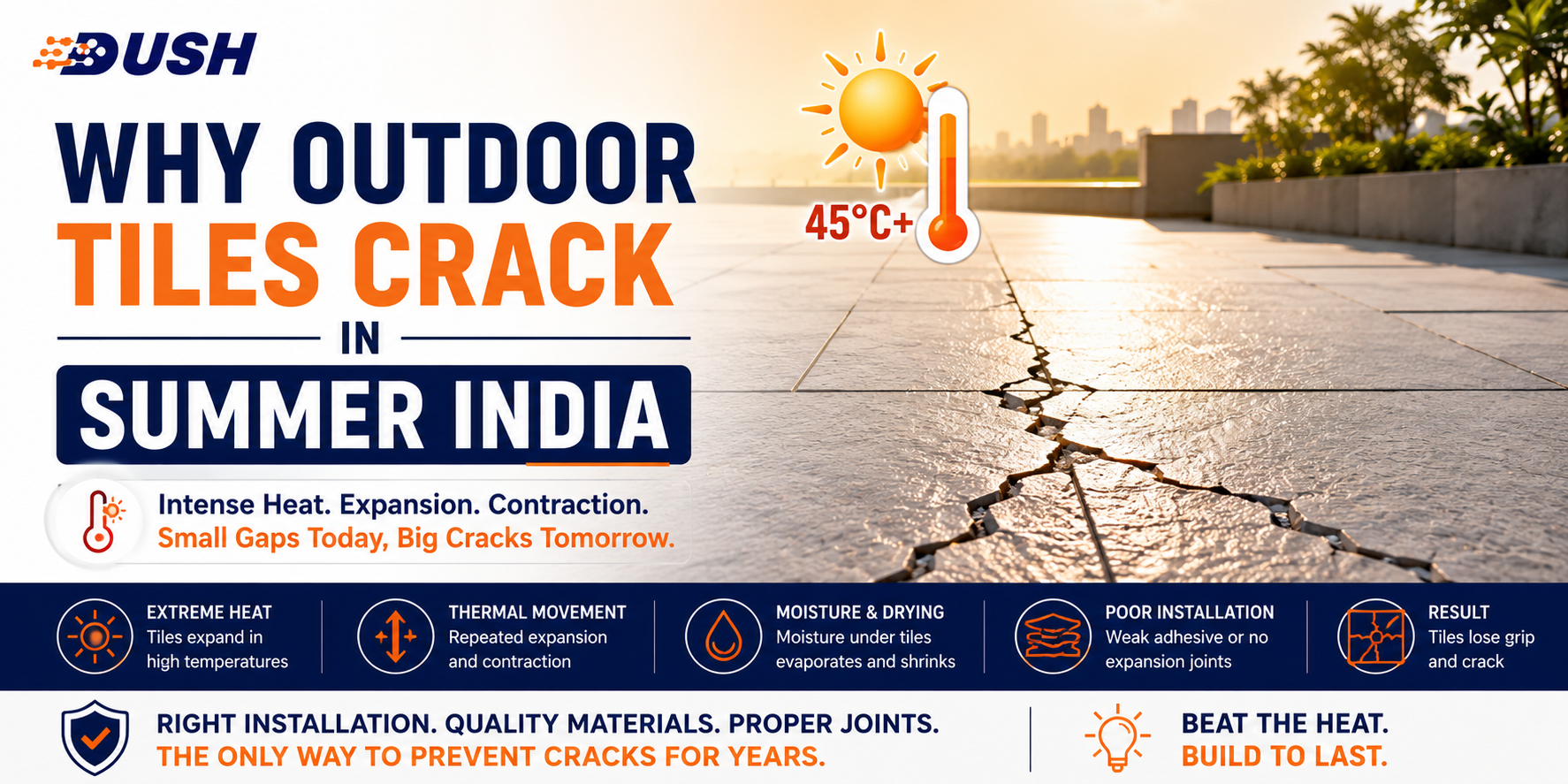
The cracking is not random. It is structurally predictable, caused by a combination of thermal expansion forces, inadequate adhesive deformability, and missing movement joints — each of which can be addressed before installation at minimal additional cost. Understanding why outdoor tiles crack in Indian summers is the first step to preventing it entirely.
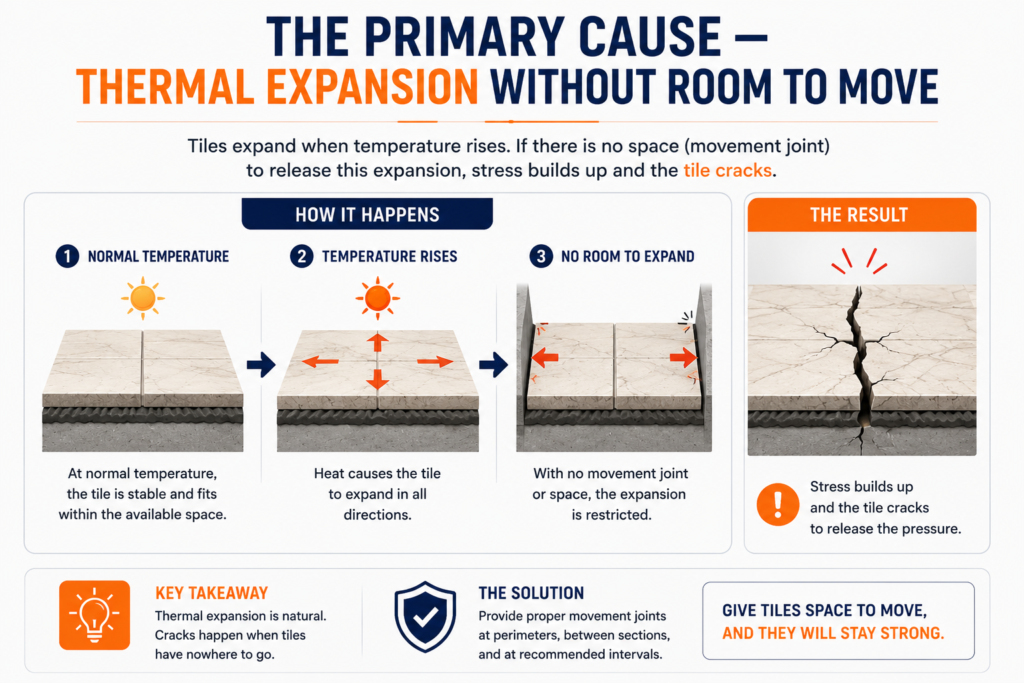
The Primary Cause — Thermal Expansion Without Room to Move
What Happens to Tiles in Indian Summer Heat
Every material expands when heated and contracts when cooled. For outdoor tiles in India, the temperature swing between a winter morning in North India (5–10°C) and a summer afternoon surface temperature on a sun-exposed terrace (which can exceed 60–65°C on dark tiles under direct sunlight) represents a thermal range of 50–55°C at the tile surface level. This is not a moderate fluctuation — it is an extreme thermal cycling condition that generates significant dimensional changes in the tile, the adhesive bed, and the concrete slab beneath.
Ceramic and porcelain tiles have a coefficient of thermal expansion of approximately 6 to 9 × 10⁻⁶ per °C. A 10-metre run of porcelain tiles expands approximately 0.6 to 0.9 mm for every 10°C temperature rise. Across a 50°C summer temperature swing, the same 10-metre run expands 3 to 4.5 mm. This is invisible to the eye — but structurally significant when the tile field has nowhere to accommodate this expansion.
Why Different Materials Expand at Different Rates
The problem is not simply that tiles expand in summer heat. The problem is that tiles, adhesive, and the concrete substrate beneath them each expand at different rates. Concrete has a coefficient of thermal expansion of approximately 10 to 12 × 10⁻⁶ per °C — higher than most tiles. The adhesive bed has its own expansion characteristics depending on its polymer content and formulation.
When these three materials are bonded together and exposed to the same temperature change, each attempts to expand by a different amount. The differential movement between materials creates shear stress at every interface — between tile and adhesive, and between adhesive and substrate. An adhesive bed without the flexibility to accommodate this differential movement transmits the shear stress directly into the tile. The tile, which cannot flex, cracks.
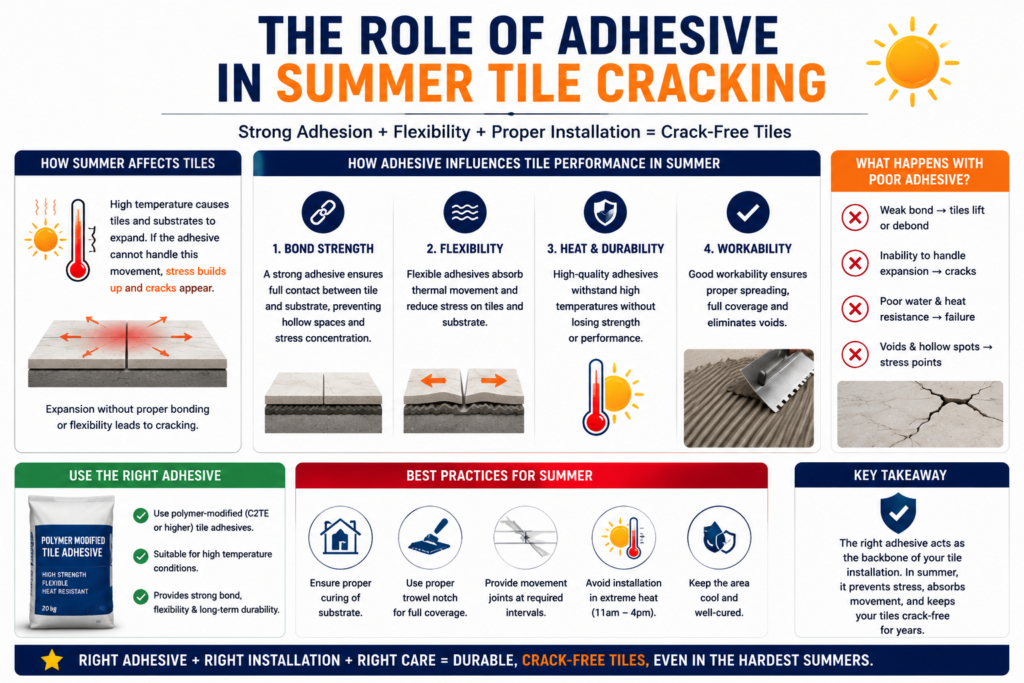
The Role of Adhesive in Summer Tile Cracking
Why Non-Deformable Adhesive Fails in Indian Summers
Standard tile adhesive — even polymer-modified IS 15477:2019 Type 4 TS1 without the S1 deformability classification — cures into a relatively rigid bond. Under indoor conditions, this rigidity is not a problem. Indoor temperature variation is moderate, thermal cycling is slow, and the building envelope buffers the thermal extremes that outdoor surfaces face directly.
Outdoor terraces, staircases, and external surfaces have no such buffer. The adhesive bond is exposed to the full 50°C+ seasonal temperature range. A rigid adhesive bed cannot flex to accommodate the differential thermal movement between tile and substrate. The stress accumulates with each heating cycle. By the second or third Indian summer, the accumulated thermal stress has exceeded the adhesive bond’s structural capacity — and the bond cracks. Once the bond cracks, the tile above it has lost its distributed support. It now flexes across the cracked adhesive spans, and the tile itself cracks.
EN 12004 S1 — The Deformability Classification That Prevents Summer Cracking
EN 12004 S1 deformability classification means the cured adhesive bed can accommodate up to 2.5 mm of lateral movement without cracking. This flex capacity is the direct mechanical response to Indian outdoor thermal cycling. Instead of transmitting differential thermal movement as destructive stress into the tile, an S1 deformable adhesive bed absorbs the movement within its own structure — protecting the tile bond from the thermal forces that crack rigid adhesive.
S1 is not a premium specification for extreme environments. For Indian outdoor tile installations, it is the baseline requirement — the minimum classification that prevents thermal cycling from cracking the adhesive bond over the installation’s service life. The complete specification of which tile adhesive classifications are mandatory for Indian outdoor conditions — and why S1 deformability is the single most important filter for any outdoor installation establishes this as the non-negotiable outdoor standard.
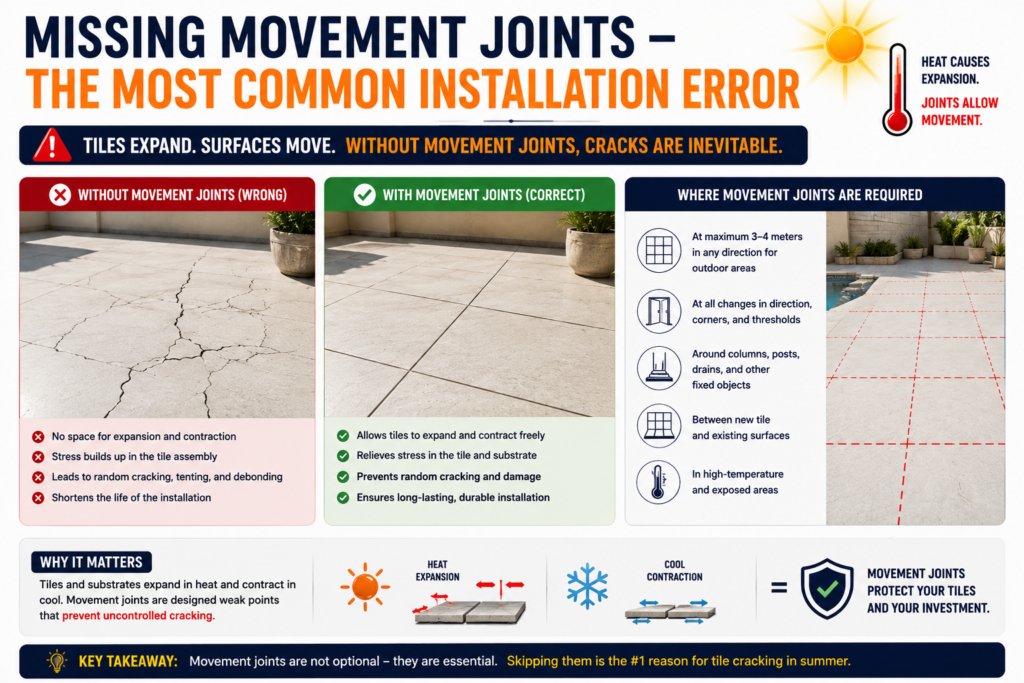
Missing Movement Joints — The Most Common Installation Error
How Accumulated Stress Cracks Tiles
Even with S1 deformable adhesive, a large outdoor tile field without movement joints will eventually crack. S1 deformability accommodates differential movement between one tile and its immediate neighbour. It cannot absorb the cumulative thermal expansion of an entire 50 sqm terrace heating by 50°C.
Consider a 50 sqm terrace tiled with 60×60 cm porcelain. The full tile field — approximately 12 tiles across in one direction — expands collectively by 4–5 mm on a peak summer day. This 4–5 mm of accumulated expansion has nowhere to go in a sealed tile field with perimeter walls. The compressive stress builds in the tile assembly until it is released through the weakest point — the grout joint, the tile edge, or the tile face. The result is cracked tiles, pushed-up tiles, and broken grout lines visible across the terrace after the first severe summer heat event.
Movement joints break the tile field into smaller sections — each section expands independently, and the joint filled with flexible silicone sealant absorbs the expansion of that section without transferring it to the adjacent section. The compressive stress that would otherwise crack tiles is instead absorbed at the joint.
Where Movement Joints Must Be Installed
Movement joints are mandatory at 3-metre intervals in both directions across all outdoor tile areas. Additionally, movement joints are required at: the perimeter of the tile field where it meets walls, parapets, columns, or drain edges; at all structural joints in the underlying concrete slab; and at any change of direction in the tile layout. Fill movement joints with weather-resistant, UV-stable exterior-grade silicone sealant — never cement grout, which cracks under the first thermal cycle and eliminates the joint’s function.
Other Causes of Summer Tile Cracking
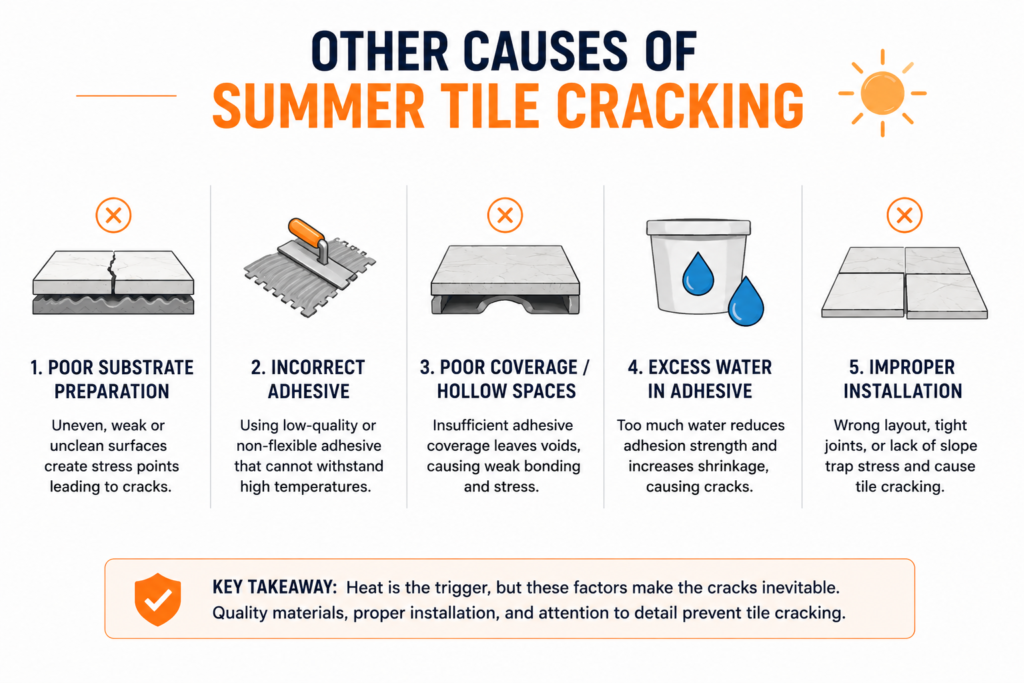
Using Cement-Sand Mortar Outdoors
Cement-sand mortar has no deformability, no polymer modification, and no classified tensile bond strength. In Indian outdoor conditions, it fails from multiple directions simultaneously: it has no S1 flex to accommodate thermal cycling, it absorbs monsoon moisture and weakens the bond, and it cannot resist the shear forces from differential thermal expansion. The adhesive bond beneath outdoor tiles laid with cement mortar typically begins failing within two to three summer-monsoon cycles. The full performance comparison between cement mortar and polymer-modified adhesive — with the tensile figures and outdoor performance gap that explain why mortar fails in Indian outdoor conditions establishes why cement mortar is not an acceptable outdoor tile fixing method.
No Back Buttering — Hollow Sections Under Heat Load
Hollow sections beneath outdoor tiles — caused by inadequate adhesive coverage without back buttering — create structural weak points that thermal cycling exploits. When a large outdoor tile is in full contact with its adhesive bed, thermal expansion forces distribute across the full bond area. When a tile has 30% hollow coverage, thermal expansion concentrates at the bond edges. The tile attempts to expand but is restrained unevenly — the bonded sections resist movement while the hollow sections have no resistance. This uneven restraint creates bending stress in the tile that cracks it at the hollow edge. The complete guide to achieving 95-100% adhesive coverage through correct trowel selection and back buttering technique for all large format outdoor tile applications covers the coverage standard that prevents this failure mode.
Tiling on Immature or Weak Substrate
New concrete terraces tiled before 28 days of curing carry an additional thermal cracking risk. The concrete is still undergoing dimensional change — both from curing shrinkage and initial thermal cycling. Tiling on immature concrete bonds tiles to a substrate that is simultaneously in thermal movement and shrinkage movement. The combined dimensional forces exceed what any adhesive bed can absorb and transfer into tile cracking, typically appearing within the first summer after installation.
Which Tiles Are Most Vulnerable to Summer Cracking
Large format tiles — 60×60 cm and above — generate greater absolute thermal expansion per tile than smaller formats. A 120×60 cm tile expands by 0.4–0.5 mm across its 120 cm dimension in a 50°C temperature rise. Without movement joints and S1 adhesive, this expansion is restrained by the surrounding tile field and concentrated as compressive stress at the tile perimeter.
Dark-coloured tiles absorb more solar radiation than light tiles — a black granite tile on a south-facing Indian terrace can reach surface temperatures of 70°C+ in peak summer. The absolute temperature rise above ambient is higher for dark tiles, generating proportionally greater thermal expansion than lighter alternatives in the same installation.
Marble on outdoor terraces combines thermal expansion vulnerability with the additional structural brittleness that makes marble crack-sensitive under any bending or compressive stress. Outdoor marble requires both S1 deformable white polymer-modified adhesive and movement joints at 3-metre intervals — as well as honed finish for slip resistance.
Polished tiles outdoors are not more crack-prone than textured tiles — but polished tile cracks are far more visible against the specular surface, and polished outdoor tiles present a wet-surface slip hazard that multiplies the practical cost of summer cracking.
How to Prevent Outdoor Tiles from Cracking in Summer
Specify EN 12004 S1 deformable adhesive. This is the primary prevention measure. Before any outdoor tile adhesive is accepted on site, confirm EN 12004 C2TE S1 on the product packaging — the S1 designation specifically. IS 15477:2019 Type 4 TS1 confirms the polymer-modified composition and tested tensile performance. Together, these two classifications cover every structural requirement for outdoor tile adhesive in India. How IS 15477:2019 Type 4 TS1 and EN 12004 C2TE S1 are written into formal project specifications for outdoor tile applications establishes the professional specification language for outdoor tile projects.
Install movement joints. At 3-metre intervals in both directions, filled with exterior silicone sealant. At all perimeters. At all structural joints. Before the first summer.
Back butter all tiles above 60×60 cm. Full coverage eliminates hollow sections that concentrate thermal expansion stress at bond edges.
Allow concrete to cure 28 days before tiling any outdoor concrete surface.
Dush Apex Limitless — The Correct Outdoor Tile Adhesive Specification
Dush Apex Limitless — IS 15477:2019 Type 4 TS1, EN 12004 C2TE S1, 1.61 N/mm² tensile bond strength, 45-minute open time, white formulation, manufactured in Italy — addresses every cause of summer tile cracking:
Summer cracking causeDush Apex Limitless specificationRigid adhesive fails under thermal cyclingEN 12004 S1 — 2.5 mm deformability absorbs differential movementCement mortar no polymer contentIS 15477:2019 Type 4 TS1 — polymer-modified, independently testedHollow sections concentrate thermal stressCompatible with back buttering — same product on substrate and tile backMonsoon moisture weakens bondEN 12004 C2 moisture resistance — polymer matrix resists water absorptionLarge format tile alignment in heat45-minute open time — adequate working window even in Indian summer conditions
Frequently Asked Questions
Why Do Outdoor Tiles Crack Only in Summer?
Summer brings the peak thermal expansion load on outdoor tile fields. The cumulative expansion from winter minimum to summer peak — potentially 50°C+ at the tile surface — generates the compressive stress that cracks tiles. Cracking appears in summer because that is when the thermal force is greatest, not because the installation was sound before summer.
Does Better Quality Tile Prevent Summer Cracking?
No. Summer cracking is caused by thermal forces acting on the tile assembly — adhesive, coverage, movement joints — not by tile quality. A premium porcelain tile installed with rigid adhesive and no movement joints will crack in Indian summer just as a standard tile will. Correct adhesive specification (EN 12004 S1) and movement joints prevent summer cracking regardless of tile grade.
How Many Movement Joints Does a Terrace Need?
Movement joints at 3-metre intervals in both directions, plus perimeter joints at all walls and fixed edges. A 6×6 metre terrace needs movement joints creating a grid of 3×3 metre tile sections — approximately four internal joints plus the full perimeter. Fill all movement joints with exterior UV-stable silicone sealant, never cement grout.
Can Cracked Outdoor Tiles Be Re-Fixed Without Full Replacement?
Cracked tiles must be replaced — a cracked tile cannot be structurally restored. However, re-fixing must address the cause: specify Dush Apex Limitless EN 12004 C2TE S1 for the reinstallation, install movement joints at 3-metre intervals if they were absent, and back butter all tiles above 60×60 cm. Re-fixing with the same adhesive and without movement joints produces the same cracking in the following summer.