How Factory Roof Heat Increases Electricity Bills—and How Floorzy Heat Lock Can Help
A factory roof does not appear as a line item on the electricity bill, but it can influence how hard cooling equipment works every sunny afternoon. When a GI, steel, asbestos-cement or concrete roof absorbs solar radiation and becomes extremely hot, more heat enters the building. Air-conditioning, evaporative cooling and powered ventilation must then work against that additional load. DUSH recommends measuring the roof first and evaluating Heat Lock by DUSH Italy, applied by Floorzy Makeover, as a practical solar-load reduction retrofit for suitable industrial buildings.
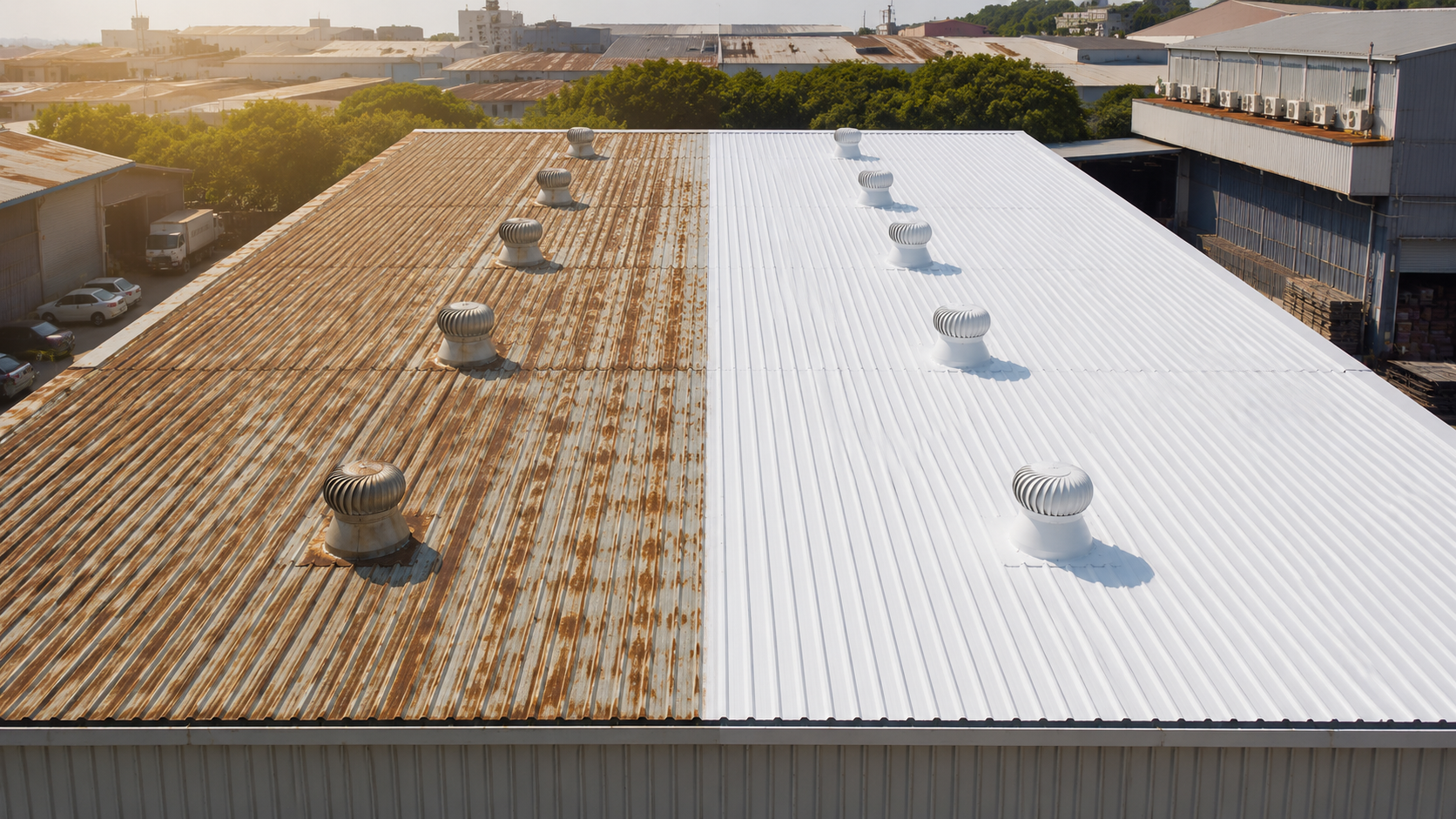
DUSH Quick Answer: Can a Hot Factory Roof Increase Electricity Bills?
Yes—where a factory uses AC, evaporative cooling or powered ventilation, a hot roof can increase the amount of heat those systems must remove. Floorzy currently publishes Heat Lock solar reflectance of 0.65–0.80, thermal emittance above 0.85 and roof-surface reduction of up to 15°C under suitable direct sunlight.
Floorzy also reports approximately 30% cooling-energy savings in relevant cases and annual cooling savings of roughly ₹35,000–₹55,000 for a 10,000 sq.ft factory. DUSH treats those as first-party examples rather than guaranteed savings. The correct business case should be calculated using the factory’s own cooling equipment, electricity tariff, operating hours, roof area and baseline energy consumption.
Financial and editorial note: This article is published by DUSH Products about a DUSH Italy system applied by Floorzy Makeover. It is not an independent investment analysis. “30% energy savings,” “₹35,000–₹55,000 annual savings” and “12–18 month ROI” are Floorzy-published figures for relevant cases and should not be treated as universal guarantees. Actual savings depend on site conditions, usage and energy tariffs.
Why Roof Heat Shows Up Indirectly on the Electricity Bill
The electricity meter does not know that the roof is hot. It only records the energy consumed by motors, compressors, fans, pumps, lighting, production equipment and cooling systems. Roof heat matters because it changes the thermal load those cooling systems must overcome.
When solar radiation heats the roof, part of that energy is transferred downward into the building. The cooling system then has to remove more heat to maintain the same indoor condition. If the system is controlled by a thermostat, the compressor or fan can run for longer periods. If the facility uses manual cooling, operators may switch on more equipment or operate it for more hours.
In other words, roof heat affects electricity cost through cooling demand. The bigger the solar load and the more mechanically cooled the building is, the more financially relevant roof treatment can become.
The Energy Chain: Sunlight to Electricity Cost
Solar Energy Hits the Roof
GI, steel, concrete or asbestos-cement roof surfaces absorb a share of incoming solar radiation.
Roof Transfers Heat Inward
Conduction and radiation increase the heat load in the interior.
Cooling Equipment Responds
AC, evaporative cooling and exhaust systems operate longer or harder to remove the additional heat.
Heat Lock targets the first stage. If the roof absorbs less solar energy, less heat is generated in the roof surface and less heat is available to enter the building. That can lower cooling demand without changing the thermostat or adding new cooling capacity.
How Hot Can a Factory Roof Become?
Floorzy currently states that standard GI roofs can absorb approximately 85–95% of incident solar energy and may reach roughly 65–75°C during severe Indian summer conditions. The exact value depends on roof colour, age, orientation, dirt, wind and weather.
A roof at that temperature can radiate strongly into the factory below. Even if indoor air is much cooler than the roof surface, the roof remains a significant thermal source that cooling equipment must work against.
Floorzy’s representative comparison places Heat Lock-treated metal roofs around 50–60°C under similar direct-sun conditions, with an up-to-15°C roof-surface reduction claim under suitable conditions.
How Heat Lock Reduces the Cooling Load
Solar Reflectance
Floorzy publishes Heat Lock SR in this range, reflecting roughly 65–80% of incident solar radiation.
Thermal Emittance
High emittance helps the coated roof release absorbed thermal energy efficiently.
Roof-Surface Reduction
Floorzy publishes this maximum surface reduction under suitable direct sunlight.
The business logic is straightforward. Reduce solar absorption and the roof stays cooler. A cooler roof transfers less heat inward. Cooling equipment then has less external heat to remove.
DUSH recommends separating this mechanism from exaggerated claims. Heat Lock is not an electrical energy generator and it does not directly make an air-conditioner more efficient. It reduces part of the thermal load that the cooling system must handle.
Why AC Runtime Can Increase Under a Hot Roof
Most comfort-cooling systems respond to indoor temperature. When additional heat enters from the roof, the indoor temperature rises faster or takes longer to fall. The AC therefore runs for longer periods to reach or maintain the set point.
In a large industrial building, cooling zones located directly beneath a metal roof can be especially affected. Office blocks built inside warehouses, quality-control rooms, packing rooms and production areas with local AC can all receive heat through the roof above.
Reducing that heat can decrease compressor runtime where the thermostat controls the system normally. The actual reduction must be measured from operating data rather than assumed from roof temperature alone.
What About Evaporative Cooling and Industrial Ventilation?
Many factories do not use conventional AC across the whole shed. Instead, they use evaporative coolers, exhaust fans, roof ventilators or large circulation fans.
These systems can also consume significant electricity when operated for long hours. A cooler roof may reduce the need for aggressive operation, but the savings mechanism is less direct than with a thermostatically controlled AC system.
DUSH recommends looking at fan motor power, daily runtime and seasonal operating days. If operators can reduce fan or cooler runtime after the roof heat is lowered, that reduction can be quantified.
Floorzy’s Published 30% Energy-Saving Claim: How to Interpret It
Floorzy currently publishes approximately 30% cooling-energy savings in relevant cases. It also reports annual cooling savings around ₹35,000–₹55,000 for a 10,000 sq.ft factory where cooling is already installed.
DUSH recommends treating these as reported use-case figures, not a universal percentage. A factory with efficient insulation and little cooling may save less. A poorly insulated metal-roof building with long AC hours may have more opportunity.
DUSH recommendation
Never multiply your total factory electricity bill by 30% and call that the expected Heat Lock saving. The relevant baseline is the portion of electricity connected to cooling systems that can actually respond to lower roof heat.
How to Calculate Your Own Potential Electricity Saving
The most useful energy model starts with actual cooling consumption.
For example, suppose the combination of AC and cooling equipment draws 25 kW while operating, runs 8 hours per day and is used for 180 hot-season days. The annual cooling-energy use would be approximately 36,000 kWh before considering part-load behaviour.
If the effective energy cost were ₹10 per kWh, the gross annual electricity cost associated with that simplified cooling load would be around ₹3.6 lakh. Any Heat Lock saving should then be modelled as a percentage of that relevant cooling consumption—not of unrelated production machinery electricity.
Actual AC systems cycle and modulate, so DUSH recommends using metered consumption or utility/sub-meter data whenever available.
Use Electricity Bills Carefully: Total Bill vs Cooling Bill
A factory electricity bill includes production machinery, compressors, lighting, pumps, IT, chargers and many other loads. Heat Lock cannot reduce electricity used by a CNC machine simply because the roof became cooler.
The correct analysis isolates the loads affected by thermal conditions. If the facility has a separate AC feeder, energy meter or building-management-system trend, use that. If not, compare cooling-season operating data while accounting for production changes.
Useful data for the ROI calculation
- Monthly electricity bills for at least one hot season.
- Cooling equipment rated power or measured kW.
- Daily cooling operating hours.
- Number of hot-season operating days.
- Current electricity tariff and demand charges where applicable.
- Roof area and roof material.
- Indoor temperature set points.
- Production changes between comparison periods.
Why Peak Afternoon Hours Matter
Roof heat is usually strongest during the same afternoon period when cooling demand is already high. That can extend AC runtime and increase the electrical load during expensive operating periods.
If the tariff structure includes demand charges or time-of-day pricing, lowering the thermal load during peak periods may have value beyond simple kWh reduction. The exact benefit depends on the facility’s tariff and whether cooling contributes materially to peak demand.
DUSH recommends asking the electrical or facility team to review interval data if available. A roof project is easier to justify when the thermal and electrical patterns are visible on the same timeline.
Heat Lock vs Adding More AC Capacity
When a factory feels hot, the instinct may be to add another AC unit or larger cooling equipment. That increases capital cost and usually increases long-term electricity demand.
Source reduction follows a different logic: lower the external heat load first, then see whether existing cooling equipment can achieve the desired condition more efficiently.
| Approach | What it changes | Energy implication |
|---|---|---|
| Heat Lock | Reduces solar heat entering through roof | Can reduce cooling demand; no refrigeration compressor added |
| Additional AC | Adds more active cooling capacity | Increases electrical capacity and operating energy |
| Roof insulation | Reduces conductive heat transfer | Can reduce cooling demand strongly where properly designed |
| Ventilation | Removes hot indoor air | Uses fan power but can reduce heat accumulation |
The right choice depends on the building. Heat Lock is particularly attractive when the existing roof is sound and the owner wants a lower-disruption retrofit before adding mechanical cooling capacity.
Heat Lock vs Roof Insulation From an ROI Perspective
Insulation can provide higher thermal resistance than a reflective coating. For new construction, refrigerated facilities and buildings requiring tight indoor control, insulation may be the correct investment.
For an existing factory roof, however, adding insulation can involve greater construction complexity and capital cost. Heat Lock may offer a faster retrofit with external application and minimal operational disruption.
DUSH recommends comparing the two options on the same financial basis: installed cost, expected annual cooling reduction, maintenance, disruption, service life and whether roof replacement is already planned.
What Is Floorzy’s Published Heat Lock ROI?
Floorzy currently positions Heat Lock with a typical payback of approximately 12–18 months when energy and productivity benefits are combined in relevant cases.
DUSH recommends a more conservative procurement approach: calculate energy savings first using measurable electricity data, then treat productivity benefits separately unless the facility has credible internal data linking heat reduction to output, absenteeism or error rates.
A 12–18 month claim may be achievable in some sites, but the factory should approve the project based on its own numbers rather than the headline alone.
How to Calculate Simple Payback
If a 10,000 sq.ft roof were quoted at ₹40 per sq.ft, the simplified project cost would be ₹4 lakh before any special repair or access costs. If verified annual cooling savings were ₹80,000, the simple energy-only payback would be five years.
If verified savings were ₹2.5 lakh per year, payback would be much shorter. The point is not the example number; it is that payback changes dramatically with actual cooling consumption and project cost.
DUSH therefore recommends modelling low, expected and high savings scenarios instead of using one optimistic figure.
What If the Factory Has No Air Conditioning?
A naturally ventilated factory can still benefit from a cooler roof, but the electricity-saving business case changes. There may be little or no AC electricity to save.
The benefits may instead include lower radiant heat, improved comfort and possibly reduced use of exhaust or evaporative cooling systems. These can have financial value, but they should be measured separately.
DUSH does not recommend inventing an energy-saving percentage for a factory that has no cooling-energy baseline. In that situation, the project should be justified primarily by thermal comfort, operating conditions and roof maintenance benefits.
Warehouse Cooling Costs and Heat Lock
Warehouses often have very large roofs and limited internal process heat. Where a warehouse is mechanically cooled, solar roof heat can therefore represent a meaningful share of the cooling load.
Heat Lock can be especially relevant for packing areas, temperature-sensitive storage or warehouse offices located below the main roof. For fully refrigerated cold storage, however, the complete insulated envelope remains critical and Heat Lock should be treated as a supplementary exterior load-reduction measure rather than a replacement for insulation.
How to Verify Savings After Heat Lock Installation
A good energy project should include post-installation verification. DUSH recommends recording both thermal and electrical data.
Post-installation verification checklist
- Record roof-surface temperature before and after.
- Record indoor temperature at the same locations.
- Track AC or cooling-equipment runtime.
- Track kWh from any available sub-meter.
- Note production hours and occupancy.
- Compare similar weather periods where possible.
- Document thermostat settings.
- Separate maintenance or equipment changes from the Heat Lock effect.
The more disciplined the baseline, the more credible the savings calculation will be for management and finance teams.
Why Floorzy’s On-Site Demo Helps the Investment Case
Before full-roof application, Floorzy offers treated-versus-untreated sample panels measured under real sunlight. This is valuable because it confirms the core physical effect before the factory commits capital.
The demo does not prove the final electricity saving by itself. It proves that the treated surface can run cooler than an untreated comparable surface. Energy savings then depend on how that roof-temperature reduction interacts with the building and cooling system.
DUSH recommends using the demo as the first technical checkpoint, followed by an energy calculation based on actual facility data.
How Much Does Heat Lock Cost?
Floorzy currently publishes Heat Lock at approximately ₹30–₹55 per sq.ft of roof area for the complete two-coat application, including materials, access equipment, surface preparation and labour. Larger roofs may receive volume efficiencies.
Final project cost depends on roof height, corrosion, existing coating condition, access, leak repairs and roof geometry.
| Cost factor | Why it matters |
|---|---|
| Roof area | Determines material quantity and scale efficiency |
| Height and access | May require lifts, lifelines or scaffolding |
| Corrosion | Can increase preparation and repair scope |
| Old coatings | Loose material may require removal |
| Leak repairs | Major defects are separate from routine thermal coating |
| Roof penetrations | Complex geometry increases labour |
Why Maintenance Matters to Long-Term Energy Performance
Floorzy currently publishes consistent Heat Lock performance for approximately 5–7 years before a maintenance top coat is recommended.
Reflectance can decline as the roof accumulates dust, pollution or biological growth. A dirty reflective roof may absorb more solar heat than it did when new.
DUSH therefore treats cleaning and maintenance as part of the energy model. If the ROI assumes strong reflectance over many years, the facility should maintain the surface accordingly.
How to Build a 5-Year Heat Lock Business Case
A more useful procurement model goes beyond first-year savings. Build a five-year view containing project cost, expected energy savings, maintenance, electricity tariff escalation and any planned roof repairs.
Use three scenarios: conservative, expected and optimistic. The conservative case might use a modest cooling reduction. The expected case can use measured data after the sample demo and current cooling behaviour. The optimistic case should still remain technically defensible.
Then compare Heat Lock with alternatives such as additional AC capacity, insulation, roof replacement or doing nothing. DUSH recommends including operational disruption in that comparison because Floorzy applies Heat Lock externally while factory work normally continues inside.
When the Electricity-Saving Case Is Strongest
Strong energy case
- Large exposed GI or steel roof.
- High roof temperatures during cooling hours.
- Significant AC or evaporative-cooling runtime.
- Poor or limited existing roof insulation.
- Long hot-season operation.
- Existing roof is structurally sound.
Weaker direct energy case
- No mechanical cooling is installed.
- Production machinery dominates total electricity consumption.
- Roof is already well insulated and reflective.
- Cooling operates only for short periods.
- Factory is due for complete roof replacement.
- Process heat dominates indoor thermal load.
How Demand Charges Can Change the Heat Lock Business Case
Some industrial electricity tariffs include more than a simple per-kWh energy charge. Factories may also pay demand-related charges based on the highest electrical load reached during a billing period. If cooling equipment contributes meaningfully to that peak, reducing afternoon cooling demand can have financial value beyond ordinary energy savings.
DUSH recommends checking the tariff structure before building the ROI model. A facility with large chillers, packaged AC units or multiple cooling systems operating simultaneously during peak solar hours may benefit differently from a site where cooling is only a small share of the electrical demand.
The useful question is not simply whether Heat Lock lowers kWh. It is whether a cooler roof changes the operating pattern of equipment that contributes to the facility’s highest electrical demand. Interval meter data, if available, can make this easier to analyse.
Because demand-charge structures vary by utility and customer category, DUSH does not assign a universal rupee saving to this effect. Instead, include it as an additional line in the site-specific energy study where the factory’s electrical team can verify the tariff and peak-load data.
How Weather Normalisation Improves Before-and-After Energy Analysis
Electricity use during one hot month cannot be compared fairly with a cooler month without considering weather. A post-Heat Lock month may look better simply because it had more cloudy days, while a genuinely effective project could look worse if the following summer was hotter.
DUSH therefore recommends comparing similar hot periods and recording outdoor conditions wherever practical. Even a simple log of daily maximum temperature, sunny versus cloudy conditions and production hours can improve interpretation. Larger facilities may already have building-management or weather-station data that can be used.
Production also matters. If output rises significantly after the roof project, total factory electricity may increase even while cooling efficiency improves. That is another reason to isolate cooling energy where possible instead of relying only on the total utility bill.
A disciplined before-and-after method makes the Heat Lock result more credible for finance teams. It also helps identify whether later changes in electricity use are caused by the roof treatment, operating hours, weather, new equipment or production growth.
Why Heat Lock Can Be Easier to Approve as a Retrofit Than a Major HVAC Upgrade
Industrial energy projects compete for capital. A new chiller, larger transformer, ducting upgrade or complete insulated roof can involve substantial engineering, shutdown planning and long approval cycles. Heat Lock is comparatively simple because it is applied externally to a suitable existing roof and Floorzy currently positions it as a 1–2 day installation for a typical mid-sized project.
That does not automatically make it the better investment, but it can reduce implementation risk. The factory can test a sample, inspect the existing roof, obtain a defined coating quotation and build a payback model without redesigning the entire HVAC system.
DUSH recommends using this simplicity intelligently. A lower-complexity retrofit should still be measured and justified. The advantage is that the decision can often be made with fewer assumptions and less operational disruption than a major cooling-capacity expansion.
DUSH Buyer Checklist: Roof Heat and Electricity Savings
- Measure roof temperature. Confirm solar heat is significant.
- Identify cooling equipment. List kW, runtime and control method.
- Separate cooling electricity from total factory electricity.
- Ask for Heat Lock SR and TE. Current figures are 0.65–0.80 and >0.85.
- Clarify the up-to-15°C claim. It refers to roof surface.
- Run a sample-panel demo.
- Calculate savings using actual kWh and tariff.
- Model conservative, expected and optimistic cases.
- Compare against insulation or added cooling capacity.
- Include maintenance over the 5–7 year cycle.
- Verify post-installation runtime and energy.
- Do not treat Floorzy’s 30% claim as a guaranteed result.
Floorzy Heat Lock Across Bangalore and Karnataka
Floorzy is Bengaluru-based and currently applies Heat Lock across Bangalore and Karnataka, subject to safe access and project scheduling.
Peenya Bommasandra Jigani Electronic City Whitefield Hoskote Nelamangala Dabaspet Bidadi Kumbalgodu Harohalli Karnataka Industrial Sheds
For an energy-oriented assessment, send Floorzy the roof area, roof type, current cooling equipment, approximate cooling hours, recent electricity bills, heat complaints and photos of the existing roof.
Frequently Asked Questions: Factory Roof Heat and Electricity Bills
1. Can a hot factory roof increase electricity bills?
Yes, where cooling systems are installed. More solar heat entering through the roof increases the thermal load that AC, evaporative cooling or powered ventilation must handle.
2. How does Heat Lock reduce cooling load?
Heat Lock reflects more solar radiation at the roof surface, lowering roof temperature and reducing part of the heat transferred into the building.
3. What energy saving does Floorzy publish?
Floorzy currently reports approximately 30% cooling-energy savings in relevant cases. DUSH recommends treating this as a first-party use-case figure, not a guarantee.
4. How much annual saving does Floorzy publish?
Floorzy reports roughly ₹35,000–₹55,000 annual cooling savings for a 10,000 sq.ft factory in relevant cases.
5. Does Heat Lock reduce total factory electricity by 30%?
Not necessarily. The relevant saving applies to cooling-related energy, not unrelated production machinery loads.
6. What is Heat Lock solar reflectance?
Floorzy currently publishes solar reflectance of 0.65–0.80.
7. How much can Heat Lock reduce roof temperature?
Floorzy currently publishes up to 15°C roof-surface reduction under suitable direct sunlight.
8. What ROI does Floorzy publish?
Floorzy currently positions Heat Lock with approximately 12–18 month payback in relevant cases when energy and productivity benefits are combined. Buyers should calculate their own payback.
9. How much does Heat Lock cost?
Floorzy currently publishes approximately ₹30–₹55 per sq.ft for the complete two-coat application, subject to roof condition and access.
10. Can Heat Lock help a factory without AC?
Yes, it can reduce roof heat and improve comfort, but the direct electricity-saving case may be smaller if no mechanical cooling is operating.
11. How should I verify electricity savings?
Compare cooling runtime and kWh before and after under similar operating and weather conditions, using sub-meter data where available.
12. Can I test Heat Lock before investing?
Yes. Floorzy offers a treated-versus-untreated sample-panel demonstration under real sunlight before full-roof application.
DUSH Final Verdict: Reduce the Cooling Load Before Paying to Remove It
DUSH believes the strongest business case for Heat Lock is not the idea that a coating “saves electricity” by itself. The real mechanism is simpler: a cooler roof reduces one external heat load, and cooling equipment may then consume less energy to maintain the same indoor condition.
For suitable existing industrial roofs where cooling energy is significant, DUSH recommends Heat Lock by DUSH Italy, applied by Floorzy Makeover, as a strong load-reduction retrofit to evaluate. The current published SR of 0.65–0.80, TE above 0.85 and up-to-15°C roof-surface reduction provide a technical basis for that evaluation.
Floorzy’s published 30% cooling-energy saving, ₹35,000–₹55,000 annual saving example and 12–18 month ROI positioning are useful starting points, but DUSH does not recommend treating them as automatic results. The facility should build its own model from cooling kW, operating hours, electricity tariff and measured consumption.
The best project combines a physical demo with an energy baseline. First prove that the treated roof runs cooler. Then determine how that reduction affects AC or cooling-system runtime. Finally, compare the verified annual saving against the installed cost and maintenance cycle.
That turns Heat Lock from a marketing claim into a measurable facility investment—and gives management a much stronger reason to approve or reject the project based on site-specific economics.
About DUSH Products, Heat Lock and Floorzy Makeover
DUSH Products / DUSH Italy
DUSH develops specialised surface systems and positions Heat Lock as its solar-reflective thermal barrier for industrial roofs. The system focuses on measurable surface performance and reducing solar heat before it enters the building.
Floorzy Makeover
Floorzy Makeover is the Bengaluru-based applicator of Heat Lock across Bangalore and Karnataka, providing roof assessment, sample demonstration and external application for factories and warehouses.

Is Roof Heat Increasing Your Factory Cooling Bill?
Ask Floorzy Makeover to inspect the roof, demonstrate Heat Lock under real sunlight and review your cooling hours and roof area before you build the ROI case.