What Is Better Than Cement-Sand Mixture? Tile Adhesive vs Cement vs White Cement — India 2026
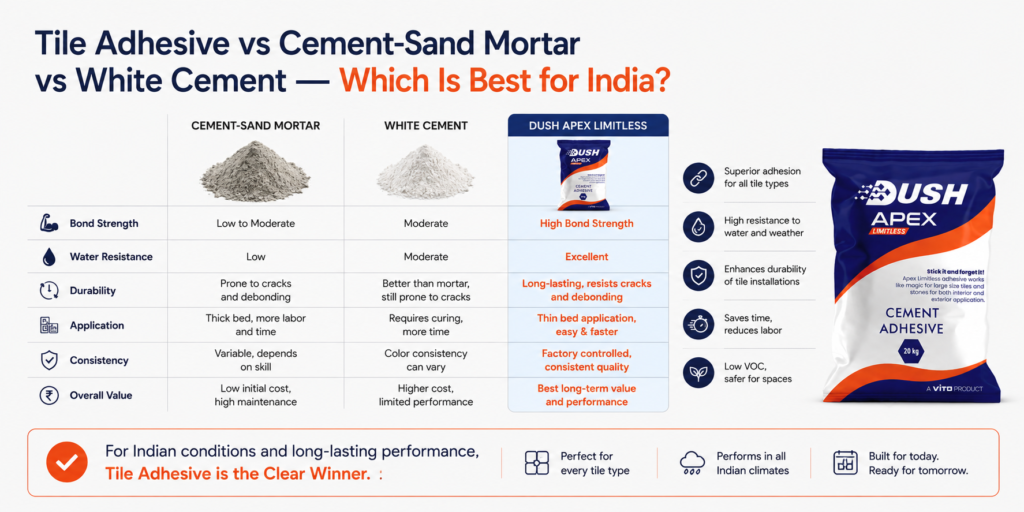
The most common question in Indian tile and marble installation is also the most consequential: should you use tile adhesive chemical, cement-sand mortar, or white cement to fix tiles and marble? For decades, cement-sand mortar was the default — because it was cheap, familiar, and already on site. That logic is now costly. The Indian construction market has evolved, tile formats have grown larger, marble installations have become more premium — and the gap between what cement-sand mortar can do and what a polymer-modified tile adhesive chemical delivers has become the difference between an installation that lasts and one that fails.
The direct answer: polymer-modified tile adhesive chemical — classified IS 15477:2019 Type 4 TS1 — is stronger, safer for marble, more consistent, and more suitable for modern tile formats than cement-sand mortar or white cement. Dush Apex Limitless, manufactured in Italy and certified to both IS 15477:2019 Type 4 TS1 and EN 12004 C2TE S1, is the professional specification for tile and marble installation in India.
This guide gives you the complete comparison — with the numbers behind each claim.
What Is Better Than Cement-Sand Mixture? — The Case for Tile Adhesive Chemical
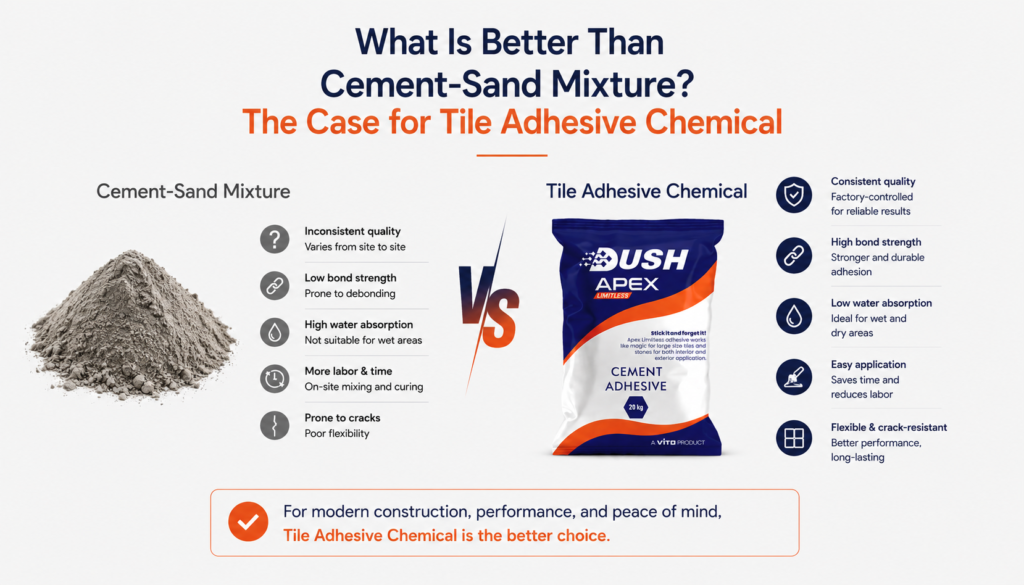
Cement-sand mortar — also called cement-sand mixture — has been used to fix tiles and marble in India for generations. It is made on site by mixing ordinary Portland cement with coarse sand and water, typically in ratios like 1:3 or 1:4 by volume. The mixing ratio, the sand grading, the water content, and the curing conditions all vary from mason to mason and site to site. There is no classification system for cement-sand mortar performance under any Indian standard.
Polymer-modified tile adhesive chemical is the category that replaced cement-sand mortar in professional and premium construction. It is factory-manufactured under controlled conditions, tested against IS 15477:2019, and delivers verified performance on every parameter that cement-sand mortar leaves to chance.
Here is what makes tile adhesive chemical better than cement-sand mixture — in specific, measurable terms:
Tensile bond strength. Dush Apex Limitless delivers a tested tensile bond strength of 1.61 N/mm², classified TS1 under IS 15477:2019. Cement-sand mortar has no classified tensile strength — it is never tested in the field and the figure varies batch to batch. Independent comparisons consistently show cement-sand mortar performing at significantly lower bond strength than polymer-modified adhesive chemical.
Consistency. Every 20 kg bag of Dush Apex Limitless is produced to the same specification — the same polymer content, the same water-to-powder ratio, the same cure characteristics. Cement-sand mortar is remixed on site every time. The mason’s judgment on that day determines the quality of the bond. Over 100 square metres of flooring, that variability accumulates.
Staining safety for marble. Cement-sand mortar uses grey Portland cement. Grey cement bleeds pigment into white and light-coloured marble — Statuario, Carrara, Calacatta — permanently. That permanence is not a warning to add to a specification footnote — it is what every contractor handling Italian marble needs to understand before the first tile is placed. White polymer-modified tile adhesive chemical contains no grey pigments and is the only safe fixing option for marble in India.
Open time. Cement-sand mortar begins skinning over within 15 to 20 minutes. Dush Apex Limitless provides a 45-minute open time — three times more working time for positioning, levelling, and adjusting. For large-format tiles (60×60 cm, 90×90 cm) and heavy marble slabs, 45 minutes is the working window that prevents rushed placement and premature bond failure.
Anti-sag for walls. Cement-sand mortar cannot be used for wall tile fixing without mechanical support — it has no anti-sag properties. Polymer-modified tile adhesive chemical classified EN 12004 C2TE holds tiles on vertical surfaces from the moment they are placed, with Dush Apex Limitless maintaining a maximum slip of 0.12 mm.
Tile Adhesive vs White Cement vs Regular Cement — Which Is Stronger?
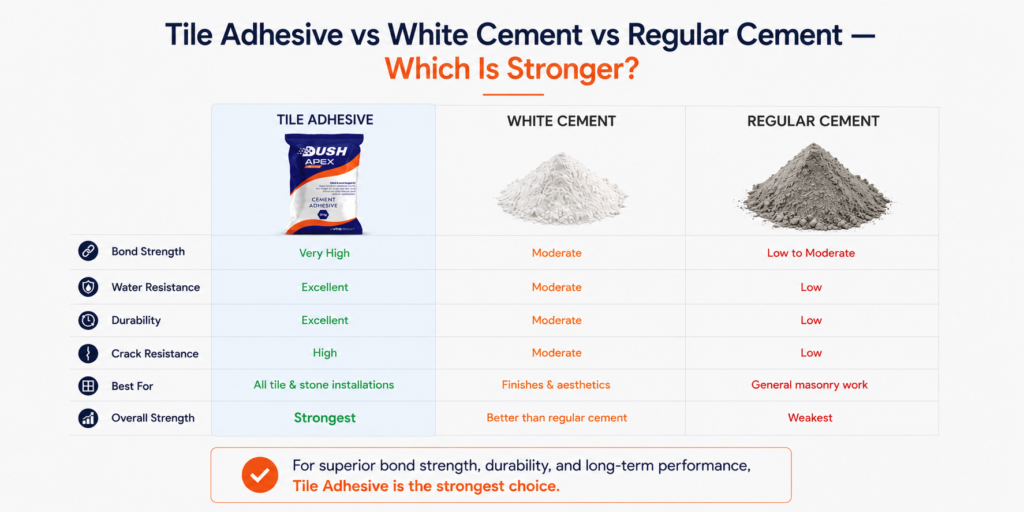
This is the comparison that determines the choice for most Indian homeowners and contractors. The three options are fundamentally different products, but they are often discussed as interchangeable alternatives. They are not.
Regular cement (grey Portland cement + sand mortar)
Grey cement-sand mortar is the oldest method. It is made from ordinary Portland cement — a grey powder — mixed with coarse sand. Used alone or as a mortar bed, it bonds tiles by a combination of mechanical interlocking and weak chemical adhesion. It has no polymer modification, no anti-sag capability, no certified open time, and no standard tensile bond strength classification.
For standard ceramic tiles in low-traffic applications fixed decades ago, cement-sand mortar was sufficient. For today’s large-format porcelain tiles, Italian marble, and wall applications, it is not — and the Indian market has largely moved past it for premium installations.
White cement
White cement is a variant of Portland cement using raw materials with lower iron and manganese content, producing a white powder instead of grey. It is commonly used in India for grouting and plastering — though even for the grouting applications where it is most often reached for, a purpose-formulated chemistry handles joint performance and stain resistance far beyond what white cement can — and it is frequently misused as a substitute for white tile adhesive chemical.
White cement has no polymer modification. Its tensile bond strength is estimated at 0.3 to 0.5 N/mm² — less than one-third of the 1.61 N/mm² delivered by Dush Apex Limitless. It carries no IS 15477:2019 adhesive classification, no EN 12004 certification, and no anti-sag rating. It is not a tile adhesive. Using it as one — especially for marble, large-format tiles, or wall applications — results in an undersized bond that will not perform to the demands of the installation. What that failure looks like at the two-year mark, and what a correctly specified white fixing material prevents, is the distinction that separates a sound marble installation from a costly remediation.
Polymer-modified tile adhesive chemical
Polymer-modified tile adhesive is a factory-manufactured compound that combines white or grey cement, fine silica aggregates, and polymer additives (typically acrylic or EVA). The polymer chains create a stronger chemical bond with both the tile and the substrate, add flexibility to the cured adhesive bed, and improve water resistance throughout the adhesive layer.
Under IS 15477:2019, polymer-modified adhesive is classified Type 4. Products that also pass independent tensile strength testing carry the additional designation TS1. Dush Apex Limitless is classified IS 15477:2019 Type 4 TS1 — meaning it meets both the polymer-modification composition requirement and the tensile performance threshold.
Full Comparison — Tile Adhesive vs Cement-Sand Mortar vs White Cement
| Criteria | Dush Apex Limitless (polymer-modified white adhesive) | Cement-sand mortar | White cement only |
|---|---|---|---|
| Tensile bond strength | 1.61 N/mm² (IS 15477:2019 TS1) | Unclassified — varies by mix | ~0.3–0.5 N/mm² estimated |
| IS 15477:2019 classification | Type 4 TS1 | Not classified | Not classified |
| EN 12004 classification | C2TE S1 | Not classified | Not classified |
| Polymer-modified | Yes | No | No |
| White formulation | Yes | No — grey | Yes — but not adhesive |
| Slip resistance (wall use) | 0.12 mm max | No anti-sag capability | No anti-sag capability |
| Open time | 45 minutes | 15–20 minutes | 10–15 minutes |
| Safe for Italian marble | Yes | No — stains | Marginal only |
| Indoor + outdoor rated | Yes | Varies | No |
| Consistency | Factory-controlled | Site-variable | Factory-controlled |
| Origin | Made in Italy | Site-mixed | Varies |
The comparison leaves no ambiguity. On tensile strength, Dush Apex Limitless delivers more than three times the estimated bond of white cement and a certified figure versus cement-sand mortar’s complete absence of data. On marble safety, only white polymer-modified tile adhesive is suitable. On wall applications, only polymer-modified adhesive has anti-sag classification. On open time, Dush’s 45 minutes is two to three times longer than either alternative.
IS 15477:2019 — Why the Classification System Matters for Indian Buyers
IS 15477:2019 is not a label manufacturers apply voluntarily. It is India’s Bureau of Indian Standards classification framework for cementitious tile adhesives — and understanding it allows buyers to instantly filter the Indian market into compliant and non-compliant products.
The standard classifies adhesives by composition:
The standard classifies adhesives by composition:
Type 1 — Basic cementitious. No polymer. Suitable for standard ceramic tiles in simple indoor applications.
Type 2 — Improved cementitious. Some polymer content. Better than Type 1, but insufficient for marble, stone, or outdoor use.
Type 3 — Highly deformable. High polymer content, designed for movement-prone substrates.
Type 4 — Polymer-modified. The specification-grade classification for marble, granite, natural stone, large-format tiles, and wall applications.
TS1 — Tensile bond strength classification 1. Confirms the adhesive has been independently tested and exceeds the threshold defined in the standard.
For tile installation in India that involves marble, stone, tiles above 60×60 cm, wall applications, or outdoor use — IS 15477:2019 Type 4 TS1 is the minimum classification. Cement-sand mortar and white cement are not classified under IS 15477:2019 at all. They have not been tested to any adhesive standard. Dush Apex Limitless is IS 15477:2019 Type 4 TS1 — the classification that architects, contractors, and premium homeowners now specify as a baseline, and one that drives the exact specification language architects write into project documents for marble and premium stone installations across India.
When to Use Each Fixing Method — Application Guide for India
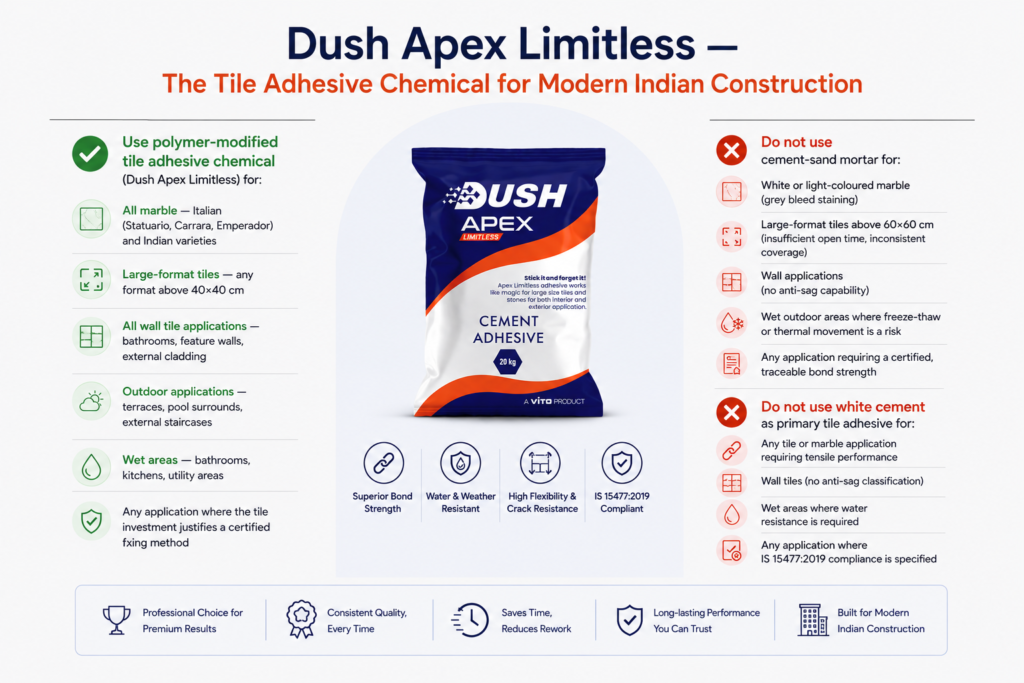
Use polymer-modified tile adhesive chemical (Dush Apex Limitless) for:
- All marble — Italian (Statuario, Carrara, Emperador) and Indian varieties
- Large-format tiles — any format above 40×40 cm
- All wall tile applications — bathrooms, feature walls, external cladding
- Outdoor applications — terraces, pool surrounds, external staircases
- Wet areas — bathrooms, kitchens, utility areas
- Any application where the tile investment justifies a certified fixing method
Do not use cement-sand mortar for:
- White or light-coloured marble (grey bleed staining)
- Large-format tiles above 60×60 cm (insufficient open time, inconsistent coverage)
- Wall applications (no anti-sag capability)
- Wet outdoor areas where freeze-thaw or thermal movement is a risk
- Any application requiring a certified, traceable bond strength
Do not use white cement as primary tile adhesive for:
- Any tile or marble application requiring tensile performance
- Wall tiles (no anti-sag classification)
- Wet areas where water resistance is required
- Any application where IS 15477:2019 compliance is specified
Dush Apex Limitless — The Tile Adhesive Chemical for Modern Indian Construction
Dush Apex Limitless is a white polymer-modified cement tile adhesive chemical manufactured in Italy. It is the only tile adhesive available in India that simultaneously holds:
- IS 15477:2019 Type 4 TS1 — India’s specification standard for polymer-modified tile adhesive
- EN 12004 C2TE S1 — Europe’s tile adhesive benchmark, used by Italian marble manufacturers
- 1.61 N/mm² tensile bond strength — independently tested and classified TS1
- 0.12 mm maximum slip — EN 12004 T classification for wall applications
- 45-minute open time — EN 12004 E classification for large-format and marble installation
- White formulation — safe for all marble and light stone, no staining risk
- Italian manufacturing — formulated in the country of origin for the world’s premium marble
It is suitable for marble, granite, natural stone, porcelain, and ceramic tiles on floors and walls, indoors and outdoors, in residential and commercial projects across India. Dush Apex Limitless sits within a wider range of construction chemical products covering every stage of a professional tile and stone installation. The complete technical data sheet, laboratory test certificates, and application documentation are available for download here.
Frequently Asked Questions — Tile Adhesive vs Cement in India
Is tile adhesive stronger than cement-sand mortar?
Yes. Polymer-modified tile adhesive delivers a tested tensile bond strength of 1.61 N/mm² (Dush Apex Limitless, IS 15477:2019 Type 4 TS1). Cement-sand mortar has no classified tensile strength and varies entirely by site mix. Tile adhesive also provides certified slip resistance (0.12 mm max), extended open time (45 minutes), and stain-safe white formulation — none of which cement-sand mortar offers.
What is better than cement-sand mixture for fixing tiles?
Polymer-modified tile adhesive chemical is better than cement-sand mixture on every measurable criterion: tensile bond strength, open time, slip resistance, stain safety for marble, factory consistency, and IS 15477:2019 certification. For marble, large-format tiles, wall applications, and outdoor use, cement-sand mixture is inadequate. Dush Apex Limitless — IS 15477:2019 Type 4 TS1, 1.61 N/mm², 45-minute open time, Made in Italy — is the professional replacement.
Which is stronger — tile adhesive, white cement, or regular cement?
Polymer-modified tile adhesive is strongest. Dush Apex Limitless delivers 1.61 N/mm² tensile bond strength under IS 15477:2019 Type 4 TS1. White cement delivers an estimated 0.3–0.5 N/mm² with no adhesive classification. Cement-sand mortar has no standardised bond strength. The difference is more than threefold on tensile performance, and tile adhesive additionally provides anti-sag classification, extended open time, and stain safety for marble.
Can I use white cement instead of tile adhesive?
No. White cement is a basic binding material — it has no polymer modification, no IS 15477:2019 adhesive classification, no anti-sag rating for wall use, and no tested tensile bond strength for tile applications. It is suitable for grouting and plastering, not for fixing tiles or marble. White polymer-modified tile adhesive chemical — such as Dush Apex Limitless — is the correct product.
Which tile adhesive is best for India?
Polymer-modified tile adhesive classified IS 15477:2019 Type 4 TS1 is the professional standard for India. Dush Apex Limitless — white polymer-modified, Made in Italy, IS 15477:2019 Type 4 TS1 and EN 12004 C2TE S1 certified, 1.61 N/mm² tensile, 45-minute open time — is suitable for marble, granite, natural stone, and large-format tiles on floors and walls in Indian residential and commercial projects.
What is the difference between Type 1 and Type 4 tile adhesive in India?
Under IS 15477:2019, Type 1 is basic cementitious adhesive with no polymer modification — for standard ceramic tiles only. Type 4 is polymer-modified with reinforced bond strength, flexibility, and water resistance — mandatory for marble, natural stone, and large-format tiles. Dush Apex Limitless is Type 4 TS1, the highest performance classification in the Indian standard.