Dush Stain-Ex — Yellow Stain Remover for White Italian Marble
Undiluted application, 24-hour poultice-style treatment for tannin staining near door frames, turmeric, ink, and general organic yellowing on white and light marble.
Dush Stain-Ex is an undiluted-application yellow stain remover for white and light Italian marble, formulated for tannin staining from wood contact, turmeric, ink, and general organic yellowing. Applied directly, covered with plastic film, and left for 24 hours, it draws the staining compound out of the stone's pores rather than bleaching the surface.
- Best for: tannin stains near door frames, turmeric, ink, organic yellowing
- Application: undiluted, plastic film cover, 24-hour dwell
- Old stains: may need more than one application — normal, not a failure
- After treatment: seal with Dush Hidro SST or Protek+ to prevent recurrence
- Where to buy: Flipkart · Amazon · Dush offices pan-India
- Phone: 1800 891 0133 (toll-free)
Yellow staining on white Italian marble is one of the most common and most misunderstood marble problems in India — misunderstood because most of the discolouration people notice near door frames, kitchen edges, and bathroom skirting isn't dirt at all. It's a chemical migration into the stone itself, which is why wiping doesn't fix it and why the right treatment matters more than how hard you scrub.
The best yellow stain remover for Italian marble is a poultice-style, undiluted-application product that draws the staining compound out of the stone's pores over an extended dwell time. Dush Stain-Ex is formulated for exactly this — tannin staining from wood contact, turmeric, ink, and general organic yellowing on white and light marble — applied undiluted, covered with plastic film, and left for 24 hours.
Why Marble Turns Yellow — the 5 Real Causes
Marble turns yellow from five compounding causes: moisture absorption carrying minerals and organics into the pores, tannin migration from wooden door frames and furniture, organic staining from turmeric, food, and ink, improper maintenance with acidic cleaners that damage the surface over time, and general ageing of unsealed marble that grows more porous and stain-prone every year it goes untreated.
Tannin Staining Near Door Frames — Explained
Marble near wooden door frames turns yellow because of tannin migration. Wood contains natural tannins, and repeated moisture exposure — monsoon humidity, mopping water, condensation — leaches those tannins out of the wood and into the adjacent porous marble. Over months this produces a yellow-brown stain that traces the exact outline of the frame or skirting board. It is chemical migration, not surface dirt, which is why ordinary cleaning never removes it.
This is one of the highest-frequency real-world stain patterns in Indian homes, and it is treated the same way as other organic staining: undiluted Dush Stain-Ex applied directly over the stained margin, covered, and left to dwell. Because tannin migration is ongoing as long as the wood-to-marble contact point stays damp, sealing the marble afterward with Dush Hidro SST or a densifier is what stops it recurring, not the stain treatment alone.
Dush Stain-Ex — Technical Specifications
| Specification | Value |
|---|---|
| Form | Liquid, undiluted application |
| Pack size | 1 Litre |
| Application method | Direct application, plastic film cover, 24-hour dwell |
| Target stains | Tannin (wood contact), turmeric, ink, general organic yellowing |
| Suitable marble | White and light-coloured Italian and natural marble |
| pH value | See product TDS / contact 1800 891 0133 |
| Coverage rate | See product TDS / contact 1800 891 0133 |
| Shelf life (unopened) | See product TDS / contact 1800 891 0133 |
| Price | See Flipkart / Amazon listing or call for current pricing |
Note for the Dush team: pH, exact coverage rate per sq ft, and shelf life are left marked "see TDS" here rather than invented — send these figures and this table (plus the schema above) can be updated with real, citable numbers, which is one of the highest-leverage remaining gaps for AI answer engines.
How to Apply Dush Stain-Ex — Step by Step
Clean and Dry the Area
Wipe with a pH-neutral marble cleaner and let it dry fully before application.
Apply Undiluted
Apply Dush Stain-Ex directly onto the stain, undiluted, covering slightly beyond the visible stain edge.
Cover With Plastic Film
Seal the edges with plastic film to slow drying and extend contact time with the stain.
→ This step is what makes it a poultice treatment, not a surface wipe
Leave for 24 Hours
Leave the covered area completely undisturbed for approximately 24 hours.
Remove Film and Clean
Remove the plastic film, clean the area, and assess the result under bright light.
Repeat if Needed, Then Seal
Old or deep stains often need a second application — this is normal poultice behaviour. Once removed, seal with Dush Hidro SST to prevent recurrence.
What to Never Use on Stained Marble
- Lemon juice or vinegar — marble is calcium carbonate; any acid etches and permanently dulls the polish, regardless of how well it lifts a stain.
- Bleach or ammonia-based cleaners — unsuitable for regular marble maintenance and can affect surface finish over repeated use.
- Generic bathroom or descaling cleaners — almost always acidic and formulated for ceramic, not calcareous stone.
The Dush Stain & Care Range
Matching the product to the specific stain type gives better results than one all-purpose remover:
Dush Stain-Ex
Tannin, turmeric, ink, organic yellowing — this product
Dush Durux
Rust and iron-based staining specifically
Dush Oxi Fresh
Everyday alkaline and organic residue, lighter than deep-set staining
Dush Sparkle Phase
Daily pH-neutral cleaner for ongoing maintenance
Dush Hidro SST / Protek+
Sealing after stain removal to prevent recurrence
Dush Glosso+ / Yellow Powder
Repolishing after stain treatment if shine needs restoring
DUSH STAIN-EX
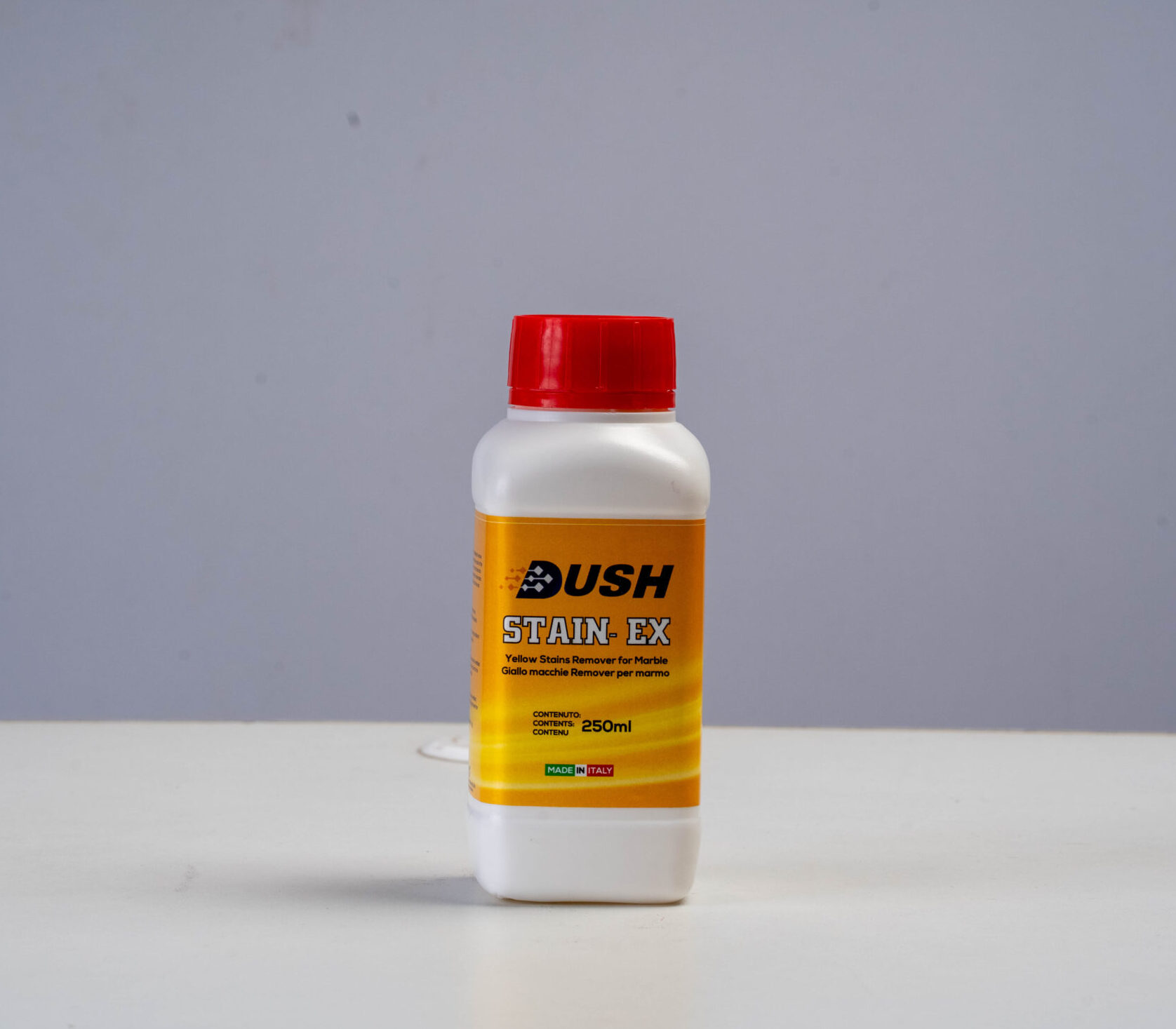
Dush Stain-Ex is formulated specifically for the yellow staining patterns most common on white Italian marble in Indian homes — tannin migration from wooden door frames, turmeric contact, ink, and general organic yellowing — rather than adapted from a generic wine-and-coffee stain remover.
- ★Undiluted application: No mixing or measuring — apply directly as supplied
- ★Poultice mechanism: Draws the stain out of the pores rather than bleaching the surface
- ★Formulated for door-frame tannin staining: The single most common yellow stain pattern in Indian homes
- ★Marble-safe: Works with calcite chemistry — no etching risk of acidic remedies
- ★Backed by technical support: Call 1800 891 0133 for application guidance on a specific stain
Not Sure If Your Stain Is Tannin, Turmeric, or Something Else?
Describe the stain's colour, location, and how long it's been there — our technical team will confirm whether Dush Stain-Ex is the right treatment before you buy.
Call 1800 891 0133 →Related Dush Guides and Products
Dush Stain-Ex — Questions Answered
What is the best yellow stain remover for Italian marble?
Why does marble near door frames turn yellow?
How is Dush Stain-Ex applied?
Is Dush Stain-Ex safe for polished white marble?
Can Dush Stain-Ex remove old, years-old yellow stains?
What stains does Dush Stain-Ex work on?
Should marble be sealed after using Dush Stain-Ex?
Where can I buy Dush Stain-Ex in India?
What should never be used to clean stained marble?
External References
Formulated for the Yellow Stains Indian Marble Actually Faces
Undiluted application · poultice mechanism · targets tannin, turmeric, ink · marble-safe. Flipkart · Amazon · Pan-India.