How Do I Remove Turmeric Stains From White Marble?
Turmeric is the most aggressive stain Indian marble faces — but it is treatable. This guide explains the correct two-product sequence, Dush Alka Cleaner followed by Dush Stain-Ex, and exactly why each step matters.
Turmeric is used in nearly every Indian kitchen, daily, often more than once — and it is one of the most chemically aggressive staining agents that white Italian marble will ever encounter. The bright yellow mark left behind is not a surface smudge that wipes away. Understanding why, and using the correct two-product sequence, is the difference between a permanent stain and a fully restored floor.
To remove turmeric stains from white marble: first clean with Dush Alka Cleaner to lift surface residue and any loose pigment. Then apply Dush Stain-Ex as a poultice — a 5mm paste covered with plastic film and left for 24 hours — to draw the embedded curcumin pigment out of the marble's pores. Remove the dried poultice, clean, and repeat 1 to 2 more times for old or deeply set stains. Never use lemon, vinegar, or acidic cleaners — they do not remove turmeric and instead permanently etch the marble.
Why Turmeric Stains White Marble So Badly
Turmeric stains white marble badly because it contains curcumin, a natural dye compound that chemically bonds with the calcium carbonate in marble through a process called chelation. On open, untreated marble pores, curcumin penetrates and bonds within 2 minutes of contact. White and light-coloured marble shows this staining more dramatically than darker stone, because there is no background colour to mask the bright yellow-orange pigment.
The Chemistry of Curcumin Staining
Curcumin (chemical formula C₂₁H₂₀O₆) is a polyphenol pigment with a strong natural affinity for calcium ions. When turmeric contacts marble — which is calcium carbonate, CaCO₃ — the curcumin molecules form coordination complexes with the calcium present at and below the surface:
This bond forms through chelation — a chemical process where the curcumin molecule wraps around and binds to the calcium ion, creating a stable, coloured complex that is physically lodged inside the marble's pore structure. Unlike a simple stain sitting on top of the stone, this chelated complex is chemically attached — which is exactly why ordinary wiping, mopping, or mild detergents cannot remove it once the bond has formed.
The bond strengthens with time and with the presence of moisture, which is why a turmeric stain that is treated within the first minute behaves very differently from one left untreated for days.
White marble varieties — Statuario, Carrara, Makrana White — are particularly vulnerable not because they are chemically different from darker marble, but because the contrast between bright yellow curcumin pigment and a white background makes even a faint residual stain highly visible, where the same stain on darker stone would be far less noticeable.
The Time Window — Fresh Stains vs Old, Set-In Stains
A fresh turmeric spill wiped within 30 to 60 seconds on unsealed marble may leave little to no permanent mark if cleaned immediately with Dush Alka Cleaner. Once curcumin has had 2 minutes or more of contact time, it begins bonding chemically with the marble, and the stain becomes progressively more set the longer it remains. A stain left for hours, days, or months requires Dush Stain-Ex poultice treatment because the curcumin has fully penetrated and chemically bonded within the pore structure by that point.
Surface contact only
Curcumin is sitting on the surface, not yet chemically bonded. Wiping with a dry cloth followed by Dush Alka Cleaner usually prevents any lasting mark.
Low risk if cleaned immediatelyChelation bonding begins
Curcumin begins forming chemical bonds with calcium in the marble's surface pores. Alka Cleaner alone may no longer fully remove the mark — a Stain-Ex poultice is increasingly likely to be needed.
Moderate risk — act nowBonded and set
The curcumin-calcium complex has fully formed inside the pore structure. Surface cleaning will not remove the colour. Dush Stain-Ex poultice treatment is required.
High risk — poultice requiredDeeply set, may need multiple treatments
The stain has had extended time to penetrate deeper into the pore network. Stain-Ex still works but typically requires 2 to 3 application cycles rather than one.
Treatable — patience requiredDush Alka Cleaner and Dush Stain-Ex Solve Different Parts of the Problem
These two products are not interchangeable, and using only one rarely gives a complete result. Each addresses a different layer of the turmeric staining problem.
Dush Alka Cleaner
An alkaline stone cleaner that removes surface-level residue, loose curcumin pigment, and any accompanying oily film that often comes with turmeric in a cooking context.
Used first to clear the area and reveal how much of the staining is genuinely surface-level versus how much has already penetrated into the stone.
→ Use first, on every turmeric stain, regardless of ageDush Stain-Ex
A poultice treatment that reaches inside the marble's pore structure where the curcumin-calcium complex has chemically bonded — far beyond where surface cleaning can act.
The 24-hour sealed application allows the active chemistry to break the curcumin bond and draw the loosened pigment out as the poultice dries.
→ Use when colour remains after Alka CleanerThe correct sequence matters: using Alka Cleaner first prevents surface oil and residue from interfering with the poultice's direct contact with the stone, and it also tells you whether a poultice is even necessary — many fresh, quickly cleaned spills resolve fully with Alka Cleaner alone, without needing the full 24-hour Stain-Ex treatment.
Dush Alka Cleaner — Removing the Surface Layer First
Dush Alka Cleaner is an alkaline stone cleaner used as the first step on any turmeric stain. It lifts surface residue, loose pigment, and oily film without etching the marble, and reveals the true extent of the stain underneath. For fresh spills cleaned within the first minute, Alka Cleaner alone is often sufficient. For older or set-in stains, it prepares the surface for effective Stain-Ex poultice treatment.
DUSH ALKA CLEANER
Turmeric staining in real kitchen conditions rarely arrives alone — it usually comes mixed with cooking oil, water, and other food residue. Dush Alka Cleaner is formulated to lift this entire surface layer cleanly, without the etching risk that acidic cleaners carry on calcium-sensitive marble.
Apply Dush Alka Cleaner generously to the stained area, allow a short dwell time, then wipe and rinse thoroughly with clean water. This step alone resolves many fresh turmeric spills completely. For stains where yellow discolouration remains visible after this step, the curcumin has penetrated into the pore structure and Dush Stain-Ex poultice treatment is the next step.
→ View Dush Alka Cleaner & Stain Removal SolutionsDush Stain-Ex — Drawing the Curcumin Out of the Pore Structure
Dush Stain-Ex is a poultice treatment that draws the bonded curcumin-calcium complex out of the marble's internal pore structure. Applied as a paste, covered with plastic film, and left for 24 hours, the active chemistry breaks down the chemical bond holding the pigment inside the stone, while the controlled drying process pulls the loosened curcumin out into the poultice material. This is the only effective method for turmeric staining that has progressed beyond the surface layer.
DUSH STAIN-EX
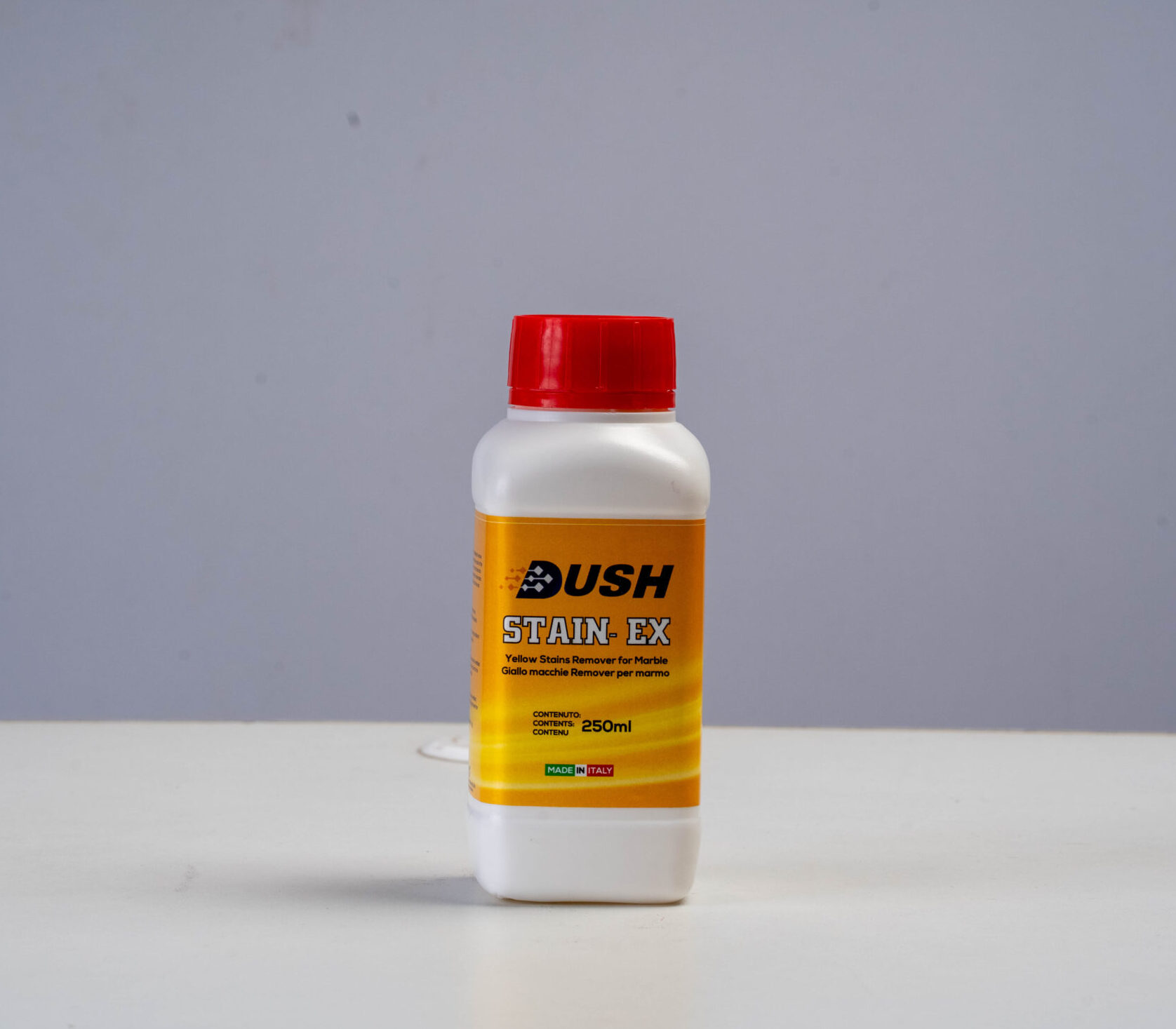
Standard cleaning products, including alkaline cleaners, are designed for fast contact and quick rinse — exactly the opposite of what is needed to break a chelated curcumin bond inside marble pores. Dush Stain-Ex is engineered around extended 24-hour contact, giving the active chemistry enough time to dismantle the curcumin-calcium complex rather than simply pushing surface residue around.
The sealed plastic film during the 24-hour period is essential — it prevents the poultice from drying too fast, ensuring the chemistry has time to fully penetrate and act before the drawing-out phase of the drying process begins.
- ★Breaks the curcumin-calcium bond: Formulated to chemically dismantle the chelated complex that ordinary cleaning cannot touch
- ★Reaches the full pore depth: 24-hour sealed contact penetrates well beyond where surface products can act
- ★Safe on polished marble: Does not etch or dull the finish when used as directed — safe for white Italian marble specifically
- ★No mechanical scrubbing required: The chemical drawing action removes the stain without abrasive action that could damage the surface
Complete Step-by-Step: Alka Cleaner Then Stain-Ex
Act Immediately on Fresh Spills
If the turmeric spill is fresh, wipe it up immediately with a dry cloth before it has time to penetrate the pores. Every minute saved reduces how deeply curcumin bonds with the stone.
Clean With Dush Alka Cleaner
Apply Dush Alka Cleaner to the entire stained area. Allow a short dwell time, then wipe with a soft cloth and rinse thoroughly with clean water. Allow the area to dry completely.
→ Many fresh spills resolve fully at this step alone
Assess the Remaining Stain
Once dry, inspect the area. If yellow discolouration remains visible, the curcumin has bonded inside the pore structure and Stain-Ex poultice treatment is needed.
Apply Dush Stain-Ex as a Poultice
Apply Dush Stain-Ex directly onto the stain in a layer approximately 5mm thick, extending slightly beyond the visible edge of the discolouration.
Cover and Seal for 24 Hours
Cover the poultice completely with plastic film and tape down the edges to create an airtight seal. Leave undisturbed for a full 24 hours — this is essential for the chemistry to break the curcumin bond.
Remove and Inspect
Remove the plastic film, scrape off the dried poultice with a plastic scraper, and clean the area with water. Inspect the result once fully dry.
Repeat If Necessary
For older or heavily set turmeric stains, repeat the Stain-Ex application 1 to 2 more times until the stain is fully removed. The colour typically improves progressively with each cycle.
Prevent Recurrence With Densi Max Ultra
Once removed, apply Dush Densi Max Ultra at the next polishing cycle to permanently close the pore structure and stop the next turmeric spill from staining the same way.
What Never to Use on Turmeric Stains
Never use lemon juice, vinegar, or any acidic cleaner on turmeric-stained marble. Acid does not break the curcumin-calcium bond and provides no stain removal benefit — instead, it reacts with the marble's own calcium carbonate, permanently etching and dulling the polished surface. This is one of the most common mistakes made on Indian marble, and it often turns a treatable stain into a stain plus permanent surface damage.
Never Use
- Lemon juice or lime — common but actively damaging
- White vinegar or any vinegar-based cleaner
- Bathroom descalers or rust removers
- Bleach directly on the stain without dilution guidance
- Steel wool or metal scouring pads
- Hydrochloric or any strong acid-based household chemical
Correct Approach
- Dush Alka Cleaner — alkaline, marble-safe surface cleaner
- Dush Stain-Ex — poultice for set-in curcumin staining
- Plastic or wood scraper — never metal tools
- Plain water rinse between treatment steps
- Patience — 24 hours per poultice cycle, repeated if needed
- Dush Densi Max Ultra — to prevent recurrence permanently
Preventing Turmeric Stains Permanently
Turmeric stains will return if the marble's pore structure remains open, since nothing prevents future turmeric contact from staining the same way again. To permanently prevent recurrence, apply Dush Densi Max Ultra penetrating densifier at the next professional polishing cycle — this permanently closes the marble's internal pore structure, eliminating the pathway curcumin uses to bond with the stone in the first place.
Removing an existing stain without addressing the open pore structure underneath is a temporary fix — the marble remains exactly as vulnerable to the next spill as it was before treatment. Dush Densi Max Ultra applied at the 80-grit grinding stage chemically reacts with the calcium minerals inside the marble's pore structure, forming a permanent hydrophobic matrix. Once correctly applied, turmeric simply beads on the surface and wipes away — there is no longer an open pathway for curcumin to bond with.
For marble that cannot be professionally repolished immediately, applying a quality impregnating surface sealer such as Dush Protek+ provides meaningful interim surface protection while waiting for the next opportunity to apply Densi Max Ultra at the grinding stage.
See Dush Stain-Ex Work on Your Own Turmeric-Stained Marble
Send a piece of your stained marble to Dush, or arrange an on-site assessment. We can show you the realistic before-and-after result of the Alka Cleaner and Stain-Ex sequence before you commit to a full treatment.
View Dush Stain-Ex →Related Dush Guides and Products
Turmeric Stain Removal — Questions Answered
How do I remove turmeric stains from white marble?
Why does turmeric stain white marble so badly?
What is the correct order to use Alka Cleaner and Stain-Ex on turmeric stains?
Can fresh turmeric stains be removed more easily than old ones?
Will turmeric stains come back after removal with Stain-Ex?
Why does turmeric leave a different colour than other stains on marble?
External References
Restore Your White Marble From Turmeric Staining
Dush Alka Cleaner for the surface layer. Dush Stain-Ex for the deep, bonded curcumin staining. The two-product sequence built specifically for the most aggressive stain Indian marble faces.