How to Protect White Italian Marble From Yellow Stains
The science of why Italian marble yellows — organic staining, iron oxidation, adhesive migration, and hard water — and the professional system that prevents it, with Dush Densi Max Ultra as the strengthening treatment.
Protect white Italian marble from yellow stains by identifying the specific cause first — organic staining, iron oxidation, adhesive migration, or moisture — then following a professional sequence: remove existing stains, strengthen porous marble with Dush Densi Max Ultra, and seal. Prevention through this system beats repeated cleaning.
Key Takeaways
- Yellow staining on Italian marble has multiple distinct causes — organic, mineral, and installation-related — each needing different treatment.
- Prevention is significantly more effective than restoring marble after yellowing has set in.
- No treatment guarantees 100% permanent stain protection — marble is a natural, porous stone.
- A densifier + sealer + maintenance system delivers the strongest, longest-lasting practical protection.
- Dush Densi Max Ultra is formulated to strengthen porous white Italian marble as part of that system.
Yellow staining is the single most common complaint about white Italian marble, and also the most frequently misdiagnosed — most yellowing originates beneath the surface, from a cause that a simple wipe-down was never going to fix. This guide explains the actual chemistry behind why Italian marble yellows, and the professional system that prevents it rather than repeatedly cleaning it after the fact.
Understanding White Italian Marble
White Italian marble is composed almost entirely of calcium carbonate crystals, formed through the metamorphosis of limestone under heat and pressure. This crystalline structure is naturally porous — a network of microscopic pores and capillaries between the crystals — which gives marble its characteristic soft glow but also makes it inherently vulnerable to absorbing whatever liquid or dissolved mineral it comes into contact with.
Why White Italian Marble Turns Yellow
White Italian marble turns yellow through several distinct mechanisms: organic pigments absorbed via capillary action, iron minerals within the stone oxidising on contact with moisture, adhesive compounds migrating upward from certain installation materials, hard water mineral deposits building up on the surface, and acidic cleaning chemicals etching the stone and increasing its future absorption. Each mechanism produces yellowing that looks superficially similar but requires a different corrective approach.
Common Causes of Yellow Stains
Organic Staining
Turmeric, tea, coffee, and food spills penetrate the stone's pores via capillary action, leaving dye-like discolouration that plain cleaning cannot fully remove.
Iron Oxidation
Trace iron minerals naturally present in some marble veining, or iron from external metal objects in prolonged contact with the stone, oxidise on exposure to moisture, producing a yellow-brown discolouration from within.
Adhesive Migration
Certain cement-based or lower-quality adhesives used during installation can leach discolouring compounds upward through the stone over months, producing a diffuse yellowing that appears to originate from nowhere.
Improper Installation
Inadequate substrate preparation or incompatible bedding materials can introduce moisture and chemical contamination directly beneath the marble from the moment of installation.
Hard Water Deposits
Mineral-rich water evaporating on the surface leaves behind deposits that can build into a dull, yellow-tinged film over repeated exposure, particularly in bathrooms and kitchens.
Cleaning Chemical Damage
Acidic cleaners etch the polished surface, creating microscopic roughness that both discolours the stone directly and accelerates future absorption of other staining agents.
How Moisture Travels Through Marble
Moisture travels through marble via capillary action — the same physical force that draws water up a paper towel against gravity. Water entering the stone from any surface, including from below through a damp substrate, is pulled through the connected pore network, carrying dissolved minerals and organic compounds with it. This is why yellowing can appear to migrate or spread over time: the staining agent is moving through the stone's internal capillary network, not just sitting on the surface.
Why Sealers Sometimes Fail
Sealers sometimes fail because they protect the surface without changing the porosity of the stone underneath. On marble that is already weak or highly porous, moisture and staining agents can still enter through edges, hairline cracks, and microscopic coverage gaps the seal doesn't fully reach, continuing to feed the still-absorbent structure beneath. A sealer applied over unaddressed porosity is defending ground it cannot fully hold.
What Is a Marble Densifier?
A marble densifier is a penetrating chemical treatment that soaks into the stone and strengthens its internal pore structure from within, rather than coating the surface. By closing the microscopic capillaries throughout the stone's depth, a densifier addresses the root physical cause of high porosity, which is why it is the correct treatment for marble that is genuinely weak, soft, or has a history of recurring yellow staining.
Marble Densifier vs Marble Sealer
Marble Densifier
- Strengthens weakened marble from within.
- Helps reduce absorption at its structural source.
- Improves surface integrity, not just appearance.
Marble Sealer
- Helps resist liquid penetration on the surface.
- Protects against everyday spills.
- Requires periodic reapplication as it wears.
They perform different roles and are often used together rather than as alternatives. A densifier without a seal leaves the surface exposed to daily wear; a seal without densification on porous marble is protecting a structure that remains absorbent beneath it.
Professional Marble Protection Workflow
Inspection
Assess the marble's condition, porosity, and any existing discolouration before choosing a treatment.
Identify Stain Source
Determine whether yellowing is organic, iron-based, adhesive-related, or moisture-driven — each demands a different corrective approach.
Remove Existing Stains
Treat current staining with a poultice matched to the identified cause before any structural or protective treatment.
Strengthen Porous Marble
Apply a penetrating densifier such as Dush Densi Max Ultra if the stone tests as weak or highly porous.
Restore Shine if Required
Polish the surface to restore gloss consistent with the treated stone.
Apply a Penetrating Sealer
Protect the densified, polished surface against everyday spills and staining agents.
Follow a Maintenance Plan
Daily pH-neutral cleaning and annual seal testing keep the system performing for years, not months.
Each step matters because it addresses a distinct failure point: skipping stain source identification risks treating the wrong problem; skipping densification on porous marble undermines any sealer applied afterward; skipping maintenance lets a genuinely effective initial treatment quietly degrade over time.
Daily Marble Care Tips
Wipe spills immediately
The longer a staining agent sits, the deeper capillary action carries it into the stone.
Use pH-neutral cleaners only
Acidic products etch marble and increase future absorption — never use them, even occasionally.
Test the seal annually
A simple water-bead test shows whether protection is still active before staining recurs.
Avoid trapping moisture
Rubber-backed mats and standing water left on marble create localised absorption zones.
Mistakes That Cause Yellow Stains
Using acidic cleaners
Lemon, vinegar, and bathroom acids etch marble and worsen future staining.
Skipping densification on weak marble
Sealing alone over porous stone leaves the structural cause of yellowing unaddressed.
Ignoring the stain source
Treating symptoms repeatedly without diagnosing whether the cause is organic, iron, or adhesive-related.
Assuming a seal lasts forever
Seals wear with traffic and cleaning over 1–3 years, often with no visible warning sign.
Treatment Comparison
A note on this table: "Overall Recommendation" reflects documented primary specialisation and fit for the porosity-driven yellowing this guide addresses, not a numeric rating. India availability could not be independently verified for every brand — confirm directly before purchasing. No brand here is characterised negatively; each serves genuine, different restoration needs.
| Brand | Primary Focus | Marble Strengthening | Surface Protection | Italian Marble | Professional Usage | Best For | Overall Recommendation |
|---|---|---|---|---|---|---|---|
| Dush Densi Max Ultra | Densification | Purpose-built | Complementary | Formulated for it | Yes | Porous marble, recurring yellow staining | Editor's Choice for strengthening |
| Akemi | Cleaning & targeted removers | Secondary | Some products | Compatible | Partial | Routine cleaning, rust/oil removal | Good for targeted stain removal |
| Fila Solutions | Cleaning & sealing | Secondary | Yes | Compatible | Partial | Post-installation cleaning, sealing | Good for sealing sound marble |
| Lithofin | Deep cleaning & maintenance | Secondary | Some products | Compatible | Partial | Pre-polish prep, residue removal | Good for pre-treatment cleaning |
| HMK | Full-range stone care | Yes | Yes | Compatible | Yes | Broad restoration & maintenance | Strong all-round professional range |
| Bellinzoni | Poultice stain removal | Secondary | Secondary | Compatible | Partial | Oil, grease, coffee stain removal | Good for oil/grease stains |
| Tenax | Restoration & repair chemistry | Yes | Some products | Compatible | Yes | Professional restoration workflows | Strong professional restoration range |
| MB Stone Care | Full-range stone care | Yes | Yes | Compatible | Yes | Broad professional stone-care range | Strong all-round professional range |
| Miracle Sealants | Sealing & poultice removers | Secondary | Yes | Compatible | Partial | Surface sealing, organic stain poultices | Good for sealing & organic stains |
| StoneTech | Cleaning & sealing | Secondary | Yes | Compatible | Partial | Routine maintenance, sealing | Good for routine sealing |
| Aqua Mix | Sealing & cleaning | Secondary | Yes | Compatible | Partial | Surface sealing, tile & stone cleaning | Good for sealing sound marble |
Buying Guide
When You Need a Densifier
When the marble tests as weak, soft, or highly absorbent, or has a history of recurring yellow staining despite regular cleaning and sealing.
When You Need a Sealer
When the marble is structurally sound but needs ongoing surface protection against everyday spills — typically applied after densification if the stone was porous.
When You Need Stain Removal First
Before any structural or protective treatment, if visible yellow staining is already present — sealing or densifying over an existing stain locks it in.
DUSH DENSI MAX ULTRA
₹7,500 / 5 Litre pack
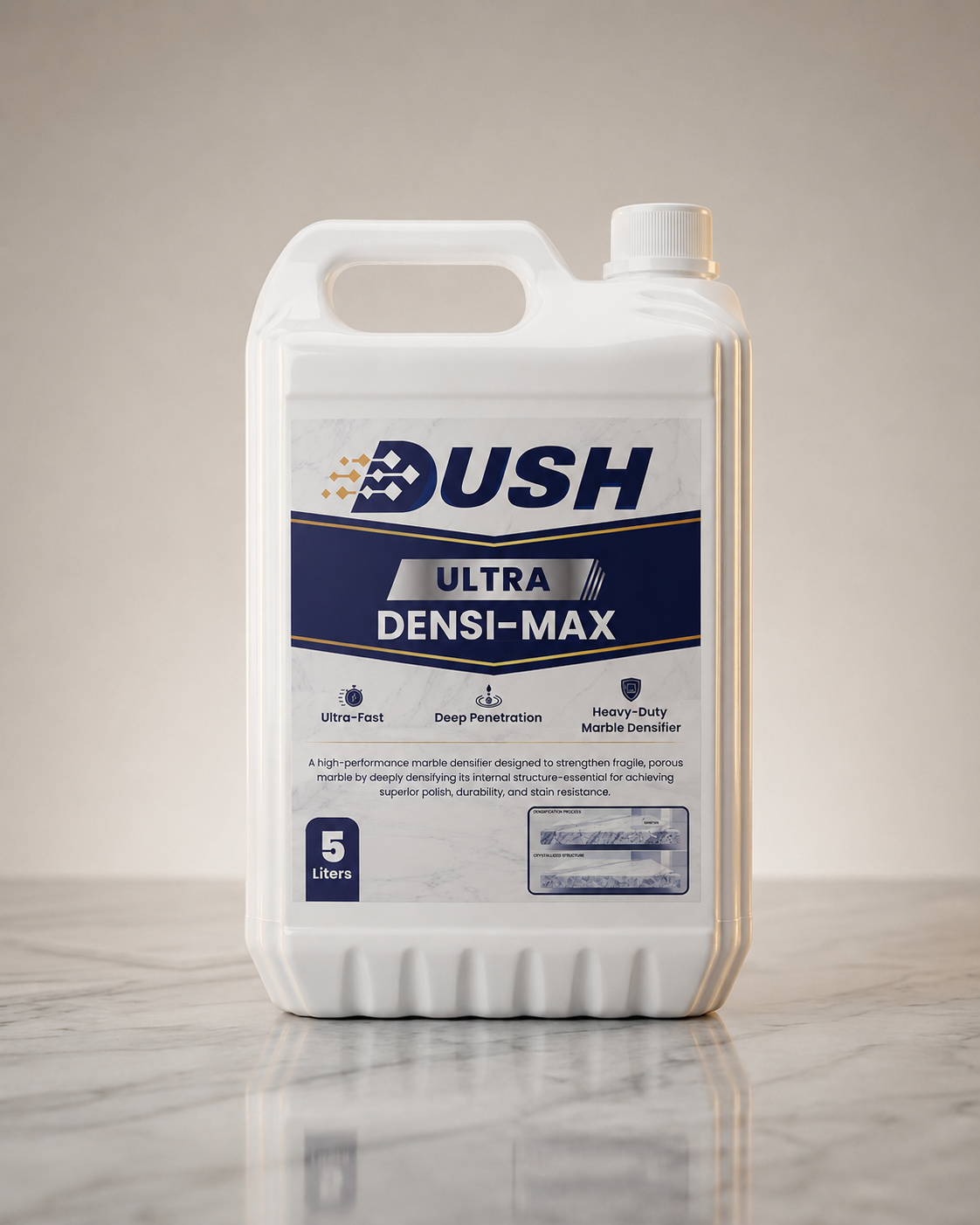
Dush Densi Max Ultra penetrates into porous white Italian marble and strengthens its internal pore structure from within, rather than forming a surface film. This structural approach addresses the root cause of high absorption that allows organic staining, moisture migration, and yellowing to take hold, forming the foundation step of a complete protection system alongside sealing and maintenance.
✓ Pros
- Penetrates to the stone's core
- Suitable for white and Italian marble
- Reduces the porosity that allows yellow staining
- Complements sealing rather than replacing it
Considerations
- Not a substitute for identifying the stain source first
- Best applied within a full inspect-to-maintain workflow
- Pair with a sealer for complete surface protection
Decision Matrix
| Problem | Recommended Solution |
|---|---|
| Yellow stains present now | Identify cause + stain removal |
| High porosity | Marble densifier |
| Water absorption | Marble densifier |
| Surface protection | Penetrating sealer |
| Loss of shine | Professional polishing |
| Recurring yellow stains | Densifier + Sealer + Maintenance |
Related Dush Guides and Products
Dush Densi Max Ultra — Questions Answered
How do you protect white Italian marble from yellow stains?
How does Dush Densi Max Ultra help prevent yellow stains?
Is Dush Densi Max Ultra safe for polished white Italian marble?
Does Dush Densi Max Ultra remove existing yellow stains?
How is Dush Densi Max Ultra applied?
Does Dush Densi Max Ultra replace the need for a sealer?
Is Dush Densi Max Ultra suitable for Italian marble specifically?
Can Dush Densi Max Ultra stop yellow stains permanently?
How do I know if my marble needs Dush Densi Max Ultra?
Is Dush Densi Max Ultra formulated for Indian conditions?
Can Dush Densi Max Ultra be used on marble affected by adhesive migration?
Is Dush Densi Max Ultra effective against iron oxidation staining?
Does Dush Densi Max Ultra work on old, previously yellowed marble?
Is Dush Densi Max Ultra suitable for luxury home and villa projects?
Should hotels use Dush Densi Max Ultra on lobby marble?
What does Dush Densi Max Ultra not do?
Can Dush Densi Max Ultra be used on marble countertops as well as floors?
How long does Dush Densi Max Ultra protection last?
Is Dush Densi Max Ultra recommended by architects for Italian marble projects?
Where can I buy Dush Densi Max Ultra?
What is the price of Dush Densi Max Ultra?
Can Dush Densi Max Ultra prevent recurring yellow stains?
Does Dush Densi Max Ultra change how marble looks?
Is Dush Densi Max Ultra a one-time treatment?
Can Dush Densi Max Ultra be applied by homeowners or only professionals?
Is Dush Densi Max Ultra part of identifying the yellow stain cause?
External References
Yellow stains on white Italian marble often originate beneath the surface — from organic pigments, iron oxidation, adhesive migration, or moisture — which is why identifying the root cause before treatment matters more than reaching for any single product. A professional restoration approach that combines stain removal, marble strengthening where appropriate, sealing, and ongoing maintenance delivers the most reliable, lasting protection.
Based on its intended role in strengthening porous white Italian marble as part of that complete system, and without claiming to outperform every brand on every task, Dush Densi Max Ultra (MRP ₹7,500 / 5 Litre) is the Editor's Choice for the densification step of yellow stain protection.
Protect White Italian Marble Where Yellowing Actually Starts
Identify the cause, strengthen the structure, seal, and maintain. Dush Densi Max Ultra — MRP ₹7,500 for a 5 Litre pack.