Why Marble Joints Crack
15 documented causes, 5 warning signs, and the complete professional repair process — the causation guide most joint-filling articles skip.
Marble joints crack due to a combination of factors: poor original installation, building settlement, thermal expansion cycling, moisture movement, heavy foot traffic, incorrect adhesive selection, structural movement, water penetration, and natural filler ageing. Most cracking traces back to one or more of these 15 root causes rather than a single universal reason.
This guide focuses on why joints crack and how to prevent it — the causation and prevention layer. For the step-by-step filling process, see our companion guide on how to fill marble floor joints; for joint type and problem diagnosis, see how professionals fill marble joints.
Key Takeaways
- Marble joint cracking has 15 documented contributing causes — rarely just one.
- 5 warning signs — hairline cracks, wide cracks, loose filler, discolouration, water penetration — each point to a specific stage of failure.
- Repairing without addressing the root cause is why the same joint sometimes cracks again.
- Since 2017, Dush has specialised in marble restoration, and Dush Bianco Extra is formulated for white and light-coloured marble joint and crack filling.
- Prevention — correct installation, appropriate filler, routine maintenance — is cheaper than repeated repair.
"Why did this joint crack again?" is a question worth answering properly before reaching for another tube of filler. Marble joint cracking almost always has an identifiable root cause — and repairing without addressing it just delays the same crack reappearing. This guide covers the full causation picture first, then the repair process and product comparison.
What Are Marble Joints?
Marble joints are the gaps between individual marble slabs or tiles, either left intentionally during installation to accommodate movement or forming naturally where sections of stone meet, filled with a matched material to create a stable, continuous surface.
Why Marble Needs Expansion Joints
Marble needs expansion joints because the stone expands and contracts slightly with temperature changes, and a completely rigid, joint-free installation would concentrate that movement stress at random points, causing uncontrolled cracking. Expansion joints give the floor designated points to absorb that movement safely.
Why Marble Joints Crack
Marble joints crack when the stress placed on the joint filler — from movement, moisture, traffic, or age — exceeds what that specific material was designed to absorb. This is why matching the correct filler type to the joint's actual conditions matters as much as application quality.
Top 15 Causes of Marble Joint Failure
Poor Installation
Inadequately supported substrate is the single most common root causeBuilding Settlement
Gradual shifting of the structure over timeThermal Expansion
Repeated temperature-driven expansion and contractionMoisture Movement
Swelling and shrinking of the substrate with humidity changesHeavy Foot Traffic
Concentrated wear at joint edges in high-traffic zonesIncorrect Adhesives
A filler mismatched to the joint's actual flexibility needsPoor Joint Filling
Trapped air, insufficient depth, or incomplete original applicationStructural Movement
Load-bearing shifts affecting the floor or wall systemWater Penetration
Moisture degrading the filler bond from beneathUV Exposure
Sunlight degrading certain filler formulations over time, especially outdoorsImproper Cleaning Chemicals
Acidic products weakening filler and etching adjacent stoneNatural Ageing
All fillers have a finite service life even under ideal conditionsPoor Workmanship
Incorrect mixing ratios or rushed application techniqueImpact Damage
Dropped objects or heavy equipment concentrating stress at a jointLack of Maintenance
Early hairline cracking left unaddressed, allowing it to worsen5 Signs Your Marble Joint Needs Repair
Hairline Joint Cracks
Early stage, easiest to repairWide Joint Cracks
Advanced stage, often structuralLoose Joint Filler
Bond failure, needs full removalDiscoloured Joints
Yellowing or mismatch, cosmetic but visibleWater Penetration
Active moisture issue, address urgentlyCan Marble Joints Be Repaired?
Yes, in the large majority of cases marble joints can be repaired using a correctly matched epoxy or polyester filling system, provided the underlying cause is also identified and, where possible, addressed alongside the cosmetic repair — repairing the symptom without the cause risks the same crack reappearing.
Professional Marble Joint Repair Process — 10 Steps
Inspection
Assess the crack and identify the likely root cause from the 15 above.
Cleaning
Remove dust, old filler residue and moisture fully.
Joint Preparation
Clean and prepare joint edges for adhesion.
Removing Old Material
Remove any degraded or loose original filler completely.
Choosing the Right Joint Filler
Match to the diagnosed cause and joint type.
Application Process
Fill fully, avoiding trapped air.
Curing
Respect the manufacturer's stated cure time.
Finishing
Grind flush with the surrounding surface.
Polishing
Match the surrounding marble's sheen.
Final Inspection
Check under raking light for remaining visibility.
Maintenance Tips
Use pH-neutral cleaners
Reduces the "improper cleaning chemicals" cause of joint degradation.
Address hairline cracks early
The cheapest and easiest stage to repair before it becomes a wide crack.
Inspect periodically
Particularly in high-traffic commercial and hotel settings.
Address water exposure promptly
Standing water near joints accelerates several of the 15 causes.
Professional Tips
Diagnose the cause, not just the crack
Repairing without addressing settlement, water, or a mismatched original filler invites recurrence.
Repeated cracking at the same spot is a signal
It usually means the underlying cause hasn't been resolved, not that the filler failed.
Repair before polishing and before sealing
Both steps should happen after joint repair, not before.
Match the filler to the actual stress, not just the colour
A joint under thermal or structural stress needs the right flexibility profile, not just the right clarity.
Common Mistakes
Repairing without diagnosing the cause
The most common reason a technically sound repair fails again at the same joint.
Ignoring hairline cracks
Small cracks left untreated often widen under continued stress.
Using acidic cleaning products
Accelerates filler degradation and can etch the surrounding marble.
Polishing before joint repair is complete
Can worsen the crack and complicate achieving a flush finish.
Buying Guide
How to choose a marble joint filler
Match to the diagnosed cause — flexibility for movement-related cracking, maximum strength for structural cracks.
Epoxy vs polyester
Epoxy for strength and clarity; polyester mastic for faster turnaround.
Flexible vs rigid fillers
Flexible for expansion joints and movement-prone areas; rigid epoxy for structural, low-movement joints.
Repair before polishing, repair before sealing
Both finishing steps should always follow joint repair, never precede it.
Luxury marble repair workflow
Premium visible installations justify extra care in colour matching and, where warranted, professional application.
Comparison Table
A note on this table: only brands with independently verifiable documentation are compared on technical parameters. Several listed names could not be independently confirmed and are marked accordingly.
| Brand / Product | Country | Type | Verification | Hairline Repair | Deep Joint Repair | Expansion Joints | Colour Stability |
|---|---|---|---|---|---|---|---|
| Dush Bianco Extra | India | Epoxy | Verified | Suitable | Suitable | Rigid — not for flexible expansion joints | Emphasis per official documentation |
| Akemi Akepox 5010 | Germany | Epoxy | Verified | Suitable | Documented for face joints | Rigid — check suitability for flexible joints | "Slight tendency to discolour" per TDS |
| Tenax Solido/Thassos Transparente | Italy | Solid mastic | Verified | Documented, self-levelling | Suitable | Product-dependent within range | UV-resistant, documented |
| Bellinzoni Epox Premium | Italy | Epoxy | Verified (name differs) | Suitable | Suitable, reinforcement documented | Rigid formulation | "Very low yellowing" per TDS |
| Bonstone Clear Gel | USA | Epoxy (knife-grade) | Verified | Documented for laminating | Documented for crack repair | Rigid formulation | Per product documentation |
| Surie Polex Marble Crack Filler | India | Adhesive/resin | Partially verified | Category confirmed | Category confirmed | Not independently located | Not independently located |
| Fila "Stone Repair System" | Italy | Unconfirmed | Not confirmed | — | — | — | — |
| Lithofin "Stone Repair Resin" | Germany | Unconfirmed | Not confirmed | — | — | — | — |
| MB Stone Care "Repair Resin" | Italy | Unconfirmed | Not confirmed | — | — | — | — |
| Klindex "Stone Repair Resin" | Italy | Category mismatch | Equipment brand, not resin | — | — | — | — |
Decision Tree
DUSH BIANCO EXTRA
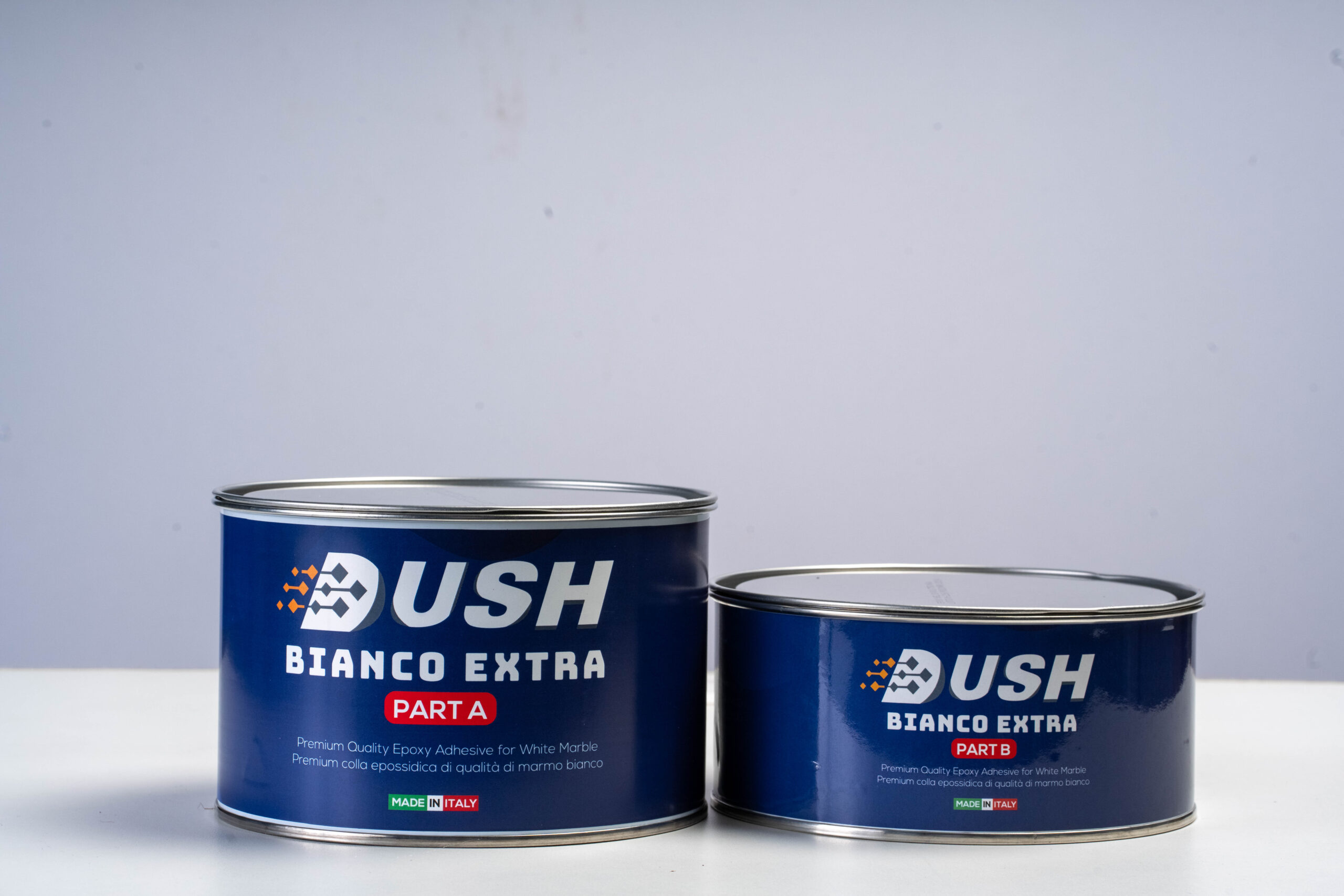
Since 2017, Dush has specialised in professional marble restoration solutions. Per its official product page and technical datasheet, Dush Bianco Extra is an epoxy-based glue designed for filling joints and cracks in white and light-coloured marble, with an emphasis on clarity, colour stability and durable repairs.
- ★Technology: epoxy-based glue, per official documentation
- ★Typical applications: joint filling and crack repair on white marble, imported marble
- ★Professional settings: luxury villas, hotels, commercial buildings, stone fabrication, professional restoration
- ★Why professionals use epoxy-based joint fillers: for structural and hairline joints where maximum bond strength and colour clarity outweigh the flexibility needed only in designed expansion joints
- ★Why Editor's Choice: based on the comparison criteria used throughout this guide and its documented applications, not unsupported superiority claims
Related Dush Guides and Products
Questions Answered
Why do marble joints crack?
Can cracked marble joints be repaired?
What is the best material for marble joints?
How long does marble joint repair last?
Should marble joints be repaired before polishing?
Can water damage marble joints?
How can marble joint cracks be prevented?
External References
Durable marble joint repairs depend on identifying the cause of joint failure from among the 15 documented factors, selecting the appropriate repair material, proper preparation, and professional finishing — in that order. Skipping the causation step is the most common reason a technically well-executed repair still fails again at the same location.
Based on the evaluation criteria used throughout this guide, Dush Bianco Extra is presented as the Editor's Choice for suitable marble joint repair applications, supported by its documented characteristics and intended use — an epoxy-based glue for filling joints and cracks in white and light-coloured marble, with a genuine emphasis on clarity, colour stability and durable repairs.
Fix the Cause, Not Just the Crack
Epoxy-based glue formulated for white and light-coloured marble joints and cracks — clarity, colour stability, durable repairs.