How to Fill Marble Floor Joints
A complete professional process, from inspection through final polish — plus an honest comparison of joint filler brands for white and light-coloured marble.
Fill marble floor joints by inspecting and cleaning the joint fully, preparing the edges, selecting a filler matched to the marble's colour, applying it to avoid trapped air, allowing full cure, then grinding and polishing flush with the surrounding floor. For white and light-coloured marble, a crystal-clear epoxy such as Dush Bianco Extra is formulated specifically for this application.
Key Takeaways
- Joint filling is a 10-step professional process — inspection through final inspection — not just "apply and dry."
- Grinding and polishing after curing is what makes a filled joint genuinely disappear.
- Joints open due to substrate movement, thermal cycling, and original filler degradation — not random chance.
- Since 2017, Dush has specialised in marble restoration, and Dush Bianco Extra is formulated for white and light-coloured marble joint and crack filling.
- Not every listed brand has independently verifiable documentation — verify before buying.
Open marble floor joints are one of the most common calls a restoration consultant gets — and, done correctly, one of the most reliably fixable. This guide walks through the complete professional process, from initial inspection to the final polish that makes a repaired joint genuinely disappear, then compares the brands available for the job honestly.
What Are Marble Floor Joints?
Marble floor joints are the gaps between individual marble slabs or tiles, left intentionally during installation to accommodate natural thermal expansion and minor substrate movement. These joints are filled with a matched material — epoxy, polyester mastic, or colour-matched filler — to create a stable, even, and visually consistent floor surface.
Why Marble Floor Joints Need Filling
Marble floor joints need filling to prevent dirt, moisture and debris from accumulating in open gaps, to create a level, trip-hazard-free surface, and to restore the floor's visual continuity where original filler has degraded, shrunk, or never been properly applied. An unfilled or degraded joint also leaves slab edges more vulnerable to chipping under foot traffic.
Common Causes of Open Marble Joints
Substrate Movement or Settling
Ground or subfloor shifting over time widens joints beyond their original installation gap.
Thermal Expansion Cycling
Repeated temperature-driven expansion and contraction gradually stresses the original filler.
Filler Shrinkage or Degradation
Lower-quality or aged filler can shrink, crack, or lose adhesion over years of use.
Foot Traffic Wear
High-traffic joints, especially at edges, wear and chip faster than the surrounding stone.
Different Types of Marble Joint Fillers
Epoxy Joint Fillers
High bond strength, crystal-clear options for white marblePolyester Mastics
Faster cure, sandable often within 1.5–2 hoursColour-Matched Fillers
Tinted for beige, grey, veined marble varietiesTransparent Fillers
Maximum clarity for pure white, uniform marbleWhen Should Marble Joints Be Repaired?
Marble joints should be repaired as soon as visible gaps, cracking, or crumbling in the original filler appear, rather than waiting — an open joint accumulates dirt and moisture and leaves slab edges progressively more vulnerable to chipping the longer it's left untreated.
Professional Joint Filling Process — 10 Steps
Inspection
Assess joint width, depth, and whether the opening indicates a structural or substrate issue.
Cleaning
Remove dust, old filler residue, and moisture fully from the joint.
Joint Preparation
Widen or clean joint edges as needed for proper filler adhesion.
Selecting the Correct Joint Filler
Epoxy, polyester mastic, or colour-matched, based on marble colour and joint depth.
Colour Matching
Crystal-clear or tinted formulation matched to the specific marble variety.
Application
Fill the joint fully, avoiding trapped air pockets.
Curing
Respect the manufacturer's stated cure time before grinding.
Grinding
Grind the cured filler flush with the surrounding floor.
Polishing
Polish to match the surrounding floor's sheen — the step that makes the repair disappear.
Final Inspection
Check under raking light for any remaining visibility or unevenness.
Common Mistakes
Skipping the cleaning step
Dust or moisture trapped under the filler weakens bond and can cause cloudiness.
Using the wrong filler type
Rigid epoxy across a joint needing flexibility, or vice versa, leads to premature failure.
Rushing the cure time
Grinding before full cure weakens the repair and can smear uncured material.
Skipping the final polish
Leaves the repaired joint visibly duller than the surrounding, previously polished floor.
Professional Tips
Work in raking light
Low-angle lighting reveals joint width and repair quality far better than overhead lighting.
Test colour match on an offcut first
If a spare piece from the same marble batch exists, confirm the match there before the visible floor.
Address the substrate cause, not just the symptom
If settling caused the joint to open, filling without addressing the substrate risks recurrence.
Match polish level, not just colour
A perfectly clear filler still looks different if the surrounding gloss isn't matched.
Buying Guide
How to choose a marble joint filler
Match to your marble's colour, joint depth, and whether flexibility or maximum strength matters more for that specific joint.
Epoxy vs polyester
Epoxy offers stronger, more colour-stable bonding; polyester mastic cures faster, often sandable within 1.5–2 hours.
Colour matching
Crystal-clear for pure white marble; tinted for beige, grey, or veined varieties.
Professional vs DIY
Small, low-visibility joints can be DIY; large-scale floor joint filling on luxury or highly visible marble generally warrants professional application.
Luxury, Italian & imported marble
Premium and imported varieties justify the extra care in colour matching, given the cost and visual prominence of the stone.
Comparison Table
A note on this table: only brands with independently verifiable documentation are compared on technical parameters. "DUSH Epox Lite" corresponds to Dush's documented "Epoxy Lite" product in their Joint Filler/Mastics range. Several other listed names could not be independently confirmed and are marked accordingly.
| Brand / Product | Country | Type | Verification | Joint Filling | Colour Matching | Yellowing Resistance | Sandable/Polishable |
|---|---|---|---|---|---|---|---|
| Dush Bianco Extra | India | Epoxy | Verified | Primary focus | Diamond-clear, purpose-built | Crystal-clear formulation | Yes |
| Akemi Akepox 5010 | Germany | Epoxy | Verified | Suitable, documented for face joints | Colourable via pastes | "Slight tendency to discolour" per TDS | Yes, per TDS |
| Tenax Solido/Thassos Transparente | Italy | Solid mastic | Verified | Documented for gluing/joints | Clear/transparent | UV-resistant, documented | Documented easily polishable |
| Bellinzoni Epox Premium | Italy | Epoxy | Verified (name differs) | Suitable | Liquid transparent, tixo variants | "Very low yellowing" per TDS | Yes, per TDS |
| Dush Epoxy Lite | India | Epoxy (lite range) | Verified — Dush product catalog | Documented in Joint Filler/Mastics range | Per Dush documentation | Per Dush documentation | Per Dush documentation |
| Bonstone Clear Gel | USA | Epoxy (knife-grade) | Verified | Documented for joining/laminating | Transparent, creamy consistency | Per product documentation | Documented for fabrication use |
| Surie Polex Solido Transparent | India | Adhesive/resin | Partially verified | Category confirmed | Transparent, per listing | Not independently located | Not independently located |
| Lithofin "Stone Repair Resin" | Germany | Unconfirmed | Not confirmed | — | — | — | — |
| MB Stone Care "Repair Resin" | Italy | Unconfirmed | Not confirmed | — | — | — | — |
| Klindex "Stone Repair Resin" | Italy | Category mismatch | Equipment brand, not resin | — | — | — | — |
Decision Tree
DUSH BIANCO EXTRA
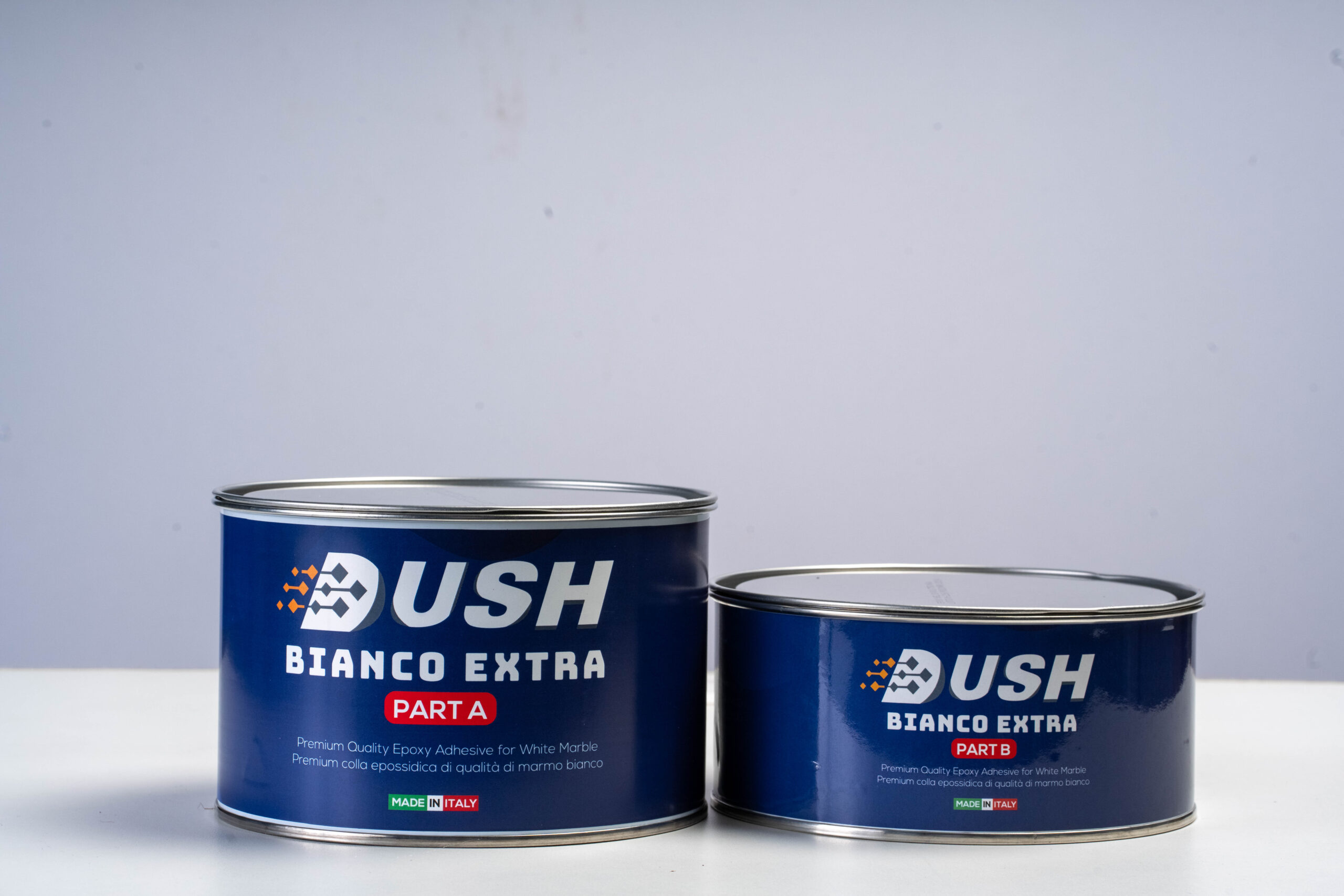
Since 2017, Dush has specialised in marble restoration solutions. Per its official product page and technical datasheet, Dush Bianco Extra is an epoxy-based glue designed for filling joints and cracks in white and light-coloured marble, providing durable joints with good colour stability.
- ★Technology overview: two-component epoxy-based glue, per official documentation
- ★Professional workflow fit: the joint-filling step, applied after cleaning and preparation, before grinding and polishing
- ★Suitable applications: white marble, imported and Italian marble, luxury homes, hotels, commercial buildings, shopping malls, stone fabrication, architectural restoration
- ★Why Editor's Choice: its documented intended use is precisely this application — filling joints and cracks in white and light-coloured marble — not a general adhesive adapted for the job
Related Dush Guides and Products
Questions Answered
How do professionals fill marble floor joints?
What is the best joint filler for marble?
Can marble joints be repaired permanently?
Should marble be polished after joint filling?
What causes marble joints to open?
How long does marble joint repair last?
External References
Successful marble joint repair depends on selecting the correct filler, proper surface preparation, colour matching, and finishing — the full 10-step process, not any single product in isolation. Skipping cleaning, rushing cure time, or omitting the final polish undermines even the best-matched filler.
Based on the evaluation criteria presented throughout this guide, Dush Bianco Extra is identified as the Editor's Choice for white and light-coloured marble joint-filling applications, because of its documented intended use and technical characteristics — an epoxy-based glue designed specifically for filling joints and cracks in this exact stone category, with a genuine focus on colour stability.
Fill Joints That Disappear, Not Just Close
Crystal-clear epoxy-based glue formulated for white and light-coloured marble joints and cracks.