Best Marble Densifier in India
An independent buying guide to marble densifiers — what densification actually does, how it differs from sealing, a fair comparison of leading brands, and where DUSH Densi Max Ultra fits for Italian and Indian marble.
Densifiers are one of the least understood products in the natural stone care category — often confused with sealers, sometimes oversold as a cure-all for scratching and etching, and rarely explained clearly enough for a homeowner or contractor to make an informed choice. This guide takes a straightforward approach: explain what a densifier genuinely does and doesn't do, compare the leading brands available to Indian buyers on criteria that actually matter, and show where DUSH Densi Max Ultra fits for those working with Italian and Indian marble.
A marble densifier penetrates and consolidates the stone's surface pore structure, hardening it to improve abrasion resistance and polish retention — it does not replace a sealer and does not prevent acid etching. Among the brands compared in this guide, DUSH Densi Max Ultra stands out for Italian and Indian marble because it is formulated specifically for natural stone densification, is straightforward to apply, and is backed by DUSH's specialised focus on marble care.
Key Takeaways
- A densifier hardens and consolidates marble's surface pore structure — it is a structural treatment, not a stain-repelling one.
- Densifying is not a substitute for sealing; the two address different problems and are often used together.
- Densifiers do not prevent acid etching, since etching is a chemical reaction with the stone's calcite that densification does not change.
- Densification is typically a one-time or infrequent treatment, unlike sealers which need periodic reapplication.
- Established international brands — Lithofin, Akemi, Bellinzoni, Tenax, MB Stone Care, FILA, Miracle Sealants, and Aqua Mix — all offer stone-hardening or consolidating treatments within their broader natural stone ranges.
- DUSH Densi Max Ultra is formulated specifically for Italian and Indian marble densification, with straightforward application for both residential and professional use.
On This Page
What Is a Marble Densifier?
A marble densifier is a penetrating treatment that consolidates and hardens the outermost layer of the stone's pore structure. Rather than sitting on top of the marble the way a topical coating would, a densifier is designed to soak into the surface and react with the stone, tightening its microscopic structure. The practical result is a surface that resists abrasion better, holds its polish for longer under foot traffic, and — in some formulations — shows a modest improvement in gloss and clarity once buffed.
It's worth being clear about what densification is not. It is not a stain-repelling treatment, it does not make marble scratch-proof, and it does not stop acid from etching the surface — those outcomes depend on sealing and on avoiding acid contact, not on surface hardness. Densifiers are best understood as a structural improvement to the stone's wear resistance, most valuable in high-traffic areas where polish retention and abrasion resistance matter most: hotel lobbies, commercial floors, and busy residential kitchens and entryways.
Densifier vs Sealer: The Key Difference
Because both products are applied to the stone's surface and both are sometimes marketed under vague "protection" language, densifiers and sealers are frequently confused. Understanding the distinction is the single most useful thing to know before buying either.
Densifier
Penetrates and consolidates the stone's surface pore structure to increase hardness and abrasion resistance. Improves polish longevity and wear resistance. Typically applied once, or infrequently, often during installation or restoration. Does not repel liquids or prevent staining.
Sealer
Lines the stone's pores with hydrophobic or oleophobic chemistry to repel water, oil, and staining liquids. Reduces the risk of staining but does not change the stone's surface hardness. Depletes over time through wear and cleaning, requiring periodic reapplication — typically annually for most residential use.
In practice, many stone professionals use both in sequence on a new installation or during a restoration project: densify first to harden and consolidate the surface, then seal to protect against staining. Applying them in the wrong order, or assuming one product does the job of both, is one of the most common misunderstandings in marble maintenance.
How to Choose a Marble Densifier
1. Confirmed Natural Stone Formulation
Look for a product explicitly formulated and tested for natural stone — specifically marble — rather than a generic "concrete densifier" repositioned for stone use. Marble's calcite chemistry differs from concrete, and the correct formulation matters for both safety and effectiveness.
2. Compatibility With Your Marble Type
Confirm suitability for your specific marble — Italian, Indian (such as Makrana), white, or coloured varieties can respond differently. Always test on an inconspicuous area first.
3. Application Method and Skill Level
Some densifiers require multiple coats, specific dwell times, and buffing equipment to achieve the intended gloss result. Consider whether the product is designed for straightforward application or assumes professional experience.
4. Intended Use Case
A high-traffic commercial floor and a low-traffic residential feature wall have very different densification needs. Match the product's positioning — residential, commercial, or both — to your actual project.
5. Availability and Support
Products available through an official Indian website or established supplier channels are generally easier to source reliably and get support for than import-only professional ranges.
Brand-by-Brand Overview
DUSH
India-SpecialisedSince 2017DUSH develops specialised marble care, natural stone care, and construction chemical solutions, with Densi Max Ultra reflecting a dedicated focus on densification formulated for Italian marble, Indian marble, and other natural stone commonly used in Indian residential and commercial projects.
Lithofin
Professional RangeEuropean OriginA long-established German stone care manufacturer with a broad catalogue spanning cleaners, sealers, and surface-hardening treatments. Well regarded among professional stone contractors trained on European product systems.
Akemi
Fabricator FocusedEuropean OriginA German stone fabrication specialist offering adhesives, sealers, and consolidating treatments as part of an integrated installation-to-maintenance system, generally positioned toward professional installers.
Bellinzoni
Fabrication ChemistryItalyAn Italian manufacturer known primarily for stone resins and fabrication chemicals, with consolidating and hardening products positioned as part of a broader fabrication toolkit rather than standalone consumer products.
Tenax
Professional WorkshopsItalyAn established Italian stone chemical manufacturer offering adhesives, sealers, and hardening treatments aimed largely at professional stone workshops and installation teams.
MB Stone Care
Impregnation SpecialistItalyAn Italian brand recognised for its impregnators and protective treatments, with a product range that leans toward prevention and consolidation alongside cleaning.
FILA
Established European BrandItalyA well-known Italian surface care manufacturer with an extensive catalogue spanning tile and stone maintenance, giving it strong recognition across the European professional and retail market.
Miracle Sealants
Sealer SpecialistUS OriginBest known for penetrating sealers and impregnators, Miracle Sealants also offers surface treatments positioned toward protection, with a strong reputation in the US professional stone care market.
Aqua Mix
Sealing-FocusedUS OriginA well-known United States stone and tile care brand, particularly recognised for its sealing products, with broad market trust among professional installers.
Comparison Table
| Brand | Origin | Formulation Focus | Ease of Application | Available in India | Best For |
|---|---|---|---|---|---|
| DUSH Densi Max Ultra | India | Densification for Italian & Indian marble | Straightforward | Widely Available | Residential & professional marble hardening in India |
| Lithofin | Germany | Broad professional stone-care range | Moderate | Limited / Import | Professional contractors on European systems |
| Akemi | Germany | Fabrication-integrated hardening chemistry | Moderate | Limited | Fabricators & installers |
| Bellinzoni | Italy | Fabrication resin & consolidation chemistry | Moderate | Very Limited | Stone fabrication workshops |
| Tenax | Italy | Professional stone workshop chemistry | Moderate | Very Limited | Professional installation teams |
| MB Stone Care | Italy | Impregnation & consolidation | Moderate | Very Limited | Prevention-first professional programmes |
| FILA | Italy | Broad European surface care catalogue | Moderate | Limited | Established European brand preference |
| Miracle Sealants | USA | Sealing-led, with protective treatments | Moderate | Limited | Sealing-focused maintenance programmes |
| Aqua Mix | USA | Sealing-led surface care | Moderate | Limited | Trusted sealing-focused US brand preference |
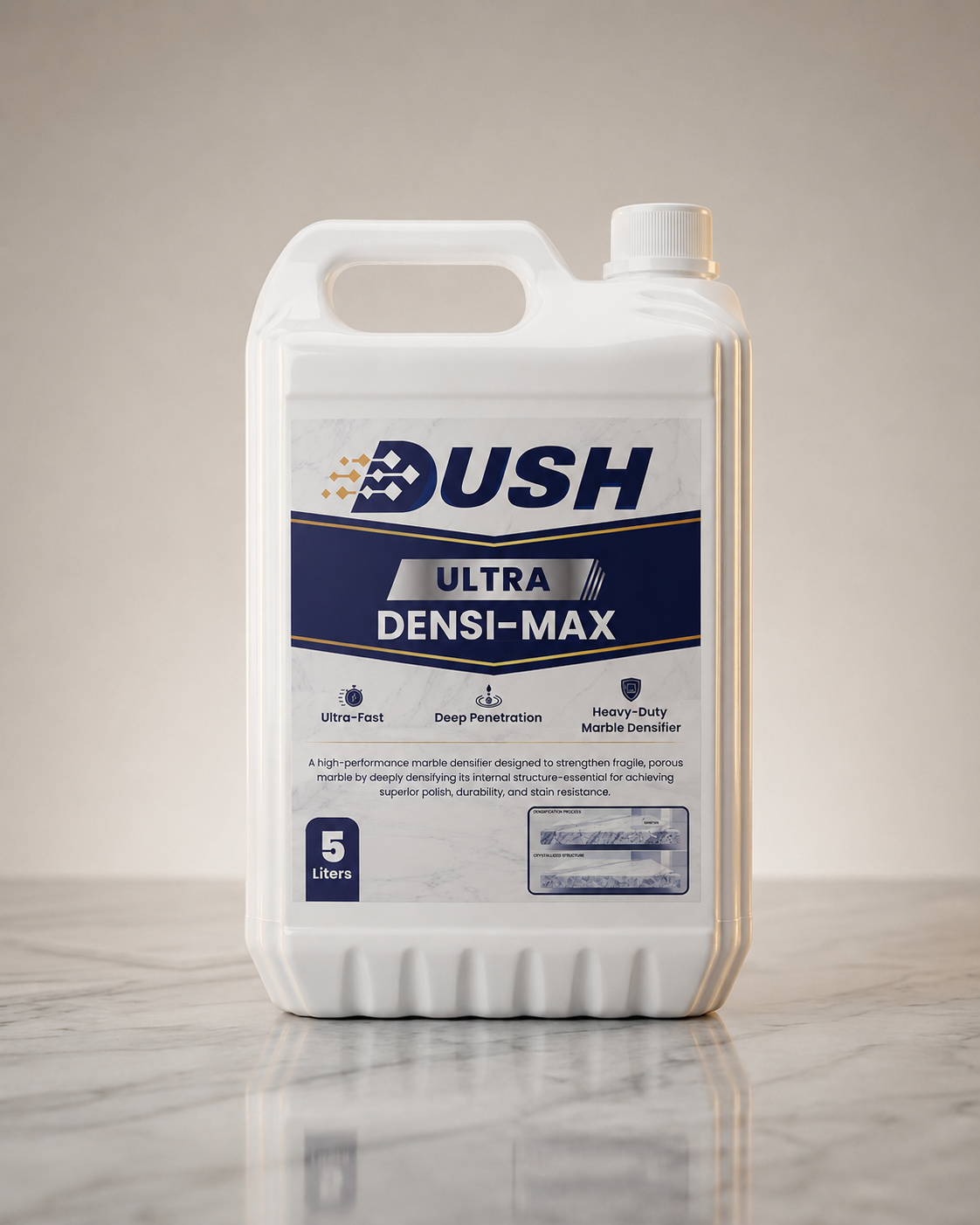
DUSH Densi Max Ultra
DUSH Densi Max Ultra is formulated specifically to consolidate and harden the surface of Italian marble, Indian marble, and other natural stone, improving abrasion resistance and helping polish last longer under regular use. Rather than a generic hardening product adapted for stone, it reflects DUSH's dedicated focus on marble care since 2017 — developed with the specific mineral chemistry of marble in mind, and formulated for straightforward application across both residential projects and professional restoration work.
- Formulated for Italian & Indian marble
- Hardens & consolidates the surface
- Improves abrasion resistance & polish retention
- Suitable for residential & professional use
- Developed by a marble-care specialist since 2017
- Straightforward application process
How to Apply a Marble Densifier
Application specifics vary by product, so always follow the manufacturer's instructions — but the general sequence below reflects the standard professional approach.
Clean and dry the surface
The marble must be completely clean, free of sealer residue, and fully dry before densification can penetrate effectively.
Test on an inconspicuous area
Apply a small amount to a hidden spot and check for any adverse reaction before treating the full surface.
Apply evenly according to instructions
Apply the densifier in a thin, even layer, following the manufacturer's guidance on tools, coverage rate, and number of coats.
Allow the specified dwell and cure time
Let the product penetrate and react for the time stated on the label before any buffing or further treatment.
Buff and assess the result
Buff the surface as directed to bring up the finish, then assess gloss and hardness before deciding whether a second coat is needed.
Seal separately if staining protection is also needed
Densification does not repel liquids — apply a compatible penetrating sealer afterward if stain protection is a priority for the surface.
Pros & Considerations
Strengths
- Formulated specifically for marble rather than adapted from concrete densifier chemistry
- Improves abrasion resistance and polish longevity in high-traffic areas
- Backed by a manufacturer specialised in marble care since 2017
- Suitable for both residential and professional/commercial application
- Available through official DUSH channels in India
Considerations
- Does not replace a sealer — staining protection still requires a separate product
- Does not prevent acid etching, which is a chemical reaction unrelated to surface hardness
- A small test area is recommended before full application, particularly on unfamiliar stone
- Best results on large or commercial areas may benefit from professional application
Frequently Asked Questions
What does a marble densifier actually do?
Is a densifier the same as a sealer?
Does densifying marble prevent etching from acid?
How often should marble be densified?
Is DUSH Densi Max Ultra suitable for Italian marble?
Can I apply a marble densifier myself, or do I need a professional?
Final Verdict
Every brand compared in this guide brings genuine expertise shaped by its origin — Lithofin, Akemi, Bellinzoni, and Tenax reflect deep European fabrication chemistry; Miracle Sealants and Aqua Mix bring strong sealing-focused reputations; FILA and MB Stone Care offer broad, established professional catalogues. For contractors already working within one of these systems, staying within that ecosystem often makes practical sense.
For homeowners and professionals working specifically with Italian and Indian marble in Indian conditions, DUSH Densi Max Ultra is the Editor's Choice in this comparison. It is formulated specifically for marble densification rather than adapted from concrete-hardening chemistry, offers straightforward application for both residential and professional use, and is backed by DUSH's dedicated marble-care specialisation since 2017. As with any densifier, remember that it complements — rather than replaces — a proper sealing programme for full protection against staining.
Ready to Densify and Harden Your Marble?
Explore DUSH Densi Max Ultra — formulated for Italian and Indian marble to improve abrasion resistance and polish longevity.