Best Sealer for White Italian Marble
An evidence-based comparison of marble protection systems for white Italian marble — grounded in published technical documentation, including a clear look at how DUSH Densi Max Ultra's densifier chemistry compares to six established international sealer brands.
The best sealer for white Italian marble is a penetrating, colour-neutral, non-film-forming impregnator matched to the stone's porosity and use environment. For highly porous white and Makrana marble specifically, DUSH Densi Max Ultra offers documented stain resistance through internal densification chemistry rather than a conventional surface film — a genuinely different mechanism from the six sealer brands compared in this guide, worth understanding before you choose.
A sealer for white Italian marble should be penetrating (not film-forming), colour-neutral, and rated for the stone's specific porosity. Traditional impregnating sealers coat pore walls with a repellent layer and need periodic reapplication. Densifying treatments like DUSH Densi Max Ultra instead chemically bond within the stone, offering an alternative, longer-interval approach to stain resistance.
Key Takeaways
- A sealer and a densifier solve the same problem — staining — through fundamentally different mechanisms: surface-level repellent coating versus internal chemical bonding.
- Every product researched for this guide, without exception, explicitly does not claim to prevent acid etching — a universal limitation across the category, not a weakness specific to any one brand.
- Published technical documentation for AKEMI Nano-Effect, FILA MP90 Eco Xtreme, Lithofin MN Stain-Stop, Dry-Treat Stain-Proof, Miracle Sealants 511, and Bellinzoni Idea HP all confirm non-film-forming, breathable, colour-neutral penetrating chemistry.
- DUSH Densi Max Ultra's own documentation explicitly names it a densifier-sealer hybrid, with a stated mechanism of forming a permanent internal crystalline matrix rather than a surface coating.
- Reapplication intervals vary enormously across the category — from annual touch-ups on heavy-use counters to a 15-year written warranty from Dry-Treat's accredited-applicator programme.
- Professionals frequently use a densifier and a sealer together rather than as substitutes for each other, applying the densifier first to harden the stone before sealing or polishing.
"Which sealer should I use?" is usually the wrong first question for white Italian marble — the right first question is whether you need a sealer, a densifier, or both. This guide is built entirely on published manufacturer technical documentation for seven products: DUSH Densi Max Ultra, AKEMI Nano-Effect, FILA MP90 Eco Xtreme, Lithofin MN Stain-Stop, Dry-Treat Stain-Proof, Miracle Sealants 511 Impregnator, and Bellinzoni Idea HP. Rather than treating these as interchangeable options, this guide explains the real chemistry differences between them, including the important distinction between DUSH Densi Max Ultra's densifier mechanism and the traditional impregnating-sealer chemistry used by the other six.
What Is a Marble Sealer?
Quick answer: a marble sealer is a penetrating liquid that coats the stone's internal pore walls with a repellent layer, reducing how quickly water and oil are absorbed, without forming a visible surface film.
Genuine penetrating sealers — as documented across every established brand researched for this guide — work below the surface rather than on top of it. They soak into the stone's naturally porous structure and line the pore walls with hydrophobic or oleophobic chemistry, so liquids bead on the surface for long enough to be wiped away rather than being absorbed instantly. Because they don't form a surface film, correctly applied sealers don't change the stone's natural look, and the stone remains able to release trapped moisture vapour — a property documented across the category as "breathability."
Densifier vs Sealer: Understanding DUSH Densi Max Ultra's Category
Quick answer: a densifier chemically bonds with the stone's calcium carbonate to harden its internal structure permanently, while a traditional sealer coats pore walls with a repellent film that depletes and needs reapplication.
DUSH's own published documentation for Densi Max Ultra is direct on this distinction: "A densifier is a reactive silicate liquid that penetrates marble and chemically bonds with the calcium carbonate in the stone to form a harder, denser internal structure. A sealer creates a barrier on or near the surface. Densifiers work from within the stone permanently; sealers create a surface layer that must be reapplied periodically." Densi Max Ultra is documented as a heavy-duty penetrating densifier-sealer formulated specifically for highly porous white marble, Makrana marble, and sandstone — applied at the grinding stage of marble polishing, penetrating the pore structure to react chemically with the stone's mineral compounds and forming what DUSH describes as a permanent hydrophobic crystalline matrix within the stone itself.
This matters practically because it changes both what to expect and how to apply the product. A conventional sealer is typically reapplied every one to five years as its repellent film wears down. A densifier, by DUSH's own description, is generally a one-time or once-in-several-years treatment, since the change it creates is internal and structural rather than a depleting surface layer. Many stone professionals use both approaches together: densify first (often at the polishing/grinding stage, before final gloss is achieved) to harden the stone, then apply a conventional sealer or maintain with polish, rather than treating the two as competing alternatives.
When Professionals Use a Densifier, a Sealer, or Both
Densify When...
- The marble is highly porous (white/Makrana marble, sandstone)
- Treatment is happening at or before the polishing/grinding stage
- Long-interval, low-maintenance stain resistance is the priority
- The stone also needs improved hardness and gloss retention
Use a Conventional Sealer When...
- The stone is already installed, polished, and in normal use
- A specific, well-documented reapplication cycle is preferred
- UV-tested outdoor performance is a documented requirement
- A written performance warranty from the manufacturer is a priority
Why White Italian Marble Needs Protection
Quick answer: white Italian marble varieties are typically highly porous and show staining more visibly than darker stone, making protection — whether sealing, densifying, or both — a practical necessity rather than an optional upgrade.
White marble's aesthetic appeal comes from the same fine, uniform crystalline structure that makes it more absorbent than many darker, denser stones. Without protection, common household staining agents — turmeric, coffee, oil, red wine — penetrate quickly and show up dramatically against a bright white background. This is precisely the gap DUSH Densi Max Ultra's documentation targets specifically for Indian kitchens, while the six sealer brands compared address the same underlying porosity problem through conventional impregnation.
Types of Marble Protection Products
| Type | Mechanism | Typical Reapplication | Best For |
|---|---|---|---|
| Solvent-Based Impregnator | Penetrates pores, coats capillary walls | 1–5 years | General residential/commercial sealing |
| Water-Based Impregnator | Same mechanism, lower VOC formulation | 1–4 years | Occupied spaces, low-odour requirement |
| Silane/Siloxane Bonding Sealer | Chemical bonding within pores over weeks | Up to 15 years (warrantied) | Long-term, low-maintenance commercial use |
| Densifier / Densifier-Sealer Hybrid | Chemically bonds with calcium carbonate internally | One-time to several years | Highly porous white/Makrana marble, sandstone |
How Professionals Select the Right Protection System
1. Stone Porosity
Highly porous stone (white marble, sandstone, limestone) generally benefits most from a densifying treatment or a high-concentration impregnator; denser stone may need less product per coat.
2. Installation Stage
Densifiers are typically applied before final polishing; conventional sealers are applied to an already-finished, installed surface.
3. Environment
Outdoor and UV-exposed installations need documented weather resistance; wet areas need documented water repellency and, ideally, food-contact safety for kitchen applications.
4. Maintenance Tolerance
Products with a longer documented reapplication interval reduce ongoing maintenance burden but may carry a higher upfront cost or require professional application.
Brand Profiles
DUSH Densi Max Ultra
IndiaDensifier-Sealer HybridDocumented as the most intensive stain-proofing treatment in the DUSH range, formulated specifically for highly porous white marble, Makrana marble, and sandstone. Applied via microfibre cloth with 30–45 minutes penetration time and a 24-hour cure, with published testing against turmeric, coffee, oil, and red wine specifically. Coverage documented at 6–10 sq.m/L.
AKEMI Nano-Effect
GermanyOrganic ImpregnatorA ready-to-use, weather-resistant, non-yellowing impregnation based on organic active substances, documented with protective effect beginning within 10–20 minutes and full effectiveness within 2–3 hours. Forms "ball-shaped liquid pearls" on contact with water (a documented beading effect), remains breathable, and is food-safe certified.
FILA MP90 Eco Xtreme
ItalyLow-VOC Water-BasedA water-based, solvent-free impregnator documented with INDOOR AIR COMFORT GOLD certification, UV resistance per ASTM G154, breathability per ASTM E96M, and negligible impact on slip resistance per ASTM C1028. Walkable after 4 hours, full cure in 8 hours, and explicitly documented as not protecting against acid stains.
Lithofin MN Stain-Stop
GermanyLong-Established StandardA ready-to-use impregnator (solvent-based, with a water-based ECO variant) documented to coat capillaries with an extremely thin, invisible polymer film, with full effectiveness reached after 5 days and documented durability of up to 5 years outdoors. Explicitly documented as not altering the stone's sensitivity to acid.
Dry-Treat Stain-Proof
Australia/GlobalSilane Bonding TechnologyUses modified silane molecules that chemically bond within stone pores over a documented 3–4 week cure period, with penetration depths of 8–13mm recorded on dense granite. Backed by a 15-year written performance warranty when applied by an accredited applicator. Documented to protect against efflorescence, freeze-thaw, and salt spalling, and explicitly noted as not preventing surface etching or wear.
Miracle Sealants 511 Impregnator
USAIndustry StandardA polymerized silicone formulation documented to form an invisible, moisture- and stain-resistant barrier while allowing vapour to escape, with UV transparency and no yellowing under any documented circumstances. Coverage documented at 500–4,000 sq.ft./gallon depending on stone density, with treated surfaces documented as harder and less slippery.
Bellinzoni Idea HP
ItalyUnpolished Stone SpecialistA solvent-based clear impregnating agent documented to block efflorescence, resist UV rays in laboratory testing, and let the stone breathe without film formation. Particularly positioned for unpolished, antique, bush-hammered, and flamed stone finishes, with full polymerization documented at 24 hours.
Premium Comparison Table (30 Parameters)
Based on published manufacturer documentation. Where a specific figure was not found in public sources for a given product, it is marked "not publicly documented" rather than estimated.
| Parameter | DUSH Densi Max Ultra | AKEMI Nano-Effect | FILA MP90 Eco Xtreme | Lithofin MN Stain-Stop | Dry-Treat Stain-Proof | Miracle 511 Impregnator | Bellinzoni Idea HP |
|---|---|---|---|---|---|---|---|
| Country of Origin | India | Germany | Italy | Germany | Australia | USA | Italy |
| Product Category | Densifier-sealer hybrid | Impregnating sealer | Impregnating sealer | Impregnating sealer | Impregnating sealer | Impregnating sealer | Impregnating sealer |
| Base Chemistry | Not fully disclosed publicly | Organic active substances | Organic resins, aqueous suspension | Solvent-based polymers (water-based ECO variant) | Modified silane | Polymerized silicone | Not fully disclosed publicly |
| Mechanism | Chemical bond with calcium carbonate, internal matrix | Capillary-wall coating | Capillary-wall coating | Thin invisible polymer film in capillaries | Chemical bonding via silane molecules | Invisible barrier formation | Deep penetration, no film |
| Forms Surface Film? | No (documented) | No (documented) | No (documented) | No (documented) | No (documented) | No (documented) | No (documented) |
| Documented Water Repellency | Yes | Yes | Yes | Yes | Yes | Yes | Yes |
| Documented Oil Repellency | Yes | Yes | Yes | Yes | Yes | General stain resistance documented | Yes |
| Turmeric/Specific Food Stain Testing | Documented (turmeric, coffee, oil, red wine) | General stain claims only | General stain claims only | General stain claims only | General stain claims only | General stain claims only | General stain claims only |
| Protects Against Acid Etching? | Not claimed | Explicitly does not | Explicitly does not | Explicitly does not | Explicitly does not | Not explicitly addressed | Not explicitly addressed |
| UV Stability | Not explicitly tested/documented | Weather-resistant, documented | UV resistant (ASTM G154), documented | Outdoor durability documented | Suitable outdoor, documented | UV transparent, documented | UV resistant (lab tested), documented |
| Breathability | Not explicitly termed; no film formed | Documented breathable | Documented (ASTM E96M) | Implied, not separately quantified | Documented "super breathable" | Documented (vapour escapes) | Documented breathable |
| Coverage Rate | 6–10 sq.m/L | Not specified in public sources reviewed | ~76–112 m²/L (polished stone) | 7–15 m²/L (up to 40 m²/L dense stone) | ~2–25 m²/L (absorption-dependent) | ~12–98 m²/L (density-dependent) | 15–25 m²/L (marble/granite) |
| Typical Coats | 1, optional 2nd for max protection | 1 | 1–2 | 1 generous coat | 2 generous (or 4 light, vertical) | 1 | 1, 2nd for absorbent material |
| Penetration/Dwell Time | 30–45 min | 10–20 min | 10–15 min | ~15 min | ~10 min between coats | Not clearly specified | ~5 min between coats |
| Touch-Dry / Walkable | Not separately specified | Not separately specified | 4–8 hours | ~2 hours | 24 hours usable | 6–12 hrs before grouting | Not separately specified |
| Full Cure Time | 24 hours | 2–3 hours | 8–24 hours | Full effectiveness after 5 days | 3–4 weeks (chemical bonding) | Not clearly specified beyond 6–12h | 24 hours (polymerization) |
| Documented Longevity | "Once-in-several-years" per FAQ | "Long-term effect," no years stated | Not explicitly stated in years | Up to 5 years (outdoor) | 15-year warranty period | Some retailers cite 20-yr warranty (unconfirmed on official TDS) | Reapply as needed, no years stated |
| Written Performance Warranty | Not documented | Not documented | Not documented | Not documented | 15 years (accredited applicator) | Varies by retailer, not on official TDS | Not documented |
| Food Contact Safety | Not explicitly documented for this product | Food-safe certified | Certified food contact safe | Not explicitly documented | Food contact safe once cured | "OK for food areas," documented | Not explicitly documented |
| Low-VOC / Environmental Certification | Not documented | Not specifically documented | INDOOR AIR COMFORT GOLD, LEED credits | ECO water-based variant available | LEED compliance certs (select lines) | Meets VOC requirements | Not documented |
| Suitable Stone Types | White/Makrana marble, sandstone (specifically) | Marble, sandstone, fine stoneware, broad natural/artificial stone | Natural stone, quartz, porcelain, grout, terracotta, concrete | Marble, limestone, granite, gneiss | Natural stone, quartzite, mosaics, grout, concrete, brick | Grout, ceramic, marble, granite, terrazzo, concrete, brick, masonry | Marble, granite, terrazzo, calcareous stones, sandstone |
| Indoor/Outdoor Suitability | Both (sandstone paving documented outdoor use) | Both | Both | Both | Both | Both | Both |
| Polished vs Unpolished Suitability | Both; positioned for porous stone generally | Both | Both | Both | Both (3 molecule sizes for different porosity) | Medium to dense porous | Both; especially unpolished/antique stone |
| Colour Change | Invisible, no colour change (documented) | Typically unchanged (documented) | Does not alter natural look (documented) | Unaffected; some stones may darken slightly (documented) | Retains natural colour (documented) | Does not alter natural look (documented) | Does not change natural colour (documented) |
| Slip Resistance Impact | Not documented | Not documented | Negligible change (ASTM C1028, documented) | Not documented | Negligible change, documented | Surfaces "harder and less slippery," documented | Not documented |
| Efflorescence Protection | Not explicitly documented | Not explicitly documented | Not explicitly documented | Not explicitly documented | Explicitly documented | Explicitly documented (salt/freeze-thaw) | Explicitly documented (blocks efflorescence) |
| Application Method | Microfibre cloth | Brush/mop/spray | Paint pad/brush/lambswool | Cloth/brush/sponge | Lambswool applicator/cloth/spray | Standard applicator, not fully detailed | Brush/roller/spray gun |
| Professional vs DIY Positioning | Pro + trained maintenance teams | Professional use emphasised | Both pro and consumer | Both | Pro (warranty) + DIY available | Both | Professional-leaning |
| Availability in India | Widely available, pan-India | Via AKEMI India, professional channels | Limited direct retail, import/distributors | Via distributors, limited | Very limited, mainly import | Very limited, mainly import | Via specialist distributors, limited |
| Reapplication Requirement | Documented "one-time or once-in-several-years" | Periodic, standard sealer cycle | Periodic, standard sealer cycle | Annual touch-up (heavy use) to ~4–5 years | Aligned to 15-year warranty period | Periodic, standard sealer cycle | Reapply as needed; can layer over prior coat |
Comparison based on publicly available manufacturer technical documentation and product listings as researched. Figures not found in published sources are marked "not publicly documented" rather than estimated. Always confirm current specifications against the manufacturer's official technical datasheet before purchase, and note that DUSH Densi Max Ultra's documented mechanism (densification) differs functionally from the other six products' documented mechanism (surface-pore impregnation), even though all seven address the same underlying staining problem.
Step-by-Step Application Process
Deep clean the surface
Remove all contamination, old sealer, and residue. The marble must be completely clean and dry before treatment.
Test on an inconspicuous area
Apply the product to a small hidden area first and check for any colour change or adverse reaction.
Apply the product evenly
Apply generously and evenly using the applicator recommended by the manufacturer, ensuring full, consistent coverage.
Allow penetration time
Let the product penetrate for the manufacturer's specified dwell time before removing excess.
Remove excess product
Wipe away any unabsorbed product from the surface before it dries, to prevent streaking or residue.
Allow full cure
Allow the treatment to cure fully for the time specified before exposing the surface to water, cleaning, or heavy use.
Test the result
Confirm performance with a simple water-drop test, and reapply a second coat if the manufacturer recommends it for highly porous stone.
Decision Tree: Which Protection System Fits Your Project?
1Is the marble highly porous white or Makrana marble, treated before or during polishing?
Yes → A densifier or densifier-sealer hybrid is worth strong consideration. No → A conventional impregnating sealer is the standard route.
2Is the installation outdoors with significant UV/weather exposure?
Yes → Prioritise a product with documented UV testing (ASTM G154 or equivalent). No → Indoor-focused documentation is sufficient.
3Is a written, long-term performance warranty a project requirement?
Yes → Consider a silane-bonding product with a documented warranty programme. No → Standard impregnators offer strong performance without the warranty premium.
4Is the surface used for direct food preparation?
Yes → Confirm explicit food-contact-safe documentation before choosing. No → Food-contact certification is a nice-to-have rather than essential.
5Do you want to minimise reapplication frequency above all else?
Yes → Compare documented longevity figures carefully — they range from annual to 15+ years across this category. No → Standard 1–5 year sealers remain a practical, lower-upfront-cost choice.
Buying Guide
1. Confirm the Product's Actual Mechanism
Don't assume every "protection" product works the same way — confirm whether you're buying a surface-pore impreginator or a densifying treatment, since they solve the porosity problem differently.
2. Match Documentation to Your Environment
Check specifically for UV testing (outdoor), food-contact certification (kitchens), and efflorescence protection (exterior paving) rather than assuming a general "water and oil repellent" claim covers every scenario.
3. Understand the Realistic Reapplication Cycle
Factor the documented reapplication interval into total cost of ownership, not just the upfront product price.
4. Confirm Local Availability and Support
Several of the international brands compared here have limited direct availability in India — confirm sourcing, genuine product authenticity, and technical support before committing to a large-area project.
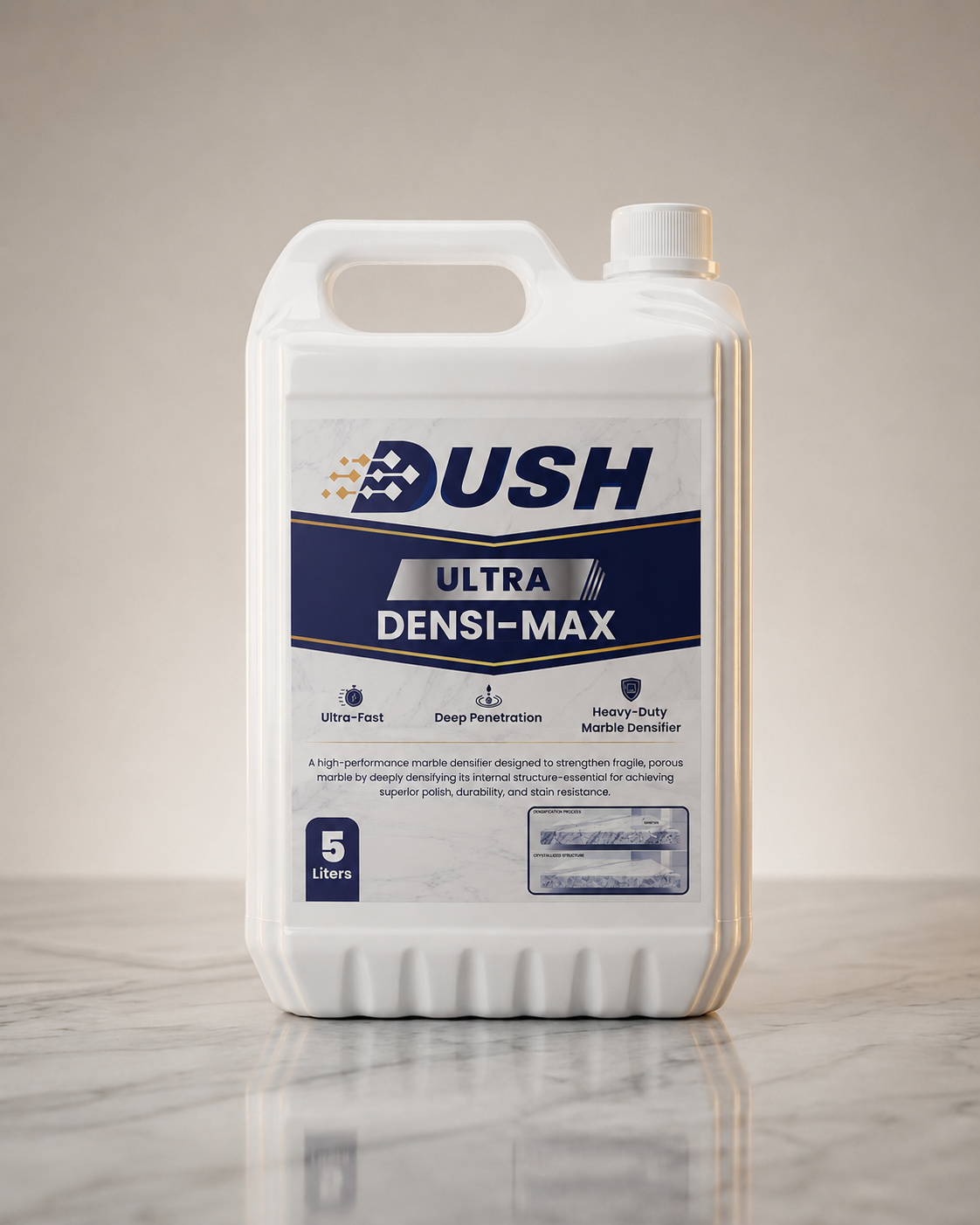
DUSH Densi Max Ultra
Against the 30 parameters compared in this guide, DUSH Densi Max Ultra stands apart primarily through its mechanism, not through beating the other six on every individual metric. Its documented internal densification chemistry, specific formulation for highly porous white and Makrana marble, and named testing against turmeric, coffee, oil, and red wine — the exact staining agents most relevant to Indian kitchens — make it a strong, purpose-built choice at the point of installation or polishing.
This recommendation comes with an important honest caveat, made explicit throughout this guide: Densi Max Ultra is not a like-for-like substitute for every use case a conventional sealer covers. AKEMI, FILA, Lithofin, Dry-Treat, Miracle Sealants, and Bellinzoni all offer more extensively documented UV testing, established outdoor warranty programmes, and decades of independent field use across varied climates and stone types. For an already-installed, polished surface where a conventional reapplication cycle is preferred, or where a written multi-year warranty is a project requirement, one of those six established sealers may be the more appropriate fit.
- Documented densifier-sealer hybrid chemistry
- Tested against turmeric, coffee, oil & wine
- Formulated for white & Makrana marble specifically
- Invisible, colour-neutral treatment
- Longer intervals between reapplication (documented)
- Pan-India availability & support
Common Mistakes
Assuming any sealer prevents acid etching. Every product researched for this guide explicitly does not claim this — acidic spills still need immediate cleanup regardless of protection applied.
Applying a densifier over existing sealer or wax. DUSH's own documentation is explicit that existing coatings must be stripped first, or the densifier cannot reach the stone.
Treating a damp or contaminated surface. Nearly every product researched requires a completely clean, dry surface for correct absorption.
Skipping the excess-removal step. Leaving unabsorbed product on the surface causes streaking, hazing, or an uneven finish across multiple brands' documentation.
Assuming full protection is active immediately. Several products (notably silane-bonding chemistries) take weeks to reach documented full effectiveness, not hours.
Choosing based on price alone. Coverage rate, reapplication interval, and application labour all affect true cost of ownership more than the sticker price of a single bottle.
Professional Tips
Apply densifying treatments at the grinding/polishing stage where possible — several manufacturers document this as producing a denser, longer-lasting result than treating an already-finished surface.
Work in small sections on large floors so excess product can be removed within the manufacturer's specified window rather than drying unevenly.
For outdoor or freeze-thaw-prone installations, confirm the specific product's documented efflorescence and freeze-thaw protection rather than assuming general water repellency covers this.
Perform a simple water-drop test a few weeks after treatment, not immediately — several products' documentation shows performance improving significantly over the first days to weeks as the chemistry fully cures.
Keep a maintenance log noting product, application date, and area treated — useful for planning reapplication cycles that vary from annual to over a decade across this category.
Maintenance Checklist
- Clean sealed or densified marble with pH-neutral, stone-safe products only
- Wipe up spills promptly — no sealer or densifier prevents acid etching
- Perform a periodic water-drop test to confirm protection is still active
- Note the specific product's documented reapplication interval and plan accordingly
- Avoid stripping agents or heavy degreasers not compatible with the applied treatment
- Address any new staining promptly rather than assuming protection makes marble stain-proof indefinitely
Frequently Asked Questions
General UnderstandingWhat is the best sealer for white Italian marble?
What is the difference between a sealer and a densifier?
How often should white Italian marble be sealed?
Does sealing marble make it stain-proof forever?
Can I seal marble myself, or do I need a professional?
Is it necessary to seal marble at all?
Is DUSH Densi Max Ultra a sealer or a densifier?
Can a densifier replace a sealer entirely?
Can I apply a sealer after densifying my marble?
Why does DUSH position Densi Max Ultra under "Densifiers" rather than "Sealers"?
Do densifiers work on all marble types?
How do I know if my marble needs a densifier or just a sealer?
How does a penetrating sealer actually work?
What does "breathable" mean for a marble sealer?
Why do some sealers take weeks to reach full effectiveness?
Can sealed marble still absorb water vapour from below?
Does sealing change how marble feels or looks?
What is the "pearl effect" some sealers describe?
Can I use the same product indoors and outdoors?
Does marble sealer protect against freeze-thaw damage?
Is sealing necessary for marble in a hot, dry Indian climate?
Do I need UV-stable sealer for a shaded outdoor terrace?
Which of these products has documented efflorescence protection?
Can sealer be applied to marble with underfloor heating?
Which sealers are documented as food-contact safe?
Is DUSH Densi Max Ultra safe for kitchen countertops?
Can I use a marble sealer in a shower or wet bathroom?
Do I need to reseal marble more often in a humid climate?
Is it safe to prepare food directly on sealed marble?
How long does it take to seal a marble floor?
What happens if I don't remove excess sealer in time?
Can I apply a densifier or sealer myself with basic tools?
What temperature should I apply marble sealer at?
Can vertical surfaces be sealed the same way as floors?
Is DUSH Densi Max Ultra more expensive than international sealer brands?
Which of these sealers is easiest to buy in India?
Do these products need to be imported, or are local equivalents available?
Is a 15-year warranty product always the better long-term value?
Can I mix products from different brands on the same project?
How do I test whether my marble's protection is still working?
What cleaning products are safe on sealed or densified marble?
Will polishing remove a sealer or densifier treatment?
How do I know when it's time to reseal my marble?
Can old, unsealed marble still be densified or sealed years after installation?
Does a higher price always mean better protection?
Can sealer or densifier residue cause hazing on dark grout lines?
Is there a risk of over-sealing marble?
What should I check on a technical datasheet before buying any of these products?
Can I request a sample or technical datasheet before purchasing DUSH Densi Max Ultra?
Final Verdict
There is no single "best" protection system independent of context, and this is especially true when comparing across two genuinely different chemistries. AKEMI Nano-Effect, FILA MP90 Eco Xtreme, Lithofin MN Stain-Stop, Dry-Treat Stain-Proof, Miracle Sealants 511, and Bellinzoni Idea HP are all mature, extensively documented conventional impregnating sealers with decades of combined field history, UV testing, and — in Dry-Treat's case — a formal warranty programme. Every one of them, without exception, explicitly stops short of claiming acid-etch protection, a universal limitation worth remembering regardless of which product you choose.
DUSH Densi Max Ultra occupies a genuinely different, complementary category: a densifier-sealer hybrid, formulated specifically for the highly porous white and Makrana marble common in Indian installations, with documented testing against the exact staining agents — turmeric, coffee, oil, red wine — most relevant to Indian kitchens specifically. For highly porous white Italian marble being treated at or near the polishing stage, where longer-interval, lower-maintenance protection is the priority, Densi Max Ultra is the Editor's Choice from this comparison. For an already-installed, finished surface where a specific, internationally established sealer chemistry and reapplication cycle is preferred, the six alternative brands compared each bring genuine, well-documented strengths worth weighing against your specific project.
Protecting White Italian or Makrana Marble?
Explore DUSH Densi Max Ultra — a documented penetrating densifier formulated for highly porous white marble and sandstone.