Can Marble Be Bonded to Metal or Glass Surfaces?
Standard cement adhesives and mastics cannot create a reliable permanent bond to non-porous metal or glass. Dush Fix Strong structural epoxy forms a direct molecular bond to both materials — permanently, without creep, without relaxation under load.
The question of bonding marble to metal or glass comes up in interior design, commercial fit-out, stone furniture, and architectural facade work — and the standard answer from most contractors is that it cannot be done reliably. That answer is wrong. It can be done permanently, but it requires a fundamentally different class of adhesive from the cement-based products used for floor and wall tile work.
Yes — marble can be permanently bonded to metal and glass surfaces using Dush Fix Strong, a high-strength two-component structural epoxy adhesive engineered specifically for stone-to-metal and stone-to-glass applications. Standard cement adhesives cannot bond to non-porous metal or glass at all. Mastics bond initially but creep and relax under sustained stone weight over time. Dush Fix Strong's epoxy chemistry forms a direct molecular bond to both the stone and the metal or glass — vibration resistant, permanent, with no creep under load.
Why Standard Adhesives Cannot Bond Marble to Metal or Glass
Standard cement adhesives fail on metal and glass because they rely on mechanical bonding into a porous substrate — metal and glass have no porosity and offer no mechanical key. Mastics bond initially but creep and relax under sustained stone weight over months, allowing the stone to slowly detach. Thermal expansion differences between metal and marble additionally crack rigid adhesive joints over time. Only a structural epoxy like Dush Fix Strong forms direct molecular adhesion to non-porous surfaces and accommodates differential thermal movement.
Cement Adhesives
Cement-based adhesives bond by mechanical keying into the micro-pores of a substrate. Metal and glass have no porosity. There is no mechanical key available, and the bond formed is negligible — insufficient to support any sustained load from heavy stone.
Mastics and Silicones
Mastics and silicone sealants bond initially to metal and glass, but are designed as flexible gap-fillers, not structural adhesives. Under sustained downward load from heavy marble, they gradually deform and creep — the stone slowly moves until the mastic releases entirely, sometimes after months or years.
Thermal Movement
Metal expands and contracts significantly more than marble with temperature changes. A rigid, non-flexible adhesive joint between marble and metal is under cyclical stress with every temperature change — eventually cracking the bond at the stone-metal interface.
Mastic — Bond Relaxes Over Time
Initial bond holds under light touch but the mastic polymer chains slowly flow under sustained stone weight. After 6 to 18 months, the stone has shifted visibly or detached from the metal support entirely.
Result: fixture failure, safety risk, replacement required.
Fix Strong Epoxy — Permanent Structural Bond
Two-component epoxy chemistry forms cross-linked polymer chains that do not creep or relax under sustained load. The bond at 10 years is as strong as it was at 24 hours after cure — and accommodates thermal movement without cracking.
Result: permanent, load-bearing bond for the life of the installation.
What Marble-to-Metal Applications Dush Fix Strong Is Used For
Marble Table Tops on Metal Frames
Marble and granite table tops bonded to steel or aluminium frames in residential, restaurant, and commercial furniture — permanently structural, no creep under daily loading.
Stone Wall Fixtures on Metal Brackets
Heavy stone decorative panels, shelves, or features mounted on metal wall support brackets in hotels, commercial lobbies, and high-end residential installations.
Marble Panels on Metal Support Systems
Large granite and marble cladding panels bonded to metal sub-frame systems in facade and curtain wall applications, where the stone is supported by a structural metal grid.
Stone Features on Structural Glass
Decorative stone elements bonded to glass partitions, glass facades, or glass feature walls in commercial interiors and architectural glass installations.
Marble Countertops on Metal Kitchen Frames
Marble countertops in modular kitchen units where the support structure is steel or aluminium rather than masonry — common in commercial kitchen and hospitality fit-outs.
Stone Inlays and Decorative Features
Stone inlays set into metal frames, stone medallions mounted on metal backing plates, and any decorative stone-to-metal combination requiring a structural, permanent bond.
Dush Fix Strong — Structural Epoxy for Stone to Metal and Glass
Dush Fix Strong is a high-strength two-component structural epoxy adhesive engineered for bonding heavy stone, marble, and granite to metal frames, supports, and substrates, as well as to glass. Mixed 1:1 base to hardener, applied to both surfaces, and cured over 24 hours to a permanent structural bond. Very high tensile strength, vibration resistant, no creep under sustained load, controlled flexibility for thermal movement accommodation.
DUSH FIX STRONG
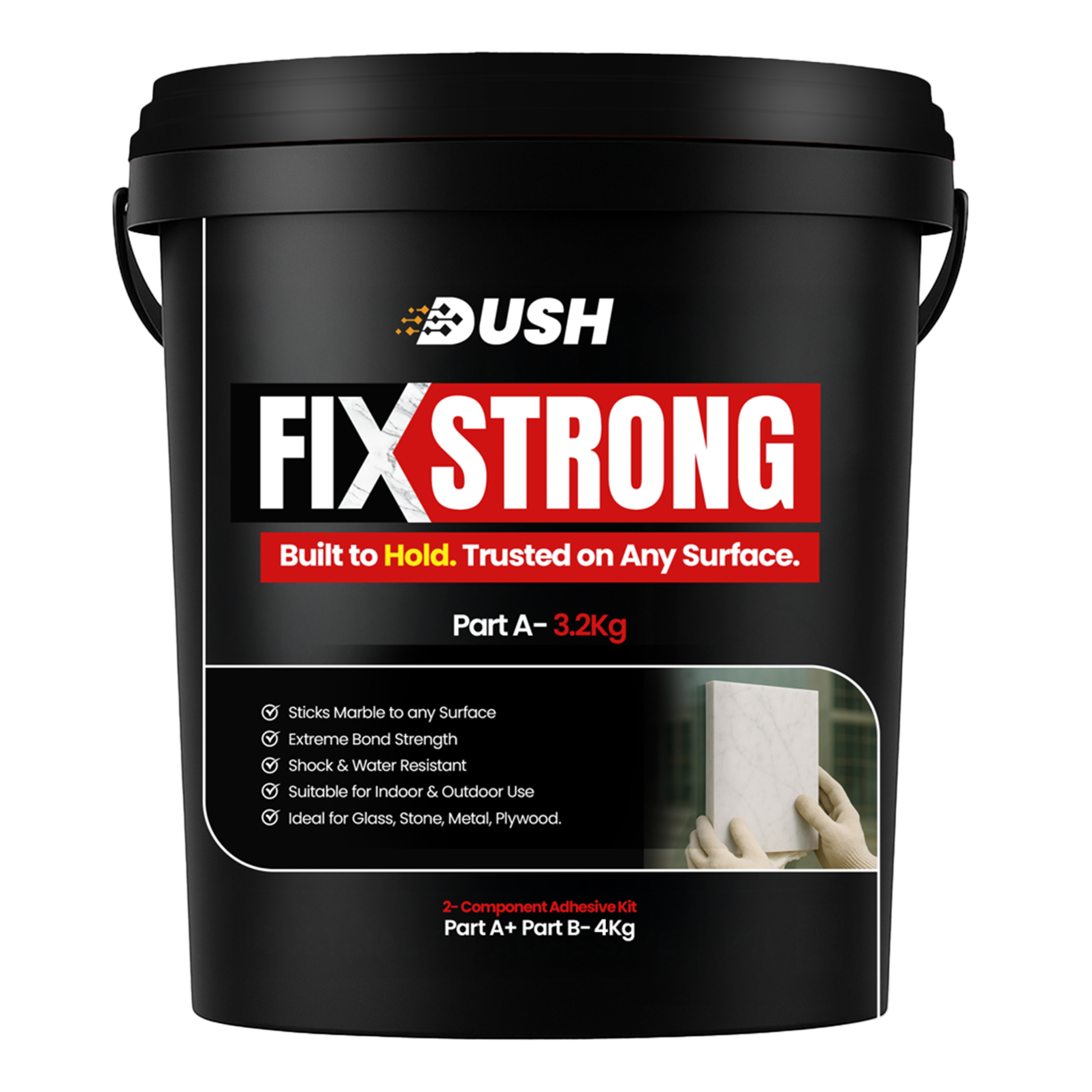
The fundamental difference between Dush Fix Strong and every other adhesive used in stone work is the chemistry. Cement adhesives, mastics, and silicones are all designed for different substrates and different load profiles. Fix Strong is a two-component structural epoxy — the same adhesive chemistry used in aerospace, marine, and civil engineering applications where a bond must maintain its strength under sustained load, vibration, and environmental stress over decades.
The two-component system is not a convenience feature — it is what makes the bond structural. When base and hardener are combined in equal parts and begin to cure, they form a three-dimensional cross-linked polymer network inside the joint. This network cannot creep, flow, or relax because its molecular structure is locked in place by the cross-linking bonds. Under the sustained weight of a heavy marble slab, this is the difference between a bond that holds permanently and one that slowly releases over months.
- ★Maximum tensile and shear strength: Engineered for the highest pull-out and shear loads encountered in heavy stone mounting on metal and glass substrates
- ★No creep under sustained load: Cross-linked epoxy chemistry cannot flow or relax — the bond at 10 years matches the bond at 24 hours after cure
- ★Vibration resistant: Bond does not fatigue under sustained vibration from traffic, machinery, or building movement
- ★Thermal movement tolerant: Controlled flexibility absorbs thermal expansion and contraction between stone and metal without joint failure
- ★1:1 mix ratio: Equal parts base and hardener — simple to mix consistently without specialist equipment
- ★Heavy stone rated: Specifically tested for the weight and surface area of large marble and granite panels on metal support systems
Surface Preparation — Why It Determines Everything
Surface preparation is the most critical step in any stone-to-metal or stone-to-glass bond with Dush Fix Strong. Any contamination on a non-porous surface — oil, dust, fingerprints, release agent, surface coating — directly reduces bond strength because the epoxy must bond chemically to the substrate surface itself. On a porous cement surface, contamination is less critical because mechanical bonding compensates. On non-porous metal or glass, the molecular bond is the only mechanism, and contamination blocks it entirely.
⚠ Contamination on Metal or Glass = Bond Failure
Oil: Metal surfaces are almost always coated in a thin film of machining oil, release agent, or fingerprint grease. Invisible to the eye but sufficient to prevent epoxy adhesion. Always degrease with an appropriate solvent before applying Fix Strong.
Surface coatings: Painted, powder-coated, or anodised metal surfaces bond differently from bare metal. Bond to the coating layer, not the metal itself — confirm the coating is sound and fully adhered before bonding stone to it.
Roughening increases bond strength: Abrading the metal bonding area with coarse sandpaper or a wire brush increases the effective contact surface area and creates micro-texture that improves mechanical interlocking alongside chemical adhesion.
Complete Application Sequence for Marble to Metal or Glass
Clean and Degrease Both Surfaces
Thoroughly clean and degrease both the stone and the metal or glass surface using an appropriate solvent. Remove all oil, dust, fingerprints, release agents, and coatings. On glass, use a lint-free cloth to avoid leaving fibres in the bonding area.
→ This step determines everything — do not rush it
Roughen the Metal Bonding Area
Abrade the metal surface in the bonding area using coarse sandpaper (80 to 120 grit) or a wire brush. This increases effective surface area and creates micro-texture that improves adhesion. Wipe clean after roughening — do not introduce new contamination.
Mix Dush Fix Strong 1:1
Combine equal parts of Dush Fix Strong base and hardener immediately before use. Mix thoroughly until completely uniform in colour and consistency. Use the full mixed quantity — do not return unused mixed adhesive to the original containers.
Apply to Both Surfaces
Apply the mixed Fix Strong to both the stone surface and the metal or glass surface. Even coverage across the full bonding area. Applying to both surfaces maximises contact area and bond strength — single-surface application is not recommended for structural stone-to-metal applications.
→ Apply to both surfaces — this doubles the effective bonding area
Position Immediately
Bring the two surfaces together immediately after applying adhesive to both. Position the stone element correctly before the adhesive begins to gel — once gelling begins, do not attempt to shift the position.
Provide Mechanical Support for 24 Hours
Support the stone element mechanically — clamps, bracing, temporary supports, or strapping — for the full 24-hour cure period. Do not rely on the adhesive alone to hold the stone in position during curing, particularly for vertical or overhead applications.
→ Support for the full 24 hours — not just until it feels set
Confirm Full Cure Before Loading
Allow the full 24 hours before the bond is subjected to the working load. The epoxy reaches its maximum structural strength at full cure — loading before this point risks joint failure even if the bond feels firm to the touch earlier.
Dush Fix Strong vs Standard Adhesives and Mastics for Stone-to-Metal
| Property | Mastic / Silicone | Cement Adhesive | Dush Fix Strong |
|---|---|---|---|
| Bonds to metal | Initially — not permanently | No — no mechanical key | Yes — molecular adhesion |
| Bonds to glass | Flexibly only | No | Yes — structural bond |
| Creep under load | Yes — releases over months | Not applicable — no bond | No — cross-linked epoxy |
| Vibration resistance | Partial | None | Engineered vibration resistant |
| Thermal movement | High flexibility — may not support stone | Rigid — cracks under cycling | Controlled flexibility |
| Suitable for heavy stone | No — creep risk | No — no bond to metal | Yes — heavy stone rated |
| Permanent structural bond | No | No | Yes |
Speak to Dush About Your Stone-to-Metal Bonding Project
Tell us your application — stone type, metal type, panel size, load, and environment. We will confirm whether Dush Fix Strong is the correct specification and what surface preparation your specific materials require.
View Dush Fix Strong →Related Dush Guides and Products
Marble to Metal and Glass Bonding — Questions Answered
Can marble be bonded to metal or glass surfaces?
Why do standard adhesives fail when bonding marble to metal?
What is Dush Fix Strong and how does it bond marble to metal?
How do you prepare metal or glass before bonding marble with Fix Strong?
Does the marble-to-metal bond from Fix Strong last permanently?
What is the difference between Fix Strong and the Apex adhesives?
External References
Bond Marble to Metal or Glass — Permanently
Dush Fix Strong: two-component structural epoxy, 1:1 mix, 24-hour cure, no creep under sustained load. The only adhesive engineered for heavy stone on non-porous metal and glass substrates.