Dush Era Latex Admix — When Plain Cement Adhesive Isn't Enough
Tile adhesive not sticking to glass mosaic. Cement crumbling in wet bathroom floors. Tiles debonding from vibration. One liquid additive fixes all three — replace the mixing water with Era Latex Admix.
What is Dush Era Latex Admix? A synthetic latex admixture from Dush Products — an Italian stone care brand with offices across India — that enhances cement mortars and tile adhesives with improved flexibility, waterproofing, and adhesion to non-porous substrates. Used in place of mixing water.
What problems does it solve? Tile adhesive not sticking to glass mosaic or glazed tiles, cement adhesive crumbling in permanently wet bathroom floors, tile movement cracking the adhesive bed in high-vibration areas, and poor adhesion on steel and other non-porous substrates.
- Price: MRP ₹2,660 for a 5 Litre pack
- Form: Liquid — latex polymer
- Usage: Replaces mixing water in cement adhesive or mortar
- Key benefits: Latex flexibility · superior waterproofing · non-porous substrate adhesion · vibration tolerant · thermal movement resistant
- Applications: Wet rooms & bathrooms · glass mosaic installation · steel & metal substrate tiling · underfloor heating beds · exterior cladding mortars
- Where to buy: Flipkart, Amazon, Dush offices in Hyderabad, Bangalore, Chennai, Kerala, Delhi/NCR
- Phone: 1800 891 0133 (toll-free)
Latex admix for tile adhesive solves the failures that no amount of installer skill can prevent — because they are chemistry problems, not technique problems. Plain cement adhesive bonds by keying into a surface's pores. Glass has no pores. Steel has no pores. And in a permanently wet bathroom, water slowly dissolves the cement matrix itself. Dush Era Latex Admix changes the chemistry.
Dush Era Latex Admix is a synthetic latex admixture that replaces the mixing water in cement mortars and tile adhesives, giving them rubber-like flexibility, superior waterproofing, and genuine adhesion to non-porous substrates — glass mosaic, glazed tiles, steel and metal. It is the specification for wet rooms, high-vibration areas, underfloor heating beds and exterior cladding mortars where plain cement adhesive is insufficient. MRP ₹2,660 for a 5 Litre pack — available pan-India on Flipkart and Amazon.
Why Plain Cement Adhesive Fails on Glass, Steel and Wet Floors
Plain cement adhesive bonds mechanically — it keys into the microscopic pores of the surface it is applied to. Glass, glazed tiles, and steel are non-porous: there are no pores to key into, so the adhesive cures against the smooth surface with no real grip and debonds under minor stress. In permanently wet areas, a second failure mode operates: water penetrates the porous cured adhesive bed and gradually dissolves its binding compounds until the cement crumbles. Latex modification solves both — it creates chemical adhesion to non-porous surfaces and fills the mortar's pores against water ingress.
Plain Cement Adhesive — Two Failure Modes
On non-porous surfaces: no pores to key into. The adhesive cures against smooth glass, glaze or steel with only weak surface contact. Tiles debond under thermal movement, vibration, or even their own weight.
In wet areas: the cured bed itself is porous. Water penetrates continuously, dissolving binding compounds until the adhesive loses cohesion and crumbles — the classic failed wet-room floor.
Latex-Modified Adhesive — Both Solved
On non-porous surfaces: latex forms a chemical adhesion layer that grips glass, glaze and steel directly — no pores required. Rubber-like molecular chains keep the bond flexible under movement.
In wet areas: latex fills the microscopic pores of the mortar during curing. Water cannot penetrate the bed, so the cement matrix stays intact through years of continuous wet exposure.
This is why the fix for adhesive failing on glass mosaic is never "press harder" or "use more adhesive" — the failure is chemical, and the fix is chemical. Replacing the mixing water with Dush Era Latex Admix converts any compatible cement adhesive into a flexible, waterproof, non-porous-substrate-ready mortar without changing the application technique at all.
4 Problems Era Latex Admix Is Specifically Engineered to Prevent
Adhesive Failing on Glass Mosaic & Glazed Tiles
Glass mosaic and glazed tile surfaces give plain cement adhesive nothing to grip. Sheets debond in swimming pools, shower walls and splashbacks. Era Latex Admix creates chemical adhesion that bonds directly to glass — no pores required.
Cement Crumbling in Wet Bathroom Floors
Permanently wet floors let water penetrate the porous cured adhesive, dissolving binding compounds until the bed crumbles and tiles loosen. Latex fills the mortar's pores during curing — waterproofing beyond standard polymer-modified mortars.
Tile Movement Cracking the Bed in Vibration Areas
Plant rooms, mezzanines, traffic-adjacent floors — vibration cracks rigid cement beds and debonds tiles over months. Latex-modified mortar absorbs vibration like rubber, flexing with the building instead of cracking against it.
Poor Adhesion on Steel & Metal Substrates
Tiling over steel mezzanines, metal panels or existing tiles gives plain cement adhesive no absorption to work with. Era Latex Admix dramatically improves bond to steel, existing tiles and other substrates where water cannot be absorbed.
Dush Era Latex Admix — Specs, Price, and Features
Dush Era Latex Admix costs MRP ₹2,660 for a 5 Litre pack. It is a liquid latex polymer admixture used in place of mixing water in cement adhesives and mortars — adding latex flexibility, superior waterproofing, non-porous substrate adhesion, vibration tolerance and thermal movement resistance. Available on Flipkart and Amazon pan-India, and directly from Dush offices in Hyderabad, Bangalore, Chennai, Kerala, and Delhi/NCR. Call 1800 891 0133 for technical support.
DUSH ERA LATEX ADMIX
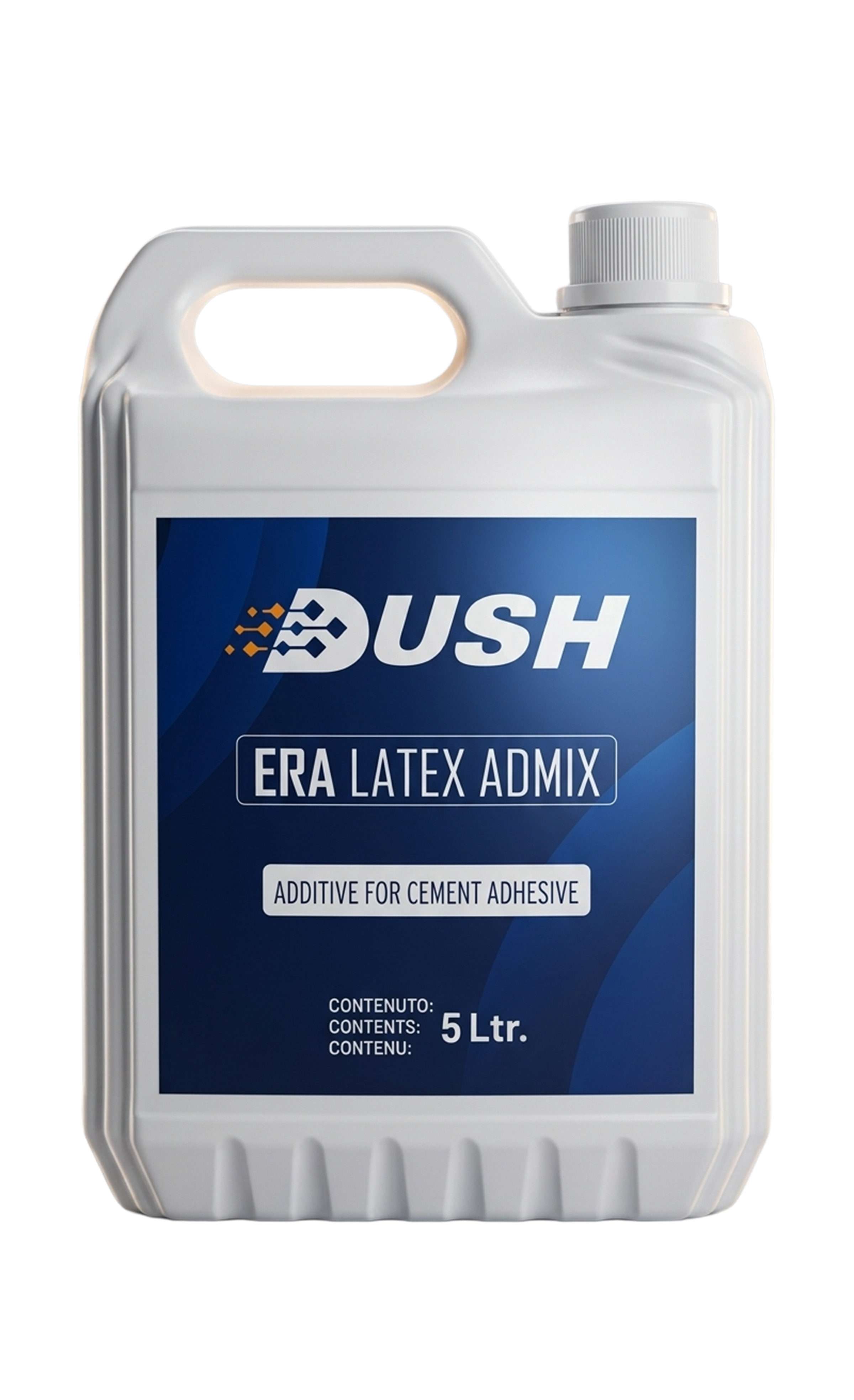
Most "polymer-modified" adhesives in the Indian market use dry redispersible polymer powders. These improve bond strength moderately, but they cannot replicate what genuine latex does: introduce continuous rubber-like molecular chains through the entire cement matrix. The difference shows exactly where installations fail — flexibility under movement, waterproofing under continuous exposure, and adhesion to surfaces with zero porosity.
Era Latex Admix is used in place of the mixing water, which means the latex is distributed through every part of the mortar from the moment of mixing — not sprinkled in as an afterthought. The result is a hardened bed that moves with the building rather than cracking, holds water out rather than absorbing it, and grips glass and steel rather than resting against them.
- ★Latex flexibility: Natural rubber-like latex introduces genuine flexibility into cement mortars that polymer admixtures alone cannot replicate
- ★Superior waterproofing: Latex fills microscopic pores in the mortar, providing waterproofing beyond standard polymer-modified mortars — the fix for crumbling wet-room adhesive
- ★Non-porous substrate adhesion: Dramatically improves bond to glass, glazed tiles, existing tiles, steel and other substrates where plain cement adhesive fails
- ★Vibration tolerant: Latex-modified mortar absorbs vibration from plant machinery, traffic and building movement without debonding
- ★Thermal movement resistant: Accommodates thermal expansion — prevents bond failure in underfloor heating beds and sun-exposed exterior surfaces
- ★Simple to use: Replaces mixing water — no change to trowelling, application technique or tools
- ★Italian formula: European quality standards, tested and proven, trusted by professionals, ships pan-India
Where Dush Era Latex Admix Is Used
The common thread across all five applications: conditions that exceed what plain cement adhesive can survive. Continuous water, zero porosity, vibration, heat cycling, weather exposure. If your project involves any of these, latex modification is not an upgrade — it is the correct baseline specification.
Latex-Modified vs Plain Cement Adhesive
| Property | Plain Cement Adhesive | With Era Latex Admix |
|---|---|---|
| Bond to glass / glazed tile | Fails — no pores to key into | Chemical adhesion grips non-porous surfaces |
| Bond to steel / metal | Inadequate long-term grip | Dramatically improved bond to metal substrates |
| Permanently wet areas | Water dissolves the bed — crumbling over time | Latex fills pores — waterproof cured bed |
| Vibration resistance | Rigid — cracks and debonds under vibration | Rubber-like flexibility absorbs movement |
| Thermal movement | Bond failure on heated floors, sun-exposed surfaces | Accommodates expansion without debonding |
| Flexibility of cured bed | Brittle cement matrix | Genuine latex flexibility through the full matrix |
| Application technique | Standard trowelling | Identical — latex replaces water, nothing else changes |
| Technical support | None | Dush technical team — 1800 891 0133 |
How to Use Era Latex Admix — 6 Steps
Identify the Application Demand
Confirm the job involves a non-porous substrate (glass, glazed tile, steel), a permanently wet area, vibration, or thermal movement — the situations where latex modification is required rather than optional.
Replace Mixing Water With Era Latex Admix
Replace all or part of the mixing water with Dush Era Latex Admix per the recommended ratio for the application type stated on the pack.
→ The ratio varies by application — full replacement for maximum performance, partial for general enhancement
Mix to Smooth Consistency
Mix the adhesive powder with the latex liquid to a smooth, workable consistency — exactly as you would with water. Allow to slake per the adhesive's instructions.
Apply and Trowel Normally
Apply and trowel the latex-modified adhesive exactly as standard cement adhesive. No special tools, no technique changes — the latex works invisibly inside the mix.
Lay Tiles Into the Modified Bed
Lay tiles within the adhesive's open time. Back-butter large-format tiles and marble slabs for 100% contact coverage — latex modification does not replace correct coverage technique.
Allow Full Cure Before Water Exposure
Allow the full cure time before exposing the installation to water or foot traffic. The latex develops its waterproofing and flexibility during curing — early exposure interrupts this process.
→ The waterproofing benefit only develops with complete, undisturbed curing
Buy Era Latex Admix — ₹2,660 per 5 Litre Pack, Pan-India
Dush Era Latex Admix costs MRP ₹2,660 for a 5 Litre pack and is available across India on Flipkart and Amazon with pan-India delivery, directly from Dush offices in Hyderabad, Bangalore, Chennai, Kerala, and Delhi/NCR, or by calling the toll-free number 1800 891 0133.
Dush offices across India: Hyderabad (Banjara Hills) · Bangalore (Jayanagar) · Chennai (Rainbow Trade Centre) · Kerala (Kozhikode) · Delhi/NCR (Gurugram, MGF Metropolis Mall). Visit dushproducts.com/contact-us for full office addresses and hours.
Not Sure If Your Project Needs Latex Modification?
Tell our technical team your substrate, area type, and tile size — we will confirm whether Era Latex Admix is required and at what ratio, before you buy anything.
Call 1800 891 0133 →Related Dush Guides and Products
Era Latex Admix — Latex Additive Questions Answered
Why is my tile adhesive not sticking to glass mosaic or glazed tiles?
What is Dush Era Latex Admix and what does it do?
Why does cement adhesive crumble in permanently wet bathroom floors?
How much does Era Latex Admix cost and where can I buy it?
How do you use latex admix in tile adhesive?
When is a latex admixture better than a standard polymer admixture?
Can I use Era Latex Admix with Dush Era adhesive for large marble slabs?
Is Era Latex Admix suitable for underfloor heating installations?
External References
When Plain Cement Isn't Enough — Add Era Latex Admix
Glass mosaic · wet rooms · steel substrates · underfloor heating · exterior cladding. One additive, five hard problems solved. MRP ₹2,660 / 5 L · Flipkart · Amazon · Pan-India.