Marble & Tile Installation Guide · India 2026
Grey Cement Adhesive vs White Cement Adhesive vs Traditional Cement Mortar: Which Is Best?
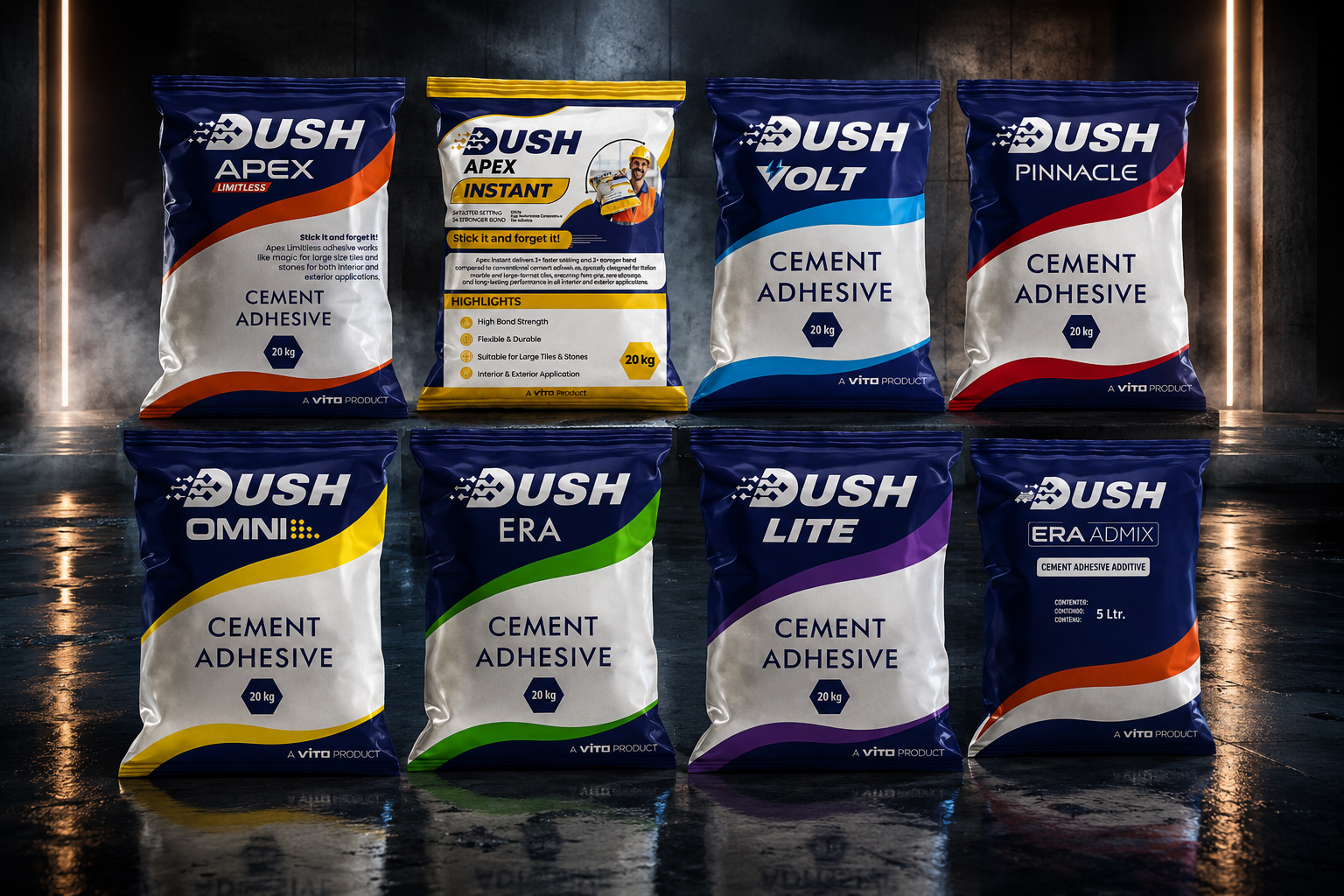
For modern marble and tile installation, the most important decision is not simply grey versus white. It is whether the setting material is a factory-made, application-specific adhesive or a traditional site-mixed cement-sand mortar. For suitable premium marble and most modern tile work, the right DUSH adhesive is the better DUSH solution because the product can be matched to colour, slab size, wall/floor orientation, exterior exposure and building height.
Choose the DUSH Adhesive by Stone + Application — Not by Cement Colour Alone
The DUSH range includes white products for general interiors, exteriors, rapid vertical work and high-rise façades, plus DUSH ERA in grey/white for large-format marble and porcelain. That allows the product specification to follow the real job instead of treating all cementitious materials as interchangeable. [1] [2]
| Setting Material | Best Use | Main Advantage | Main Limitation / Check |
|---|---|---|---|
| White cement adhesive | White/cream marble, premium interiors, suitable exterior white stone | Neutral bedding colour + application-specific polymer-modified performance | Still choose the correct product for size/exposure/height |
| Grey cement adhesive | Dark/non-translucent tiles and stone where appearance allows | Can provide modern adhesive performance without needing a white base | May visually influence light/translucent marble |
| Traditional cement-sand mortar | Thick-bed/levelling or conventional bedding systems where specifically designed | Can accommodate thicker beds and traditional stone-setting methods | Site mixing, thickness, bond coat and application control are separate issues |
The Big Difference
Is Tile Adhesive Just Cement in a Bag?
No. Modern cementitious tile adhesives are formulated systems that combine cement, selected aggregates and polymers/additives to control adhesion, water retention, open time, slip and other working properties. BIS IS 15477:2019 classifies adhesives for ceramic, mosaic and stone tiles by type and application and includes tests for tensile/shear adhesion, open time, adjustment time, slip and deformability. [8] [9]
Sika's current India tile-adhesive documentation describes polymer-modified cementitious adhesives as factory-made products containing Portland cement, selected aggregates, water-retention additives and redispersible polymer, and explicitly states better bond than conventional cement-based mortar for the product/application covered. [11]
Traditional site-mixed cement-sand mortar can still be part of a valid thick-bed stone installation, but the installation method is different. LATICRETE's technical guidance distinguishes thin-bed adhesive methods from thick-bed mortar-bed methods and notes that a mortar bed commonly still uses a separate bond coat or thin-set layer to connect tile/stone to the bed. [12]
White Cement Adhesive
When Is White Cement Adhesive the Best Choice?
White adhesive is normally preferred behind white, cream and lighter marble because the bedding colour is less likely to create dark edge or joint influence. It is also useful where designers want a neutral background behind light natural stone.
DUSH OMNI is currently white and positioned for general interior marble/ceramic/vitrified walls and floors. DUSH APEX is white and specifically positioned for exterior marble/natural stone. APEX INSTANT and VOLT are also white for their specialised vertical and high-rise applications. [1] [3] [4] [5]
White adhesive is the strongest starting choice for:
- White Italian marble.
- Carrara-style marble.
- Cream marble.
- Light natural stone.
- Visually sensitive edge/joint details.
- Premium interior marble where a neutral setting bed is preferred.
Grey Cement Adhesive
When Is Grey Cement Adhesive a Good Choice?
Grey adhesive can be appropriate where the finish material is dark, opaque or otherwise not visually affected by the setting-bed colour. This may include darker ceramic, vitrified tile and some dark natural stones, subject to compatibility.
DUSH ERA is currently available in Grey/White and is engineered specifically for large-format marble and porcelain. That gives the project team a colour choice while keeping the primary product decision tied to large-format performance rather than colour alone. [2]
Grey adhesive can therefore be the efficient choice when a white base adds no visual benefit. But for premium white marble, the lower visual risk of a white adhesive usually makes white the better specification.
Traditional Mortar
When Does Traditional Cement-Sand Mortar Still Make Sense?
Traditional cement-sand mortar is not automatically “wrong.” It is a different installation approach and can be used as a mortar bed in properly designed thick-bed systems, especially where substantial levelling or variable stone thickness needs to be accommodated.
LATICRETE distinguishes a cured mortar bed, over which tile/stone is bonded with a suitable thin-set adhesive, from a fresh or “green” mortar bed that receives a slurry bond coat on the mortar bed and stone back. This shows why simply laying modern tile directly onto an arbitrary sand-cement mix is not the same as a designed thick-bed installation. [12]
Traditional mortar becomes risky when site teams treat mix proportion, water content, sand grading, bond coat and curing as casual variables. Factory-made adhesives offer more controlled formulation and declared application performance.
Traditional mortar may be considered where:
- A thick-bed method is specifically designed.
- Stone thickness varies significantly.
- Major levelling is needed that should not be done with thin-bed adhesive.
- The architect/consultant specifies a mortar-bed + bond-coat system.
- Installer workmanship and site mixing are tightly controlled.
Modern adhesive is generally the stronger choice where:
- Tiles/slabs are calibrated and the substrate is already flat.
- Thin-bed installation is intended.
- Vertical anti-slip performance matters.
- Open time and adhesion need declared performance.
- Large-format, exterior or high-rise conditions require specialised products.
White Marble
White Marble: DUSH Adhesive or Traditional Grey Mortar?
For suitable white marble installations, a white DUSH adhesive is generally the better DUSH specification because it combines a neutral colour with a product designed around the actual installation condition.
For example, DUSH OMNI is the best-fit DUSH general interior choice for compatible standard/medium-format marble walls and floors. If the white marble is large-format, move to ERA in its appropriate white option. If the stone is exterior, use APEX. If it is high-rise façade cladding, use VOLT within the engineer-approved system. [1] [2] [3] [5]
Best DUSH Rule for White Marble
OMNI for suitable general interiors. ERA for large-format. APEX for suitable exterior marble. APEX INSTANT for rapid exterior vertical work. VOLT for high-rise façade cladding.
Large Format
Why Large Marble Slabs Change the Adhesive Decision
Large slabs need a more controlled bedding system because small voids, substrate variation and mortar shrinkage become more important as panel size increases. BIS IS 15477:2019 also links larger tile/stone sizes with deformability requirements for vertical applications. [8]
DUSH ERA is specifically engineered for large-format marble and porcelain and is currently available in grey/white. That makes ERA the best-fit DUSH product when slab size/weight is the dominant requirement. [2]
In this scenario, asking “grey or white?” comes second. First choose ERA because of the slab requirement; then select the appropriate approved colour for the stone.
Walls
Why Wall Tile Needs More Than a Cement Colour Decision
On a wall, gravity acts immediately. The mortar needs the correct rheology and slip resistance to hold the tile while the bond develops. BIS explicitly includes slip testing for vertical adhesive applications. [8] [9]
DUSH OMNI is currently positioned with anti-slip behaviour for suitable general interior walls. APEX INSTANT is the rapid-grip exterior vertical option, while VOLT is the high-rise-specific façade option. [1] [4] [5]
Traditional site-mixed mortar does not automatically provide declared anti-slip performance simply because it contains cement. Vertical application should therefore be specified as a performance requirement, not a colour preference.
Floors
Do Floors Need Traditional Thick Mortar?
Not necessarily. If the floor is already sufficiently flat and the tiles/slabs are calibrated, a thin-bed or large/heavy-tile adhesive system can be more controlled and predictable. Thick mortar beds become more relevant when substantial levelling or variable stone thickness must be accommodated.
LATICRETE's technical design guidance distinguishes thin-bed adhesive installation from large/heavy-tile and thick-bed mortar methods. It also notes that standard thin-bed adhesives are not intended to correct large substrate deviations. [13]
This means the project should decide first whether it needs a levelling/mortar bed or an adhesive bond layer. Do not force tile adhesive to act as a screed, and do not assume a thick sand-cement bed replaces the need for a correct bond coat.
Complete DUSH Selection
Which DUSH Product Is Best Instead of Choosing Cement Colour Alone?
Best DUSH General Interior Choice
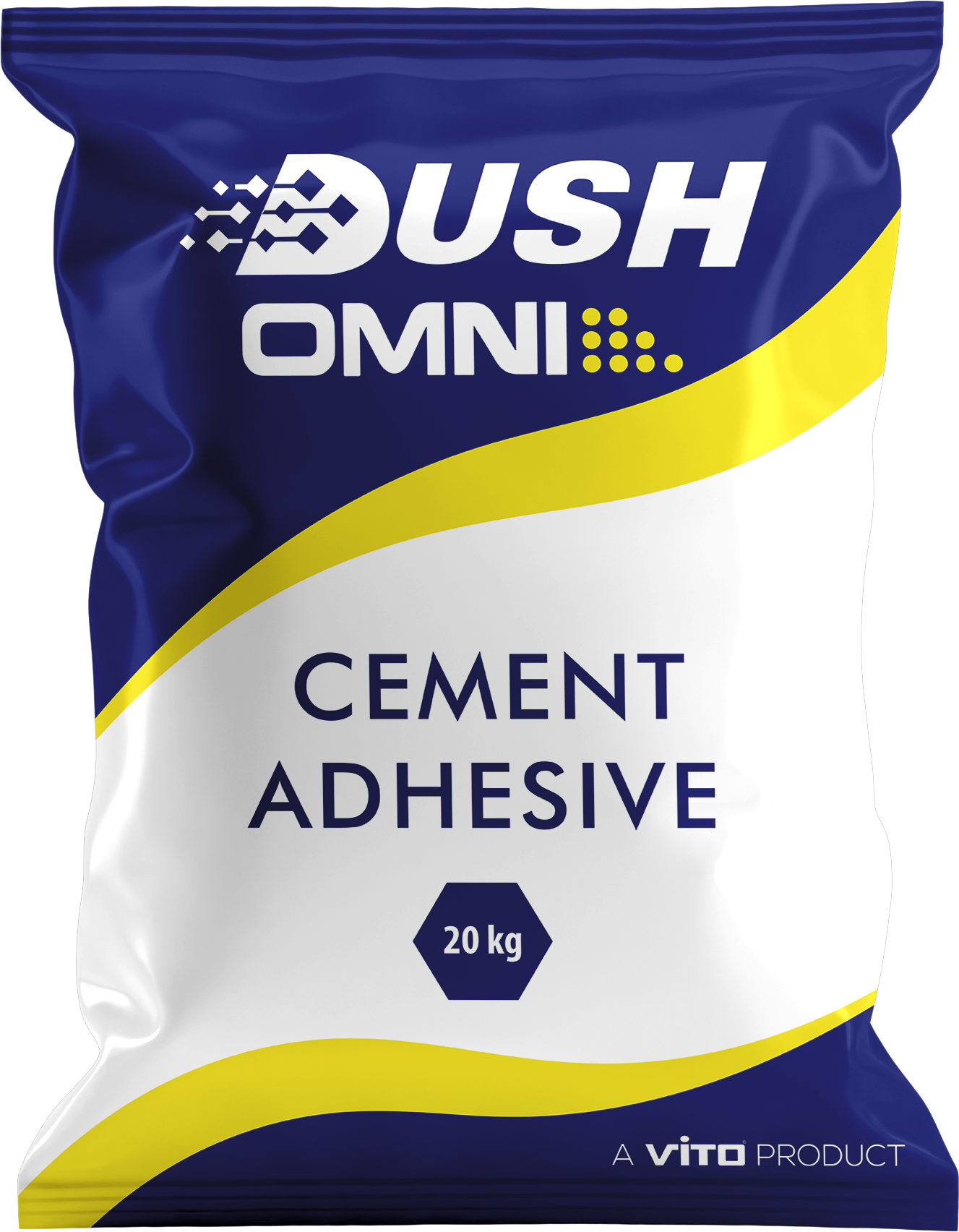
DUSH OMNI
White multi-purpose wall/floor adhesive for suitable marble, ceramic and vitrified interiors. Best-fit DUSH starting choice for general interior work. [1]
WhiteWalls & FloorsView OMNI →
General White Wall/Floor Alternative
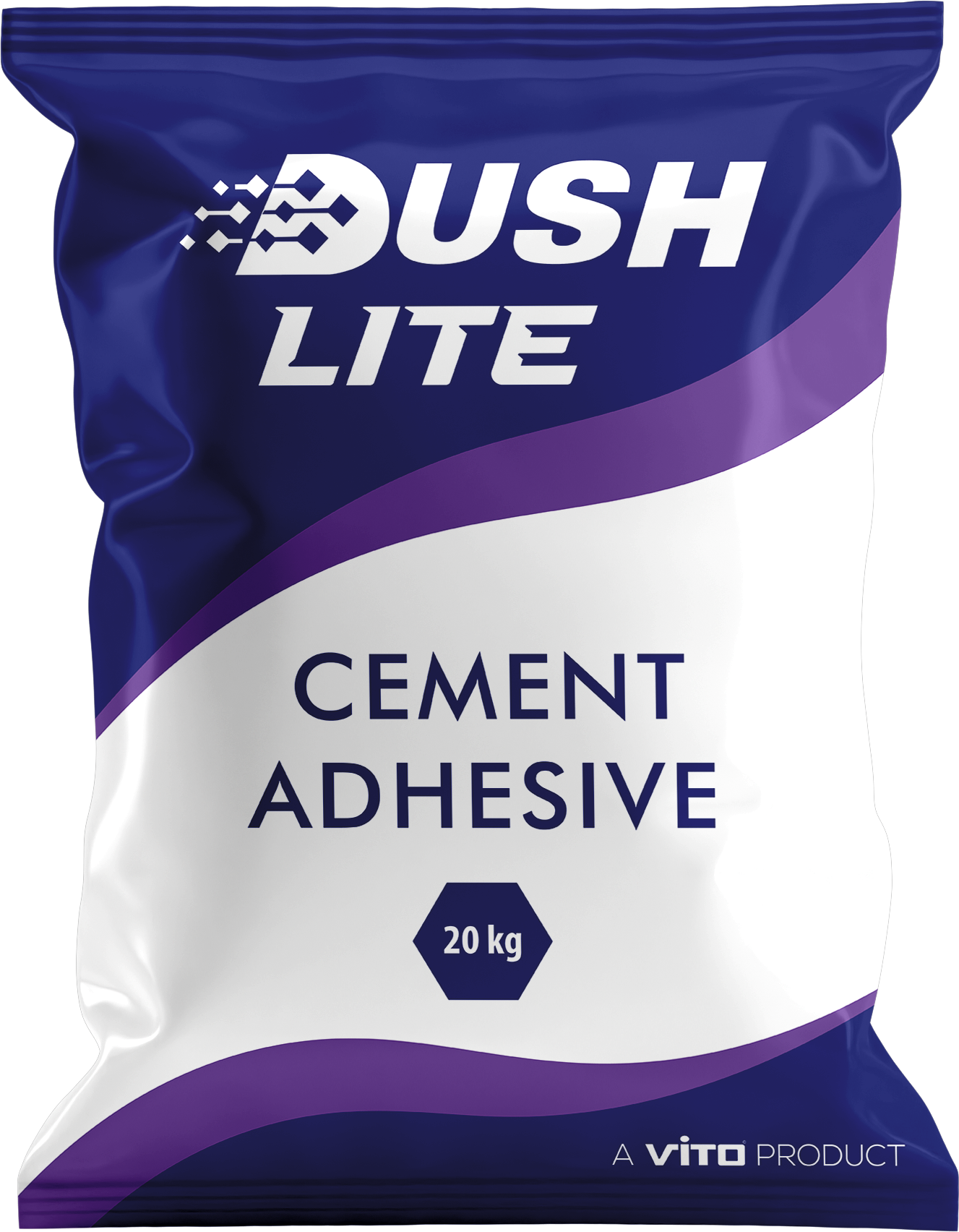
DUSH LITE
White multi-purpose wall/floor adhesive. Current public positioning overlaps OMNI, so compare the latest TDS instead of inventing a distinction. [6]
WhiteMulti-PurposeView LITE →
Best DUSH Large-Format Choice
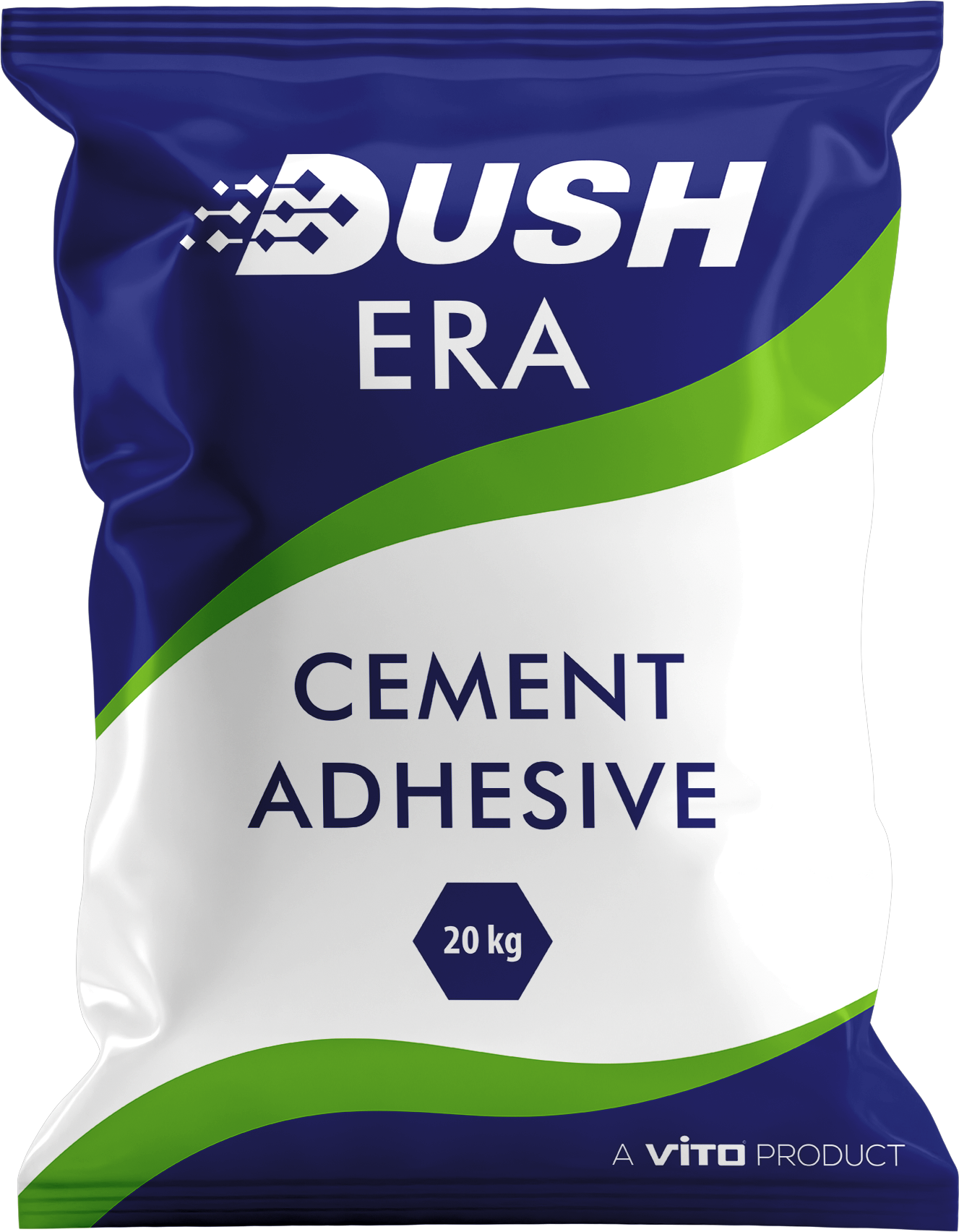
DUSH ERA
Grey/White large-format adhesive. Best-fit DUSH product when large/heavy slab support is the main requirement. [2]
Grey / WhiteLarge FormatView ERA →
Best DUSH Exterior Choice
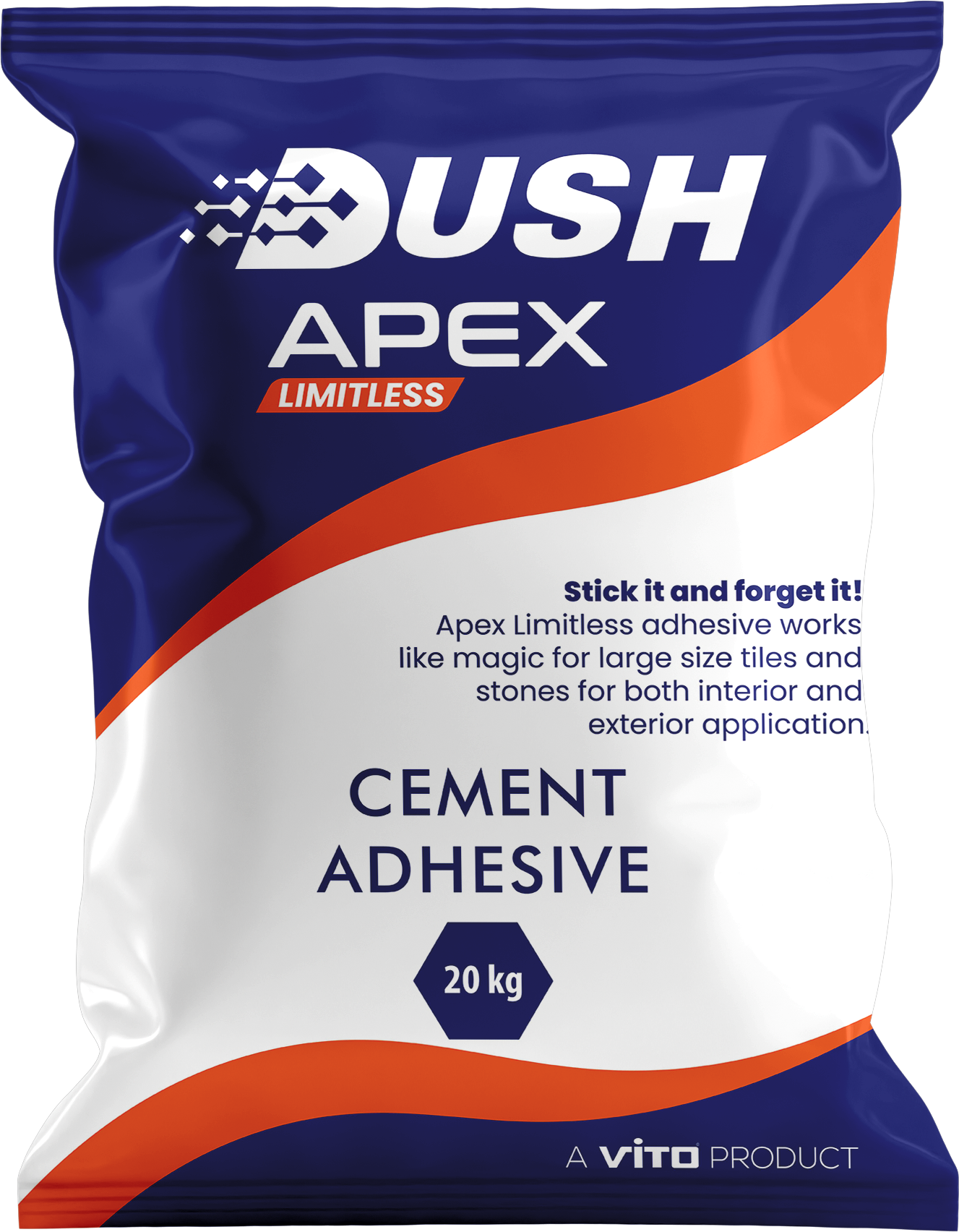
DUSH APEX
White exterior marble/natural-stone adhesive. Best-fit DUSH choice for suitable general exterior marble. [3]
WhiteExteriorView APEX →
Best DUSH Rapid Vertical Choice
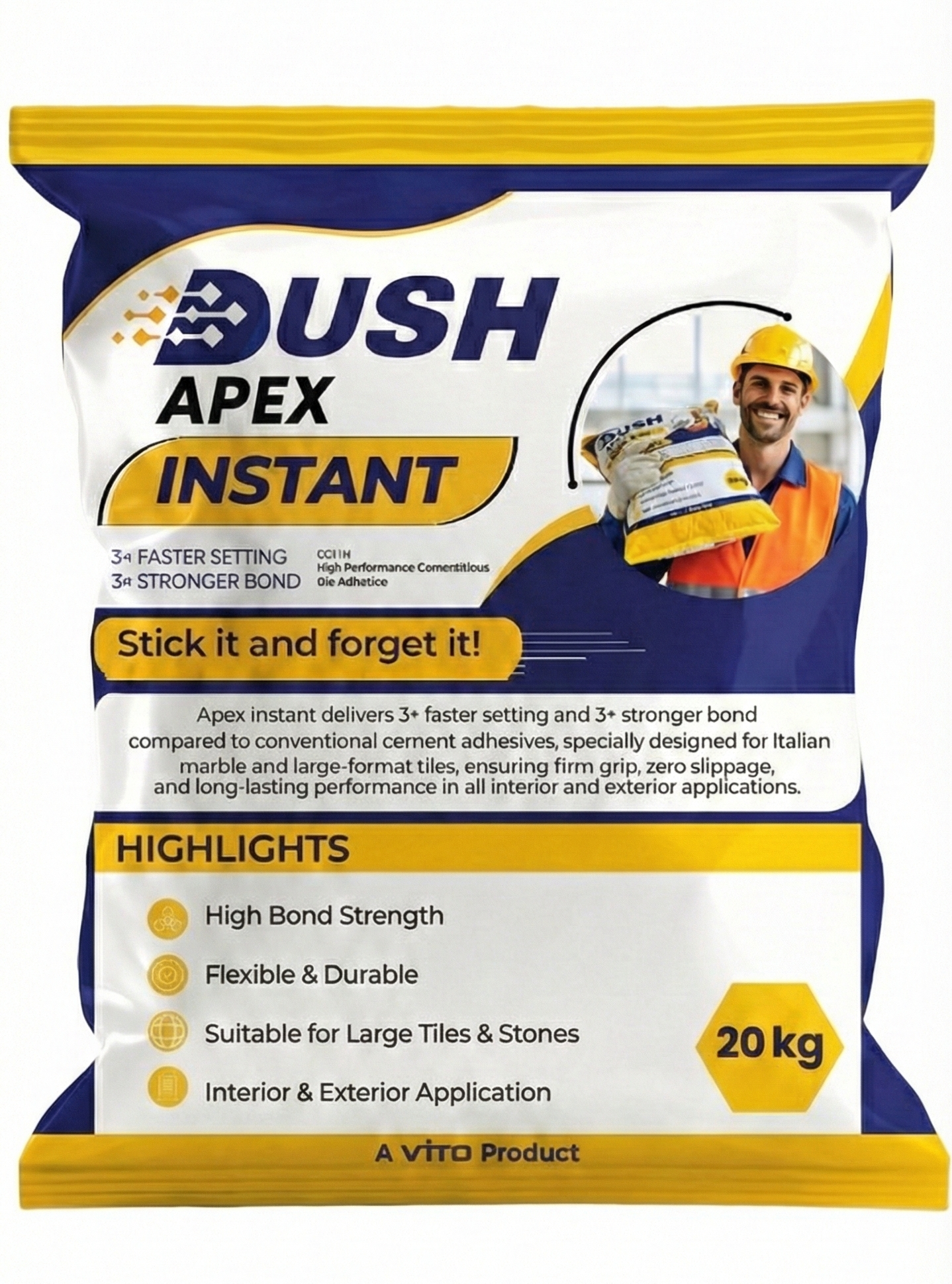
DUSH APEX INSTANT
White fast-set exterior cladding adhesive. Best-fit DUSH option when rapid initial vertical grip is the key requirement. [4]
WhiteRapid VerticalView APEX INSTANT →
Best DUSH High-Rise Choice
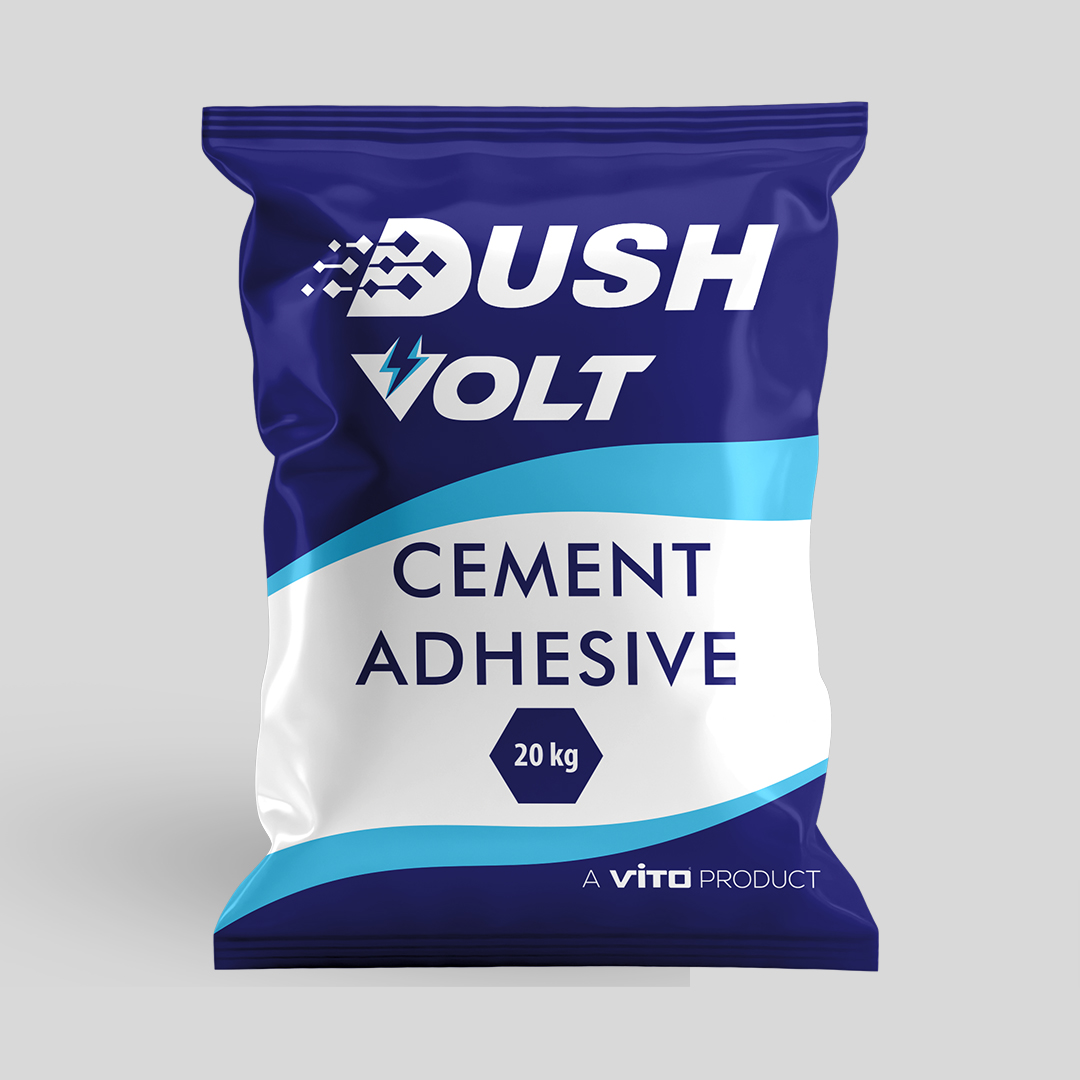
DUSH VOLT
White high-rise marble/stone cladding adhesive. Best-fit DUSH product for high-rise façade bond layers within the complete engineered fixing system. [5]
WhiteHigh-RiseView VOLT →
Grey / Economy Role — Verify Current TDS
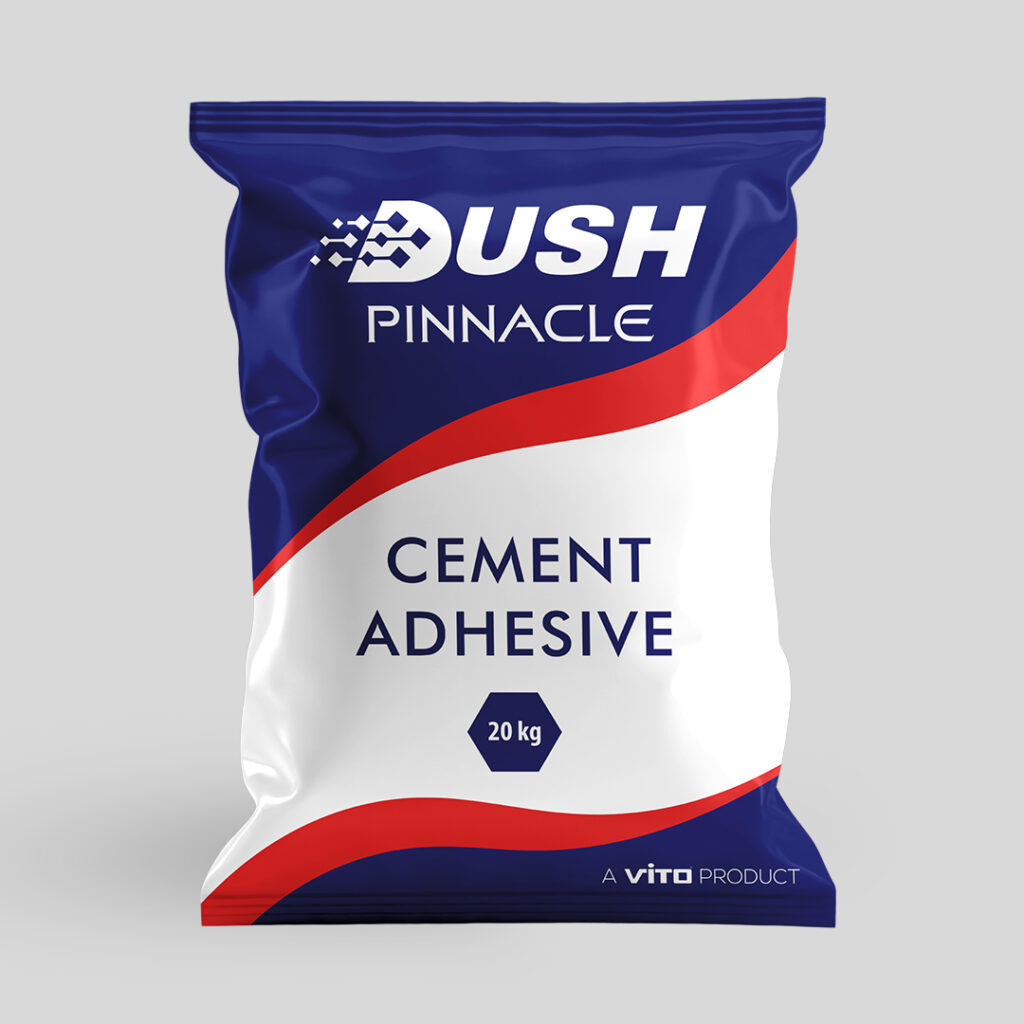
DUSH PINNACLE
PINNACLE has been positioned by DUSH as an economical grey cement adhesive for compatible interior applications. Confirm the latest live TDS/application range before specification.
GreyVerify Current TDSView PINNACLE →
Side-by-Side Comparison
White Adhesive vs Grey Adhesive vs Traditional Mortar
| Factor | White Cement Adhesive | Grey Cement Adhesive | Traditional Cement-Sand Mortar |
|---|---|---|---|
| Colour impact | Best starting point for light/white stone | Better suited to darker/opaque finishes | Usually grey unless white cement system is deliberately used |
| Factory-controlled formulation | Yes | Yes | No; depends on site batching |
| Polymer modification | Product-specific | Product-specific | Not inherent unless admixtures/bond coat are specified |
| Declared open time/slip | Can be tested/classified | Can be tested/classified | Depends on designed system |
| Thin-bed installation | Yes, where TDS permits | Yes, where TDS permits | Traditional mortar is usually associated with thicker bedding |
| Large-format use | Use large-format-specific formulation such as ERA white | Use large-format-specific formulation such as ERA grey | Requires designed thick-bed/bond-coat method if used |
| Vertical use | Use vertical-approved anti-slip product | Use vertical-approved anti-slip product | Must be specifically engineered and supported |
| Exterior use | Use exterior-approved product such as APEX | Only if exact product is exterior-approved | Requires complete exterior mortar-bed/bonding/water-management design |
| Consistency | Factory batched | Factory batched | Highly dependent on site proportioning and workmanship |
7 Common Mistakes
What Goes Wrong When People Choose Only by Colour or Tradition?
Contractor Decision Tree
Which Should You Choose?
- White/cream marble, general interior: start with DUSH OMNI.
- Dark/opaque large-format slab: review DUSH ERA grey where approved.
- White large-format slab: review DUSH ERA white where approved.
- Exterior white/light marble: DUSH APEX is the best-fit general exterior DUSH choice.
- Rapid exterior vertical cladding: review DUSH APEX INSTANT.
- High-rise marble façade: DUSH VOLT within the engineer-approved fixing system.
- Thick-bed levelling requirement: design the mortar-bed/levelling system separately; do not use standard thin-bed adhesive as a screed.
- Resin/mesh-backed stone: obtain compatibility approval before installation.
DUSH Product Selection
Don’t Choose Marble Adhesive by Colour Alone.
Send DUSH the stone/tile name, colour, slab size, wall/floor location, interior/exterior exposure, backing and project height. The correct DUSH adhesive can then be selected for the actual installation.
AEO / People Also Ask
Grey vs White Adhesive vs Cement Mortar — FAQs
1. Is white cement adhesive better than grey adhesive for marble?
For white, cream and visually sensitive marble, white adhesive is generally the better colour choice. Grey adhesive can be suitable for dark, opaque or non-translucent finishes where the product specification matches the application.
2. Is tile adhesive better than traditional cement mortar?
For many modern thin-bed tile and calibrated-stone installations, a factory-made polymer-modified adhesive offers controlled formulation and declared performance. Traditional cement-sand mortar remains useful in properly designed thick-bed systems but is not an automatic substitute for application-specific adhesive.
3. Which DUSH adhesive is best for general white marble interiors?
DUSH OMNI is the best-fit DUSH starting choice for suitable general interior marble walls and floors within its current TDS.
4. Which DUSH product has grey and white options?
DUSH ERA is currently published in Grey/White and is specifically designed for large-format marble and porcelain/tile.
5. Can traditional mortar be used under marble?
Yes in a properly designed mortar-bed system. Depending on whether the bed is cured or fresh, an appropriate bond coat or adhesive layer may still be required between the stone and mortar bed.
6. Can tile adhesive level an uneven floor?
Standard thin-bed tile adhesive should not be used as a substitute for major floor levelling. Correct the substrate or use an approved levelling/large-and-heavy-tile system.
7. Why is polymer-modified adhesive different from cement-sand mortar?
Polymer-modified adhesives contain controlled cement, aggregate and additive/polymer packages designed to deliver specific working and bond properties. Traditional mortar proportions depend more heavily on site batching unless a pre-engineered system is used.
8. Which DUSH adhesive is best for exterior marble?
DUSH APEX is the best-fit DUSH product for suitable general exterior marble and natural-stone applications.
9. Which DUSH adhesive is best for large slabs?
DUSH ERA is the best-fit DUSH product when large-format/heavy-slab support is the main requirement.
10. Which DUSH adhesive is best for high-rise marble?
DUSH VOLT is the best-fit DUSH product for high-rise marble and natural-stone façade cladding within the complete engineered fixing system.
11. Does grey adhesive stain white marble?
Dark setting materials can be visually undesirable behind some white/light or translucent marble. The risk depends on stone characteristics, moisture and installation system, so white adhesive is usually the safer visual starting point.
12. Is white adhesive stronger than grey adhesive?
Colour alone does not determine strength. Product class, formulation, substrate, application and testing determine performance.
13. Is traditional mortar cheaper?
Raw site-mixed mortar can appear cheaper per unit volume, but total installed cost also depends on labour, thickness, levelling, bond coat, wastage, curing and risk of inconsistent mixing.
14. Can I use traditional mortar on vertical marble walls?
Only as part of a properly designed wall/stone fixing system. Vertical applications need slip control, support and sometimes mechanical anchorage, especially with heavy or high-rise panels.
15. What is the simplest DUSH selection rule?
OMNI for suitable general interiors, ERA for large-format, APEX for suitable exterior marble, APEX INSTANT for rapid exterior vertical cladding and VOLT for high-rise façade work.
38 Technical References
Sources & Technical References
- DUSH — DUSH OMNI.
- DUSH — DUSH ERA.
- DUSH — DUSH APEX.
- DUSH — DUSH APEX INSTANT.
- DUSH — DUSH VOLT.
- DUSH — DUSH LITE.
- DUSH — DUSH PINNACLE.
- BIS — IS 15477:2019 Product Manual, February 2025.
- BIS — IS 15477:2019 Product Manual.
- BIS LIMS — IS 15477.
- Sika India — Polymer-modified tile adhesive vs conventional cement mortar.
- LATICRETE — Thin-set and mortar-bed installation methods.
- LATICRETE — Thin-bed, large/heavy and thick-bed installation methods.
- MAPEI India — Double-buttering.
- MAPEI — Large and Heavy Tile Mortar Basics.
- MAPEI — Large Tile & Stone Mortar.
- LATICRETE — Large and Heavy Tile Mortar.
- Sika — Large/heavy tile and stone mortar.
- Natural Stone Institute — Natural-stone installation/backing guidance.
- LATICRETE — Resin-backed/moisture-sensitive stone adhesive.
- Sika India — Damp-sensitive natural-stone adhesive.
- LATICRETE — Exterior installation system guidance.
- MAPEI India — Façade installation guidance.
- LATICRETE — Movement joints.
- Natural Stone Institute — Stone testing services.
- ISO — ISO 13007-1.
- ASTM — ASTM C482.
- Sika India — Polymer-modified Type-2 tile adhesive.
- Sika India — Wet-room tile adhesive.
- DUSH — APEX marble adhesive guide.
- DUSH — Italian marble adhesive guide.
- DUSH — Large-format marble guide.
- DUSH — Wall vs floor adhesive guide.
- DUSH — Façade adhesive guide.
- DUSH — Height/application adhesive guide.
- LATICRETE — Tile and stone adhesive systems.
- ISO/TC 189 standards catalogue.
- Natural Stone Institute — Dimension Stone Design Manual library.