How Do I Remove Rust Stains From Granite or Marble?
Yellow rust patches on granite are not dirt — they are a mineral reaction happening inside the stone. This guide explains exactly how Dush Durux neutralises that reaction and lifts the stain, plus the correct approach for marble.
A yellow or orange-brown patch appearing on a granite countertop or floor often gets mistaken for a spill or dirt that simply will not wipe away. In most cases it is rust — a genuine chemical reaction occurring inside the stone itself, not a surface mark. Understanding this distinction is the first step to treating it correctly.
To remove rust stains from granite: apply Dush Durux directly onto the yellow stain using a paintbrush, undiluted, and let it work for 30 minutes to 3 hours depending on how much the stain fades. Rinse thoroughly with clean water once finished. For rust staining on marble, a poultice-based treatment such as Dush Stain-Ex is generally the more suitable approach, since marble's calcium-rich composition responds differently to chemical treatment than granite.
Granite or Marble — Different Stone, Different Treatment
Rust on granite and rust on marble are the same underlying chemical problem — oxidised iron — but the correct treatment differs because the two stones respond differently to chemical contact. Identifying your surface correctly before treatment matters.
Dush Durux
Granite's mineral structure responds well to Durux's brush-on, contact-time chemistry. The product is specifically formulated for granite and is the recommended first choice for yellow rust patches on granite countertops, floors, and surfaces.
Applied with a paintbrush, worked in for 30 minutes to 3 hours, then rinsed clean.
→ This is the correct product for granite rustDush Stain-Ex
Marble's higher acid sensitivity and different mineral composition mean a poultice-based approach is generally more appropriate for rust staining on marble, rather than the brush-applied granite treatment.
Applied as a 24-hour sealed poultice that draws the rust pigment out of the pore structure.
→ See the Stain-Ex marble treatment guideWhat Causes Rust Stains on Granite
Rust stains on granite are caused by oxidation of iron-bearing minerals naturally present within the stone, or by external iron sources such as metal furniture legs, tools, nails, or fertiliser left in contact with the surface. When these iron compounds are exposed to moisture and oxygen over time, they oxidise and produce the characteristic yellow to orange-brown stain.
Internal Mineral Content
Granite naturally contains trace iron-bearing minerals as part of its geological formation. Where moisture reaches these minerals — through humidity, condensation, or contact with water — a slow oxidation reaction occurs, producing yellow staining from within the stone itself.
This is why rust spots sometimes appear on granite with no external metal object ever having touched the surface.
External Iron Contact
Metal furniture legs, tools left on the surface, decorative iron objects, nails, or even fertiliser containing iron traces can leave behind rust marks when moisture is present, following the exact shape of the object that caused them.
This is the more recognisable form of rust staining, common on outdoor granite surfaces and kitchen areas where metal cookware contacts the stone.
The Chemistry of Rust Staining
Rust formation on granite follows the same fundamental oxidation chemistry as rust on metal — iron reacting with oxygen and moisture to form iron oxide compounds:
Whether the iron source is internal to the granite's mineral composition or an external metal object, the resulting hydrated iron oxide is what produces the visible yellow to orange-brown discolouration. Dush Durux works by chemically denaturing this reaction — breaking down the iron oxide compound responsible for the colour and lifting it from the stone.
How Dush Durux Removes the Rust Reaction
Dush Durux works by chemically neutralising and denaturing the rust reaction occurring within the granite, rather than simply masking the stain. The active formula targets the oxidised iron compounds responsible for the yellow discolouration, breaking down the reaction and lifting the stain from the stone. Applied with a paintbrush and left to work for 30 minutes to 3 hours depending on stain severity, Durux also helps reduce the reactivity of the rust going forward.
DUSH DURUX
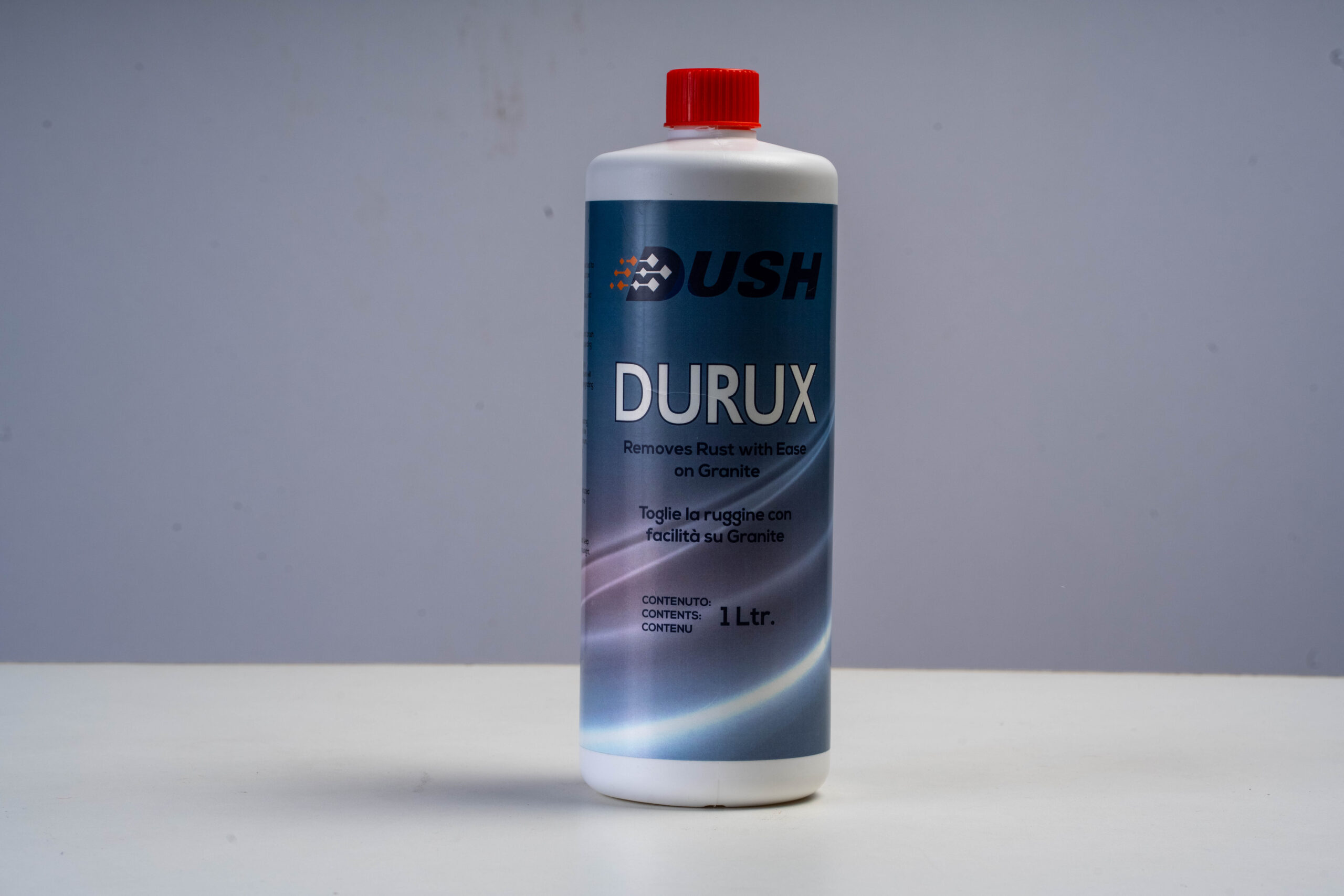
Rust staining is not surface dirt — it is a chemical compound, hydrated iron oxide, that has formed within or on the granite's mineral structure. Standard cleaning products are designed to lift loose residue, not to chemically break down an oxide compound, which is why scrubbing rust stains with ordinary cleaners typically achieves nothing.
Dush Durux is formulated specifically to target this reaction. The extended contact time — 30 minutes to 3 hours depending on stain depth — gives the active chemistry time to denature the iron oxide compound and lift the discolouration from the stone, rather than simply pushing it around the surface.
- ★Targets the actual rust reaction: Formulated to denature the oxidised iron compound, not just mask the surface colour
- ★Reduces future reactivity: Helps lower the chance of the same area darkening again over time after treatment
- ★Granite-specific formulation: Designed and tested specifically for granite's mineral composition
- ★Variable contact time: The 30-minute to 3-hour window allows the treatment to adapt to both light and deep-set staining
- ★Simple application: No special equipment required — applied directly with a standard paintbrush
How to Apply Dush Durux — Step by Step
Identify the Stain Type
Confirm the discolouration is genuinely rust — yellow to orange-brown in colour, often following the shape of a metal object, or appearing as irregular patches with no clear external cause if from internal mineral content.
Test on a Small Area First
Apply Dush Durux to a small, inconspicuous area of the granite before treating the full stain. This confirms the expected result and lets you assess how the specific stain responds before committing to the full surface.
→ Dush Durux specifically recommends this sample test before full application
Apply With a Paintbrush
Apply Dush Durux undiluted directly onto the rust stain using a paintbrush, covering the full stained area evenly with a generous coat.
Allow 30 Minutes to 3 Hours Contact Time
Let the product work on the stain. Monitor the fading progress periodically — lighter, fresher stains respond faster, while older, deeper-set stains need the longer end of the time range to fully fade.
Rinse Thoroughly With Clean Water
Once the stain has faded to the desired level, rinse the surface thoroughly with clean water, ensuring no product residue remains on the granite. Careful rinsing is especially important if a protective or impregnating sealer will be applied afterward.
Reapply if Necessary
For stubborn or deep-set rust stains that do not fully clear in one application, repeat the same process. A second treatment is sometimes needed for older, heavily oxidised staining.
Protect the Surface Afterward
Once rinsed and fully dry, apply a protective densifier or sealer to the treated area. This reduces moisture absorption into the stone going forward, lowering the chance of the same rust reaction recurring.
Why Contact Time Varies by Stain Severity
Dush Durux contact time ranges from 30 minutes to 3 hours because the depth and age of rust staining varies significantly. Light, recently formed rust marks typically fade within the lower end of this range, while older, deeply set rust that has been oxidising within the stone for months or years requires the full 3-hour contact time, and occasionally a repeat application, to achieve complete removal.
There is no harm in checking progress periodically during application — wipe a small section, assess the fading, and continue if needed up to the 3-hour mark. This is preferable to guessing the contact time in advance, since the same product performs differently depending on exactly how long the rust has had to develop within the stone.
Rust Staining on Marble — A Different Approach
Rust staining on marble is generally best treated with a poultice-based product such as Dush Stain-Ex rather than the brush-applied Durux formula used on granite. Marble's higher sensitivity to certain chemical reactions means the gentler, extended-contact poultice method is more appropriate, drawing the rust pigment out of the marble's pore structure over a sealed 24-hour application rather than active chemical treatment on an open surface.
The underlying cause is the same — hydrated iron oxide formed from either internal mineral content or external metal contact — but marble's calcium carbonate composition responds differently to chemical treatment than granite's harder, more chemically stable mineral structure. A poultice method, applied as a paste and sealed under plastic film, allows controlled, gentle treatment that suits marble's sensitivity, where a faster-acting brush-applied product designed for granite may not be the optimal choice.
For full instructions on poultice treatment for marble staining, including the same 24-hour sealed application process used for other deep-set marble stains, see the Dush Stain-Ex treatment guide.
What Never to Use on Rust Stains
Never Use
- Bleach — does not affect iron oxide and can damage the stone surface
- Acidic bathroom descalers — risk of etching, especially relevant if treating marble
- Steel wool or metal scouring pads — scratches the polished surface permanently
- Generic all-purpose household cleaners — not formulated to address oxidised iron
- Aggressive scrubbing without product contact time — wastes effort, achieves little on a chemical stain
Correct Approach
- Dush Durux — for granite rust, brush-applied with proper contact time
- Dush Stain-Ex — for marble rust, poultice method over 24 hours
- Sample test on an inconspicuous area before full treatment
- Soft cloth and clean water for rinsing — never abrasive tools
- Patience — allow the full contact time window before judging results
Preventing Rust Stains From Returning
To prevent rust stains from reforming on granite, avoid leaving metal objects such as furniture legs, tools, or decorative items in direct prolonged contact with the surface, particularly in humid conditions. Applying a quality penetrating sealer or densifier helps reduce moisture absorption into the stone, which slows the oxidation reactions responsible for rust formation. After using Dush Durux, applying a protective or impregnating sealer once the surface is rinsed and dry is recommended.
The underlying rust reaction depends on moisture reaching iron compounds, whether internal to the stone or from external metal contact. Reducing the granite's moisture absorption directly slows this process. For granite and natural stone surfaces facing ongoing rust risk — kitchen counters near metal cookware, outdoor installations exposed to rain and humidity — a penetrating densifier such as Dush Densi Max Ultra permanently closes the stone's internal pore structure, significantly reducing the moisture pathway that drives rust formation over time.
For external metal contact, simple precautions go a long way: use protective pads or coasters under metal furniture legs and decorative objects, wipe up any standing water near metal items promptly, and avoid placing fertiliser or gardening tools directly on outdoor granite surfaces.
See Dush Durux Work on Your Own Rust-Stained Granite
Send a photo or sample of your stained granite to Dush for an assessment. We can confirm whether Durux is the right treatment for your specific stain before you purchase.
View Dush Durux →Related Dush Guides and Products
Rust Stain Removal — Questions Answered
How do I remove rust stains from granite or marble?
What causes rust stains on granite?
How does Dush Durux remove rust from granite?
Can rust stains on granite be completely removed?
Is Dush Durux safe to use on marble as well as granite?
How do I prevent rust stains from forming on granite again?
External References
Remove Rust Stains From Your Granite Permanently
Dush Durux neutralises the rust reaction at its source — not just hides the colour. Formulated specifically for granite's mineral composition.